REVIEW 3 major objections 6 minor 47 references
Enhancing Contrastive Learning-based Electrocardiogram Pretrained Model with Patient Memory Queue
T0 review · 3 major / 6 minor · reviewed 2026-08-07 · deepseek-v4-flash
Pith's one-line read A patient memory queue gives ECG contrastive learning the same-patient positives and inter-patient negatives that a mini-batch lacks, improving downstream classification when labels are scarce.
desk verdict A solid, incremental paper: PMQ adapts MoCo's queue to patient-level positives for ECG contrastive pretraining; the experiments are broad and mostly support the claim, with a few reporting and completeness issues. read the letter →
The pith
A machine-rendered reading of the paper's core claim, the machinery that carries it, and where it could break.
The reading
What carries the argument
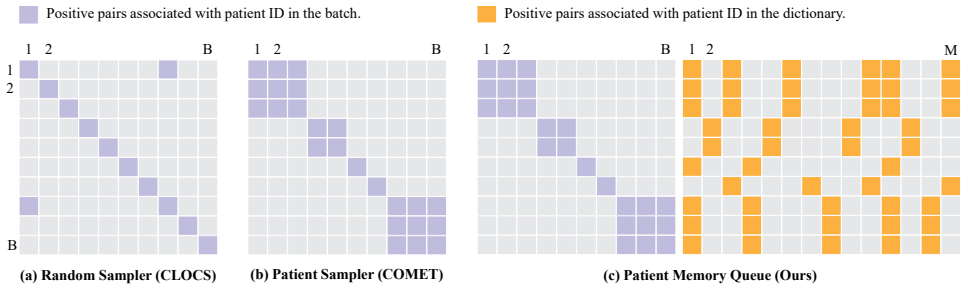
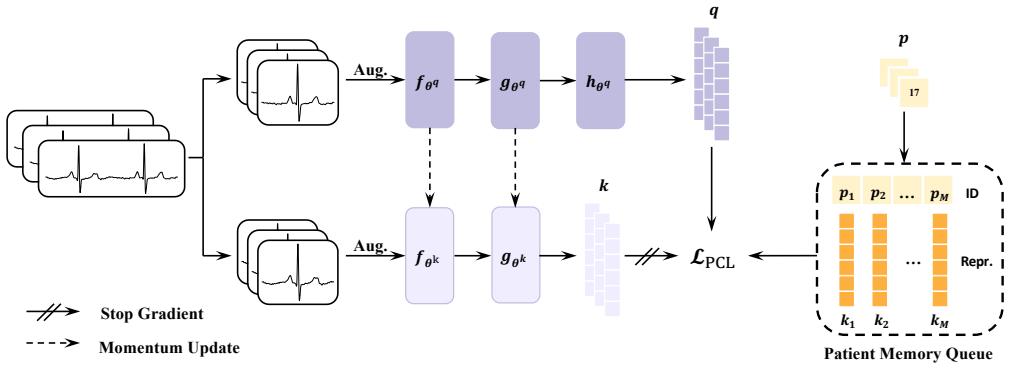
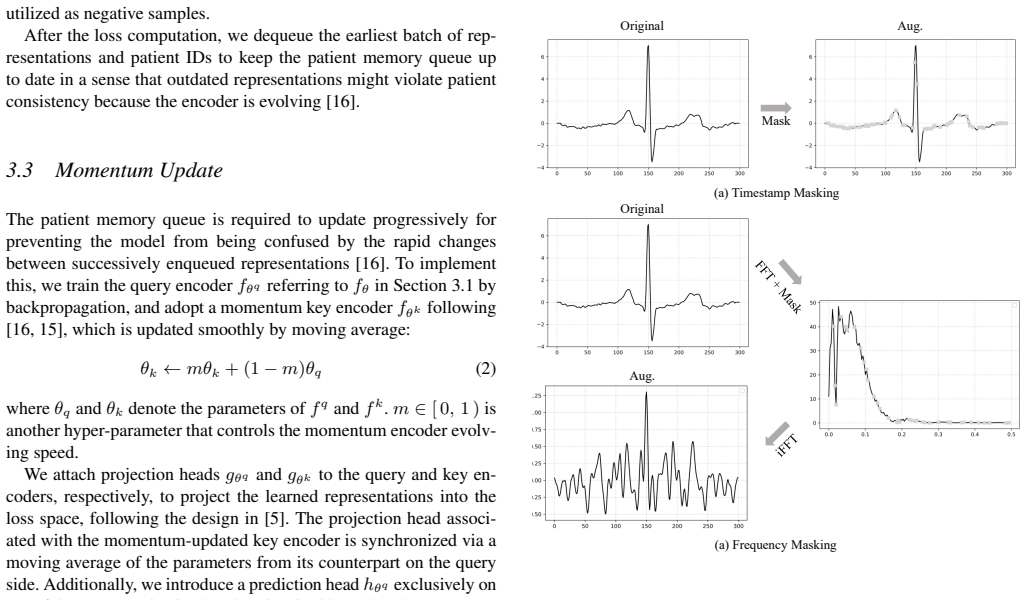
The load-bearing object is the Patient Memory Queue, a dictionary of M key representations with associated patient IDs, maintained by a momentum key encoder (momentum m=0.999) with first-in-first-out dequeuing. It decouples the count of intra-patient positives and inter-patient negatives from the batch size, since the loss in Eq. (1) sums over all queue entries rather than over the sampled batch. The query branch adds a prediction head after its projection head, following the asymmetric design of BYOL, while the key branch is updated by a moving average. Three augmentations — temporal neighboring sampling, timestamp masking, and frequency masking — are applied sequentially to produce the query and key views. The queue's role is to give each query a large set of patient-consistency candidates that stay reasonably current as the encoder evolves.
What would settle it
Freeze the key encoder during pretraining (momentum m=0) while keeping the queue size at 16,384; if fine-tuning F1 on PTB-XL at 1% labels does not drop below the reported 46.8, then the queue's benefit does not come from consistent patient representations, and patient consistency is not the mechanism.
Extended reading notes
Core claim
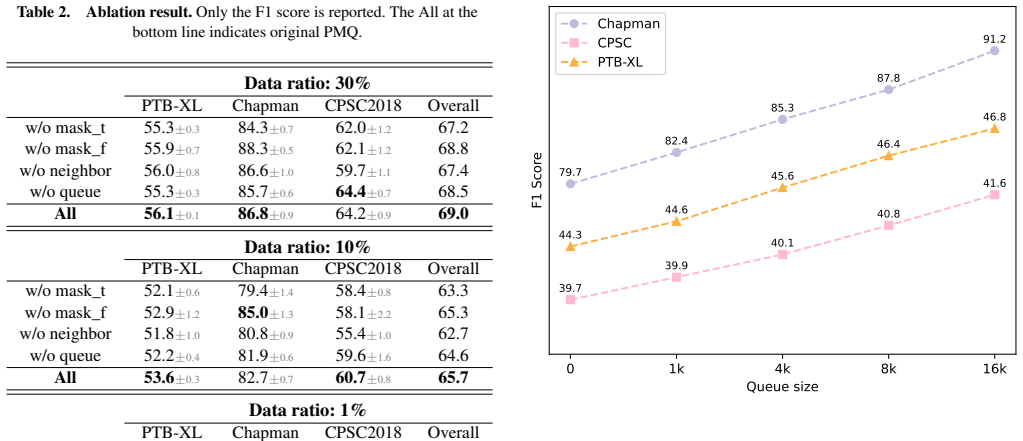
The central claim is that enlarging the dictionary of patient-keyed representations, rather than tinkering with the sampler, is what lets patient contrastive learning work well. PMQ stores M=16,384 entries of the form (patient ID, key representation) produced by a momentum-updated encoder, and computes a contrastive loss in which positives are every queue entry with the same patient ID as the query. The paper reports that this one-to-many dictionary look-up formulation beats general contrastive methods (MoCo, BYOL) and patient-level baselines (CLOCS, PCLR, COMET) on most metrics, and outperforms the text-pretrained ETP while using only raw ECG. Ablations show the queue contributes most when only 1% of labels are available, where removing it drops the overall score by 2.5, and that increasing queue size from 1k to 16k monotonically improves F1 across all three datasets.
Load-bearing premise
The assumption the method depends on is that a patient's heart-signal representation stored in the queue earlier in training still stands for that patient later; if the encoder drifts, stale entries could become false positives instead of helpful context.
Editorial extensions
If this is right
- PMQ should keep improving as the queue grows: the paper reports monotonic F1 gains at 1% labels from M=1k to M=16k.
- The method achieves its results with raw ECG only, without text reports or language models, so pretraining stays cheap (about 1.5 hours on one GPU).
- Because the queue replaces sampler engineering, patient contrastive learning can be applied to any ECG dataset without hierarchical or grouped batching.
- The gain is largest where supervision is scarcest, suggesting pretrained patient-level representations are especially valuable in low-resource deployments.
- MoCo's negative-only queue is not enough; the ablation against MoCo shows the patient-ID positive structure is what carries the improvement.
Reading between the lines
- One untested consequence is that pushing M well beyond 16k might yield further gains, with the limit set by encoder drift making old features stale rather than by hardware.
- The same patient-keyed queue idea could transfer to other multi-visit or longitudinal medical data (wearable time series, ICU stays), where batches also rarely contain the same person twice.
- Because the ablation singles out temporal neighboring as the most important augmentation, combining the queue with finer instance-level augmentations might close the gap to COMET on datasets like Chapman where PMQ trailed.
- A direct stress test would be to randomize the patient IDs attached to queue entries; if downstream performance survives, the benefit would come from feature diversity rather than patient consistency.
Editorial analysis
A structured set of objections, weighed in public.
Referee Report
Summary. The paper proposes PMQ, a contrastive pretraining method for ECG that maintains a queue of past key representations tagged by patient ID and uses them as additional intra-patient positives and inter-patient negatives in an InfoNCE-style loss, with a momentum key encoder and two extra augmentations (timestamp masking and frequency masking). The method is pretrained on MIMIC-IV-ECG and transferred to PTB-XL, Chapman, and CPSC2018 at 30%, 10%, and 1% labeled data ratios, with the claim that PMQ achieves the best performance on 21 out of 27 metrics and is especially robust under label scarcity.
Significance. If the mechanism is validated, the paper makes a useful but modest contribution: it adapts the standard MoCo queue to patient-level positives in ECG, which is a simple and practical idea, and it provides a broad evaluation across three downstream datasets and three label ratios with released code. The experimental finding that queue-based patient positives help under label scarcity would be of interest to the ECG self-supervised learning community. However, the current evidence does not fully separate the effect of patient positives from that of a larger negative set, and the headline 'Overall' metric is not a well-defined aggregate, so the strength of the central claim is not yet established.
major comments (3)
- [Sections 3.2 and 3.3, Eq. (1)] The central mechanism assumes that key representations enqueued by the momentum encoder at earlier iterations remain valid positives for the current query. The paper asserts that FIFO dequeuing and m=0.999 keep the queue consistent, but no experiment varies m, queue age, or re-encodes stored keys. The 'w/o queue' ablation in Table 2 removes additional positives and negatives simultaneously, so it cannot distinguish the benefit of patient positives from the benefit of a larger negative pool. Please add an ablation that keeps the queue but restricts positives to the current batch key (using queue entries only as negatives), and/or vary m or the queue size, to verify that the gains are attributable to the queued intra-patient positives.
- [Table 1 and Section 4.2] The 'Overall' metric averages F1, AUROC, and ACC across datasets, but these metrics are on different scales and ranges (e.g., F1 values around 0.3-0.6, AUROC values around 0.75-0.97, ACC values around 0.4-0.9). Equal-weight averaging of raw values is not interpretable and can change rankings; please report per-metric averages or standardized scores. In addition, many of the claimed improvements are within overlapping standard deviations across the five seeds (e.g., 30% PTB-XL F1: Ours 56.1±0.1 vs Random 56.0±0.8; 10% Chapman AUROC: Ours 95.2±0.2 vs BYOL 94.8±0.8), and no significance test is provided, so the statement that PMQ 'consistently outperforms' the baselines is stronger than the data currently support.
- [Section 4.3, Figure 4] The queue-size ablation reports F1 values without error bars or error ranges, and it does not include the baseline methods that the text claims PMQ exceeds at M=1k (CLOCS, PCLR, COMET). Moreover, selecting M=16384 based on downstream 1% performance and then using that setting for all main results introduces a selection effect; please show stability across M choices and clarify whether the figure reports one seed or the mean over five seeds.
minor comments (6)
- [Section 1] There are typos: 'An shown' should be 'As shown' and 'entitiled' should be 'entitled'.
- [Section 3.1] The symbol p is used both for the number of patients and for a patient ID (p in {0,1,...,p-1}); please rename one of these to avoid confusion.
- [Section 3.2, Eq. (1)] The sentence 'all samples stored in the memory queue are utilized as negative samples' conflicts with the loss, where same-patient queue entries are positives and also appear in the denominator; please clarify the role of positives in the denominator.
- [Section 3.4] The frequency-masking notation is incomplete: R_D is undefined, and the phrase 'for randomly selected components j in R D' does not specify whether masking is applied per lead or across all leads.
- [Section 4.2] The text says 'In the remaining five metrics' after stating PMQ is best in 21 out of 27 metrics; the remaining count should be six.
- [Table 1] The capitalization of 'MOCO' in the table is inconsistent with 'MoCo' used in the text and references.
Circularity Check
No significant circularity; the patient memory queue is evaluated against external downstream benchmarks.
full rationale
The paper's derivation chain is not circular. The patient contrastive loss in Eq. (1) is defined over positive keys sharing a patient ID with the query and all queue keys as negatives; this is a training objective, not a prediction of downstream performance. The reported claims are measured on external datasets (PTB-XL, Chapman, CPSC2018) under accuracy, F1, and AUROC, so the predicted quantities are not constructed from the fitted parameters. The momentum update in Eq. (2) follows the standard MoCo mechanism and is not used to define the target metric. The only tuning performed on downstream data is the choice of queue size M from Figure 4 under the 1% labeled setting, which is ordinary hyperparameter selection rather than circular reasoning, and the paper does not present that curve as independent validation of itself. The ablation 'w/o queue' removes positive and negative queue samples simultaneously, which blurs cause attribution, but that is an experimental confound rather than a circular step. No self-citation is load-bearing; citations to MoCo [16], BYOL [15], CLOCS [20], PCLR [9], and COMET [34] are external prior work and do not include the present authors. No equation in the paper reduces a reported result to its own input by construction.
Assumptions & free parameters
free parameters (5)
- Memory queue size M =
16384
- Temperature tau =
0.1
- Momentum coefficient m =
0.999
- Timestamp masking probability p =
not reported
- Neighbor offset Delta-t =
not reported
assumptions (5)
- domain assumption Patient consistency: multiple recordings from the same patient share meaningful cardiac context.
- domain assumption Temporal locality: neighboring ECG segments are highly correlated and serve as positive views.
- ad hoc to paper Momentum update keeps queue representations valid.
- standard math InfoNCE and cosine similarity are standard contrastive machinery.
- domain assumption Patient IDs are available and correct for all pretraining samples.
Cite this review
Pith. "Pith review of Enhancing Contrastive Learning-based Electrocardiogram Pretrained Model with Patient Memory Queue." pith.science (2026). https://pith.science/paper/75U7QXVF
@misc{pith2026250606310,
  author       = {Pith},
  title        = {Pith review of: Enhancing Contrastive Learning-based Electrocardiogram Pretrained Model with Patient Memory Queue},
  year         = {2026},
  howpublished = {\url{https://pith.science/paper/75U7QXVF}},
  note         = {Machine review of arXiv:2506.06310}
}
read the original abstract
In the field of automatic Electrocardiogram (ECG) diagnosis, due to the relatively limited amount of labeled data, how to build a robust ECG pretrained model based on unlabeled data is a key area of focus for researchers. Recent advancements in contrastive learning-based ECG pretrained models highlight the potential of exploiting the additional patient-level self-supervisory signals inherent in ECG. They are referred to as patient contrastive learning. Its rationale is that multiple physical recordings from the same patient may share commonalities, termed patient consistency, so redefining positive and negative pairs in contrastive learning as intrapatient and inter-patient samples provides more shared context to learn an effective representation. However, these methods still fail to efficiently exploit patient consistency due to the insufficient amount of intra-inter patient samples existing in a batch. Hence, we propose a contrastive learning-based ECG pretrained model enhanced by the Patient Memory Queue (PMQ), which incorporates a large patient memory queue to mitigate model degeneration that can arise from insufficient intra-inter patient samples. In order to further enhance the performance of the pretrained model, we introduce two extra data augmentation methods to provide more perspectives of positive and negative pairs for pretraining. Extensive experiments were conducted on three public datasets with three different data ratios. The experimental results show that the comprehensive performance of our method outperforms previous contrastive learning methods and exhibits greater robustness in scenarios with limited labeled data. The code is available at https://github.com/3hiuwoo/PMQ.
Figures
Figures from the paper (1 more)
Reference graph
Works this paper leans on
-
[4]
H. Chen, G. Wang, G. Zhang, P. Zhang, and H. Yang. CLECG: A Novel Contrastive Learning Framework for Electrocardiogram Arrhyth- mia Classification.IEEE Signal Processing Letters, 28:1993–1997,
work page 1993
-
[1]
E. Alsentzer, J. R. Murphy, W. Boag, W.-H. Weng, D. Jin, T. Naumann, and M. B. A. McDermott. Publicly Available Clinical BERT Embed- dings, June 2019
work page 2019
-
[2]
P. Awasthi, N. Dikkala, and P. Kamath. Do More Negative Sam- ples Necessarily Hurt In Contrastive Learning? InProceedings of the 39th International Conference on Machine Learning, pages 1101–1116. PMLR, June 2022
work page 2022
-
[3]
S. Bai, J. Z. Kolter, and V . Koltun. An Empirical Evaluation of Generic Convolutional and Recurrent Networks for Sequence Modeling, Apr. 2018
work page 2018
-
[5]
T. Chen, S. Kornblith, M. Norouzi, and G. Hinton. A Simple Framework for Contrastive Learning of Visual Representations, July 2020
work page 2020
-
[6]
W. Chen, H. Wang, L. Zhang, and M. Zhang. Temporal and spa- tial self supervised learning methods for electrocardiograms.Scien- tific Reports, 15(1):6029, Feb. 2025. ISSN 2045-2322. doi: 10.1038/ s41598-025-90084-2
work page 2025
-
[7]
H. Choi and P. Kang. Multi-Task Self-Supervised Time-Series Repre- sentation Learning, Mar. 2023
work page 2023
-
[8]
J. Devlin, M.-W. Chang, K. Lee, and K. Toutanova. Bert: Pre-training of deep bidirectional transformers for language understanding. InPro- ceedings of the 2019 conference of the North American chapter of the association for computational linguistics: human language technolo- gies, volume 1 (long and short papers), pages 4171–4186, 2019
work page 2019
Show all 47 references
-
[9]
Diamant, E
N. Diamant, E. Reinertsen, S. Song, A. Aguirre, C. Stultz, and P. Ba- tra. Patient Contrastive Learning: A Performant, Expressive, and Prac- tical Approach to ECG Modeling.PLOS Computational Biology, 18 (2):e1009862, Feb. 2022. ISSN 1553-7358. doi: 10.1371/journal.pcbi. 1009862
2022 doi
-
[10]
J. Dong, H. Wu, Y . Wang, Y . Qiu, L. Zhang, J. Wang, and M. Long. TimeSiam: A Pre-Training Framework for Siamese Time-Series Mod- eling, June 2024
2024
-
[11]
Eldele, M
E. Eldele, M. Ragab, Z. Chen, M. Wu, C. K. Kwoh, X. Li, and C. Guan. Time-series representation learning via temporal and contextual con- trasting.arXiv preprint arXiv:2106.14112, 2021
2021 arXiv
-
[12]
Gidaris, P
S. Gidaris, P. Singh, and N. Komodakis. Unsupervised repre- sentation learning by predicting image rotations.arXiv preprint arXiv:1803.07728, 2018
2018 arXiv
-
[13]
A. L. Goldberger, L. A. Amaral, L. Glass, J. M. Hausdorff, P. C. Ivanov, R. G. Mark, J. E. Mietus, G. B. Moody, C.-K. Peng, and H. E. Stan- ley. Physiobank, physiotoolkit, and physionet: components of a new re- search resource for complex physiologic signals.circulation, 101(2...
2000
-
[14]
B. Gow, T. Pollard, L. A. Nathanson, A. Johnson, B. Moody, C. Fernan- des, N. Greenbaum, J. W. Waks, P. Eslami, T. Carbonati, et al. Mimic- iv-ecg: Diagnostic electrocardiogram matched subset.Type: dataset, 6: 13–14, 2023
2023
-
[15]
Grill, F
J.-B. Grill, F. Strub, F. Altché, C. Tallec, P. H. Richemond, E. Buchatskaya, C. Doersch, B. A. Pires, Z. D. Guo, M. G. Azar, B. Piot, K. Kavukcuoglu, R. Munos, and M. Valko. Bootstrap your own latent: A new approach to self-supervised Learning, Sept. 2020
2020
-
[16]
K. He, H. Fan, Y . Wu, S. Xie, and R. Girshick. Momentum con- trast for unsupervised visual representation learning. InProceedings of the IEEE/CVF conference on computer vision and pattern recognition, pages 9729–9738, 2020
2020
-
[17]
K. He, X. Chen, S. Xie, Y . Li, P. Dollár, and R. Girshick. Masked Autoencoders Are Scalable Vision Learners, Dec. 2021
2021
-
[18]
R. Hu, J. Chen, and L. Zhou. Spatiotemporal self-supervised representa- tion learning from multi-lead ecg signals.Biomedical Signal Processing and Control, 84:104772, 2023
2023
-
[19]
Jaiswal, A
A. Jaiswal, A. R. Babu, M. Z. Zadeh, D. Banerjee, and F. Makedon. A Survey on Contrastive Self-Supervised Learning.Technologies, 9(1):2, Dec. 2020. ISSN 2227-7080. doi: 10.3390/technologies9010002
2020 doi
-
[20]
Kiyasseh, T
D. Kiyasseh, T. Zhu, and D. A. Clifton. CLOCS: Contrastive Learning of Cardiac Signals Across Space, Time, and Patients, May 2021
2021
-
[21]
J. Li, C. Liu, S. Cheng, R. Arcucci, and S. Hong. Frozen Language Model Helps ECG Zero-Shot Learning, Mar. 2023
2023
-
[22]
C. Liu, Z. Wan, S. Cheng, M. Zhang, and R. Arcucci. ETP: Learn- ing Transferable ECG Representations via ECG-Text Pre-Training. In ICASSP 2024 - 2024 IEEE International Conference on Acoustics, Speech and Signal Processing (ICASSP), pages 8230–8234, Seoul, Ko- rea, Republic of...
2024
-
[23]
F. Liu, C. Liu, L. Zhao, X. Zhang, X. Wu, X. Xu, Y . Liu, C. Ma, S. Wei, Z. He, et al. An open access database for evaluating the algorithms of electrocardiogram rhythm and morphology abnormality detection. Journal of Medical Imaging and Health Informatics, 8(7):1368–1373, 2018
2018
-
[24]
Liu and S
J. Liu and S. Chen. Timesurl: Self-supervised contrastive learning for universal time series representation learning. InProceedings of the AAAI conference on artificial intelligence, volume 38, pages 13918– 13926, 2024
2024
-
[25]
X. Liu, H. Wang, Z. Li, and L. Qin. Deep learning in ecg diagnosis: A review.Knowledge-Based Systems, 227:107187, 2021
2021
-
[26]
D. Luo, W. Cheng, Y . Wang, D. Xu, J. Ni, W. Yu, X. Zhang, Y . Liu, Y . Chen, H. Chen, and X. Zhang. Time Series Contrastive Learning with Information-Aware Augmentations, Mar. 2023
2023
-
[27]
Y . Na, M. Park, Y . Tae, and S. Joo. Guiding Masked Representation Learning to Capture Spatio-Temporal Relationship of Electrocardio- gram, Mar. 2024
2024
-
[28]
Robinson, C.-Y
J. Robinson, C.-Y . Chuang, S. Sra, and S. Jegelka. Contrastive learning with hard negative samples.arXiv preprint arXiv:2010.04592, 2020
2010 arXiv
-
[29]
Sarkar and A
P. Sarkar and A. Etemad. Self-Supervised ECG Representation Learn- ing for Emotion Recognition.IEEE Transactions on Affective Comput- ing, 13(3):1541–1554, July 2022. ISSN 1949-3045, 2371-9850. doi: 10.1109/TAFFC.2020.3014842
2022
-
[30]
Tonekaboni, D
S. Tonekaboni, D. Eytan, and A. Goldenberg. Unsupervised representa- tion learning for time series with temporal neighborhood coding.arXiv preprint arXiv:2106.00750, 2021
2021 arXiv
-
[31]
van den Oord, Y
A. van den Oord, Y . Li, and O. Vinyals. Representation Learning with Contrastive Predictive Coding, Jan. 2019
2019
-
[32]
Wagner, N
P. Wagner, N. Strodthoff, R.-D. Bousseljot, D. Kreiseler, F. I. Lunze, W. Samek, and T. Schaeffter. Ptb-xl, a large publicly available electro- cardiography dataset.Scientific data, 7(1):1–15, 2020
2020
-
[33]
N. Wang, P. Feng, Z. Ge, Y . Zhou, B. Zhou, and Z. Wang. Adver- sarial Spatiotemporal Contrastive Learning for Electrocardiogram Sig- nals.IEEE Transactions on Neural Networks and Learning Systems, 35 (10):13845–13859, Oct. 2024. ISSN 2162-2388. doi: 10.1109/TNNLS. 2023.3272153
2024
-
[34]
Y . Wang, Y . Han, H. Wang, and X. Zhang. Contrast Everything: A Hi- erarchical Contrastive Framework for Medical Time-Series, Nov. 2023
2023
-
[35]
Weimann and T
K. Weimann and T. O. F. Conrad. Self-Supervised Pre-Training with Joint-Embedding Predictive Architecture Boosts ECG Classification Performance, Oct. 2024
2024
-
[36]
G. Woo, C. Liu, D. Sahoo, A. Kumar, and S. Hoi. Cost: Contrastive learning of disentangled seasonal-trend representations for time series forecasting.arXiv preprint arXiv:2202.01575, 2022
2022 arXiv
-
[37]
Z. Wu, Y . Xiong, S. Yu, and D. Lin. Unsupervised Feature Learning via Non-Parametric Instance-level Discrimination, May 2018
2018
-
[38]
Yang and S
L. Yang and S. Hong. Unsupervised Time-Series Representation Learn- ing with Iterative Bilinear Temporal-Spectral Fusion, May 2022
2022
-
[39]
Z. Yue, Y . Wang, J. Duan, T. Yang, C. Huang, Y . Tong, and B. Xu. Ts2vec: Towards universal representation of time series. InProceed- ings of the AAAI conference on artificial intelligence, volume 36, pages 8980–8987, 2022
2022
-
[40]
Zhang, W
H. Zhang, W. Liu, J. Shi, S. Chang, H. Wang, J. He, and Q. Huang. Maefe: Masked autoencoders family of electrocardiogram for self- supervised pretraining and transfer learning.IEEE Transactions on In- strumentation and Measurement, 72:1–15, 2022
2022
-
[41]
Zhang, Q
K. Zhang, Q. Wen, C. Zhang, R. Cai, M. Jin, Y . Liu, J. Zhang, Y . Liang, G. Pang, D. Song, and S. Pan. Self-Supervised Learning for Time Series Analysis: Taxonomy, Progress, and Prospects, Apr. 2024
2024
-
[42]
Zhang, P
R. Zhang, P. Isola, and A. A. Efros. Colorful image colorization. In Computer Vision–ECCV 2016: 14th European Conference, Amsterdam, The Netherlands, October 11-14, 2016, Proceedings, Part III 14, pages 649–666. Springer, 2016
2016
-
[43]
Zhang, Z
X. Zhang, Z. Zhao, T. Tsiligkaridis, and M. Zitnik. Self-Supervised Contrastive Pre-Training For Time Series via Time-Frequency Consis- tency, Oct. 2022
2022
-
[44]
Zhao and L
W. Zhao and L. Fan. Time-series representation learning via Time- Frequency Fusion Contrasting.Frontiers in Artificial Intelligence, 7, June 2024. ISSN 2624-8212. doi: 10.3389/frai.2024.1414352
2024
-
[45]
Zheng, J
J. Zheng, J. Zhang, S. Danioko, H. Yao, H. Guo, and C. Rakovski. A 12- lead electrocardiogram database for arrhythmia research covering more than 10,000 patients.Scientific data, 7(1):48, 2020
2020
-
[46]
Zheng, G
T. Zheng, G. Cao, L. Chen, and K. Hao. Contrastive Representation Learning for Time Series via Compound Consistency and Hierarchical Contrasting. In2023 IEEE 12th Data Driven Control and Learning Sys- tems Conference (DDCLS), pages 1623–1628. IEEE, May 2023. doi: 10.1109/DDCLS...
2023
-
[2021]
doi: 10.1109/LSP.2021.3114119
ISSN 1558-2361. doi: 10.1109/LSP.2021.3114119
2021
Reviewed August 7, 2026 · model on record in the stance chip above.
Discussion (0). Sign in to comment.