REVIEW 4 major objections 4 minor 29 references
Quantum Particle Creation by Cosmic Strings in de Sitter Spacetime
T0 review · 4 major / 4 minor · reviewed 2026-08-07 · deepseek-v4-flash
Pith's one-line read For a charged cosmic string in de Sitter spacetime, the vacuum produces particles with probability exactly $P=|B/A|^2=e^{-2\pi(Qq+(\varepsilon-qC_0)/H)}$, and with the thermal factor $e^{-2\pi\varepsilon/H}$ for a neutral string.
desk verdict A promising but internally inconsistent derivation of particle creation probabilities; the central formula is a complex number as printed. read the letter →
The pith
A machine-rendered reading of the paper's core claim, the machinery that carries it, and where it could break.
The reading
What carries the argument
The machinery is the exact solution of the radial Klein-Gordon equation in terms of generalized Heun functions, a second-order special-function class with an extra regular singular point beyond the Gauss hypergeometric equation, followed by their reduction to Gauss hypergeometric functions using the parameter-shift, sign-flip, and connection identities in Eqs. (14), (16), (17), and (20). That reduction puts the exact modes in a form where the hypergeometric connection formula can be read as a Bogoliubov transformation, $\varphi_{\rm out}=A\varphi_{\rm in}+B\varphi_{\rm in}^*$, so the creation probability $P=|B/A|^2$ comes from a coefficient ratio. The key identity is Eq. (23), $P=-\frac{1}{2}(E_Q-1)=e^{-2\pi(Qq+(\varepsilon-qC_0)/H)}$, which converts a complicated special-function coefficient into a thermal exponential controlled by the Hubble scale.
What would settle it
Substitute the defining series of the generalized Heun function into Eqs. (16)-(19) at representative values of $H$, $Q$, $q$, and $\varepsilon$ and check whether the identities hold numerically; a mismatch would invalidate the reduction and with it Eq. (23). Alternatively, integrate the radial equation Eq. (10) numerically from $r=0$ to $r=1/H$ with in- and out-boundary conditions and compare the extracted $|B/A|$ with the claimed exponential for fixed $H$, $Q$, $q$, and $\varepsilon$.
Extended reading notes
Core claim
The central claim, stated in Eq. (23), is that in de Sitter spacetime with a point-like charged cosmic string and a scalar field of charge $q$, the probability that the vacuum produces a particle is $P=e^{-2\pi(Qq+(\varepsilon-qC_0)/H)}$. The same construction for a dense point-like source gives $P\to e^{-2\pi Qq}$ for large $Q$; for an electrically neutral string it gives $P=e^{-2\pi\varepsilon/H}$, a thermal spectrum at temperature $H/2\pi$; and for a linear potential it gives $P=e^{-2\pi(Q_l q/H^2+(\varepsilon-qC_0)/H)}$. In every case the string tension enters through the angular deficit parameter $\alpha$, which shifts the angular quantum number to $l_\alpha=n+|m|/\alpha$, and in the neutral case the creation probability vanishes when $H\to0$, recovering the static cosmic-string behavior.
Load-bearing premise
The argument depends on the assumption that the special-function identities used to simplify the exact solutions are correct, and that the coefficient ratio they produce really is the particle-creation probability; if either fails, the exponential formulas do not follow.
Editorial extensions
If this is right
- For a charged point-like string, larger charge coupling $qQ$ or larger particle energy $\varepsilon$ exponentially suppresses creation, while a larger Hubble parameter $H$ amplifies it, especially for low-energy modes.
- A neutral cosmic string in de Sitter spacetime still creates scalar particles with a thermal spectrum at temperature $H/2\pi$; the creation stops in the static limit $H\to0$.
- The dense-charge limit $Q\to\infty$ returns the same $e^{-2\pi Qq}$ suppression as the point-like formula, confirming internal consistency between the two regimes.
- With a linear potential, the exponent acquires the additional term $Q_l q/H^2$, so an external field strength directly tunes the particle yield.
- At GUT-scale parameters the model predicts on the order of a hundred neutral scalar particles created per year for $G\mu=10^{-6}$, which could leave observable imprints such as gamma rays from neutral-pion decay.
Reading between the lines
- Going beyond the paper: if the exponential law of Eq. (23) is exact, one would expect the same $H/2\pi$ thermal structure to organize particle creation for other localized defects in de Sitter space; the paper does not attempt that unification.
- A natural next step the authors do not take is to repeat the Bogoliubov calculation for fermions, where the angular spectrum and Pauli blocking would modify both the density and the exponent.
- Extending the parity analysis in Appendix B, the results imply an observational discriminant: neutral-string creation should yield chargeless pseudoscalar particles decaying to gamma rays, while dense charged strings should yield charged pions and ultimately electron and neutrino cosmic rays; one could search for these channels separately.
- A direct check the authors do not report would be to verify Eqs. (16)-(19) numerically; the identities are stated without proof, so such a check would settle the entire chain.
Editorial analysis
A structured set of objections, weighed in public.
Referee Report
Summary. The paper studies scalar particle creation by a cosmic string in de Sitter spacetime. It separates the Klein-Gordon equation in static spherical coordinates, writes the radial solutions in terms of generalized Heun functions, and claims a reduction to Gauss hypergeometric functions that yields Bogoliubov coefficients and closed-form particle-creation probabilities: Eq. (23) for a point-like charge, Eq. (33) for a dense charge, Eq. (36) for a neutral string, and Eq. (42) for a linear potential. The central physical claim is that the creation probability is e^{-2π(Qq+(ε-qC0)/H)}, reducing to a Gibbons-Hawking-like thermal factor in the neutral limit.
Significance. If established, the paper would provide a compact analytic extension of de Sitter particle creation to cosmic-string backgrounds, with explicit dependence on string charge and on a linear-potential coupling. The neutral-limit result e^{-2πε/H} does match the familiar de Sitter thermal factor, and the static-space H→0 limit correctly vanishes, in agreement with known cosmic-string pair-production results. However, the central derivation rests on unproved Heun-to-hypergeometric identities, and the printed probability formula is internally inconsistent. As it stands, the claimed generality is not supported, so the significance is conditional on a complete rederivation.
major comments (4)
- [§2.1, Eq. (23)] The equality P=|B/A|² = -1/2(E_Q-1) = e^{-2π(Qq+(ε-qC0)/H)} is not a valid probability as printed. With E_Q = 1+i(Qq+(ε-qC0)/H) from Eq. (12), the quantity -1/2(E_Q-1) is purely imaginary for nonzero argument, whereas P must be real and nonnegative. No intermediate algebra from Eq. (21) is shown that produces either the factor -1/2(E_Q-1) or the exponential. Since this formula is the central result and is used for the limits in Eqs. (33), (36), and (42), the derivation needs to be redone.
- [§2.1, after Eq. (12); §3.1, Eq. (33)] The stated simplifying choice C0 = ε/q - HQ makes (ε - qC0)/H = Qq, so Eq. (23) becomes e^{-4πQq}. This contradicts the claim that the large-Q dense-source limit is e^{-2πQq} and that it is 'consistent with the results obtained in the previous Section.' If instead C0 = 0 is intended in Eq. (23), then the text's use of C0 = ε/q - HQ to set ε̃ = 0 is inconsistent. The discrepancy is not discussed.
- [§2.1, Eqs. (16)-(19)] The reduction of the generalized Heun functions in Eq. (11) to the Gauss hypergeometric form in Eq. (19) is asserted without proof or citation. This is not a standard transformation as written: the mapping in Eqs. (16)-(18) introduces parameters q_H, a, and b whose relation to the Heun parameters of Eq. (13) is not defined, and Eq. (17) contains an unorthodox denominator involving (z-1). Because all subsequent probabilities depend on this reduction, the central claim is unsupported unless these identities are proved or replaced by a documented connection formula.
- [§2.1, Eqs. (21)-(22)] The identification of the coefficients in the hypergeometric connection formula with the Bogoliubov coefficients A and B is not justified. Eq. (21) writes φ3 as a combination of φ1 and φ1*, while the text assigns φ1, φ2 to φ_in^+, φ_in^-; the relation between φ2 and φ1* that would make the mode assignment consistent is not specified, and the normalization N is not computed. A reader cannot verify that |A|² - |B|² = 1 or that the ratio |B/A|² equals the claimed exponential. The same issue affects the analogous identifications leading to Eqs. (33) and (36).
minor comments (4)
- [§3.2, Eq. (37)] The production rate Γ is introduced with Γ ∝ 2πGμ/ε and assumed time-invariant, but its normalization and physical origin are not derived; the numerical estimate for ⟨N⟩ should be labeled as heuristic.
- [§4, Conclusions] The phrase 'huge differentiation on supercharge interpretations' appears to be a typo; 'supercritical' or a related term is likely intended.
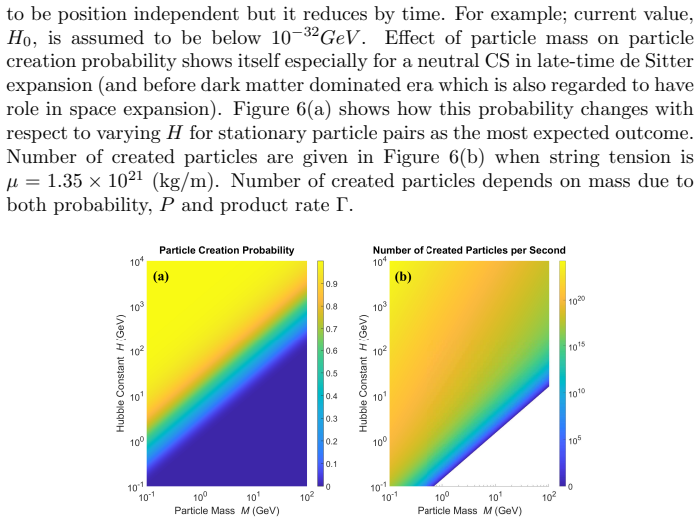
- [Figures] Figures 1-6 are described in the text, but the parameter conventions are not fully specified; for example, Figure 1 gives H = 10^{13} GeV and C0 = 0 but does not state the mass M or the range of ε used in the plotted probability.
- [Appendix A, Eq. (47)] The sign of A0 and the identification C ∼ Q are stated without showing the charge normalization; this is only motivational, but should be clarified for completeness.
Circularity Check
No significant circularity: the paper's derivation is self-contained and parameter-free; the problematic Eq. (23) chain is an internal mathematical inconsistency, not a circular reduction.
full rationale
The manuscript contains no fitted parameters, no data-calibrated inputs, and no load-bearing self-citation chain. The claimed particle-creation probabilities are presented as following from Bogoliubov coefficient ratios obtained by hypergeometric connection formulas, and the angular and radial equations are set up from the curved-space Klein-Gordon equation rather than assumed from the final probabilities. The neutral limit e^{-2πε/H} is a standard de Sitter thermal factor, but it is re-derived in the paper's own Bogoliubov scheme rather than imported as an input; this at most raises a novelty concern, not a circularity concern. The most suspicious passage is Eq. (23), where the paper writes P = |B/A|^2 = -1/2(E_Q-1) = e^{-2π(Qq+(ε-qC0)/H)}. With the definition E_Q = 1 + i(Qq+(ε-qC0)/H) from Eq. (12), the middle expression equals -(i/2)(Qq+(ε-qC0)/H), which is not equal to the subsequent exponential and is not even real. This is a substantive correctness gap in the derivation, but it is not circular: the exponential is not equivalent to the definition of E_Q by construction, nor is it obtained by fitting or by renaming an earlier result. Likewise, the later limits in Eqs. (33), (36), and (42) follow the same template and inherit the same unproved equality, but no step reduces to its own input in the sense required for a circularity finding. Since the requested analysis is specifically circularity, not correctness, the honest finding is no significant circularity with score 0.
Assumptions & free parameters
free parameters (2)
- C0 =
taken as ε/q - HQ in one derivation step, set to 0 in figures
- Γ (production rate) =
Γ ∝ 2πGμ/ε, proportionality unspecified
assumptions (6)
- domain assumption Cosmic string in de Sitter spacetime is described by the conical-defect metric (1) with α = 1-4Gμ and transformation (2).
- standard math A minimally coupled scalar field satisfies the Klein-Gordon equation (4) with four-potential A=(A0,0,0,0).
- domain assumption Angular wave functions satisfy Eq. (7) with l_α = n + |m|/α.
- ad hoc to paper Generalized Heun solutions reduce to Gauss hypergeometric functions via Eqs. (16)-(19).
- ad hoc to paper The choice C0 = ε/q - HQ is an admissible simplification that sets ε̃ = 0.
- ad hoc to paper Particle production rate Γ is proportional to 2πGμ/ε and time-invariant.
Cite this review
Pith. "Pith review of Quantum Particle Creation by Cosmic Strings in de Sitter Spacetime." pith.science (2026). https://pith.science/paper/QQ7GU4AJ
@misc{pith2026250606370,
  author       = {Pith},
  title        = {Pith review of: Quantum Particle Creation by Cosmic Strings in de Sitter Spacetime},
  year         = {2026},
  howpublished = {\url{https://pith.science/paper/QQ7GU4AJ}},
  note         = {Machine review of arXiv:2506.06370}
}
read the original abstract
This paper explores the phenomenon of particle creation associated with cosmic strings in de Sitter spacetime, a model that represents the universe exponential expansion. We examine how the presence of cosmic strings in a de Sitter background affects particle production, focusing on the roles of string tension and angular deficits. Utilizing the Klein Gordon equation adapted to curved spacetime with cosmic string defects, we derive solutions expressed through hypergeometric functions to describe particle states. Our findings highlight how string properties influence particle creation rates and energy distributions. By analyzing both point-like and linear potentials near the string, we determine exact solutions, investigate asymptotic behaviors, and calculate particle creation probabilities using Bogoliubov transformations.
Figures


Figures from the paper (3 more)


Reference graph
Works this paper leans on
-
[1]
Tom W. B. Kibble, Topology of Cosmic Domains and Strings, J. Phys. A: Math. and Gen. 9(8) 1387 1976
work page 1976
-
[2]
Vilenkin, Cosmic strings as gravitational lenses, The Astr
A. Vilenkin, Cosmic strings as gravitational lenses, The Astr. J. 2 82 L51–L53 1984
work page 1984
-
[3]
T. Damour and A. Vilenkin, Gravitational wave bursts from cosmic strings, Phys. Rev. Lett. 85(18) 3761–3764 2000
work page 2000
-
[4]
M. Hindmarsh, Cosmic strings and the microwave background, As tro- physics and Space Science, 230(1-2) 117–128 1995
work page 1995
-
[5]
L. Pogosian and T. Vachaspati, Cosmic microwave background an isotropy from wiggly strings, Phys. Rev. D 60: 083504 1999
work page 1999
-
[6]
Blanco-Pillado, J. J., Olum, K. D., and Shlaer, B., The number of cosm ic string loops, Phys. Rev. D 89(2): 023512 2014. 20
work page 2014
-
[7]
E.R. Bezerra de Mello and A.A. Saharian, Vacuum polarization by a co smic string in de Sitter spacetime , J. High En. Phys. 04 2009
work page 2009
-
[8]
E. R. Bezerra de Mello, A. A. Saharian and M. R. Setare , Casimir eff ect for parallel plates in a Friedmann-Robertson-Walker universe, Phy s. Rev. D, 95 065024 2017
work page 2017
Show all 29 references
-
[9]
S. G. Dogan, G. Gecim and Y. Sucu, Particle Production via Dirac Dip ole Moments in the Magnetized and Nonmagnetized Exponentially Expand ing Universe, 2019 208712 2019
2019
-
[10]
´O. J. C. Dias and Jos´ e P. S. Lemos, Pair creation of de Sitter black h oles on a cosmic string background, Phys. Rev. D 69 084006 2004
2004
-
[11]
Belbaki and A
B. Belbaki and A. Bounames, Influence of a cosmic string on the rate of pairs produced by the Coulomb potential, Int. J. Theo. Phys. 62(6 ) 136 2023
2023
-
[12]
Srednicki and S
M. Srednicki and S. Theisen, Nongravitational Decay of Cosmic Strings, Phys. Lett. B 198(4): 397-400 1987
1987
-
[13]
Damour and A
T. Damour and A. Vilenkin, Gravitational wave bursts from cusp s and kinks on cosmic strings, Phys. Rev. D 64(6): 064008 2001
2001
-
[14]
Albrecht and N
A. Albrecht and N. Turok, Evolution of cosmic string networks, Phys. Rev. D 40(12): 973-997 1989
1989
-
[15]
Polchinski, Cosmic superstrings revisited, AIP Conference P roceedings, 743(1): 331-340 2005
J. Polchinski, Cosmic superstrings revisited, AIP Conference P roceedings, 743(1): 331-340 2005
2005
-
[16]
Hardy and G
M, Gorghetto, E. Hardy and G. Villadoro, More axions from strin gs, Sci- ence Advances, 7(11) 072 2021
2021
-
[17]
J., Olum, K
Blanco-Pillado, J. J., Olum, K. D., and Siemens, X., New limits on cos- mic strings from gravitational wave observation, Phys. Rev. Lett . 120(19): 191101 2018
2018
-
[18]
Bellucci, W
S. Bellucci, W. Oliveira dos Santos, E. R. Bezerra de Mello and A. A. Saharian, Cosmic string and brane induced effects on the fermionic v acuum in AdS spacetime, JHEP 21 2022
2022
-
[19]
N. N. Bogoliubov, ”On the Theory of Superfluidity,” Journal of P hysics (USSR), vol. 11, 1947, pp. 23-32
1947
-
[20]
Weinberg, The Quantum Theory of Fields Volume 2: Modern App lica- tions, Cambridge University Press, 1996
S. Weinberg, The Quantum Theory of Fields Volume 2: Modern App lica- tions, Cambridge University Press, 1996
1996
-
[21]
S. W. Hawking, Particle creation by black holes. Communications in Math- ematical Physics, 43(3) 199-220 1975. 21
1975
-
[22]
S. A. Fulling, Nonuniqueness of canonical field quantization in Riem annian space-time. Physical Review D 7(10) 2850-2862 1973
1973
-
[23]
T. S. Bunch, P. C. W. Davies, Quantum field theory in de Sitter sp ace: Renormalization by point-splitting. Proceedings of the Royal Societ y of London. A. Mathematical and Physical Sciences, 360(1700) 117- 134 1978
1978
-
[24]
V. P. Frolovand I. D. Novikov, Black Hole Physics: Basic Concept s and New Developments. Kluwer Academic Publishers, 1998
1998
-
[25]
W. G. Unruh, Notes on black-hole evaporation, Physical Review D, 14(4) 870-892 1976
1976
-
[26]
I. H. Duru, Spontaneous pair production in a magnetic monopole field, J. Phys. A: Math. Gen. 28 5883
-
[27]
and Reinhardt, J
Greiner, W. and Reinhardt, J. (2008). Quantum electrodynam ics. Springer Science & Business Media
2008
-
[28]
and Sigl, G
Bhattacharjee, P. and Sigl, G. (2000). Origin and propagation of extremely high-energy cosmic rays. Physics Reports, 327(3-4), 109-247
2000
-
[29]
and Tian, Z
Yang, Y., Jing, J. and Tian, Z. (2022). Probing cosmic string spa cetime through parameter estimation. The European Physical Journal C , 82(8), 688. 22
2022
Reviewed August 7, 2026 · model on record in the stance chip above.
Discussion (0). Sign in to comment.