REVIEW 4 major objections 6 minor 26 references
Relationship Detection on Tabular Data Using Statistical Analysis and Large Language Models
T0 review · 4 major / 6 minor · reviewed 2026-08-07 · deepseek-v4-flash
Pith's one-line read A hybrid pipeline that prunes the candidate relationship list with statistical filters before an LLM is queried can match the upper tier of SemTab's column-property-annotation systems without any fine-tuning.
desk verdict Fine-tuning-free domain/range pruning plus LLM prompting is plausibly competitive for SemTab CPA, but unmeasured candidate recall and single-run results make variant-level claims conditional. read the letter →
The pith
A machine-rendered reading of the paper's core claim, the machinery that carries it, and where it could break.
The reading
What carries the argument
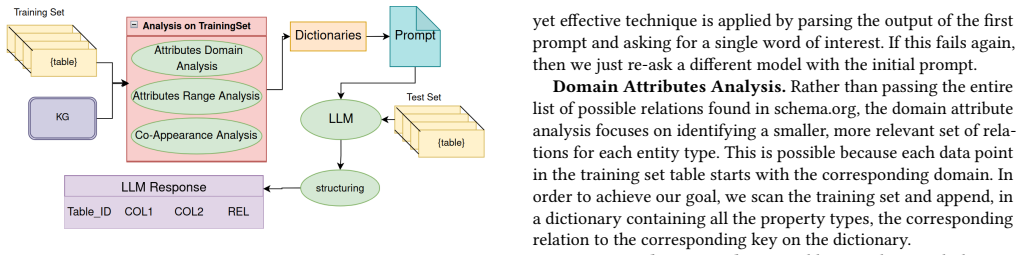
The load-bearing machinery is a pair of dictionaries built once from the training set, plus a co-occurrence dictionary. The domain dictionary maps each entity type (for example, Book or Person) to all relations in Schema.org whose domain is that type; the range dictionary classifies each column's values into one of four primitive types and keeps only relations matching that type, discarding any relation rarer than 5 percent of the most frequent one. At inference, the table's topic, or domain, is detected, each column's type is classified, and the intersection of the two lists is handed to the LLM as the candidate set from which it must pick a single relation. A third module records which relations co-appear in the same training table and removes already-assigned relations from later columns' candidate lists, but the paper finds this step propagates errors and lowers scores in every configuration tested.
What would settle it
Measure dictionary coverage on the test tables: run each test table through the domain and range filters, ignoring the LLM entirely, and count how often the ground-truth relation survives in the candidate list. If that pass rate is materially below 100 percent, the gap to TorchicTab's 0.871 on Round 2 is fixed by the pruning dictionaries rather than by LLM reasoning; likewise, building the dictionaries on one set of domains and testing on disjoint ones would expose whether the method collapses under distribution shift.
Extended reading notes
Core claim
The paper's central claim is that a competitive Column Property Annotation system can be built without fine-tuning by letting cheap, data-derived statistics do the heavy lifting of narrowing the candidate space before an LLM is ever queried. Concretely, the Range & Domain configuration, a lookup dictionary mapping entity domains to their plausible relations intersected with a dictionary mapping column value types (string, number, date, URL) to relations, reaches Micro-F1 of 0.812 on SOTAB Round 1 and 0.776 on Round 2 with a quantized Qwen2.5-32B model on a single GPU, compared with 0.871 for the fine-tuned TorchicTab system on Round 2 and 0.793 for MUT2KG. The paper positions this as competitive with state-of-the-art approaches while openly acknowledging it does not beat them; its stated advantage over the top systems is that it requires no fine-tuning.
Load-bearing premise
The whole pipeline rests on the training-set-derived domain and range dictionaries covering every relation that appears in the test tables and on the table-topic detection being correct; if either fails, the true relation is pruned away before the LLM is asked, and no prompting change can recover it.
Editorial extensions
If this is right
- A pipeline of quantized open-weight LLMs plus statistical pre-filtering lands in the upper tier of SemTab CPA results, trailing only TorchicTab among the compared systems on Round 2.
- Domain filtering is the decisive module, raising Micro-F1 by 16.7 percent on Round 1 and 17.3 percent on Round 2 relative to the unfiltered base.
- Co-appearance pruning is counterproductive as implemented: any single mistake narrows later columns' candidate lists around the wrong answer, suppressing Micro-F1 whenever it is included.
- Model scale and quantization matter less than output structure: Qwen2.5-32B at 3-bit quantization outperforms LLaMA 3.3 70B and Qwen 72B at 2-bit, which fail to produce well-formed answers.
- Prompt composition is dataset-dependent: removing chain-of-thought and the example helps on the easier Round 1, while keeping them helps on Round 2.
Reading between the lines
- The pruned candidate list sets a hard ceiling the LLM cannot break through: if the domain-and-range dictionaries miss a test relation, the correct label is absent before prompting. Computing the oracle pass rate, the fraction of ground-truth relations that survive the dictionaries with the LLM removed, would separate pruning error from prompting error directly.
- Because the dictionaries are mined from the SOTAB training tables, the method's edge should shrink on tables from unseen domains or with novel relation types; a train/test domain split would test this more sharply than the in-distribution rounds do.
- The paper's left-to-right column scan makes co-appearance self-defeating; reordering columns by candidate-list size or by the LLM's confidence before applying the co-occurrence cutoff is a direct, testable repair.
- The pipeline is knowledge-graph-agnostic on paper, with the same dictionary builder and prompt applied to a different schema, so rebuilding the dictionaries for DBpedia or Wikidata is a low-cost check of whether the result generalizes beyond Schema.org.
Editorial analysis
A structured set of objections, weighed in public.
Referee Report
Summary. The paper proposes a hybrid approach to Column Property Annotation (CPA) on the SemTab 2023 SOTAB benchmarks, combining LLM prompting with three statistical modules: domain attribute dictionaries, range primitive-type dictionaries, and relation co-appearance filtering. The authors evaluate several local LLMs at different quantization levels and report that the Range & Domain (RD) configuration with Qwen2.5-32B reaches Micro_F1 0.812 on R1 and 0.776 on R2 without any fine-tuning. They claim this is competitive with state-of-the-art approaches, while emphasizing the practical advantage of not requiring fine-tuning. The paper includes ablations of each module, prompt ablations, and comparison across models, and the code is publicly available on GitHub.
Significance. If the reported numbers are taken at face value, the paper demonstrates that an open-source, fine-tuning-free LLM pipeline with statistical pre-filtering can approach the upper tier of SemTab CPA systems, closing part of the gap with fine-tuned systems like TorchicTab (Micro_F1 0.871 on R2) while avoiding model training. The manuscript also provides useful empirical data on how different low-billion-parameter LLMs and quantization levels behave under structured-output constraints, and on how prompt components affect performance. The strengths are the public artifact, the ablation coverage, and the honest reporting of the co-appearance module's failure. However, the absence of uncertainty quantification and the unmeasured recall of the candidate-generation stage currently prevent the central claim from being fully supported.
major comments (4)
- [Section 4.1, Tables 1 and 2] Every reported configuration is a single run with no seeds, no variance, and no significance testing. Since LLM decoding is stochastic and several reported differences are small (e.g., RD 0.812 vs D 0.802 on R1; RDC_p 0.820 vs RD 0.812 in Table 1), the observed ordering of configurations and the central claim of competitiveness are not statistically grounded. Please repeat each configuration multiple times (e.g., 5 runs with different seeds or temperatures), report mean and standard deviation (or confidence intervals), and where relevant apply a paired significance test.
- [Section 3, 'Domain Attributes Analysis' and 'Inference phase'] The candidate-generation stage is never evaluated for recall. The domain dictionary is built from the training set and the table topic is obtained from a TD step whose accuracy is not reported; if the true relation's domain or range is missing from the dictionaries, or if the topic detector is wrong, the true relation is pruned before the LLM is prompted. This is load-bearing because the paper itself shows that a faulty reduction stage (C alone) can dominate the LLM's contribution (Micro_F1 0.232 on R1, 0.146 on R2, Tables 1 and 2). Please report at least (a) the fraction of test ground-truth relations that survive the domain+range filter, (b) the accuracy of the table-topic detection, and (c) the reliability of the primitive-type parser.
- [Section 4.1, RDC_p] The RDC_p configuration activates co-appearance only for relations that achieved 100% precision in a validation set, and the positive result on R1 (Table 1, Micro_F1 0.820) is then presented as a final outcome. If the relation set was selected using the same benchmark split on which the result is reported, this is a selection-on-validation procedure whose improvement over RD (0.812) may not generalize. Please either fix the relation set on a distinct development split and report the held-out result, or clearly label RDC_p as a validation-tuned configuration and provide the selected relation list.
- [Section 3, 'Base'] The fallback procedure for structured-output failures—one corrective prompt followed by switching to a different model—is an uncontrolled component of the system. Different LLMs have very different failure rates (Section 4.1), so the comparison across models is confounded unless the fallback policy is applied identically and its effect is quantified. Please specify exactly when a corrective prompt or model switch was triggered, and how often this occurred for each model and configuration.
minor comments (6)
- [Section 3, 'Co-appearance Analysis'] The phrase 'from left to write' should be 'from left to right'.
- [Section 3, 'Range Attributes Analysis'] The 5% frequency threshold and the 500-row sampling size appear to be fixed choices without sensitivity analysis; please add a brief discussion of their stability or a one-point sensitivity check.
- [Table 2] The Gemma3 RD row is shown with dashes; the text mentions that Gemma failed due to unexpected token errors, but this should be stated in the table caption or with a footnote for clarity.
- [Abstract] The sentence 'The experiments were performed, as well as at different prompting techniques' is ungrammatical and should be rephrased.
- [Tables 1 and 2] The 'Time(s)' column should indicate whether the reported time is per iteration, per table, or total runtime; Section 4.1 says 'execution time in seconds' but the later text refers to per-iteration time.
- [Table 3] The column labeled 'Without' is unclear: specify whether the dash denotes the full prompt or another default configuration, and define the acronym 'COT' in the caption.
Circularity Check
No significant circularity: the reported results are held-out benchmark evaluations, not derivations that reduce to their own inputs.
full rationale
This is an empirical systems paper that reports benchmark results on the SemTab SOTAB R1 and R2 datasets. The domain, range, and co-appearance dictionaries are built from the training set and then applied to separate test tables, so the reported Micro_F1 values are not equivalent to the training-set statistics by construction. The 5% range threshold and the RDC_p per-class activation are configuration choices; RDC_p was selected using a validation-set per-class precision calculation, which is a post-hoc model-selection concern rather than a fitted parameter renamed as a prediction, and the central 'competitive' claim rests on the RD variant, which does not depend on that selection. The paper's self-citations ([7], [10]) include a coauthor but are background references to the SemTab benchmark and earlier table-matching work; they are not load-bearing and no uniqueness theorem or ansatz is imported from them. No circular step can be exhibited under the stated standards.
Assumptions & free parameters
free parameters (3)
- Range frequency threshold =
5% of the most frequent relation
- RDC_p precision cutoff =
per-class validation precision = 1.0
- Row sample size per table =
500 rows
assumptions (5)
- domain assumption Relations that co-appear in training tables will tend to co-appear in test tables, and each relation appears at most once per table.
- domain assumption The LLM's first prediction for a column is correct when co-appearance is used.
- domain assumption Training-set statistics generalize to test tables: the domain dictionary and the range (primitive type) dictionary built from the training set cover all test relations.
- domain assumption Table topic detection and column primitive typing are accurate enough not to remove the true relation.
- ad hoc to paper LLM structured-output failures can be repaired by one corrective prompt, and two failures justify switching models.
Cite this review
Pith. "Pith review of Relationship Detection on Tabular Data Using Statistical Analysis and Large Language Models." pith.science (2026). https://pith.science/paper/3THLWO42
@misc{pith2026250606371,
  author       = {Pith},
  title        = {Pith review of: Relationship Detection on Tabular Data Using Statistical Analysis and Large Language Models},
  year         = {2026},
  howpublished = {\url{https://pith.science/paper/3THLWO42}},
  note         = {Machine review of arXiv:2506.06371}
}
read the original abstract
Over the past few years, table interpretation tasks have made significant progress due to their importance and the introduction of new technologies and benchmarks in the field. This work experiments with a hybrid approach for detecting relationships among columns of unlabeled tabular data, using a Knowledge Graph (KG) as a reference point, a task known as CPA. This approach leverages large language models (LLMs) while employing statistical analysis to reduce the search space of potential KG relations. The main modules of this approach for reducing the search space are domain and range constraints detection, as well as relation co-appearance analysis. The experimental evaluation on two benchmark datasets provided by the SemTab challenge assesses the influence of each module and the effectiveness of different state-of-the-art LLMs at various levels of quantization. The experiments were performed, as well as at different prompting techniques. The proposed methodology, which is publicly available on github, proved to be competitive with state-of-the-art approaches on these datasets.
Figures

Reference graph
Works this paper leans on
-
[1]
Wiem Baazouzi, Marouen Kachroudi, and Sami Faïz. 2023. Kepler-aSI at SemTab
work page 2023
-
[2]
Jean Petit Bikim, Carick Appolinaire Atezong Ymele, Azanzi Jiomekong, Allard Oelen, Gollam Rabby, Jennifer D’Souza, and Sören Auer. 2024. Leveraging GPT Models For Semantic Table Annotation. In SemTab@ISWC (CEUR Workshop Proceedings, Vol. 3889). 43–53
2024
-
[3]
Michael J. Cafarella, Alon Y. Halevy, Daisy Zhe Wang, Eugene Wu, and Yang Zhang. 2008. WebTables: exploring the power of tables on the web. Proc. VLDB Endow. (2008), 538–549
work page 2008
-
[4]
Marco Cremaschi, Blerina Spahiu, Matteo Palmonari, and Ernesto Jiménez-Ruiz
-
[5]
Ioannis Dasoulas, Duo Yang, Xuemin Duan, and Anastasia Dimou. 2023. TorchicTab: Semantic Table Annotation with Wikidata and Language Models. In SemTab@ISWC (CEUR Workshop Proceedings, Vol. 3557). 21–37
2023
-
[6]
Jacob Devlin, Ming-Wei Chang, Kenton Lee, and Kristina Toutanova. 2019. BERT: Pre-training of Deep Bidirectional Transformers for Language Understanding. In NAACL-HLT
work page 2019
-
[7]
Vasilis Efthymiou, Oktie Hassanzadeh, Mariano Rodriguez-Muro, and Vassilis Christophides. 2017. Matching Web Tables with Knowledge Base Entities: From Entity Lookups to Entity Embeddings. In ISWC. 260–277
work page 2017
-
[8]
Viet-Phi Huynh, Yoan Chabot, Thomas Labbé, Jixiong Liu, and Raphaël Troncy
Show all 26 references
-
[9]
Viet-Phi Huynh, Jixiong Liu, Yoan Chabot, Frédéric Deuzé, Thomas Labbé, Pierre Monnin, and Raphaël Troncy. 2021. DAGOBAH: Table and Graph Contexts For Efficient Semantic Annotation Of Tabular Data. In SemTab@ISWC (CEUR Workshop Proceedings, Vol. 3103). 19–31
2021
-
[10]
Ernesto Jiménez-Ruiz, Oktie Hassanzadeh, Vasilis Efthymiou, Jiaoyan Chen, and Kavitha Srinivas. 2020. SemTab 2019: Resources to Benchmark Tabular Data to Knowledge Graph Matching Systems. In ESWC, Vol. 12123. 514–530
2020
-
[11]
Azanzi Jiomekong, Uriel Melie, Hippolyte Tapamo, and Gaoussou Camara. 2023. Semantic Annotation of TSOTSATable Dataset. In SemTab@ISWC (CEUR Work- shop Proceedings, Vol. 3557). 15–20
2023
-
[12]
Keti Korini, Ralph Peeters, and Christian Bizer. 2022. SOTAB: The WDC Schema.org Table Annotation Benchmark. In SemTab@ISWC, Vol. 3320. CEUR- WS.org, 14–19
2022
-
[13]
Oliver Lehmberg and Christian Bizer. 2016. Web table column categorisation and profiling. In WebDB. 4
2016
-
[14]
Peng Li, Yeye He, Dror Yashar, Weiwei Cui, Song Ge, Haidong Zhang, Danielle Rifinski Fainman, Dongmei Zhang, and Surajit Chaudhuri. 2023. Table- GPT: Table-tuned GPT for Diverse Table Tasks. CoRR abs/2310.09263 (2023)
2023 arXiv
-
[15]
Ariana Martino, Michael Iannelli, and Coleen Truong. 2023. Knowledge Injection to Counter Large Language Model (LLM) Hallucination. In ESWC. 182–185
2023
-
[16]
Shervin Mehryar and Remzi Celebi. 2023. Semantic Annotation of Tabular Data for Machine-to-Machine Interoperability via Neuro-Symbolic Anchoring. In SemTab@ISWC (CEUR Workshop Proceedings, Vol. 3557). 61–71
2023
-
[17]
Phuc Nguyen, Natthawut Kertkeidkachorn, Ryutaro Ichise, and Hideaki Takeda
-
[18]
Vishvapalsinhji Ramsinh Parmar and Alsayed Algergawy. 2023. DREIFLUSS: A Minimalist Approach for Table Matching. In SemTab@ISWC (CEUR Workshop Proceedings, Vol. 3557). 50–60
2023
-
[19]
Dominique Ritze, Oliver Lehmberg, and Christian Bizer. 2015. Matching HTML Tables to DBpedia. In WIMS. 10:1–10:6
2015
-
[20]
Yalin Wang and Jianying Hu. 2002. A machine learning based approach for table detection on the web. In WWW. 242–250
2002
-
[21]
Richard Zanibbi, Dorothea Blostein, and James R. Cordy. 2004. A survey of table recognition. Int. J. Document Anal. Recognit. (2004), 1–16
2004
-
[22]
Tianshu Zhang, Xiang Yue, Yifei Li, and Huan Sun. 2024. TableLlama: Towards Open Large Generalist Models for Tables. In NAACL. 6024–6044. 5
2024
-
[2019]
In SemTab@ISWC (CEUR Workshop Proceedings, Vol
MTab: Matching Tabular Data to Knowledge Graph using Probability Models. In SemTab@ISWC (CEUR Workshop Proceedings, Vol. 2553). 7–14
-
[2022]
In SemTab@ISWC (CEUR Workshop Proceedings, Vol
From Heuristics to Language Models: A Journey Through the Universe of Semantic Table Interpretation with DAGOBAH. In SemTab@ISWC (CEUR Workshop Proceedings, Vol. 3320). 45–58
-
[2023]
In SemTab@ISWC (CEUR Workshop Proceedings, Vol. 3557). 85–91
-
[2024]
CoRR abs/2411.11891 (2024)
Survey on Semantic Interpretation of Tabular Data: Challenges and Direc- tions. CoRR abs/2411.11891 (2024)
2024 arXiv
Reviewed August 7, 2026 · model on record in the stance chip above.
Discussion (0). Sign in to comment.