REVIEW 4 major objections 5 minor 35 references
DURA-CPS: A Multi-Role Orchestrator for Dependability Assurance in LLM-Enabled Cyber-Physical Systems
T0 review · 4 major / 5 minor · reviewed 2026-08-07 · deepseek-v4-flash
Pith's one-line read DURA-CPS claims that a multi-role orchestration loop can automate dependability assurance for AI-controlled vehicles, and demonstrates it by finding safety and security weaknesses in an LLM-based intersection planner.
desk verdict A sensible multi-role orchestration architecture for LLM-enabled CPS V&V, but the case study never isolates the orchestration layer, so the central 'effectively' claim is under-supported. read the letter →
The pith
A machine-rendered reading of the paper's core claim, the machinery that carries it, and where it could break.
The reading
What carries the argument
The central object is the multi-role orchestration loop. It is a configurable cycle in which an Orchestration Controller sequences specialized roles—each a pluggable Python class implementing a verification and validation function—around a shared State Manager connected to a CPS simulator through an Environment Interface. The loop's work is to close the feedback path between an AI component under test, adversarial or faulty conditions, runtime monitors, and recovery actions, so that each iteration generates dependability metrics rather than isolated test results. The roles are deliberately modular, so the mechanism is claimed to generalize across simulators and AI models.
What would settle it
Run the same DURA-CPS configuration with the same scenarios on a different driving simulator or on a physical test vehicle and compare the SafetyMonitor activation and collision rates; if the loop's detections and recovery outcomes change substantially, the framework's claimed assurance value is not tied to the orchestration mechanism itself but to the particular simulation setup. Alternatively, replace the LLM planner with a strong rule-based planner and observe whether the multi-role loop still produces meaningful safety and security findings.
Extended reading notes
Core claim
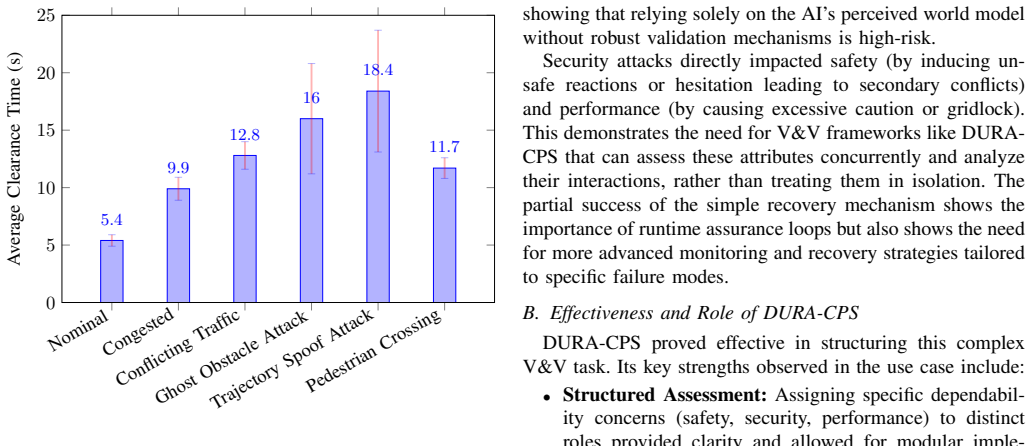
The paper's central claim is that a multi-role orchestration loop, rather than any single monitor or test, can serve as an in-the-loop verification and validation orchestrator for AI components in cyber-physical systems. DURA-CPS assigns each dependability concern to a dedicated role—Generator (the AI under test), SafetyMonitor, SecurityAssessor, FaultInjector, PerformanceOracle, RecoveryPlanner—and cycles them around a simulator through an Orchestration Controller and State Manager. In the case study, the loop produced concrete evidence: safety flags rose from 6.7% in nominal runs to 86.7% under ghost obstacles, trajectory spoofing caused gridlock in 20% of runs, and the emergency-brake recovery role prevented collisions in many flagged cases, with collision rates below monitor-activation rates. The paper argues this demonstrates the framework's ability to identify vulnerabilities, track security-to-safety and security-to-performance interactions, and evaluate recovery effectiveness within simulation.
Load-bearing premise
The paper's central effectiveness claim rests on the assumption that one simulated intersection, one LLM-based planner, and 15 runs per scenario are representative enough of real AI-powered cyber-physical systems.
Editorial extensions
If this is right
- A practitioner can wrap an opaque AI planner in the loop and automatically collect per-scenario safety, security, and performance metrics without building a bespoke test harness.
- Injected security attacks surface cross-cutting effects, such as spoofed sensor data triggering safety violations or gridlock, which isolated component-level tests would not reveal.
- The monitor-and-recovery cycle can reduce collision rates relative to raw monitor flags, suggesting that runtime assurance can compensate for AI weaknesses while the planner itself is improved.
- Because roles are pluggable, the same orchestration loop can be extended to formal monitors, different planners, or other CPS domains by swapping role implementations rather than redesigning the assurance process.
Reading between the lines
- A natural extension, listed as future work in the paper, is to generate the verification roles themselves from natural-language requirements using an LLM; if that works, the framework could turn a plain specification into a test campaign.
- The small per-scenario sample sizes (15 runs) mean the reported percentages are indicative rather than statistically certified; scaling to many runs or adding coverage arguments would be needed before these numbers could anchor a safety case.
- The observed coupling between spoofed trajectories and gridlock suggests the same loop could be used as a search procedure to find the minimal perturbation that causes a specified failure mode, a capability the paper does not claim.
Editorial analysis
A structured set of objections, weighed in public.
Referee Report
Summary. The paper presents DURA-CPS, a multi-role orchestration framework for verification and validation of AI-enabled cyber-physical systems, and demonstrates it on an autonomous-vehicle intersection navigation case study with an LLM-based planner. The framework assigns roles such as SafetyMonitor, SecurityAssessor, FaultInjector, PerformanceOracle, and RecoveryPlanner, and the authors report safety, security, performance, and recovery results from 90 simulation runs. The central claim is that DURA-CPS effectively detects vulnerabilities, manages performance impacts, and supports adaptive recovery strategies.
Significance. If the effectiveness claim were adequately supported, DURA-CPS would be a useful conceptual contribution: it provides a modular, role-based architecture that could help practitioners structure V&V for AI components in simulation. The paper clearly describes the architecture, the roles, and the orchestration loop, and the chosen case study is relevant. However, the evidence presented does not currently substantiate the main claim, because the experimental design does not isolate the orchestration layer from a simple rule-based safety envelope, and the statistical basis is very thin. The paper offers a promising framework, but the evaluation needs substantial strengthening before the central claims can be accepted.
major comments (4)
- [Section IV.B and Section V] The reported safety and recovery results are not attributable to the DURA-CPS multi-role orchestration. The SafetyMonitor is a hand-coded geometric checker, and the RecoveryPlanner uses the same geometric checks to override the Generator's action with 'emergency_brake' whenever an unsafe condition is flagged. With this configuration, the evaluated system is effectively a rule-based safety envelope wrapped around the LLM. Section V reports no baseline or ablation: there is no condition running the same scenarios without DURA-CPS, without the RecoveryPlanner, or with the roles invoked as plain functions. Consequently, the abstract's claim that DURA-CPS 'effectively detects vulnerabilities, manages performance impacts, and supports adaptive recovery strategies' is not supported by the experimental design, since the orchestration layer is exactly the part left untested.
- [Section IV.B.3] The SecurityAssessor role does not actually detect or assess security vulnerabilities; it only directs the FaultInjector to inject predesigned attacks. The paper's claim of 'detects vulnerabilities' therefore reduces to observing reactions to self-injected faults. There is no evaluation of whether the SecurityAssessor itself distinguishes attacks from benign variations, no false-positive/false-negative analysis, and no baseline detector. To support the security-resilience claim, the authors should either implement a genuine detection mechanism and evaluate its accuracy, or revise the claim to say that DURA-CPS enables systematic fault/attack injection and observation of the AUT's reactions.
- [Table II and Section V.D] The statistical evidence for the central effectiveness claim is too thin. Each scenario was run only 15 times, and results are reported as aggregate percentages without confidence intervals or significance tests. For example, a collision rate of 6.7% (1/15) is statistically indistinguishable from zero, and the overall 8.9% collision rate is based on only 8 collisions across 90 runs. Recovery effectiveness is judged by 'manual inspection of near-miss scenarios' (Section V.D) with no stated criteria, no blinding, and no inter-rater agreement measure. These weaknesses do not by themselves invalidate the framework, but they do not support the strong wording of the abstract. The authors should provide confidence intervals, report per-run data or effect sizes, and define the manual inspection protocol.
- [Section III and Section V] No code, configuration files, prompt templates, or simulator setup are provided, despite the paper describing DURA-CPS as a Python-based framework and presenting a quantitative case study. The fine-tuned Llama 3.2 11B model weights, the exact geometric thresholds, and the PerformanceOracle thresholds are also not specified. For a V&V framework whose contribution is structured assurance, the lack of reproducibility artifacts is a significant gap: an independent reader cannot re-run the experiments or verify the reported metrics. I recommend the authors release a public repository with the framework code, scenario configurations, and evaluation scripts.
minor comments (5)
- [Section II.F] The sentence 'The frameworks employs a multi-role architecture' contains a typo: 'frameworks' should be 'framework'.
- [Section IV.A.1] The abbreviation 'A V' appears with a space in several places; it should be 'AV' for consistency.
- [Figure 4] The caption states that error bars indicate standard deviation, but the figure as printed appears to be a plain bar chart; please ensure the error bars are visible in the final version.
- [Section V.C] The PerformanceOracle thresholds (jerk, acceleration, clearance time) are mentioned but not defined; please specify the numerical values used for flagging 'performance_fail' so that the results are interpretable.
- [Section VI.C] The limitations paragraph addresses sim-to-real and scalability, but does not mention the lack of a baseline or the attribution issue; adding those limitations would make the discussion more complete.
Circularity Check
No definitional or derivational circularity: the framework is demonstrated empirically; the only self-citation is minor and not load-bearing.
full rationale
DURA-CPS contains no derivation chain whose output is equivalent to its input. Section III describes an orchestration architecture, and Section V reports empirical observations from CARLA runs (monitor flag rates, collision counts, clearance times) rather than quantities forced by fitted parameters or by the framework's definitions. The SafetyMonitor and RecoveryPlanner both use geometric checks, and recovery success is assessed by manual inspection of near-miss scenarios, but that is a limitation in attribution and evidence strength, not circularity: no reported number is equal to its own input by construction. The only self-citation, Ref. [29] (LLMOrchestrator by two of the authors), appears in Related Work II.E as background and is not load-bearing. The paper's acknowledged limitations (Section VI.C: specification effort, sim-to-real gap, scalability) and the missing baseline/ablation are correctness and generalizability concerns, not circularity. Therefore the paper is self-contained in the sense required here, with a negligible self-citation that does not support any claim.
Assumptions & free parameters
free parameters (6)
- SafetyMonitor geometric safety distance threshold =
Not specified
- PerformanceOracle thresholds (jerk, acceleration, clearance time) =
Not specified
- Attack parameters (ghost obstacle placement, spoofed trajectory magnitude) =
Not specified
- RecoveryPlanner braking trigger and response parameters =
Not specified
- Fine-tuned Llama 3.2 11B weights and prompt templates =
Not released
- Number of runs per scenario =
15
assumptions (5)
- domain assumption CARLA simulation is an adequate stand-in for real-world CPS behavior
- domain assumption Geometric safety checks and CARLA collision logs are a sufficient safety specification
- domain assumption The LLM planner case is representative of AI components in CPS
- domain assumption The two injected attacks represent realistic security threats
- ad hoc to paper Manual near-miss inspection is reliable ground truth for recovery success
Cite this review
Pith. "Pith review of DURA-CPS: A Multi-Role Orchestrator for Dependability Assurance in LLM-Enabled Cyber-Physical Systems." pith.science (2026). https://pith.science/paper/WDQV7CB2
@misc{pith2026250606381,
  author       = {Pith},
  title        = {Pith review of: DURA-CPS: A Multi-Role Orchestrator for Dependability Assurance in LLM-Enabled Cyber-Physical Systems},
  year         = {2026},
  howpublished = {\url{https://pith.science/paper/WDQV7CB2}},
  note         = {Machine review of arXiv:2506.06381}
}
read the original abstract
Cyber-Physical Systems (CPS) increasingly depend on advanced AI techniques to operate in critical applications. However, traditional verification and validation methods often struggle to handle the unpredictable and dynamic nature of AI components. In this paper, we introduce DURA-CPS, a novel framework that employs multi-role orchestration to automate the iterative assurance process for AI-powered CPS. By assigning specialized roles (e.g., safety monitoring, security assessment, fault injection, and recovery planning) to dedicated agents within a simulated environment, DURA-CPS continuously evaluates and refines AI behavior against a range of dependability requirements. We demonstrate the framework through a case study involving an autonomous vehicle navigating an intersection with an AI-based planner. Our results show that DURA-CPS effectively detects vulnerabilities, manages performance impacts, and supports adaptive recovery strategies, thereby offering a structured and extensible solution for rigorous V&V in safety- and security-critical systems.
Figures


Figures from the paper (1 more)
Reference graph
Works this paper leans on
-
[1]
Comprehensive formal verification of an os micro- kernel,
G. Klein, J. Andronick, K. Elphinstone, T. Murray, T. Sewell, R. Kolan- ski, and G. Heiser, “Comprehensive formal verification of an os micro- kernel,” ACM Trans. Comput. Syst. , 2014
work page 2014
-
[2]
K. Lekadir, R. Osuala, C. Gallina, N. Lazrak, and K. e. a. Kushibara, “Future-ai: Guiding principles and consensus recommendations for trustworthy artificial intelligence in medical imaging,” arXiv preprint arXiv:2109.09658, 2024
arXiv 2024
-
[3]
Explaining and harnessing adversarial examples,
I. J. Goodfellow, J. Shlens, and C. Szegedy, “Explaining and harnessing adversarial examples,” arXiv preprint arXiv:1412.6572 , 2015
arXiv 2015
-
[4]
E. M. Clarke, O. Grumberg, and D. A. Peled, Model Checking. MIT Press, 1999
work page 1999
-
[5]
A new approach to creating clear safety arguments,
R. Hawkins, T. Kelly, J. Knight, and P. Graydon, “A new approach to creating clear safety arguments,” in Advances in Systems Safety , 2011
work page 2011
-
[6]
Principles of cyber-physical systems,
R. Alur, “Principles of cyber-physical systems,” MIT Press, 2015
work page 2015
-
[7]
C. Birchler, S. Khatiri, P. Rani, T. Kehrer, and S. Panichella, “A roadmap for simulation-based testing of autonomous cyber-physical systems: Challenges and future direction,” arXiv preprint, 2024
work page 2024
-
[8]
A brief account of runtime verification,
M. Leucker and C. Schallhart, “A brief account of runtime verification,” Journal of Logic and Algebraic Programming , 2009
work page 2009
Show all 35 references
-
[9]
A survey of challenges for runtime verification from advanced application domains (beyond software),
C. Sanchez and G. e. a. Schneider, “A survey of challenges for runtime verification from advanced application domains (beyond software),” Formal Methods in System Design , 2019
2019
-
[10]
Fault injection techniques and tools,
M.-C. Hsueh, T. K. Tsai, and R. K. Iyer, “Fault injection techniques and tools,” Computer, 1997
1997
-
[11]
Towards evaluating the robustness of neural networks,
N. Carlini and D. Wagner, “Towards evaluating the robustness of neural networks,” in IEEE Symposium on Security and Privacy (SP) , 2017
2017
-
[12]
Adversarial robustness toolbox v1.0.0,
M.-I. Nicolae, M. Sinn, M. N. Tran, A. Rawat, M. Wistuba, and V . e. a. Zittel, “Adversarial robustness toolbox v1.0.0,” arXiv preprint arXiv:1807.01069, 2018
2018 arXiv
-
[13]
Reluplex: An efficient smt solver for verifying deep neural networks,
G. Katz, C. Barrett, D. L. Dill, K. Julian, and M. J. Kochenderfer, “Reluplex: An efficient smt solver for verifying deep neural networks,” in Computer Aided Verification, 2017
2017
-
[14]
AI 2: Safety and robustness certification of neural networks with abstract interpretation,
T. Gehr, M. Mirman, D. Drachsler-Cohen, P. Tsankov, S. Chaudhuri, and M. Vechev, “AI 2: Safety and robustness certification of neural networks with abstract interpretation,” in IEEE Symposium on Security and Privacy (SP) , 2018
2018
-
[15]
"why should i trust you?
M. T. Ribeiro, S. Singh, and C. Guestrin, “"why should i trust you?": Explaining the predictions of any classifier,” in ACM SIGKDD Interna- tional Conference on Knowledge Discovery and Data Mining , 2016
2016
-
[16]
A unified approach to interpreting model predictions,
S. M. Lundberg and S.-I. Lee, “A unified approach to interpreting model predictions,” in Neural Information Processing Systems 30 , 2017
2017
-
[17]
A survey on bias and fairness in machine learning,
N. Mehrabi, F. Morstatter, N. Saxena, K. Lerman, and A. Galstyan, “A survey on bias and fairness in machine learning,” ACM Computing Surveys (CSUR), 2021
2021
-
[18]
Simulation-based testing of subsystems for autonomous vehicles at the example of an active suspension control system,
V . Landersheim, M. Jurisch, R. Bartolozzi, G. Stoll, R. Möller, and H. Dann, “Simulation-based testing of subsystems for autonomous vehicles at the example of an active suspension control system,” 2022
2022
-
[19]
Ambiegen: A search- based framework for autonomous systems testing,
D. Humeniuk, F. Khomh, and G. Antoniol, “Ambiegen: A search- based framework for autonomous systems testing,” in arXiv preprint arXiv:2301.01234, 2023
2023 arXiv
-
[20]
A taxonomy of systemic risks from general-purpose AI,
R. Uuk, C. I. Gutierrez, D. Guppy, L. Lauwaert, A. Kasirzadeh, and L. e. a. Velasco, “A taxonomy of systemic risks from general-purpose AI,” 2024, arXiv preprint
2024
-
[21]
The black-box simplex architecture for runtime assurance of multi- agent cps,
S. Sheikhi, U. Mehmood, S. Bak, S. A. Smolka, and S. D. Stoller, “The black-box simplex architecture for runtime assurance of multi- agent cps,” Innovations in Systems and Software Engineering , 2024
2024
-
[22]
Monitor-based runtime assurance for temporal logic specifications,
M. Abate, E. Feron, and S. Coogan, “Monitor-based runtime assurance for temporal logic specifications,” arXiv preprint, 2019
2019
-
[23]
Monitoring temporal properties of contin- uous signals,
O. Maler and D. Nickovic, “Monitoring temporal properties of contin- uous signals,” in Formal Techniques, Modeling and Analysis of Timed and Fault-Tolerant Systems, 2004
2004
-
[24]
Breach, a toolbox for verification and parameter synthesis of hybrid systems,
A. Donzé, “Breach, a toolbox for verification and parameter synthesis of hybrid systems,” in Computer Aided Verification, 2010
2010
-
[25]
Cyber-physical system model based on multi-agent system,
M. Ahmed, O. Kazar, A. Ratnayake, and S. Harous, “Cyber-physical system model based on multi-agent system,” IET Cyber-Physical Sys- tems: Theory & Applications , 2024
2024
-
[26]
Langchain,
H. Chase, “Langchain,” 2022, gitHub repository
2022
-
[27]
Llamaindex (gpt index),
J. Liu, “Llamaindex (gpt index),” 2022, gitHub repository
2022
-
[28]
Autogen: Enabling next-gen llm applications via multi-agent conversation frame- work,
Q. Wu, G. Bansal, J. Zhang, Y . Wu, S. Li, and E. e. a. Zhu, “Autogen: Enabling next-gen llm applications via multi-agent conversation frame- work,” arXiv preprint arXiv:2308.08155 , 2023
2023 arXiv
-
[29]
Llmorchestrator: A multi-model llm orchestration framework for reducing bias and iterative reasoning,
T. Srinivasan and S. Patapati, “Llmorchestrator: A multi-model llm orchestration framework for reducing bias and iterative reasoning,” 2025
2025
-
[30]
Rtamt: Online robustness monitors from signal temporal logic,
D. Nickovic, A. Pant, and G. Schneider, “Rtamt: Online robustness monitors from signal temporal logic,” in Runtime Verification, 2016
2016
-
[31]
Carla: An open urban driving simulator,
A. Dosovitskiy, G. Ros, F. Codevilla, A. Lopez, and V . Koltun, “Carla: An open urban driving simulator,” in Proceedings of the 1st Annual Conference on Robot Learning , 2017
2017
-
[32]
Airsim: High-fidelity visual and physical simulation for autonomous vehicles,
S. Shah and Dey, “Airsim: High-fidelity visual and physical simulation for autonomous vehicles,” in Field and Service Robotics , 2017
2017
-
[33]
Design and use paradigms for gazebo, an open-source multi-robot simulator,
N. Koenig and A. Howard, “Design and use paradigms for gazebo, an open-source multi-robot simulator,” in IEEE/RSJ Int. Conf. on Intelligent Robots and Systems (IROS) , 2004
2004
-
[34]
The llama 3 herd of models,
A. Grattafiori, A. Dubey, A. Jauhri, and A. e. a. Pandey, “The llama 3 herd of models,” 2024, arXiv preprint
2024
-
[35]
Dialogue-based generation of self- driving simulation scenarios using large language models,
X. Li, A. Kumar, and S. et al., “Dialogue-based generation of self- driving simulation scenarios using large language models,” 2023, arXiv preprint
2023
Reviewed August 7, 2026 · model on record in the stance chip above.
Discussion (0). Sign in to comment.