REVIEW 4 major objections 5 minor 86 references
Light-Matter Entanglement in Real-Time Nuclear-Electronic Orbital Polariton Dynamics
T0 review · 4 major / 5 minor · reviewed 2026-08-07 · deepseek-v4-flash
Pith's one-line read A hierarchy of real-time first-principles simulations shows that classically treated cavity modes reproduce full-quantum polariton spectra, while the full-quantum entropy reveals a distinct entanglement Rabi splitting about twice the…
desk verdict A credible set of real-time polariton methods, but the headline 'entanglement Rabi splitting' is likely reading too much into the one-particle Kohn-Sham entropy. read the letter →
The pith
A machine-rendered reading of the paper's core claim, the machinery that carries it, and where it could break.
The reading
What carries the argument
The machinery that carries the argument is the joint molecule-mode density matrix $P_{Fe(n)}(t)$, propagated under the long-wavelength QED Hamiltonian by a von Neumann equation, with the coupling written as a Kronecker-product term $\epsilon\, q \otimes (\mu - \mu_0)$. Tracing out the field yields the molecular subsystem density matrix $P_{e(n)}(t)$, and its von Neumann entropy $S(t) = -\mathrm{Tr}(P \ln P)$, computed with a four-function harmonic-oscillator basis for the mode, is the entanglement measure. Fourier analysis of $S(t)$ produces the entanglement Rabi splitting $\Omega_E$, and the spectral decomposition of $P_e(t)$ into time-dependent natural orbitals with occupation probabilities separates the $\Omega_R$-dominated state from the $\Omega_E$-dominated state. The semiclassical and mean-field-quantum methods are obtained from the same equations by replacing the mode operators with classical coordinates or by imposing a separable ansatz, which is why they reproduce the same spectra while lacking entanglement.
What would settle it
Run the same fq-RT-TDDFT calculation for H2 with a full configuration-interaction treatment of the two electrons coupled to the cavity mode in the same initial coherent state, and compare the exact bipartite von Neumann entropy with the Kohn-Sham-based one. If the exact $S(t)$ lacks the doublet separated by about 0.46 eV around 29.4 eV, the reported $\Omega_E$ is a property of the one-electron Kohn-Sham density matrix rather than of light-matter entanglement, and the paper's headline new observable would not be physical.
Extended reading notes
Core claim
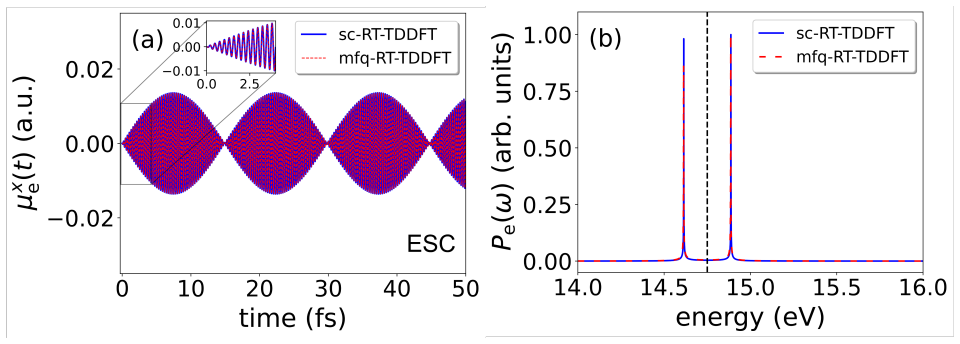
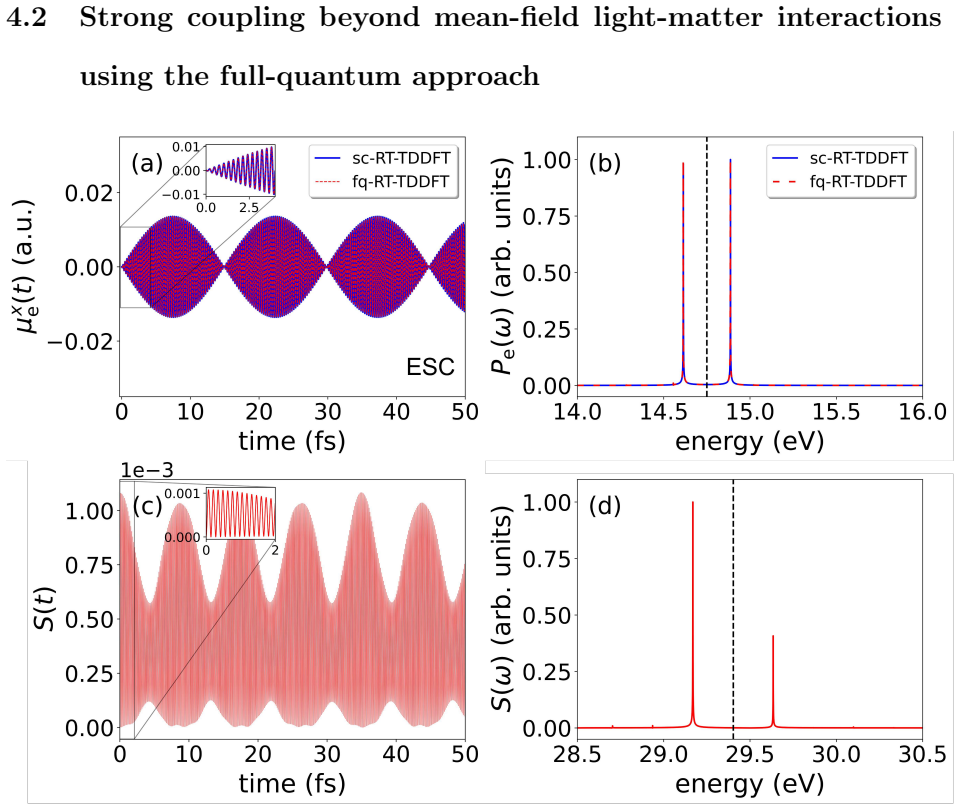
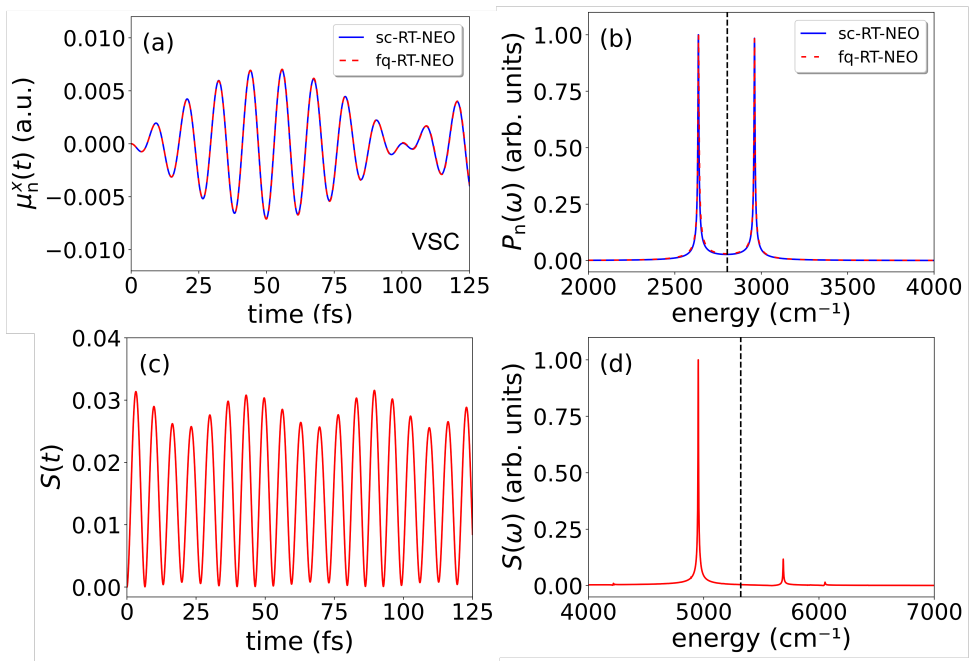
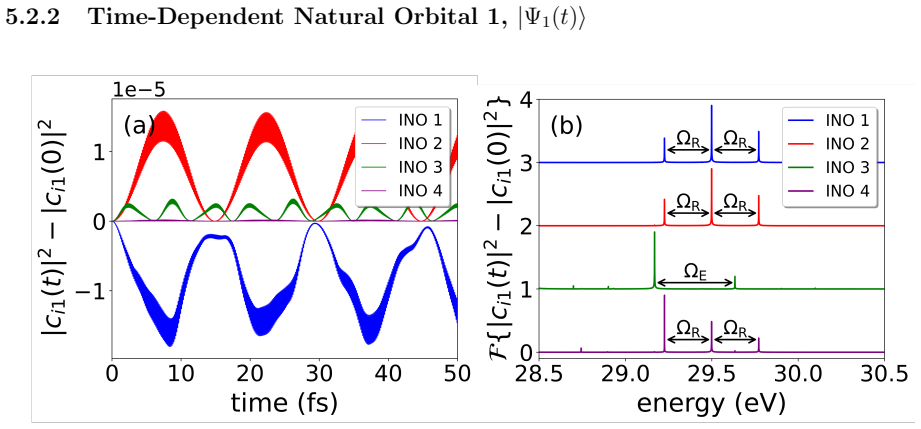
On the systems studied—H2 under electronic strong coupling and HCN under vibrational strong coupling—the central discovery is that molecule-cavity entanglement, measured by the von Neumann entropy $S(t)$ of the reduced molecular density matrix, oscillates at a frequency set by a splitting $\Omega_E$ that differs from the Rabi splitting $\Omega_R$ extracted from the time-dependent dipole moment. For H2, $\Omega_R = 0.27$ eV while $\Omega_E = 0.46$ eV; for HCN, $\Omega_R = 325\ \mathrm{cm}^{-1}$ while $\Omega_E = 735\ \mathrm{cm}^{-1}$. The full-quantum calculations also show the entanglement to be small: $S(t)$ reaches about $1.1 \times 10^{-3}$ for H2 and only about 2% of the theoretical maximum $\ln(4)$ for HCN. A time-dependent natural-orbital analysis shows why the two splittings coexist: the reduced electronic density matrix is an ensemble dominated by two pure states, the first resembling the semiclassical pure state and carrying $\Omega_R$, the second making a smaller contribution and carrying $\Omega_E$. The paper concludes that strong coupling can be characterized by both splittings, with $\Omega_E$ accessible only when the cavity mode is treated quantum mechanically.
Load-bearing premise
The load-bearing premise is that the von Neumann entropy of the molecule's reduced density matrix, obtained by tracing out the cavity, really measures light-matter entanglement; the calculation actually traces in the one-electron Kohn-Sham (or nuclear-electronic orbital) auxiliary space, which is not generally the true N-particle reduced density matrix.
Editorial extensions
If this is right
- Semiclassical and mean-field cavity treatments can be used in place of full-quantum propagation for computing linear-response polariton spectra and Rabi splittings in these strong-coupling regimes.
- Full-quantum propagation is required to access the entanglement Rabi splitting $\Omega_E$, so any simulation aiming at entanglement-related signatures must go beyond classical or mean-field cavity descriptions.
- In the systems studied, molecule-cavity entanglement is small relative to its theoretical maximum, so entanglement corrections to macroscopic spectral observables are expected to be small.
- The electronic Born-Oppenheimer variants reproduce the full results at much lower cost, making the fq-BO-RT-NEO option practical for vibrational strong coupling.
- The near-$2\omega_c$ fast frequency $\omega_N$ appears in both systems, indicating that the entropy dynamics carries a second frequency scale beyond the polariton splitting.
Reading between the lines
- A natural extension is to test whether $\Omega_E$ survives when the entanglement is computed from the exact two-electron reduced density matrix rather than the one-electron Kohn-Sham density matrix; if it does not, the splitting is an artifact of the auxiliary representation.
- If $\Omega_E$ is a genuine bipartite feature, it should appear in simpler Jaynes-Cummings-type models with the same initial coherent state, and quantitative deviations of $\Omega_E/\Omega_R$ from 2 would then map the multilevel anharmonicity of the first-principles system.
- Time-resolved entanglement witnesses or nonlinear optical probes might be designed to detect $\Omega_E$ experimentally; the paper leaves the observability question open.
- The methods are demonstrated for two paired electrons and one quantum proton; generalizing to more electrons and multiple quantum nuclei could show where the $\Omega_E$ signature strengthens or disappears.
Editorial analysis
A structured set of objections, weighed in public.
Referee Report
Summary. The paper introduces a hierarchy of real-time first-principles methods for simulating molecular polaritons under strong coupling, ranging from semiclassical (sc-RT-TDDFT, sc-RT-NEO) through mean-field-quantum (mfq-) to full-quantum (fq-) treatments in which a joint molecule-mode density matrix is propagated. For H2 under electronic strong coupling and HCN under vibrational strong coupling, the semiclassical and full-quantum methods give nearly identical dipole dynamics and Rabi splittings. The novel claim is that the full-quantum methods allow the computation of a von Neumann entropy S(t) from the molecular subsystem density matrix, whose Fourier transform shows an 'entanglement Rabi splitting' Ω_E that differs from the conventional Rabi splitting Ω_R. The paper also presents a natural-orbital analysis of the reduced electronic density matrix in the ESC case to trace the origins of the two splittings.
Significance. If substantiated, the claim that a classical treatment of the cavity mode is sufficient for macroscopic polariton observables while full-quantum dynamics reveals a distinct entanglement-related splitting would be of interest to the polariton chemistry and cavity QED communities. The numerical implementation is substantial: three levels of theory are consistently derived and cross-compared, the equations of motion are internally consistent, and the code is real (developer Q-Chem) with representative inputs provided. The paper is also honest about the small magnitude of the entropy and about the limited scope (two paired electrons or one quantum proton). The central weakness is interpretive: the quantity whose spectrum yields Ω_E is the von Neumann entropy of the one-particle Kohn-Sham density matrix, and the manuscript does not establish that this equals the physically meaningful bipartite entanglement entropy between the molecular and field subsystems. This concern is load-bearing because the abstract and conclusions explicitly frame Ω_E as a signature of molecule-mode quantum entanglement.
major comments (4)
- [Section 2.3, Eq. (16); Section 4.2, Figs. 4c–4d and 5c–5d] The manuscript computes S(t) = −Tr[Pe(t) ln Pe(t)] from the one-particle Kohn–Sham density matrix Pe(t) = Tr_F[PFe(t)], and identifies this as the entanglement entropy between the molecule and the cavity mode. For the two-electron restricted Kohn–Sham system, Pe(t) is a one-particle operator in an auxiliary noninteracting Hilbert space, not the N-electron reduced density matrix obtained by tracing the true molecular wavefunction over the field. The eigenvalues of Pe(t) are not Schmidt coefficients of the physical molecule–mode state, and the equality S(Pe) = S(PF) stated in Section 2.3 does not by itself establish that S(Pe) quantifies physical light–matter entanglement. The central claim of an 'entanglement Rabi splitting' therefore needs either a derivation connecting the eigenvalues of Pe(t) to the bipartite entanglement of the physical state, or a direct benchmark against an exact diagonalization for a small system such as H2 in a minimal basis. Without such a test, Ω_E should be presented as a property of the one-particle KS entropy, not of physical entanglement.
- [Section 4.2 and Table S1] The text states that Ω_E is 'roughly twice' Ω_R and offers a Bloch-sphere argument in which entanglement is maximized twice per Rabi precession. This factor-of-two relation is not supported by the authors' own data: Table S1 reports Ω_E/Ω_R = 3.4, 2.1, 1.7, and 1.5 for coupling strengths 0.001, 0.002, 0.004, and 0.008 a.u., respectively. The ratio is not close to 2 except at one intermediate coupling, and it decreases monotonically with coupling. Since the factor-of-two statement is used to motivate the physical interpretation of Ω_E, the manuscript should either derive the expected ratio from a concrete model, report the coupling dependence explicitly in the main text, and explain the trend, or drop the factor-of-two claim and the Bloch-sphere explanation as unsupported.
- [Section 5, Figs. 6–9] The natural-orbital decomposition in Section 5 provides additional detail about the one-particle KS density matrix but does not resolve the entanglement issue raised above. Equation (36) is a spectral decomposition of Pe(t), and the statement that it 'describes a statistical ensemble' of TDNOs is an interpretation of the one-particle KS density matrix; it does not imply that the physical two-electron state is a mixture of the corresponding Slater determinants with weights Λ_i(t). The TDNO analysis therefore cannot by itself validate the identification of S(t) with molecule–mode entanglement. If the authors wish to retain the entanglement interpretation, they need to compare S(t) with an independent measure obtained from the full N-electron state (e.g., from an exact or configuration-interaction wavefunction for H2 in the same basis).
- [Section 2.2, Eqs. (10)–(13); SI Section 2] The VSC results rely on the assumption that the cavity mode couples directly only to the quantum nuclear dipole moment, with the electronic coupling entering only through the NEO Kohn–Sham matrices. The SI total-coupling mfq-RT-NEO test shows that including direct electronic coupling changes Ω_R from 325 cm⁻¹ to 118 cm⁻¹, a large effect. Because the full-quantum VSC value of Ω_E and its factor relative to Ω_R are central to the paper's message, the robustness of the fq results to this modeling assumption should be checked at the same fq level, or the limitations of the mfq-only test should be explicitly acknowledged in the main text.
minor comments (5)
- [Figure 4 caption] The caption says 'with the same settings used as in Fig. 3a', but Fig. 3 is the HCN VSC calculation; the ESC H2 comparison should refer to Fig. 2a.
- [Figure 8 caption] The caption reads 'Fourier transforms of the coefficients in panel b', but the time-domain coefficients are shown in panel (a); this should be corrected to panel (a).
- [Section 5.2.1, Fig. 7] The sentence 'Due to the weak amplitudes of TDOPs 3 and 4, only the Fourier transforms of the TDOPs 1 and 2 are shown' is incomplete; it should explain where the remaining TDOP spectra are or state that they are omitted from the figure.
- [Section 2.2, Eq. (14)] The notation Pe(n)(t) is used for both the electronic (ESC) and quantum nuclear (VSC) subsystem density matrices; defining separate symbols or a subscript convention would improve readability.
- [Section 4.2, Fig. 4d and Fig. 5d] The vertical dashed line ωN is described as the frequency of the fast oscillations, but the text should define precisely how ωN is obtained from the two peaks (e.g., as their mean) in the figure captions as well as in the main text.
Circularity Check
No circular derivation: the entanglement Rabi splitting is an emergent spectral feature of the propagated joint density matrix, not a fitted parameter or a self-citation artifact.
full rationale
The paper's central quantities are outputs of a self-contained propagation of the QED Hamiltonian (Eqs. 6-13), with no fitting of the target splittings. The Rabi splitting Ω_R is read from the Fourier transform of the time-dependent dipole moment, and the entanglement Rabi splitting Ω_E is read from the Fourier transform of S(t) = -Tr(P_e ln P_e) with P_e = Tr_F P_Fe (Eqs. 14 and 16). Both splittings are computed from the same first-principles dynamics rather than being imposed by construction; Table S1 even shows that Ω_E/Ω_R varies with coupling strength, which would not happen if Ω_E were defined to equal 2Ω_R. The paper does cite the authors' prior RT-NEO and sc-RT-NEO work, but those citations supply the propagation framework, not the new full-quantum entanglement analysis; the joint density-matrix propagation and entropy decomposition are implemented and analyzed here. The main caveat is interpretive rather than circular: S(t) is computed from a one-electron Kohn-Sham density matrix, so identifying it with the true N-electron/mode entanglement entropy is not automatic. That is a physical validity and benchmarking question, not a reduction of the result to its inputs, because the numerical value of Ω_E does not depend on the label assigned to it. The paper also explicitly defers the physical origin of Ω_E to future work and states the two-electron/one-proton applicability limits, which are acknowledged scope limitations rather than hidden circular reductions.
Assumptions & free parameters
free parameters (6)
- Cavity mode frequency (ESC) =
14.750 eV
- Cavity mode frequency (VSC) =
2803 cm^-1
- Light-matter coupling strength (ESC) =
0.004 a.u.
- Light-matter coupling strength (VSC) =
8e-4 a.u.
- Delta pulse amplitude E0 =
0.01 a.u. (ESC), 0.3 a.u. (VSC)
- Damping factor gamma in Pade transform =
1e-5 a.u. (1e-6 for linear response spectra)
assumptions (6)
- domain assumption Long-wavelength approximation and neglect of the dipole self-energy (quadratic in mu) in the QED Hamiltonian
- domain assumption RT-TDDFT approximation with B3LYP exchange-correlation functional and adiabatic approximation
- domain assumption NEO treatment of the proton with epc17-2 electron-proton correlation functional
- ad hoc to paper Under VSC, the cavity mode couples only to the quantum nuclear dipole moment, not the electronic dipole moment
- domain assumption The joint molecule-mode density matrix evolves unitarily under a von Neumann equation with a time-dependent mean-field Kohn-Sham Hamiltonian
- domain assumption Initial state is a coherent state for the mode and the ground-state determinant for the molecule
Cite this review
Pith. "Pith review of Light-Matter Entanglement in Real-Time Nuclear-Electronic Orbital Polariton Dynamics." pith.science (2026). https://pith.science/paper/EQUKSLDH
@misc{pith2026250606490,
  author       = {Pith},
  title        = {Pith review of: Light-Matter Entanglement in Real-Time Nuclear-Electronic Orbital Polariton Dynamics},
  year         = {2026},
  howpublished = {\url{https://pith.science/paper/EQUKSLDH}},
  note         = {Machine review of arXiv:2506.06490}
}
read the original abstract
Molecular polaritons are hybrid light-matter states that enable the exploration of potential cavity-modified chemistry. The development of dynamical, first-principles approaches for simulating molecular polaritons is important for understanding their origins and properties. Herein, we present a hierarchy of first-principles methods to simulate the real-time dynamics of molecular polaritons in the strong coupling regime. These methods are based on real-time time-dependent density functional theory (RT-TDDFT) and the corresponding real-time nuclear-electronic orbital (RT-NEO) approach, in which specified nuclei are treated quantum mechanically on the same level as the electrons. The hierarchy spans semiclassical, mean-field-quantum, and full-quantum approaches to simulate polariton dynamics under both electronic strong coupling and vibrational strong coupling. In the semiclassical approaches, the cavity mode is treated classically, whereas in the full-quantum approaches, the cavity mode is treated quantum mechanically with propagation of a joint molecule-mode density matrix. The semiclassical and full-quantum approaches produce virtually identical Rabi splittings and polariton peak locations for the systems studied. However, the full-quantum approaches allow exploration of molecule-mode quantum entanglement in the real-time dynamics. Although the degree of light-matter entanglement is relatively small in the systems considered, the oscillations of the von Neumann entropy reveal an entanglement Rabi splitting that differs from the Rabi splitting computed from the time-dependent dipole moment. These results suggest that a classical treatment of the cavity mode may provide an excellent description of polariton dynamics for macroscopic observables such as the Rabi splitting, but novel physics may be detectable by considering molecule-mode entanglement.
Figures


Figures from the paper (6 more)



Reference graph
Works this paper leans on
-
[1]
A.; Weight, B
Mandal, A.; Taylor, M. A.; Weight, B. M.; Koessler, E. R.; Li, X.; Huo, P. Theoretical Advances in Polariton Chemistry and Molecular Cavity Quantum Electrodynamics . Chem. Rev. 2023, 123, 9786--9879
2023
-
[2]
Molecular Vibrational Polariton Dynamics : What Can Polaritons Do ? Acc
Xiong, W. Molecular Vibrational Polariton Dynamics : What Can Polaritons Do ? Acc. Chem. Res. 2023, 56, 776--786
2023
-
[3]
Exciton-Polariton Bose - Einstein Condensation
Deng, H.; Haug, H.; Yamamoto, Y. Exciton-Polariton Bose - Einstein Condensation. Rev. Mod. Phys. 2010, 82, 1489--1537
2010
-
[4]
Bose– Einstein Condensation of Exciton - Polaritons in Organic Microcavities
Keeling, J.; Kéna-Cohen, S. Bose– Einstein Condensation of Exciton - Polaritons in Organic Microcavities . Annu. Rev. Phys. Chem. 2020, 71, 435--459
2020
-
[5]
P.; Simpkins, B
Long, J. P.; Simpkins, B. S. Coherent Coupling between a Molecular Vibration and Fabry – Perot Optical Cavity to Give Hybridized States in the Strong Coupling Limit . ACS Photonics 2015, 2, 130--136
2015
-
[6]
A.; Genet, C.; Ebbesen, T
George, J.; Shalabney, A.; Hutchison, J. A.; Genet, C.; Ebbesen, T. W. Liquid- Phase Vibrational Strong Coupling . J. Phys. Chem. Lett. 2015, 6, 1027--1031
2015
-
[7]
Wright, A. D.; Nelson, J. C.; Weichman, M. L. Rovibrational Polaritons in Gas - Phase Methane . J. Am. Chem. Soc. 2023, 145, 5982--5987
work page 2023
-
[8]
Molecular Polaritons for Chemistry , Photonics and Quantum Technologies
Xiang, B.; Xiong, W. Molecular Polaritons for Chemistry , Photonics and Quantum Technologies . Chem. Rev. 2024, 124, 2512--2552
work page 2024
Show all 86 references
-
[9]
D.; Leng, H
Pelton, M.; Storm, S. D.; Leng, H. Strong Coupling of Emitters to Single Plasmonic Nanoparticles: Exciton-Induced Transparency and Rabi Splitting. Nanoscale 2019, 11, 14540--14552
2019
-
[10]
F.; Recabal, F.; Herrera, F.; Simpkins, B
Ahn, W.; Triana, J. F.; Recabal, F.; Herrera, F.; Simpkins, B. S. Modification of Ground-State Chemical Reactivity via Light–Matter Coherence in Infrared Cavities. Science 2023, 380, 1165--1168
2023
-
[11]
J.; Moran, J.; Chervy, T.; Zhong, X.; Devaux, E.; Genet, C.; Hutchison, J
Thomas, A.; George, J.; Shalabney, A.; Dryzhakov, M.; Varma, S. J.; Moran, J.; Chervy, T.; Zhong, X.; Devaux, E.; Genet, C.; Hutchison, J. A.; Ebbesen, T. W. Ground‐ State Chemical Reactivity under Vibrational Coupling to the Vacuum Electromagnetic Field . Angew. Chem. Int. Ed...
2016
-
[12]
W.; George, J
Lather, J.; Bhatt, P.; Thomas, A.; Ebbesen, T. W.; George, J. Cavity Catalysis by Cooperative Vibrational Strong Coupling of Reactant and Solvent Molecules . Angew. Chem. Int. Ed. 2019, 58, 10635--10638
2019
-
[13]
A.; Ebbesen, T
Zhong, X.; Chervy, T.; Zhang, L.; Thomas, A.; George, J.; Genet, C.; Hutchison, J. A.; Ebbesen, T. W. Energy Transfer between Spatially Separated Entangled Molecules . Angew. Chem. Int. Ed. 2017, 56, 9034--9038
2017
-
[14]
F.; Du, M.; Chen, L.; Yang, Z.; Wang, J.; Yuen-Zhou, J.; Xiong, W
Xiang, B.; Ribeiro, R. F.; Du, M.; Chen, L.; Yang, Z.; Wang, J.; Yuen-Zhou, J.; Xiong, W. Intermolecular Vibrational Energy Transfer Enabled by Microcavity Strong Light–Matter Coupling. Science 2020, 368, 665--667
2020
-
[15]
J.; Ciuti, C.; Ebbesen, T
Garcia-Vidal, F. J.; Ciuti, C.; Ebbesen, T. W. Manipulating Matter by Strong Coupling to Vacuum Fields. Science 2021, 373, 178
2021
-
[16]
Georgiou, K.; Jayaprakash, R.; Othonos, A.; Lidzey, D. G. Ultralong‐ Range Polariton ‐ Assisted Energy Transfer in Organic Microcavities . Angew. Chem. Int. Ed. 2021, 60, 16661--16667
2021
-
[17]
Kertzscher, C.; Mauch, M.; Keck, J.; Meixner, A. J. A Tunable Fabry - Pérot Microcavity Enables Systematic Investigation of Strong Light-Matter Coupling and Energy Transfer at Distances of Several m. 2024 24th International Conference on Transparent Optical Networks ( ICTON )....
2024
-
[18]
G.; Bradley, D
Lidzey, D. G.; Bradley, D. D. C.; Skolnick, M. S.; Virgili, T.; Walker, S.; Whittaker, D. M. Strong Exciton–Photon Coupling in an Organic Semiconductor Microcavity. Nature 1998, 395, 53--55
1998
-
[19]
Feist, J.; Garcia-Vidal, F. J. Extraordinary Exciton Conductance Induced by Strong Coupling . Phys. Rev. Lett. 2015, 114, 196402
2015
-
[20]
Cavity- Enhanced Transport of Excitons
Schachenmayer, J.; Genes, C.; Tignone, E.; Pupillo, G. Cavity- Enhanced Transport of Excitons . Phys. Rev. Lett. 2015, 114, 196403
2015
-
[21]
M.; Somaschi, N.; Michetti, P.; Clark, C.; Lagoudakis, P
Coles, D. M.; Somaschi, N.; Michetti, P.; Clark, C.; Lagoudakis, P. G.; Savvidis, P. G.; Lidzey, D. G. Polariton-Mediated Energy Transfer Between Organic Dyes in a Strongly Coupled Optical Microcavity. Nat. Mater. 2014, 13, 712--719
2014
-
[22]
Kasprzak, J.; Richard, M.; Kundermann, S.; Baas, A.; Jeambrun, P.; Keeling, J. M. J.; Marchetti, F. M.; Szymańska, M. H.; André, R.; Staehli, J. L.; Savona, V.; Littlewood, P. B.; Deveaud, B.; Dang, L. S. Bose– Einstein Condensation of Exciton Polaritons. Nature 2006, 443, 409--414
2006
-
[23]
Thomas, A.; Lethuillier-Karl, L.; Nagarajan, K.; Vergauwe, R. M. A.; George, J.; Chervy, T.; Shalabney, A.; Devaux, E.; Genet, C.; Moran, J.; Ebbesen, T. W. Tilting a Ground-State Reactivity Landscape by Vibrational Strong Coupling. Science 2019, 363, 615--619
2019
-
[24]
Comparison of Quantum and Semiclassical Radiation Theories with Application to the Beam Maser
Jaynes, E.; Cummings, F. Comparison of Quantum and Semiclassical Radiation Theories with Application to the Beam Maser. IEEE Proc. 1963, 51, 89--109
1963
-
[25]
Tavis, M.; Cummings, F. W. Exact Solution for an N - Molecule — Radiation - Field Hamiltonian . Phys. Rev. 1968, 170, 379--384
1968
-
[26]
Tavis, M.; Cummings, F. W. Approximate Solutions for an N - Molecule - Radiation - Field Hamiltonian . Phys. Rev. 1969, 188, 692--695
1969
-
[27]
F.; Hernández, F
Triana, J. F.; Hernández, F. J.; Herrera, F. The Shape of the Electric Dipole Function Determines the Sub-Picosecond Dynamics of Anharmonic Vibrational Polaritons. J. Chem. Phys. 2020, 152, 234111
2020
-
[28]
M.; Lacombe, L.; Rubio, A.; Maitra, N
Hoffmann, N. M.; Lacombe, L.; Rubio, A.; Maitra, N. T. Effect of Many Modes on Self-Polarization and Photochemical Suppression in Cavities. J. Chem. Phys. 2020, 153, 104103
2020
-
[29]
H.; Feist, J.; Groenhof, G
Tichauer, R. H.; Feist, J.; Groenhof, G. Multi-Scale Dynamics Simulations of Molecular Polaritons: The Effect of Multiple Cavity Modes on Polariton Relaxation. J. Chem. Phys. 2021, 154, 104112
2021
-
[30]
L.; Feist, J.; Toppari, J
Luk, H. L.; Feist, J.; Toppari, J. J.; Groenhof, G. Multiscale Molecular Dynamics Simulations of Polaritonic Chemistry . J. Chem. Theory Comput. 2017, 13, 4324--4335
2017
-
[31]
Ab initio Nonrelativistic Quantum Electrodynamics: Bridging Quantum Chemistry and Quantum Optics from Weak to Strong Coupling
Schäfer, C.; Ruggenthaler, M.; Rubio, A. Ab initio Nonrelativistic Quantum Electrodynamics: Bridging Quantum Chemistry and Quantum Optics from Weak to Strong Coupling. Phys. Rev. A 2018, 98, 043801
2018
-
[32]
E., III Cavity-Modulated Ionization Potentials and Electron Affinities from Quantum Electrodynamics Coupled-Cluster Theory
DePrince, A. E., III Cavity-Modulated Ionization Potentials and Electron Affinities from Quantum Electrodynamics Coupled-Cluster Theory. J. Chem. Phys. 2021, 154, 094112
2021
-
[33]
D.; DePrince, A
Mallory, J. D.; DePrince, A. E. Reduced-Density-Matrix-Based Ab initio Cavity Quantum Electrodynamics. Phys. Rev. A 2022, 106, 053710
2022
-
[34]
P.; Panyala, A.; Mutlu, E.; Govind, N.; Foley, J
Vu, N.; Mejia-Rodriguez, D.; Bauman, N. P.; Panyala, A.; Mutlu, E.; Govind, N.; Foley, J. J. I. Cavity Quantum Electrodynamics Complete Active Space Configuration Interaction Theory . J. Chem. Theory Comput. 2024, 20, 1214--1227
2024
-
[35]
R.; Castagnola, M.; Ronca, E.; Koch, H
El Moutaoukal, Y.; Riso, R. R.; Castagnola, M.; Ronca, E.; Koch, H. Strong Coupling Møller – Plesset Perturbation Theory . J. Chem. Theory Comput. 2025, 21, 3981--3992
2025
-
[36]
Perturbation Theoretical Approaches to Strong Light–Matter Coupling in Ground and Excited Electronic States for the Description of Molecular Polaritons
Bauer, M.; Dreuw, A. Perturbation Theoretical Approaches to Strong Light–Matter Coupling in Ground and Excited Electronic States for the Description of Molecular Polaritons. J. Chem. Phys. 2023, 158, 124128
2023
-
[37]
McTague, J.; Foley, J. J. Non- Hermitian Cavity Quantum Electrodynamics–Configuration Interaction Singles Approach for Polaritonic Structure with Ab initio Molecular Hamiltonians . J. Chem. Phys. 2022, 156, 154103
2022
-
[38]
Wavefunction Embedding for Molecular Polaritons
Pavošević, F.; Rubio, A. Wavefunction Embedding for Molecular Polaritons. J. Chem. Phys. 2022, 157, 094101
2022
-
[39]
Cui, Z.-H.; Mandal, A.; Reichman, D. R. Variational Lang – Firsov Approach Plus Møller – Plesset Perturbation Theory with Applications to Ab Initio Polariton Chemistry . J. Chem. Theory Comput. 2024, 20, 1143--1156
2024
-
[40]
M.; Ruggenthaler, M.; Appel, H.; Rubio, A
Flick, J.; Welakuh, D. M.; Ruggenthaler, M.; Appel, H.; Rubio, A. Light– Matter Response in Nonrelativistic Quantum Electrodynamics . ACS Photonics 2019, 6, 2757--2778
2019
-
[41]
V.; Rubio, A
Ruggenthaler, M.; Flick, J.; Pellegrini, C.; Appel, H.; Tokatly, I. V.; Rubio, A. Quantum-electrodynamical density-functional theory: Bridging quantum optics and electronic-structure theory. Phys. Rev. A 2014, 90, 012508
2014
-
[42]
Kohn– Sham approach to quantum electrodynamical density-functional theory: Exact time-dependent effective potentials in real space
Flick, J.; Ruggenthaler, M.; Appel, H.; Rubio, A. Kohn– Sham approach to quantum electrodynamical density-functional theory: Exact time-dependent effective potentials in real space. Proc. Natl. Acad. Sci. U.S.A. 2015, 112, 15285--15290
2015
-
[43]
Shining light on the microscopic resonant mechanism responsible for cavity-mediated chemical reactivity
Schäfer, C.; Flick, J.; Ronca, E.; Narang, P.; Rubio, A. Shining light on the microscopic resonant mechanism responsible for cavity-mediated chemical reactivity. Nat. Commun. 2022, 13, 7817
2022
-
[44]
Ab initio Polaritonic Potential-Energy Surfaces for Excited-State Nanophotonics and Polaritonic Chemistry
Flick, J.; Narang, P. Ab initio Polaritonic Potential-Energy Surfaces for Excited-State Nanophotonics and Polaritonic Chemistry. J. Chem. Phys. 2020, 153, 094116
2020
-
[45]
P.; Appel, H.; Ruggenthaler, M.; Rubio, A
Konecny, L.; Kosheleva, V. P.; Appel, H.; Ruggenthaler, M.; Rubio, A. Relativistic linear response in quantum-electrodynamical density functional theory. Phys. Rev. X 2025, DOI: 10.1103/ttc3-867m
2025 doi
-
[46]
del Pino, J.; Feist, J.; Garcia-Vidal, F. J. Signatures of Vibrational Strong Coupling in Raman Scattering . J. Phys. Chem. C 2015, 119, 29132--29137
2015
-
[47]
A.; Poh, Y
Campos-Gonzalez-Angulo, J. A.; Poh, Y. R.; Du, M.; Yuen-Zhou, J. Swinging between shine and shadow: Theoretical advances on thermally activated vibropolaritonic chemistry. J. Chem. Phys. 2023, 158, 230901
2023
-
[48]
E.; Subotnik, J
Li, T. E.; Subotnik, J. E.; Nitzan, A. Cavity Molecular Dynamics Simulations of Liquid Water Under Vibrational Ultrastrong Coupling. Proc. Natl. Acad. Sci. U.S.A. 2020, 117, 18324--18331
2020
-
[49]
E.; Hammes-Schiffer, S
Li, T. E.; Hammes-Schiffer, S. QM / MM Modeling of Vibrational Polariton Induced Energy Transfer and Chemical Dynamics . Journal of the American Chemical Society 2023, 145, 377--384
2023
-
[50]
E.; Tao, Z.; Hammes-Schiffer, S
Li, T. E.; Tao, Z.; Hammes-Schiffer, S. Semiclassical Real - Time Nuclear - Electronic Orbital Dynamics for Molecular Polaritons : Unified Theory of Electronic and Vibrational Strong Couplings . J. Chem. Theory Comput. 2022, 18, 2774--2784
2022
-
[51]
Real- Time Time - Dependent Nuclear - Electronic Orbital Approach : Dynamics beyond the Born – Oppenheimer Approximation
Zhao, L.; Tao, Z.; Pavošević, F.; Wildman, A.; Hammes-Schiffer, S.; Li, X. Real- Time Time - Dependent Nuclear - Electronic Orbital Approach : Dynamics beyond the Born – Oppenheimer Approximation . J. Phys. Chem. Lett. 2020, 11, 4052--4058
2020
-
[52]
P.; Iordanov, T.; Hammes-Schiffer, S
Webb, S. P.; Iordanov, T.; Hammes-Schiffer, S. Multiconfigurational Nuclear-Electronic Orbital Approach: Incorporation of Nuclear Quantum Effects in Electronic Structure Calculations. J. Chem. Phys. 2002, 117, 4106--4118
2002
-
[53]
Nuclear–Electronic Orbital Methods: Foundations and Prospects
Hammes-Schiffer, S. Nuclear–Electronic Orbital Methods: Foundations and Prospects. J. Chem. Phys. 2021, 155, 030901
2021
-
[54]
Miller, W. H. The Semiclassical Initial Value Representation : A Potentially Practical Way for Adding Quantum Effects to Classical Molecular Dynamics Simulations . J. Phys. Chem. A 2001, 105, 2942--2955
2001
-
[55]
J.; Miller, W
Cotton, S. J.; Miller, W. H. Symmetrical Windowing for Quantum States in Quasi - Classical Trajectory Simulations . J. Phys. Chem. A 2013, 117, 7190--7194
2013
-
[56]
Optics of Exciton-Plasmon Nanomaterials
Sukharev, M.; Nitzan, A. Optics of Exciton-Plasmon Nanomaterials. J. Phys. Condens. Matter 2017, 29, 443003
2017
-
[57]
M.; Gadea, E
Bustamante, C. M.; Gadea, E. D.; Horsfield, A.; Todorov, T. N.; González Lebrero, M. C.; Scherlis, D. A. Dissipative Equation of Motion for Electromagnetic Radiation in Quantum Dynamics . Phys. Rev. Lett. 2021, 126, 087401
2021
-
[58]
Octopus, a Computational Framework for Exploring Light-Driven Phenomena and Quantum Dynamics in Extended and Finite Systems
Tancogne-Dejean, N.; et al. Octopus, a Computational Framework for Exploring Light-Driven Phenomena and Quantum Dynamics in Extended and Finite Systems. J. Chem. Phys. 2020, 152, 124119
2020
-
[59]
Time-Dependent Density Functional Theory for Interaction of Ultrashort Light Pulse with Thin Materials
Yamada, S.; Noda, M.; Nobusada, K.; Yabana, K. Time-Dependent Density Functional Theory for Interaction of Ultrashort Light Pulse with Thin Materials. Phys. Rev. B 2018, 98, 245147
2018
-
[60]
M.; Ratner, M
Chen, H.; McMahon, J. M.; Ratner, M. A.; Schatz, G. C. Classical Electrodynamics Coupled to Quantum Mechanics for Calculation of Molecular Optical Properties : a RT - TDDFT / FDTD Approach . J. Phys. Chem. C 2010, 114, 14384--14392
2010
-
[61]
E.; Nitzan, A.; Subotnik, J
Chen, H.-T.; Li, T. E.; Nitzan, A.; Subotnik, J. E. Predictive Semiclassical Model for Coherent and Incoherent Emission in the Strong Field Regime : The Mollow Triplet Revisited . J. Phys. Chem. Lett. 2019, 10, 1331--1336
2019
-
[62]
M.; Lacombe, L.; Maitra, N
Rosenzweig, B.; Hoffmann, N. M.; Lacombe, L.; Maitra, N. T. Analysis of the Classical Trajectory Treatment of Photon Dynamics for Polaritonic Phenomena. J. Chem. Phys. 2022, 156, 054101
2022
-
[63]
J.; Morin, S
Zhu, Y.; Gauthier, D. J.; Morin, S. E.; Wu, Q.; Carmichael, H. J.; Mossberg, T. W. Vacuum Rabi Splitting as a Feature of Linear-Dispersion Theory: Analysis and Experimental Observations. Phys. Rev. Lett. 1990, 64, 2499--2502
1990
- [64]
-
[65]
Linear Response of Molecular Polaritons
Yuen-Zhou, J.; Koner, A. Linear Response of Molecular Polaritons. J. Chem. Phys. 2024, 160, 154107
2024
-
[66]
Atoms and Molecules in Cavities, from Weak to Strong Coupling in Quantum-Electrodynamics ( QED ) Chemistry
Flick, J.; Ruggenthaler, M.; Appel, H.; Rubio, A. Atoms and Molecules in Cavities, from Weak to Strong Coupling in Quantum-Electrodynamics ( QED ) Chemistry. Proc. Natl. Acad. Sci. U.S.A. 2017, 114, 3026--3034
2017
-
[67]
Ke, Y.; Richardson, J. O. Quantum nature of reactivity modification in vibrational polariton chemistry. J. Chem. Phys. 2024, 161, 054104
2024
-
[68]
R.; Runeson, J
Fiechter, M. R.; Runeson, J. E.; Lawrence, J. E.; Richardson, J. O. How Quantum is the Resonance Behavior in Vibrational Polariton Chemistry ? J. Phys. Chem. Lett. 2023, 14, 8261--8267
2023
-
[69]
Simko, I.; Hoffmann, N. M. Twin- Polaritons : Classical versus Quantum Features in Polaritonic Spectra . arXiv 2025, DOI: 10.48550/arXiv.2503.11968
2025 doi
-
[70]
A.; Kirton, P
Zeb, M. A.; Kirton, P. G.; Keeling, J. Exact States and Spectra of Vibrationally Dressed Polaritons . ACS Photonics 2018, 5, 249--257
2018
-
[71]
Relevance of the Quadratic Diamagnetic and Self - Polarization Terms in Cavity Quantum Electrodynamics
Schäfer, C.; Ruggenthaler, M.; Rokaj, V.; Rubio, A. Relevance of the Quadratic Diamagnetic and Self - Polarization Terms in Cavity Quantum Electrodynamics . ACS Photonics 2020, 7, 975--990
2020
-
[72]
A.; Chuang, I
Nielsen, M. A.; Chuang, I. L. Quantum computation and quantum information, 10th ed.; Cambridge Univ. Press: Cambridge, 2009
2009
-
[73]
E.; Hammes-Schiffer, S
Li, T. E.; Hammes-Schiffer, S. Electronic Born – Oppenheimer Approximation in Nuclear-Electronic Orbital Dynamics. J. Chem. Phys. 2023, 158, 114118
2023
-
[74]
Software for the Frontiers of Quantum Chemistry: An Overview of Developments in the Q - Chem 5 Package
Epifanovsky, E.; et al. Software for the Frontiers of Quantum Chemistry: An Overview of Developments in the Q - Chem 5 Package. J. Chem. Phys. 2021, 155, 084801
2021
-
[75]
M.; Markevitch, A
Li, X.; Smith, S. M.; Markevitch, A. N.; Romanov, D. A.; Levis, R. J.; Schlegel, H. B. A Time-Dependent Hartree – Fock Approach for Studying the Electronic Optical Response of Molecules in Intense Fields. Phys. Chem. Chem. Phys. 2005, 7, 233--239
2005
-
[76]
M.; Tarantelli, F
De Santis, M.; Storchi, L.; Belpassi, L.; Quiney, H. M.; Tarantelli, F. PyBERTHART : A Relativistic Real - Time Four - Component TDDFT Implementation Using Prototyping Techniques Based on Python . J. Chem. Theory Comput. 2020, 16, 2410--2429
2020
-
[77]
J.; Ditchfield, R.; Pople, J
Hehre, W. J.; Ditchfield, R.; Pople, J. A. Self— Consistent Molecular Orbital Methods . XII . Further Extensions of Gaussian — Type Basis Sets for Use in Molecular Orbital Studies of Organic Molecules . J. Chem. Phys. 1972, 56, 2257--2261
1972
-
[78]
Lee, C.; Yang, W.; Parr, R. G. Development of the Colle - Salvetti Correlation-Energy Formula into a Functional of the Electron Density. Phys. Rev. B 1988, 37, 785--789
1988
-
[79]
Becke, A. D. A New Inhomogeneity Parameter in Density-Functional Theory. J. Chem. Phys. 1998, 109, 2092--2098
1998
-
[80]
Becke, A. D. Density-Functional Exchange-Energy Approximation with Correct Asymptotic Behavior. Phys. Rev. A 1988, 38, 3098--3100
1988
-
[81]
Dunning, T. H. Gaussian Basis Sets for Use in Correlated Molecular Calculations. I . The Atoms Boron through Neon and Hydrogen. J. Chem. Phys. 1989, 90, 1007--1023
1989
-
[82]
R.; Culpitt, T.; Pak, M
Yang, Y.; Brorsen, K. R.; Culpitt, T.; Pak, M. V.; Hammes-Schiffer, S. Development of a Practical Multicomponent Density Functional for Electron-Proton Correlation to Produce Accurate Proton Densities. J. Chem. Phys. 2017, 147, 114113
2017
-
[83]
R.; Yang, Y.; Hammes-Schiffer, S
Brorsen, K. R.; Yang, Y.; Hammes-Schiffer, S. Multicomponent Density Functional Theory : Impact of Nuclear Quantum Effects on Proton Affinities and Geometries . J. Phys. Chem. Lett. 2017, 8, 3488--3493
2017
-
[84]
vibropolaritonic chemistry
Garner, S. M.; Li, X.; Hammes-Schiffer, S. Simulation of Vibronic Strong Coupling and Cavity - Modified Hydrogen Tunneling Dynamics . arXiv 2025, DOI: 10.48550/arXiv.2506.18647 mcitethebibliography main.tex0000664000000000000000000030152415036174246011241 0ustar rootroot [jour...
-
[85]
Quantum-Electrodynamical Time-Dependent Density Functional Theory within Gaussian Atomic Basis
Yang, J.; Ou, Q.; Pei, Z.; Wang, H.; Weng, B.; Shuai, Z.; Mullen, K.; Shao, Y. Quantum-Electrodynamical Time-Dependent Density Functional Theory within Gaussian Atomic Basis. J. Chem. Phys. 2021, 155, 064107
2021
-
[86]
b馛ϊ -K > zw lٲi @p 1v noo @ @ @ !kmO @ @ @ @ @ @ 0a¨7 =X/]vU >xꫯ&O *ofgqF|H 0 /| Ci @ @ @@ PR w= @ ٸ@! @ @ @ @ (@]G4 @ @ @ @ @
De Santis, M.; Storchi, L.; Belpassi, L.; Quiney, H. M.; Tarantelli, F. PyBERTHART : A Relativistic Real - Time Four - Component TDDFT Implementation Using Prototyping Techniques Based on Python . J. Chem. Theory Comput. 2020, 16, 2410--2429 mcitethebibliography SI.bib00006640...
2019
Reviewed August 7, 2026 · model on record in the stance chip above.
Discussion (0). Sign in to comment.