REVIEW 3 major objections 4 minor 1 cited by
Reducing the irreducible: the charged black hole bomb in a moving cavity
T0 review · 3 major / 4 minor · reviewed 2026-08-07 · deepseek-v4-flash
Pith's one-line read A shrinking mirror after a superradiant phase can drive a charged black hole's irreducible mass downward, restoring the initial Reissner–Nordström state as the cavity vanishes.
desk verdict New numerical result, but the thermodynamic punchline is hostage to an unspecified mirror and apparent-horizon bookkeeping. read the letter →
The pith
A machine-rendered reading of the paper's core claim, the machinery that carries it, and where it could break.
The reading
What carries the argument
The moving mirror is a Dirichlet boundary at $r=r_m(t)$ where the scalar field is set to zero, turning the cavity into a piston that changes which superradiant modes fit inside. The dynamics are governed by the superradiance condition $\omega<\omega_c\equiv q\phi_H$, where $\phi_H$ is the electric potential at the horizon; the field stays at the critical frequency as the mirror moves. The black hole's irreducible mass is read from the apparent horizon area through the relation $M_{\rm irr}=\sqrt{A_{\rm AH}/(16\pi)}$, and the first law $\delta M_{\rm BH}=\frac{\kappa}{8\pi}\delta A_{\rm AH}+\phi_H\,\delta Q_{\rm BH}$ is the identity that converts the measured charge return into a decrease of area when $\delta Q_{\rm BH}>0$ and $\delta M_{\rm BH}<0$. The numerical machinery is a spherical-symmetry 3+1 evolution of the Einstein–Maxwell–(charged, complex) Klein–Gordon system, with scalar field charge computed by a volume integral and black hole charge read at the apparent horizon.
What would settle it
Track the event-horizon area instead of the apparent-horizon area in the same shrinking-cavity evolutions; if the event horizon area does not decrease, the reported drop in $M_{\rm irr}$ is an apparent-horizon artifact rather than a violation of the area theorem.
Extended reading notes
Core claim
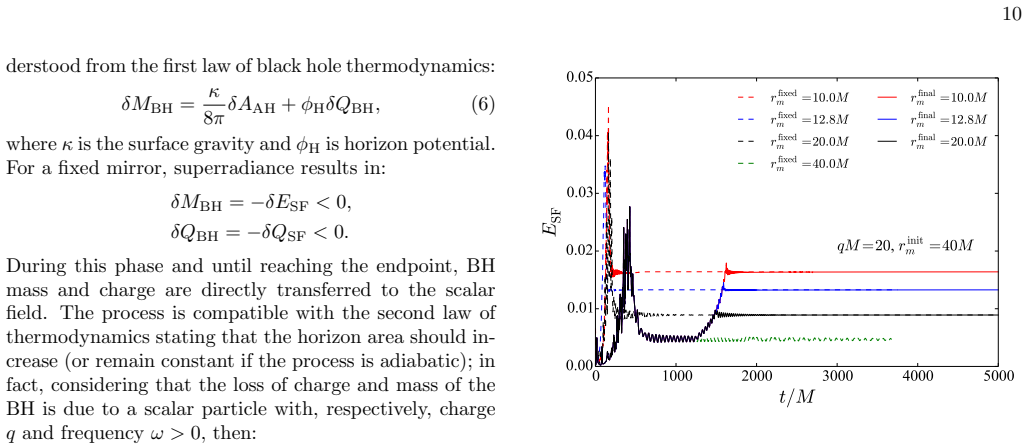
The central discovery is the reversal of superradiant charge transfer under a shrinking cavity. Starting from a hairy equilibrium reached with a fixed mirror, the authors move the mirror inward and observe that the scalar field's charge is reabsorbed by the black hole while the field's energy rises. Using the first law $\delta M_{\rm BH} = \frac{\kappa}{8\pi}\delta A_{\rm AH} + \phi_H\,\delta Q_{\rm BH}$, they argue that the black hole must shrink in apparent horizon area when it absorbs more charge than energy, which is exactly what the evolutions show through the irreducible mass $M_{\rm irr}=\sqrt{A_{\rm AH}/(16\pi)}$. The contraction continues until the mirror reaches the horizon radius, at which point the scalar cloud has been fully swallowed and the black hole has returned to the original Reissner–Nordström state with $M=1$ and $Q=0.9$. The same qualitative drop in $M_{\rm irr}$ is seen when the mirror stops well outside the horizon, so the effect is not tied to mirror material falling into the black hole.
Load-bearing premise
The analysis assumes a perfect movable mirror whose own stress-energy tensor and the work done to move it can be left unspecified, and it reads the black hole's area from the apparent horizon rather than the event horizon; if either assumption fails, the decrease in irreducible mass may be an artifact of the boundary or of the area diagnostic rather than a real property of the black hole.
Editorial extensions
If this is right
- Pushing the mirror outward after saturation makes the system resume superradiant extraction and relax to the hairy equilibrium of the larger cavity, with larger scalar charge and larger $M_{\rm irr}$.
- Pulling the mirror inward makes the scalar cloud return charge to the black hole; when the mirror reaches the horizon the black hole returns to the original Reissner–Nordström solution with $Q/M=0.9$.
- A classical, energy-condition-respecting evolution can decrease apparent horizon area, so the area theorem, if it applies at all in this setting, must be applied to the black hole together with the surrounding scalar field and cavity rather than to the black hole alone.
- For fixed mirrors, the superradiant timescale grows linearly with $r_m$ and the final $M_{\rm irr}$ increases with $r_m$; at $r_m\to\infty$ the instability becomes arbitrarily slow, so the Schwarzschild limit is approached only asymptotically.
- In three spatial dimensions, small deviations from spherical symmetry cause the black hole to recoil and escape the cavity, so the moving-cavity equilibria are mechanically unstable beyond spherical symmetry.
Reading between the lines
- The mirror's own stress-energy and the work exchanged with the external agent are never specified; if the moving boundary does work on the scalar field or requires exotic matter, the reported decrease in $M_{\rm irr}$ could be a boundary effect rather than a property of the black hole. The paper's Appendix B flags exactly this hazard.
- Because $M_{\rm irr}$ is computed from the apparent horizon, while the area theorem concerns event horizons, tracking the event horizon area in the same evolutions would directly test which premise of the theorem is evaded.
- If the effect survives a boundary treatment with a physical mirror, it would suggest that confining mechanisms such as anti-de Sitter-like potentials can classically shrink horizon area during superradiant reabsorption, and that Schwinger pair production—estimated in Appendix F to become important for $r_m/M \lesssim 1000$—would then cut off the purely classical decrease.
- A direct extension would be to compute the total entropy of black hole, scalar cloud, and mirror and check whether a generalized second law holds through the contraction, which would locate the decrease of $M_{\rm irr}$ inside a larger conserved accounting.
Editorial analysis
A structured set of objections, weighed in public.
Referee Report
Summary. The paper studies the charged black hole bomb in spherical symmetry by numerically solving the fully nonlinear Einstein-Maxwell-charged-Klein-Gordon system with a time-dependent mirror radius. After letting a superradiant hairy equilibrium form with a fixed mirror, the authors move the mirror outward or inward and observe that the system relaxes to new hairy equilibria. The central result is that when the cavity is shrunk, the apparent horizon area and the associated irreducible mass decrease while charge flows back to the black hole, and in the limit of a vanishing cavity the system returns to the original Reissner-Nordström solution. The authors interpret this as a classical process in which the black hole's irreducible mass decreases without violating charge conservation or energy conditions, and discuss consequences for the scope of Hawking's area theorem.
Significance. If the result holds, it would be a striking example of a classical, confined process in which apparent horizon area decreases, probing the robustness of area theorems in dynamical systems with boundaries and superradiant instabilities. The numerical component is strengthened by a convergence study (Appendix B) and by 1D/3D comparisons (Appendix C), and no parameter is fitted to the target result; the first-law relations in Appendix E are used as an interpretation rather than as an input. The main significance, however, is conditional on the physical consistency of the moving mirror and on the identification of the apparent horizon with the event horizon in the dynamical regime, both of which are load-bearing and currently unresolved in the manuscript.
major comments (3)
- [Framework; Appendix B] The moving mirror is implemented solely as a time-dependent Dirichlet boundary, Phi=0 at r=r_m(t), and the Einstein equations are solved with sources only from the electromagnetic and scalar fields. No stress-energy tensor or equation of state for the mirror is given, and Appendix B explicitly concedes that such reflective boundary conditions "without specifying the stress-energy tensor of the mirror itself can lead to constraint violations." A constraint violation is not merely a numerical detail: if H is nonzero, the numerical spacetime is not a solution of the coupled field equations with a physical confining device. More importantly, the first-law accounting in Appendix E contains only delta M_BH and phi_H delta Q_BH terms and has no boundary-work term, although an inward-moving reflecting wall can do work on the scalar field. Until the mirror stress-energy and the work exchanged with the external agent are specified or bounded, the observed decrease of M_irr cannot be separated from an external-work artifact, and the abstract's claim that the process occurs "without violating ... energy conditions" cannot be assessed.
- [Framework; Discussion] The irreducible mass is computed from apparent horizon area, M_irr = sqrt(A_AH/(16 pi)), while Hawking's area theorem concerns event horizons. The paper uses the decrease of A_AH to draw conclusions about the scope of the area theorem, but no argument is given that the apparent horizon coincides with, or tracks, the event horizon during the mirror's motion in these dynamical spacetimes. Without an event-horizon calculation or a proof that the apparent horizon equals the event horizon for this class of foliations, the relevance of the observed area decrease to Hawking's theorem remains a conjecture. This distinction is load-bearing because the apparent and event horizons can differ in time-dependent configurations.
- [Appendix E, Eqs. (6)-(9)] The first-law analysis in Appendix E is introduced as a schematic illustration, but it is then used to assert that the area decrease is required by the energy balance ("as such, the horizon area ... should decrease" after Eq. (9)). The argument assumes quasi-static transitions between fixed-mirror equilibrium configurations and omits any work term from the moving boundary, so it does not establish that the observed decrease is a property of the black hole rather than of the boundary. Furthermore, Eq. (8) compares a limiting initial state with the mirror at infinity and all charge extracted with a final state at r_m=r_AH, whereas the simulations start from finite mirror radii with nonzero Q_BH; extrapolating to that endpoint requires additional justification that is not provided.
minor comments (4)
- [Introduction] There is a typo in the phrase "non-trivial boundary conditions, e.gin asymptotically AdS spacetimes" where "e.g." and "in" are merged.
- [Appendix A, Fig. 4 caption] The caption "M_irr vs r_m growth during the superradiant instability" is unclear; it should specify whether the plotted quantity is the final equilibrium value of M_irr as a function of the fixed mirror radius.
- [Appendix B, Fig. 6] The convergence rescaling factors of 1.69, 2.45, and 4 are stated but the relation to grid spacings Delta r_MR = 5/3 Delta r_HR is not explicitly shown; a one-line explanation would help the reader verify the second-order scaling claim.
- [Results: decreasing the mirror radius] The sentence "This is actually equivalent to reduce the mirror up the apparent horizon radius" should read "reduce the mirror up to the apparent horizon radius."
Circularity Check
No significant circularity: the M_irr decrease is a measured numerical output, with first-law relations applied only as post-hoc interpretation.
full rationale
The paper's central result is a direct numerical observation, not a quantity reconstructed from assumptions that already contain it. The irreducible mass is defined from the apparent horizon area in the Framework section and then followed in time in Figs. 3 and 9; the sign of its change is an output of the evolution. The first-law relations in Appendix E (Eqs. (6)-(9)) are used only to interpret the measured signs of delta-Q_BH and delta-E_SF in terms of delta-A_AH; they do not themselves force the conclusion, since the entering sign choices are read off from the simulations rather than imposed. No parameter is fitted to the target result, and no prediction is a renamed fit. The self-citations to the evolution code [23,24] and to earlier superradiance studies [9] are standard methodological references; the fixed-mirror equilibrium comparisons and the independent 3D Einstein Toolkit runs in Appendix C provide cross-checks that are not circular. The paper explicitly acknowledges its main physical limitation in Appendix B: 'Introducing reflective boundary conditions without specifying the stress-energy tensor of the mirror itself can lead to a constraint violations.' This means the moving-mirror setup may be physically incomplete, and the decrease of M_irr could be an artifact of an unspecified external agent; however, incompleteness or potential non-physicality is a correctness concern, not a circularity. The same holds for the Schwinger-pair caveat in Appendix F. There is no step in the derivation that reduces to its own input.
Assumptions & free parameters
free parameters (3)
- scalar charge coupling qM =
5 and 20
- initial charge-to-mass Q/M =
0.9
- mirror trajectory (r_init, r_final, v_m) =
e.g. 9M to 3M, 40M to 10/12.8/20M, v_m about -0.08
assumptions (3)
- domain assumption Spherical symmetry removes gravitational and electromagnetic radiation, so all energy and charge remain in the BH plus scalar-field system.
- domain assumption The apparent horizon area tracks the event horizon area during the moving-mirror evolution, so M_irr = sqrt(A_AH/16 pi) measures the Hawking-theorem entropy.
- ad hoc to paper A moving Dirichlet boundary for the scalar field can be imposed without specifying the mirror's stress-energy tensor or external work.
Cite this review
Pith. "Pith review of Reducing the irreducible: the charged black hole bomb in a moving cavity." pith.science (2026). https://pith.science/paper/6A74CFJ2
@misc{pith2026250606527,
  author       = {Pith},
  title        = {Pith review of: Reducing the irreducible: the charged black hole bomb in a moving cavity},
  year         = {2026},
  howpublished = {\url{https://pith.science/paper/6A74CFJ2}},
  note         = {Machine review of arXiv:2506.06527}
}
read the original abstract
We revisit the charged black hole bomb by numerically solving the fully non-linear Einstein-Maxwell-(charged, complex) Klein-Gordon system with a moving mirror. By dynamically varying the cavity size, we find that the system evolves toward new hairy black hole equilibria. Expanding the mirror radius enhances superradiant extraction, increasing both the scalar field charge and the black hole's irreducible mass. Remarkably, on the other hand, shrinking the cavity size has the opposite effect: the black hole is able to reduce its irreducible mass as more charge than energy flows back from the field, without violating charge conservation or energy conditions. As a consistency check, in the limit of a vanishing cavity, we find that the system returns to the original Reissner-Nordstr\"om configuration. We discuss the implications of these findings for black hole thermodynamics in confined configurations where superradiant modes exist and the limitations of this setup, particularly in relation to Hawking's black hole area theorem.
Figures


Figures from the paper (7 more)



Forward citations
Cited by 1 Pith paper
-
Charged black holes embedded in matter with anisotropic pressure: Horizon Structure and Quasinormal Mode Spectra
Anisotropic fluid around a charged black hole (Kiselev metric) produces long-lived scalar quasinormal modes, avoided crossings, and spectral reorganization, computed via an extended Leaver method with automatic differ...
Reference graph
Works this paper leans on
-
[1]
Penrose, Physical Review Letters14, 57 (1965)
R. Penrose, Physical Review Letters14, 57 (1965)
1965
-
[2]
S. W. Hawking, Physical Review Letters26, 1344 (1971)
1971
-
[3]
S. W. Hawking, Physical Review D14, 2460 (1976)
1976
-
[4]
Preskill, inProceedings of the International Sympo- sium on Black Holes, Membranes, Wormholes and Su- perstrings, S
J. Preskill, inProceedings of the International Sympo- sium on Black Holes, Membranes, Wormholes and Su- perstrings, S. Kalara and DV Nanopoulos, eds.(World Scientific, Singapore, 1993) pp(World Scientific, 1992) pp. 22–39
1993
-
[5]
Bekenstein, Lettere al Nuovo Cimento (1971-1985)11, 467 (1974)
J. Bekenstein, Lettere al Nuovo Cimento (1971-1985)11, 467 (1974)
work page 1974
-
[6]
S. W. Hawking, Communications in mathematical physics43, 199 (1975)
1975
-
[7]
J. C. Degollado and C. A. R. Herdeiro, Phys.Rev.D89, 063005 (2014), arXiv:1312.4579 [gr-qc]
work page Pith review arXiv 2014
-
[8]
J. C. Degollado and C. A. Herdeiro, Gen.Rel.Grav.45, 2483 (2013), arXiv:1303.2392 [gr-qc]
work page Pith review arXiv 2013
Show all 37 references
-
[9]
Sanchis-Gual, J
N. Sanchis-Gual, J. C. Degollado, P. J. Montero, J. A. Font, and C. Herdeiro, Phys. Rev. Lett.116, 141101 (2016), arXiv:1512.05358 [gr-qc]
2016 arXiv
-
[10]
W. H. Press and S. A. Teukolsky, Nature238, 211 (1972)
1972
-
[11]
Brito, V
R. Brito, V. Cardoso, P. Pani,et al.,Superradiance New Frontiers in Black Hole Physics(Springer, 2020)
2020
-
[12]
W. E. East, F. M. Ramazano˘ glu, and F. Pretorius, Phys- ical Review D89, 061503 (2014)
2014
-
[13]
S. R. Dolan, S. Ponglertsakul, and E. Winstanley, Phys- ical Review D92, 124047 (2015)
2015
-
[14]
Bosch, S
P. Bosch, S. R. Green, and L. Lehner, Phys. Rev. Lett. 116, 141102 (2016), arXiv:1601.01384 [gr-qc]
2016 arXiv
-
[15]
Sanchis-Gual, J
N. Sanchis-Gual, J. C. Degollado, C. Herdeiro, J. A. Font, and P. J. Montero, Phys. Rev.D94, 044061 (2016), arXiv:1607.06304 [gr-qc]
2016 arXiv
-
[16]
Baake and O
O. Baake and O. Rinne, Physical Review D94, 124016 (2016)
2016
-
[17]
W. E. East and F. Pretorius, Physical review letters119, 041101 (2017)
2017
-
[18]
T. W. Baumgarte and S. L. Shapiro, Phys. Rev. D59, 024007 (1998)
1998
-
[19]
Shibata and T
M. Shibata and T. Nakamura, Phys. Rev. D52, 5428 (1995)
1995
-
[20]
J. D. Brown, Phys. Rev. D79, 104029 (2009)
2009
-
[21]
Alcubierre and M
M. Alcubierre and M. D. Mendez, Gen.Rel.Grav.43, 2769 (2011), arXiv:1010.4013 [gr-qc]
2011 arXiv
-
[22]
P. J. Montero and I. Cordero-Carrion, Phys.Rev.D85, 124037 (2012), arXiv:1204.5377 [gr-qc]
2012 arXiv
-
[23]
Sanchis-Gual, J
N. Sanchis-Gual, J. C. Degollado, P. J. Montero, and J. A. Font, Phys. Rev. D91, 043005 (2015), arXiv:1412.8304 [gr-qc]
2015 arXiv
-
[24]
Sanchis-Gual, J
N. Sanchis-Gual, J. C. Degollado, P. J. Montero, J. A. Font, and V. Mewes, Phys. Rev. D92, 083001 (2015), arXiv:1507.08437 [gr-qc]
2015 arXiv
-
[25]
J. M. Torres and M. Alcubierre, Gen. Rel. Grav.46, 1773 (2014), arXiv:1407.7885 [gr-qc]
2014 arXiv
-
[26]
Christodoulou, Phys.Rev.Lett.25, 1596 (1970)
D. Christodoulou, Phys.Rev.Lett.25, 1596 (1970)
1970
-
[27]
Alcubierre,Introduction to3 + 1Numerical Relativity (Oxford Univ
M. Alcubierre,Introduction to3 + 1Numerical Relativity (Oxford Univ. Press, New York, 2008)
2008
-
[28]
Torres, S
T. Torres, S. Patrick, A. Coutant, M. Richartz, E. W. Tedford, and S. Weinfurtner, Nature Physics13, 833 (2017)
2017
-
[29]
Schwinger, Physical Review82, 664 (1951)
J. Schwinger, Physical Review82, 664 (1951)
1951
-
[30]
Okawa, H
H. Okawa, H. Witek, and V. Cardoso, Phys.Rev.D89, 104032 (2014), arXiv:1401.1548 [gr-qc]. 6
2014 arXiv
-
[32]
L¨ offler, J
F. L¨ offler, J. Faber, E. Bentivegna, T. Bode, P. Diener, R. Haas, I. Hinder, B. C. Mundim, C. D. Ott, E. Schnet- ter, G. Allen, M. Campanelli, and P. Laguna, Classical and Quantum Gravity29, 115001 (2012)
2012
-
[33]
Zilh˜ ao, H
M. Zilh˜ ao, H. Witek, and V. Cardoso, Classical and Quantum Gravity32, 234003 (2015)
2015
-
[34]
Witek and M
H. Witek and M. Zilh˜ ao, “Canuda,”
-
[35]
Canuda: a public nu- merical relativity library to probe fundamental physics,
H. Witek, M. Zilhao, G. Bozzola, C.-H. Cheng, A. Dima, M. Elley, G. Ficarra, T. Ikeda, R. Luna, C. Richards, N. Sanchis-Gual, and H. Silva, “Canuda: a public nu- merical relativity library to probe fundamental physics,” (2023)
2023
-
[36]
Nicoules, J
J. Nicoules, J. Ferreira, C. Herdeiro, E. Radu, and M. Zilh˜ ao, (to appear)
-
[37]
C. A. R. Herdeiro, J. C. Degollado, and H. F. R¨ unarsson, Phys.Rev.D88, 063003 (2013), arXiv:1305.5513 [gr-qc]. Appendix A: Fixed Mirror Radius We explore how the instability timescale and the value ofM irr at the end of the superradiant instability change with the (fixed) mi...
2013 arXiv
-
[38]
where it was interpreted as due to the minimal wave- length (maximal frequency) allowed by the superradiance condition in this setup. Finally, for a dynamical mirror moving from a finite radius to a smaller finite radius (larger than the critical radius), the energy of the sca...
Reviewed August 7, 2026 · model on record in the stance chip above.
Discussion (0). Sign in to comment.