REVIEW 3 major objections 4 minor 18 references
NeSyPack: A Neuro-Symbolic Framework for Bimanual Logistics Packing
T0 review · 3 major / 4 minor · reviewed 2026-08-07 · deepseek-v4-flash
Pith's one-line read NeSyPack claims that bimanual packing becomes reliable and data-efficient when a symbolic planner decomposes the task and a skill graph selects small learned skills, instead of training one large end-to-end policy.
desk verdict A real competition win and honest limitations, but the headline claim against end-to-end models is untested. read the letter →
The pith
A machine-rendered reading of the paper's core claim, the machinery that carries it, and where it could break.
The reading
What carries the argument
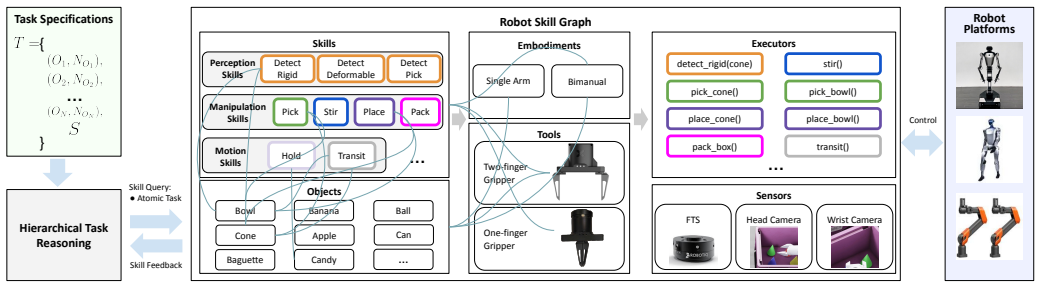
The robot skill graph is the central object: a graph whose nodes cover skills (detect, pick, place, stir, pack, hold, transit), objects described by physical and perceptive features, embodiments (single-arm versus bimanual), end-of-arm tools, executors that ground skill-object pairs into executable functions, and sensors. Given an atomic task from hierarchical reasoning, the graph symbolically selects the appropriate combination and outputs grounded control commands. The second mechanism is Cartesian-first motion planning: manipulation skills are planned in Cartesian space with labeled waypoints that encode hard constraints (reachability, collision avoidance) and soft constraints (preferred grasp orientation, smoothness), and are then mapped to configuration space; robot-specific parameters enter only at this symbolic mapping step, which is what enables cross-platform transfer.
What would settle it
Run the full packing pipeline on a bimanual platform where a required Cartesian waypoint plan has no joint-space solution within the robot's joint limits and reachable workspace—for example, an object placed at the edge of reach. If the system cannot detect the infeasibility, recover, or complete the packing, that is direct evidence against the claimed reliability and generalizability.
Extended reading notes
Core claim
The central claim is that symbolic structure is what makes a packing system reliable and reusable. NeSyPack's hierarchical task reasoning decomposes a task specification such as 'pack a bowl, two tennis balls, and seal the box' into individual object subtasks, then into atomic actions like detect, pick, transit, and place. Serving these actions is a robot skill graph—a network over skills, objects, embodiments, tools, executors, and sensors—that symbolically selects the right policy and parameters for each atomic task. Learned components are deliberately narrow: perception models map raw RGB-D data to symbolic features such as 6D poses or object edges, and manipulation skills are built from labeled Cartesian waypoints before being mapped to configuration space. Because robot-specific details enter only at the configuration-space stage, the same skills transfer to a new dual-arm platform without retraining, which the authors demonstrate by deploying NeSyPack on two different robot systems and reporting packing success rates between 83 and 100 percent across object categories.
Load-bearing premise
The reliability and cross-platform claims rest on the assumption that every motion planned in Cartesian space with labeled waypoints can be carried out by the robot's actual joints and arms on the new platform; the paper states that this mapping is not guaranteed to be complete or optimal.
Editorial extensions
If this is right
- If NeSyPack's design is correct, adding a new object type requires only a new perception module and possibly a skill variant, using a handful of labeled images, without retraining existing skills.
- The same skill graph should transfer to a new bimanual platform with minimal engineering, because robot-specific parameters are handled symbolically at the configuration-space stage.
- Because each atomic action is chosen by a symbolic planner, failures can be traced to a specific perception, planning, or execution step, and recovery actions such as 'stir bin' can be inserted dynamically when perception fails.
- The hierarchical decomposition turns long-horizon tasks into short, learnable atomic skills, which is why one-shot key-frame demonstrations and under-an-hour perception adaptation can replace the large datasets that end-to-end vision-language-action models require.
Reading between the lines
- The design suggests a broader recipe for robotic manipulation beyond packing: any long-horizon task that can be decomposed into reusable symbolic skills may achieve data efficiency and platform transfer, at the price of designing the skill abstractions in advance.
- A testable prediction follows from the paper's stated caveat: tasks whose Cartesian plan has no configuration-space solution, such as objects near workspace limits, should be exactly where success rates drop, and whole-body control or configuration-space-aware planning would close that gap.
- Because the system relies on geometric object features, it should struggle more with material-dependent behaviors than with shape-dependent ones; the paper's own report that slippery objects are dropped unless friction pads are added is evidence of this boundary.
- The claimed data efficiency could be measured directly by benchmarking NeSyPack against an end-to-end vision-language-action model under identical few-shot conditions: the advantage should shrink as data grows and the end-to-end model catches up.
Editorial analysis
A structured set of objections, weighed in public.
Referee Report
Summary. The paper presents NeSyPack, a neuro-symbolic framework for bimanual logistics packing. The system combines hierarchical task reasoning (HTR), which decomposes a packing order into atomic tasks, with a symbolic skill graph that maps each atomic task to perception, manipulation, and motion skills. Perception skills provide symbolic scene features, manipulation skills are defined as reusable, parameterized primitives, and motion skills handle collision-free transit. The authors report development results on a Unitree G1 humanoid (Table I: 9/10 or 10/10 success over ten trials per object category) and deployment results at the ICRA 2025 WBCD competition on a dual Galaxea A1X platform (Table II: 2-6 trials per category, 83.3%-100% success), where the team won first prize. The paper also describes qualitative advantages in data efficiency, cross-platform transfer, extensibility, and explainability, and it closes with a limitations section discussing reachability, Cartesian-to-configuration-space mapping incompleteness, and perception failures due to limited camera field of view.
Significance. If the reported behavior is representative, NeSyPack is a useful demonstration that a modular neuro-symbolic architecture can perform bimanual packing across diverse objects and can be transferred to new hardware with modest effort. The first-place finish in an external ICRA competition is genuine, non-synthetic evidence of practical viability, and the explicit reporting of failures and limitations is a strength. The proposed modularity, symbolic skill graph, and hierarchical decomposition are also plausible routes to data-efficient and explainable manipulation. However, the paper's most prominent advertised claim—that NeSyPack outperforms end-to-end models such as vision-language-action models—is not supported by any comparative experiment. In addition, the trial counts are small, and the acknowledged incompleteness of the Cartesian-to-configuration-space mapping leaves an important caveat for the claimed cross-platform robustness. These issues are load-bearing for the paper's central contributions rather than mere presentation details.
major comments (3)
- [Abstract and Section I] The abstract and Section I claim that NeSyPack is 'outperforming end-to-end models that require large-scale retraining,' but no end-to-end baseline is evaluated anywhere in Sections III.A or III.B. Tables I and II report only NeSyPack's own success counts, and the data-efficiency statements (perception adapted in under one hour on an RTX 4060, one-shot key-frame demonstrations) are not expressed as a training budget or compared with any VLA fine-tuning cost. The comparative claim is therefore unsupported and should either be removed or tested against a representative end-to-end policy under matched data and compute budgets.
- [Tables I and II] The reliability claim is under-powered given the trial counts. Table I uses 10 attempts per object category and Table II uses only 2-6 attempts per category. For example, the Sphere row in Table II (5/6 successes, 83.3%) has a Clopper-Pearson 95% confidence interval of roughly 36%-99.6%, and even the 9/10 rows in Table I have intervals starting near 55%. The observed rates are thus compatible with substantially lower true performance, so the paper should either report confidence intervals, increase trial counts, or soften the reliability claims.
- [Section III.C] The limitations section states that the skill graph is constructed in Cartesian space and that the mapping back to configuration space 'is not guaranteed to be complete or optimal; in some cases, feasible configuration-space motions may not exist for a given Cartesian plan.' This directly bears on the claimed cross-platform generalizability and reliability, because a single successful transfer to the Galaxea platform cannot establish robustness if the underlying planning representation can fail silently in other configurations. The paper should quantify how many development or competition failures were attributable to this mapping issue, or demonstrate a constraint-aware planning procedure that detects and corrects infeasible Cartesian plans.
minor comments (4)
- [Section III.B, Reliability paragraph] The text says the original G1 pipeline achieved 'over 90% task success' and that this level was 'preserved' on the Galaxea platform, but Table II reports an 83.3% success rate for Sphere and Stacked objects; this wording should be reconciled.
- [Section II.B, Perception Skills] The 'Detect Pick' skill is described as comparing gripper pose and perceived object pose, but the text does not specify the distance or alignment threshold used; adding this detail would make the success-detection criterion reproducible.
- [Section III.B, Generalizability paragraph] The claim that robot-specific parameters are 'performed symbolically' would be easier to assess if the paper listed exactly which kinematic and camera parameters are symbolic inputs versus learned or hard-coded values.
- [Section II.B, Manipulation Skills] The paper mentions that 'Stir' and 'Pack' are 'often executed through teleoperation or learned via imitation learning,' but it does not report how many demonstrations or how much teleoperation time were used for these skills; reporting these numbers would strengthen the data-efficiency discussion.
Circularity Check
No significant circularity: the central result is supported by an external competition benchmark, and no fitted parameter or self-citation defines the target outcome.
full rationale
The paper's central empirical claims are evaluated against an external competition benchmark (WBCD at ICRA 2025), where NeSyPack achieved first place after transfer to a dual Galaxea A1X platform not used during development. This is independent, non-synthetic evidence. The self-citations (e.g., [4], [5], [11], [12]) supply subroutines such as failure-recovery planning, multi-robot planning, convex-feasible-set motion planning, and hierarchical task allocation, but they do not define or assume the target result, namely the packing success rates reported in Tables I and II. No fitted parameter is relabeled as a prediction; the success counts are direct outcomes of physical trials. The Cartesian-to-configuration-space mapping caveat in Section III.C is a stated limitation about completeness and optimality, not a circular step. The abstract's claim of 'outperforming end-to-end models that require large-scale retraining' lacks any end-to-end baseline comparison, but that is a missing-baseline/correctness concern, not circularity. Under the rule that an honest non-finding is expected when warranted, the circularity score is 0.
Assumptions & free parameters
assumptions (3)
- domain assumption Cartesian-space waypoint plans can be realized by feasible configuration-space motions on the target robot.
- domain assumption The set of skills and their symbolic parameterization is sufficient to cover the task distribution encountered in the competition.
- domain assumption Object pose and geometric feature extraction from RGB-D is accurate enough for the downstream grasp and place skills.
Cite this review
Pith. "Pith review of NeSyPack: A Neuro-Symbolic Framework for Bimanual Logistics Packing." pith.science (2026). https://pith.science/paper/46OG3H4Q
@misc{pith2026250606567,
  author       = {Pith},
  title        = {Pith review of: NeSyPack: A Neuro-Symbolic Framework for Bimanual Logistics Packing},
  year         = {2026},
  howpublished = {\url{https://pith.science/paper/46OG3H4Q}},
  note         = {Machine review of arXiv:2506.06567}
}
read the original abstract
This paper presents NeSyPack, a neuro-symbolic framework for bimanual logistics packing. NeSyPack combines data-driven models and symbolic reasoning to build an explainable hierarchical system that is generalizable, data-efficient, and reliable. It decomposes a task into subtasks via hierarchical reasoning, and further into atomic skills managed by a symbolic skill graph. The graph selects skill parameters, robot configurations, and task-specific control strategies for execution. This modular design enables robustness, adaptability, and efficient reuse - outperforming end-to-end models that require large-scale retraining. Using NeSyPack, our team won the First Prize in the What Bimanuals Can Do (WBCD) competition at the 2025 IEEE International Conference on Robotics and Automation.
Figures


Figures from the paper (2 more)


Reference graph
Works this paper leans on
-
[1]
Amazon introduces sparrow-a state-of-the-art robot that handles millions of diverse products, 2022
Amazon. Amazon introduces sparrow-a state-of-the-art robot that handles millions of diverse products, 2022. https://tinyurl.com/2p8h4w7v [Accessed: May, 2025]
work page 2022
-
[2]
Paligemma: A versatile 3b vlm for transfer
Lucas Beyer, Andreas Steiner, Andr ´e Susano Pinto, Alexander Kolesnikov, Xiao Wang, Daniel Salz, Maxim Neumann, Ibrahim Alabdulmohsin, Michael Tschannen, Emanuele Bugliarello, et al. Paligemma: A versatile 3b vlm for transfer. arXiv preprint arXiv:2407.07726 , 2024
arXiv 2024
-
[3]
π0: A vision- language-action flow model for general robot control
Kevin Black, Noah Brown, Danny Driess, Adnan Es- mail, Michael Equi, Chelsea Finn, Niccolo Fusai, Lachy Groom, Karol Hausman, Brian Ichter, et al. π0: A vision- language-action flow model for general robot control. arXiv preprint arXiv:2410.24164 , 2024
-
[4]
Automating robot failure recovery using vision-language models with optimized prompts
Hongyi Chen, Yunchao Yao, Ruixuan Liu, Changliu Liu, and Jeffrey Ichnowski. Automating robot failure recovery using vision-language models with optimized prompts. arXiv:2409.03966, 2024
arXiv 2024
-
[5]
Apex-mr: Multi-robot asyn- chronous planning and execution for cooperative assem- bly
Philip Huang, Ruixuan Liu, Shobhit Aggarwal, Changliu Liu, and Jiaoyang Li. Apex-mr: Multi-robot asyn- chronous planning and execution for cooperative assem- bly. In Robotics: Science and Systems , 2025. URL https://arxiv.org/abs/2503.15836
arXiv 2025
-
[6]
Stow: Robotic packing of items into fabric pods
Nicolas Hudson, Josh Hooks, Rahul Warrier, Curt Sal- isbury, Ross Hartley, Kislay Kumar, Bhavana Chan- drashekhar, Paul Birkmeyer, Bosch Tang, Matt Frost, Shantanu Thakar, Tony Piaskowy, Petter Nilsson, Josh Petersen, Neel Doshi, Alan Slatter, Ankit Bhatia, Cassie Meeker, Yuechuan Xue, Dylan Cox, Alex Kyriazis, Bai Lou, Nadeem Hasan, Asif Rana, Nikhil Cha...
arXiv 2025
-
[7]
π0.5 : a vision-language-action model with open-world generalization
Physical Intelligence, Kevin Black, Noah Brown, James Darpinian, Karan Dhabalia, Danny Driess, Adnan Es- mail, Michael Equi, Chelsea Finn, Niccolo Fusai, et al. π0.5 : a vision-language-action model with open-world generalization. arXiv preprint arXiv:2504.16054 , 2025
arXiv 2025
-
[8]
Ul- tralytics yolov11 (version 11.0.0) [computer software]
Glenn Jocher, Jiacong Qiu, and Ayush Chaurasia. Ul- tralytics yolov11 (version 11.0.0) [computer software]. https://github.com/ultralytics/ultralytics, 2023. Open- source codebase, GitHub repository
work page 2023
Show all 18 references
-
[9]
Openvla: An open-source vision-language-action model
Moo Jin Kim, Karl Pertsch, Siddharth Karamcheti, Ted Xiao, Ashwin Balakrishna, Suraj Nair, Rafael Rafailov, Ethan Foster, Grace Lam, Pannag Sanketi, et al. Openvla: An open-source vision-language-action model. arXiv preprint arXiv:2406.09246, 2024
2024 arXiv
-
[10]
Kuffner and Steven M
James J. Kuffner and Steven M. LaValle. RRT-Connect: An efficient approach to single-query path planning. In Proceedings of the IEEE International Conference on Robotics and Automation (ICRA) , volume 2, pages 995– 1001, 2000
2000
-
[11]
The convex feasible set algorithm for real time optimiza- tion in motion planning
Changliu Liu, Chung-Yen Lin, and Masayoshi Tomizuka. The convex feasible set algorithm for real time optimiza- tion in motion planning. SIAM Journal on Control and Optimization, 56(4):2712–2733, 2018
2018
-
[12]
Decomposition-based hierarchical task allocation and planning for multi-robots under hierarchical temporal logic specifications
Xusheng Luo, Shaojun Xu, Ruixuan Liu, and Changliu Liu. Decomposition-based hierarchical task allocation and planning for multi-robots under hierarchical temporal logic specifications. IEEE Robotics and Automation Letters, 9(8):7182–7189, 2024
2024
-
[13]
Dinov2: Learning robust visual features without supervision
Maxime Oquab, Timoth ´ee Darcet, Th ´eo Moutakanni, Huy V o, Marc Szafraniec, Vasil Khalidov, Pierre Fer- nandez, Daniel Haziza, Francisco Massa, Alaaeldin El- Nouby, et al. Dinov2: Learning robust visual features without supervision. arXiv preprint arXiv:2304.07193 , 2023
2023 arXiv
-
[14]
Siemens presents the future of intralogistics: Simatic robot pick ai pro enables machine builders to develop their own adaptive picking robots, 2025
Siemens. Siemens presents the future of intralogistics: Simatic robot pick ai pro enables machine builders to develop their own adaptive picking robots, 2025. https: //tinyurl.com/4wv3n2te [Accessed: May, 2025]
2025
-
[15]
Llama 2: Open foundation and fine-tuned chat models
Hugo Touvron, Louis Martin, Kevin Stone, Peter Albert, Amjad Almahairi, Yasmine Babaei, Nikolay Bashlykov, Soumya Batra, Prajjwal Bhargava, Shruti Bhosale, et al. Llama 2: Open foundation and fine-tuned chat models. arXiv preprint arXiv:2307.09288 , 2023
2023 arXiv
-
[16]
Tenenbaum
Kexin Yi, Jiajun Wu, Chuang Gan, Antonio Torralba, Pushmeet Kohli, and Joshua B. Tenenbaum. Neural- symbolic vqa: disentangling reasoning from vision and language understanding. In Proceedings of the 32nd International Conference on Neural Information Process- ing Systems , NI...
2018
-
[17]
Sigmoid loss for language image pre- training
Xiaohua Zhai, Basil Mustafa, Alexander Kolesnikov, and Lucas Beyer. Sigmoid loss for language image pre- training. In Proceedings of the IEEE/CVF international conference on computer vision , pages 11975–11986, 2023
2023
-
[18]
Physics-aware robotic pal- letization with online masking inference
Tianqi Zhang, Zheng Wu, Yuxin Chen, Yixiao Wang, Boyuan Liang, Scott Moura, Masayoshi Tomizuka, Mingyu Ding, and Wei Zhan. Physics-aware robotic pal- letization with online masking inference. arXiv preprint arXiv:2502.13443, 2025
2025 arXiv
Reviewed August 7, 2026 · model on record in the stance chip above.
Discussion (0). Sign in to comment.