Quantum Interference in Two-Atom Resonant X-ray Scattering of an Intense Attosecond Pulse
Pith reviewed 2026-05-19 11:21 UTC · model grok-4.3
The pith
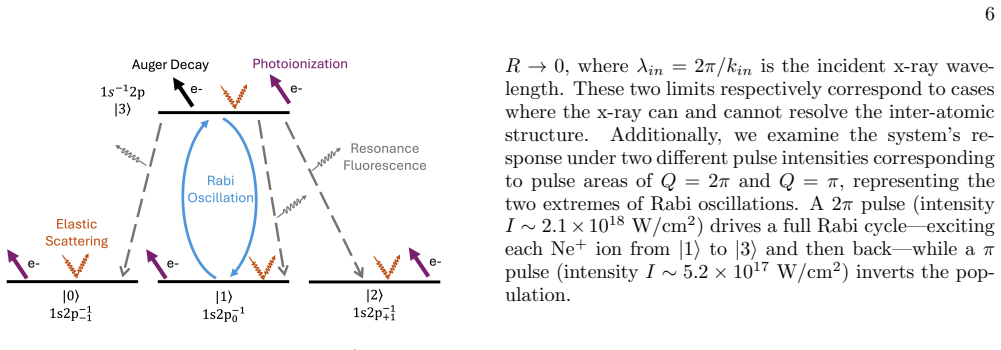
Resonant x-ray scattering from two Ne+ ions yields more signal than non-resonant processes when driven by an intense attosecond pulse.
A machine-rendered reading of the paper's core claim, the machinery that carries it, and where it could break.
Core claim
In a QED-based calculation of two non-interacting Ne+ ions driven by an intense attosecond pulse, the resonant scattering pathways produce a higher total yield than non-resonant scattering. The angular distribution of the scattered intensity follows a pattern resembling the two-atom structure factor. Quantum interference fringes are visible only in final states where resonance fluorescence pathways emit indistinguishable photons; fringe contrast depends on pulse area and the ions' initial electronic state and reaches its maximum when ionization remains negligible.
What carries the argument
Indistinguishability of photon emission pathways between resonant elastic scattering and resonance fluorescence from the two ions, which produces observable quantum interference in the detected signal.
If this is right
- The resonant scattering yield exceeds its non-resonant counterpart.
- The angular dependence of the scattering signal qualitatively follows a two-atom structure factor.
- Interference fringe visibility is sensitive to pulse area and the initial electronic state of the ions.
- Only a subset of final states reached through resonance fluorescence exhibits interference.
- Fringe visibility is maximized in the linear scattering regime where ionization is minimal.
Where Pith is reading between the lines
- The same interference mechanism might be tested by scanning attosecond pulse intensity while recording angular distributions in a real two-ion experiment.
- Extending the calculation to three or more ions could show whether the two-atom structure factor generalizes or breaks down.
- The requirement for indistinguishable pathways may limit which final states are useful for imaging applications.
- The linear-regime optimum suggests that weaker pulses could be preferable for preserving interference contrast in practical setups.
Load-bearing premise
The two Ne+ ions are treated as non-interacting, so their scattering amplitudes can be calculated separately and then combined solely through photon indistinguishability.
What would settle it
An experiment that measures a resonant scattering yield from two Ne+ ions that is equal to or lower than the non-resonant yield under intense attosecond illumination would contradict the central result.
Figures



read the original abstract
We theoretically investigate resonant x-ray scattering from two non-interacting Ne+ ions driven by an intense attosecond pulse using a non-relativistic, QED-based time-dependent framework. Our model includes Rabi oscillations, photoionization, Auger decay, and quantum interference among elastic scattering and resonance fluorescence pathways. We analyze how the total scattering signal depends on pulse intensity, atomic configuration, and initial electronic state. We find that the total resonant scattering yield exceeds its non-resonant counterpart; the angular dependence of the signal qualitatively resembles a two-atom structure factor; and the visibility of interference fringes is sensitive to pulse area and the initial electronic state. Only a subset of final states reached via resonance fluorescence exhibits interference, determined by the indistinguishability of photon emission pathways. Fringe visibility is maximized in the linear scattering regime, where ionization is minimal and resonance fluorescence pathways can be largely indistinguishable. These results highlight optimal conditions for applying ultrafast resonant x-ray scattering to single-particle imaging.
Editorial analysis
A structured set of objections, weighed in public.
Referee Report
Summary. The paper develops a non-relativistic QED-based time-dependent model for resonant x-ray scattering from two non-interacting Ne+ ions driven by an intense attosecond pulse. The framework incorporates Rabi oscillations, photoionization, Auger decay, and quantum interference among elastic scattering and resonance fluorescence pathways. Key results are that the total resonant scattering yield exceeds the non-resonant counterpart, the angular dependence qualitatively matches a two-atom structure factor, and interference fringe visibility is sensitive to pulse area and initial electronic state, occurring only for a subset of final states where photon emission pathways are indistinguishable. Optimal conditions are identified in the linear regime with minimal ionization.
Significance. If the non-interacting approximation is valid, the work offers useful insights into intensity-dependent quantum interference in attosecond x-ray scattering and its relevance to single-particle imaging. The time-dependent simulation approach, which tracks multiple decay channels and pathway indistinguishability, represents a strength over simpler perturbative treatments and enables concrete predictions for fringe visibility.
major comments (1)
- [Model description] Model description (as outlined in the abstract and framework): The assumption that the two Ne+ ions are strictly non-interacting is load-bearing for the independent time-dependent amplitudes, photon-indistinguishability interference, and the identification of the interfering subset of final states. No quantitative bound is supplied showing that residual Coulomb or dipole-dipole interaction energies remain negligible compared with the Rabi frequency, detuning, or Auger width across the explored intensity range and ion separations. If such interactions shift ionic levels or open additional channels, the pathway independence and resulting interference claims would require revision.
minor comments (2)
- [Abstract] The abstract states that 'the angular dependence of the signal qualitatively resembles a two-atom structure factor' but does not specify the precise functional form or the range of angles over which this resemblance holds; a brief comparison to the expected |1 + exp(i q · R)|^{2} form would improve clarity.
- Notation for the pulse area and initial electronic state should be defined explicitly when first introduced, as their sensitivity is central to the visibility claims.
Simulated Author's Rebuttal
We thank the referee for the careful reading of our manuscript and the constructive feedback. We address the single major comment below, indicating where revisions will be made to strengthen the presentation while preserving the core results.
read point-by-point responses
-
Referee: [Model description] Model description (as outlined in the abstract and framework): The assumption that the two Ne+ ions are strictly non-interacting is load-bearing for the independent time-dependent amplitudes, photon-indistinguishability interference, and the identification of the interfering subset of final states. No quantitative bound is supplied showing that residual Coulomb or dipole-dipole interaction energies remain negligible compared with the Rabi frequency, detuning, or Auger width across the explored intensity range and ion separations. If such interactions shift ionic levels or open additional channels, the pathway independence and resulting interference claims would require revision.
Authors: We agree that an explicit justification of the non-interacting approximation strengthens the manuscript. In the revised version we will add a dedicated paragraph to the model section that supplies order-of-magnitude estimates for the relevant ion separations (several nanometers, as appropriate for dilute targets). At these distances the residual Coulomb repulsion between two Ne+ ions is ~0.1 eV while the dipole-dipole coupling is smaller still; both remain well below the Rabi frequencies (several eV) and Auger widths (~0.2 eV) realized in the explored intensity range. These perturbative values do not shift the ionic levels enough to invalidate pathway independence or open new decay channels within the parameter space we consider. The added discussion will therefore support, rather than alter, the reported interference results. revision: yes
Circularity Check
No circularity; derivation is self-contained via explicit time-dependent simulation
full rationale
The paper derives its claims on resonant versus non-resonant yields, angular structure-factor resemblance, and fringe-visibility sensitivity directly from numerical solutions of a non-relativistic QED time-dependent framework that incorporates Rabi oscillations, photoionization, Auger decay, and photon-indistinguishability rules for non-interacting ions. The non-interacting treatment is introduced as an explicit modeling premise rather than derived or fitted; no parameters are adjusted to a data subset and then relabeled as predictions, and no load-bearing step reduces to a self-citation or ansatz imported from prior work by the same authors. All reported interference properties follow from the stated dynamics and indistinguishability conditions without circular reduction to the inputs.
Axiom & Free-Parameter Ledger
axioms (1)
- domain assumption Non-relativistic QED-based time-dependent framework governs the dynamics including Rabi oscillations, photoionization, and Auger decay.
Lean theorems connected to this paper
-
IndisputableMonolith/Cost/FunctionalEquation.leanwashburn_uniqueness_aczel unclear?
unclearRelation between the paper passage and the cited Recognition theorem.
We theoretically investigate resonant x-ray scattering from two non-interacting Ne+ ions driven by an intense attosecond pulse using a non-relativistic, QED-based time-dependent framework. Our model includes Rabi oscillations, photoionization, Auger decay, and quantum interference among elastic scattering and resonance fluorescence pathways.
-
IndisputableMonolith/Foundation/AlexanderDuality.leanalexander_duality_circle_linking unclear?
unclearRelation between the paper passage and the cited Recognition theorem.
The angular dependence of the signal qualitatively resembles a two-atom structure factor
What do these tags mean?
- matches
- The paper's claim is directly supported by a theorem in the formal canon.
- supports
- The theorem supports part of the paper's argument, but the paper may add assumptions or extra steps.
- extends
- The paper goes beyond the formal theorem; the theorem is a base layer rather than the whole result.
- uses
- The paper appears to rely on the theorem as machinery.
- contradicts
- The paper's claim conflicts with a theorem or certificate in the canon.
- unclear
- Pith found a possible connection, but the passage is too broad, indirect, or ambiguous to say the theorem truly supports the claim.
Reference graph
Works this paper leans on
-
[1]
Q = 2π pulse Figure 3(a) shows the calculated scattering yields for the Q = 2 π pulse and atomic separation R = 10 λinˆz. For simplicity and to restrict the parameter space, we focus on planar scattering where k, kin and ϵin lie in the same plane(i.e., ϕs = 90 ◦ , see Fig. 1). The polarization vector ϵ of the emitted photon need not lie in this plane. The...
-
[2]
Q = π pulse Next, we examine the scattering response in a π pulse, as shown in Fig. 5. In the absence of RF, such a pulse would transfer the population from the ground state |1⟩ to the core-hole state |3⟩ at the end of pulse, with some probability for ionization during the pulse. Therefore, as a result, the system produces significant RF after the pulse. ...
-
[3]
W. H. Bragg and W. L. Bragg, The reflection of x-rays by crystals, Proceedings of the Royal Society of London. Series A, Containing Papers of a Mathematical and Phys- ical Character 88, 428 (1913)
work page 1913
-
[4]
P. Emma, R. Akre, J. Arthur, R. Bionta, C. Bost- edt, J. Bozek, A. Brachmann, P. Bucksbaum, R. Cof- fee, F.-J. Decker, et al. , First lasing and operation of an ˚ angstrom-wavelength free-electron laser, Nat. Photon.4, 641 (2010)
work page 2010
-
[5]
L. F. DiMauro, J. Arthur, N. Berrah, J. Bozek, J. N. Galayda, and J. Hastings, Progress report on the LCLS XFEL at SLAC, Journal of Physics: Conference Series 88, 012058 (2007)
work page 2007
-
[6]
C. Bostedt, S. Boutet, D. M. Fritz, Z. Huang, H. J. Lee, H. T. Lemke, A. Robert, W. F. Schlotter, J. J. Turner, and G. J. Williams, Linac coherent light source: The first five years, Rev. Mod. Phys. 88, 015007 (2016)
work page 2016
-
[7]
Z. Huang and K.-J. Kim, Review of x-ray free-electron laser theory, Phys. Rev. ST Accel. Beams 10, 034801 (2007)
work page 2007
-
[8]
J. Rossbach, J. R. Schneider, and W. Wurth, 10 years of pioneering X-ray science at the free-electron laser FLASH at DESY, Physics reports 808, 1 (2019)
work page 2019
-
[9]
M. Altarelli, The european x-ray free-electron laser fa- cility in hamburg, Nuclear Instruments and Methods in Physics Research Section B: Beam Interactions with Ma- terials and Atoms 269, 2845 (2011), proceedings of the 10th European Conference on Accelerators in Applied Research and Technology (ECAART10)
work page 2011
-
[10]
J. Feldhaus, M. Krikunova, M. Meyer, T. M¨ oller, R. Moshammer, A. Rudenko, T. Tschentscher, and J. Ullrich, AMO science at the FLASH and european XFEL free-electron laser facilities, Journal of Physics B: Atomic, Molecular and Optical Physics 46, 164002 (2013)
work page 2013
- [11]
-
[12]
T. Ishikawa, H. Aoyagi, T. Asaka, Y. Asano, N. Azumi, T. Bizen, H. Ego, K. Fukami, T. Fukui, Y. Furukawa, et al. , A compact X-ray free-electron laser emitting in the sub-˚ angstr¨ om region, Nat. Photon.6, 540 (2012)
work page 2012
-
[13]
M. Yabashi, Status and perspective on the SACLA fa- cility (Conference Presentation), in Optics Damage and Materials Processing by EUV/X-ray Radiation VII , Vol. 11035, edited by L. Juha, S. Bajt, and S. Guizard, Inter- national Society for Optics and Photonics (SPIE, 2019)
work page 2019
-
[14]
T. Schietinger, M. Pedrozzi, M. Aiba, V. Arsov, S. Bet- toni, B. Beutner, M. Calvi, P. Craievich, M. Dehler, F. Frei, et al. , Commissioning experience and beam physics measurements at the swissfel injector test facil- ity, Physical Review Accelerators and Beams 19, 100702 (2016)
work page 2016
-
[15]
E. Prat, P. Dijkstal, E. Ferrari, and S. Reiche, Demon- stration of large bandwidth hard x-ray free-electron laser pulses at swissfel, Physical review letters 124, 074801 (2020)
work page 2020
-
[16]
F. Nolting, C. Bostedt, T. Schietinger, and H. Braun, The swiss light source and swissfel at the paul scherrer institute, The European Physical Journal Plus 138, 126 (2023). 13
work page 2023
-
[17]
Projected Run 25 LCLS FEL parameters, https://lcls.slac.stanford.edu/sites/default/ files/2024-12/LCLS-Parameters-Run-25_0.pdf (2024), accessed: 2025-03-06
work page 2024
-
[18]
eu/facility/instruments/mid/instrument_ specifications/index_eng.html (2025), accessed: 2025-03-06
Instrument specifications, https://www.xfel. eu/facility/instruments/mid/instrument_ specifications/index_eng.html (2025), accessed: 2025-03-06
work page 2025
-
[19]
M. Yabashi, H. Tanaka, and T. Ishikawa, Overview of the SACLA facility, Journal of Synchrotron Radiation 22, 477 (2015)
work page 2015
-
[20]
K. Tono, T. Hara, M. Yabashi, and H. Tanaka, Multiple- beamline operation of SACLA, Journal of Synchrotron Radiation 26, 595 (2019)
work page 2019
- [21]
-
[22]
L. Young, E. P. Kanter, B. Kr¨ assig, Y. Li, A. M. March, S. T. Pratt, R. Santra, S. H. Southworth, N. Rohringer, L. F. DiMauro, G. Doumy, C. A. Roedig, N. Berrah, L. Fang, M. Hoener, P. H. Bucksbaum, J. P. Cryan, S. Ghimire, J. M. Glownia, D. A. Reis, J. D. Bozek, C. Bostedt, and M. Messerschmidt, Femtosecond elec- tronic response of atoms to ultra-inten...
work page 2010
-
[23]
B. Rudek, S.-K. Son, L. Foucar, S. W. Epp, B. Erk, R. Hartmann, M. Adolph, R. Andritschke, A. Aquila, N. Berrah, C. Bostedt, J. Bozek, N. Coppola, F. Filsinger, H. Gorke, T. Gorkhover, H. Graafsma, L. Gumprecht, A. Hartmann, G. Hauser, S. Her- rmann, H. Hirsemann, P. Holl, A. Hoemke, L. Jour- nel, C. Kaiser, N. Kimmel, F. Krasniqi, K.-U. Kuehnel, M. Matys...
work page 2012
-
[24]
G. Doumy, C. Roedig, S.-K. Son, C. I. Blaga, A. D. DiChiara, R. Santra, N. Berrah, C. Bostedt, J. D. Bozek, P. H. Bucksbaum, J. P. Cryan, L. Fang, S. Ghimire, J. M. Glownia, M. Hoener, E. P. Kanter, B. Kr¨ assig, M. Kuebel, M. Messerschmidt, G. G. Paulus, D. A. Reis, N. Rohringer, L. Young, P. Agostini, and L. F. DiMauro, Nonlinear atomic response to inte...
work page 2011
-
[25]
M. Hoener, L. Fang, O. Kornilov, O. Gessner, S. T. Pratt, M. G¨ uhr, E. P. Kanter, C. Blaga, C. Bostedt, J. D. Bozek, P. H. Bucksbaum, C. Buth, M. Chen, R. Coffee, J. Cryan, L. DiMauro, M. Glownia, E. Hosler, E. Kukk, S. R. Leone, B. McFarland, M. Messerschmidt, B. Mur- phy, V. Petrovic, D. Rolles, and N. Berrah, Ultraintense x-ray induced ionization, dis...
work page 2010
-
[26]
S. Schorb, D. Rupp, M. L. Swiggers, R. N. Coffee, M. Messerschmidt, G. Williams, J. D. Bozek, S.-I. Wada, O. Kornilov, T. M¨ oller, and C. Bostedt, Size-dependent ultrafast ionization dynamics of nanoscale samples in in- tense femtosecond x-ray free-electron-laser pulses, Phys. Rev. Lett. 108, 233401 (2012)
work page 2012
-
[27]
C. Bostedt, E. Eremina, D. Rupp, M. Adolph, H. Thomas, M. Hoener, A. R. B. de Castro, J. Tiggesb¨ aumker, K.-H. Meiwes-Broer, T. Laarmann, H. Wabnitz, E. Pl¨ onjes, R. Treusch, J. R. Schneider, and T. M¨ oller, Ultrafast x-ray scattering of xenon nanoparti- cles: Imaging transient states of matter, Phys. Rev. Lett. 108, 093401 (2012)
work page 2012
-
[28]
P. J. Ho, C. Knight, M. Tegze, G. Faigel, C. Bostedt, and L. Young, Atomistic three-dimensional coherent x- ray imaging of nonbiological systems, Phys. Rev. A 94, 063823 (2016)
work page 2016
-
[29]
E. P. Kanter, B. Kr¨ assig, Y. Li, A. M. March, P. Ho, N. Rohringer, R. Santra, S. H. Southworth, L. F. Di- Mauro, G. Doumy, C. A. Roedig, N. Berrah, L. Fang, M. Hoener, P. H. Bucksbaum, S. Ghimire, D. A. Reis, J. D. Bozek, C. Bostedt, M. Messerschmidt, and L. Young, Unveiling and driving hidden resonances with high-fluence, high-intensity x-ray pulses, P...
work page 2011
-
[30]
P. J. Ho, B. J. Daurer, M. F. Hantke, J. Bielecki, A. Al Haddad, M. Bucher, G. Doumy, K. R. Fergu- son, L. Fl¨ uckiger, T. Gorkhover, B. Iwan, C. Knight, S. Moeller, T. Osipov, D. Ray, S. H. Southworth, M. Svenda, N. Timneanu, A. Ulmer, P. Walter, J. Hajdu, L. Young, F. R. N. C. Maia, and C. Bostedt, The role of transient resonances for ultra-fast imaging...
work page 2020
-
[31]
S. Kuschel, P. J. Ho, A. Al Haddad, F. F. Zimmermann, L. Flueckiger, M. R. Ware, J. Duris, J. P. MacArthur, A. Lutman, M.-F. Lin, et al., Non-linear enhancement of ultrafast x-ray diffraction through transient resonances, Nature Communications 16, 847 (2025)
work page 2025
- [32]
-
[33]
A. Ulmer, S. Kuschel, B. Langbehn, L. Hecht, S. Dold, L. R¨ onnebeck, T. Driver, J. Duris, A. Kamalov, X. Li, et al. , Exploring damage reduction and scattering cross section enhancement in attosecond x-ray imaging of neon near the k-edge, Bulletin of the American Physical Soci- ety (2023)
work page 2023
-
[34]
T. Richter, Interference between the resonance fluores- cence fields from two independent atoms and spatial two-photon correlations, Optics communications 80, 285 (1991)
work page 1991
-
[35]
U. Eichmann, J. C. Bergquist, J. J. Bollinger, J. M. Gilligan, W. M. Itano, D. J. Wineland, and M. G. Raizen, Young’s interference experiment with light scat- tered from two atoms, Phys. Rev. Lett. 70, 2359 (1993)
work page 1993
- [36]
-
[37]
W. M. Itano, J. C. Bergquist, J. J. Bollinger, D. J. Wineland, U. Eichmann, and M. Raizen, Complemen- tarity and young’s interference fringes from two atoms, Physical Review A 57, 4176 (1998)
work page 1998
-
[38]
F. K. Gel’mukhanov, L. Mazalov, and N. Shklyaeva, An interference effect in x-ray fluorescence spectra, Zh. Eksp. Teor. Fiz 69, 1971 (1975)
work page 1971
- [39]
-
[40]
Y. Ma, X-ray absorption, emission, and resonant inelastic scattering in solids, Physical Review B 49, 5799 (1994)
work page 1994
-
[41]
R. H. Brown and R. Q. Twiss, Correlation between pho- tons in two coherent beams of light, Nature 177, 27 (1956)
work page 1956
-
[42]
P. J. Ho, Bringing interferometric imaging into the x-ray regime, Physics 16, 66 (2023)
work page 2023
-
[43]
A. Classen, K. Ayyer, H. N. Chapman, R. R¨ ohlsberger, and J. von Zanthier, Incoherent diffractive imaging via intensity correlations of hard x rays, Phys. Rev. Lett. 119, 053401 (2017)
work page 2017
-
[44]
P. J. Ho, C. Knight, and L. Young, Fluores- cence intensity correlation imaging with high spatial resolution and elemental contrast us- ing intense x-ray pulses, Structural Dynamics 8, 044101 (2021), https://pubs.aip.org/aca/sdy/article- pdf/doi/10.1063/4.0000105/13835747/044101 1 online.pdf
-
[45]
A. Venkatesh and P. J. Ho, Effect of rabi dynamics in resonant x-ray scattering of intense attosecond pulses, Physical Review A 111, L021101 (2025)
work page 2025
-
[46]
A. Venkatesh and P. J. Ho, Theory of resonant x-ray scattering with ultrafast intense pulses, Physical Review A 111, 023101 (2025)
work page 2025
-
[47]
A. Venkatesh and F. Robicheaux, Simulation of nonlinear Compton scattering from bound electrons, Phys. Rev. A 101, 013409 (2020)
work page 2020
-
[48]
P. J. Ho and R. Santra, Theory of x-ray diffraction from laser-aligned symmetric-top molecules, Phys. Rev. A 78, 053409 (2008)
work page 2008
-
[49]
J. Cao and K. R. Wilson, Ultrafast x-ray diffraction the- ory, The Journal of Physical Chemistry A 102, 9523 (1998), https://doi.org/10.1021/jp982054p
-
[50]
S. M. Cavaletto, C. Buth, Z. Harman, E. P. Kanter, S. H. Southworth, L. Young, and C. H. Keitel, Resonance fluo- rescence in ultrafast and intense x-ray free-electron-laser pulses, Phys. Rev. A 86, 033402 (2012)
work page 2012
-
[51]
Eberly, Area theorem rederived, Opt
J. Eberly, Area theorem rederived, Opt. Express 2, 173 (1998)
work page 1998
-
[52]
P. J. Ho and C. Knight, Large-scale atomistic calcula- tions of clusters in intense x-ray pulses, Journal of Physics B: Atomic, Molecular and Optical Physics 50, 104003 (2017)
work page 2017
-
[53]
Sakurai, Advanced Quantum Mechanics (Addison- Wesley Publishing Company, 1967)
J. Sakurai, Advanced Quantum Mechanics (Addison- Wesley Publishing Company, 1967)
work page 1967
-
[54]
M. Macovei, J. Evers, G.-x. Li, and C. H. Keitel, Strong- field spatial interference in a tailored electromagnetic bath, Physical review letters 98, 043602 (2007)
work page 2007
-
[55]
J. Yan, W. Qin, Y. Chen, W. Decking, P. Dijkstal, M. Guetg, I. Inoue, N. Kujala, S. Liu, T. Long, et al. , Terawatt-attosecond hard x-ray free-electron laser at high repetition rate, Nature Photonics , 1 (2024)
work page 2024
-
[56]
A. Venkatesh and P. J. Ho, Dataset of resonant x-ray scattering of two neon ions exposed to intense attosecond x-ray pulses, 10.5281/zenodo.15604377 (2025)
discussion (0)
Sign in with ORCID, Apple, or X to comment. Anyone can read and Pith papers without signing in.