REVIEW 4 major objections 9 minor 2 cited by
Interpretable Depression Detection from Social Media Text Using LLM-Derived Embeddings
T0 review · 4 major / 9 minor · reviewed 2026-08-07 · deepseek-v4-flash
Pith's one-line read The paper claims that embeddings of LLM-written mental-health summaries beat raw-text embeddings for supervised depression classification.
desk verdict Useful recipe, shaky evaluation: the summary-embedding idea is worth trying, but the headline comparison rests on a single split and the abstract overclaims. read the letter →
The pith
A machine-rendered reading of the paper's core claim, the machinery that carries it, and where it could break.
The reading
What carries the argument
The central mechanism is the prompted summary-embedding pipeline: a mental-health-oriented prompt forces GPT-4o to paraphrase the post into a short clinical interpretation, and the sentence encoder embeds that summary instead of the raw text. This does two jobs at once: it filters irrelevant surface detail and emphasizes affective and cognitive cues, and it produces a human-readable intermediate artifact that a clinician could inspect. The same sentence encoder is used for both raw text and summaries, so the only difference is the LLM-mediated interpretation inserted before embedding.
What would settle it
Re-annotate a random sample of posts from MHB, CAMS, HelaDepDet, RMHD, and DepressionEmo with clinician-reviewed labels, then rerun the same 70/30 comparison; if classifiers trained on raw text embeddings match or exceed those trained on LLM summaries under the cleaner labels, the paper's central claim is false.
Extended reading notes
Core claim
The paper claims that prompting an LLM to summarize a social media post's mental state before embedding it yields feature vectors that carry more task-relevant signal than embeddings of the raw post. Concretely, it proposes a pipeline: GPT-4o receives a mental-health-expert prompt and writes one or two sentences describing emotional tone, cognitive state, and possible signs of conditions; the sentence encoder all-mpnet-base-v2 turns that summary into a 768-dimensional vector; and logistic regression, SVM, or random forest is trained on those vectors. Across the three tasks, summary-embedding classifiers generally match or beat classifiers trained on raw text embeddings plus LIWC features, and the logistic-regression variant reaches the best severity accuracy (58%). The zero-shot LLM is the best binary classifier (96% accuracy) but the weakest severity predictor, showing that the LLM's raw judgment and its summarization ability are different capabilities.
Load-bearing premise
The evaluation assumes that the public datasets' labels are trustworthy enough that a better feature representation is what makes summary embeddings win, and that GPT-4o's summaries preserve rather than distort the cues needed for each task.
Editorial extensions
If this is right
- LLM-derived summary embeddings make lightweight linear models competitive with, and on severity tasks better than, direct LLM classification, so expensive LLM calls can be spent once per post rather than per prediction.
- Because summary embeddings beat raw text plus LIWC features while using the same classifiers, the representation, not the classifier, drives most of the gain.
- The readable summary gives a built-in explanation channel: a clinician can read why the model produced its feature vector, which directly addresses interpretability concerns.
- The zero-shot LLM's strength on binary detection but weakness on ordinal tasks suggests that LLMs should be assigned to screening, while supervised summary-embedding models handle severity triage.
Reading between the lines
- Editorial: because GPT-4o is itself a strong classifier, part of the summary-embedding gain may be inherited from the model's prior knowledge; testing with a smaller open LLM or with summaries generated to exclude diagnostic words would isolate the summarization effect.
- Editorial: the binary control set consists of AITA moral-dilemma posts from a different community than the depression datasets, so the 96% binary result may partly reflect domain differences rather than depression detection; a matched control sample would sharpen the estimate.
- Editorial: severity predictions could likely be improved further by ordinal-aware losses that treat the four severity labels as ordered, or by training on summary embeddings plus the zero-shot LLM's predicted probabilities.
- Editorial: the summary-embedding approach should transfer to other mental-health labels such as suicidal ideation or eating disorders, and to languages beyond English, since the summary is natural language that can be inspected for faithfulness.
Editorial analysis
A structured set of objections, weighed in public.
Referee Report
Summary. The paper proposes a feature-engineering approach for social-media-based depression detection: an LLM (GPT-4o) is prompted to generate a one-to-two-sentence mental-health summary of each post, the summary is embedded with a sentence encoder (all-mpnet-base-v2), and these summary embeddings are fed to traditional classifiers (logistic regression, SVM, random forest). The approach is compared against classifiers using raw text embeddings plus LIWC features and against zero-shot GPT-4o classification on three tasks: binary depression detection, depression severity grading, and differential diagnosis among depression, anxiety, and PTSD. The paper reports that summary embeddings improve over raw-text features in binary and severity tasks, while zero-shot LLM classification is strongest in binary detection but weak in severity.
Significance. If the reported results are reliable, the paper makes a useful, easily reproducible contribution: it shows that using an LLM as a semantic interpreter before embedding can preserve or sharpen task-relevant signal, and it provides an interpretability path via the intermediate summaries. Strengths include the use of five public datasets, a simple and transparent pipeline, standard classifiers, and a clear research question. The central comparative claim, however, rests on an evaluation protocol that is internally inconsistent (abstract states five-fold cross-validation, methods describe a single 70/30 split) and lacks any measure of variance or statistical testing. These issues are load-bearing because the entire contribution is a comparison; without a sound evaluation, the headline result is not yet established.
major comments (4)
- [Section III-A / Abstract] The abstract and Section IV state that five-fold cross-validation was used, but Section III-A specifies that "the corresponding dataset is partitioned into a 70% training set and a 30% test set with no overlap," and all reported numbers appear to come from that single split. No standard deviations, confidence intervals, or significance tests are provided anywhere in the results. This matters because the observed improvements are small in several key comparisons (e.g., Table II: LR summary accuracy 0.93 vs. text+LIWC 0.89; RF summary 0.92 vs. 0.91), and on a single split these gaps could easily arise from a favorable partition. Please clarify the exact protocol and provide repeated evaluation (e.g., 5-fold CV with per-fold metrics, or bootstrap confidence intervals) and appropriate significance tests.
- [Section IV-C / Abstract] The abstract claims that supervised models trained on LLM summary embeddings "often achieve more accurate and consistent performance, particularly for multi-class and ordinal classification tasks," but Section IV-C reports that the zero-shot LLM classifier achieved the highest accuracy (65%) on the multi-class differential diagnosis task, outperforming the best summary-embedding model (logistic regression, 59%). This directly contradicts the abstract's implication for multi-class tasks. The conclusion also states that summary embeddings lead to "more accurate and consistent performance" specifically for severity, not for multi-class diagnosis. Please align the abstract with the actual results, or provide additional evidence to support the multi-class superiority claim.
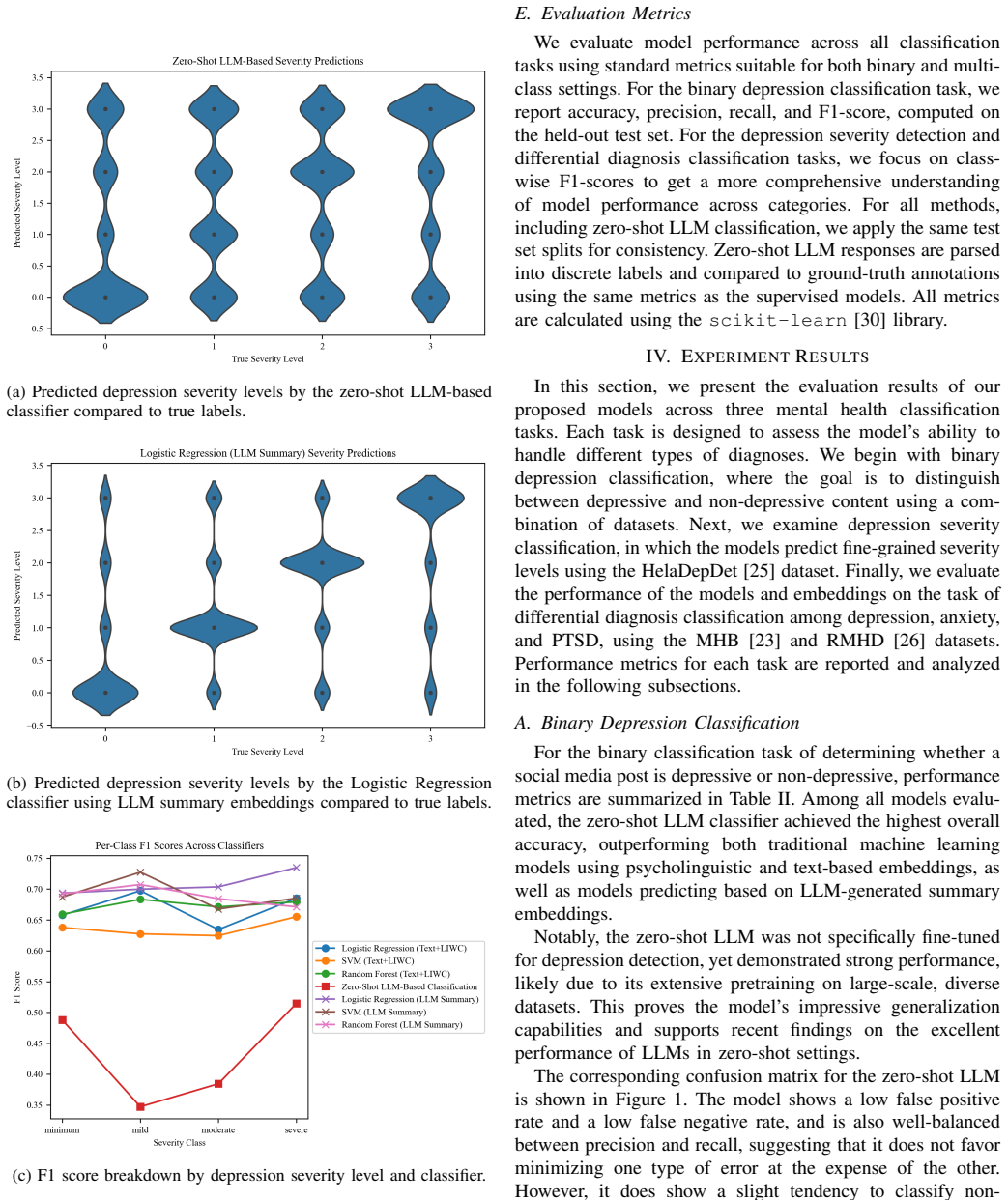
- [Section IV-B] The claim that the logistic-regression summary-embedding model performed "significantly outperforming the zero-shot LLM-based approach" on depression severity is unsupported: no accuracy figure for the zero-shot LLM is reported, no statistical test is conducted, and the word "significantly" is used without evidence. Please report exact accuracy and per-class F1 for all models on this task, and perform a paired statistical test (e.g., McNemar's test for model predictions on the same test set) to substantiate the claim.
- [Section III-A / Table I] The construction of the binary depression label from HelaDepDet is unclear. Table I lists HelaDepDet labels as "Depression, Minimum, Mild, Moderate, Severe," but the binary classification task requires a positive/negative distinction. Are all severity levels (minimum, mild, moderate, severe) mapped to the positive "depression" class, or only some? If the severity levels are ordinal, the mapping to binary labels needs explicit description, because it affects the class balance and the resulting test set, and therefore the comparison in Table II.
minor comments (9)
- [Section V] There is a typo: "accurante" should be "accurate."
- [Section II-B] Reference [21] is cited as "Qian el al."; the correct spelling is "Qian et al."
- [Section II-A] The description of [12] contains "V ADER" with an extra space; it should read "VADER."
- [Section III-A] The phrase "with no overlap between the two" is ambiguous: it likely means the training and test sets are disjoint, but it could also be read as no posts being shared. Please clarify.
- [Section IV-A / Figure 1] The confusion matrix in Figure 1 is described as showing "a slight tendency to classify non-depressive posts as depressive," but the normalized percentages are not given in the text, making the magnitude of this bias difficult to assess.
- [Section IV-B / Figure 2] The violin plots in Figures 2a and 2b are not fully described; the axes (predicted severity level vs. true severity level) are implied but not labeled clearly in the text, which makes it hard to interpret the distributions.
- [Section IV-C] The paper reports overall accuracy for differential diagnosis but does not report class-wise accuracy or balanced accuracy; given that the classes may be imbalanced (e.g., RMHD has only 658 posts), macro-averaged metrics or balanced accuracy would be more informative.
- [Section III-D] The paper does not discuss the computational cost or API usage of GPT-4o for generating summaries across all datasets, which is relevant for reproducibility and practical deployment.
- [Section III-A] The paper assumes that the labels in the five public datasets are reliable ground truth. Some of these datasets are based on self-disclosure or crowdsourced annotations; a discussion of label noise and its potential impact on feature rankings would strengthen the evaluation.
Circularity Check
No significant circularity: label-free LLM summaries and standard held-out classification.
full rationale
No circularity is present in the paper's derivation chain. The proposed feature pipeline (Section III-D) generates summaries with GPT-4o using a label-free prompt, embeds them with the fixed pretrained all-mpnet-base-v2 encoder, and trains standard classifiers on a 70/30 split (Section III-A). The summary-generation step does not see labels, and the classifiers are not evaluated on their training partition, so the reported comparison between LLM-summary embeddings and raw-text embeddings is not forced by construction. Zero-shot LLM predictions are also made directly on the held-out test set with no training. There are no load-bearing self-citations, no imported uniqueness theorems, and no fitted parameters being renamed as predictions. The only manuscript-internal inconsistency is that the abstract and Section IV describe five-fold cross-validation while Section III-A specifies a single 70/30 split and no variance or significance metrics are reported; this is a statistical-support concern, not a circularity concern, because it does not make the predicted outputs equivalent to the inputs.
Assumptions & free parameters
free parameters (3)
- text length percentile filter =
10th to 90th percentile
- classifier regularization C =
1.0
- random forest tree count =
100
assumptions (3)
- domain assumption Dataset labels reflect true mental health status.
- domain assumption GPT-4o summaries are faithful and task-relevant.
- domain assumption AITA posts are non-depressive controls.
Cite this review
Pith. "Pith review of Interpretable Depression Detection from Social Media Text Using LLM-Derived Embeddings." pith.science (2026). https://pith.science/paper/SWE7XIJX
@misc{pith2026250606616,
  author       = {Pith},
  title        = {Pith review of: Interpretable Depression Detection from Social Media Text Using LLM-Derived Embeddings},
  year         = {2026},
  howpublished = {\url{https://pith.science/paper/SWE7XIJX}},
  note         = {Machine review of arXiv:2506.06616}
}
read the original abstract
Accurate and interpretable detection of depressive language in social media can support early identification of mental health conditions and inform timely interventions. In this paper, we investigate the use of large language models (LLMs) and traditional machine learning classifiers for three social media-based mental health prediction tasks: binary depression classification, depression severity classification, and differential diagnosis among depression, PTSD, and anxiety. We compare zero-shot LLMs with supervised classifiers trained on conventional text embeddings, psycholinguistic features, and embeddings derived from LLM-generated mental health summaries. Across multiple publicly available social media text datasets and five-fold cross-validation experiments, we find that zero-shot LLMs exhibit strong performance and generalization in binary depression classification, but struggle with fine-grained severity prediction. In contrast, supervised models trained on LLM summary embeddings often achieve more accurate and consistent performance, particularly for multi-class and ordinal classification tasks. These findings highlight both the strengths and limitations of current LLMs for mental health prediction and suggest that using LLMs as semantic interpreters, rather than solely as end-to-end classifiers, may provide a promising direction for building more effective and interpretable mental health assessment systems.
Figures


Forward citations
Cited by 2 Pith papers
-
WPG-MoE: Weak-Prior-Guided Dense Mixture-of-Experts for User-Level Social Media Depression Detection
A dense mixture-of-experts model guided by training-only weak evidence-layout priors outperforms single-detector baselines on Chinese and English user-level depression detection.
-
Improving Topic Modeling of Social Media Short Texts with Rephrasing: A Case Study of COVID-19 Related Tweets
LLM rephrasing of tweets before topic modeling raises Wikipedia-measured coherence (LDA 0.31→0.50) but the abstract's claim of broad improvements is contradicted by the paper's own table for LDA and by the metric choice.
Reference graph
Works this paper leans on
-
[1]
Machine learning driven mental stress detection on Reddit posts using natural language processing,
S. Inamdar, R. Chapekar, S. Gite, and B. Pradhan, “Machine learning driven mental stress detection on Reddit posts using natural language processing,” Hum-Cent Intell Syst 3, 80–91, 2023
work page 2023
-
[2]
Teenagers’ stress detection based on time- sensitive micro-blog comment/response actions,
L. Zhao, J. Jia, and L. Feng, “Teenagers’ stress detection based on time- sensitive micro-blog comment/response actions,” In IFIP International Conference on Artificial Intelligence in Theory and Practice, pp. 26–36, 2015
work page 2015
-
[3]
Mental distress detection and triage in forum posts: the lt3 clpsych 2016 shared task system,
B. Desmet, G. Jacobs, and V . Hoste, “Mental distress detection and triage in forum posts: the lt3 clpsych 2016 shared task system,” In Proc. Third Workshop on Computational Linguistics and Clinical Psychology, pp. 148–152, 2016
work page 2016
-
[4]
Stress detection using natural language processing and machine learning over social interactions,
T. Nijhawan, G. Attigeri, and T. Ananthakrishna, “Stress detection using natural language processing and machine learning over social interactions,” J Big Data 9, 33, 2022
work page 2022
-
[5]
Incorporating forthcoming events and personality traits in social media based stress prediction,
N. Li, H. Zhang, and L. Feng, “Incorporating forthcoming events and personality traits in social media based stress prediction,” IEEE Trans. Affect. Comput, 2021
work page 2021
-
[6]
Understanding and measuring psychological stress using social media,
S. C. Guntuku, A. Buffone, L. Jaidka, J. C. Eichstaedt, and L. H. Ungar, “Understanding and measuring psychological stress using social media,” In Proc. International AAAI Conference on Web and Social Media, vol. 13, pp. 214–225, 2019
work page 2019
-
[7]
Mental stress prediction from the text of social media using machine learning techniques,
M. H. Kabir, N. Samrat, A. Al Mahmud, R. Akter and M. Raihan, “Mental stress prediction from the text of social media using machine learning techniques,” 2023 14th International Conference on Computing Communication and Networking Technologies (ICCCNT), Delhi, India, 2023
work page 2023
-
[8]
Q. He, B. P. Veldkamp, C. A. W. Glas, and T. de Vries, “Automated assessment of patients’ self-narratives for posttraumatic stress disorder screening using natural language processing and text mining,” Assess- ment 24, 157–172, 2017
work page 2017
Show all 30 references
-
[9]
Predicting posttraumatic stress disorder risk: a machine learning approach,
S. Wshah S, C. Skalka C, and M. Price, “Predicting posttraumatic stress disorder risk: a machine learning approach,” JMIR Ment Health 2019;6(7):e13946
2019
-
[10]
Text mining to improve screening for trauma-related symptoms in a global sample,
D. Marengo, C. M. Hoeboer, B. P. Veldkamp, and M. Olff, “Text mining to improve screening for trauma-related symptoms in a global sample,” Psychiatry Research, V olume 316, 2022
2022
-
[11]
Artificial intelligence language predictors of two-year trauma-related outcomes,
J. R. Oltmanns, H. A. Schwartz, C. Ruggero, Y . Son, J. Miao, M. Waszczuk, S. A. P. Clouston, E. J. Bromet, B. J. Luft, and R. Kotov, “Artificial intelligence language predictors of two-year trauma-related outcomes,” Journal of psychiatric research, 143, 239–245, 2021
2021
-
[12]
Detecting presence of PTSD using sentiment analysis from text data,
J. Sawalha, M. Yousefnezhad, Z. Shah, M. R. G. Brown, A. J. Green- shaw, and R. Greiner, “Detecting presence of PTSD using sentiment analysis from text data,” Frontiers in psychiatry, 12, 811392, 2022
2022
-
[13]
A novel text mining approach for mental health prediction using Bi- LSTM and BERT model,
K. Zeberga, M. Attique, B. Shah, F. Ali, Y . Z. Jembre, and T. S. Chung, “A novel text mining approach for mental health prediction using Bi- LSTM and BERT model,” Computational intelligence and neuroscience, 2022, 7893775
2022
-
[14]
Early detection of mental health crises through artifical-intelligence-powered social media analysis: a prospective observational study,
M. A. Mansoor and K. H. Ansari, “Early detection of mental health crises through artifical-intelligence-powered social media analysis: a prospective observational study,” Journal of personalized medicine, 14(9), 958, 2024
2024
-
[15]
Large-scale analysis of coun- seling conversations: an application of natural language processing to mental health,
T. Althoff, K. Clark, and J. Leskovec, “Large-scale analysis of coun- seling conversations: an application of natural language processing to mental health,” Transactions of the Association for Computational Linguistics, 4:463–476, 2016
2016
-
[16]
M. P. Ewbank, R. Cummins, V . Tablan, A. Catarino, S. Buchholz, and A. D. Blackwell, “Understanding the relationship between patient language and outcomes in internet-enabled cognitive behavioural therapy: A deep learning approach to automatic coding of session transcripts,” P...
2021
-
[17]
Just in time crisis response: suicide alert system for telemedicine psychotherapy settings,
N. Bantilan, M. Malgaroli, B. Ray, and T. D. Hull, “Just in time crisis response: suicide alert system for telemedicine psychotherapy settings,” Psychotherapy Research, 31(3), 289–299, 2020
2020
-
[18]
Mental-LLM: leveraging large language models for mental health prediction via online text data,
X. Xu, B. Yao, Y . Dong, S. Gabriel, H. Yu, J. Hendler, M. Ghassemi, A. K. Dey, and D. Wang, “Mental-LLM: leveraging large language models for mental health prediction via online text data,” Proc. ACM Interact. Mob. Wearable Ubiquitous Technol. 8, 1, Article 31 (March 2024), 3...
2024
-
[19]
Evaluating enhanced LLMs for precise mental health diagnosis from clinical notes,
L. Boggavarapu, V . Srivastava, A. M. Varanasi, Y . Lu, R. Bhaumik, “Evaluating enhanced LLMs for precise mental health diagnosis from clinical notes,” medRxiv, 2024, unpublished
2024
-
[20]
Large language models for the mental health community: framework for translating code to care,
M. Malgaroli, K. Schultebraucks, K. J. Myrick, A. A. Loch, L. Ospina- Pinillos, T. Choudhury, R. Kotov, M. De Choudhury, and J. Torous, “Large language models for the mental health community: framework for translating code to care,” The Lancet. Digital health, 7(4), e282–e285, 2025
2025
-
[21]
Foundation models for digital mental health: igniting the dawn,
K. Qian, H. Zhang, X. Jing, B. Hu, Y . Yamamoto, and B. W. Schuller, “Foundation models for digital mental health: igniting the dawn,” Medicine Plus, V olume 2, Issue 2, 2025
2025
-
[22]
A scoping review of large language models for generative tasks in mental health care,
Y . Hua, H. Na, Z. Li, F. Liu, X. Fang, D. Clifton, and J. Torous, “A scoping review of large language models for generative tasks in mental health care,” npj Digit. Med. 8, 230, 2025
2025
-
[23]
Leveraging mental health forums for user-level depression detection on social media,
S. Boinepelli, T. Raha, H. Abburi, P. Parikh, N. Chhaya, and V . Varma, “Leveraging mental health forums for user-level depression detection on social media,” In Proceedings of the Thirteenth Language Resources and Evaluation Conference, pages 5418–5427, Marseille, France. Eur...
2022
-
[24]
CAMS: an annotated corpus for causal analysis of mental health issues in social media posts,
M. Garg, C. Saxena, S. Saha, V . Krishnan, R. Joshi, and V . Mago, “CAMS: an annotated corpus for causal analysis of mental health issues in social media posts,” In Proceedings of the Thirteenth Language Resources and Evaluation Conference, pages 6387–6396, Marseille, France. ...
2022
-
[25]
HelaDepDet: a novel multi-class classification model for detecting the severity of human depression,
Y . H. P. P. Priyadarshana, Z. Liang, and I. Piumarta, “HelaDepDet: a novel multi-class classification model for detecting the severity of human depression,” In Collaboration Technologies and Social Com- puting: 29th International Conference, CollabTech 2023, Osaka, Japan, Aug...
2023
-
[26]
From posts to knowledge: annotating a pandemic-Era Reddit dataset to navigate mental health narratives,
S. Rani, K. Ahmed, and S. Subramani, “From posts to knowledge: annotating a pandemic-Era Reddit dataset to navigate mental health narratives,” Applied Sciences, 2024; 14(4):1547
2024
-
[27]
De- pressionEmo: a novel dataset for multilabel classification of depression emotions,
A. B. S. Rahman, H. Ta, L. Najjar, A. Azadmanesh, A. S. G ¨onul, “De- pressionEmo: a novel dataset for multilabel classification of depression emotions,” Journal of Affective Disorders, V olume 366, 2024, Pages 445-458
2024
-
[28]
‘Am I the Bad One’? predicting the moral judgement of the crowd using pre–trained language models,
A. Alhassan, J. Zhang, and V . Schlegel, “‘Am I the Bad One’? predicting the moral judgement of the crowd using pre–trained language models,” In Proceedings of the Thirteenth Language Resources and Evaluation Conference, pages 267–276, Marseille, France. European Language Reso...
2022
-
[29]
MPNet: masked and permuted pre-training for language understanding,
K. Song, X. Tan, T. Qin, J. Lu, and T. Liu, “MPNet: masked and permuted pre-training for language understanding,” In Proceedings of the 34th International Conference on Neural Information Processing Systems (NIPS ’20), Curran Associates Inc., Red Hook, NY , USA, Article 1414, ...
2020
-
[30]
Scikit-learn: machine learning in Python,
F. Pedregosa, G. Varoquaux, A. Gramfort, V . Michel, B. Thirion, O. Grisel, M. Blondel, P. Prettenhofer, R. Weiss, V . Dubourg, J. Vanderplas, A. Passos, D. Cournapeau, M. Brucher, M. Perrot, and ´E. Duchesnay, “Scikit-learn: machine learning in Python,” J. Mach. Learn. Res. 1...
2011
Reviewed August 7, 2026 · model on record in the stance chip above.
Discussion (0). Sign in to comment.