REVIEW 3 major objections 4 minor 11 references
QuantMCP: Grounding Large Language Models in Verifiable Financial Reality
T0 review · 3 major / 4 minor · reviewed 2026-08-07 · deepseek-v4-flash
Pith's one-line read QuantMCP grounds LLM financial answers in live API data, so numbers come from Wind or yfinance rather than from the model's memory.
desk verdict Routine MCP integration with one anecdote, no evaluation, and an overstated guarantee. read the letter →
The pith
A machine-rendered reading of the paper's core claim, the machinery that carries it, and where it could break.
The reading
What carries the argument
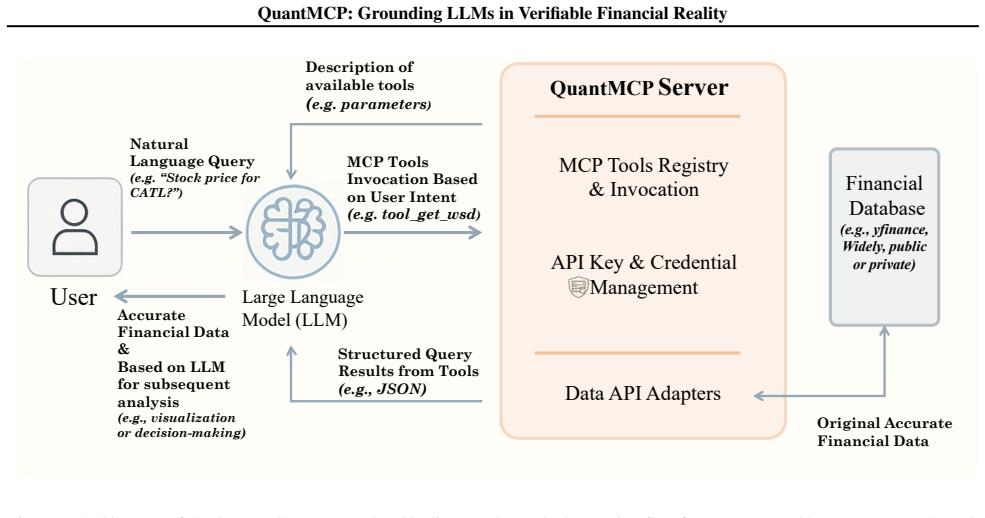
The Model Context Protocol (MCP) server is the central mechanism: a standardized gateway that exposes financial data functions as discoverable tools with declared parameters, invokes the appropriate Python API adapter (such as WindPy or yfinance), manages API credentials server-side, and returns structured JSON to the LLM. The work it does is to turn the LLM's natural-language intent into a parameterized, authenticated data request, so the model's answer is built on externally sourced facts rather than memory.
What would settle it
Run a set of ambiguous financial queries through QuantMCP—company names that map to multiple tickers, relative dates like 'last quarter', and field codes that vary by provider—then compare the MCP tool-call parameters against human-annotated ground truth. If a meaningful share of calls retrieve data for the wrong security, date window, or field, the claim that grounding guarantees data integrity fails.
Extended reading notes
Core claim
The paper claims that routing every specific financial data point through an MCP server—rather than letting the LLM answer from parametric memory—mitigates hallucination and guarantees data integrity in finance. The LLM's job is restricted to understanding intent, choosing a tool, and assembling parameters; the data itself comes from the API, so the user sees numbers with external provenance. The paper then argues that the same architecture unlocks analysis: with grounded data in hand, the LLM can compute averages, identify trends, compare benchmarks, and generate explanations it could not safely produce otherwise. The demonstration shows DeepSeek-V3-0324 correctly parsing a query about Contemporary Amperex Technology's first-quarter 2024 close, price-to-book, and turnover, retrieving the data through Wind, and returning both retrieved values and calculated averages.
Load-bearing premise
The load-bearing premise is that the LLM reliably turns natural-language intent into correct tool calls—right ticker, date range, and field codes—because any error at that step would deliver an authoritative-looking wrong answer, and the paper does not test that step.
Editorial extensions
If this is right
- Financial queries answered through QuantMCP carry data provenance: every number traces to a named API call at query time, so a user can audit where a figure came from.
- Non-programmers can request professional datasets in plain language and get structured, analysis-ready data without learning Wind or yfinance call syntax.
- The same MCP server can expose additional Python-accessible financial sources, so the framework scales beyond the prototype's Wind integration.
- Analysis tasks such as averages, comparisons, trend detection, and visualization are performed on externally sourced data, making the reasoning less likely to be built on fabricated inputs.
- Credential handling stays server-side, so users and models never see API keys, reducing the attack surface for financial data access.
Reading between the lines
- Editorial inference: the paper's failure mode shifts but does not disappear—if the LLM mis-parameterizes a tool call with the wrong ticker, date window, or field code, the wrong data arrives with the same authoritative provenance, and the paper does not test this step.
- Editorial inference: a natural extension is to benchmark the natural-language-to-tool-call step against a human-annotated set of ambiguous financial queries, which would give a quantitative test of the data-integrity guarantee.
- Editorial inference: the same MCP-grounded pattern could transfer to other high-stakes domains where the model should never invent facts, such as medical records, legal dockets, or scientific databases, provided a comparable API layer exists.
Editorial analysis
A structured set of objections, weighed in public.
Referee Report
Summary. The paper proposes QuantMCP, a framework that uses the Model Context Protocol (MCP) to let a large language model (LLM) retrieve financial data from external APIs (Wind, yfinance, etc.) through a set of registered tools, and then use that retrieved data for downstream analysis. The architecture has three layers: an LLM-based natural language interface, an MCP server that exposes and invokes financial data tools, and a final LLM stage that performs analysis on the grounded data. The paper also describes a prototype implementation using DeepSeek-V3 and Wind, and illustrates the workflow with a single query about CATL stock data for Q1 2024, including the computation of average closing price and turnover rate. The central claim is that grounding LLM responses in API-retrieved data 'mitigates hallucination and guarantees data integrity.'
Significance. If the central claim were convincingly demonstrated, QuantMCP would be a useful contribution to applied LLM systems for finance: it addresses a real problem (LLM hallucination on financial facts), uses a timely standardization mechanism (MCP), and lowers the barrier to querying professional financial data. The paper is clearly written and the architecture description is plausible. However, the evidence presented is limited to a single successful invocation with no baseline, no error analysis, and no quantitative evaluation of tool-call accuracy, hallucination rates, or analysis correctness. The framework itself is not fundamentally flawed, but the claimed guarantees are not currently supported by the manuscript's experiments.
major comments (3)
- [Section 4.2] The central claim that QuantMCP 'mitigates hallucination and guarantees data integrity' (abstract, Section 3.2) is not supported by the evaluation. Section 4.2 reports a single successful query execution, with no error rate, no comparison against an LLM without grounding, no adversarial or out-of-distribution queries, and no quantitative metric for retrieval or computation accuracy. Because this is the only demonstration, the paper does not establish that the framework reliably produces correct answers across realistic queries. A revision should add a systematic evaluation: a benchmark of diverse natural language queries, measurement of tool-call parameterization accuracy (ticker, date range, field codes), comparison with a baseline LLM on the same questions, and an analysis of hallucination/error cases.
- [Section 3.2] The claim that grounding in external APIs 'guarantees data integrity' overstates what the architecture ensures. As described in Section 3.1, the LLM is solely responsible for translating natural language into correct MCP tool calls. If the model emits a wrong ticker, an incorrect date range, or a misnamed field, the MCP server will faithfully execute the call and return authoritative-looking data that does not answer the user's question. No component in the pipeline verifies that the retrieved data matches the user's intent. This is not a hypothetical concern: it is the standard failure mode of LLM tool use. The paper should either add a verification/feedback mechanism for tool-call correctness or explicitly scope the claim to 'data provenance is verified, not semantic correctness of retrieval.'
- [Section 4.2] The demonstration claims that the LLM computes the average closing price and average turnover rate, but there is no independent check of these computed values. The paper does not report the exact numbers, compare them against ground-truth calculations, or assess the LLM's arithmetic reliability. Since analytical outputs are not API data, they are not automatically grounded. The manuscript should include a verification of any derived metrics, or explicitly separate 'API-retrieved data' from 'LLM-computed analytics' and discuss the associated error modes.
minor comments (4)
- [Abstract / Section 3.2] The phrase 'guarantees data integrity' is too strong given the analysis above; consider replacing it with something like 'verifies data provenance' or 'reduces the risk of hallucinated data points.'
- [Figure 1] The figure contains a typo: 'Financial Database (e.g., yfinance, Widely, public or private)' should presumably be 'Windy' or 'Wind'; please correct.
- [Section 4.2] The example JSON snippet has mismatched brackets: it opens with '[' but the inner dictionaries use '}' without a closing ']' for the list. This makes the example harder to parse; fix the formatting.
- [Section 4.1] The manuscript describes a prototypical implementation but does not provide a link to code or a repository. For reproducibility, please consider releasing the MCP server implementation and the example configurations.
Circularity Check
No circularity: QuantMCP is an integration framework with no derived prediction that reduces to its inputs.
full rationale
The paper makes no formal derivation, fits no parameters, and contains no equation whose output is equivalent to its input by construction. Its central claim is architectural: using MCP tools to route LLM requests to financial APIs (Wind, yfinance) so that returned data is sourced externally rather than from parametric memory. This is an engineering claim, not a prediction derived from fitted inputs. The only self-citation is Zeng (2024), used alongside Achiam et al. (2023) to support the generic statement that LLMs can understand complex queries and synthesize information; that citation is not load-bearing because the QuantMCP mechanism does not depend on it. The illustrative workflow in Section 4.2 is a single successful invocation, not a benchmark, and the paper's unsubstantiated 'guarantee' of data integrity is a correctness/validation gap rather than a circularity. No passage asserts a limitation that would constitute an admission of circular reasoning, and none of the seven enumerated circularity patterns is instantiated with quotable reduction.
Assumptions & free parameters
assumptions (3)
- domain assumption MCP standardizes tool discovery and invocation sufficiently for reliable LLM-tool interaction.
- domain assumption Financial data retrieved from Wind/yfinance APIs is authoritative, accurate, and timely.
- domain assumption The LLM (e.g., DeepSeek-V3) can reliably translate natural language queries into correct tool names and parameters.
Cite this review
Pith. "Pith review of QuantMCP: Grounding Large Language Models in Verifiable Financial Reality." pith.science (2026). https://pith.science/paper/FVMHNUJO
@misc{pith2026250606622,
  author       = {Pith},
  title        = {Pith review of: QuantMCP: Grounding Large Language Models in Verifiable Financial Reality},
  year         = {2026},
  howpublished = {\url{https://pith.science/paper/FVMHNUJO}},
  note         = {Machine review of arXiv:2506.06622}
}
read the original abstract
Large Language Models (LLMs) hold immense promise for revolutionizing financial analysis and decision-making, yet their direct application is often hampered by issues of data hallucination and lack of access to real-time, verifiable financial information. This paper introduces QuantMCP, a novel framework designed to rigorously ground LLMs in financial reality. By leveraging the Model Context Protocol (MCP) for standardized and secure tool invocation, QuantMCP enables LLMs to accurately interface with a diverse array of Python-accessible financial data APIs (e.g., Wind, yfinance). Users can interact via natural language to precisely retrieve up-to-date financial data, thereby overcoming LLM's inherent limitations in factual data recall. More critically, once furnished with this verified, structured data, the LLM's analytical capabilities are unlocked, empowering it to perform sophisticated data interpretation, generate insights, and ultimately support more informed financial decision-making processes. QuantMCP provides a robust, extensible, and secure bridge between conversational AI and the complex world of financial data, aiming to enhance both the reliability and the analytical depth of LLM applications in finance.
Figures


Reference graph
Works this paper leans on
-
[1]
L., Almeida, D., Altenschmidt, J., Altman, S., Anadkat, S., et al
Achiam, J., Adler, S., Agarwal, S., Ahmad, L., Akkaya, I., Aleman, F. L., Almeida, D., Altenschmidt, J., Altman, S., Anadkat, S., et al. Gpt-4 technical report. arXiv preprint arXiv:2303.08774, 2023
arXiv 2023
-
[2]
Ai in finance: challenges, techniques, and opportunities
Cao, L. Ai in finance: challenges, techniques, and opportunities. ACM Computing Surveys (CSUR), 55 0 (3): 0 1--38, 2022
work page 2022
-
[3]
A survey on hallucination in large language models: Principles, taxonomy, challenges, and open questions
Huang, L., Yu, W., Ma, W., Zhong, W., Feng, Z., Wang, H., Chen, Q., Peng, W., Feng, X., Qin, B., et al. A survey on hallucination in large language models: Principles, taxonomy, challenges, and open questions. ACM Transactions on Information Systems, 43 0 (2): 0 1--55, 2025
2025
-
[4]
Large language models in finance: A survey
Li, Y., Wang, S., Ding, H., and Chen, H. Large language models in finance: A survey. In Proceedings of the fourth ACM international conference on AI in finance, pp.\ 374--382, 2023
work page 2023
-
[5]
Liu, A., Feng, B., Xue, B., Wang, B., Wu, B., Lu, C., Zhao, C., Deng, C., Zhang, C., Ruan, C., et al. Deepseek-v3 technical report. arXiv preprint arXiv:2412.19437, 2024
arXiv 2024
-
[6]
Singh, A., Ehtesham, A., Kumar, S., and Khoei, T. T. A survey of the model context protocol (mcp): Standardizing context to enhance large language models (llms). 2025
work page 2025
-
[7]
\"U nsal, E., \"O ztekin, B., C avu s , M., and \"O zdemir, S. Building a fintech ecosystem: Design and development of a fintech api gateway. In 2020 international symposium on networks, computers and communications (ISNCC), pp.\ 1--5. IEEE, 2020
work page 2020
-
[8]
V., Zhou, D., et al
Wei, J., Wang, X., Schuurmans, D., Bosma, M., Xia, F., Chi, E., Le, Q. V., Zhou, D., et al. Chain-of-thought prompting elicits reasoning in large language models. Advances in neural information processing systems, 35: 0 24824--24837, 2022
2022
Show all 11 references
-
[9]
Fincon: A synthesized llm multi-agent system with conceptual verbal reinforcement for enhanced financial decision making
Yu, Y., Yao, Z., Li, H., Deng, Z., Jiang, Y., Cao, Y., Chen, Z., Suchow, J., Cui, Z., Liu, R., et al. Fincon: A synthesized llm multi-agent system with conceptual verbal reinforcement for enhanced financial decision making. Advances in Neural Information Processing Systems, 37...
2024
-
[10]
Histolens: An llm-powered framework for multi-layered analysis of historical texts--a case application of yantie lun
Zeng, Y. Histolens: An llm-powered framework for multi-layered analysis of historical texts--a case application of yantie lun. arXiv preprint arXiv:2411.09978, 2024
2024 arXiv
-
[11]
write newline
" write newline "" before.all 'output.state := FUNCTION n.dashify 't := "" t empty not t #1 #1 substring "-" = t #1 #2 substring "--" = not "--" * t #2 global.max substring 't := t #1 #1 substring "-" = "-" * t #2 global.max substring 't := while if t #1 #1 substring * t #2 gl...
Reviewed August 7, 2026 · model on record in the stance chip above.
Discussion (0). Sign in to comment.