REVIEW 4 major objections 5 minor 14 references
Psychological Counseling Cannot Be Achieved Overnight: Automated Psychological Counseling Through Multi-Session Conversations
T0 review · 4 major / 5 minor · reviewed 2026-08-07 · deepseek-v4-flash
Pith's one-line read A multi-session dataset and memory-guided model let an LLM counselor track client progress and produce sustained mood improvement over six simulated sessions.
desk verdict Useful new multi-session counseling dataset and three-task model, but the headline 'long-term improvement' claim rests entirely on a closed GPT-4o loop and needs human outcome validation before it can be cited as a counseling effect. read the letter →
The pith
A machine-rendered reading of the paper's core claim, the machinery that carries it, and where it could break.
The reading
What carries the argument
The load-bearing mechanism is a structured external memory and the three-task loop built around it. After each session, a Memory Extraction task condenses the dialogue into client profiles, counseling notes (counselor observations, session goals, assignments), and a counseling summary; a Goal Planning task then proposes the next session's CBT goal from that memory; and the Counseling Generation task produces the next dialogue conditioned on the memory and goal. On the data side, the enabling construction step is 'seed conversations': the authors generate short coherent multi-session dialogues in one pass and then expand each seed into a full session, which is what keeps the generated corpus coherent across sessions. This memory-plus-goal loop is what distinguishes MusPsy-Model from single-session baselines and is claimed to carry the longitudinal improvement.
What would settle it
Run the same six-session protocol with a simulated client explicitly instructed to resist the counselor's reframing and to report emotions honestly; if PANAS and WAI still climb steadily, the gains are likely artifacts of role-play. A complementary check is to have blinded human raters score transcripts for whether the client's reported improvement is grounded in concrete behavioral changes mentioned in the dialogue.
Extended reading notes
Core claim
The paper's central claim is that the multi-session setting is not just an add-on but the defining condition of realistic automated counseling, and that a model explicitly built for it outperforms single-session systems over time. The authors construct MusPsy-Dataset from real client profiles and session goals in public CBT case reports, generating 1,400 clients with an average of 6.17 sessions each, then train MusPsy-Model to extract session memories, plan next-session goals, and generate counseling conditioned on both. In six-session simulations where an LLM plays the client, the model reduces negative affect and raises positive affect and working-alliance scores across sessions, whereas single-session baselines become repetitive after two sessions. The authors also show that the dataset alone contributes part of the gain: a version of the model using only generation, without memory and goal planning, still beats some baselines but cannot match the full multi-session system.
Load-bearing premise
The effectiveness result stands on the assumption that an LLM prompted to act as a client and then rate its own affect, together with GPT-4o's alliance ratings, captures genuine therapeutic change rather than prompt-driven compliance or stylistic matching to the training data; the paper offers no human-client outcome measure for the model.
Editorial extensions
If this is right
- Multi-session counseling models can be trained to make working alliance grow over sessions instead of flatlining, mirroring the expected therapy trajectory.
- A counselor LLM that keeps session-level memory and plans next-session goals can continue addressing a client's issues past session two, where single-session baselines start repeating themselves.
- Evaluation of automated counseling should include longitudinal measures such as PANAS and WAI over multiple simulated sessions, not only single-turn quality.
- The ablation shows that dataset quality and architecture both matter: the multi-session data alone lifts performance above some baselines, but the memory-and-goal design is needed for sustained long-term gains.
Reading between the lines
- The same memory-extraction and goal-planning loop could serve as a general longitudinal case-management pattern for other helping conversations—tutoring, coaching, chronic-care follow-up—where the system must remember progress and re-plan each encounter.
- Because the simulated-client PANAS protocol is cheap, it could be turned into a screening test for counseling models before human trials, provided it is first validated against human-client outcomes.
- The case-report-to-dataset pipeline suggests that anonymized session-level case documentation from other therapeutic schools could generate multi-session corpora without full transcripts, broadening beyond CBT.
Editorial analysis
A structured set of objections, weighed in public.
Referee Report
Summary. The paper proposes a multi-session paradigm for automated psychological counseling. It introduces MusPsy-Dataset, constructed from public case reports by extracting client profiles and counseling goals, generating short seed conversations, expanding them into complete sessions, and producing structured memories, and MusPsy-Model, a Llama-3-8B-Instruct model fine-tuned jointly for memory extraction, goal planning, and counseling generation. The central empirical claim is that the model outperforms single-session baselines across sessions and produces long-term improvement in simulated clients' positive and negative affect, measured by GPT-4o-rated WAI scores and an LLM-simulated client's PANAS ratings.
Significance. If validated, the dataset and modeling tasks address a genuine gap: most counseling datasets are single-session despite counseling in practice being longitudinal. The construction pipeline is thoughtful, with grounding in case reports, explicit session goals, and a memory module, and the dataset receives positive human expert ratings in Table 2. The weakness is that the model-effectiveness claim rests entirely on an unvalidated closed-loop LLM evaluation in which GPT-4o generates the data, plays the client, and judges the outputs, so the central contribution is not yet established. The dataset itself may still be a useful resource for the community.
major comments (4)
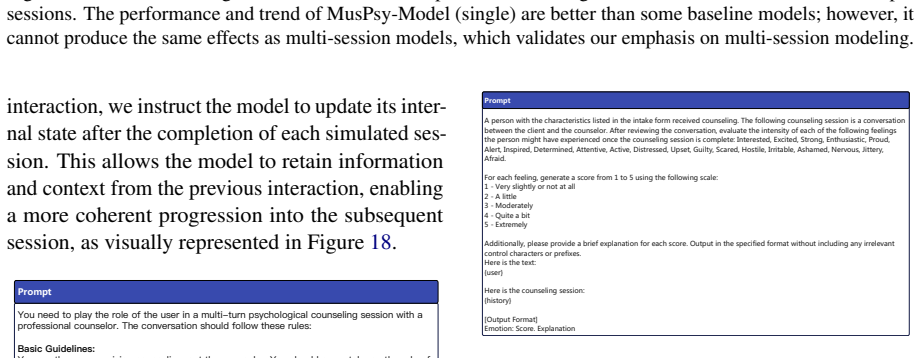
- [6.3, Appendix G (Figures 13, 18, 19)] The central claim that MusPsy-Model 'effectively reduces negative emotions and enhances positive emotions in the long term' is supported only by a closed GPT-4o loop. GPT-4o generates the training data, simulates the client, infers the client's PANAS, and rates WAI; no human evaluation of model-generated outputs is reported. Because the simulated client is prompted to update its internal dynamic state after each session, the positive PANAS trajectory may reflect the simulation protocol rather than counselor skill. The Limitations paragraph acknowledges LLM-evaluation bias, but the abstract and Section 6.3.1 still state the effectiveness result without this caveat. This is load-bearing: the model comparison and the abstract's 'better than baseline' claim depend on these measures.
- [6.3, Appendix G] The outcome measures are not validated for this setting. PANAS and WAI are psychometric instruments designed for human respondents and human raters; an LLM prompted to 'play the role of the user' and then asked to rate its own emotions (Figure 19) has no established validity, and no comparison against human PANAS or WAI ratings on the same transcripts is provided. A cross-family LLM judge or human ratings would be needed to rule out prompt-induced compliance and in-distribution style matching with the GPT-4o-generated data.
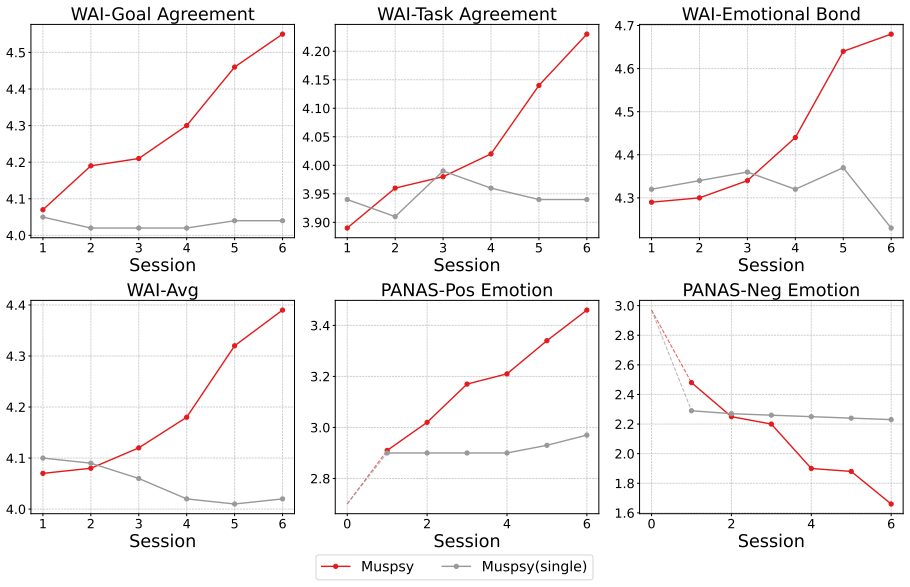
- [Figure 6, Section 6.3.1] The plots show mean trajectories over 100 test clients without error bars, confidence intervals, or significance tests, yet the text claims the model 'significantly alleviates' negative emotions and shows a 'long-term upward trend.' With 100 clients, inferential statistics are feasible, and without them the apparent separation from baselines may be driven by a few extreme clients or by the closed-loop protocol.
- [6.1, Figure 6, Appendix H] The baseline comparison is confounded by training data. Baselines are fine-tuned on SMILE, CACTUS, SimPsyDial, and CPsyCoun, which are single-session or multi-turn datasets but not multi-session counseling corpora, so their inferior multi-session performance may reflect dataset mismatch rather than the MusPsy-Model's multi-session design. Appendix H's MusPsy(single) control is a partial remedy, but it is evaluated with the same unvalidated loop and without statistical tests.
minor comments (5)
- [4.3] The qualifications of the 'two psychology experts' are described only in the Ethical Statement as a bachelor's degree and two years of relevant experience; the main text should state their credentials and report inter-annotator agreement.
- [Figure 6] The PANAS panels use a session axis starting at 0 while the WAI panels start at 1; the axes should be made consistent or the difference should be explained.
- [Table 3] Task 1 and Task 2 report BLEU and F1 scores without any baseline, so values such as BLEU-1 42.7 for memory extraction are difficult to interpret; adding a simple baseline or reference model would help.
- [Introduction, References] The introduction cites 'Organization, 2024' for rising mental-health burden, but the reference list entry is 'Global tuberculosis report 2024'; the intended WHO mental health report should be cited.
- [Throughout] There are typos and inconsistent terminology throughout, e.g., 'counseling' versus 'counseling,' 'The construction of our dataset involves' with an initial capital mid-sentence, and inconsistent capitalization of MusPsy.
Circularity Check
Central 'long-term improvement' claim rests on a closed GPT-4o loop: the training data generator, the simulated client, and the PANAS/WAI judges are the same model family, so the measured effect is a self-consistency check rather than an independent outcome.
-
other
[Section 6.3 and Appendix G (Figures 18-19)]
"In these simulations, the LLM acts as a client interacting with the counselor model. ... After the session, we ask it to evaluate its PANAS score to analyze the counseling model's effectiveness. It updates its own state and prepares for the next counseling conversation. ... For these evaluations, we utilize GPT-4o."
The outcome used to support the claim that the model 'effectively reduces negative emotions and enhances positive emotions in the long term' is produced by the same model family that generated the training dialogues and that plays the client in the simulation. The counselor model is fine-tuned on GPT-4o-generated dialogues; the 'client' is a GPT-4o prompt instructed to update its internal state after each session; the PANAS score is GPT-4o's inference about that simulated client; the WAI scores are also GPT-4o judgments. The measured improvement is therefore a closed-loop consistency check between the trained model and the generator/judge, not an externally validated counseling outcome.
full rationale
The dataset construction itself is not circular: MusPsy-Dataset is assembled from public case reports with human validation, and the dataset-quality comparisons use human expert ratings in addition to GPT-4o. The central problem is that the model's behavioral claim—the abstract's 'better than baseline models across multiple sessions' and Section 6.3.1's 'effectively reduces negative emotions and enhances positive emotions in the long term'—is evaluated entirely inside a GPT-4o loop. GPT-4o generates the training dialogues from case reports whose dynamic states already document improvement; GPT-4o plays the client and updates its own internal state after each session; GPT-4o scores the resulting PANAS trajectory and WAI ratings. Thus the trained Llama model is rewarded for imitating the GPT-4o-generated counseling style, and the evaluation judges that imitation using the same model's priors. The observed upward PANAS/WAI trends are therefore a self-consistency check, not independent evidence of therapeutic effectiveness. No self-citation chain or imported uniqueness theorem is present; the circularity is in the evaluation design. Because this loop is the load-bearing evidence for the central performance claim, the paper receives a score of 7 rather than a lower score for minor self-citation.
Assumptions & free parameters
assumptions (4)
- domain assumption CBT counseling is inherently multi-session and progress across sessions is a valid target for automation.
- domain assumption Public psychological case reports, though lacking full transcripts, contain enough session-by-session state and goals to reconstruct realistic counseling.
- ad hoc to paper LLM-generated expansions of seed conversations faithfully represent real counseling practice and client responses.
- ad hoc to paper An LLM prompted to role-play a client can provide a valid self-report of emotional state (PANAS) and the LLM judge's WAI scores reflect the true working alliance.
Cite this review
Pith. "Pith review of Psychological Counseling Cannot Be Achieved Overnight: Automated Psychological Counseling Through Multi-Session Conversations." pith.science (2026). https://pith.science/paper/P2VYJXQ4
@misc{pith2026250606626,
  author       = {Pith},
  title        = {Pith review of: Psychological Counseling Cannot Be Achieved Overnight: Automated Psychological Counseling Through Multi-Session Conversations},
  year         = {2026},
  howpublished = {\url{https://pith.science/paper/P2VYJXQ4}},
  note         = {Machine review of arXiv:2506.06626}
}
read the original abstract
In recent years, Large Language Models (LLMs) have made significant progress in automated psychological counseling. However, current research focuses on single-session counseling, which doesn't represent real-world scenarios. In practice, psychological counseling is a process, not a one-time event, requiring sustained, multi-session engagement to progressively address clients' issues. To overcome this limitation, we introduce a dataset for Multi-Session Psychological Counseling Conversation Dataset (MusPsy-Dataset). Our MusPsy-Dataset is constructed using real client profiles from publicly available psychological case reports. It captures the dynamic arc of counseling, encompassing multiple progressive counseling conversations from the same client across different sessions. Leveraging our dataset, we also developed our MusPsy-Model, which aims to track client progress and adapt its counseling direction over time. Experiments show that our model performs better than baseline models across multiple sessions.
Figures


Figures from the paper (12 more)


Reference graph
Works this paper leans on
-
[1]
As a result of these sessions I am clearer as to how I might be able to change
-
[2]
What I am doing in therapy gives me new ways of looking at my problem
-
[3]
I believe counselor likes me
-
[4]
counselor and I collaborate on setting goals for my therapy
-
[5]
counselor and I respect each other
-
[6]
counselor and I are working towards mutually agreed upon goals
-
[7]
I feel that counselor appreciates me
-
[8]
counselor and I agree on what is important for me to work on
Show all 14 references
-
[9]
I feel counselor cares about me even when I do things that he/she does not approve of
-
[10]
I feel that the things I do in therapy will help me to accomplish the changes that I want
-
[11]
counselor and I have established a good understanding of the kind of changes that would be good for me
-
[12]
I believe the way we are working with my problem is correct. [Rating Scale] 1: Seldom 2: Sometimes 3: Fairly Often 4: Very Often 5: Always [Response Format] Question number: Score [Below is the history of the counseling dialogue] {diag} Prompt Figure 13: The prompt used for to...
-
[2014]
client-centered
Digital cognitive behaviour therapy (cbt) in canada: Ethical considerations.Canadian Psychol- ogy/Psychologie canadienne, 55(4):231. Suyeon Lee, Sunghwan Mac Kim, Minju Kim, Dongjin Kang, Dongil Yang, Harim Kim, Minseok Kang, Dayi Jung, Min Kim, Seungbeen Lee, et al. 2024. Cac...
2024 arXiv
-
[2024]
Judith S Beck
Content and attainment of individual treatment goals in cbt.Psychotherapy Research, 34(1):111– 123. Judith S Beck. 2020.Cognitive behavior therapy: Ba- sics and beyond. Guilford Publications. Judith S Beck, AT Beck, and JS Beck. 2011. Cognitive behavior therapy: basics and bey...
2020 arXiv
Reviewed August 7, 2026 · model on record in the stance chip above.
Discussion (0). Sign in to comment.