REVIEW 3 major objections 6 minor 74 references
Learning Variational Quantum Circuit Parameters with Classical Artificial Intelligence for Quantum Phase Transition Detection
T0 review · 3 major / 6 minor · reviewed 2026-08-07 · deepseek-v4-flash
Pith's one-line read The paper proposes that quantum phase boundaries can be read off directly from VQE-converged circuit parameters, without measuring physical observables, by learning the parameter distribution with a classical attention-based variational…
desk verdict A genuinely new architecture for reading phase information out of VQE parameter distributions, with honest authors and a real robustness overclaim that needs fixing before publication. read the letter →
The pith
A machine-rendered reading of the paper's core claim, the machinery that carries it, and where it could break.
The reading
What carries the argument
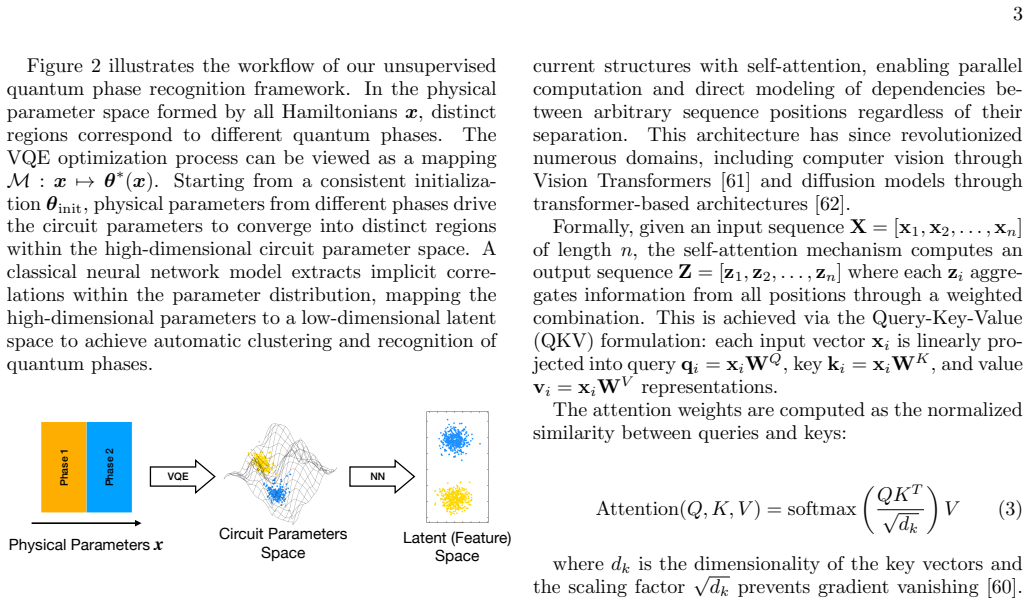
The mapping $M: x \mapsto \theta^*(x)$ defined by fixing the VQE initialization and letting the optimizer follow the energy landscape is the central object. The machinery is a variational autoencoder with a 1D-convolutional encoder and decoder and a multi-head self-attention layer between them; the attention layer is what lets the model couple parameters far apart in the circuit, which the paper argues is needed to capture non-local correlations relevant to topological phases. Post-processing on the latent vectors, PCA or kernel PCA to define a generalized order parameter and Gaussian mixture models to assign phase labels, turns the learned manifold into phase boundaries and a full phase diagram.
What would settle it
Take the transverse-field Ising model at N=8 with a shallow ansatz, scan h across the known transition at h=1, but randomize the VQE starting point for each h instead of using a consistent initialization; if the attention-VAE latent clusters no longer separate at the known boundary, the clustering hypothesis and the method's reliance on a fixed initialization would be falsified.
Extended reading notes
Core claim
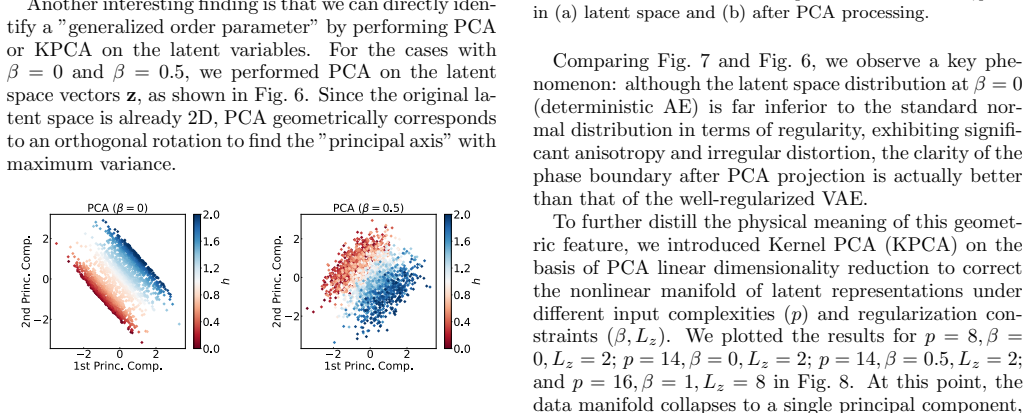
The central claim is that the optimization mapping from physical parameters $x$ to converged circuit parameters $\theta^*(x)$, under a consistent initialization, organizes itself into clusters that mirror the quantum phases of the Hamiltonian. Because ground states in different phases have incompatible entanglement and symmetry structure, the ansatz must land in different parts of parameter space; the paper hypothesizes that parameters from the same phase form continuous clusters while crossing a critical point induces a discontinuity or pattern shift. A classical attention-VAE learns a low-dimensional latent representation of these parameter distributions, and a single principal component of the latent space behaves like a data-driven generalized order parameter, crossing zero at the transition. The paper further claims that this holds even when the converged parameters are trapped in local minima or nearly orthogonal to the ground state, because the framework learns the distribution of convergence outcomes rather than a single state.
Load-bearing premise
The paper assumes that with a consistent initialization, VQE-converged circuit parameters cluster according to the physical phase, with phase boundaries showing up as discontinuities or pattern shifts in parameter space, and it also presumes the number of phases is known in advance for the Gaussian-mixture clustering step.
Editorial extensions
If this is right
- Phase boundaries for both Landau-type and topological transitions can be located without measuring any order parameter observable.
- VQE runs that fail to converge to the true ground state are still usable for phase detection, relaxing fidelity requirements on near-term hardware.
- The latent space can serve as a classical representation of the parameterized circuit family, and decoding samples from it generates circuit parameters for new states in a targeted phase, verified through the string order parameter of the cluster-Ising model.
- The intersection point of the generalized order parameter curves across different latent dimensions and regularization strengths provides a model-independent estimate of the critical point in finite-size systems.
Reading between the lines
- A natural next test is whether the same parameter-distribution approach transfers to two-dimensional topologically ordered systems, where the ansatz parameters may not cluster as cleanly as in one dimension.
- The consistent-initialization premise suggests a diagnostic: if random initializations destroy the latent clustering at known critical points, the method would be measuring optimizer artifacts rather than phase structure.
- The decoder side of the VAE could be viewed as a classical generative model for variational circuits, so the framework implicitly proposes a way to seed VQE for new Hamiltonians in a known phase, which the paper does not explore.
- Because the paper supplies the number of phases $K$ to the Gaussian mixture step, the unsupervised claim would be strengthened by a model selection criterion that infers $K$ from the latent density itself.
Editorial analysis
A structured set of objections, weighed in public.
Referee Report
Summary. This paper proposes a classical machine-learning framework that takes as input the converged variational parameters θ*(x) obtained from VQE runs for a family of Hamiltonians H(x), and uses an attention-augmented variational autoencoder (VAE) to learn a low-dimensional latent representation. The authors argue that, under a fixed circuit ansatz and consistent initialization, the mapping x→θ*(x) clusters by quantum phase, so that phase boundaries can be identified by clustering the latent vectors with PCA/KPCA and GMM—without measuring physical observables. The framework is tested on the transverse-field Ising model (TFIM) and the cluster-Ising model, yielding a claimed data-driven 'generalized order parameter' for the TFIM, a reconstructed (h1,h2) phase diagram for the cluster-Ising model, and a conditional diffusion model that generates states with expected order-parameter values. The paper further claims robustness to VQE local minima, including convergence to excited states orthogonal to the ground state. Code and data are publicly available.
Significance. The paper addresses a timely and practical question: can quantum phase transition information be extracted from variational circuits that fail to reach the ground state? The proposed pipeline is concrete, the code and data are openly released, and the diffusion-model generation experiment (Sec. V.C) provides an external check that the latent space carries phase-relevant information for a simplified cluster-Ising model. If the central claim were fully established, the framework would be a useful tool for NISQ-era phase detection and for studying VQE optimization landscapes. However, the current evidence does not yet separate the claimed phase learning from simpler confounding signals—most importantly, optimizer-failure detection—and several quantitative comparisons (known phase boundaries, error bars, null models) are missing. The work is therefore significant in potential but requires major revision to substantiate its headline claims.
major comments (3)
- [V.D, Fig. 18, Conclusion] The robustness-to-local-minima claim is not established by the presented evidence. The text in §V.D states 'We actually only need to learn whether a certain converged state is the ground state to determine which phase it belongs to,' and Fig. 18 is described as showing 'a clear division between high-fidelity states and low-fidelity states.' This is a fidelity partition, not a phase partition. For the L=12,16,p=4 TFIM tasks shown in Fig. 17, VQE is trapped in h∈(0.5,1.0), an interval that lies within the ordered phase (h<1); a clustering method can separate phases by detecting that failure interval without accessing any ground-state phase structure. To support the advertised claim, the authors should (i) show for the p=4 tasks that the learned phase boundary coincides with h≈1 rather than with the edges of the failure region, and (ii) demonstrate a case in which VQE fails in both phases and the method still recovers the true phase boundary, or explicitly soften the claim to optimizer-failure diagnosis.
- [IV.B, Figs. 12-14] The reconstructed cluster-Ising phase diagram is never compared with the known phase boundaries of the model. Reference [74] (Smacchia et al.) is cited only for the order parameter of the simplified model in Sec. V.C, not for the (h1,h2) diagram of Eq. (8). Without overlaying the known transition lines on Fig. 14, the agreement between the GMM-based boundaries and the actual SPT/Ising/paramagnetic phases is unverified. In addition, K=3 is supplied to GMM a priori, so the 'unsupervised' claim is partial; the authors should either infer K from the data (e.g., BIC, silhouette score) or explicitly state that the number of phases is used as prior knowledge and discuss the impact of this choice.
- [IV.A, Figs. 8-9] The 'generalized order parameter' and the 'model-independent fixed point' are vulnerable to a centering artifact. The first principal component is computed after standardizing latent variables over a uniform grid h∈[0,2] whose mean is exactly 1; a zero crossing near h=1 is therefore expected for any smooth, transition-free monotonic curve, independent of a phase transition. The crossing in Fig. 9 for curves with different latent dimensions/regularization weights is not a finite-size scaling (the curves are not different system sizes) and no error bars or multiple seeds are reported. The authors should include a null-model control (e.g., PCA/KPCA on a continuous parameter curve with no phase transition) and report statistics over repeated VQE and VAE runs to demonstrate that the observed zero crossing and its location are not artifacts of centering or of a single training run.
minor comments (6)
- [IV.A, Fig. 8] The caption of Fig. 8 lists 'p=12' for the second and third panels, while the text describes configurations with p=14; please make the labeling consistent.
- [IV.A] In the paragraph discussing the N=16, p=12 task, 'L_in = 3N p = 6×16×12 = 1152' is internally inconsistent; the correct expression is L_in = 6Np = 1152.
- [II] The core premise of the paper is explicitly introduced as a hypothesis ('It is reasonable to hypothesize...'). The authors should more clearly state what evidence would confirm or refute this hypothesis and avoid presenting it as an established fact in the abstract and conclusion.
- [V.B] The claim that the attention mechanism is necessary is based on a single qualitative comparison for h1=0.6 in Fig. 15; a systematic ablation over multiple h1 values and models would substantially strengthen this claim.
- [IV.B] The term 'unsupervised' is used loosely: the cluster-Ising analysis fixes K=3, and the diffusion-model experiment in Sec. V.C conditions on known phase labels. Please qualify the unsupervised claim in the text.
- [Fig. 9] The legend entries '4,8,16,32,64,128' are not explained in the caption; please state that these are the tested latent dimensions (or whatever they denote) and define the curve labels.
Circularity Check
Partial circularity: local-minima robustness reduces to fidelity clustering of the same VQE parameters, and Cluster-Ising phase boundaries are defined as GMM label changes; TFIM and diffusion-model checks provide independent anchors.
-
self definitional
[Section V.D ('VQE Ansatz and Local Minima'), extreme-example paragraph and Fig. 18]
"We actually only need to learn whether a certain converged state is the ground state to determine which phase it belongs to. ... For the Ising model with L=8,p=4,b=0, we obtained a set of VQE-converged states with fidelity ranging from 0 to 1 and then clustered them using our framework. As shown in Fig. 18, the results indicate a clear division between high-fidelity states and low-fidelity states based on our clustering method."
The advertised robustness claim is that phase identification works even when VQE lands in local minima. The supporting experiment feeds the very same VQE parameters θ* into the clustering that defines the phases, and then shows that the clusters separate states by fidelity to the true ground state. Since fidelity is a function of the same θ* that generated the clusters, the high/low fidelity division is an inevitable property of the input clustering rather than an independent check of phase membership. The quoted sentence makes the reduction explicit: phase membership is declared to be determined by the learned binary 'is this the ground state?' property.
-
self definitional
[Section IV.B ('Cluster-Ising Model'), paragraph following Fig. 12]
"These mutation points of GMM classification labels under different parameters are exactly the phase transition points of the system. Therefore, we can find approximate phase transition points by locating the mutation points of GMM labels."
The GMM labels are fitted to the VQE-parameter data (after VAE+PCA projection of the same θ*), so the locations where the labels change are boundaries of clusters in the input data. Calling those boundaries 'exactly the phase transition points' defines the target quantity as the output of the clustering procedure. Without comparing the inferred boundaries to the known phase diagram of the Cluster-Ising model or to an independent order parameter, the 'phase transition points' are by construction the GMM label-change points; the reconstructed phase diagram in Fig. 14 is a relabeling of cluster boundaries rather than a prediction that could fail.
full rationale
The paper does not rely on self-citations; the attention/VAE machinery is standard and the ablations are internal. The TFIM experiment is genuinely informative: the latent/KPCA structure separates near h=1, an externally known transition, and the diffusion-model generation check computes the order parameter S of the simplified Cluster-Ising model and verifies the VAE latent content against theory. Those parts are self-contained and prevent the whole paper from being a pure tautology. However, two load-bearing claims are circular by construction. First, the advertised robustness to VQE local minima: the evidence (Fig. 18) is that clustering separates high-fidelity from low-fidelity states, and the text explicitly reduces phase determination to learning 'whether a certain converged state is the ground state.' Because the clusters and the fidelity are both functions of the same θ*, the observed separation is an identity of the input, not a validated phase prediction. Second, for the full Cluster-Ising phase diagram, the phase transition points are defined as GMM label mutation points, and no independent theoretical boundary or order parameter is used to check them; the number of phases K=3 is also supplied a priori, so the three-cluster structure is partly imposed. These steps make the central 'even in local minima' and 'complete phase diagram' claims partially circular. Overall score 6: partial circularity with some independent external anchors.
Assumptions & free parameters
free parameters (4)
- beta, VAE KL weight =
0.5 for TFIM; varied in {0, 1} for comparison
- Lz, latent space dimension =
2 for TFIM, 16 for cluster-Ising, and 2 to 128 for diffusion experiments
- K, number of GMM components =
3 for cluster-Ising
- Sliding window size for smoothing and variance =
Not specified numerically
assumptions (5)
- domain assumption VQE optimization is deterministic under a consistent initialization, defining a fixed mapping M: x to theta*(x).
- domain assumption For physical parameters within the same quantum phase, converged VQE parameters form proximate clusters, and phase boundaries appear as discontinuities.
- domain assumption The ansatz must occupy structurally different parameter regions to represent states from different phases.
- domain assumption The number of phases is known a priori (K=3 for the cluster-Ising model).
- standard math PCA, KPCA, GMM, and the ELBO loss are valid standard tools for this data.
invented entities (2)
-
data-driven generalized order parameter
-
model-independent fixed point
Cite this review
Pith. "Pith review of Learning Variational Quantum Circuit Parameters with Classical Artificial Intelligence for Quantum Phase Transition Detection." pith.science (2026). https://pith.science/paper/I6BEHHZT
@misc{pith2026250606678,
  author       = {Pith},
  title        = {Pith review of: Learning Variational Quantum Circuit Parameters with Classical Artificial Intelligence for Quantum Phase Transition Detection},
  year         = {2026},
  howpublished = {\url{https://pith.science/paper/I6BEHHZT}},
  note         = {Machine review of arXiv:2506.06678}
}
read the original abstract
Learning many-body quantum states and quantum phase transitions remains a major challenge in quantum many-body physics. Classical machine learning methods offer certain advantages in addressing these difficulties. In this work, we propose a novel framework that bypasses the need to measure physical observables by directly learning the parameters of parameterized quantum circuits. By integrating the attention mechanism from large language models (LLMs) with a variational autoencoder (VAE), we efficiently capture hidden correlations within the circuit parameters. These correlations allow us to extract information about quantum phase transitions in an unsupervised manner. Moreover, our VAE acts as a classical representation of parameterized quantum circuits and the corresponding many-body quantum states, enabling the efficient generation of quantum states associated with specific phases. We apply our framework to a variety of quantum systems and demonstrate its broad applicability, with particularly strong performance in identifying topological quantum phase transitions.
Figures


Figures from the paper (13 more)




Reference graph
Works this paper leans on
-
[74]
P. Smacchia, L. Amico, P. Facchi, R. Fazio, G. Florio, S. Pascazio, and V. Vedral, Statistical mechanics of the cluster ising model, Physical Review A84, 10.1103/phys- reva.84.022304 (2011)
doi:10.1103/phys- 2011
-
[1]
Sachdev,Quantum Phase Transitions, 2nd ed
S. Sachdev,Quantum Phase Transitions, 2nd ed. (Cam- bridge University Press, 2011)
2011
-
[2]
Sachdev,Quantum Phases of Matter(Cambridge Uni- versity Press, 2023)
S. Sachdev,Quantum Phases of Matter(Cambridge Uni- versity Press, 2023)
2023
-
[3]
Preskill, Quantum computing in the nisq era and be- yond, Quantum2, 79 (2018)
J. Preskill, Quantum computing in the nisq era and be- yond, Quantum2, 79 (2018)
2018
-
[4]
R. Islam, E. Edwards, K. Kim, S. Korenblit, C. Noh, H. Carmichael, G.-D. Lin, L.-M. Duan, C.- C. Joseph Wang, J. Freericks, and C. Monroe, On- set of a quantum phase transition with a trapped ion quantum simulator, Nature Communications2, 10.1038/ncomms1374 (2011)
-
[5]
Bloch, J
I. Bloch, J. Dalibard, and S. Nascimb` ene, Quantum sim- ulations with ultracold quantum gases, Nature Physics 8, 267 (2012)
2012
-
[6]
Peruzzo, J
A. Peruzzo, J. McClean, P. Shadbolt, M.-H. Yung, X.-Q. Zhou, P. J. Love, A. Aspuru-Guzik, and J. L. O’Brien, A variational eigenvalue solver on a photonic quantum processor, Nature communications5, 1 (2014)
2014
-
[7]
A. Kandala, A. Mezzacapo, K. Temme, M. Takita, J. M. Chow, and J. M. Gambetta, Hardware-efficient varia- tional quantum eigensolver for small molecules and quan- tum magnets, Nature549, 242 (2017)
work page 2017
Show all 74 references
-
[8]
S. Endo, Y. Cao, C. Jones, S. C. Benjamin, Y. Li, D. Mills, A. Prakash, and X. Yuan, Practical quantum er- ror mitigation for near-term quantum computers, arXiv preprint arXiv:1812.09258 (2018)
2018 arXiv
-
[9]
J. R. McClean, J. Romero, R. Babbush, and A. Aspuru- Guzik, The theory of variational hybrid quantum- classical algorithms, New Journal of Physics18, 023023 (2016)
2016
-
[10]
N. Moll, P. Barkoutsos, L. S. Bishop, J. M. Chow, A. Cross, D. J. Egger, S. Filipp, A. Fuhrer, J. M. Gambetta, M. Ganzhorn, A. Kandala, A. Mezzacapo, P. M¨ uller, W. Riess, G. Salis, J. Smolin, I. Tavernelli, and K. Temme, Quantum optimization using variational algorithms on n...
2018
-
[11]
Tilly, H
J. Tilly, H. Chen, S. Cao, D. Picozzi, K. Setia, Y. Li, E. Grant, L. Wossnig, I. Rungger, G. H. Booth, and J. Tennyson, The variational quantum eigensolver: A re- view of methods and best practices, Physics Reports986, 1 (2022), the Variational Quantum Eigensolver: a review of...
2022
-
[12]
Cerezo, A
M. Cerezo, A. Arrasmith, R. Babbush, S. C. Benjamin, S. Endo, K. Fujii, J. R. McClean, K. Mitarai, X. Yuan, L. Cincio, and P. J. Coles, Variational quantum algo- rithms, Nature Reviews Physics3, 625 (2021), published: 12 August 2021; Accepted: 14 June 2021
2021
-
[13]
Li and F
H. Li and F. D. M. Haldane, Entanglement spectrum as a generalization of entanglement entropy: Identification of topological order in non-abelian fractional quantum hall effect states, Phys. Rev. Lett.101, 010504 (2008)
2008
-
[14]
Pollmann and A
F. Pollmann and A. M. Turner, Detection of symmetry- protected topological phases in one dimension, Physical Review B86, 10.1103/physrevb.86.125441 (2012)
2012 doi
-
[15]
Haegeman, D
J. Haegeman, D. P´ erez-Garc ´ ıa, I. Cirac, and N. Schuch, Order parameter for symmetry-protected phases in one dimension, Phys. Rev. Lett.109, 050402 (2012)
2012
-
[16]
Pollmann, A
F. Pollmann, A. M. Turner, E. Berg, and M. Oshikawa, Entanglement spectrum of a topological phase in one di- mension, Phys. Rev. B81, 064439 (2010)
2010
-
[19]
Lidiak and Z
A. Lidiak and Z. Gong, Unsupervised machine learning of quantum phase transitions using diffusion maps, Phys- ical Review Letters125, 10.1103/physrevlett.125.225701 (2020)
2020 doi
-
[20]
X.-Y. Dong, F. Pollmann, and X.-F. Zhang, Machine learning of quantum phase transitions, Physical Review B99, 10.1103/physrevb.99.121104 (2019)
2019 doi
-
[21]
B. S. Rem, N. K¨ aming, M. Tarnowski, L. Asteria, N. Fl¨ aschner, C. Becker, K. Sengstock, and C. Weit- enberg, Identifying quantum phase transitions using ar- tificial neural networks on experimental data, Nature Physics15, 917 (2019). 17
2019
-
[22]
I. Cong, S. Choi, and M. D. Lukin, Quantum convolu- tional neural networks, Nature Physics15, 1273–1278 (2019)
2019
-
[23]
Herrmann, S
J. Herrmann, S. M. Llima, A. Remm, P. Zapletal, N. A. McMahon, C. Scarato, F. Swiadek, C. K. Andersen, C. Hellings, S. Krinner, N. Lacroix, S. Lazar, M. Ker- schbaum, D. C. Zanuz, G. J. Norris, M. J. Hartmann, A. Wallraff, and C. Eichler, Realizing quantum convo- lutional neur...
2022 doi
-
[24]
Monaco, O
S. Monaco, O. Kiss, A. Mandarino, S. Vallecorsa, and M. Grossi, Quantum phase detection generalization from marginal quantum neural network models, Physical Re- view B107, 10.1103/physrevb.107.l081105 (2023)
2023 doi
-
[25]
J. Chen, Y. Wu, Z. Yang, S. Xu, X. Ye, D. Li, K. Wang, C. Zhang, F. Jin, X. Zhu, Y. Gao, Z. Tan, Z. Cui, A. Zhang, N. Wang, Y. Zou, T. Li, F. Shen, J. Zhong, Z. Bao, Z. Zhu, Z. Song, J. Deng, H. Dong, P. Zhang, W. Zhang, H. Li, Q. Guo, Z. Wang, Y. Li, X. Wang, C. Song, and H. ...
2025 arXiv
-
[26]
L. C. Sander, N. A. McMahon, P. Zapletal, and M. J. Hartmann, Quantum convolutional neural net- work for phase recognition in two dimensions (2024), arXiv:2407.04114 [quant-ph]
2024
-
[27]
Huang, R
H.-Y. Huang, R. Kueng, and J. Preskill, Predicting many properties of a quantum system from very few measure- ments, Nature Physics16, 1050–1057 (2020)
2020
-
[28]
Huang, R
H.-Y. Huang, R. Kueng, G. Torlai, V. V. Albert, and J. Preskill, Provably efficient machine learning for quan- tum many-body problems, Science377, 10.1126/sci- ence.abk3333 (2022)
2022 doi
-
[29]
Lewis, H.-Y
L. Lewis, H.-Y. Huang, V. T. Tran, S. Lehner, R. Kueng, and J. Preskill, Improved machine learning algorithm for predicting ground state properties, Nature Communica- tions15, 10.1038/s41467-024-45014-7 (2024)
2024 doi
-
[30]
Broecker, J
P. Broecker, J. Carrasquilla, R. G. Melko, and S. Trebst, Machine learning quantum phases of matter beyond the fermion sign problem, Scientific Reports7, 10.1038/s41598-017-09098-0 (2017)
2017 doi
-
[31]
Canabarro, F
A. Canabarro, F. F. Fanchini, A. L. Malvezzi, R. Pereira, and R. Chaves, Unveiling phase transitions with machine learning, Phys. Rev. B100, 045129 (2019)
2019
-
[32]
S. S. Rahaman, S. Haldar, and M. Kumar, Machine learn- ing approach to study quantum phase transitions of a frustrated one dimensional spin-1/2 system, Journal of Physics: Condensed Matter35, 115603 (2023)
2023
-
[33]
Kasatkin, E
V. Kasatkin, E. Mozgunov, N. Ezzell, U. Mishra, I. Hen, and D. Lidar, Classifim: An unsupervised method to de- tect phase transitions (2024), arXiv:2408.03323 [cs.LG]
2024 arXiv
-
[34]
R. Ziv, D. Wei, A. Rubio-Abadal, D. Adler, A. Ke- selman, E. Lustig, J. I. Cirac, Y. Lahav, I. Block, L. Karpa, D. Wecker, B. Zhou, P. Peng, and A. G. Rey, Unsupervised machine learning for experimental de- tection of quantum-many-body phase transitions (2025), arXiv:2512.0109...
2025
-
[35]
M. A. Marashli, H. L. H. Lam, H. Mokayed, J. J´ auregui, I.-C. Chang, and T.-C. Wei, Identifying quantum phase transitions with minimal prior knowledge by unsuper- vised learning, SciPost Physics Core8, 029 (2025)
2025
-
[36]
Chowdhuryet al., Autoencoder-based learning of quan- tum phase transitions in two-component bose-hubbard model (2024), arXiv:2409.18480 [quant-ph]
I. Chowdhuryet al., Autoencoder-based learning of quan- tum phase transitions in two-component bose-hubbard model (2024), arXiv:2409.18480 [quant-ph]
2024 arXiv
-
[38]
C. Cao, F. M. Gambetta, and J. Eisert, Unveiling quan- tum phase transitions from traps in variational quantum algorithms, npj Quantum Information11, 29 (2025)
2025
-
[39]
Angelides, P
T. Angelides, P. Naredi, A. Crippa, K. Jansen, S. K¨ uhn, I. Tavernelli, and D. S. Wang, First-order phase tran- sition of the schwinger model with a quantum com- puter, npj Quantum Information11, 10.1038/s41534- 024-00950-6 (2025)
2025 doi
-
[40]
K. N. Okada, K. Osaki, K. Mitarai, and K. Fujii, Clas- sically optimized variational quantum eigensolver with applications to topological phases, Phys. Rev. Res.5, 043217 (2023)
2023
-
[41]
Grossi, O
M. Grossi, O. Kiss, F. De Luca, C. Zollo, I. Gremese, and A. Mandarino, Finite-size criticality in fully con- nected spin models on superconducting quantum hard- ware, Phys. Rev. E107, 024113 (2023)
2023
-
[42]
J. R. McClean, S. Boixo, V. N. Smelyanskiy, R. Bab- bush, and H. Neven, Barren plateaus in quantum neural network training landscapes, Nature Communications9, 4812 (2018)
2018
-
[43]
Holmes, K
Z. Holmes, K. Sharma, M. Cerezo, and P. J. Coles, Con- necting ansatz expressibility to gradient magnitudes and barren plateaus, PRX Quantum3, 010313 (2022)
2022
-
[44]
Ortiz Marrero, M
C. Ortiz Marrero, M. Kieferov´ a, and N. Wiebe, Entanglement-induced barren plateaus, PRX Quantum 2, 040316 (2021)
2021
-
[45]
S. Wang, E. Fontana, M. Cerezo, K. Sharma, A. Sone, L. Cincio, and P. J. Coles, Noise-induced barren plateaus in variational quantum algorithms, Nature Communica- tions12, 10.1038/s41467-021-27045-6 (2021)
2021 doi
-
[46]
E. R. Anschuetz and B. T. Kiani, Quantum variational algorithms are swamped with traps, Nature Communica- tions13, 7760 (2022)
2022
-
[47]
C. F. Chen, H. Y. Huang, J. Preskill,et al., Local minima in quantum systems, Nature Physics21, 654 (2025)
2025
-
[48]
A. Apte, K. Marwaha, and A. Murugan, Non- convex optimization by hamiltonian alternation (2022), arXiv:2206.14072 [cond-mat.dis-nn]
2022 arXiv
-
[49]
Li, Quantum computers quickly find local minima, Nature Physics21, 512 (2025)
T. Li, Quantum computers quickly find local minima, Nature Physics21, 512 (2025)
2025
-
[50]
C. Cao, F. M. Gambetta, A. Montanaro, and R. A. San- tos, Unveiling quantum phase transitions from traps in variational quantum algorithms (2024), arXiv:2405.08441 [quant-ph]
2024 arXiv
-
[51]
Crognaletti, G
G. Crognaletti, G. Di Bartolomeo, M. Vischi, and L. Loris Viteritti, Equivariant variational quantum eigen- solver to detect phase transitions through energy level crossings, Quantum Science and Technology10, 015048 (2024)
2024
-
[52]
I. T. Jolliffe and J. Cadima, Principal component anal- ysis: A review and recent developments, Philosophi- cal Transactions of the Royal Society A374, 20150202 (2016)
2016
-
[53]
Pearson, Liii
K. Pearson, Liii. on lines and planes of closest fit to sys- tems of points in space, The London, Edinburgh, and Dublin philosophical magazine and journal of science2, 559 (1901)
1901
-
[54]
Permuter, J
H. Permuter, J. Francos, and I. Jermyn, Gaussian mix- ture models of texture and colour for image database re- 18 trieval, in2003 IEEE International Conference on Acous- tics, Speech, and Signal Processing, 2003. Proceedings. (ICASSP ’03)., Vol. 3 (2003) pp. III–569
2003
-
[55]
Sch¨ olkopf, A
B. Sch¨ olkopf, A. Smola, and K.-R. M¨ uller, Nonlinear component analysis as a kernel eigenvalue problem, Neu- ral Computation10, 1299 (1998)
1998
-
[56]
J. Xie, R. Girshick, and A. Farhadi, Unsuper- vised deep embedding for clustering analysis (2016), arXiv:1511.06335 [cs.LG]
2016 arXiv
-
[57]
Jiang, Y
Z. Jiang, Y. Zheng, H. Tan, B. Tang, and H. Zhou, Varia- tional deep embedding: An unsupervised and generative approach to clustering (2017), arXiv:1611.05148 [cs.CV]
2017 arXiv
-
[58]
Correia, J.-C
L. Correia, J.-C. Goos, P. Klein, T. B¨ ack, and A. Kononova, Ma-vae: Multi-head attention-based vari- ational autoencoder approach for anomaly detection in multivariate time-series applied to automotive endurance powertrain testing, inProceedings of the 15th Interna- tional J...
-
[59]
Bahdanau, K
D. Bahdanau, K. Cho, and Y. Bengio, Neural machine translation by jointly learning to align and translate (2016), arXiv:1409.0473 [cs.CL]
2016 arXiv
-
[60]
Vaswani, N
A. Vaswani, N. Shazeer, N. Parmar, J. Uszkoreit, L. Jones, A. N. Gomez, L. Kaiser, and I. Polosukhin, At- tention is all you need (2023), arXiv:1706.03762 [cs.CL]
2023 arXiv
-
[61]
Dosovitskiy, L
A. Dosovitskiy, L. Beyer, A. Kolesnikov, D. Weissenborn, X. Zhai, T. Unterthiner, M. Dehghani, M. Minderer, G. Heigold, S. Gelly, J. Uszkoreit, and N. Houlsby, An im- age is worth 16x16 words: Transformers for image recog- nition at scale (2021), arXiv:2010.11929 [cs.CV]
2021 arXiv
-
[62]
Peebles and S
W. Peebles and S. Xie, Scalable diffusion models with transformers (2023), arXiv:2212.09748 [cs.CV]
2023 arXiv
-
[63]
D. P. Kingma and M. Welling, Auto-encoding variational bayes, Frontiers in Computational Neuroscience10, 2 (2016)
2016
-
[64]
Kim and A
H. Kim and A. Mnih, Disentangling by factorising (2019), arXiv:1802.05983 [stat.ML]
2019 arXiv
-
[65]
R. T. Q. Chen, X. Li, R. Grosse, and D. Duvenaud, Iso- lating sources of disentanglement in variational autoen- coders (2019), arXiv:1802.04942 [cs.LG]
2019 arXiv
-
[66]
J. Ho, A. Jain, and P. Abbeel, Denoising diffusion prob- abilistic models (2020), arXiv:2006.11239 [cs.LG]
2020 arXiv
-
[67]
Rombach, A
R. Rombach, A. Blattmann, D. Lorenz, P. Esser, and B. Ommer, High-resolution image synthesis with latent diffusion models (2022), arXiv:2112.10752 [cs.CV]
2022 arXiv
-
[68]
Radford, J
A. Radford, J. W. Kim, C. Hallacy, A. Ramesh, G. Goh, S. Agarwal, G. Sastry, A. Askell, P. Mishkin, J. Clark, G. Krueger, and I. Sutskever, Learning transferable vi- sual models from natural language supervision (2021), arXiv:2103.00020 [cs.CV]
2021 arXiv
-
[69]
Chenet al., Quantum mixed-state self-attention net- work, Information Sciences668, 1 (2025)
F. Chenet al., Quantum mixed-state self-attention net- work, Information Sciences668, 1 (2025)
2025
-
[70]
Rocchiaet al., Unveiling the physical meaning of transformer attention in molecular wave functions, Chi- nese Physics B (2024), in press
A. Rocchiaet al., Unveiling the physical meaning of transformer attention in molecular wave functions, Chi- nese Physics B (2024), in press
2024
-
[71]
Campostrini, A
M. Campostrini, A. Pelissetto, and E. Vicari, Finite-size scaling at quantum transitions, Phys. Rev. B89, 094516 (2014)
2014
-
[72]
Schuld, I
M. Schuld, I. Sinayskiy, and F. Petruccione, Machine learning for quantum physicists, Reviews of Modern Physics91, 045004 (2019)
2019
-
[73]
Luo, J.-G
X.-Z. Luo, J.-G. Liu, P. Zhang, and L. Wang, Yao.jl: Extensible, efficient framework for quantum algorithm design, Quantum4, 341 (2020)
2020
-
[75]
X. Xu, J. Cui, Z. Cui, R. He, Q. Li, X. Li, Y. Lin, J. Liu, W. Liu, J. Lu,et al., Mindspore quantum: A user- friendly, high-performance, and ai-compatible quantum computing framework (2024), arXiv:2406.17248 [quant- ph]
2024 arXiv
-
[76]
Paszke, S
A. Paszke, S. Gross, F. Massa, A. Lerer, J. Brad- bury, G. Chanan, T. Killeen, Z. Lin, N. Gimelshein, L. Antiga, A. Desmaison, A. K¨ opf, E. Yang, Z. De- Vito, M. Raison, A. Tejani, S. Chilamkurthy, B. Steiner, L. Fang, J. Bai, and S. Chintala, Pytorch: An impera- tive style, ...
2019 arXiv
-
[1008]
The distribution of 2001 samples in the latent space is shown in Fig
We set the V AE latent space dimensionL z = 2, β= 0.5 inL V AE, and trained the model for 1000 epochs until convergence. The distribution of 2001 samples in the latent space is shown in Fig. 5(b). The data form two adjacent clusters, aggregating by the physical parameter Rx(θ)...
2001
Reviewed August 7, 2026 · model on record in the stance chip above.
Discussion (0). Sign in to comment.