REVIEW 2 major objections 4 minor 1 cited by
On symmetry and exterior problems of knotted handlebodies
T0 review · 2 major / 4 minor · reviewed 2026-08-07 · deepseek-v4-flash
Pith's one-line read For knotted handlebodies admitting type 4-1 annuli, characteristic slope data determine the handlebody, and the symmetry group is Z2 or Z2 × Z2.
desk verdict Solid handlebody-knot results with a real internal inconsistency in Theorem 1.9(3) that needs a one-line fix before publication. read the letter →
The pith
A machine-rendered reading of the paper's core claim, the machinery that carries it, and where it could break.
The reading
What carries the argument
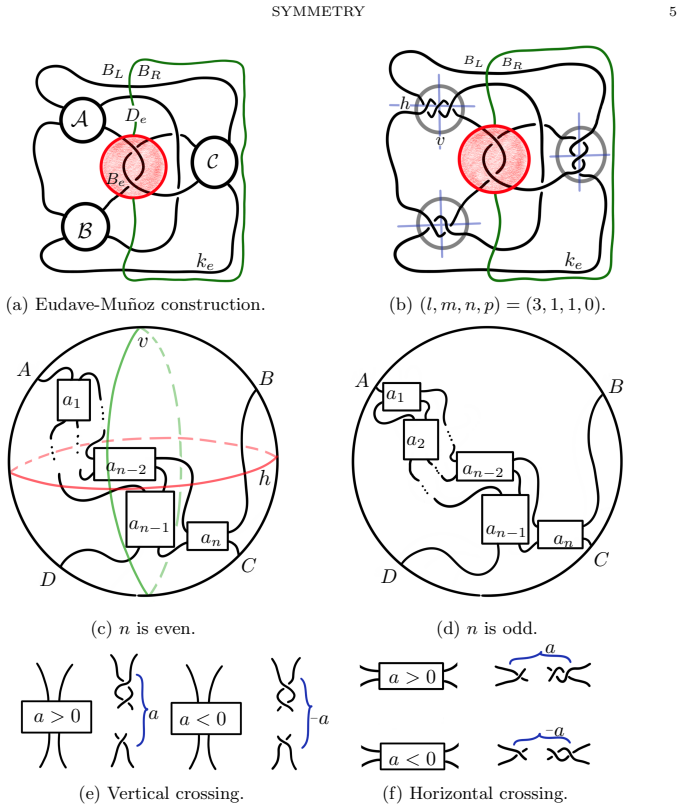
The load-bearing object is the type 4-1 annulus: an essential annulus in the exterior whose boundary components are parallel in $\partial V$ and which cuts off a solid torus $U$ whose complement in $\partial V$ is an incompressible twice-punctured torus, with the remaining piece $W$ a handlebody. The paper's toolkit is the JSJ decomposition of handlebody-knot exteriors: the characteristic surface is a unique union of essential annuli, and its JSJ graph makes $V$ type M (an I-bundle over a once-punctured Möbius band, with two characteristic annuli) or type K (an I-bundle over a once-punctured Klein bottle, with one characteristic annulus). Slopes of these characteristic annuli are computed explicitly from tangle parameters $(l,m,n,p)$ via continued-fraction formulas and determinants of double branched covers; equality of slope data is then shown, case by case, to force equality of the parameters up to the allowed tangle moves. The symmetry classification runs through an injectivity argument for mapping classes preserving the characteristic annuli.
What would settle it
Find a non-trivial, atoroidal genus-two handlebody-knot whose exterior admits a type 4-1 annulus but whose mapping class group has order other than 2 or 4, or find two such handlebody-knots with identical characteristic slope data that are not isotopic.
Extended reading notes
Core claim
The central claim is a classification and rigidity statement. Suppose $(S^3,V)$ is an atoroidal genus-two handlebody-knot whose exterior $E(V)$ admits a type 4-1 annulus. Then $\mathrm{MCG}(S^3,V) \cong \mathrm{MCG}^+(S^3,V)$, and $\mathrm{MCG}(S^3,V)$ is $\mathbb{Z}_2$ when $V$ is of type M and $\mathbb{Z}_2$ or $\mathbb{Z}_2 \times \mathbb{Z}_2$ when $V$ is of type K; it is $\mathbb{Z}_2 \times \mathbb{Z}_2$ precisely when $V$ is equivalent to $V_L(*,1,n,0)$ for some $n$. In parallel, the characteristic annulus, or annuli, of $E(V)$ carries a slope, or slope pair, and two such handlebody-knots are equivalent exactly when these slope data agree. Thus the exterior problem has a positive answer for this class: $E(V)$ determines $V$ up to isotopy, and the symmetry group is read off from the same slope data.
Load-bearing premise
The paper inherits the classification that every atoroidal handlebody-knot whose exterior has a type 4-1 annulus is one of the two parameter families, type M or type K; if a case outside those families exists, the symmetry and exterior theorems do not cover it.
Editorial extensions
If this is right
- Every handlebody-knot with a type 4-1 annulus has a finite symmetry group of order at most 4, and orientation-reversing symmetries cannot enlarge it: $\mathrm{MCG} \cong \mathrm{MCG}^+$.
- Within this class the exterior problem is solved: homeomorphic exteriors with the same characteristic slopes imply isotopic handlebody-knots, and the slopes are explicitly computable from $(l,m,n,p)$.
- There are infinite families, such as $\{V_L(*,m,0,p)\}_{p\in\mathbb{Z}}$ for each $m\neq 0,1$, of pairwise inequivalent handlebody-knots with homeomorphic exteriors; this generalizes and identifies the earlier second family.
- The larger symmetry group $\mathbb{Z}_2 \times \mathbb{Z}_2$ occurs exactly for $V_L(*,1,n,0)$, which is also precisely the case $r_1 = r_2$ where a self-homeomorphism swaps the boundary components of the type 3-3 annulus.
- At most five, and at least four, of the infinitely many non-characteristic essential annuli of a type K exterior fail to be type 4-1, and this bound is attained.
Reading between the lines
- The equivalence between $\mathrm{MCG} = \mathbb{Z}_2 \times \mathbb{Z}_2$ and coincidence of the two vertical slopes suggests a general principle for cylindrical atoroidal handlebody-knots: the symmetry group is generated by the branched-cover involution plus, exactly when the characteristic slope pair has matching entries, a swap of the annulus boundary components; this could be tested on type 3-
- Theorem 1.10 effectively gives a recovery algorithm from slope data, so the same slope formulas could be used to decide equivalence among all parameter values $V_R(l,m,n,p)$ and $V_L(l,m,n,p)$, turning the classification into a finite computation.
- The infinite families $V_L(*,m,0,p)$ are natural candidates for studying which invariants of handlebody-knots are not determined by the exterior; one could ask whether quandle colorings or higher-order linking invariants distinguish the members.
- If the imported type M/type K dichotomy were extended or corrected, the proof skeleton used here would immediately yield the same symmetry and exterior classification for the enlarged class.
Editorial analysis
A structured set of objections, weighed in public.
Referee Report
Summary. The paper studies genus-two handlebody-knots whose exteriors contain a type 4-1 essential annulus, equivalently handlebody-knots induced by Eudave-Muñoz knots. After reviewing the tangle construction and establishing slope and determinant formulas, the authors classify the mapping class group: type M handlebody-knots have MCG(S^3,V) ≅ Z_2, and type K handlebody-knots have MCG(S^3,V) either Z_2 or Z_2 × Z_2, with the latter characterized in Theorem 4.14. They then prove that the slopes of the characteristic annuli determine the handlebody-knot among the type M and type K families, and they use this to exhibit infinite families of inequivalent handlebody-knots with homeomorphic exteriors and to identify Lee-Lee's second family with {VL(∗,−1,0,p)}. The proofs are explicit and computational, relying on the JSJ classification of [20] and on the Gordon-Luecke characterization of Eudave-Muñoz knots.
Significance. If the stated results are correct, the paper gives a complete symmetry classification and exterior determination theorem for a substantial class of genus-two handlebody-knots, namely those admitting type 4-1 annuli. The slope formulas in Lemmas 4.2, 4.4, 4.5, 4.8 and 5.5 are concrete and checkable, and Theorem 1.10 provides a sharp 'slope determines handlebody-knot' statement. The identification of Lee-Lee's family with a one-parameter subfamily of the left handlebody-knots is a useful clarification. The main caveats are that the classification's domain is imported from an unpublished preprint and that the statement of the symmetry criterion in the introduction is not consistent with the theorem proved in Section 4.
major comments (2)
- [§1.4, Theorem 1.9(3); §4, Theorem 4.14 and Corollary 4.12] The introduction states that MCG(S^3,V) ≅ Z_2 × Z_2 if and only if (S^3,V) is equivalent to VL(∗,1,n,0), whereas Theorem 4.14 states the same conclusion for VL(∗,±1,n,0). Corollary 4.12 proves that r_1 = r_2 exactly for VL(∗,±1,n,0) and constructs a self-homeomorphism swapping the two boundary components of the type 3-3 annulus for both signs. If handlebody-knot equivalence is the standard orientation-preserving one, no proof is supplied that VL(∗,−1,n,0) is equivalent to some VL(∗,1,n′,0); Lemma 3.1(i) gives only a mirror equivalence. Therefore Theorem 1.9(3) is false as written unless the equivalence convention is stated to include mirrors, in which case that convention must be made explicit and justified. The two statements cannot both be correct as they stand.
- [§1.3, Theorem 1.8; §3, Theorem 3.6] Every proof in Sections 4 and 5 begins by invoking the dichotomy that an atoroidal handlebody-knot with a type 4-1 annulus is either type M or type K, and that type K is exactly the left family VL(∗,m,n,p). This classification is quoted from the same authors' arXiv preprint [20, Theorem 4.3] and is not proved in the present paper. Since Theorem 1.8 fixes the domain of the main theorems, the paper should either include a proof of Theorem 1.8 or replace the citation with a published, refereed version. As it stands, the main results are conditional in a load-bearing way on an unreviewed preprint.
minor comments (4)
- [§3, Corollary 3.4(ii)] The expression 1∓3/2 should be typeset as (1∓3)/2; in the current rendering it can be misread as a non-integer fraction.
- [§2] The paper should define explicitly what 'equivalent' means for handlebody-knots, indicating whether mirror images are allowed. This is especially important because the proof of Corollary 4.12 uses mirror identities from Lemma 3.1.
- [§4, Theorem 4.13] The proof uses A_1 and A_2 before introducing them; these should be the characteristic annuli A_a and A_b defined earlier in the section.
- [Page 6, after Theorem 1.10] The phrase 'Gordon-Lueke type theorem' contains a typo; the correct spelling is Gordon-Luecke.
Circularity Check
Main theorems rest on the authors' own preprint [20] for the entire type-M/K dichotomy, and Theorem 1.9(3) drops the m=-1 case that Theorem 4.14 proves; no fitted-parameter circularity is present.
-
self citation load bearing
[Theorem 1.8, Section 1.3; proof of Theorem 3.6, Section 3; used in Theorems 4.13, 4.14, 5.4, 5.7]
"Theorem 1.8 ([20, Theorem 4.3]). Given an atoroidal handlebody-knot (S3, V), if (S3, V) is of type K, then E(V) admits a type 4-1 annulus. Conversely, if E(V) admits a type 4-1 annulus, then (S3, V) is either of type K or of type M, and furthermore (i) (S3, V) is of type K if and only if (S3, V) ≃ VR(l, m, n, p) with l = ±2 or ∆(l, m, p) = ±2 or (S3, V) ≃ VL(∗, m, n, p); (ii) ..."
The proof of Theorem 3.6 says 'The direction “⇐” follows from Theorem 1.8(i)' and 'by the first assertion of Theorem 1.8 and Theorem 1.8(i), it suffices to prove...' Theorems 4.13, 4.14, 5.4, and 5.7 then assume this classification to delimit all type M and type K handlebody-knots. Since [20] is an arXiv preprint by the same three authors, the domain of the paper's main theorems is imported as a load-bearing self-citation rather than proved here. This is not a fitted-input circularity, but the paper's central claims inherit their validity from an overlapping-authors preprint that the paper does not itself establish.
-
other
[Theorem 1.9(3) versus Theorem 4.14 and Corollary 4.12]
"Theorem 1.9(3): 'MCG(S3, V) ≃ Z2 × Z2 if and only if (S3, V) is equivalent to the left handlebody-knot VL(∗, 1, n, 0), for some n.' Theorem 4.14: 'MCG(S3, V) ≃ Z2 × Z2 if and only if (S3, V) ≃ VL(∗, ±1, n, 0).' Corollary 4.12(ii): 'VL(∗, ±1, n, 0)'."
This is not a circular derivation but an internal inconsistency. Corollary 4.12 explicitly builds the swapping self-homeomorphism for both m = 1 and m = -1, and Theorem 4.14 concludes the larger group for VL(∗, ±1, n, 0), whereas the introduction restricts to VL(∗, 1, n, 0). Unless VL(∗, -1, n, 0) is proved orientation-preservingly equivalent to some VL(∗, 1, n', 0) — and no such equivalence is shown; Lemma 3.1 only gives mirror equivalences — the advertised 'if and only if' loses the m = -1 case. This weakens the stated classification independently of any imported classification.
full rationale
Most of the genuinely new work in this paper is self-contained once the type-M/type-K dichotomy is granted: the slopes (ra, rb), (r1, r2), and rc are computed from explicit rational-tangle data via Lemmas 2.1, 4.2-4.8, and 5.5; the mapping-class-group arguments in Theorems 4.13 and 4.14 use the characteristic surface, standard facts about mapping class groups of surfaces, and an injectivity result [4, Theorem 2.5]; and Theorems 5.4 and 5.7 compare explicit slope formulas. There is no fitted parameter renamed as a prediction and no case where an equation is shown to be its own input. However, the classification that fixes the domain of all main theorems — that every atoroidal handlebody-knot whose exterior admits a type 4-1 annulus is type K or type M, with the explicit parameter families VL and VR — is imported from [20, Theorem 4.3], an overlapping-authors preprint, and used repeatedly at the start of the proofs of Theorems 3.6, 4.13, 4.14, 5.4, and 5.7. The identification of Lee-Lee's second family with {VL(∗, -1, 0, p)} also relies on [20, Example 5.3.8] and [31, Theorem 3.6], both by the third author. Those citations may be correct, but they are load-bearing self-citations, not internal proofs. Additionally, the introduction's Theorem 1.9(3) states the Z2 × Z2 criterion with only VL(∗, 1, n, 0), while the paper's own Theorem 4.14 and Corollary 4.12 prove it for VL(∗, ±1, n, 0); unless the minus family is equivalent to the plus family, the statement is false as written. This is a correctness issue, not a circularity. Overall, the central derivation is conditional on imported same-author classification results rather than circular by construction.
Assumptions & free parameters
assumptions (5)
- ad hoc to paper An atoroidal handlebody-knot whose exterior admits a type 4-1 annulus is either type M or type K, with type K iff equivalent to VL(l,m,n,p), and type M iff equivalent to VR(l,m,n,p) under parameter restrictions.
- standard math Gordon-Luecke's characterization that a hyperbolic knot admits a non-integral toroidal Dehn surgery iff it is an Eudave-Munoz knot, and every twice-punctured incompressible torus is isotopic to Te.
- domain assumption The mapping class group restriction map MCG+(S3, Gamma_A) to MCG(Gamma_A) is injective for nontrivial atoroidal handlebody-knots.
- standard math The pure mapping class group of a four-punctured sphere is free, and Dehn twists along the cores generate the kernel of the cutting homomorphism.
- standard math Every rational tangle is equivalent to R(a1,...,an), and slopes and determinants associated to double branched covers are computed by continued fractions and determinants as in Section 2.
Cite this review
Pith. "Pith review of On symmetry and exterior problems of knotted handlebodies." pith.science (2026). https://pith.science/paper/WTHBXWIN
@misc{pith2026250606713,
  author       = {Pith},
  title        = {Pith review of: On symmetry and exterior problems of knotted handlebodies},
  year         = {2026},
  howpublished = {\url{https://pith.science/paper/WTHBXWIN}},
  note         = {Machine review of arXiv:2506.06713}
}
abstract
The paper concerns two classical problems in knot theory pertaining to knot symmetry and knot exteriors. In the context of a knotted handlebody $V$ in a $3$-sphere $S^3$, the symmetry problem seeks to classify the mapping class group of the pair $(S^3,V)$, whereas the exterior problem examines to what extent the exterior $E(V)$ determines or fails to determine the isotopy type of $V$. The paper determines the symmetries of knotted genus two handlebodies arising from hyperbolic knots with non-integral toroidal Dehn surgeries, and solve the knot exterior problem for them. A new interpretation and generalization of a Lee-Lee family of knotted handlebodies is provided.
Figures


Figures from the paper (2 more)


Forward citations
Cited by 1 Pith paper
-
Handlebody-knots obtained by tangle replacement
Tangle replacement on the four-crossing handcuff graph G4_1 determines the handlebody-knot up to swapping two strands, resolving hard pairs (6_12 vs 7_39; 7_59 vs 7_60) and their symmetry groups.
Reference graph
Works this paper leans on
-
[20]
Y. Koda, M. Ozawa, Y.-S. Wang: Essential annuli in genus two handlebody exteriors , arXiv:2404.04503 [math.GT]
-
[10]
K. Funayoshi, Y. Koda: Extending automorphisms of the genus- 2 surface over the 3-sphere, Q. J. Math. 71 (2020), 175–196
work page 2020
-
[30]
Wang: Rigidity and symmetry of cylindrical handlebody-knots , Osaka J
Y.-S. Wang: Rigidity and symmetry of cylindrical handlebody-knots , Osaka J. Math. 60 (2023), 267–304
work page 2023
-
[32]
Wang: JSJ decomposition for handlebody-knots , J
Y.-S. Wang: JSJ decomposition for handlebody-knots , J. Math. Soc. Japan 76(4) (2024), 1049–1085. Department of Mathematics, Hiyoshi Campus, Keio University, 4-1-1, Hiyoshi, Ko- hoku, Yokohama, 223-8521, Japan / International Institute for Sustainability with Knotted Chiral Meta Matter (WPI-SKCM2), Hiroshima University, 1-3-1 Kagamiyama, Higashi-Hiroshima...
work page 2024
-
[1]
E. Akbas: A presentation for the automorphisms of the 3-sphere that preserve a genus two Heegaard splitting, Pacific J. Math. 236(2) (2008), 201–222
work page 2008
-
[2]
G. Bellettini, M. Paolini, Y.-S. Wang: A complete invariant for connected surfaces in the 3-sphere, J. Knot Theory Ramifications 29 (2020), 1950091
work page 2020
-
[3]
Cho: Homeomorphisms of the 3-sphere that preserve a Heegaard splitting of genus two, Proc
S. Cho: Homeomorphisms of the 3-sphere that preserve a Heegaard splitting of genus two, Proc. Amer. Math. Soc. 136(3) (2008), 1113–1123
work page 2008
-
[4]
S. Cho, Y. Koda, Topological symmetry groups and mapping class groups for spatial graphs , Michigan Math. J. 62 (2013), 131–142
work page 2013
Show all 32 references
-
[5]
S. Cho, Y. Koda, J. H. Lee: The Powell Conjecture for the genus-three Heegaard splitting of the 3-sphere, arXiv:2402.07438v2
-
[6]
Eudave-Mu˜ noz,Non-hyperbolic manifolds obtained by Dehn surgery on hyperbolic knots , in: W
M. Eudave-Mu˜ noz,Non-hyperbolic manifolds obtained by Dehn surgery on hyperbolic knots , in: W. Kazez (Ed.), Proceedings of the 1993 International Georgia Topology Conference, AMS/IP Stud. in Adv. Math., 2, AMS, Providence, RI, (1997), 35–61
1997
-
[7]
Eudave-Munoz: On hyperbolic knots with Seifert fibered Dehn surgeries , Topology Appl
M. Eudave-Munoz: On hyperbolic knots with Seifert fibered Dehn surgeries , Topology Appl. 121 (2002), 119–141
2002
-
[8]
Eudave-Munoz: Knotted handlebodies and half-integral toroidal surgeries., Bol
M. Eudave-Munoz: Knotted handlebodies and half-integral toroidal surgeries., Bol. Soc. Mat. Mex. 31(25) (2025)
2025
-
[9]
Farb and D
B. Farb and D. Margalit: A Primer on Mapping Class Groups , Princeton University Press, (2012)
2012
-
[11]
Freedman and M
M. Freedman and M. Scharlemann: Powell moves and the Goeritz group , arXiv:1804.05909
-
[12]
Goeritz: Die Abbildungen der Brezelfl¨ ache und der Volbrezel vom Gesschlect 2, Abh
L. Goeritz: Die Abbildungen der Brezelfl¨ ache und der Volbrezel vom Gesschlect 2, Abh. Math. Sem. Univ. Hamburg 9 (1933), 244–259
1933
-
[13]
Gordon, J
C. Gordon, J. Luecke, Knots are determined by their complements , J. Amer. Math. Soc. 2(2) (1989), 371–415
1989
-
[14]
Gordon, J
C. Gordon, J. Luecke: Dehn Surgeries on Knots Creating Essential Tori, II , Commun. Anal. Geom. 8(4) (2000), 671–725
2000
-
[15]
Gordon, J
C. Gordon, J. Luecke: Non-integral Toroidal Dehn Surgeries , Commun. Anal. Geom. 12(2) (2004), 417–485
2004
-
[16]
Ishii, K
A. Ishii, K. Kishimoto, H. Moriuchi, M. Suzuki: A table of genus two handlebody-knots up to six crossings , J. Knot Theory Ramifications 21(4), (2012) 1250035
2012
-
[17]
Kawauchi: A Survey of Knot Theory , Birkh¨ auser Verlag, Basel, (1996)
A. Kawauchi: A Survey of Knot Theory , Birkh¨ auser Verlag, Basel, (1996)
1996
-
[18]
Koda: Automorphisms of the 3-sphere that preserve spatial graphs and handlebody-knots , Math
Y. Koda: Automorphisms of the 3-sphere that preserve spatial graphs and handlebody-knots , Math. Proc. Cambridge Philos. Soc. 159 (2015), 1–22
2015
-
[19]
Y. Koda, M. Ozawa, with an appendix by C. Gordon: Essential surfaces of non-negative Euler characteristic in genus two handlebody exteriors , Trans. Amer. Math. Soc. 367 (2015), no. 4, 2875–2904
2015
-
[21]
J. H. Lee, S. Lee: Inequivalent handlebody-knots with homeomorphic complements , Algebr. Geom. Topol. 12 (2012), 1059–1079. 1[31, Theorem 3 .6], in fact, computes the mirror image of Lee-Lee handlebody-knots SYMMETRY 21
2012
-
[22]
Motto: Inequivalent genus two handlebodies in S3 with homeomorphic complements , Topology Appl
M. Motto: Inequivalent genus two handlebodies in S3 with homeomorphic complements , Topology Appl. 36 (1990), 283–290
1990
-
[23]
Powell: Homeomorphisms of S3 leaving a Heegaard surface invariant , Trans
J. Powell: Homeomorphisms of S3 leaving a Heegaard surface invariant , Trans. Amer. Math. Soc. 257(1) (1980), 193–216
1980
-
[24]
Sakuma: Realization of the symmetry groups of links , In: Transformation groups (ed
M. Sakuma: Realization of the symmetry groups of links , In: Transformation groups (ed. K. Kawakubo), Lect. Notes in Math. Springer-Verlag, 1375 (1989) 291–306
1989
-
[25]
Scharlemann: Automorphisms of the 3-sphere that preserve a genus two Heegaard split- ting, Bol
M. Scharlemann: Automorphisms of the 3-sphere that preserve a genus two Heegaard split- ting, Bol. Soc. Mat. Mexicana (3) 10, Special Issue (2004), 503–514
2004
-
[26]
Suzuki: On surfaces in 3-sphere: prime decompositions , Hokkaido Math
S. Suzuki: On surfaces in 3-sphere: prime decompositions , Hokkaido Math. J. 4 (1975), 179–195
1975
-
[27]
W. P. Thurston: Three-dimensional manifolds, Kleinian groups and hyperbolic geometry , Bull. Amer. Math. Soc. 6 (1982), 357–381
1982
-
[28]
Tsukui, On a prime surface of genus 2 and homeomorphic splitting of 3-sphere, The Yokohama Math
Y. Tsukui, On a prime surface of genus 2 and homeomorphic splitting of 3-sphere, The Yokohama Math. J. 23 (1975), 63–75
1975
-
[29]
Wang: Unknotting annuli and handlebody-knot symmetry , Topology Appl
Y.-S. Wang: Unknotting annuli and handlebody-knot symmetry , Topology Appl. 305 (2021), 107884
2021
-
[31]
Wang: Annulus configuration in handelbody-knot exteriors , Adv
Y.-S. Wang: Annulus configuration in handelbody-knot exteriors , Adv. Geom. 24(3), (2024), 341–355
2024
Reviewed August 7, 2026 · model on record in the stance chip above.
Discussion (0). Sign in to comment.