REVIEW 4 major objections 6 minor 62 references
SAR2Struct: Extracting 3D Semantic Structural Representation of Aircraft Targets from Single-View SAR Image
T0 review · 4 major / 6 minor · reviewed 2026-08-07 · deepseek-v4-flash
Pith's one-line read A single radar image of an aircraft can yield a semantic 3D structure: a tree of oriented boxes for fuselage, wings, tail, and engines, linked by adjacency and reflection symmetry.
desk verdict A genuinely new SAR task with a sensible two-step design, but the real-data claim is undercut by fixed-orientation training and rule-based post-processing that consumes the input keypoints. read the letter →
The pith
A machine-rendered reading of the paper's core claim, the machinery that carries it, and where it could break.
The reading
What carries the argument
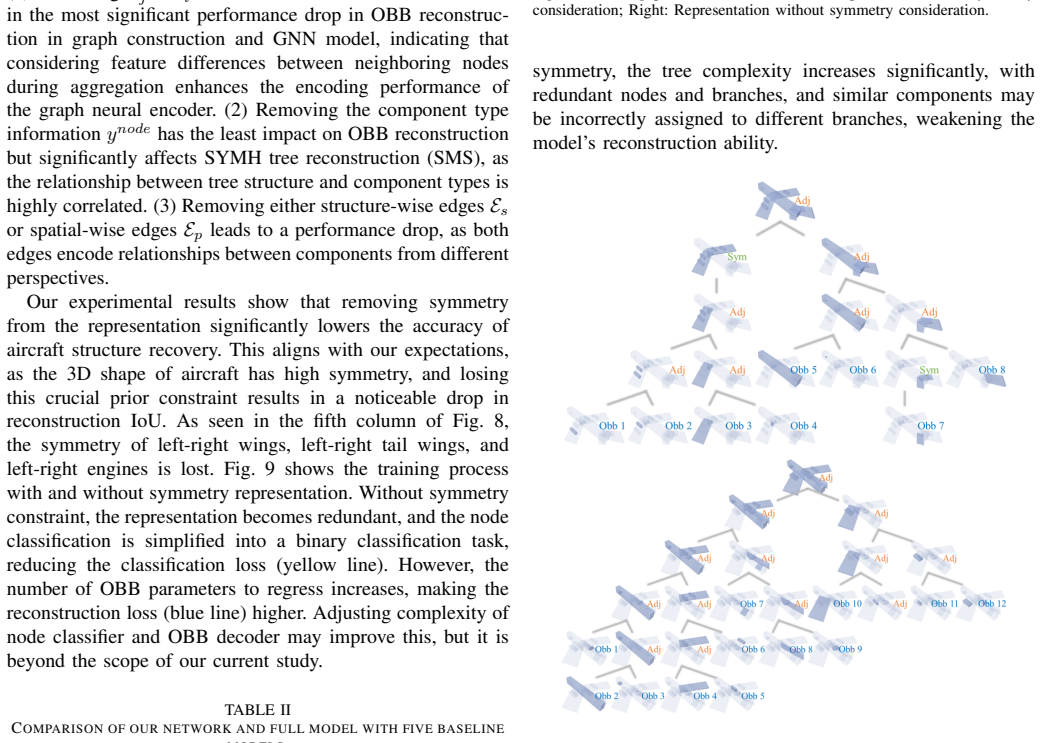
The load-bearing object is the Symmetry Hierarchy (SYMH), a tree in which each leaf is an oriented bounding box encoded by its center, edge lengths, and two direction vectors, and each internal node is either an adjacency node (two boxes touch) or a symmetry node (two sets of boxes are mirror images across a plane). The argument is carried by a two-step bridge: Step 1 uses a multi-task network with a shared feature backbone to output a heatmap of component keypoints, wing quadrilateral contours, and left/right wing classification; Step 2 builds a multi-graph from those keypoints with two edge families (structure-wise and spatial-wise), encodes it with a dual-stream graph neural network into an 80-dimensional root code, then decodes that code recursively with a recursive neural network into the SYMH tree. A rule-based post-processing pass re-aligns boxes to keypoints and uses Hungarian assignment for engine boxes. The symmetry structure is what makes the representation compact and supplies a strong prior that compensates for missing keypoints on difficult images.
What would settle it
Take a real SAR image whose acquisition geometry is known, render the same aircraft's true 3D model from that geometry, and compare SAR2Struct's recovered OBB tree, especially wing and tail symmetry-plane normals and component proportions, to the truth. Systematic disagreement that grows as the real viewing azimuth or depression angle moves away from the synthetic fixed orientation would falsify the transfer claim; a cleaner controlled test is to render simulated SAR images at those unseen orientations and measure the drop in IoU and subtree matching score.
Extended reading notes
Core claim
On its own terms, the discovery is that the component keypoints visible in a single SAR image—nose, fuselage center, tail, engines, and wing-corner vertices—carry enough information to recover a full hierarchical 3D structural model, and that the recovery can be learned without paired real images by training on simulated 3D models. The output is not a surface mesh but a compact semantic structure: each component is an oriented bounding box, and the SYMH tree encodes how boxes are joined (adjacency) and mirrored (reflectional symmetry, e.g., left/right wings). The paper reports that on simulated test data the full pipeline improves over ablations in box accuracy (IoU, Hausdorff error) and tree topology (subtree matching score), and that on real SAR images the reconstructed structures agree qualitatively with optical reference views in component count, connections, and proportions. The authors state this is the first time semantic 3D hierarchical structure representation of aircraft targets has been directly derived from a single-view SAR image.
Load-bearing premise
The load-bearing premise is that a keypoint-to-3D-structure mapping trained on simulated aircraft shapes at fixed orientations generalizes to real SAR images whose viewing geometries and scattering layouts differ from that fixed setup; the paper itself notes the training does not yet include viewpoint diversity.
Editorial extensions
If this is right
- SAR target retrieval gains a directly human-readable output: a component list with positions, sizes, orientations, and symmetry/adjacency relationships, rather than a raw surface or point cloud.
- The symmetry prior lets the pipeline recover sensible 3D structure even when Step 1 misses or misplaces keypoints, because mirror-symmetric components constrain each other.
- Decoupling keypoint detection (trained on real images) from structure recovery (trained on simulated keypoint–tree pairs) sidesteps the lack of paired real SAR images and shrinks the simulation-to-real domain gap.
- The same two-step descriptor bridge should transfer to new aircraft types or other man-made targets with well-defined component structure, provided keypoints can be annotated or detected.
Reading between the lines
- An implication the paper leaves implicit is that the predicted SYMH tree is itself a compact, editable prior: once the boxes and symmetry planes are known, the internal geometry could be filled in by fitted CAD primitives or deformable meshes, turning structure recovery into a stepping stone for full 3D reconstruction with much lower ambiguity than surface-from-scratch methods.
- The fixed-orientation training suggests a testable extension: augmenting Step 2 with viewpoint and azimuth conditioning should make the keypoint-to-structure mapping more view-invariant, which would also let the model flag input images whose viewing geometry is outside its training distribution.
- Because symmetry is encoded explicitly, the recovered tree could be checked for consistency with the image, for example by verifying that the two wing OBBs project onto the detected left and right wing quadrilaterals; such a check would provide a cheap self-supervision signal on unlabeled real SAR data.
- One could quantify real-data performance without 3D ground truth by rendering the recovered OBB tree back into a simulated SAR image and measuring overlap with the input image's scattering centers, a route the paper does not pursue.
Editorial analysis
A structured set of objections, weighed in public.
Referee Report
Summary. The paper proposes SAR2Struct, a two-step framework for recovering a 3D symmetry-hierarchy (SYMH) representation of aircraft targets from a single SAR image. Step 1 detects 2D component keypoints (nose, fuselage center, tail, engines) and wing polygons from real GF-3 SAR images using a multi-task CNN with an adaptive training strategy. Step 2 learns a mapping from these keypoints to a tree of oriented bounding boxes (fuselage, wings, tails, engines) via a dual-stream GNN encoder and a recursive (RvNN) decoder, trained on synthetic keypoint-structure pairs generated from ShapeNet aircraft models. The paper reports ablation results for both steps, introduces a Subtree Matching Score (SMS) for tree-structure evaluation, and shows qualitative real-data results. The central claim is that this is the first demonstration that semantic 3D hierarchical structure can be directly derived from a single-view SAR image.
Significance. The task definition is novel and the overall direction is valuable: translating SAR images into structured, human-interpretable 3D semantic representations is a meaningful step beyond surface reconstruction or scattering-center approaches. The design of a physical intermediate descriptor (component keypoints) to decouple real-image detection from synthetic-data structure learning is a sensible strategy for coping with the SAR domain gap. The paper also contributes a data-synthesis pipeline, a graph-based dual-stream encoder, and a topology-aware evaluation metric (SMS). If the real-data transfer were rigorously established, this would be an important advance for SAR ATR and scene interpretation. However, the current evidence does not yet support the strong claim of 'directly derived' from a single SAR image, because the real-data evaluation is qualitative, orientation is manually adjusted, and a substantial part of the recovered geometry is produced by hand-coded rules operating on the input keypoints.
major comments (4)
- [Section VI-D, Fig. 11] The real-data 3D results are displayed only after 'adjusting the orientation manually' (Fig. 11 caption and the sentence 'the third row shows the visualization after adjusting the orientation manually'). Since the OBB representation includes 3D orientation (Section III-A), this manual step means that the system does not recover the absolute 3D orientation from the image. The abstract and contribution 3 claim that 3D structure is 'directly derived' from a single SAR image, which is not supported by these experiments. Please either provide quantitative real-data evaluation without manual alignment, or explicitly state that orientation is user-supplied and revise the claim accordingly.
- [Section V-C] The rule-based post-processing computes the fuselage center, length, and direction, the wing centers and dimensions, and the engine positions directly from the input 2D keypoints, using the Hungarian algorithm to match predicted engine centers to keypoint coordinates. Consequently, a large part of the recovered geometry is a deterministic function of the input keypoints, not of the learned GNN/RvNN mapping. To support the stated contribution, please quantify the relative contribution of the learned decoder versus the post-processing rules: for example, report results on the synthetic test set with and without post-processing, and for the real-data examples report the raw network output and the refined output separately.
- [Section VI-A and Section VII (limitation 3)] Step 2 is trained and evaluated only on synthetic keypoint-structure pairs generated from ShapeNet aircraft models at fixed orientations, as the authors acknowledge in Section VII: 'the current Step 2 algorithm does not consider viewpoint diversity.' Because real GF-3 SAR viewing geometries may produce keypoint layouts not represented in the synthetic training distribution, and because Step 1 exhibits non-trivial errors on real images (missed engines, misclassified wing boxes, keypoint deviations, as shown in Fig. 7), the conclusion that the step-2 model 'can effectively link with the keypoint detection model trained on real data' (Section VI-D) is not established quantitatively. Please augment the synthetic evaluation with viewpoint variation and with injected keypoint noise, and, if feasible, evaluate on real SAR images using manually annotated keypoints to isolate the keypoint-to-structure mapping from detection noise.
- [Abstract and Section I contribution 3] The phrase 'directly derived' overstates the current evidence. The experiments demonstrate that a two-step pipeline with post-processing and manual orientation alignment can produce plausible 3D structures on real SAR images, but they do not demonstrate that the 3D structure is uniquely or automatically determined by the single SAR image alone. Please temper the claim (e.g., 'recovered with manual orientation alignment' or 'recovered in a pipeline that combines learned mapping with geometric post-processing'), or add experiments that close the loop automatically and quantitatively.
minor comments (6)
- [Section IV-B, after Eq. (8)] The phrase 'α is oefficient ratio' should be 'α is the coefficient ratio of positive and negative samples.'
- [Eq. (22)] The loss weights are introduced as λ_cls, λ_sym, and λ_obb in Eq. (22), but the following sentence refers to 'w1, w2, w3'; please unify the notation.
- [Section V-C] The post-processing description is informal: 'the center position, length, and direction are calculated using keypoints' and 'we compute their center and dimensions' — please provide explicit formulas or pseudocode so the algorithm is reproducible.
- [Table II and Fig. 8] The terms 'Ours-Net' and 'Ours-All' are used in the table and figure but are not defined in the text; please state what 'All' adds (presumably the post-processing refinement) and define both in the experimental setup.
- [Section VI-B.3] The descriptions of the 'Independent' and 'Uniform' baselines would benefit from explicit statements about which losses and heads are used in each case, so that the comparison in Table I is unambiguous.
- [References] Reference [48] is cited as an arXiv preprint; if a peer-reviewed version is available, please cite that version instead.
Circularity Check
No significant circularity: the SAR-to-keypoints-to-SYMH pipeline is a learned mapping trained on independent synthetic pairs; rule-based post-processing and manual orientation adjustment are validation limitations, not circular reductions.
full rationale
The paper's derivation chain is SAR image → 2D component keypoints (learned in Step 1) → 3D SYMH structure (learned in Step 2 from synthetic keypoint-structure pairs). The training pairs are generated by projecting ShapeNet 3D models to 2D and extracting keypoints, so the mapping from keypoints to 3D structure is supervised with ground truth derived independently of the test SAR image. No equation defines the target structure in terms of the SAR image or vice versa; the intermediate keypoint descriptor is a legitimate bridge, not a circular redefinition. The rule-based post-processing in Section V-C computes OBB parameters from input keypoints, and Section VI-D uses manual orientation adjustment, but these are transparent engineering choices and evaluation limitations rather than hidden circular reductions: the final output is not fed back as input, and the learned mapping is still evaluated on synthetic data with held-out ground truth. The self-citations to prior work by the authors (e.g., [4], [5], [25], [26]) provide background on SAR rendering and scattering models and are not load-bearing for the central claim. Section VII limitation 3 explicitly acknowledges fixed-orientation training, which undermines generalization evidence but does not constitute circularity. The real-data results are qualitative and lack ground truth, so the 'directly derived' claim is not fully validated, but that is a correctness/evidence concern, not a circularity concern. Overall, the derivation is self-contained and does not reduce to its inputs by construction.
Assumptions & free parameters
free parameters (5)
- Step 2 loss weights (lambda_cls, lambda_sym, lambda_obb) =
not reported
- Step 1 loss weights (w_heatmap, w_score, w_loc, w_polycls, w_conf, w_aircls, w_kp, w_poly) =
not reported
- Feature code dimension d =
80
- Keypoint score threshold =
not reported
- Number of GNN update steps T =
not reported
assumptions (4)
- domain assumption OBBs fitted to fine-grained ShapeNet segmentations and the iterative graph contraction algorithm in [9] yield correct ground-truth symmetry hierarchies for aircraft.
- domain assumption Component keypoints are a sufficient intermediate descriptor to bridge real SAR images and 3D structure.
- ad hoc to paper Simulated fixed-orientation keypoint layouts cover the real SAR keypoint distribution.
- domain assumption ShapeNet aircraft models are representative of the 21 GF-3 aircraft types.
Cite this review
Pith. "Pith review of SAR2Struct: Extracting 3D Semantic Structural Representation of Aircraft Targets from Single-View SAR Image." pith.science (2026). https://pith.science/paper/MTOFSEP2
@misc{pith2026250606757,
  author       = {Pith},
  title        = {Pith review of: SAR2Struct: Extracting 3D Semantic Structural Representation of Aircraft Targets from Single-View SAR Image},
  year         = {2026},
  howpublished = {\url{https://pith.science/paper/MTOFSEP2}},
  note         = {Machine review of arXiv:2506.06757}
}
read the original abstract
To translate synthetic aperture radar (SAR) image into interpretable forms for human understanding is the ultimate goal of SAR advanced information retrieval. Existing methods mainly focus on 3D surface reconstruction or local geometric feature extraction of targets, neglecting the role of structural modeling in capturing semantic information. This paper proposes a novel task: SAR target structure recovery, which aims to infer the components of a target and the structural relationships between its components, specifically symmetry and adjacency, from a single-view SAR image. Through learning the structural consistency and geometric diversity across the same type of targets as observed in different SAR images, it aims to derive the semantic representation of target directly from its 2D SAR image. To solve this challenging task, a two-step algorithmic framework based on structural descriptors is developed. Specifically, in the training phase, it first detects 2D keypoints from real SAR images, and then learns the mapping from these keypoints to 3D hierarchical structures using simulated data. During the testing phase, these two steps are integrated to infer the 3D structure from real SAR images. Experimental results validated the effectiveness of each step and demonstrated, for the first time, that 3D semantic structural representation of aircraft targets can be directly derived from a single-view SAR image.
Figures


Figures from the paper (8 more)




Reference graph
Works this paper leans on
-
[1]
A preliminary study on sar advanced information retrieval and scene reconstruction,
F. Xu, Y .-Q. Jin, and A. Moreira, “A preliminary study on sar advanced information retrieval and scene reconstruction,” IEEE Geoscience and remote sensing letters , vol. 13, no. 10, pp. 1443–1447, 2016
work page 2016
-
[2]
A fast progressive ship detection method for very large full-scene sar images,
H. Jia, X. Pu, Q. Liu, H. Wang, and F. Xu, “A fast progressive ship detection method for very large full-scene sar images,” IEEE Transactions on Geoscience and Remote Sensing , 2024
work page 2024
-
[3]
Soft rasterizer: A differen- tiable renderer for image-based 3d reasoning,
S. Liu, T. Li, W. Chen, and H. Li, “Soft rasterizer: A differen- tiable renderer for image-based 3d reasoning,” in Proceedings of the IEEE/CVF international conference on computer vision , 2019, pp. 7708–7717
work page 2019
-
[4]
Differentiable sar renderer and image-based target reconstruction,
S. Fu and F. Xu, “Differentiable sar renderer and image-based target reconstruction,” IEEE Transactions on Image Processing, vol. 31, pp. 6679–6693, 2022
work page 2022
-
[5]
S. Fu, H. Jia, X. Pu, and F. Xu, “Extension of differentiable sar renderer for ground target reconstruction from multi-view images and shadows,” IEEE Transactions on Geoscience and Remote Sensing, 2023
work page 2023
-
[6]
F. Xu and Y .-Q. Jin, “Imaging simulation of polarimetric sar for a comprehensive terrain scene using the mapping and projection algorithm,” IEEE Transactions on Geoscience and Remote Sensing, vol. 44, no. 11, pp. 3219–3234, 2006
work page 2006
-
[7]
Attributed scattering centers for sar atr,
L. C. Potter and R. L. Moses, “Attributed scattering centers for sar atr,” IEEE Transactions on image processing , vol. 6, no. 1, pp. 79–91, 1997
work page 1997
-
[8]
A complex target reconstruc- tion characterized by canonical scattering objects,
Y . Li, F. Xu, and Y .-Q. Jin, “A complex target reconstruc- tion characterized by canonical scattering objects,” in 2016 IEEE International Geoscience and Remote Sensing Symposium (IGARSS). IEEE, 2016, pp. 1278–1280
work page 2016
Show all 62 references
-
[9]
Symmetry hierarchy of man-made objects,
Y . Wang, K. Xu, J. Li, H. Zhang, A. Shamir, L. Liu, Z. Cheng, and Y . Xiong, “Symmetry hierarchy of man-made objects,” in Computer graphics forum, vol. 30, no. 2. Wiley Online Library, 2011, pp. 287–296
2011
-
[10]
Grass: Generative recursive autoencoders for shape structures,
J. Li, K. Xu, S. Chaudhuri, E. Yumer, H. Zhang, and L. Guibas, “Grass: Generative recursive autoencoders for shape structures,” ACM Transactions on Graphics (TOG), vol. 36, no. 4, pp. 1–14, 2017
2017
-
[11]
Generating 3d point clouds from a single sar image using 3d reconstruction net- work,
L. Peng, X. Qiu, C. Ding, and W. Tie, “Generating 3d point clouds from a single sar image using 3d reconstruction net- work,” in IGARSS 2019-2019 IEEE International Geoscience and Remote Sensing Symposium . IEEE, 2019, pp. 3685–3688
2019
-
[12]
Moving and stationary target acquisition and recognition (mstar) model-based auto- matic target recognition: Search technology for a robust atr,
J. R. Diemunsch and J. Wissinger, “Moving and stationary target acquisition and recognition (mstar) model-based auto- matic target recognition: Search technology for a robust atr,” in Algorithms for synthetic aperture radar Imagery V , vol. 3370. SPIE, 1998, pp. 481–492
1998
-
[13]
3d point cloud reconstruction using inversely mapping and voting from single pass csar images,
S. Feng, Y . Lin, Y . Wang, F. Teng, and W. Hong, “3d point cloud reconstruction using inversely mapping and voting from single pass csar images,” Remote Sensing , vol. 13, no. 17, p. 3534, 2021
2021
-
[14]
Multi-baseline sar 3d reconstruction of vehicle from very sparse aspects: A generative adversarial network based approach,
S. Wang, J. Guo, Y . Zhang, and Y . Wu, “Multi-baseline sar 3d reconstruction of vehicle from very sparse aspects: A generative adversarial network based approach,” ISPRS Journal of Pho- togrammetry and Remote Sensing , vol. 197, pp. 36–55, 2023
2023
-
[15]
Geometric constraints based 3d reconstruction method of tomographic sar for buildings,
D. Han, Z. Jiao, L. Zhou, C. Ding, and Y . Wu, “Geometric constraints based 3d reconstruction method of tomographic sar for buildings,” Science China Information Sciences , vol. 66, no. 1, p. 112301, 2023
2023
-
[16]
A probabilistic approach for stereo 3d point cloud reconstruction from airborne single-channel multi-aspect sar image sequences,
H. Zhang, Y . Lin, F. Teng, and W. Hong, “A probabilistic approach for stereo 3d point cloud reconstruction from airborne single-channel multi-aspect sar image sequences,” Remote Sens- ing, vol. 14, no. 22, p. 5715, 2022
2022
-
[17]
Lightweight pixel2mesh for 3d target reconstruction from a single sar image,
L. Yu, J. Zou, M. Liang, L. Li, X. Xie, X. Yu, and W. Hong, “Lightweight pixel2mesh for 3d target reconstruction from a single sar image,” IEEE Geoscience and Remote Sensing Letters, 2023
2023
-
[18]
Sar-3dtr: A novel feature hybrid transformer network for end-to-end 3d target reconstruction from sar images,
Y . Qin, W. Xu, Y . Yao, and X. Huang, “Sar-3dtr: A novel feature hybrid transformer network for end-to-end 3d target reconstruction from sar images,” IEEE Geoscience and Remote Sensing Letters, 2024
2024
-
[19]
Supervised fitting of geometric primitives to 3d point clouds,
L. Li, M. Sung, A. Dubrovina, L. Yi, and L. J. Guibas, “Supervised fitting of geometric primitives to 3d point clouds,” in Proceedings of the IEEE/CVF Conference on Computer Vision and Pattern Recognition , 2019, pp. 2652–2660
2019
-
[20]
Image domain feature extraction from synthetic aperture imagery,
M. A. Koets and R. L. Moses, “Image domain feature extraction from synthetic aperture imagery,” in 1999 IEEE International Conference on Acoustics, Speech, and Signal Processing. Pro- ceedings. ICASSP99 (Cat. No. 99CH36258) , vol. 4. IEEE, 1999, pp. 2319–2322
1999
-
[21]
Target reconstruction based on 3-d scattering center model for robust sar atr,
B. Ding and G. Wen, “Target reconstruction based on 3-d scattering center model for robust sar atr,”IEEE Transactions on Geoscience and Remote Sensing, vol. 56, no. 7, pp. 3772–3785, 2018
2018
-
[22]
Attributed scattering center extraction with genetic algorithm,
M. Jing and G. Zhang, “Attributed scattering center extraction with genetic algorithm,” IEEE Transactions on Antennas and Propagation, vol. 69, no. 5, pp. 2810–2819, 2020
2020
-
[23]
Efficient attributed scatter center extraction based on image-domain sparse repre- sentation,
D. Yang, W. Ni, L. Du, H. Liu, and J. Wang, “Efficient attributed scatter center extraction based on image-domain sparse repre- sentation,” IEEE Transactions on Signal Processing , vol. 68, pp. 4368–4381, 2020
2020
-
[24]
At- tributed scattering center extraction method for microwave pho- tonic signals using dsm-pmm-regularized optimization,
Y . Xie, M. Xing, Y . Gao, Z. Wu, G.-C. Sun, and L. Guo, “At- tributed scattering center extraction method for microwave pho- tonic signals using dsm-pmm-regularized optimization,” IEEE Transactions on Geoscience and Remote Sensing , vol. 60, pp. 1–16, 2022
2022
-
[25]
A reinforcement learning framework for scattering feature extraction and sar image interpretation,
J. Chen, X. Zhang, H. Wang, and F. Xu, “A reinforcement learning framework for scattering feature extraction and sar image interpretation,” IEEE Transactions on Geoscience and Remote Sensing, 2024
2024
-
[26]
Extraction of attributed scattering center based on physics informed machine learning,
Z. Yue and F. Xu, “Extraction of attributed scattering center based on physics informed machine learning,” Journal of Elec- tronics & Information Technology , vol. 46, no. 5, pp. 1–12, 2024
2024
-
[27]
Learning shape abstractions by assembling volumetric prim- itives,
S. Tulsiani, H. Su, L. J. Guibas, A. A. Efros, and J. Malik, “Learning shape abstractions by assembling volumetric prim- itives,” in Proceedings of the IEEE Conference on Computer Vision and Pattern Recognition , 2017, pp. 2635–2643
2017
-
[28]
Unsupervised learning for cuboid shape abstraction via joint segmentation from point clouds,
K. Yang and X. Chen, “Unsupervised learning for cuboid shape abstraction via joint segmentation from point clouds,” ACM Transactions On Graphics (TOG) , vol. 40, no. 4, pp. 1–11, JOURNAL OF LATEX CLASS FILES 13 2021
2021
-
[29]
Superquadrics revisited: Learning 3d shape parsing beyond cuboids,
D. Paschalidou, A. O. Ulusoy, and A. Geiger, “Superquadrics revisited: Learning 3d shape parsing beyond cuboids,” in Pro- ceedings of the IEEE/CVF Conference on Computer Vision and Pattern Recognition (CVPR), June 2019
2019
-
[30]
Robust and accurate superquadric recovery: A probabilistic approach,
W. Liu, Y . Wu, S. Ruan, and G. S. Chirikjian, “Robust and accurate superquadric recovery: A probabilistic approach,” in Proceedings of the IEEE/CVF Conference on Computer Vision and Pattern Recognition, 2022, pp. 2676–2685
2022
-
[31]
Iterative superquadric recomposition of 3d objects from multiple views,
S. Alaniz, M. Mancini, and Z. Akata, “Iterative superquadric recomposition of 3d objects from multiple views,” in Proceed- ings of the IEEE/CVF International Conference on Computer Vision, 2023, pp. 18 013–18 023
2023
-
[32]
Marching- primitives: Shape abstraction from signed distance function,
W. Liu, Y . Wu, S. Ruan, and G. S. Chirikjian, “Marching- primitives: Shape abstraction from signed distance function,” in Proceedings of the IEEE/CVF Conference on Computer Vision and Pattern Recognition, 2023, pp. 8771–8780
2023
-
[33]
Bsp-net: Generating compact meshes via binary space partitioning,
Z. Chen, A. Tagliasacchi, and H. Zhang, “Bsp-net: Generating compact meshes via binary space partitioning,” in Proceedings of the IEEE/CVF conference on computer vision and pattern recognition, 2020, pp. 45–54
2020
-
[34]
Neural parts: Learning expressive 3d shape abstractions with invertible neural networks,
D. Paschalidou, A. Katharopoulos, A. Geiger, and S. Fidler, “Neural parts: Learning expressive 3d shape abstractions with invertible neural networks,” in Proceedings of the IEEE/CVF Conference on Computer Vision and Pattern Recognition, 2021, pp. 3204–3215
2021
-
[35]
Sdm-net: Deep generative network for structured deformable mesh,
L. Gao, J. Yang, T. Wu, Y .-J. Yuan, H. Fu, Y .-K. Lai, and H. Zhang, “Sdm-net: Deep generative network for structured deformable mesh,” ACM Transactions on Graphics (TOG) , vol. 38, no. 6, pp. 1–15, 2019
2019
-
[36]
Sagnet: Structure-aware generative network for 3d-shape modeling,
Z. Wu, X. Wang, D. Lin, D. Lischinski, D. Cohen-Or, and H. Huang, “Sagnet: Structure-aware generative network for 3d-shape modeling,” ACM Transactions on Graphics (TOG) , vol. 38, no. 4, pp. 1–14, 2019
2019
-
[37]
Cvxnet: Learnable convex decomposition,
B. Deng, K. Genova, S. Yazdani, S. Bouaziz, G. Hinton, and A. Tagliasacchi, “Cvxnet: Learnable convex decomposition,” in Proceedings of the IEEE/CVF conference on computer vision and pattern recognition , 2020, pp. 31–44
2020
-
[38]
Dpa-net: Structured 3d abstraction from sparse views via differentiable primitive assembly,
F. Yu, Y . Qian, X. Zhang, F. Gil-Ureta, B. Jackson, E. Ben- nett, and H. Zhang, “Dpa-net: Structured 3d abstraction from sparse views via differentiable primitive assembly,” inEuropean Conference on Computer Vision. Springer, 2025, pp. 454–471
2025
-
[39]
Anise: Assembly-based neural implicit surface reconstruction,
D. Petrov, M. Gadelha, R. M ˇech, and E. Kalogerakis, “Anise: Assembly-based neural implicit surface reconstruction,” IEEE Transactions on Visualization and Computer Graphics , 2023
2023
-
[40]
Bae-net: Branched autoencoder for shape co-segmentation,
Z. Chen, K. Yin, M. Fisher, S. Chaudhuri, and H. Zhang, “Bae-net: Branched autoencoder for shape co-segmentation,” in Proceedings of the IEEE/CVF International Conference on Computer Vision, 2019, pp. 8490–8499
2019
-
[41]
Dae-net: Deforming auto-encoder for fine-grained shape co-segmentation,
Z. Chen, Q. Chen, H. Zhou, and H. Zhang, “Dae-net: Deforming auto-encoder for fine-grained shape co-segmentation,” in ACM SIGGRAPH 2024 Conference Papers , 2024, pp. 1–11
2024
-
[42]
Part123: part-aware 3d reconstruction from a single- view image,
A. Liu, C. Lin, Y . Liu, X. Long, Z. Dou, H.-X. Guo, P. Luo, and W. Wang, “Part123: part-aware 3d reconstruction from a single- view image,” in ACM SIGGRAPH 2024 Conference Papers , 2024, pp. 1–12
2024
-
[43]
Generating part-aware editable 3d shapes without 3d supervision,
K. Tertikas, D. Paschalidou, B. Pan, J. J. Park, M. A. Uy, I. Emiris, Y . Avrithis, and L. Guibas, “Generating part-aware editable 3d shapes without 3d supervision,” in Proceedings of the IEEE/CVF Conference on Computer Vision and Pattern Recognition, 2023, pp. 4466–4478
2023
-
[44]
Pq-net: A generative part seq2seq network for 3d shapes,
R. Wu, Y . Zhuang, K. Xu, H. Zhang, and B. Chen, “Pq-net: A generative part seq2seq network for 3d shapes,” in Proceedings of the IEEE/CVF Conference on Computer Vision and Pattern Recognition, 2020, pp. 829–838
2020
-
[45]
Im2struct: Recovering 3d shape structure from a single rgb image,
C. Niu, J. Li, and K. Xu, “Im2struct: Recovering 3d shape structure from a single rgb image,” in Proceedings of the IEEE conference on computer vision and pattern recognition , 2018, pp. 4521–4529
2018
-
[46]
Partnet: A recursive part decomposition network for fine-grained and hier- archical shape segmentation,
F. Yu, K. Liu, Y . Zhang, C. Zhu, and K. Xu, “Partnet: A recursive part decomposition network for fine-grained and hier- archical shape segmentation,” in Proceedings of the IEEE/CVF conference on computer vision and pattern recognition , 2019, pp. 9491–9500
2019
-
[47]
Grains: Gener- ative recursive autoencoders for indoor scenes,
M. Li, A. G. Patil, K. Xu, S. Chaudhuri, O. Khan, A. Shamir, C. Tu, B. Chen, D. Cohen-Or, and H. Zhang, “Grains: Gener- ative recursive autoencoders for indoor scenes,” ACM Transac- tions on Graphics (TOG) , vol. 38, no. 2, pp. 1–16, 2019
2019
-
[48]
Structurenet: Hierarchical graph networks for 3d shape generation,
K. Mo, P. Guerrero, L. Yi, H. Su, P. Wonka, N. Mitra, and L. J. Guibas, “Structurenet: Hierarchical graph networks for 3d shape generation,” arXiv preprint arXiv:1908.00575 , 2019
1908 arXiv
-
[49]
Learning adaptive hierarchical cuboid abstractions of 3d shape collections,
C.-Y . Sun, Q.-F. Zou, X. Tong, and Y . Liu, “Learning adaptive hierarchical cuboid abstractions of 3d shape collections,” ACM Transactions on Graphics (TOG), vol. 38, no. 6, pp. 1–13, 2019
2019
-
[50]
Learning unsu- pervised hierarchical part decomposition of 3d objects from a single rgb image,
D. Paschalidou, L. V . Gool, and A. Geiger, “Learning unsu- pervised hierarchical part decomposition of 3d objects from a single rgb image,” in Proceedings of the IEEE/CVF Conference on Computer Vision and Pattern Recognition , 2020, pp. 1060– 1070
2020
-
[51]
Dsg- net: Learning disentangled structure and geometry for 3d shape generation,
J. Yang, K. Mo, Y .-K. Lai, L. J. Guibas, and L. Gao, “Dsg- net: Learning disentangled structure and geometry for 3d shape generation,” ACM Transactions on Graphics (TOG) , vol. 42, no. 1, pp. 1–17, 2022
2022
-
[52]
Rim-net: Recursive implicit fields for unsupervised learning of hierarchical shape structures,
C. Niu, M. Li, K. Xu, and H. Zhang, “Rim-net: Recursive implicit fields for unsupervised learning of hierarchical shape structures,” in Proceedings of the IEEE/CVF Conference on Computer Vision and Pattern Recognition , 2022, pp. 11 779– 11 788
2022
-
[53]
Shapenet: An information-rich 3d model repository,
A. X. Chang, T. Funkhouser, L. Guibas, P. Hanrahan, Q. Huang, Z. Li, S. Savarese, M. Savva, S. Song, H. Su et al., “Shapenet: An information-rich 3d model repository,” arXiv preprint arXiv:1512.03012, 2015
2015 arXiv
-
[54]
Simple baselines for human pose estimation and tracking,
B. Xiao, H. Wu, and Y . Wei, “Simple baselines for human pose estimation and tracking,” in Proceedings of the European conference on computer vision (ECCV) , 2018, pp. 466–481
2018
-
[55]
Polygon intersection-over-union loss for viewpoint-agnostic monocular 3d vehicle detection,
D. Gloudemans, X. Lu, S. Xia, and D. B. Work, “Polygon intersection-over-union loss for viewpoint-agnostic monocular 3d vehicle detection,” arXiv preprint arXiv:2309.07104 , 2023
2023
-
[56]
End-to-end multi-task learning with attention,
S. Liu, E. Johns, and A. J. Davison, “End-to-end multi-task learning with attention,” in Proceedings of the IEEE/CVF con- ference on computer vision and pattern recognition , 2019, pp. 1871–1880
2019
-
[57]
Quantifying task priority for multi- task optimization,
W. Jeong and K.-J. Yoon, “Quantifying task priority for multi- task optimization,” in Proceedings of the IEEE/CVF Conference on Computer Vision and Pattern Recognition , 2024, pp. 363– 372
2024
-
[58]
Recognizing vector graphics without rasterization,
X. Jiang, L. Liu, C. Shan, Y . Shen, X. Dong, and D. Li, “Recognizing vector graphics without rasterization,” Advances in Neural Information Processing Systems , vol. 34, pp. 24 569– 24 580, 2021
2021
-
[59]
Hierarchical recognizing vector graphics and a new chart-based vector graphics dataset,
S. Dou, X. Jiang, L. Liu, L. Ying, C. Shan, Y . Shen, X. Dong, Y . Wang, D. Li, and C. Zhao, “Hierarchical recognizing vector graphics and a new chart-based vector graphics dataset,” IEEE Transactions on Pattern Analysis and Machine Intelligence , 2024
2024
-
[60]
The hungarian method for the assignment prob- lem,
H. W. Kuhn, “The hungarian method for the assignment prob- lem,” Naval research logistics quarterly , vol. 2, no. 1-2, pp. 83–97, 1955
1955
-
[61]
Semi-supervised 3d shape segmentation with multilevel consistency and part substitution,
C.-Y . Sun, Y .-Q. Yang, H.-X. Guo, P.-S. Wang, X. Tong, Y . Liu, and H.-Y . Shum, “Semi-supervised 3d shape segmentation with multilevel consistency and part substitution,” Computational Visual Media, vol. 9, no. 2, pp. 229–247, 2023
2023
-
[62]
Microsoft coco: Common objects in context,
T.-Y . Lin, M. Maire, S. Belongie, J. Hays, P. Perona, D. Ra- manan, P. Doll´ar, and C. L. Zitnick, “Microsoft coco: Common objects in context,” in Computer Vision–ECCV 2014: 13th European Conference, Zurich, Switzerland, September 6-12, 2014, Proceedings, Part V 13 . Springer...
2014
Reviewed August 7, 2026 · model on record in the stance chip above.
Discussion (0). Sign in to comment.