REVIEW 2 major objections 4 minor 40 references
Lie Algebra Contractions and Interbasis Expansions on Two-Dimensional Hyperboloid IIB. Non-Subgroup Basis
T0 review · 2 major / 4 minor · reviewed 2026-08-07 · deepseek-v4-flash
Pith's one-line read The paper constructs, for the first time, orthonormal discrete-spectrum eigenfunctions for the hyperboloid's hyperbolic parabolic system and derives their explicit overlap coefficients with the equidistant basis.
desk verdict The paper does solid special-function work (SCP-HO exponentials, EP-EQ expansions), but its new discrete HP spectrum is underdetermined by an arbitrary offset ς0 and lacks completeness. read the letter →
The pith
A machine-rendered reading of the paper's core claim, the machinery that carries it, and where it could break.
The reading
What carries the argument
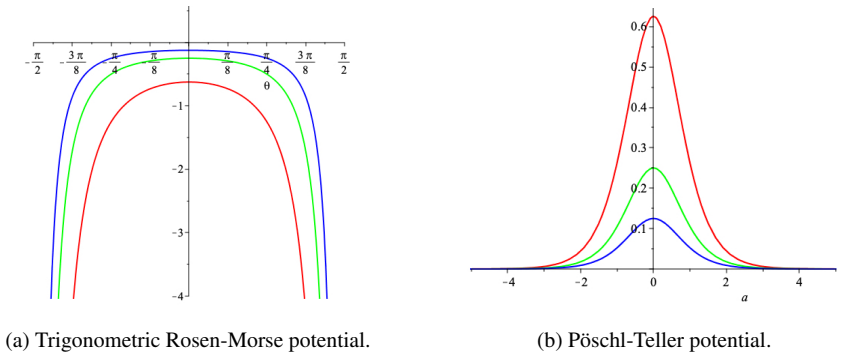
The machinery is separation of variables: in each non-subgroup system the Laplace–Beltrami equation splits into two one-dimensional hypergeometric equations with singular potentials (trigonometric Rosen–Morse, Pöschl–Teller, a hyperbolic centrifugal term, and an algebraic term where the separation constants fail to decouple). The hyperbolic parabolic solutions are assembled from toroidal functions, the associated Legendre functions of the second kind $Q^{-i\rho}_{-1/2+\varsigma}(\cosh b)$ and $Q^{-i\rho}_{-1/2+\varsigma}(\cos\theta)$; their connection formulas and endpoint asymptotics at $b=0$, $\theta=0$, $\theta=\pi$ impose square integrability, fix the ladder structure $\varsigma_n = \varsigma_0 + 2n$, and determine the gamma-function normalization constants (252) and (264). The interbasis coefficients are then extracted by analytic continuation and residue evaluation of known integrals: the SCP-to-HO coefficients collapse to the $\rho$-independent exponentials $K^{(1,2)}_{\rho A} = \mp \frac{i}{2\sqrt{\pi}}\frac{e^{\pm i|A|/2s}}{s}$, the EP-to-PS coefficients are unit-argument $_4F_3$ series identified with Wilson–Racah polynomials, and the EP-to-EQ and HP-to-EQ coefficients are $_3F_2$ series with delta-function terms.
What would settle it
Compute numerically the resolution of identity for the discrete HP family at a fixed generic offset, say $\varsigma_0 = 1/2$: truncate the series in (57) and test whether, with the weight $\sin^{-2}\theta + \sinh^{-2}b$ of Eq. (34), it converges to $\delta(b-b')\delta(\theta-\theta')$. The orthogonality proof in Appendix B fixes only the spacing between neighboring $\varsigma$ values; if the truncated series converges to a delta only for special offsets, or to a projector on a subspace, the discrete family is not complete. A simpler check: insert the coefficients (151)–(152) into Parseval's identity for the expansion (139) and see whether it holds for $\varsigma_0 = 1/2$ and $\varsigma_0 = 1$ alike.
Extended reading notes
Core claim
The paper's central claim is that the hyperbolic parabolic system on $H^+_2$ possesses a discrete series of orthonormal eigenfunctions, presented here for the first time in explicit closed form: $\Psi^{HP}_{\rho\varsigma_n}(b,\theta) = N^d_{\rho\varsigma_n}\sqrt{\sinh b\,\sin\theta}\,Q^{-i\rho}_{-1/2+\varsigma_n}(\cosh b)\,Q^{-i\rho}_{-1/2+\varsigma_n}(\cos\theta)$ with the normalization (252), where the separation constant runs over the ladder $\varsigma_n = \varsigma_0 + 2n$ with offset $\varsigma_0 \in (0,2]$, together with a continuous-spectrum family obtained by $\varsigma \to i\varsigma$ (Eq. (63)). It further claims that the expansion of these new eigenfunctions in the equidistant basis has the explicit coefficients (151)–(152) (discrete) and (159)–(160) (continuous), finally answering the problem of expanding the hyperbolic parabolic basis that earlier work had flagged as intractable. The same paper obtains normalized eigenfunctions for the semi-circular parabolic and elliptic parabolic systems and computes their overlaps with subgroup bases: exponentials for SCP into the horocyclic basis, Wilson–Racah polynomials for EP into the pseudo-spherical basis, and $_3F_2$ series with delta terms for EP into the equidistant basis. The upshot claimed is a complete, explicitly normalized set of separable eigenfunctions for all three non-subgroup coordinate systems, tied to the subgroup bases by explicit unitary coefficients and contracting, as the radius tends to infinity, to the familiar separable solutions of the Helmholtz equation on the Euclidean plane.
Load-bearing premise
The discrete spectrum of the hyperbolic parabolic system is assumed to have ladder spacing 2 starting from an arbitrary offset between 0 and 2; the orthogonality calculation fixes only the spacing, no boundary condition determines the offset, and completeness for such a choice is not proved.
Editorial extensions
If this is right
- The hyperbolic parabolic discrete-series eigenfunctions (57) with normalization (252) make explicit, for the first time, the discrete spectrum that earlier work had detected but not solved for the hyperbolic parabolic coordinate system on $H^+_2$.
- The expansions (151)–(152) and (159)–(160) supply explicit unitary coefficients between the hyperbolic parabolic basis and the equidistant basis, so spectral computations can be translated freely between the two systems.
- The SCP-to-horocyclic coefficients take the closed form $\mp \frac{i}{2\sqrt{\pi}} e^{\pm i|A|/2s}/s$, independent of the energy label $\rho$, giving the simplest possible connection between two of the separable systems.
- The EP-to-PS coefficients, expressed through Wilson–Racah polynomials, inherit orthogonality and completeness from known polynomial systems, which is the mechanism by which the paper proves completeness of the EP basis.
- The contraction results of Section IV give explicit $R\to\infty$ limits of every normalized non-subgroup basis, recovering parabolic, polar, and Cartesian solutions of the Helmholtz equation on the Euclidean plane and showing how the curved-space solutions degenerate.
Reading between the lines
- I read the free offset $\varsigma_0 \in (0,2]$ as labelling a one-parameter family of quantizations rather than a unique discrete spectrum: the orthogonality calculation fixes only the ladder spacing $2$, and no boundary condition picks a value. On this reading the hyperbolic parabolic system has inequivalent self-adjoint extensions, which matters for any quantum-mechanical application of the new
- Since the contraction limit sets $\varsigma_n \sim R\sqrt{k_2^2-k_1^2}$, the offset enters only at order $1/R$; the Euclidean plane formulas of Section IV should therefore be insensitive to $\varsigma_0$, and verifying that the phases (207)–(215) do not depend on it is a direct, purely analytic check of the construction's robustness.
- The paper proves orthonormality for the discrete HP family but not its completeness for a fixed offset; the expansions (151)–(152) would double as a completeness proof if the coefficients were shown to satisfy Parseval's identity, which is not verified in the text. Confirming that identity numerically is the cheapest way to upgrade the result from an orthonormal family to a basis.
- The $\rho$-independence of the SCP-to-HO coefficients suggests that overlap is fixed by the coordinate geometry alone; a natural extension is to look for an analogous simplification in the HP-to-EQ coefficients (151)–(152), which currently carry explicit $\rho$-dependence through the factor $F^{(\pm)}_{\rho\nu}$.
Editorial analysis
A structured set of objections, weighed in public.
Referee Report
Summary. This paper, a continuation of the authors' previous work on subgroup-type bases, studies separation of variables for the Laplace-Beltrami equation on the two-sheeted hyperboloid H_2^+ in three non-subgroup coordinate systems: semi-circular parabolic (SCP), elliptic parabolic (EP), and hyperbolic parabolic (HP). For SCP and EP the paper presents normalized eigenfunctions, orthonormality and completeness relations, and interbasis expansions into subgroup bases (equidistant, horocyclic, and pseudo-spherical). The principal new claim is a discrete series of orthonormal HP eigenfunctions, given in Eq. (57) with normalization (252), together with HP-to-EQ interbasis expansions (151)-(152). The paper also derives contractions of the normalized eigenfunctions and some expansion coefficients to the Euclidean plane.
Significance. If the HP discrete-series issue were resolved, the paper would provide explicit, normalized separable eigenfunctions for all three non-subgroup coordinate systems, with interbasis coefficients connecting them to subgroup bases. There are genuine strengths: the SCP-HO overlap coefficients are remarkably simple and ρ-independent (Eq. (82)); the EP-PS coefficients are expressed through Wilson-Racah polynomials; and Appendices A-C contain substantial independent calculations, including a contour-integral derivation of the SCP-HO coefficients. However, the HP discrete spectrum depends on an undetermined offset ς₀, so the central novelty is not uniquely specified. This is a load-bearing weakness rather than a presentation issue.
major comments (2)
- [Section II.C.1 and Appendix B, Eq. (249)] The discrete HP spectrum ς_n = ς₀ + 2n with arbitrary ς₀ ∈ (0,2] is declared, not derived. The orthogonality computation in Eqs. (247)-(248) forces only the spacing condition ς₂ - ς₁ = 2m; the sentence 'starting from the minimum positive fixed value ς₀ ∈ (0,2]' introduces the offset without any boundary condition. This matters because the separated equations (33) are singular at b = 0 and at θ = 0, π, and the asymptotics (51), (55), (56) show that both Frobenius branches are square-integrable at each singular endpoint. The square-integrability condition (42) at b → ∞ only forces ς > 0 and fixes the ratio C(-ρ,ς)/C(ρ,ς), not the value of ς. Consequently the eigenfunctions (57), the normalization (252), and the interbasis coefficients (151)-(152) all depend on an undetermined self-adjoint-extension parameter. The authors should either impose a boundary condition or a self-adjointness/completeness argument that fixes ς₀, or explicitly present the result as a one-parameter family of orthonormal bases and qualify the claim that the discrete series is 'presented for the first time'.
- [Section III.E.1, Eq. (139)] The interbasis expansion (139) presupposes completeness of the HP discrete basis, but no completeness proof is supplied for the HP system. This is in contrast with the SCP and EP bases, for which completeness is stated in Eqs. (15) and (28). Without a Parseval identity, the coefficient formulas (151)-(152) are not justified as true interbasis expansions. Moreover, if a completeness proof were supplied, it might select a particular value of ς₀, which would also resolve the ambiguity raised above. The manuscript should either prove completeness for the HP eigenfunctions with specified boundary conditions or cite a theorem that covers the relevant self-adjoint realization.
minor comments (4)
- [Abstract and Section IV.D] There are typographical errors such as 'semi-sircular' in the abstract and 'continuos' in Section IV.D; these should be corrected.
- [Eq. (57) and Eq. (252)] The typesetting of Eq. (57) leaves it ambiguous whether the two Gamma functions appear in the numerator or in the denominator; comparison with Eq. (252) resolves the intended normalization, but Eq. (57) should be typeset to match (252) explicitly.
- [Eq. (34)] The notation ilde{δ}_{ςς'} is introduced with a function f(ς) that is not defined until later; the Kronecker/Dirac distinction should be explained where the normalization condition is first stated.
- [Section III.D and Eq. (131)] The use of the formal identity δ±(z) in Eq. (131) and the resulting delta-function terms in the EP-EQ coefficients is standard in physics but should be accompanied by a sentence specifying the distributional interpretation.
Circularity Check
No circular derivation chain: the interbasis coefficients are computed by independent integrals and special-function identities, not fitted or defined by the target expansions. The arbitrary HP offset is an underdetermination gap, not a circular reduction.
full rationale
The paper derives the new interbasis coefficients by direct calculation rather than by construction. The SCP-HO coefficients K^{(1,2)}_{ρA} are obtained in Appendix C by contour integration of (81) and reduce to the closed form (82), independent of ρ; orthogonality relations (83)-(84) verify them. The EP-PS coefficients (94)-(95) are identified with Wilson-Racah polynomials and checked via (101) and (113). The EP-EQ coefficients are computed from hypergeometric integral representations (117)-(138). The HP-EQ coefficients (151)-(152) are derived from Legendre-function integrals (146)-(150). None of these steps fits a parameter to the claimed result or defines an expansion coefficient as its own overlap integral. The paper does rely on the authors' prior Ref. 1 for the subgroup bases and Ref. 6 for the SCP basis, but those are standard, explicit, independently checkable functions, and the new HP discrete series is not imported from those citations. The most notable weakness is that the discrete HP spectrum is fixed only up to an arbitrary offset: Eq. (249) states 'starting from the minimum positive fixed value ς0 ∈ (0,2]', with no boundary condition or self-adjointness argument selecting ς0, and no completeness proof is supplied for the HP family. That is a mathematical gap, not a circularity: the orthogonality calculation (247)-(248) does not presuppose (151)-(152), and the coefficients are well-defined for any admitted ςn. Hence the paper's central derivations are self-contained and the circularity score is low.
Assumptions & free parameters
free parameters (1)
- ς_0 (discrete HP spectrum offset) =
in (0,2], chosen by hand
assumptions (4)
- standard math Special function identities from Bateman-Erdélyi, Prudnikov, Magnus, and Koekoek are used without proof throughout.
- domain assumption The Hamiltonian is the Laplace-Beltrami operator on the upper sheet of H+2, and the eigenvalue problem is Eq. (3).
- domain assumption Separation of variables in the three non-subgroup coordinate systems is valid and yields two one-dimensional equations with singular potentials.
- ad hoc to paper The discrete HP spectrum is ς_n = ς_0 + 2n for an arbitrary ς_0 in (0,2].
Cite this review
Pith. "Pith review of Lie Algebra Contractions and Interbasis Expansions on Two-Dimensional Hyperboloid IIB. Non-Subgroup Basis." pith.science (2026). https://pith.science/paper/BAVYFZF7
@misc{pith2026250606827,
  author       = {Pith},
  title        = {Pith review of: Lie Algebra Contractions and Interbasis Expansions on Two-Dimensional Hyperboloid IIB. Non-Subgroup Basis},
  year         = {2026},
  howpublished = {\url{https://pith.science/paper/BAVYFZF7}},
  note         = {Machine review of arXiv:2506.06827}
}
read the original abstract
The paper describes solutions of the Laplace-Beltrami equation on two-dimensional two-sheeted hyperboloid for three non-subgroup coordinate systems: semi-sircular parabolic, elliptic parabolic and hyperbolic parabolic. The coefficients of interbasis expansions of solutions in the specified coordinate systems through some subgroup bases are calculated. A contraction procedure for all normalized eigenfunctions in three non-subgroup coordinate systems from the hyperboloid to the Euclidean plane is realized.
Figures


Figures from the paper (2 more)


Reference graph
Works this paper leans on
-
[1]
author author G. Pogosyan \ and\ author A. Yakhno ,\ title title Lie algebra contractions and interbasis expansions on two-dimensional hyperboloid iia. subgroup basis. \ 10.48550/arXiv.2504.05514 journal journal ArXiV \ ( year 2025 a ),\ 10.48550/arXiv.2504.05514 NoStop
-
[2]
author author M. Olevski i ,\ title title Three orthogonal systems in spaces of constant curvature in which the equation _2u+ u=0 allows the complete separation of variables , \ @noop journal journal Math. Sb. \ volume 27 ,\ pages 379--426 ( year 1950 ) NoStop
work page 1950
-
[3]
author author E. Kalnins \ and\ author W. Miller Jr. ,\ title title Lie theory and separation of variables. 4. the group so(2,1) and so(3) , \ @noop journal journal J. Math. Phys. \ volume 15 ,\ pages 1263--1274 ( year 1974 ) NoStop
work page 1974
-
[4]
author author C. Grosche ,\ title title Path integration and separation of variables in spaces of constant curvature in two and three dimensions , \ @noop journal journal Fortschr. Phys. \ volume 42 ,\ pages 509--584 ( year 1994 ) NoStop
work page 1994
-
[5]
author author C. Grosche ,\ @noop title Path Integrals, Hyperbolic Space, and Selberg Trace Formulas \ ( publisher World Scientific ,\ address Singapore ,\ year 1996 ) NoStop
work page 1996
-
[6]
author author G. Pogosyan \ and\ author A. Yakhno ,\ title title Semi-circular parabolic system on two-dimensional hyperboloid , \ @noop journal journal Physics of Particles and Nuclei \ volume 55 ,\ pages 667--671 ( year 2024 ) NoStop
work page 2024
-
[7]
author author H. Bateman \ and\ author A. Erd \'e lyi ,\ @noop title Higher Transcendental Functions ,\ Vol. volume 2 \ ( publisher Mc Graw-Hill ,\ address New York ,\ year 1952 ) NoStop
work page 1952
-
[8]
author author H. Bateman \ and\ author A. Erd \'e lyi ,\ @noop title Higher Transcendental Functions ,\ Vol. volume 1 \ ( publisher Mc Graw-Hill ,\ address New York ,\ year 1953 ) NoStop
work page 1953
Show all 40 references
- [9]
-
[10]
Prudnikov , author Y
author author A. Prudnikov , author Y. Brychkov , \ and\ author O. Marichev ,\ @noop title Integrals and Series. Special Functions ,\ Vol. volume 2 \ ( publisher Gordon and Breach Sci. Publ. ,\ address New York ,\ year 1990 ) NoStop
1990
-
[11]
Wilson ,\ title title Some hypergeometric orthogonal polynomials , \ @noop journal journal SIAM J
author author J. Wilson ,\ title title Some hypergeometric orthogonal polynomials , \ @noop journal journal SIAM J. Math. Anal. \ volume 11 ,\ pages 690 ( year 1980 ) NoStop
1980
-
[12]
Koekoek , author P
author author R. Koekoek , author P. Lesky , \ and\ author R. Swarttouw ,\ @noop title Hypergeometric Orthogonal Polynomials and Their q-Analogues ,\ edition 1st \ ed.,\ 185 Springer Monographs in Mathematics\ ( publisher Springer-Verlag ,\ address Berlin ,\ year 2010 ) NoStop
2010
-
[13]
author author T. Koornwinder ,\ title title Special orthogonal polynomial systems mapped onto each other by the fourier-jacobi transform , \ in\ @noop booktitle Polyn \^o mes Orthogonaux et Applications ,\ series Lecture Notes in Mathematics , Vol.\ volume 1171 ,\ editor edite...
1985
-
[14]
@citealpnum KAL-MIL1
note The connection between the EP and PS basis is presented as an overlap integral in Ref. @citealpnum KAL-MIL1 . However, the expression obtained in that paper differs from our result for E ^ m( ) _ due to a significant difference in the definition of the EP wave function. Stop
-
[15]
Madelung ,\ title Die mathematischen hilfsmittel des physikers , \ \ ( publisher Springer Berlin Heidelberg ,\ year 1957 )\ Chap.\ chapter Zahlen, Funktionen und Operatoren NoStop
author author E. Madelung ,\ title Die mathematischen hilfsmittel des physikers , \ \ ( publisher Springer Berlin Heidelberg ,\ year 1957 )\ Chap.\ chapter Zahlen, Funktionen und Operatoren NoStop
1957
-
[16]
Pogosyan \ and\ author A
author author G. Pogosyan \ and\ author A. Yakhno ,\ title title Separations of variables and analytic contractions on two-dimensional hyperboloids , \ @noop journal journal Physics of Particles and Nuclei \ volume 50 ,\ pages 87--140 ( year 2019 ) NoStop
2019
-
[17]
Magnus , author F
author author W. Magnus , author F. Oberhettinger , \ and\ author R. Soni ,\ @noop title Formulas and Theorems for the Special Functions of Mathematical Physics \ ( publisher Springer-Verlag ,\ year 1966 ) NoStop
1966
-
[18]
and Yakhno, A
Pogosyan, G.S. and Yakhno, A. Separations of variables and analytic contractions on two-dimensional hyperboloids. IIA. Basis functions
-
[19]
and Yakhno, A
Pogosyan, G.S. and Yakhno, A. Separations of Variables and Analytic Contractions on Two-Dimensional Hyperboloids . Physics of Particles and Nuclei, 50(2) , 87-140, 2019
2019
-
[20]
Separation of Variables and Contractions on Two-Dimensional Hyperboloid
E.Kalnins, G.S.Pogosyan and A.Yakhno. Separation of Variables and Contractions on Two-Dimensional Hyperboloid . SIGMA, 8(105) , 2012
2012
-
[21]
Bateman and A
H. Bateman and A. Erd \'e lyi Higher Transcendental Functions V.1 (New York Toronto London Mc Graw-Hill Book Company, Inc., 1953)
1953
-
[22]
Bateman and A
H. Bateman and A. Erd \'e lyi Higher Transcendental Functions V.2 (New York Toronto London Mc Graw-Hill Book Company, Inc., 1953)
1953
-
[23]
Whittaker and G.N
E.T. Whittaker and G.N. Watson,
-
[24]
Table of Integrals, Series and Products
Rijik...... Table of Integrals, Series and Products . Academic Press, New York, 1980
1980
-
[25]
Prudnikov, Yu.A
A.P. Prudnikov, Yu.A. Brychkov and O.I. Marichev Integrals and Series, Vol. 2, Special Functions (Gordon and Breach Sci. Publ., New York, 1990)
1990
-
[26]
Prudnikov, Yu.A
A.P. Prudnikov, Yu.A. Brychkov and O.I. Marichev Integrals and Series, Vol. 3, More Special Functions (Gordon and Breach Sci. Publ., New York, 1990)
1990
-
[27]
Contractions of Lie algebra and separation of variables , J
A.A.Izmest'ev, G.S.Pogosyan, A.N.Sissakian, P.Winternitz. Contractions of Lie algebra and separation of variables , J. Phys. A29 , 5949-5962, 1996
1996
-
[28]
Contractions of Lie algebra and separation of variables
A.A.Izmest'ev, G.S.Pogosyan, A.N.Sissakian, P.Winternitz. Contractions of Lie algebra and separation of variables. Two-dimensional hyperboloid . Int. J. Modern Phys. A12 , 53-61, 1997
1997
-
[29]
Separation of variables and subgroup bases on n-dimensional hyperboloid , J.Math.Phys
G.S.Pogosyan and P.Winternitz. Separation of variables and subgroup bases on n-dimensional hyperboloid , J.Math.Phys. 43 (6), 3387-3410, 2002
2002
-
[30]
and G.S.Pogosyan
E.G.Kalnins, W.Miller Jr. and G.S.Pogosyan. Contractions of Lie algebras: Applications to special functions and separation of variables . J.Phys. A32 , 4709-4732, 1999
1999
-
[31]
Lie theory and separation of variables
E.G.Kalnins and W.Miller Jr. Lie theory and separation of variables. 4. The group SO(2,1) and SO(3) . J. Math. Phys., 15 1263-1274, 1974
1974
-
[32]
Sov.J.Nucl.Phys
Winternitz, P., Lukach, I., Smorodinsky, Ya.A.: Quantum Numbers in the Little Group of the Poincar\'e Group. Sov.J.Nucl.Phys. \ 7 (1968) 139--145
1968
-
[33]
W.Miller Jr., Symmetry and Separation of Variables
-
[34]
E.G.Kalnins, On the Separation of Variables for the
-
[35]
C. Grosche. Path Integration and Separation of Variables in Spaces of Constant Curvature in Two and Three Dimensions . Fortschr. Phys. 42 (1994) 509--584
1994
-
[36]
Path Integrals, Hyperbolic Space, and Selberg Trace Formulas
C.Grosche. Path Integrals, Hyperbolic Space, and Selberg Trace Formulas . World Scientific, Singapore, 1996
1996
-
[37]
M.N.Olevski i , Triorthogonal Systems in Spaces of Constant Curvature in which the Equation _2u+ u=0 Allows the Complete Separation of Variables. Math.Sb. \ 27 (1950) 379--426, (in Russian)
1950
-
[38]
Olver, Asymptotics and Special Functions , Academic Press, 1974
F.W.J. Olver, Asymptotics and Special Functions , Academic Press, 1974
1974
-
[39]
Lebedev N.N., Dokladi AN SSSR, 52 , (1946) 655-658 (in russian)
1946
-
[40]
Koekoek et al., Hypergeometric Orthogonal Polynomials and Their q-Analogues , 185 Springer Monographs in Mathematics, Springer-Verlag Berlin Heidelberg, 2010
R. Koekoek et al., Hypergeometric Orthogonal Polynomials and Their q-Analogues , 185 Springer Monographs in Mathematics, Springer-Verlag Berlin Heidelberg, 2010
2010
Reviewed August 7, 2026 · model on record in the stance chip above.
Discussion (0). Sign in to comment.