REVIEW 4 major objections 7 minor 23 references
Incorporating Failure of Machine Learning in Dynamic Probabilistic Safety Assurance
T0 review · 4 major / 7 minor · reviewed 2026-08-07 · deepseek-v4-flash
Pith's one-line read This paper builds a closed-loop safety monitor that joins SafeML out-of-distribution detection with a Bayesian network, and shows that the OOD flag can force an autonomous platoon into its critical fallback state even when speed and…
desk verdict A genuinely new SafeML-BN integration with an unverifiable headline result due to missing CPTs; worth a revision cycle, not acceptance as-is. read the letter →
The pith
A machine-rendered reading of the paper's core claim, the machinery that carries it, and where it could break.
The reading
What carries the argument
The load-bearing mechanism is a pipeline in which SafeML acts as a statistical gatekeeper in front of the Bayesian network. SafeML computes $W(\hat{X}, X_{\text{train}})$ via Wasserstein distance and a bootstrap p-value, flagging an input as unreliable when the minimum p-value across the three RGB channels falls below 0.01. The Bayesian network then treats both the CNN class and the SafeML flag as observed evidence, using the chain rule $\Pr\{V_1,\dots,V_n\}=\prod_i \Pr\{V_i \mid \mathrm{Parents}(V_i)\}$ to update posteriors over the system states S0 through S5. The design claim is that the SafeML_Status node propagates through the SpeedCheck and IsItSafe nodes into SystemState with enough influence to override otherwise nominal speed, distance, and detection nodes.
What would settle it
Re-run the same Bayesian inference with conditional probability tables estimated from published platoon collision data or measured adaptive-cruise-control behavior, feeding the identical SafeML evidence; if the posterior on S5 stops dominating the nominal state S0, the central claim that an OOD flag alone forces fallback is not supported.
Extended reading notes
Core claim
The central claim is that explicit probabilistic modeling of ML reasoning failure changes what a runtime safety case can conclude. The paper couples a CNN traffic-sign classifier with SafeML, which computes the Wasserstein distance between an input and the training distribution and converts it, via bootstrap p-values for each colour channel, into a binary in-distribution/out-of-distribution reliability flag. That flag is entered as observed evidence into a Bayesian network whose nodes encode speed-limit compliance, inter-vehicle distance, detection quality, and a system state from S0 (fully safe) to S5 (critical ML failure). In the evaluated scenario the posterior assigns 54.08% probability to S5, the critical ML-failure fallback state, although the contextual nodes for speed within limit, safe distance, and detection quality all remain within acceptable ranges. In contrast, without SafeML the same network can keep the highest posterior on the fully safe state S0 under a misclassification that matters, because speed is checked against the wrong predicted sign.
Load-bearing premise
The demonstration that an OOD SafeML flag moves the posterior to state S5 depends entirely on the Bayesian network's conditional probability tables, which are not reported in the paper; if those tables encode unrealistic relationships, the headline 54.08% posterior is a modeling choice rather than a measured property of the platooning system.
Editorial extensions
If this is right
- Misclassification alone does not necessarily trigger a risk state; the network must also know the input is out-of-distribution, so runtime statistical monitoring is what converts silent perception error into a safety action.
- With SafeML active, every tested OOD flag, including false alarms on correctly classified signs, drives the highest posterior to S5, meaning the default response is conservative fallback rather than continued normal platooning.
- Without SafeML, the same Bayesian safety model can assign the highest posterior to the fully safe state S0 even when the vehicle is speeding relative to the true sign, because the speed check is performed against the wrong predicted limit.
- The method is presented as transferable to other intelligent systems: any component whose outputs can be statistically compared with its training distribution can feed a Bayesian-network safety monitor with ML-reliability evidence.
Reading between the lines
- If the SafeML flag were treated as a continuous reliability score rather than a binary in-distribution/out-of-distribution decision, the Bayesian network could weight fallback activation by the degree of drift and avoid unnecessary adaptive-cruise engagement; the paper does not test this.
- A natural extension is to cross-validate a single follower's OOD flag against the lead vehicle's perception before full fallback, trading some conservatism for higher availability in multi-agent platoons.
- The same architecture could be applied to other ML sensors, such as object detection, lane estimation, or LiDAR segmentation, wherever a runtime statistical distance from training data can be computed.
Editorial analysis
A structured set of objections, weighed in public.
Referee Report
Summary. The paper presents a runtime safety assurance framework that couples SafeML out-of-distribution detection with a Bayesian network for a simulated autonomous vehicle platooning scenario with traffic sign recognition. A CNN trained on GTSRB produces the predicted sign; SafeML computes Wasserstein distances and bootstrap p-values to label inputs as in-distribution or out-of-distribution; and a hand-designed Bayesian network fuses the SafeML flag with speed, distance, sensor-quality, and decision nodes to infer one of six system states S0-S5. The authors report that an OOD flag makes the modal posterior state S5 (critical ML failure, fallback activation) with probability 54.08%, that without SafeML the BN can report 'fully safe' under a misclassification, and that SafeML flagged two investigated misclassified test images as OOD. The paper concludes that explicit modeling of ML reasoning failures can support dynamic probabilistic safety assurance.
Significance. The conceptual contribution—treating ML reliability as a first-class observable in a probabilistic runtime safety model—is timely, and the choice of SafeML as a monitor is sensible given its traction in uncertainty-quantification standards. The authors correctly identify a gap in earlier BN-based platooning work, which either assumed fixed speed limits or did not model imperfection of learned perception. If the empirical demonstration were fully specified, the framework could be a useful proof-of-concept for dynamic safety contracts extended to ML components. However, the manuscript as submitted does not yet deliver that demonstration: the headline Bayesian result is determined by conditional probability tables that are never reported, and the SafeML evaluation rests on two images. These are load-bearing gaps rather than presentation issues, but they are addressable by supplying the missing artifacts and tempering the claims.
major comments (4)
- [Section 4.2/4.3 and Eq. (4)-(5)] The central demonstration that SafeML_Status=1 raises the posterior of S5 to 54.08% (Table 4, rows 1-8) is a direct numerical consequence of the Bayesian network's conditional probability tables, but no CPT is reported anywhere in Section 4.2, Section 4.3, or an appendix. Without these tables the experiment cannot be reproduced, and the 54.08% figure cannot be distinguished from an arbitrary modeling choice. Please publish the full CPTs (or code that generates them) and include a sensitivity analysis showing that the claimed dominance of S5 is not an artifact of a single hand-set table.
- [Section 3.3, Eq. (3)] The decision rule and its prose are contradictory. Equation (3) flags the input unreliable when min(p_R,p_G,p_B) <= 0.01, i.e., when at least one color channel shows a significant deviation, while the text first says the input is flagged 'only if all three colour channels yield a statistically significant deviation' and then says 'any statistically significant deviation in a single channel is sufficient.' The direction of the inequality is also inconsistent with the phrase 'p-value > 0.01' in the text. Please correct the equation and the surrounding explanation.
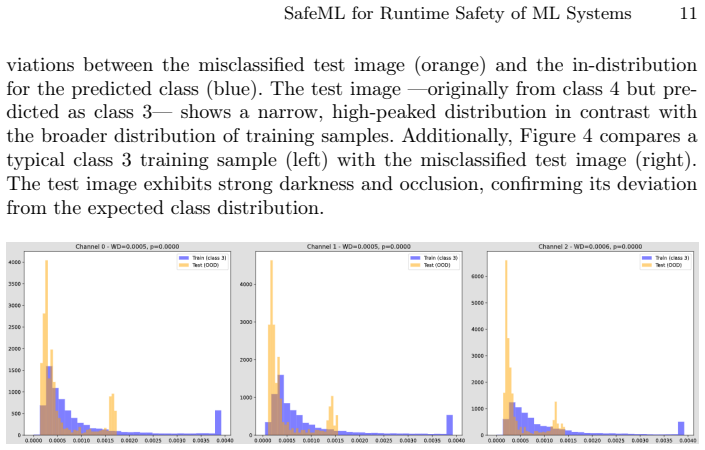
- [Section 5.1 and Table 2] SafeML's detection capability is supported by only two misclassified test images, with no detection rate, false-positive rate, or test-set-wide statistics. The reported p-values of 0.0000 with Wasserstein distances around 0.0004-0.0006 are also not defensible without stating the bootstrap count B; an exact zero should be reported as <0.0001. These numbers are too thin to support the claim that SafeML 'can effectively identify unreliable predictions' and should be replaced with a systematic evaluation over the full test set.
- [Section 4.1 and 5.2] Although the paper repeatedly refers to a 'simulated automotive platooning system,' no vehicle dynamics, control model, accident data, or calibration source enters the evaluation; the system-level safety conclusions follow entirely from BN inference over the undisclosed CPTs. Please either integrate a concrete platooning simulation and calibrate the BN against it, or explicitly reframe the claims as a proof-of-concept inference exercise rather than a platooning safety measurement.
minor comments (7)
- [Section 3.3, Eq. (3)] Use standard indicator notation instead of '1[[otherwise]]'.
- [Abstract] The phrase 'an simulated automotive platooning system' should be 'a simulated automotive platooning system'.
- [Section 4.3] The sentence 'A custom Sequential CNN was trained... classification across 43 classes..' contains a duplicated period.
- [Section 5.3 and Table 4] The prose uses 'ODD' where 'OOD' is intended; please correct this in the table row descriptions.
- [Section 5.3, Table 4 caption] The caption says 'under low statistical distance'; clarify whether this applies to all rows or only to rows 9-10, since rows 1-8 have SafeML_Status=1.
- [Tables 3 and 4] Several rows have identical posterior distributions despite different speed values (e.g., Table 3 rows 1, 3, and 4); explain whether this follows from the deterministic logic nodes or is a copy error.
- [Section 4.3] Specify the exact train/validation/test split and report the CNN's test accuracy, since the SafeML analysis depends on which samples are misclassified.
Circularity Check
The headline BN result that an OOD SafeML flag drives the posterior to the critical state S5 is enforced by the definition of S5 and the paper's own implementation rule, while the undisclosed conditional probability tables make the reported 54.08% an input assumption renamed as a prediction.
-
self definitional
[Section 4.2, Table 1 (S5 semantics) and Section 4.3 (implementation rule)]
"S5 | Critical ML Failure | ML perception deemed unreliable (due to OOD or adversarial input); activate fallback safety mode (e.g., degraded ACC). ... If this p-value falls below a predefined threshold (e.g., 0.01), the system considers the input as OOD and degrades safely by transitioning into ACC mode."
S5 is defined as the state caused by OOD/adversarial input, and the implementation rule hard-codes p<0.01 to mean OOD and to degrade into ACC mode. The Section 5.2 finding that an OOD flag 'prompts the system to transition to fallback control (ACC mode)' is therefore the same rule restated in Bayesian-network vocabulary, not a discovery from independent evidence. The result is guaranteed by construction: S5's semantics and the implementation threshold already encode OOD -> fallback.
-
fitted input called prediction
[Section 5.2 and Tables 3-4; no CPTs reported in Sections 4.2-4.3 or appendix]
"The impact of SafeML is evident in rows 1-8 where SafeML_Status = 1. In each of these cases, the system assigns the highest probability to state S5, signaling a shift to the most conservative safety response."
The posterior probabilities in Table 4 are direct outputs of the Bayesian network's conditional probability tables, but no CPT is reported or calibrated to vehicle dynamics, accident data, or any external source. Rows with SafeML_Status=1 all yield the same S5 probability (0.5408 or 0.4249) regardless of speed, distance, or ML decision, while rows with SafeML_Status=0 give S5 below 5%. This pattern is exactly what a designer-chosen CPT with a dominant P(S5|OOD) entry produces. The 54.08% 'prediction' is thus an unstated model input renamed as an empirical safety result.
full rationale
The paper's SafeML detection experiment (Section 5.1, Table 2) is not circular: it independently computes Wasserstein distances and bootstrap p-values on misclassified GTSRB samples and shows that the selected samples are flagged OOD. The self-citations in Sections 2.1 and 4.1 are prior-work references rather than the load-bearing justification for that experiment, so they do not raise the circularity score on their own. However, the central safety-assurance claim in Sections 3.3 and 5.2 reduces to the paper's own definitions and implementation choices. S5 is defined as 'ML perception deemed unreliable (due to OOD or adversarial input); activate fallback safety mode', and the implementation says p<0.01 means OOD and triggers ACC fallback; therefore the observation that SafeML_Status=OOD yields S5 is guaranteed by construction. The reported posterior magnitudes are unverifiable because the CPTs are never disclosed, and the perfect correlation between SafeML_Status=1 and S5 as the modal state in Table 4 indicates that the CPTs, not measured system behavior, force the headline result. A separate consistency problem, not itself circular, is that Equation (3) and its surrounding text disagree: the equation flags unreliable when min p-value <= 0.01, while the text claims 'only if all three colour channels yield a statistically significant deviation (p-value > 0.01)'. Overall, the BN demonstration is partially circular: the OOD detection itself has independent content, but the claimed safety consequence is an input assumption renamed as a posterior prediction.
Assumptions & free parameters
free parameters (3)
- OOD p-value threshold =
0.01
- BN conditional probability tables =
not specified
- Bootstrap resample count B =
not specified
assumptions (3)
- domain assumption Wasserstein distance between pixel-intensity histograms of a test image and training class images is a valid proxy for ML reasoning failure.
- ad hoc to paper The Bayesian network graph and its conditional probability tables accurately represent the platooning safety semantics.
- domain assumption Misclassified test samples can be treated as out-of-distribution instances for SafeML evaluation.
Cite this review
Pith. "Pith review of Incorporating Failure of Machine Learning in Dynamic Probabilistic Safety Assurance." pith.science (2026). https://pith.science/paper/UBACXGOU
@misc{pith2026250606868,
  author       = {Pith},
  title        = {Pith review of: Incorporating Failure of Machine Learning in Dynamic Probabilistic Safety Assurance},
  year         = {2026},
  howpublished = {\url{https://pith.science/paper/UBACXGOU}},
  note         = {Machine review of arXiv:2506.06868}
}
read the original abstract
Machine Learning (ML) models are increasingly integrated into safety-critical systems, such as autonomous vehicle platooning, to enable real-time decision-making. However, their inherent imperfection introduces a new class of failure: reasoning failures often triggered by distributional shifts between operational and training data. Traditional safety assessment methods, which rely on design artefacts or code, are ill-suited for ML components that learn behaviour from data. SafeML was recently proposed to dynamically detect such shifts and assign confidence levels to the reasoning of ML-based components. Building on this, we introduce a probabilistic safety assurance framework that integrates SafeML with Bayesian Networks (BNs) to model ML failures as part of a broader causal safety analysis. This allows for dynamic safety evaluation and system adaptation under uncertainty. We demonstrate the approach on an simulated automotive platooning system with traffic sign recognition. The findings highlight the potential broader benefits of explicitly modelling ML failures in safety assessment.
Figures


Figures from the paper (2 more)


Reference graph
Works this paper leans on
-
[1]
Akram, M.N., et al.: Stadre and stadro: Reliability and robustness of ml forecasting using s-d measures. In: SAFECOMP 2022 Wkps. pp. 289–301. Springer (2022) SafeML for Runtime Safety of ML Systems 15
work page 2022
-
[2]
Computer54(8), 66–76 (2021)
Aslansefat, K., Kabir, S., Abdullatif, A., Vasudevan, V., Papadopoulos, Y.: To- ward improving confidence in autonomous vehicle software: A study on traffic sign recognition systems. Computer54(8), 66–76 (2021)
2021
-
[3]
Aslansefat, K., Sorokos, I., Whiting, D., Tavakoli Kolagari, R., Papadopoulos, Y.: Safeml: safety monitoring of machine learning classifiers through statistical differ- ence measures. In: IMBSA 2020, Lisbon. pp. 197–211. Springer (2020)
work page 2020
-
[4]
Aslansefat, K., et al.: Safedrones: Real-time reliability evaluation of uavs using eddis. In: IMBSA 2022, Munich. pp. 252–266. Springer (2022)
work page 2022
-
[5]
Aslansefat, K., et al.: Explaining black boxes with a smile: Statistical model- agnostic interpretability with local explanations. IEEE Software (2023)
work page 2023
-
[6]
IEEE Access10, 39769–39781 (2022)
Cho, H., Lee, K., Choi, N., Kim: Online safety zone estimation and violation detec- tion for nonstationary objects in workplaces. IEEE Access10, 39769–39781 (2022)
work page 2022
-
[7]
DIN SPEC 92005: Machine Learning – Uncertainty Quantification. Tech. rep., Berlin, Germany (2022), https://www.din.de/en/wdc-beuth:din21:343195966
work page 2022
-
[8]
Trans- port Research Part A: Policy and Practice77, 167–181 (2015)
Fagnant, D.J., Kockelman, K.: Preparing a nation for autonomous vehicles. Trans- port Research Part A: Policy and Practice77, 167–181 (2015)
work page 2015
Show all 23 references
-
[9]
In: IMBSA 2022, Munich
Farhad, et al.: Keep your distance: Determining sampling and distance thresholds in ml monitoring. In: IMBSA 2022, Munich. pp. 219–234. Springer (2022)
2022
-
[10]
arXiv preprint arXiv:2312.10801 (2023)
Farhad, A.H., Sorokos, I., Akram, M.N., Aslansefat, K., Schneider, D.: Scope com- pliance uncertainty estimate. arXiv preprint arXiv:2312.10801 (2023)
2023 arXiv
-
[11]
In: Proceedings of the Workshop on Artificial Intelligence Safety (SafeAI 2021)
Gautam, V., Gheraibia, Y., Alexander, R., Hawkins, R.D.: Runtime decision mak- ing under uncertainty in autonomous vehicles. In: Proceedings of the Workshop on Artificial Intelligence Safety (SafeAI 2021). CEUR Workshop Proceedings (2021)
2021
-
[12]
Safety science115, 154–175 (2019)
Kabir, S., Papadopoulos, Y.: Applications of bns and petri nets in safety, reliability, and risk assessments: A review. Safety science115, 154–175 (2019)
2019
-
[13]
In: IMBSA 2019, Thessaloniki
Kabir, S., Sorokos, I., Aslansefat, K., Papadopoulos, Y., Gheraibia, Y., Reich, J., Saimler, M., Wei, R.: A runtime safety analysis concept for open adaptive systems. In: IMBSA 2019, Thessaloniki. pp. 332–346. Springer (2019)
2019
-
[14]
Safety science105, 55–70 (2018)
Kabir, S., Walker, M., Papadopoulos, Y.: Dynamic system safety analysis in hip- hops with petri nets and bayesian networks. Safety science105, 55–70 (2018)
2018
-
[15]
In: Intl Conf.on Computing, Electronics & Communications Engineering (iCCECE)
Kabir, S., et al.: Combining drone-based monitoring and machine learning for on- line reliability evaluation of wind turbines. In: Intl Conf.on Computing, Electronics & Communications Engineering (iCCECE). pp. 53–58. IEEE (2022)
2022
-
[16]
https://www.kaggle.com/datasets/meowmeowmeowmeowmeow/gtsrb-german- traffic-sign (2021)
Kaggle Contributor: GTSRB - German Traffic Sign Recognition Benchmark. https://www.kaggle.com/datasets/meowmeowmeowmeowmeow/gtsrb-german- traffic-sign (2021)
2021
-
[17]
Int’l Joint Conferences on AI, Inc
McAllister, R.T., Gal, Y., Kendall, A., Van Der Wilk, M., Shah, A., Cipolla, R., Weller, A.: Concrete problems for autonomous vehicle safety: Advantages of bayesian deep learning. Int’l Joint Conferences on AI, Inc. (2017)
2017
-
[18]
In: ISSREW
Müller, S., Liggesmeyer, P.: Safety assurance for emergent collaboration of open distributed systems. In: ISSREW. pp. 249–256. IEEE (2016)
2016
-
[19]
Reich, J.: Systematic engineering of safe open adaptive systems shown for truck platooning. Ph.D. thesis, TU Kaiserslautern (2016)
2016
-
[20]
ACM Trans Autonomous and Adaptive Systems (TAAS)8(2), 1–20 (2013)
Schneider, D., Trapp, M.: Conditional safety certification of open adaptive systems. ACM Trans Autonomous and Adaptive Systems (TAAS)8(2), 1–20 (2013)
2013
-
[21]
In: IJCNN
Stallkamp, J., et al.: The german traffic sign recognition benchmark: A multi-class classification competition. In: IJCNN. pp. 1453–1460. IEEE (2011)
2011
-
[22]
IEEE Transactions on Intelligent Vehicles1(1), 68–77 (2016)
Tsugawa, S., Jeschke, S., Shladover, S.E.: A review of truck platooning projects for energy savings. IEEE Transactions on Intelligent Vehicles1(1), 68–77 (2016)
2016
-
[23]
Villani, C.: Optimal Transport: Old and New, Grundlehren der Mathematischen Wissenschaften, vol. 338. Springer, Berlin (2008)
2008
Reviewed August 7, 2026 · model on record in the stance chip above.
Discussion (0). Sign in to comment.