REVIEW 1 major objections 6 minor 1 cited by
Memory cost of quantum contextuality with Pauli observables
T0 review · 1 major / 6 minor · reviewed 2026-08-07 · deepseek-v4-flash
Pith's one-line read A classical machine reproducing the contextual predictions of Mermin's pentagram needs exactly five internal states, while any machine simulating all 15 two-qubit Pauli observables needs at least six.
desk verdict The pentagram results are likely solid; the log2(6) lower bound for the 15-observable set currently rests on an unproved claim in Proposition 11 that needs a full case analysis. read the letter →
The pith
A machine-rendered reading of the paper's core claim, the machinery that carries it, and where it could break.
The reading
What carries the argument
The engine of the argument is the Mealy machine: a finite automaton with states $S$, inputs given by the observables, outputs $\pm 1$, an output function $\Omega(S_i, p)$ giving the result of measuring $p$ in state $S_i$, and an update function $\Upsilon(S_i, p)$ giving the post-measurement state. From such a machine the authors build commuting digraphs $D_R$ whose vertices are state–observable pairs $(S_i, p)$ with $p$ compatible with all of $R$; walks in these digraphs are exactly the allowed sequences of measurements. Three structural lemmas carry the proofs: each contradiction context—a context whose output product has the wrong sign—contains at least two 'nonsimple' vertices, i.e., measurements that change the machine's state (Proposition 3); each contradiction context radiates to at least two distinct strongly connected sinks with different output assignments (Proposition 4); and a point whose commuting digraph has multiple sinks—a 'multi-sink point'—counts against the machine, so Proposition 8 forces enough such points per state while Proposition 10 limits how many states can share a simple sink. The optimality proofs are just the resulting linear inequalities on the numbers $x_i$ of points with exactly $i$ states outside every sink.
What would settle it
An exhaustive computer search over all 4-state Mealy machines for the ten pentagram observables that satisfy (Ia), (Ib), and (II) would settle Result 1: finding one refutes the exact value $\log_2(5)$, while proving none exists confirms it. The analogous search over all 5-state machines for the fifteen two-qubit Pauli observables would settle whether the lower bound $\log_2(6)$ is tight or false.
Extended reading notes
Core claim
The paper's central claim, stated in its own terms, is twofold. Result 1: the memory cost of simulating predictions (Ia), (Ib), and (II) for the three-qubit observables of Mermin's pentagram is $\log_2(5)$ bits—no four-state Mealy machine can do it, and the five-state machine exhibited in Eq. (16) shows it can be done. Result 2: the memory cost of simulating the same predictions for all fifteen two-qubit Pauli observables is at least $\log_2(6)$ bits, so no five-state machine suffices; the six-state machine in Eq. (19) is the current upper bound. Here (Ia) is the repeatability of a measurement within a single context, (Ib) is the stronger repeatability after any sequence of compatible measurements, and (II) is the fixed $\pm 1$ product of the outcomes in each context that quantum theory dictates. The lower bounds are obtained by translating a hypothetical smaller machine into constraints on directed graphs and showing that the resulting counting inequalities cannot all be satisfied. The authors also prove that the exact cost for the pentagram with only (Ia) and (II) is $\log_2(4) = 2$ bits.
Load-bearing premise
The lower-bound proofs assume that each contradiction context forces at least two nonsimple vertices and at least two distinct strongly connected sinks in the corresponding commuting digraph, and that every strongly connected sink is a union of entire states; if any of these structural lemmas fails in its generalized form, the counting arguments collapse.
Editorial extensions
If this is right
- For Mermin's pentagram, any classical simulation of the repeatability and product predictions requires exactly five automaton states; no four-state machine exists, and the explicit five-state machine shows sufficiency.
- For the fifteen two-qubit Pauli observables, simulating the same subset of predictions needs at least six states, i.e., at least $\log_2(6) \approx 2.58$ bits of memory, surpassing the two-bit classical capacity of the two-qubit system.
- With the weaker prediction set (Ia) and (II), the pentagram's memory cost is exactly $\log_2(4) = 2$ bits, matching the exact cost previously known for the Peres-Mermin square.
- For the fifteen-observable set with only (Ia) and (II), the memory cost is now pinned between $\log_2(4) = 2$ bits and $\log_2(6) \approx 2.58$ bits.
- The known 27-state upper bound for simulating all deterministic predictions of the fifteen observables still stands, so the gap between contextuality-relevant sub-predictions and full deterministic predictions remains open.
Reading between the lines
- If the multi-sink-point counting generalizes, it could yield lower bounds for other state-independent contextuality configurations, potentially showing that these repeatability-plus-product predictions require more than $n$ bits whenever the observable set is built from $n$ qubits.
- The six-state machine for the fifteen observables is constructed with an omitted proof that nonsimple vertices map to simple vertices; since the authors state the optimality proof does not use this fact, a mechanical verification would close this gap without changing the lower bound.
- A natural next question is whether the 6-state bound is exact: a targeted search over five-state machines either refutes Result 2 or, if none exists, makes $\log_2(6)$ the exact memory cost for the 15-observable set.
- The fact that these sub-predictions already exceed two bits for a two-qubit system suggests that the memory cost of contextuality is not just a matter of storing the quantum state—the logical consistency of repeatability and context products is itself information-theoretically expensive.
Editorial analysis
A structured set of objections, weighed in public.
Referee Report
Summary. The paper studies the memory cost, in units of log2 of the number of states of a Mealy machine, of classically simulating deterministic quantum predictions for state-independent contextuality in Pauli observables. Two scenarios are considered: Mermin's pentagram (ten three-qubit observables) and the extended Peres-Mermin set (all fifteen two-qubit Pauli observables). The authors prove that the pentagram can be simulated with exactly five states when the simulated predictions include (Ia), (Ib), and (II), and with exactly four states when only (Ia) and (II) are imposed; they further prove a lower bound of six states for the fifteen-observable set under (Ia), (Ib), and (II), and give an explicit six-state machine for (Ia) and (II). The technical framework uses commuting digraphs attached to Mealy machines, contradiction contexts, multi-sink points, and counting inequalities inherited and generalized from Kleinmann et al. [5].
Significance. Exact memory-cost values for contextuality simulation are rare, and the pentagram result together with the improved doily lower bound are valuable advances if the proofs are complete. The paper provides explicit, checkable Mealy machines and clean graph-theoretic counting arguments for the pentagram lower bounds. The headline claim that fifteen two-qubit Pauli observables require more than two bits of memory, exceeding the classical capacity of the two-qubit system, would strengthen the earlier result of Kleinmann et al. However, the main new lower bound (Theorem 1) rests on Proposition 11, whose proof is currently a sketch rather than a complete case analysis; this is a load-bearing gap that must be repaired before the central claim can be considered established.
major comments (1)
- [Section III.C, Proposition 11; Theorem 1, Eq. (20)] Proposition 11 states that each state has at least five nonsimple vertices, and, under prediction (Ib), at least five multi-sink points for which the state is not in any sink. The text says this 'immediately follows by applying Propositions 3 and 8,' but the preceding classification of minimal sets of 3, 4, and 5 contradiction contexts is only sketched via Fig. 6 and example labelings. In particular, the manuscript does not rule out a state whose three contradiction contexts are concurrent, e.g., the three lines {1,2}, {3,4}, {5,6} in the doily's pair labeling. For such a pencil, Proposition 8 applied to each of the three contexts would yield only the common point plus one additional point per context, i.e., as few as four distinct multi-sink points for which the state is not in a sink. The text asserts that the unique three-context case is the triangle {1,2}, {2,3}, {1,3}, but the exclusion of the concurrent triple is not proved. If the pencil is realizable as the contradiction contexts of a state, the bound in inequality (20) would drop from 25 to 20, and the contradiction in Theorem 1 would not follow. The same gap affects the companion claim of at least five nonsimple vertices per state, which is used in Proposition 13. The authors must supply a complete finite case analysis, or a rigorous symmetry/parity argument, showing that every possible set of 3, 4, or 5 contradiction contexts in the extended Peres-Mermin set yields at least five such points, and in particular that a concurrent triple either is impossible or still gives five points.
minor comments (6)
- [Section II.D.2, Proposition 8] Proposition 8 is stated without assuming prediction (Ib), but the proof uses the assertion that all reachable vertices (S', q) have the same output for q, which is only guaranteed by (Ib). Since the proposition is used only for machines satisfying (Ib) in the later proofs, either the statement should explicitly include that hypothesis, or the proof under (Ia),(II) should be supplied.
- [Section III.D, after Eq. (19)] The sentence 'a fact whose proof we have ommitted' contains a typo ('ommitted' should be 'omitted'). More substantively, the claim that the six-state machine's transition function is unique under the stated assumptions is left unproven; the explicit machine can still be verified independently, but the authors should provide the missing proof or a machine-checkable verification certificate.
- [Abstract and Section I.A] Result 2 is stated as 'the memory cost ... is, at least, log2(6) bits' without specifying the subset of predictions in the abstract; the body makes clear that this applies to predictions (Ia), (Ib), and (II). The abstract should state this restriction explicitly to avoid overgeneralization.
- [Section III.C] The counts of possible minimal contradiction-context cases (20, 60, 72) and the exhaustive nature of Fig. 6 are not derived in the text. A complete derivation, or a computer-assisted certificate, should be provided; this is directly related to the major comment on Proposition 11.
- [Section III.E, Theorem 1 proof] The display (20) is typeset as '3X i=1 ixi ≥ 25', which should be a standard summation Σ_{i=1}^3 i x_i ≥ 25, and the allowed range of i (0,...,3) should be stated explicitly in the proof for clarity.
- [Section III.B, Eq. (16) and Section III.D, Eq. (19)] The explicit five-state pentagram machine and the six-state doily machine are asserted to satisfy the relevant predictions, but no verification is provided. Since these machines are finite, the authors should include a short verification argument or a computer-verifiable certificate for each.
Circularity Check
No significant circularity: the lower bounds are graph-counting arguments built on independent structural lemmas, and the upper bounds are explicit automata.
full rationale
The derivation chain is self-contained relative to the adopted automaton-and-digraph framework. Upper bounds are supplied by explicit Mealy machines (the 4- and 5-state pentagram machines and the 6-state two-qubit machine), while lower bounds come from counting arguments on strongly connected sinks, multi-sink points, and nonsimple vertices. No parameter is fitted to a subset of data and then renamed as a prediction. The main inherited result, Proposition 3, is quoted from Kleinmann et al. [5]; it is a general lemma about any Mealy machine satisfying predictions (Ia) and (II), and it does not state the pentagram or 15-observable memory cost, so it is independent support rather than a circular premise, despite one author overlapping with [5]. Propositions 4 and 8 are proved in the text, and Proposition 11 is derived from Propositions 3 and 8 via a stated classification of minimal sets of contradiction contexts; a reader may want the case analysis expanded, but that is a completeness or correctness concern, not circularity. The authors explicitly flag the omitted proof that nonsimple vertices map to simple vertices in the 6-state construction, and they state that this fact was not used in any of the optimality arguments; accordingly, the omission does not make the central claim depend on its own conclusion. The inequalities (17)-(23) follow from the stated propositions and elementary point and context counts; they do not presuppose the lower bounds they are used to prove. No step in the paper reduces, by construction or by definition, to its own input.
Assumptions & free parameters
assumptions (4)
- domain assumption The Mealy machine model of classical simulation is the correct model for the memory cost of sequential ideal measurements.
- domain assumption Predictions (Ia), (Ib), and (II) are the right subset of deterministic quantum predictions to simulate.
- standard math Proposition 3: each contradiction context has at least two nonsimple vertices.
- standard math Proposition 4: each contradiction context leads to at least two strongly connected sinks with different output sets.
Cite this review
Pith. "Pith review of Memory cost of quantum contextuality with Pauli observables." pith.science (2026). https://pith.science/paper/YTNQYCGH
@misc{pith2026250606869,
  author       = {Pith},
  title        = {Pith review of: Memory cost of quantum contextuality with Pauli observables},
  year         = {2026},
  howpublished = {\url{https://pith.science/paper/YTNQYCGH}},
  note         = {Machine review of arXiv:2506.06869}
}
abstract
Classically simulating the quantum contextual correlations produced by sequences of ideal measurements of compatible observables requires the measured system to have an internal memory. Computing the minimum amount of memory needed is, in general, challenging. Here, building upon the work of Kleinmann et al. [New J. Phys. 13, 113011 (2011)], we prove that the memory cost for simulating the contextuality produced by the $10$ three-qubit observables of Mermin's pentagram is only $\log_2(5) \approx 2.32$ bits, but the memory cost for simulating the contextuality produced by all $15$ two-qubit Pauli observables is, at least, $\log_2(6) \approx 2.58$ bits, thus exceeding the classical capacity of the system on which the measurements are performed. We also add results on the memory for simulating some subsets of quantum predictions.
Figures

Figures from the paper (3 more)


Forward citations
Cited by 1 Pith paper
-
Quantum Memory Advantage from Contextuality
Quantum automata solve exclusivity-graph promise problems with dimension O(n) versus classical 2^Omega(n) states via representational contextuality, maintaining O(1) noise threshold.
Reference graph
Works this paper leans on
-
[5]
Moreover, we assume that b ∈ B is a block of H
The digraphs Db In this section, we assume that M = ( I, O, S, Ω, Υ) is a Mealy machine satisfying predictions (Ia) and (II) for some set of observables with underlying incidence structure H = (P, B), and that each commuting digraph is constructed from this Mealy machine. Moreover, we assume that b ∈ B is a block of H. Proposition 2. Let S ∈ S, b ∈ B. If ...
-
[1]
Sup- pose that the possible results of measuring each of them are +1 and −1
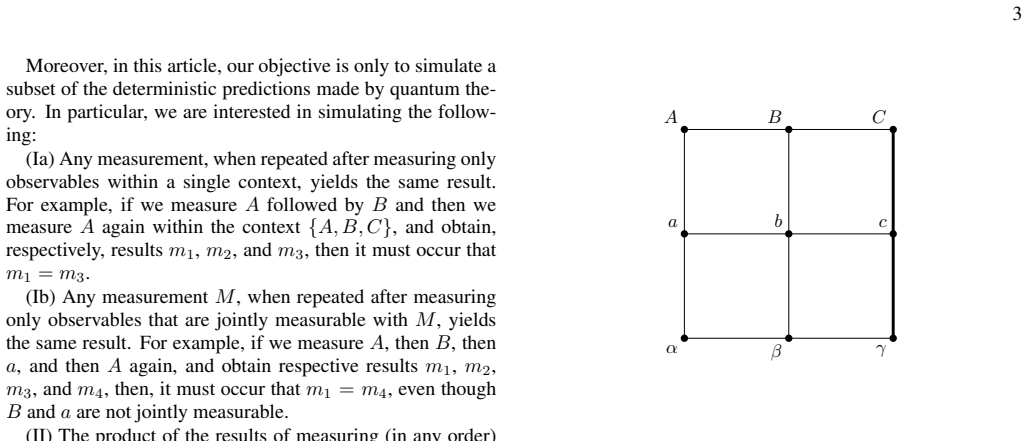
Case 1: Contextuality produced by the Peres-Mermin square Consider 9 observables: A, B, C, a, b, c, α, β, and γ. Sup- pose that the possible results of measuring each of them are +1 and −1. Noncontextual hidden-variable models assume that measurements reveal predetermined results that are in- dependent of which other jointly measurable observables are mea...
-
[2]
The quantum predictions we want to simulate Our main objective is to simulate the deterministic predic- tions made by quantum theory. For example, if one measures the observable A of the Peres-Mermin square twice in succes- sion, to obtain measurement outcomes m1, m2, then it must be the case that m1 = m2. 3 Moreover, in this article, our objective is onl...
-
[3]
Suppose that the possible results of mea- suring each of them are +1 and −1
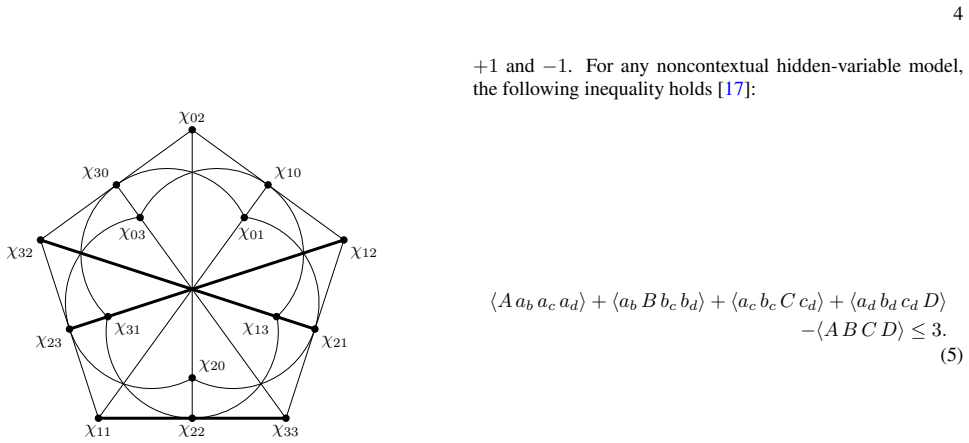
Case 2: Contextuality produced by the 15 two-qubit Pauli observables Consider 15 observables χkl, where k, l∈ {0, 1, 2, 3} and χ00 is excluded. Suppose that the possible results of mea- suring each of them are +1 and −1. For any noncontextual A B C a b c α β γ FIG. 1: The Peres-Mermin square. Each observable is indicated by a dot. Observables in the same ...
-
[4]
Case 3: Contextuality produced by Mermin’s pentagram Consider 10 observables: A, B, C, D, ab, ac, ad, bc, bd, and cd. The possible results for measuring each of them are 4 χ11 χ22 χ33 χ23 χ32 χ21 χ12 χ31 χ13 χ02 χ30 χ10 χ20 χ03 χ01 FIG. 2: The extended Peres-Mermin set. Each observable is represented by a dot. Observables in the same line are jointly meas...
-
[6]
The digraphs Dp In Sec. II D 1, we studied the digraphs Db that naturally model sequences of observables within a given context [and thus relate directly to predictions (Ia) and (II)]. In this section, we study the digraphs Dp corresponding to the points p ∈ P . These model sequences of observables that are all compati- ble with the observable correspondi...
-
[7]
Cabello, Quantum correlations from simple assumptions, Phys
A. Cabello, Quantum correlations from simple assumptions, Phys. Rev. A 100, 032120 (2019)
work page 2019
-
[8]
G. Chiribella, A. Cabello, M. Kleinmann, and M. P. M ¨uller, General Bayesian theories and the emergence of the exclusivity principle, Phys. Rev. Res. 2, 042001 (2020)
work page 2020
Show all 52 references
-
[9]
Cabello, The role of bounded memory in the foundations of quantum mechanics, Found
A. Cabello, The role of bounded memory in the foundations of quantum mechanics, Found. Phys. 42, 10.1007/s10701-010- 9507-2 (2012)
2012 doi
-
[10]
Cabello and J
A. Cabello and J. J. Joosten, Hidden variables simulating quan- tum contextuality increasingly violate the Holevo bound, in Unconventional Computation, Lecture Notes in Computer Sci- ence, V ol. 6714/2011, edited by C. S. Calude, J. Kari, I. Petre, and G. Rozenberg (Springer, ...
2011
-
[11]
Kleinmann, O
M. Kleinmann, O. G ¨uhne, J. R. Portillo, J.- ˚A. Larsson, and A. Cabello, Memory cost of quantum contextuality, New J. Phys. 13, 113011 (2011)
2011
-
[12]
Horodecki, J
K. Horodecki, J. Zhou, M. Stankiewicz, R. Salazar, P. Horodecki, R. Raussendorf, R. Horodecki, R. Ramanathan, and E. Tyhurst, The rank of contextuality, New J. Phys. 25, 073003 (2023)
2023
-
[13]
Peres, Incompatible results of quantum measurements, Phys
A. Peres, Incompatible results of quantum measurements, Phys. Lett. A 151, 107 (1990)
1990
-
[14]
N. D. Mermin, Simple unified form for the major no-hidden- variables theorems, Phys. Rev. Lett. 65, 3373 (1990)
1990
-
[15]
N. D. Mermin, Hidden variables and the two theorems of John Bell, Rev. Mod. Phys. 65, 803 (1993)
1993
-
[16]
A. S. Holevo, Probabilistic and Statistical Aspects of Quantum Theory (North-Holland, Amsterdam, 1982)
1982
-
[17]
Budroni, A
C. Budroni, A. Cabello, O. G ¨uhne, M. Kleinmann, and J.- ˚A. 14 Larsson, Kochen-Specker contextuality, Rev. Mod. Phys. 94, 045007 (2022)
2022
-
[18]
Brunner, D
N. Brunner, D. Cavalcanti, S. Pironio, V . Scarani, and S. Wehner, Bell nonlocality, Rev. Mod. Phys.86, 419 (2014)
2014
-
[19]
N. N. V orob’ev, On coalition games (in russian), Dokl. Akad. Nauk SSSR 124, 253 (1959)
1959
-
[20]
V orob’ev, Consistent families of measures and their exten- sions, Theory Probab
N. V orob’ev, Consistent families of measures and their exten- sions, Theory Probab. Appl. 7, 147 (1962)
1962
-
[21]
N. N. V orob’yev, Coalition games, Theory Probab. Appl. 12, 251 (1967)
1967
-
[22]
J. S. Bell, On the Einstein Podolsky Rosen paradox, Physics 1, 195 (1964)
1964
-
[23]
Cabello, Experimentally testable state-independent quantum contextuality, Phys
A. Cabello, Experimentally testable state-independent quantum contextuality, Phys. Rev. Lett.101, 210401 (2008)
2008
-
[24]
Xu and A
Z.-P. Xu and A. Cabello, Necessary and sufficient condition for contextuality from incompatibility, Phys. Rev. A 99, 020103 (2019)
2019
-
[25]
J. F. Clauser, M. A. Horne, A. Shimony, and R. A. Holt, Pro- posed experiment to test local hidden-variable theories, Phys. Rev. Lett. 23, 880 (1969)
1969
-
[26]
A. A. Klyachko, M. A. Can, S. Binicio ˘glu, and A. S. Shu- movsky, Simple test for hidden variables in spin-1 systems, Phys. Rev. Lett. 101, 020403 (2008)
2008
-
[27]
Ahrens, E
J. Ahrens, E. Amselem, A. Cabello, and M. Bourennane, Two fundamental experimental tests of nonclassicality with qutrits, Sci. Rep. 3, 2170 (2013)
2013
-
[28]
Marques, J
B. Marques, J. Ahrens, M. Nawareg, A. Cabello, and M. Bourennane, Experimental observation of Hardy-like quan- tum contextuality, Phys. Rev. Lett.113, 250403 (2014)
2014
-
[29]
Malinowski, C
M. Malinowski, C. Zhang, F. M. Leupold, A. Cabello, J. Alonso, and J. P. Home, Probing the limits of correlations in an indivisible quantum system, Phys. Rev. A 98, 050102 (2018)
2018
-
[30]
X.-M. Hu, Y . Xie, A. S. Arora, M.-Z. Ai, K. Bharti, J. Zhang, W. Wu, P.-X. Chen, J.-M. Cui, B.-H. Liu, Y .-F. Huang, C.-F. Li, G.-C. Guo, J. Roland, A. Cabello, and L.-C. Kwek, Self-testing of a single quantum system from theory to experiment, npj Quantum Information 9, 10.10...
2023 doi
-
[31]
Yu and C
S. Yu and C. H. Oh, State-independent proof of Kochen- Specker theorem with 13 rays, Phys. Rev. Lett. 108, 030402 (2012)
2012
-
[32]
Kirchmair, F
G. Kirchmair, F. Z ¨ahringer, R. Gerritsma, M. Kleinmann, O. G ¨uhne, A. Cabello, R. Blatt, and C. F. Roos, State- independent experimental test of quantum contextuality, Nature 460, 494 (2009)
2009
-
[33]
Amselem, M
E. Amselem, M. R ˚admark, M. Bourennane, and A. Cabello, State-independent quantum contextuality with single photons, Phys. Rev. Lett. 103, 160405 (2009)
2009
-
[34]
F. M. Leupold, M. Malinowski, C. Zhang, V . Negnevit- sky, A. Cabello, J. Alonso, and J. P. Home, Sustained state- independent quantum contextual correlations from a single ion, Phys. Rev. Lett. 120, 180401 (2018)
2018
-
[35]
B. F. Toner and D. Bacon, Communication cost of simulating Bell correlations, Phys. Rev. Lett. 91, 187904 (2003)
2003
-
[36]
Pironio, Violations of Bell inequalities as lower bounds on the communication cost of nonlocal correlations, Phys
S. Pironio, Violations of Bell inequalities as lower bounds on the communication cost of nonlocal correlations, Phys. Rev. A 68, 062102 (2003)
2003
-
[37]
Kochen and E
S. Kochen and E. P. Specker, The Problem of Hidden Variables in Quantum Mechanics, J. Math. Mech. 17, 59 (1967)
1967
-
[38]
Cabello, Proposed test of macroscopic quantum contextual- ity, Phys
A. Cabello, Proposed test of macroscopic quantum contextual- ity, Phys. Rev. A82, 032110 (2010)
2010
-
[39]
S. E. Payne and J. A. Thas, Finite generalized quadrangles (EMS, Zurich, 2009)
2009
-
[40]
G. H. Mealy, A method for synthesizing sequential circuits, Bell Syst. Tech. J. 34, 1045 (1955)
1955
-
[41]
Harrysson, Memory Cost of Quantum Contextuality, Master’s thesis, Link¨oping University (2016)
P. Harrysson, Memory Cost of Quantum Contextuality, Master’s thesis, Link¨oping University (2016)
2016
-
[42]
Fagundes and M
G. Fagundes and M. Kleinmann, Memory cost for simulating all quantum correlations from the Peres–Mermin scenario, J. Phys. A: Math. Theor. 50, 325302 (2017)
2017
-
[43]
Bang-Jensen and G
J. Bang-Jensen and G. Z. Gutin, Digraphs: theory, algorithms and applications (Springer Science & Business Media, London, 2008)
2008
-
[44]
Saniga and P
M. Saniga and P. L ´evay, Mermin’s pentagram as an ovoid of PG(3,2), Europhys. Lett. 97, 50006 (2012)
2012
-
[45]
de Boutray, F
H. de Boutray, F. Holweck, A. Giorgetti, P.-A. Masson, and M. Saniga, Contextuality degree of quadrics in multi-qubit symplectic polar spaces, J. Phys. A: Math. Theor. 55, 475301 (2022)
2022
-
[46]
Muller, M
A. Muller, M. Saniga, A. Giorgetti, H. de Boutray, and F. Hol- weck, New and improved bounds on the contextuality degree of multi-qubit configurations, Math. Struct. Comput. Sci. 34, 322 (2024)
2024
-
[47]
Muller and A
A. Muller and A. Giorgetti, An abstract structure determines the contextuality degree of observable-based Kochen-Specker proofs (2024), arXiv:2410.14463
2024 arXiv
-
[48]
Muller, M
A. Muller, M. Saniga, A. Giorgetti, F. Holweck, and C. Kelleher, A new heuristic approach for contextuality de- gree estimates and its four- to six-qubit portrayals (2024), arXiv:2407.02928
2024 arXiv
-
[49]
Godsil and G
C. Godsil and G. F. Royle, Algebraic Graph Theory, V ol. 207 (Springer Science & Business Media, New York, 2013)
2013
-
[50]
Cabello, M
A. Cabello, M. Gu, O. G ¨uhne, and Z.-P. Xu, Optimal classical simulation of state-independent quantum contextuality, Phys. Rev. Lett. 120, 130401 (2018)
2018
-
[51]
L. B. Vieira and C. Budroni, Temporal correlations in the sim- plest measurement sequences, Quantum 6, 623 (2022)
2022
-
[52]
Amaral, M
B. Amaral, M. T. Cunha, and A. Cabello, Quantum theory allows for absolute maximal contextuality, Phys. Rev. A 92, 062125 (2015)
2015
Reviewed August 7, 2026 · model on record in the stance chip above.
Discussion (0). Sign in to comment.