REVIEW 3 major objections 5 minor 111 references
Graph Neural Networks in Modern AI-aided Drug Discovery
T0 review · 3 major / 5 minor · reviewed 2026-08-07 · deepseek-v4-flash
Pith's one-line read Graph neural networks supply the common backbone of AI-aided drug discovery, from property prediction to synthesis planning.
desk verdict A useful curated tour of GNNs in drug discovery, but the 'comprehensive' claim is under-supported; worth peer review with revisions. read the letter →
The pith
A machine-rendered reading of the paper's core claim, the machinery that carries it, and where it could break.
The reading
What carries the argument
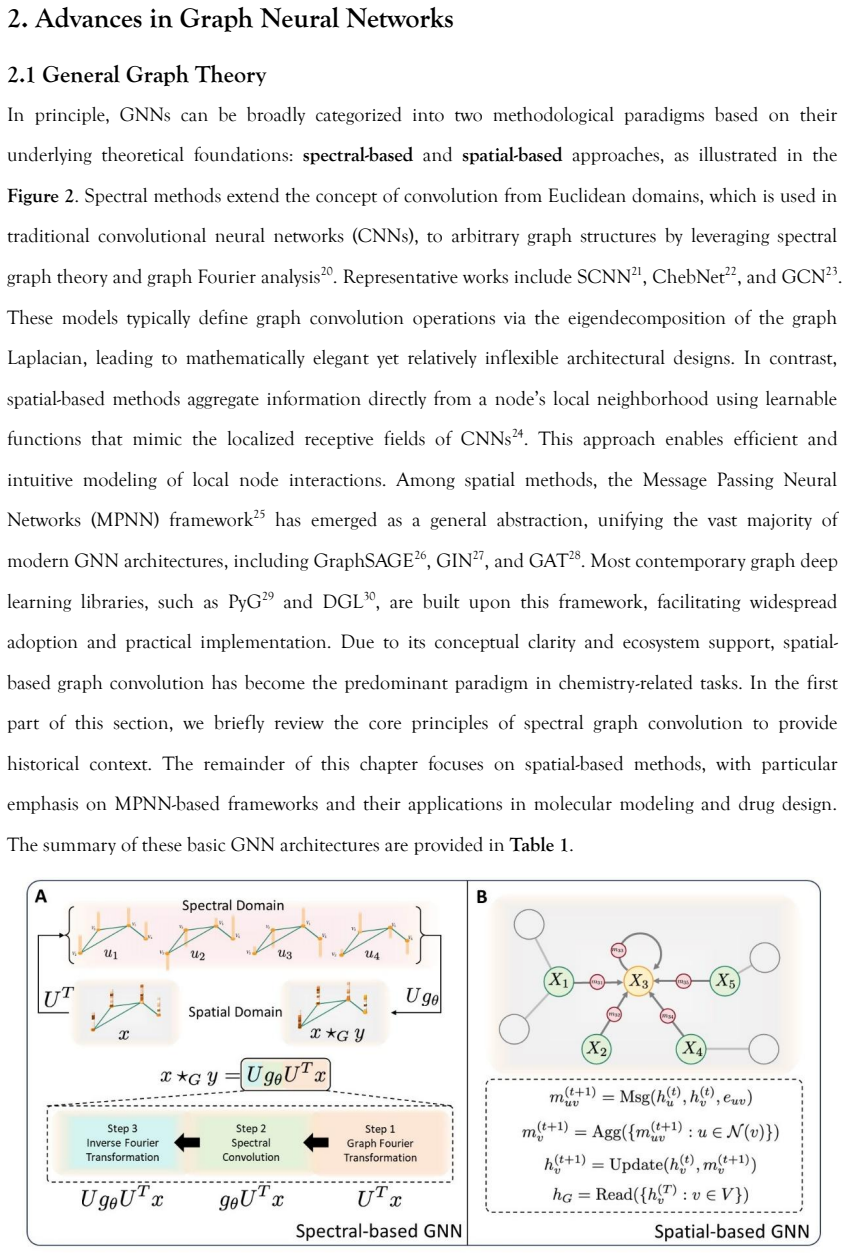
The central machinery is the Message Passing Neural Network (MPNN) abstraction, which reduces a graph neural network to four functions: message, aggregation, update, and readout. Nearly every model reviewed, from GCN and GAT to SchNet, DimeNet, GemNet, EGNN, and graph transformers, is presented as an instance or extension of this framework. The review uses MPNN as the organizing lens: symmetry-aware variants modify the message function to respect rotations and translations, scalable variants modify aggregation and update to avoid over-smoothing and over-squashing, and generative and reinforcement-learning variants replace the readout with decoding, editing, or value functions.
What would settle it
A reader could check the review's benchmark tables—for example, the ZINC test MAE values in Table 4 and the QM9/MD17 errors in Table 2—against the original model reports; if a substantial fraction of entries are not reproducible, the reliability of the field map collapses. A systematic literature scan for a major GNN family absent from the taxonomy, such as generative diffusion models or large-language-model-based molecular agents, would directly test the comprehensiveness claim.
Extended reading notes
Core claim
On the paper's own terms, the central discovery is that the message-passing abstraction—a graph neural network built from message, aggregation, update, and readout functions—is expressive enough to cover the full range of drug-discovery tasks. The review documents a progression from spectral and spatial graph convolutions, through internal-coordinate, tensor-product, and vector-based equivariant GNNs, to large-scale graph transformers and pretraining schemes. It argues that this progression follows the constraints real molecules impose: rotational symmetry, three-dimensional geometry, chirality, scalability, uncertainty, and interpretability. If that is right, progress in drug-discovery AI is largely progress in graph representation learning, and task-specific models are special cases of a common graph-based design space.
Load-bearing premise
The review's claims of comprehensiveness rest on the authors' editorial selection of papers, since no systematic search or inclusion criteria are specified; if representative method families are missing or misclassified, the field maps and benchmark tables could mislead.
Editorial extensions
If this is right
- If GNNs are the common backbone, then improvements in one task—such as better geometric message passing for property prediction—should transfer to virtual screening and synthesis planning, because the same graph-representation machinery underlies all of them.
- Symmetry-aware and chirality-aware GNNs become necessary components for any task where three-dimensional structure determines function, making equivariant design a default rather than an option.
- Scaling GNNs with graph-transformer architectures and pretraining on unlabeled molecular data should reduce the field's dependence on scarce, noisy experimental labels.
- Uncertainty quantification and explainability stop being optional additions; they become part of the reliability case a model must make before entering real screening or lead-optimization decisions.
- Graph editing combined with reinforcement learning closes the loop from prediction to design, turning learned representations into molecules that satisfy specific objectives.
Reading between the lines
- Beyond the paper, the model-centric taxonomy suggests a testable hypothesis: a benchmark spanning property prediction, docking, generation, and retrosynthesis with shared graph backbones would reveal more cross-task transfer than current task-siloed leaderboards show.
- An implicit extension is that foundation-model-style pretraining on molecular graphs could eventually absorb the review's separate categories—geometric GNNs, graph transformers, and generative models—into a single architecture family.
- A practical extension would be to report conformal prediction intervals and epistemic uncertainty alongside every GNN property prediction, turning the review's reliability discussion into a reporting standard.
- The chirality-aware discussion points to a clean test: an equivariant GNN that respects rotations but not reflections should distinguish enantiomers that ordinary two-dimensional GNNs cannot, which is directly checkable on datasets with R/S labels.
Editorial analysis
A structured set of objections, weighed in public.
Referee Report
Summary. This manuscript is a review of graph neural network (GNN) methods in AI-aided drug discovery (AIDD). It proposes a model-centric taxonomy—spectral/spatial GNNs, symmetry-aware (invariant/equivariant) GNNs, large/deep GNNs, graph generative models, and graph editing with reinforcement learning—and then surveys applications in molecular property prediction, virtual screening, molecular generation, biomedical knowledge graphs, and chemical synthesis. The review also covers uncertainty quantification, explainability, pretraining, and graph transformers, and closes with practical challenges and future directions. The stated goal is to provide a comprehensive, structured overview for both chemistry/biology researchers and computational scientists.
Significance. If the accuracy and completeness issues are addressed, this review could be a useful entry point for researchers entering GNN-based drug discovery. Its strengths are the breadth of topics, the model-centric organization, and the compact comparative tables (e.g., Tables 2, 3, 5, 9, 11) that condense a large literature. The inclusion of less commonly surveyed areas such as conformal prediction, evidential deep learning, and counterfactual explainability adds value beyond existing reviews. The paper does not provide code or machine-checked proofs, so its value rests on the correctness and representativeness of its narrative, equations, and tables. At present, the undocumented basis for the ‘comprehensive’ claim and several technical/factual errors prevent the manuscript from being fully reliable as a field map, but these issues are fixable within the scope of a major revision.
major comments (3)
- [1.2] The abstract and Section 1.2 claim a ‘comprehensive overview,’ but the review never specifies how the covered literature was selected: there is no search strategy, inclusion/exclusion criteria, time window, or coverage target. Tables 2, 4, 9–12 and the section-level maps in Sections 2–7 are therefore presented as representative without a reproducible basis, so a reader cannot distinguish a comprehensive survey from a curated sample. Please add a short methodology paragraph and, ideally, a coverage audit that names the major model families and benchmark datasets considered and states why any omissions were made. This is not a demand for a formal systematic review; it is a request to bound the claim of comprehensiveness.
- [2.1.2] The MPNN reformulation of GCN is internally inconsistent. The text defines Message m_uv = h_u, Aggregate m_v = Σ_{u∈N(v)} m_uv/√(d_u d_v) + h_v, and Update h_v = σ(W m_v). The ‘more compact’ form then writes h_v = σ(Σ_{u∈N(v)∪{v}} m_uv W h_u / √(d_u d_v)), which multiplies h_u by both m_uv and W and does not follow from the preceding three equations. The intended expression is presumably σ(Σ_{u∈N(v)∪{v}} W h_u / √(d_u d_v)) with the appropriate normalization. Since Section 2 is the methodological foundation of the review, these equations need to be corrected.
- [3.1.4.1] The data-imbalance discussion contains a factual error: it states that ‘in the FreeSolv dataset 205, most compounds are recorded as active,’ but FreeSolv is a regression benchmark of experimental hydration free energies and has no active/inactive labels; Table 8 itself lists FreeSolv as a regression task (R). This mischaracterizes a standard benchmark and weakens the illustration of class imbalance. Please replace the example with a genuinely imbalanced classification dataset (e.g., HIV or Tox21) and align the text with Table 8.
minor comments (5)
- [2.4.1.2] In the energy-based model paragraph, the partition function is written as Z = exp∫(-E(x)) dx; it should be Z = ∫ exp(-E(x)) dx.
- [2.2.2, 2.2.3, 3.3] Several typos and name errors should be corrected: ‘Glebsch-Gorden’ should be ‘Clebsch–Gordan’ (Section 2.2.2); ‘Victor et al. 48’ referring to EGNN should be ‘Satorras et al.’ (Section 2.2.3); and the Section 3.3 heading ‘Blak-box’ should be ‘black-box.’
- [2.3.2.1] In the Transformer equations, the notation is inconsistent: V_i = W_V H_I^T and H_i = Σ_j α_ij V_j should use consistent token indices, and the softmax denominator is written ambiguously. Please align the notation with the standard self-attention formula.
- [3.1.1.3, Table 8] The text says PCBA contains 125 biological targets, while Table 8 reports 128 tasks; Table 8 also labels MUV as ‘R’ (regression) although MUV is a classification benchmark. Please reconcile these numbers and task labels.
- [Table 1] Table 1 lists ‘SCNN21’ and the text attributes the formulation to Shuman et al. [21]; if reference 21 is the Shuman review, the SCNN model itself is usually attributed to Bruna et al. Please check the citation and the attribution.
Circularity Check
No circular derivation: the review is a curated survey, not a fitted prediction chain.
full rationale
This is a review/taxonomy paper, not a derivation or prediction study. Its stated contribution in Section 1.2 is to organize GNN methods and applications from a model-centric perspective; it fits no parameters, computes no new benchmark results, and reports no quantities that are then 'predicted' from the same fitted inputs. The methodological sections (Sections 2-7) describe existing architectures and cite external empirical results; Tables 1-12 summarize performance values from the cited works rather than deriving them. Self-citations to the authors' own models (e.g., KarmaDock, MolGpKa, MTGL-ADMET) appear as representative examples, not as load-bearing justifications for the review's organizational claims. No uniqueness theorem from the authors is invoked to forbid alternative taxonomies, and no ansatz is smuggled in via self-citation. The only substantive concern is the claim of 'comprehensive overview' without a documented systematic search or inclusion protocol in Section 1.2; that is a coverage/selection-bias risk, not a logical circularity, because the review's content does not reduce to its own inputs by construction. Accordingly, no circular step is identified and the circularity score is 0.
Assumptions & free parameters
assumptions (4)
- domain assumption Molecules are naturally represented as graphs with atoms as nodes and bonds as edges, with 3D coordinates as additional data.
- domain assumption The selected literature is representative of the field's progress.
- ad hoc to paper The model-centric taxonomy dividing GNNs into spectral/spatial, symmetric, large/deep, generative, and RL-based categories is a useful organizing scheme.
- standard math Standard mathematical results (graph Laplacian eigendecomposition, group-theoretic equivariance, Bayes' rule, score matching) are correct and applicable as cited.
Cite this review
Pith. "Pith review of Graph Neural Networks in Modern AI-aided Drug Discovery." pith.science (2026). https://pith.science/paper/7AZZHR5Q
@misc{pith2026250606915,
  author       = {Pith},
  title        = {Pith review of: Graph Neural Networks in Modern AI-aided Drug Discovery},
  year         = {2026},
  howpublished = {\url{https://pith.science/paper/7AZZHR5Q}},
  note         = {Machine review of arXiv:2506.06915}
}
read the original abstract
Graph neural networks (GNNs), as topology/structure-aware models within deep learning, have emerged as powerful tools for AI-aided drug discovery (AIDD). By directly operating on molecular graphs, GNNs offer an intuitive and expressive framework for learning the complex topological and geometric features of drug-like molecules, cementing their role in modern molecular modeling. This review provides a comprehensive overview of the methodological foundations and representative applications of GNNs in drug discovery, spanning tasks such as molecular property prediction, virtual screening, molecular generation, biomedical knowledge graph construction, and synthesis planning. Particular attention is given to recent methodological advances, including geometric GNNs, interpretable models, uncertainty quantification, scalable graph architectures, and graph generative frameworks. We also discuss how these models integrate with modern deep learning approaches, such as self-supervised learning, multi-task learning, meta-learning and pre-training. Throughout this review, we highlight the practical challenges and methodological bottlenecks encountered when applying GNNs to real-world drug discovery pipelines, and conclude with a discussion on future directions.
Figures


Figures from the paper (5 more)


Reference graph
Works this paper leans on
-
[1]
Modelling compound cytotoxicity using conformal prediction and PubChem HTS data
ensson, F.; Norinder, U.; Bender, A. Modelling compound cytotoxicity using conformal prediction and PubChem HTS data. Toxicol. Res. 2017, 6 (1), 73 -80. Norinder, U.; Carlsson, L.; Boyer, S.; Eklund, M. Introducing conformal prediction in predictive modeling. A transparent and flexible alternative to applicability domain determination. J. Chem. Inf. Model...
2017
-
[2]
Evaluation methods and general results. J. Chem. Inf. Model. 2014, 54 (6), 1717-1736. (403) Wang, L.; Chambers, J.; Abel, R. Protein -ligand binding free energy calculations with FEP+. Methods Mol. Biol. 2019, 2022, 201-232. (404) Ballester, P. J.; Mitchell, J. B. A machine learning approach to predicting protein –ligand binding affinity with applications...
work page Pith review arXiv 2014
-
[3]
Nature 2024, 1-3. (375) Evans, R.; O’Neill, M.; Pritzel, A.; Antropova, N.; Senior, A.; Green, T.; Ž ídek, A.; Bates, R.; Blackwell, S.; Yim, J. Protein complex prediction with AlphaFold -Multimer. biorxiv 2021, 2021.2010. 2004.463034. (376) Aggarwal, R.; Gupta, A.; Priyakumar, U. Apobind: a dataset of ligand unbound protein conformations for machine lear...
-
[4]
Why should i trust you?
(282) Ribeiro, M. T.; Singh, S.; Guestrin, C. " Why should i trust you?" Explaining the predictions of any classifier. In Proceedings of the 22nd ACM SIGKDD international conference on knowledge discovery and data mining, 2016; pp 1135-1144. (283) Shrikumar, A.; Greenside, P.; Kundaje, A. Learning important features through propagating activation differen...
2016
-
[15]
(328) Mayor, M. J. B.; Ivars, A. J. E -Learning for interpreting. Babel: International Journal of Translation/Revue Internationale de la Traduction 2007, 53 (4). Du, M.; Liu, N.; Hu, X. Techniques for interpretable machine learning. Commun. ACM 2019, 63 (1), 68-77. (329) Zhang, Q. C.; Petrey, D.; Norel, R.; Honig, B. H. Protein interface conservation acro...
2007
-
[23]
Tankbind: Trigonometry-aware neural networks for drug-protein binding structure prediction
(355) Lu, W.; Wu, Q.; Zhang, J.; Rao, J.; Li, C.; Zheng, S. Tankbind: Trigonometry-aware neural networks for drug-protein binding structure prediction. Adv. Neural Inf. Process. Syst 2022, 35, 7236-7249. (356) Cai, H.; Shen, C.; Jian, T.; Zhang, X.; Chen, T.; Han, X.; Yang, Z.; Dang, W.; Hsieh, C. -Y.; Kang, Y. CarsiDock: a deep learning paradigm for accu...
2022
-
[24]
DiffDock: Diffusion Steps, Twists, and Turns for Molecular Docking
(359) Corso, G.; Jing, B.; Barzilay, R.; Jaakkola, T. DiffDock: Diffusion Steps, Twists, and Turns for Molecular Docking. In International Conference on Learning Representations (ICLR 2023),
2023
-
[25]
Algorithm for reaction classification
(670) Kraut, H.; Eiblmaier, J.; Grethe, G.; L öw, P.; Matuszczyk, H.; Saller, H. Algorithm for reaction classification. J. Chem. Inf. Model. 2013, 53 (11), 2884-2895. (671) Bell, R. P. The theory of reactions involving proton transfers. Proc. R. soc. Lond. Ser. A Math. Phys. Sci. 1936, 154 (882), 414-429. (672) Probst, D.; Schwaller, P.; Reymond, J. -L. ...
work page 2013
Show all 111 references
-
[26]
Fabind: Fast and accurate protein-ligand binding
(361) Pei, Q.; Gao, K.; Wu, L.; Zhu, J.; Xia, Y.; Xie, S.; Qin, T.; He, K.; Liu, T.-Y.; Yan, R. Fabind: Fast and accurate protein-ligand binding. Adv. Neural Inf. Process. Syst 2024,
2024
-
[27]
-Y.; Wu, L
(362) Gao, K.; Pei, Q.; Zhu, J.; Qin, T.; He, K.; Liu, T. -Y.; Wu, L. FABind+: Enhancing Molecular Docking through Improved Pocket Prediction and Pose Generation. arXiv preprint arXiv:2403.20261
-
[30]
Deep inside convolutional networks: Visualising image classification models and saliency maps
(285) Simonyan, K.; Vedaldi, A.; Zisserman, A. Deep inside convolutional networks: Visualising image classification models and saliency maps. arXiv preprint arXiv:1312.6034
-
[31]
K.; Berman, H
(371) Burley, S. K.; Berman, H. M.; Kleywegt, G. J.; Markley, J. L.; Nakamura, H.; Velankar, S. Protein Data Bank (PDB): the single global macromolecular structure archive. Protein Crystallogr. 2017, 627-
2017
-
[32]
Parameterized explainer for graph neural network
(290) Luo, D.; Cheng, W.; Xu, D.; Yu, W.; Zong, B.; Chen, H.; Zhang, X. Parameterized explainer for graph neural network. Adv. Neural Inf. Process. Syst 2020, 33, 19620-19631. (291) Schlichtkrull, M. S.; De Cao, N.; Titov, I. Interpreting graph neural networks for NLP with dif...
2020 arXiv
-
[34]
P.; Nguyen, T.; Le, T
(377) Nguyen, T.; Le, H.; Quinn, T. P.; Nguyen, T.; Le, T. D.; Venkatesh, S. GraphDTA: predicting drug– target binding affinity with graph neural networks. Bioinformatics 2021, 37 (8), 1140-1147. (378) Yang, Z.; Zhong, W.; Zhao, L.; Chen, C. Y.-C. MGraphDTA: deep multiscale gr...
2021
-
[36]
Uncertainty quantification over graph with conformalized graph neural networks
(281) Huang, K.; Jin, Y.; Candes, E.; Leskovec, J. Uncertainty quantification over graph with conformalized graph neural networks. Adv. Neural Inf. Process. Syst 2024,
2024
-
[37]
(386) Moon, S.; Zhung, W.; Yang, S.; Lim, J.; Kim, W. Y. PIGNet: a physics -informed deep learning model toward generalized drug–target interaction predictions. Chem. Sci. 2022, 13 (13), 3661-3673. (387) Guo, J. Improving structure -based protein -ligand affinity prediction by...
2022
-
[38]
R.; Baumgartner, M
(409) Koes, D. R.; Baumgartner, M. P.; Camacho, C. J. Lessons learned in empirical scoring with smina from the CSAR 2011 benchmarking exercise. J. Chem. Inf. Model. 2013, 53 (8), 1893-1904. (410) Imrie, F.; Bradley, A. R.; Deane, C. M. Generating property -matched decoy molecu...
2011
-
[39]
Graph normalizing flows
(416) Liu, J.; Kumar, A.; Ba, J.; Kiros, J.; Swersky, K. Graph normalizing flows. Adv. Neural Inf. Process. Syst 2019,
2019
-
[40]
Graphnvp: An invertible flow model for generating molecular graphs
(417) Madhawa, K.; Ishiguro, K.; Nakago, K.; Abe, M. Graphnvp: An invertible flow model for generating molecular graphs. arXiv preprint arXiv:1905.11600
1905 arXiv
-
[41]
Graphvae: Towards generation of small graphs using variational autoencoders
(418) Simonovsky, M.; Komodakis, N. Graphvae: Towards generation of small graphs using variational autoencoders. In International conference on artificial neural networks, 2018; Springer: pp 412-422. (419) De Cao, N.; Kipf, T. MolGAN: An implicit generative model for small mol...
2018 arXiv
-
[42]
(420) Jo, J.; Lee, S.; Hwang, S. J. Score -based generative modeling of graphs via the system of stochastic differential equations. In International conference on machine learning, 2022; PMLR: pp 10362-10383. (421) Vignac, C.; Krawczuk, I.; Siraudin, A.; Wang, B.; Cevher, V.; ...
2022 arXiv
-
[43]
MolecularRNN: Generating realistic molecular graphs with optimized properties
(422) Popova, M.; Shvets, M.; Oliva, J.; Isayev, O. MolecularRNN: Generating realistic molecular graphs with optimized properties. arXiv preprint arXiv:1905.13372
1905 arXiv
-
[44]
Graphaf: a flow-based autoregressive model for molecular graph generation
(423) Shi, C.; Xu, M.; Zhu, Z.; Zhang, W.; Zhang, M.; Tang, J. Graphaf: a flow-based autoregressive model for molecular graph generation. arXiv preprint arXiv:2001.09382
2001 arXiv
-
[45]
Categorical normalizing flows via continuous transformations
(424) Lippe, P.; Gavves, E. Categorical normalizing flows via continuous transformations. arXiv preprint arXiv:2006.09790
2006 arXiv
-
[46]
Graphdf: A discrete flow model for molecular graph generation
(425) Luo, Y.; Yan, K.; Ji, S. Graphdf: A discrete flow model for molecular graph generation. In International conference on machine learning, 2021; PMLR: pp 7192-7203. (426) Kwon, Y.; Yoo, J.; Choi, Y.; Son, W.; Lee, D.; Kang, S. Efficient learning of non -autoregressive grap...
2021
-
[47]
-S.; Shin, K.; Kang, S
(427) Kwon, Y.; Lee, D.; Choi, Y. -S.; Shin, K.; Kang, S. Compressed graph representation for scalable molecular graph generation. J. Cheminformatics 2020, 12, 1-8. (428) Arjovsky, M.; Chintala, S.; Bottou, L. Wasserstein generative adversarial networks. In International confe...
2020
-
[48]
Hierarchical generation of molecular graphs using structural motifs
(430) Jin, W.; Barzilay, R.; Jaakkola, T. Hierarchical generation of molecular graphs using structural motifs. In International conference on machine learning, 2020; PMLR: pp 4839-4848. (431) Xie, Y.; Shi, C.; Zhou, H.; Yang, Y.; Zhang, W.; Yu, Y.; Li, L. Mars: Markov molecula...
2020 arXiv
-
[49]
J.; Segler, M.; Hernández -Lobato, J
(432) Bradshaw, J.; Paige, B.; Kusner, M. J.; Segler, M.; Hernández -Lobato, J. M. A model to search for synthesizable molecules. Adv. Neural Inf. Process. Syst 2019,
2019
-
[50]
Molecule generation by principal subgraph mining and assembling
(433) Kong, X.; Huang, W.; Tan, Z.; Liu, Y. Molecule generation by principal subgraph mining and assembling. Adv. Neural Inf. Process. Syst 2022, 35, 2550-2563. (434) Geng, Z.; Xie, S.; Xia, Y.; Wu, L.; Qin, T.; Wang, J.; Zhang, Y.; Wu, F.; Liu, T.-Y. De novo molecular generat...
2022 arXiv
-
[51]
N.; Hernández -Lobato, J
(435) Simm, G. N.; Hernández -Lobato, J. M. A generative model for molecular distance geometry. arXiv preprint arXiv:1909.11459
1909 arXiv
-
[52]
Learning neural generative dynamics for molecular conformation generation
(436) Xu, M.; Luo, S.; Bengio, Y.; Peng, J.; Tang, J. Learning neural generative dynamics for molecular conformation generation. arXiv preprint arXiv:2102.10240
-
[53]
An end -to-end framework for molecular conformation generation via bilevel programming
(437) Xu, M.; Wang, W.; Luo, S.; Shi, C.; Bengio, Y.; Gomez -Bombarelli, R.; Tang, J. An end -to-end framework for molecular conformation generation via bilevel programming. In International Conference on Machine Learning, 2021; PMLR: pp 11537-11547. (438) Zhang, H.; Li, S.; Z...
2021 arXiv
-
[54]
Geodiff: A geometric diffusion model for molecular conformation generation
(440) Xu, M.; Yu, L.; Song, Y.; Shi, C.; Ermon, S.; Tang, J. Geodiff: A geometric diffusion model for molecular conformation generation. arXiv preprint arXiv:2203.02923
-
[55]
Torsional Diffusion for Molecular Conformer Generation
(441) Jing, B.; Corso, G.; Chang, J.; Barzilay, R.; Jaakkola, T. Torsional Diffusion for Molecular Conformer Generation. arXiv preprint arXiv:2206.01729
-
[56]
(442) Riniker, S.; Landrum, G. A. Better informed distance geometry: using what we know to improve conformation generation. J. Chem. Inf. Model. 2015, 55 (12), 2562-2574. (443) Shi, C.; Luo, S.; Xu, M.; Tang, J. Learning Gradient Fields for Molecular Conformation Generation. I...
2015
-
[57]
E (n) equivariant normalizing flows
(444) Garcia Satorras, V.; Hoogeboom, E.; Fuchs, F.; Posner, I.; Welling, M. E (n) equivariant normalizing flows. Adv. Neural Inf. Process. Syst 2021, 34, 4181-4192. (445) Hoogeboom, E.; Satorras, V. G.; Vignac, C.; Welling, M. Equivariant diffusion for molecule generation in ...
2021
-
[58]
(448) Huang, L.; Zhang, H.; Xu, T.; Wong, K. -C. Mdm: Molecular diffusion model for 3d molecule generation. In Proceedings of the AAAI Conference on Artificial Intelligence, 2023; Vol. 37, pp 5105-5112. (449) Dunn, I.; Koes, D. R. Mixed Continuous and Categorical Flow Matching...
2023
-
[59]
Symmetry -adapted generation of 3d point sets for the targeted discovery of molecules
(450) Gebauer, N.; Gastegger, M.; Schütt, K. Symmetry -adapted generation of 3d point sets for the targeted discovery of molecules. Adv. Neural Inf. Process. Syst 2019,
2019
-
[60]
W.; Gastegger, M.; Hessmann, S
(451) Gebauer, N. W.; Gastegger, M.; Hessmann, S. S.; Müller, K. -R.; Schütt, K. T. Inverse design of 3d molecular structures with conditional generative neural networks. Nat. Commun. 2022, 13 (1),
2022
-
[62]
A 3D generative model for structure -based drug design
(456) Luo, S.; Guan, J.; Ma, J.; Peng, J. A 3D generative model for structure -based drug design. Adv. Neural Inf. Process. Syst 2021, 34, 6229-6239. (457) Peng, X.; Luo, S.; Guan, J.; Xie, Q.; Peng, J.; Ma, J. Pocket2mol: Efficient molecular sampling based on 3d protein pocke...
2021
-
[64]
Structure -based drug design with equivariant diffusion models
(463) Schneuing, A.; Du, Y.; Harris, C.; Jamasb, A.; Igashov, I.; Du, W.; Blundell, T.; Lió, P.; Gomes, C.; Welling, M. Structure -based drug design with equivariant diffusion models. In arXiv preprint arXiv:2210.13695,
-
[65]
(464) Lin, H.; Huang, Y.; Liu, M.; Li, X.; Ji, S.; Li, S. Z. DiffBP: Generative Diffusion of 3D Molecules for Target Protein Binding. arXiv preprint arXiv:2211.11214
-
[66]
W.; Peng, X.; Su, Y.; Peng, J.; Ma, J
(465) Guan, J.; Qian, W. W.; Peng, X.; Su, Y.; Peng, J.; Ma, J. 3d equivariant diffusion for target -aware molecule generation and affinity prediction. arXiv preprint arXiv:2303.03543
-
[67]
J.; Park, C.; Park, S
(466) Choi, S.; Seo, S.; Kim, B. J.; Park, C.; Park, S. PIDiff: Physics informed diffusion model for protein pocket-specific 3D molecular generation. Comput. Biol. Med. 2024, 180, 108865. (467) Qian, H.; Huang, W.; Tu, S.; Xu, L. KGDiff: towards explainable target -aware molec...
2024 arXiv
-
[68]
Automated exploration of the low -energy chemical space with fast quantum chemical methods
(469) Pracht, P.; Bohle, F.; Grimme, S. Automated exploration of the low -energy chemical space with fast quantum chemical methods. Phys. Chem. Chem. Phys. 2020, 22 (14), 7169-7192. (470) Olanders, G.; Alogheli, H.; Brandt, P.; Karlén, A. Conformational analysis of macrocycles...
2020
-
[70]
P.; Plowright, A
(481) Schneider, P.; Walters, W. P.; Plowright, A. T.; Sieroka, N.; Listgarten, J.; Goodnow Jr, R. A.; Fisher, J.; Jansen, J. M.; Duca, J. S.; Rush, T. S. Rethinking drug design in the artificial intelligence era. Nat. Rev. Drug Discov. 2020, 19 (5), 353-364. (482) You, J.; Li...
2020
-
[71]
(483) Yang, S.; Hwang, D.; Lee, S.; Ryu, S.; Hwang, S. J. Hit and lead discovery with explorative rl and fragment-based molecule generation. Adv. Neural Inf. Process. Syst 2021, 34, 7924-7936. (484) Jin, W.; Barzilay, R.; Jaakkola, T. Multi -objective molecule generation using...
2021
-
[72]
R.; Parthasarathy, S.; Ning, X
(490) Chen, Z.; Min, M. R.; Parthasarathy, S.; Ning, X. A deep generative model for molecule optimization via one fragment modification. Nat. Mach. Intell. 2021, 3 (12), 1040-1049. (491) Mukaidaisi, M.; Vu, A.; Grantham, K.; Tchagang, A.; Li, Y. Multi -objective drug design ba...
2021 arXiv
-
[73]
N.; Greene, C
(504) Nicholson, D. N.; Greene, C. S. Constructing knowledge graphs and their biomedical applications. Comput. Struct. Biotechnol. J. 2020, 18, 1414-1428. (505) Chandak, P.; Huang, K.; Zitnik, M. Building a knowledge graph to enable precision medicine. Sci. Data 2023, 10 (1),
2020
-
[74]
Toward better drug discovery with knowledge graph
(506) Zeng, X.; Tu, X.; Liu, Y.; Fu, X.; Su, Y. Toward better drug discovery with knowledge graph. Curr. Opin. Struct. Biol. 2022, 72, 114-126. (507) Chen, X.; Jia, S.; Xiang, Y. A review: Knowledge reasoning over knowledge graph. Expert Syst. Appl. 2020, 141, 112948. (508) Br...
2022
-
[75]
2021, 49 (D1), D884-D891
Nucleic Acids Res. 2021, 49 (D1), D884-D891. (510) Consortium, U. UniProt: a worldwide hub of protein knowledge. Nucleic Acids Res. 2019, 47 (D1), D506-D515. (511) Oughtred, R.; Rust, J.; Chang, C.; Breitkreutz, B. J.; Stark, C.; Willems, A.; Boucher, L.; Leung, G.; Kolas, N.;...
2021
-
[76]
2024, 52 (D1), D1265-D1275
Nucleic Acids Res. 2024, 52 (D1), D1265-D1275. (515) Ursu, O.; Holmes, J.; Knockel, J.; Bologa, C. G.; Yang, J. J.; Mathias, S. L.; Nelson, S. J.; Oprea, T. I. DrugCentral: online drug compendium. Nucleic Acids Res. 2016, gkw993. (516) Gremse, M.; Chang, A.; Schomburg, I.; Gro...
2024
-
[80]
P.; Ye, C.; Swiers, R.; Engkvist, O.; Bender, A.; Hoyt, C
(537) Bonner, S.; Barrett, I. P.; Ye, C.; Swiers, R.; Engkvist, O.; Bender, A.; Hoyt, C. T.; Hamilton, W. L. A review of biomedical datasets relating to drug discovery: a knowledge graph perspective. Brief. Bioinform. 2022, 23 (6), bbac404. (538) Himmelstein, D. S.; Lizee, A.;...
2022 arXiv
-
[81]
K.; Nová č ek, V
(540) Walsh, B.; Mohamed, S. K.; Nová č ek, V. Biokg: A knowledge graph for relational learning on biological data. In Proceedings of the 29th ACM International Conference on Information & Knowledge Management, 2020; pp 3173-3180. (541) Zheng, S.; Rao, J.; Song, Y.; Zhang, J.;...
2020
-
[82]
Translating embeddings for modeling multi-relational data
(545) Bordes, A.; Usunier, N.; Garcia -Duran, A.; Weston, J.; Yakhnenko, O. Translating embeddings for modeling multi-relational data. Adv. Neural Inf. Process. Syst 2013,
2013
-
[83]
R -gat: relational graph attention network for multi - relational graphs
(546) Chen, M.; Zhang, Y.; Kou, X.; Li, Y.; Zhang, Y. R -gat: relational graph attention network for multi - relational graphs. arXiv preprint arXiv:2109.05922
-
[84]
DeepDDS: deep graph neural network with attention mechanism to predict synergistic drug combinations
(547) Wang, J.; Liu, X.; Shen, S.; Deng, L.; Liu, H. DeepDDS: deep graph neural network with attention mechanism to predict synergistic drug combinations. Brief. Bioinform. 2022, 23 (1), bbab390. (548) Rozemberczki, B.; Gogleva, A.; Nilsson, S.; Edwards, G.; Nikolov, A.; Papa,...
2022
-
[87]
Network -principled deep generative models for designing drug combinations as graph sets
(557) Karimi, M.; Hasanzadeh, A.; Shen, Y. Network -principled deep generative models for designing drug combinations as graph sets. Bioinformatics 2020, 36 (Supplement_1), i445-i454. (558) Gao, C.; Yin, S.; Wang, H.; Wang, Z.; Du, Z.; Li, X. Medical-knowledge-based graph neur...
2020
-
[88]
Modeling polypharmacy side effects with graph convolutional networks
(559) Zitnik, M.; Agrawal, M.; Leskovec, J. Modeling polypharmacy side effects with graph convolutional networks. Bioinformatics 2018, 34 (13), i457-i466. (560) Huang, K.; Xiao, C.; Glass, L. M.; Zitnik, M.; Sun, J. SkipGNN: predicting molecular interactions with skip-graph ne...
2018
-
[90]
W.; Jané -Valbuena, J.; Kryukov, G
(580) Ghandi, M.; Huang, F. W.; Jané -Valbuena, J.; Kryukov, G. V.; Lo, C. C.; McDonald III, E. R.; Barretina, J.; Gelfand, E. T.; Bielski, C. M.; Li, H. Next-generation characterization of the cancer cell line encyclopedia. Nature 2019, 569 (7757), 503-508. (581) Liu, H.; Zha...
2019 arXiv
-
[91]
Integrating multi-modal deep learning on knowledge graph for the discovery of synergistic drug combinations against infectious diseases
(585) Ye, Q.; Xu, R.; Li, D.; Kang, Y.; Deng, Y.; Zhu, F.; Chen, J.; He, S.; Hsieh, C.-Y.; Hou, T. Integrating multi-modal deep learning on knowledge graph for the discovery of synergistic drug combinations against infectious diseases. Cell Rep. Phys. Sci. 2023, 4 (8). (586) P...
2023
-
[95]
T.; Filipek, J.; Zhang, W
(602) Baul, S.; Ahmed, K. T.; Filipek, J.; Zhang, W. omicsGAT: Graph attention network for cancer subtype analyses. Int. J. Mol. Sci. 2022, 23 (18), 10220. (603) Liang, C.; Shang, M.; Luo, J. Cancer subtype identification by consensus guided graph autoencoders. Bioinformatics ...
2022
-
[99]
Positive - unlabeled learning in bioinformatics and computational biology: a brief review
(613) Li, F.; Dong, S.; Leier, A.; Han, M.; Guo, X.; Xu, J.; Wang, X.; Pan, S.; Jia, C.; Zhang, Y. Positive - unlabeled learning in bioinformatics and computational biology: a brief review. Brief. Bioinform. 2022, 23 (1), bbab461. (614) Grover, A.; Leskovec, J. node2vec: Scala...
2022
-
[100]
The open world assumption
(623) Drummond, N.; Shearer, R. The open world assumption. In eSI Workshop: The Closed World of Databases meets the Open World of the Semantic Web, 2006; Vol. 15, p
2006
-
[101]
P.; Law, J.; Mirzazadeh, M.; Ravitz, O.; Simon, A
(624) Cook, A.; Johnson, A. P.; Law, J.; Mirzazadeh, M.; Ravitz, O.; Simon, A. Computer ‐aided synthesis design: 40 years on. Wires Comput. Mol. Sci. 2012, 2 (1), 79-107. (625) Coley, C. W.; Green, W. H.; Jensen, K. F. Machine learning in computer -aided synthesis planning. Ac...
2012
-
[102]
(631) Schneider, N.; Stiefl, N.; Landrum, G. A. What’s what: The (nearly) definitive guide to reaction role assignment. J. Chem. Inf. Model. 2016, 56 (12), 2336-2346. (632) Dai, H.; Li, C.; Coley, C.; Dai, B.; Song, L. Retrosynthesis prediction with conditional graph logic net...
2016
-
[103]
T.; Estrada, J
(633) Ahneman, D. T.; Estrada, J. G.; Lin, S.; Dreher, S. D.; Doyle, A. G. Predicting reaction performance in C–N cross-coupling using machine learning. Science 2018, 360 (6385), 186-190. (634) Perera, D.; Tucker, J. W.; Brahmbhatt, S.; Helal, C. J.; Chong, A.; Farrell, W.; Ri...
2018
-
[107]
Graph transformation policy network for chemical reaction prediction
(657) Do, K.; Tran, T.; Venkatesh, S. Graph transformation policy network for chemical reaction prediction. In Proceedings of the 25th ACM SIGKDD international conference on knowledge discovery & data mining, 2019; pp 750-760. (658) Bi, H.; Wang, H.; Shi, C.; Coley, C.; Tang, ...
2019 arXiv
-
[108]
R.; Cui, A
(663) Maser, M. R.; Cui, A. Y.; Ryou, S.; DeLano, T. J.; Yue, Y.; Reisman, S. E. Multilabel classification models for the prediction of cross -coupling reaction conditions. J. Chem. Inf. Model. 2021, 61 (1), 156-166. (664) Kwon, Y.; Kim, S.; Choi, Y. -S.; Kang, S. Generative m...
2021
-
[109]
-S.; Kang, S
(667) Kwon, Y.; Lee, D.; Choi, Y. -S.; Kang, S. Uncertainty -aware prediction of chemical reaction yields with graph neural networks. J. Cheminformatics 2022, 14, 1-10. (668) Sato, A.; Asahara, R.; Miyao, T. Chemical Graph-Based Transformer Models for Yield Prediction of High-...
2022
-
[203]
-L.; Gulbahce, N.; Loscalzo, J
(609) Barabási, A. -L.; Gulbahce, N.; Loscalzo, J. Network medicine: a network -based approach to human disease. Nat. Rev. Genet. 2011, 12 (1), 56-68. Goh, K. -I.; Cusick, M. E.; Valle, D.; Childs, B.; Vidal, M.; Barabási, A.-L. The human disease network. Proc. Natl. Acad. Sci...
2011
-
[265]
M.; Arze, C.; Nadendla, S.; Chang, Y.-W
(523) Schriml, L. M.; Arze, C.; Nadendla, S.; Chang, Y.-W. W.; Mazaitis, M.; Felix, V.; Feng, G.; Kibbe, W. A. Disease Ontology: a backbone for disease semantic integration. Nucleic Acids Res. 2012, 40 (D1), D940-D946. (524) Robinson, P. N.; Köhler, S.; Bauer, S.; Seelow, D.; ...
2012
-
[378]
Geometric interaction graph neural network for predicting protein–ligand binding affinities from 3d structures (gign)
(384) Yang, Z.; Zhong, W.; Lv, Q.; Dong, T.; Yu -Chian Chen, C. Geometric interaction graph neural network for predicting protein–ligand binding affinities from 3d structures (gign). J. Phys. Chem. Lett. 2023, 14 (8), 2020-2033. (385) Yang, Z.; Zhong, W.; Lv, Q.; Dong, T.; Che...
2023
-
[641]
P2Rank: machine learning based tool for rapid and accurate prediction of ligand binding sites from protein structure
(372) Krivák, R.; Hoksza, D. P2Rank: machine learning based tool for rapid and accurate prediction of ligand binding sites from protein structure. J. Cheminformatics 2018, 10, 1-12. (373) Alcaide, E.; Gao, Z.; Ke, G.; Li, Y.; Zhang, L.; Zheng, H.; Zhou, G. Uni -Mol Docking V2:...
2018 arXiv
-
[739]
Genome -scale annotation of protein binding sites via language model and geometric deep learning
(346) Yuan, Q.; Tian, C.; Yang, Y. Genome -scale annotation of protein binding sites via language model and geometric deep learning. Elife 2024, 13, RP93695. (347) Wang, Y.; Xia, Y.; Yan, J.; Yuan, Y.; Shen, H. -B.; Pan, X. ZeroBind: a protein -specific zero -shot predictor wi...
2024
-
[973]
M.; Banck, M.; James, C
(452) O'Boyle, N. M.; Banck, M.; James, C. A.; Morley, C.; Vandermeersch, T.; Hutchison, G. R. Open Babel: An open chemical toolbox. J. Cheminformatics 2011, 3, 1-14. (453) Huang, X.; Belongie, S. Arbitrary style transfer in real -time with adaptive instance normalization. In ...
2011
-
[1053]
P.; Tiwary, P
(340) Smith, Z.; Strobel, M.; Vani, B. P.; Tiwary, P. Graph attention site prediction (grasp): Identifying druggable binding sites using graph neural networks with attention. J. Chem. Inf. Model. 2024, 64 (7), 2637-2644. (341) Gainza, P.; Sverrisson, F.; Monti, F.; Rodola, E.;...
2024
-
[1071]
Re -Dock: Towards Flexible and Realistic Molecular Docking with Diffusion Bridge
(370) Huang, Y.; Zhang, O.; Wu, L.; Tan, C.; Lin, H.; Gao, Z.; Li, S.; Li, S. Re -Dock: Towards Flexible and Realistic Molecular Docking with Diffusion Bridge. arXiv preprint arXiv:2402.11459
-
[1603]
A.; Norinder, U.; Spjuth, O
Alvarsson, J.; McShane, S. A.; Norinder, U.; Spjuth, O. Predicting with confidence: using conformal prediction in drug discovery. J. Pharm. Sci. 2021, 110 (1), 42-49. (280) Laghuvarapu, S.; Lin, Z.; Sun, J. CoDrug: Conformal Drug Property Prediction with Density Estimation und...
2021
-
[1741]
Estimation of synthetic accessibility score of drug -like molecules based on molecular complexity and fragment contributions
(475) Ertl, P.; Schuffenhauer, A. Estimation of synthetic accessibility score of drug -like molecules based on molecular complexity and fragment contributions. J. Cheminformatics 2009, 1 (1), 1-11. (476) Ganesan, A. The impact of natural products upon modern drug discovery. Cu...
2009 arXiv
-
[1953]
(313) Hu, Y.; Stumpfe, D.; Bajorath, J. r. Computational exploration of molecular scaffolds in medicinal chemistry: Miniperspective. J. Med. Chem. 2016, 59 (9), 4062-4076. (314) Yuan, H.; Tang, J.; Hu, X.; Ji, S. Xgnn: Towards model-level explanations of graph neural networks....
2016
-
[1978]
TP53 mutations in human cancers: origins, consequences, and clinical use
(530) Olivier, M.; Hollstein, M.; Hainaut, P. TP53 mutations in human cancers: origins, consequences, and clinical use. CSH Perspect. Biol. 2010, 2 (1), a001008. Rosen, E. M.; Fan, S.; Pestell, R. G.; Goldberg, I. D. BRCA1 gene in breast cancer. J. Cell. Physiol. 2003, 196 (1)...
2010
-
[2001]
Using LeDock as a docking tool for computational drug design
(352) Liu, N.; Xu, Z. Using LeDock as a docking tool for computational drug design. In IOP Conference Series: Earth and Environmental Science, 2019; IOP Publishing: Vol. 218, p 012143. (353) Méndez-Lucio, O.; Ahmad, M.; del Rio -Chanona, E. A.; Wegner, J. K. A geometric deep l...
2019
-
[2009]
Deep retrosynthetic reaction prediction using local reactivity and global attention
(638) Chen, S.; Jung, Y. Deep retrosynthetic reaction prediction using local reactivity and global attention. JACS Au 2021, 1 (10), 1612-1620. (639) Shi, C.; Xu, M.; Guo, H.; Zhang, M.; Tang, J. A graph to graphs framework for retrosynthesis prediction. In International confer...
2021
-
[2012]
Molecule Edit Graph Attention Network: Modeling Chemical Reactions as Sequences of Graph Edits
(654) Sacha, M.; B łaż , M.; Byrski, P.; D ąbrowski-Tumań ski, P.; Chromiń ski, M.; Loska, R.; W łodarczyk- Pruszyń ski, P.; Jastrz ębski, S. Molecule Edit Graph Attention Network: Modeling Chemical Reactions as Sequences of Graph Edits. J. Chem. Inf. Model. 2021, 61 (7), 3273...
2021 arXiv
-
[2013]
A.; Lin, Z.; Brandt, J.; Shen, X.; Sclaroff, S
(286) Zhang, J.; Bargal, S. A.; Lin, Z.; Brandt, J.; Shen, X.; Sclaroff, S. Top -down neural attention by excitation backprop. Int. J. Comput. Vis. 2018, 126 (10), 1084-1102. (287) Selvaraju, R. R.; Cogswell, M.; Das, A.; Vedantam, R.; Parikh, D.; Batra, D. Grad -cam: Visual e...
2018
-
[2018]
Interpretable deep learning in drug discovery
(323) Preuer, K.; Klambauer, G.; Rippmann, F.; Hochreiter, S.; Unterthiner, T. Interpretable deep learning in drug discovery. Explainable AI: interpreting, explaining and visualizing deep learning 2019, 331-345. (324) Hochuli, J.; Helbling, A.; Skaist, T.; Ragoza, M.; Koes, D....
2019
-
[2019]
M.; Howard, P
(319) Meylan, W. M.; Howard, P. H. Atom/fragment contribution method for estimating octanol –water partition coefficients. J. Pharm. Sci. 1995, 84 (1), 83-92. (320) Crawford, V.; Kuhnle, A.; Thai, M. Submodular cost submodular cover with an approximate oracle. In International...
1995 arXiv
-
[2020]
On explainability of graph neural networks via subgraph explorations
(292) Yuan, H.; Yu, H.; Wang, J.; Li, K.; Ji, S. On explainability of graph neural networks via subgraph explorations. In International conference on machine learning, 2021; PMLR: pp 12241-12252. (293) Wu, Z.; Wang, J.; Du, H.; Jiang, D.; Kang, Y.; Li, D.; Pan, P.; Deng, Y.; C...
2021
-
[2021]
Prottrans: Toward understanding the language of life through self - supervised learning
(349) Elnaggar, A.; Heinzinger, M.; Dallago, C.; Rehawi, G.; Wang, Y.; Jones, L.; Gibbs, T.; Feher, T.; Angerer, C.; Steinegger, M. Prottrans: Toward understanding the language of life through self - supervised learning. IEEE Trans. Pattern Anal. Mach. Intell. 2021, 44 (10), 7...
2021
-
[2022]
Relex: A model -agnostic relational model explainer
(296) Zhang, Y.; Defazio, D.; Ramesh, A. Relex: A model -agnostic relational model explainer. In Proceedings of the 2021 AAAI/ACM Conference on AI, Ethics, and Society, 2021; pp 1042-1049. (297) Duval, A.; Malliaros, F. D. Graphsvx: Shapley value explanations for graph neural ...
2021 arXiv
-
[2023]
Pre -Training on Large -Scale Generated Docking Conformations with HelixDock to Unlock the Potential of Protein-ligand Structure Prediction Models
(360) Liu, L.; He, D.; Ye, X.; Zhang, S.; Zhang, X.; Zhou, J.; Li, J.; Chai, H.; Wang, F.; He, J. Pre -Training on Large -Scale Generated Docking Conformations with HelixDock to Unlock the Potential of Protein-ligand Structure Prediction Models. arXiv preprint arXiv:2310.13913
-
[2024]
R.; Morey-Burrows, F
(363) Krishna, R.; Wang, J.; Ahern, W.; Sturmfels, P.; Venkatesh, P.; Kalvet, I.; Lee, G. R.; Morey-Burrows, F. S.; Anishchenko, I.; Humphreys, I. R. Generalized biomolecular modeling and design with RoseTTAFold All-Atom. Science 2024, eadl2528. (364) AlQuraishi, M. AlphaFold ...
2024
-
[2092]
Self -attention graph pooling
(317) Lee, J.; Lee, I.; Kang, J. Self -attention graph pooling. In International conference on machine learning , 2019; PMLR: pp 3734-3743. (318) Serrano, S.; Smith, N. A. Is attention interpretable? arXiv preprint arXiv:1906.03731
2019 arXiv
-
[2117]
Drug repositioning based on the heterogeneous information fusion graph convolutional network
(593) Cai, L.; Lu, C.; Xu, J.; Meng, Y.; Wang, P.; Fu, X.; Zeng, X.; Su, Y. Drug repositioning based on the heterogeneous information fusion graph convolutional network. Brief. Bioinform. 2021, 22 (6). DOI: 10.1093/bib/bbab319. (594) Cereto-Massagué, A.; Ojeda, M. J.; Valls, C...
2021 doi
-
[2175]
(345) Tubiana, J.; Schneidman -Duhovny, D.; Wolfson, H. J. ScanNet: an interpretable geometric deep learning model for structure -based protein binding site prediction. Nat. Methods 2022, 19 (6), 730-
2022
-
[2345]
KGANSynergy: knowledge graph attention network for drug synergy prediction
(554) Zhang, G.; Gao, Z.; Yan, C.; Wang, J.; Liang, W.; Luo, J.; Luo, H. KGANSynergy: knowledge graph attention network for drug synergy prediction. Brief. Bioinform. 2023, 24 (3), bbad167. (555) Chen, H.; Lu, Y.; Yang, Y.; Rao, Y. A drug combination prediction framework based...
2023
-
[2585]
Generative causal explanations for graph neural networks
(294) Lin, W.; Lan, H.; Li, B. Generative causal explanations for graph neural networks. In International Conference on Machine Learning, 2021; PMLR: pp 6666-6679. (295) Huang, Q.; Yamada, M.; Tian, Y.; Singh, D.; Chang, Y. Graphlime: Local interpretable model explanations for...
2021
-
[2688]
Pocketflow is a data -and-knowledge-driven structure-based molecular generative model
(460) Jiang, Y.; Zhang, G.; You, J.; Zhang, H.; Yao, R.; Xie, H.; Zhang, L.; Xia, Z.; Dai, M.; Wu, Y. Pocketflow is a data -and-knowledge-driven structure-based molecular generative model. Nat. Mach. Intell. 2024, 6 (3), 326-337. (461) Zhang, Z.; Min, Y.; Zheng, S.; Liu, Q. Mo...
2024
-
[2807]
(526) Piñero, J.; Bravo, À.; Queralt -Rosinach, N.; Gutiérrez -Sacristán, A.; Deu -Pons, J.; Centeno, E.; García-García, J.; Sanz, F.; Furlong, L. I. DisGeNET: a comprehensive platform integrating information on human disease-associated genes and variants. Nucleic Acids Res. 2...
2016
-
[3009]
Gnn -retro: Retrosynthetic planning with graph neural networks
(647) Han, P.; Zhao, P.; Lu, C.; Huang, J.; Wu, J.; Shang, S.; Yao, B.; Zhang, X. Gnn -retro: Retrosynthetic planning with graph neural networks. In Proceedings of the AAAI conference on artificial intelligence , 2022; Vol. 36, pp 4014-4021. (648) Xie, S.; Yan, R.; Han, P.; Xi...
2022
-
[3445]
-C.; Hererra, A.; Mostavi, M.; Ramirez, J.; Chen, Y.; Huang, Y.; Jin, Y
(608) Ramirez, R.; Chiu, Y. -C.; Hererra, A.; Mostavi, M.; Ramirez, J.; Chen, Y.; Huang, Y.; Jin, Y. -F. Classification of cancer types using graph convolutional neural networks. Front. Phys. 2020, 8,
2020
-
[3570]
KG -Predict: A knowledge graph computational framework for drug repurposing
(567) Gao, Z.; Ding, P.; Xu, R. KG -Predict: A knowledge graph computational framework for drug repurposing. J. Biomed. Inform. 2022, 132, 104133. (568) Yu, Z.; Huang, F.; Zhao, X.; Xiao, W.; Zhang, W. Predicting drug–disease associations through layer attention graph convolut...
2022
-
[3582]
A.; Szymku č , S.; Gajewska, E
(675) Grzybowski, B. A.; Szymku č , S.; Gajewska, E. P.; Molga, K.; Dittwald, P.; Wo łos, A.; Klucznik, T. Chematica: a story of computer code that started to think like a chemist. Chem 2018, 4 (3), 390-398
2018
-
[4536]
F.; Anandkumar, A
(366) Qiao, Z.; Nie, W.; Vahdat, A.; Miller III, T. F.; Anandkumar, A. State -specific protein –ligand complex structure prediction with a multiscale deep generative model. Nat. Mach. Intell. 2024, 6 (2), 195-208. (367) Dong, T.; Yang, Z.; Zhou, J.; Chen, C. Y. -C. Equivariant...
2024
-
[4789]
DTSyn: a dual - transformer-based neural network to predict synergistic drug combinations
(550) Hu, J.; Gao, J.; Fang, X.; Liu, Z.; Wang, F.; Huang, W.; Wu, H.; Zhao, G. DTSyn: a dual - transformer-based neural network to predict synergistic drug combinations. Brief. Bioinform. 2022, 23 (5), bbac302. (551) Zhang, P.; Tu, S.; Zhang, W.; Xu, L. Predicting cell line -...
2022
-
[4874]
(589) Hanahan, D.; Weinberg, R. A. Hallmarks of cancer: the next generation. Cell 2011, 144 (5), 646-674. Kantarjian, H.; Giles, F.; Wunderle, L.; Bhalla, K.; O'Brien, S.; Wassmann, B.; Tanaka, C.; Manley, P.; Rae, P.; Mietlowski, W. Nilotinib in imatinib -resistant CML and Ph...
2011
-
[6594]
LIT -PCBA: an unbiased data set for machine learning and virtual screening
(336) Tran -Nguyen, V.-K.; Jacquemard, C.; Rognan, D. LIT -PCBA: an unbiased data set for machine learning and virtual screening. J. Chem. Inf. Model. 2020, 60 (9), 4263-4273. (337) Schindler, C. E.; Baumann, H.; Blum, A.; B öse, D.; Buchstaller, H. -P.; Burgdorf, L.; Cappel,...
2020
-
[6797]
MOGONET integrates multi-omics data using graph convolutional networks allowing patient classification and biomarker identification
(607) Wang, T.; Shao, W.; Huang, Z.; Tang, H.; Zhang, J.; Ding, Z.; Huang, K. MOGONET integrates multi-omics data using graph convolutional networks allowing patient classification and biomarker identification. Nat. Commun. 2021, 12 (1),
2021
-
[7206]
Identifying cancer subtypes using a residual graph convolution model on a sample similarity network
(601) Dai, W.; Yue, W.; Peng, W.; Fu, X.; Liu, L.; Liu, L. Identifying cancer subtypes using a residual graph convolution model on a sample similarity network. Genes 2021, 13 (1),
2021
-
[7861]
J.; Lipman, Y
(348) Puny, O.; Atzmon, M.; Ben -Hamu, H.; Misra, I.; Grover, A.; Smith, E. J.; Lipman, Y. Frame averaging for invariant and equivariant network design. arXiv preprint arXiv:2110.03336
Reviewed August 7, 2026 · model on record in the stance chip above.
Discussion (0). Sign in to comment.