REVIEW 4 major objections 8 minor 27 references
Reading in the Dark with Foveated Event Vision
T0 review · 4 major / 8 minor · reviewed 2026-08-07 · deepseek-v4-flash
Pith's one-line read An event-camera OCR pipeline using eye-gaze foveation and binary reconstruction reads printed text at 30 lux with 8.3% word error, where the RGB camera fails completely, while transmitting up to 2,400 times less data.
desk verdict Plausible systems paper on foveated event-camera OCR, but the headline 8.3% WER rests on a self-referential fine-tuning loop that no held-out split protects. read the letter →
The pith
A machine-rendered reading of the paper's core claim, the machinery that carries it, and where it could break.
The reading
What carries the argument
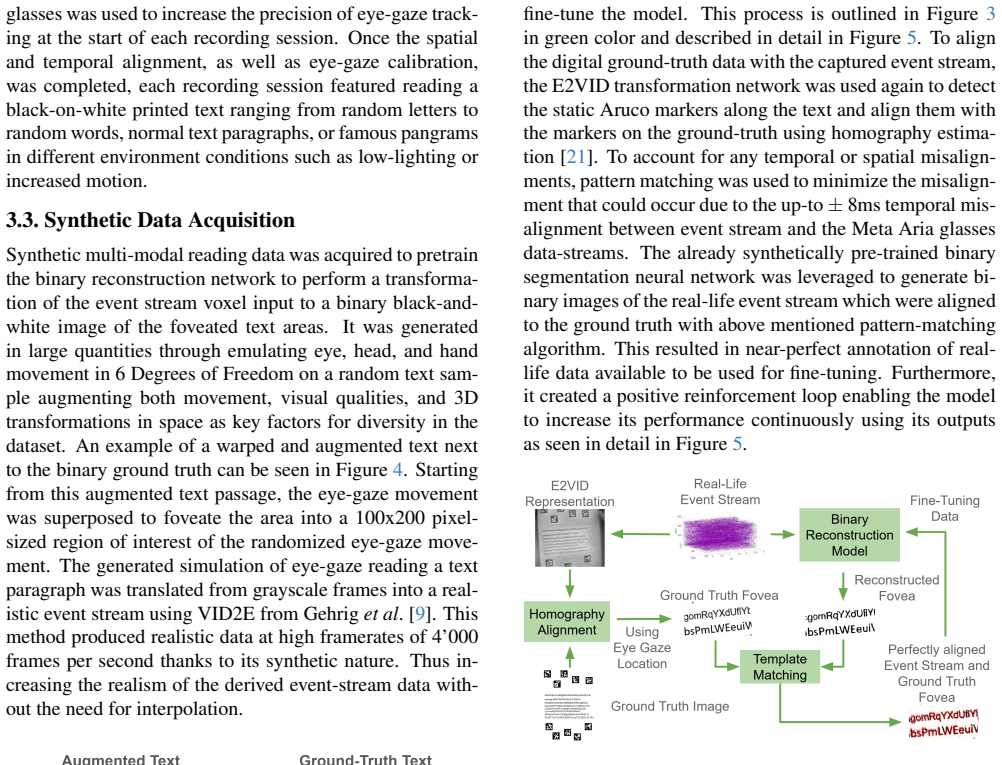
The load-bearing mechanism is a foveated event-to-binary reconstruction front end. Eye gaze selects a 100x200 pixel window around the text being read; a voxel-adapted U-Net, pretrained on about 90,000 synthetic event samples and fine-tuned on real-life recordings, maps a 1,600-event voxel grid into a binary black-and-white patch. Synthetic pretraining uses a video-to-events simulator to generate realistic event streams from augmented text images, and real-life fine-tuning data is aligned to digital text ground truth using Aruco markers, homography estimation, and pattern matching. The reconstruction network's own outputs also generate the labels used for fine-tuning, creating a closed loop. A hierarchical stitching stage uses eye-gaze saccades and KLT tracking to merge the binary frames into one de-warped text image, which is then transcribed by a multimodal LLM or a dedicated OCR API.
What would settle it
Re-transcribe the same 30-lux recordings from the evaluation set using labels produced independently of the pipeline—human transcription or a high-sensitivity camera—and compare WER/CER against those labels; if the event pipeline's error is far above 8.3%, the reported accuracy was inflated by self-agreement in the annotation loop.
Extended reading notes
Core claim
The paper's central claim is that a wearable event camera can substitute for an RGB camera in egocentric OCR: events encode text edges without motion blur and across a wide dynamic range, and a foveated event stream can be reconstructed into a legible binary text image. In controlled real-life recordings at 30 lux, the event-based LLM pipeline reaches 8.3% word error and 2.5% character error, whereas the Meta Aria RGB camera in the same scene returns 100% WER and CER. The authors estimate the event pipeline still gives reasonable OCR output down to about 7 lux. They position the result as extending the operational envelope into low-light and high-motion regimes, not as beating RGB in bright quasi-static scenes, where RGB still wins. Bandwidth is the paired claim: foveation removes about 98% of the event data, and the full stitched-binary pipeline reduces file size by up to 2,400 times relative to a compressed RGB snapshot.
Load-bearing premise
The load-bearing premise is that the synthetically pretrained U-Net's own binary reconstructions, aligned to digital ground truth by pattern matching, are accurate enough to serve as fine-tuning labels, and that the real-life evaluation recordings are independent of that fine-tuning data.
Editorial extensions
If this is right
- At 30 lux, event-based OCR gives 8.3% WER and 2.5% CER where the tested RGB camera returns 100% error, and the approach is estimated to work down to about 7 lux.
- Foveation alone removes roughly 98% of the event data, and the full stitched-binary pipeline transmits up to 2,400 times fewer bytes than a compressed RGB image.
- Multimodal LLM OCR outperforms dedicated OCR on structured text such as paragraphs and pangrams, while dedicated OCR is better on random letters and words.
- A letter height below about 6 pixels on the sensor causes WER and CER to rise sharply for both camera types, implying that higher angular resolution sensors are needed for wearable OCR at normal reading distances.
- For always-on assistive glasses, the continuous foveated event stream can be sent to cloud LLMs instead of periodic high-resolution RGB snapshots, reducing latency and battery drain.
Reading between the lines
- The same foveated event-to-binary front end could generalize beyond OCR to always-on wearable tasks such as object detection, segmentation, or action recognition, since it compresses the visual scene to the region the user actually attends to; the paper suggests this transferability, and a concrete test would be feeding the reconstructed binary patches to standard detectors.
- A natural extension is to remove the controlled Aruco-marker setup and test on unmodified natural scenes using self-supervised alignment, to see whether the low-light gains survive outside the lab.
- The bandwidth comparison assumes the RGB baseline is a single snapshot; a fairer always-on comparison would stream foveated or compressed RGB video, which would shrink but not eliminate the event advantage, and would clarify where the crossover lies.
Editorial analysis
A structured set of objections, weighed in public.
Referee Report
Summary. The paper proposes an egocentric OCR pipeline based on an event camera mounted on Meta Aria glasses. Eye-gaze is used to foveate the event stream, a U-Net trained on synthetic data performs binary image reconstruction, and a multimodal LLM performs OCR on the stitched binary images. The headline result is that at 30 lux ambient illumination the event-based LLM pipeline achieves 8.3% WER and 2.5% CER while the RGB camera fails completely, with an additional claim of up to 2,400x bandwidth reduction. The authors argue that foveation, event-based sensing, and binary reconstruction extend egocentric OCR into low-light and high-motion regimes that are inaccessible to frame-based RGB cameras, at a fraction of the data rate.
Significance. If the central result holds, this is a valuable contribution to egocentric event vision and assistive wearables. The paper's strengths include a concrete hardware prototype with careful angular-resolution matching between the RGB and event sensors, synthetic pretraining on about 90,000 samples, a plausible foveation mechanism driven by eye gaze, and a comparison of dedicated OCR versus LLM-based OCR. The bandwidth-reduction analysis is also practically relevant for always-on cloud-connected glasses. However, the significance of the 8.3% WER claim depends entirely on the validity and independence of the evaluation, which is currently not established.
major comments (4)
- [3.4, Figure 5] The fine-tuning dataset is generated from the synthetically pretrained U-Net's own binary reconstructions, aligned to digital ground truth by pattern matching, and then used to fine-tune the same model. The manuscript explicitly calls this a 'positive reinforcement loop.' No statement is made about whether the evaluation recordings in Section 4.3 are disjoint from the fine-tuning recordings, and no independent human-verified labels are described. Without a clear held-out split, the reported WER/CER may measure self-agreement between the model and its own labels rather than true text-reading ability. Please specify the session split, report per-session results, and, if possible, validate a subset of the fine-tuning labels by human annotation.
- [4.3, Figure 10] The paper reports single values of WER=8.3% and CER=2.5% at 30 lux, with no variance, number of sessions, or text-type information. Section 4.4 demonstrates that OCR performance depends strongly on text coherency, with LLM OCR performing much better on news articles and pangrams than on random words. Since the text used in the 30-lux experiment is not reported, it is impossible to determine whether the result benefits from the LLM's prior knowledge of a known paragraph. Please report per-session and per-text-type WER/CER with error bars, and state exactly which texts were used in the experiment.
- [4.5, Figure 12] The 2,400x and 20x bandwidth-reduction figures are not supported by explicit file sizes. The text gives RGB JPEG sizes (e.g., 0.22 MB at 20% quality) but does not state the byte counts for the foveated event stream, the binary foveated video, or the stitched binary image. The comparison also mixes a single RGB snapshot with a continuous event stream, which conflates bandwidth and latency. To make the claim testable, please provide the byte counts underlying Figure 12, clarify the RGB JPEG settings used for the 2,400x comparison, and state whether that case assumes on-device stitching and transmission of only the final binary image.
- [4.2, 4.3] The evaluation compares only against the Meta Aria RGB camera and a dedicated cloud OCR service. It does not compare against the existing event-based scene text recognition baseline EventSTR (Ref. [26]) or against the standard E2VID-plus-OCR baselines. Given the abstract's claim that the method 'outperforms traditional OCR solutions,' a comparison with at least one prior event-based OCR approach would substantially strengthen the paper and help calibrate whether the 8.3% WER is a genuinely strong event-based result.
minor comments (8)
- [3.1] The phrase 'lais out' should be 'lays out.'
- [3.2] The text contains several grammatical slips: 'it’s HD resolution' should be 'its HD resolution,' and 'an high 60 pixel/degree angular resolution' should be 'a high angular resolution of 60 pixels/degree.'
- [3.6] 'essentialy de-warping' should be 'essentially de-warping.'
- [4.5, Figure 12] Please add a table or axis labels with actual file sizes in bytes; the relative factors alone are not sufficient for readers to reproduce or verify the bandwidth claim.
- [4.3] The statement that the event-based approach is 'estimated to provide reasonable OCR output down to ≈7 Lux' appears to be an extrapolation; please provide a measurement or a citation for the estimate.
- [4.4, Figure 11] The y-axis label in Figure 11 could be clarified; the reader must infer that positive values favor LLM-based OCR and negative values favor the dedicated OCR, and this should be stated explicitly in the caption.
- [5.1] The bandwidth discussion would benefit from a quantitative latency or power model, since the claimed benefit depends on the tradeoff between on-device computation (foveation, reconstruction, stitching) and data transmission.
- [References] Several references are incomplete or formatted inconsistently, e.g., [18] lists only 'ChatGPT-4o, 2025' without a full citation.
Circularity Check
The 30-lux OCR result is partially circular: Section 3.4 fine-tunes the reconstruction U-Net on labels generated by the same U-Net's own output (a "positive reinforcement loop"), and Section 4.3 reports the headline WER without a stated held-out split.
-
self definitional
[Section 3.4 "Finetune Dataset Generation"; headline result in Section 4.3 "Performance Results".]
"The already synthetically pre-trained binary segmentation neural network was leveraged to generate binary images of the real-life event stream which were aligned to the ground truth with above mentioned pattern-matching algorithm. This resulted in "near-perfect annotation" of real-life data available to be used for fine-tuning. Furthermore, it created a positive reinforcement loop enabling the model to increase its performance continuously using its outputs."
The fine-tuning labels for the reconstruction network are the network's own binary reconstructions after pattern-matching alignment, so the target used for training is defined by the model's output rather than by independent human-verified ground truth. Fine-tuning on these labels reinforces whatever systematic letter-shape errors the pretrained U-Net already makes. The headline Section 4.3 claim (8.3% WER and 2.5% CER at 30 Lux) is produced by this fine-tuned model, and the paper does not state which recording sessions were used for fine-tuning vs. evaluation, nor does it report error bars or a comparison against the EventSTR benchmark.
full rationale
The paper's bandwidth-reduction analysis (Section 4.5) and the qualitative low-light RGB failure comparison are not circular: they compare file sizes and camera behaviour against external devices and formats. The self-citations to E2VID and VID2E are ordinary prior-work references and do not by themselves make the derivation circular. The central 30-lux OCR claim, however, depends on Section 3.4's self-referential fine-tuning loop: the pre-trained U-Net generates the binary images that are aligned and then used as "near-perfect annotation" to fine-tune the same U-Net. Because no independent held-out evaluation split or human-verified pixel labels are described, the reported WER/CER cannot be shown to be independent of the model's own reconstruction bias. This makes the headline result partially circular, while leaving the non-OCR contributions (foveation bandwidth savings, event-based low-light capture) intact. Score 6 reflects a partial circularity in the central accuracy claim rather than a fully definitional collapse.
Assumptions & free parameters
free parameters (5)
- Foveated window size =
100x200 pixels
- Event history window and voxel bins =
1600 events in 4 bins
- Inference binarization threshold =
not reported
- Letter-height legibility cutoff =
6-7 pixels lower-case
- Fine-tuning learning rate scaling =
1e-3 relative reduction
assumptions (6)
- domain assumption The synthetic event stream generated by VID2E from augmented text frames faithfully represents real event-camera behavior under low light and motion.
- domain assumption The text region is a flat plane, so homographies from Aruco markers correctly align RGB, gaze, and event data.
- domain assumption Temporal sync within ±8 ms and spatial homography errors are small enough for 100x200 foveation and stitching.
- ad hoc to paper The pretrained U-Net's binary outputs, aligned to digital ground truth by pattern matching, are accurate enough to serve as fine-tuning labels.
- domain assumption Event cameras can capture text contrast at roughly 7 lux with the stated optics.
- domain assumption KLT tracking can recover 6DoF text-plane motion during stitching to de-warp text lines.
Cite this review
Pith. "Pith review of Reading in the Dark with Foveated Event Vision." pith.science (2026). https://pith.science/paper/M2B5HC35
@misc{pith2026250606918,
  author       = {Pith},
  title        = {Pith review of: Reading in the Dark with Foveated Event Vision},
  year         = {2026},
  howpublished = {\url{https://pith.science/paper/M2B5HC35}},
  note         = {Machine review of arXiv:2506.06918}
}
read the original abstract
Current smart glasses equipped with RGB cameras struggle to perceive the environment in low-light and high-speed motion scenarios due to motion blur and the limited dynamic range of frame cameras. Additionally, capturing dense images with a frame camera requires large bandwidth and power consumption, consequently draining the battery faster. These challenges are especially relevant for developing algorithms that can read text from images. In this work, we propose a novel event-based Optical Character Recognition (OCR) approach for smart glasses. By using the eye gaze of the user, we foveate the event stream to significantly reduce bandwidth by around 98% while exploiting the benefits of event cameras in high-dynamic and fast scenes. Our proposed method performs deep binary reconstruction trained on synthetic data and leverages multimodal LLMs for OCR, outperforming traditional OCR solutions. Our results demonstrate the ability to read text in low light environments where RGB cameras struggle while using up to 2400 times less bandwidth than a wearable RGB camera.
Figures


Figures from the paper (7 more)


Reference graph
Works this paper leans on
-
[26]
Eventstr: A benchmark dataset and baselines for event stream based scene text recognition, 2025
Xiao Wang, Jingtao Jiang, Dong Li, Futian Wang, Lin Zhu, Yaowei Wang, Yongyong Tian, and Jin Tang. Eventstr: A benchmark dataset and baselines for event stream based scene text recognition, 2025. 2
work page 2025
-
[1]
Helios: An extremely low power event-based gesture recognition for always-on smart eyewear, 2024
Prarthana Bhattacharyya, Joshua Mitton, Ryan Page, Owen Morgan, Ben Menzies, Gabriel Homewood, Kemi Jacobs, Paolo Baesso, David Trickett, Chris Mair, Taru Muhonen, Rory Clark, Louis Berridge, Richard Vigars, and Iain Wal- lace. Helios: An extremely low power event-based gesture recognition for always-on smart eyewear, 2024. 1, 2
work page 2024
-
[2]
Recent event camera innovations: A survey, 2024
Bharatesh Chakravarthi, Aayush Atul Verma, Kostas Dani- ilidis, Cornelia Fermuller, and Yezhou Yang. Recent event camera innovations: A survey, 2024. 1
work page 2024
-
[3]
Midi-assisted egocentric opti- cal music recognition
Liang Chen and Kun Duan. Midi-assisted egocentric opti- cal music recognition. In2016 IEEE Winter Conference on Applications of Computer Vision (WACV), pages 1–9, 2016. 2
work page 2016
-
[4]
Michael F Deering. The limits of human vision. In2nd inter- national immersive projection technology workshop, 1998. 3, 6
work page 1998
-
[5]
Project aria: A new tool for egocentric multi-modal ai research.arXiv preprint arXiv:2308.13561
Jakob Engel, Kiran Somasundaram, Michael Goesele, Albert Sun, Alexander Gamino, Andrew Turner, Arjang Talattof, Arnie Yuan, Bilal Souti, Brighid Meredith, et al. Project aria: A new tool for egocentric multi-modal ai research.arXiv preprint arXiv:2308.13561. Accessed: 14 April 2025, 2023. 3
arXiv 2025
-
[6]
Real-time gaze tracking with event- driven eye segmentation, 2022
Yu Feng, Nathan Goulding-Hotta, Asif Khan, Hans Reyser- hove, and Yuhao Zhu. Real-time gaze tracking with event- driven eye segmentation, 2022. 2
work page 2022
-
[7]
S. Garrido-Jurado, R. Mu ˜noz-Salinas, F.J. Madrid-Cuevas, and M.J. Mar ´ın-Jim´enez. Automatic generation and detec- tion of highly reliable fiducial markers under occlusion.Pat- tern Recognition, 47(6):2280–2292, 2014. 3
work page 2014
Show all 27 references
-
[8]
Low-latency au- tomotive vision with event cameras.Nature, 629(8014): 1034–1040, 2024
Daniel Gehrig and Davide Scaramuzza. Low-latency au- tomotive vision with event cameras.Nature, 629(8014): 1034–1040, 2024. 1
2024
-
[9]
Video to events: Recycling video datasets for event cameras
Daniel Gehrig, Mathias Gehrig, Javier Hidalgo-Carri ´o, and Davide Scaramuzza. Video to events: Recycling video datasets for event cameras. InIEEE Conf. Comput. Vis. Pat- tern Recog. (CVPR), 2020. 4
2020
-
[10]
Imaging for all-day wearable smart glasses.arXiv preprint, 2025
Michael Goesele, Daniel Andersen, Yujia Chen, Simon Green, Eddy Ilg, Chao Li, Johnson Liu, Grace Kuo, Logan Wan, and Richard Newcombe. Imaging for all-day wearable smart glasses.arXiv preprint, 2025. 1
2025
-
[11]
Google cloud vision ocr, 2025
Google. Google cloud vision ocr, 2025. 5
2025
-
[12]
Rajesh Kumar, and Shahid Mohammad Ganie
Hemachandran K., Manjeet Rege, Zita Zoltay-Paprika, Ko- rupalli V . Rajesh Kumar, and Shahid Mohammad Ganie. Handbook of Artificial Intelligence and wearables: Appli- cations and case studies. CRC Press, 2024. 2
2024
-
[13]
Applications of smart glasses in applied sciences: A systematic review.Appl
Dawon Kim and Yosoon Choi. Applications of smart glasses in applied sciences: A systematic review.Appl. Sci. (Basel), 11(11):4956, 2021. 1
2021
-
[14]
Augmented reality smart glasses: Current chal- lenges and future innovations in wearable technology.Theo- retical and Natural Science, 83:209–215, 2025
Weiye Lin. Augmented reality smart glasses: Current chal- lenges and future innovations in wearable technology.Theo- retical and Natural Science, 83:209–215, 2025. 1
2025
-
[15]
An Iterative Image Reg- istration Technique with an Application to Stereo Vision
Bruce D Lucas and Takeo Kanade. An Iterative Image Reg- istration Technique with an Application to Stereo Vision. In IJCAI’81: 7th international joint conference on Artificial in- telligence, pages 674–679, Vancouver, Canada, 1981. 5
1981
-
[16]
Even- tego3d: 3d human motion capture from egocentric event streams, 2024
Christen Millerdurai, Hiroyasu Akada, Jian Wang, Diogo Luvizon, Christian Theobalt, and Vladislav Golyanik. Even- tego3d: 3d human motion capture from egocentric event streams, 2024. 1, 2
2024
-
[17]
Etori, Valia Kalokyri, and Giovanni Trappolini
Wiktor Mucha, Florin Cuconasu, Naome A. Etori, Valia Kalokyri, and Giovanni Trappolini. Text2taste: A versatile egocentric vision system for intelligent reading assistance using large language model, 2024. 1, 2
2024
-
[18]
Chatgpt-4o, 2025
OpenAI. Chatgpt-4o, 2025. 5
2025
-
[19]
E 2(go)motion: Motion augmented event stream for egocentric action recognition, 2022
Chiara Plizzari, Mirco Planamente, Gabriele Goletto, Marco Cannici, Emanuele Gusso, Matteo Matteucci, and Barbara Caputo. E 2(go)motion: Motion augmented event stream for egocentric action recognition, 2022. 2
2022
-
[20]
Energy-efficient computation offloading for wearable devices and smart- phones in mobile cloud computing
Claudio Ragona, Fabrizio Granelli, Claudio Fiandrino, Dzmitry Kliazovich, and Pascal Bouvry. Energy-efficient computation offloading for wearable devices and smart- phones in mobile cloud computing. pages 1–6, 2015. 8
2015
-
[21]
Events-to-video: Bringing modern computer vision to event cameras.IEEE Conf
Henri Rebecq, Ren ´e Ranftl, Vladlen Koltun, and Davide Scaramuzza. Events-to-video: Bringing modern computer vision to event cameras.IEEE Conf. Comput. Vis. Pattern Recog. (CVPR), 2019. 3, 4
2019
-
[22]
U-net: Convolutional networks for biomedical image segmentation,
Olaf Ronneberger, Philipp Fischer, and Thomas Brox. U-net: Convolutional networks for biomedical image segmentation,
-
[23]
Lumos : Empowering multimodal llms with scene text recognition, 2024
Ashish Shenoy, Yichao Lu, Srihari Jayakumar, Debojeet Chatterjee, Mohsen Moslehpour, Pierce Chuang, Abhay Harpale, Vikas Bhardwaj, Di Xu, Shicong Zhao, Longfang Zhao, Ankit Ramchandani, Xin Luna Dong, and Anuj Ku- mar. Lumos : Empowering multimodal llms with scene text recogni...
2024
-
[24]
Lee, and Alireza Tavakkoli
Ethan Waisberg, Joshua Ong, Mouayad Masalkhi, Nasif Za- man, Prithul Sarker, Andrew G. Lee, and Alireza Tavakkoli. Meta smart glasses—large language models and the future for assistive glasses for individuals with vision impairments. Eye, 38(6):1036–1038, 2023. 1
2023
-
[25]
Gazesam: What you see is what you segment, 2023
Bin Wang, Armstrong Aboah, Zheyuan Zhang, and Ulas Bagci. Gazesam: What you see is what you segment, 2023. 1, 2
2023
-
[27]
Qi Yutong, Ju Hang, Jing Rui Chen, and P. S. Ng. The im- pact of smart glasses on a new generation of users.Inter- national Journal of Business Strategy and Automation, 2(4): 1–25, 2021. 2
2021
Reviewed August 7, 2026 · model on record in the stance chip above.
Discussion (0). Sign in to comment.