REVIEW 3 major objections 6 minor 16 references
Conditional Denoising Diffusion for ISAC Enhanced Channel Estimation in Cell-Free 6G
T0 review · 3 major / 6 minor · reviewed 2026-08-07 · deepseek-v4-flash
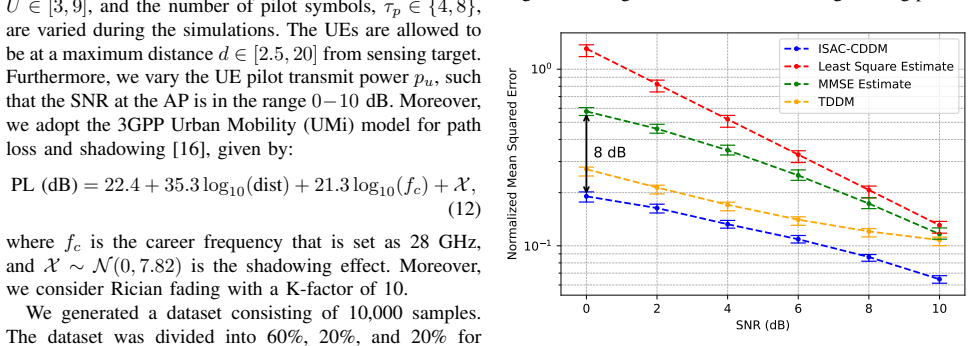
Pith's one-line read The paper claims that fusing ISAC sensing-channel estimates with UE locations through a multimodal transformer lets a conditional denoising diffusion model reconstruct true channels from noisy pilot estimates, beating LS by 8 dB, MMSE by…
desk verdict Novel use of sensing side info to condition diffusion for UE channel estimation, but the architecture as written doesn't clearly use the LS estimate it claims to denoise. read the letter →
The pith
A machine-rendered reading of the paper's core claim, the machinery that carries it, and where it could break.
The reading
What carries the argument
The carrier of the argument is a multimodal-transformer-conditioned denoising diffusion model. Sensing channel estimates, with real and imaginary parts split into separate channels and passed through convolutional layers, and UE locations, converted to polar coordinates and passed through linear layers, are embedded separately; a cross-modal attention layer fuses the two embeddings into a conditioning vector $R_{\mathrm{MMT}}$. The reverse diffusion process then predicts each denoising step as $\mathrm{MLP}(x_t, \tau_t, R_{\mathrm{MMT}})$, where $x_t$ is the current noisy channel state and $\tau_t$ is the diffusion time embedding, so the fused sensing-location embedding is the conditioning input that guides the reconstruction. The NMSE loss in Eq. (11) trains the network to predict the next cleaner state rather than the final channel directly.
What would settle it
Retrain the identical architecture with the sensing and location embeddings replaced by random vectors of the same size and compare NMSE: if the conditional model still beats TDDM and MMSE by roughly the same margins, the reported gains come from the diffusion prior alone rather than from sensing-communication correlation. A second check is to add 5-10 m Gaussian error to the UE location input at test time; the paper's distance-dependence result predicts the advantage over TDDM should collapse.
Extended reading notes
Core claim
The paper sets out to establish that the true UE-to-AP channel can be recovered from a noisy least-squares estimate more accurately when the denoiser is conditioned on the ISAC sensing channel and the UE's location than when it sees only the noisy pilot-derived estimate. The authors argue that in a cell-free ISAC network the sensing channel and the communication channel share geometry, and that a cross-modal transformer can expose that shared structure. The reverse diffusion network is trained to predict the previous denoising step from the current noisy state, the diffusion timestep, and the fused sensing-location embedding. In their simulations this conditioning is what delivers the reported gains over LS, MMSE, and a traditional diffusion model, and what keeps NMSE lower when pilot reuse contaminates the LS estimate.
Load-bearing premise
The load-bearing premise is that the sensing-channel estimate and the UE's reported location contain all the information needed to reconstruct the true communication channel, so the reverse network can rely on them without directly using the pilot-based LS estimate; this is only clearly true in a simulated environment where UE position and single-point reflector geometry determine the channel.
Editorial extensions
If this is right
- In deployments where access points already sense targets, the same hardware can feed channel estimation without requiring extra pilot overhead for the conditioning side information.
- The 27.8% NMSE improvement over the unconditional diffusion model suggests that sensing context, not just a learned generative prior, drives the reported gain.
- The reported resilience to pilot contamination implies the approach could relax the orthogonality constraint on pilot assignment, since contaminated LS estimates are denoised below the level LS would reach with clean pilots.
- The degradation as users move farther from the sensing target implies the benefit is localized, so users near sensing targets are the ones for whom this conditioning is most valuable.
Reading between the lines
- As written, Eq. (10) lists only $x_t$, $\tau_t$, and $R_{\mathrm{MMT}}$ as inputs to the reverse network, not the LS estimate $H_{\mathrm{LS}}$ named in the problem formulation; if $H_{\mathrm{LS}}$ does not enter through the initialization of $x_T$ or another implicit pathway, the reported gains amount to reconstruction from sensing geometry and location in a simulated environment rather than ref
- The single-point-reflector sensing model and the simulator's known UE positions make the sensing-to-communication correlation strong; a testable extension is to inject position error and multi-path sensing returns and measure how quickly the 27.8% advantage over TDDM shrinks.
- Because the model's edge over TDDM declines once users are more than about 10 m from the sensing target, a system-level extension is to switch between conditional and unconditional diffusion per user based on estimated distance to the target, saving computation where sensing correlation is low.
- The cleanest way to test whether the model truly exploits sensing-communication correlation is to retrain the same architecture with permuted sensing embeddings; if the gain over TDDM persists, the model would be learning simulator statistics rather than a physical coupling.
Editorial analysis
A structured set of objections, weighed in public.
Referee Report
Summary. The paper proposes ISAC-CDDM, a conditional denoising diffusion model combined with a multimodal transformer, to refine LS channel estimates in a cell-free ISAC system. The claimed side information consists of sensing channel estimates and UE locations, and the authors report NMSE gains of about 8 dB over LS, 9 dB over MMSE, and 27.8% over a diffusion baseline that does not use sensing information, with additional robustness to pilot contamination. The system model, problem formulation, and simulation setup are clearly described, and the paper addresses a relevant question: whether sensing observations can help denoise communication channel estimates. However, the central architecture as written does not include the LS estimate as an input to the reverse diffusion process, and the evaluation is entirely closed-loop on a simulator that builds in the sensing-communication correlation the paper claims to exploit.
Significance. If the proposed mechanism were fully implemented and validated, the idea of using ISAC sensing channels and location data as conditioning for communication channel denoising would be a useful contribution to cell-free 6G research. The paper is timely and the comparison against LS, MMSE, and a diffusion baseline is appropriate in principle. The authors provide training details and a clear system model, which helps reproducibility. That said, the significance is currently undermined by two load-bearing issues: the reverse diffusion network in Eqs. (9)-(10) does not use the LS estimate as an input, so the method as written is not actually denoising the pilot-based measurement; and the synthetic evaluation places UEs near a single sensing target, directly engineering the correlation that the model learns. These issues must be resolved before the claimed gains can be taken as evidence for the method.
major comments (3)
- [Sec. III-C2, Eqs. (9)-(10), Fig. 2] The reverse diffusion process is specified as p_w(x_{t-1}|x_t) = N(mu_w(x_t, tau_t, R_MMT), sigma_t^2 I) and x_{t-1} = MLP(x_t, tau_t, R_MMT), and the text says inference starts from 'a noisy sample x_T' without stating that x_T = H_LS or that H_LS is concatenated at any point. The problem formulation in Eqs. (5)-(6) and the opening of Section III, however, define the estimator as a function of H_LS. As written, if x_T is drawn from the prior noise and R_MMT contains only sensing and location embeddings, the output is a sensing/location-conditioned channel generator rather than a channel estimator that denoises the received pilot signal. This makes the 8-9 dB gains over LS and MMSE non-comparable. Please state explicitly how H_LS enters the reverse process (e.g., x_T := H_LS, or concatenation of H_LS at each reverse step) and provide inference pseudocode or code to disambiguate.
- [Sec. II and Sec. IV, Fig. 6] The evaluation is closed-loop: the system model assumes UEs are within a maximum distance d of the sensing target, and the simulator places UEs near a single sensing target, thereby building in the correlation between sensing and communication channels that the paper claims to exploit. The model is trained and tested on this same synthetic distribution, and Fig. 6 shows that performance degrades as d increases, which confirms the model relies on the injected geometry. No out-of-distribution test, no decorrelated sensing/communication scenario, and no independent or real data are provided to validate the general assumption. Please add robustness experiments with mismatched target-UE geometry or ablations where sensing and communication channels are statistically independent.
- [Sec. IV, Figs. 4-6] The implementations of the LS and MMSE baselines are not specified. In particular, it is unclear whether the MMSE estimator uses the true channel covariance, the true noise statistics, and how pilot contamination is modeled in its derivation. Additionally, the LS curves are omitted for U > 6 in Fig. 5, which is exactly the regime where pilot contamination is strongest and where the claimed robustness should be demonstrated. Please provide complete baseline definitions, include all curves or explain the omission, and add error bars or confidence intervals over dataset realizations.
minor comments (6)
- [Eq. (2)] The notation theta_lt, theta_lr in Eq. (2) is written as elements of C^{M x 1}, but these are scalar angles; the dimension notation should be corrected.
- [Eq. (6)] The constraint E[|x_lt|^2 = 1] appears to have a typo; it should be E[|x_lt|^2] = 1.
- [Sec. IV, Fig. 6] The text and figure caption refer to 'minimum distance' d, while the system model defines d as the maximum distance of UEs from the sensing target; the terminology should be made consistent.
- [Sec. IV, Fig. 5] The text refers to 'ISAC MT-DDM' in the discussion of Fig. 5, while the model is otherwise called ISAC-CDDM; the naming should be unified.
- [Sec. IV] There are minor typographical errors, including 'career frequency' instead of 'carrier frequency' and 'prepocessing' instead of 'preprocessing'.
- [References] Reference [15] is cited for the CDDM formulation, but the cited paper is about classifier-free guidance; please clarify the source of the conditional diffusion training and inference procedure.
Circularity Check
No circular derivation: the conditioning inputs are simulator-generated side information, not fitted targets; the notable HLS omission in Eq. (10) is a correctness gap, not a circularity.
full rationale
No circular derivation chain is present. The proposed model is trained and evaluated on a synthetic dataset, but that is a data-generation assumption rather than a circularity: the sensing channel estimates, UE locations, and true channels are all simulator-generated, and the model learns correlations between them; it does not fit a parameter to the test outputs and then report those outputs as predictions. The self-citations ([7], [8] and related prior work) are used only as examples of generative AI at the physical layer and are not load-bearing for the channel-estimation claim; no uniqueness theorem or ansatz is imported from the authors' prior work. A genuine correctness gap exists that is distinct from circularity: Eq. (5)-(6) formulate the problem as Hden = f(HLS, {Hsens}, ku), but the reverse-process network in Eq. (10) is defined as MLP(xt, tau_t, RMMT) with no HLS term, and the inference description says only that the reverse process starts from a noisy sample xT without stating xT = HLS. If xT is drawn from the prior noise and RMMT contains only sensing and location embeddings, then the model as written is a sensing/location-conditioned channel generator rather than the HLS-based denoiser claimed in the problem formulation. This is an architectural/implementation inconsistency, not an equivalence-by-construction or a fitted-input-renamed-as-prediction, so it does not raise the circularity score. The LS, MMSE, and TDDM comparisons are external benchmarks run in the same simulator, so the central claim has independent content that is not forced by the paper's own equations.
Assumptions & free parameters
free parameters (5)
- Neural network weights =
Learned from 10,000 synthetic samples (not reported in detail)
- Diffusion noise schedule alpha_t =
0.9999 to 0.98 across T steps (T not stated)
- Network architecture sizes =
CNN filters {16,32,64}, embeddings 16, 16, 128, MLP 512-512, batch 32, lr 0.001
- Rician K-factor =
10
- Maximum UE-target distance d =
2.5 to 20 m
assumptions (4)
- standard math The DDPM forward and reverse process equations (Eqs. 7-9) are valid generative models.
- domain assumption Single-point reflector sensing channel with Swerling-I static target and full-duplex APs (Eq. 1, Sec. II).
- ad hoc to paper UEs are located within d meters of the sensing target, so sensing and communication channels share geometry and are correlated.
- domain assumption 3GPP UMi path loss and Rician fading with K=10 (Eq. 12, Sec. IV).
Cite this review
Pith. "Pith review of Conditional Denoising Diffusion for ISAC Enhanced Channel Estimation in Cell-Free 6G." pith.science (2026). https://pith.science/paper/ZZ3QTGEB
@misc{pith2026250606942,
  author       = {Pith},
  title        = {Pith review of: Conditional Denoising Diffusion for ISAC Enhanced Channel Estimation in Cell-Free 6G},
  year         = {2026},
  howpublished = {\url{https://pith.science/paper/ZZ3QTGEB}},
  note         = {Machine review of arXiv:2506.06942}
}
read the original abstract
Cell-free Integrated Sensing and Communication (ISAC) aims to revolutionize 6th Generation (6G) networks. By combining distributed access points with ISAC capabilities, it boosts spectral efficiency, situational awareness, and communication reliability. Channel estimation is a critical step in cell-free ISAC systems to ensure reliable communication, but its performance is usually limited by challenges such as pilot contamination and noisy channel estimates. This paper presents a novel framework leveraging sensing information as a key input within a Conditional Denoising Diffusion Model (CDDM). In this framework, we integrate CDDM with a Multimodal Transformer (MMT) to enhance channel estimation in ISAC-enabled cell-free systems. The MMT encoder effectively captures inter-modal relationships between sensing and location data, enabling the CDDM to iteratively denoise and refine channel estimates. Simulation results demonstrate that the proposed approach achieves significant performance gains. As compared with Least Squares (LS) and Minimum Mean Squared Error (MMSE) estimators, the proposed model achieves normalized mean squared error (NMSE) improvements of 8 dB and 9 dB, respectively. Moreover, we achieve a 27.8% NMSE improvement compared to the traditional denoising diffusion model (TDDM), which does not incorporate sensing channel information. Additionally, the model exhibits higher robustness against pilot contamination and maintains high accuracy under challenging conditions, such as low signal-to-noise ratios (SNRs). According to the simulation results, the model performs well for users near sensing targets by leveraging the correlation between sensing and communication channels.
Figures


Figures from the paper (3 more)


Reference graph
Works this paper leans on
-
[1]
Integrated sensing and communi- cation signals toward 5G-A and 6G: A survey,
Z. Wei, H. Qu, Y . Wang et al. , “Integrated sensing and communi- cation signals toward 5G-A and 6G: A survey,” IEEE Internet of Things Journal, vol. 10, no. 13, pp. 11 068–11 092, 2023
work page 2023
-
[2]
A survey on user-centric cell-free massive MIMO systems,
S. Chen, J. Zhang, J. Zhang, E. Bj ¨ornson, and B. Ai, “A survey on user-centric cell-free massive MIMO systems,” Digital Communica- tions and Networks , vol. 8, no. 5, pp. 695–719, 2022
work page 2022
-
[3]
Cell-Free Integrated Sensing and Communication: Principles, Advances, and Future Directions,
D. Galappaththige, M. Mohammadi, G. A. Baduge et al., “Cell-Free Integrated Sensing and Communication: Principles, Advances, and Future Directions,” arXiv preprint arXiv:2502.20345 , 2025
arXiv 2025
-
[4]
Cell-free ISAC MIMO systems: Joint sensing and communication beamforming,
U. Demirhan and A. Alkhateeb, “Cell-free ISAC MIMO systems: Joint sensing and communication beamforming,” IEEE Transactions on Communications , 2024
work page 2024
-
[5]
Power allocation for joint communication and sensing in cell- free massive MIMO,
Z. Behdad, ¨O. T. Demir, K. W. Sung, E. Bj ¨ornson, and C. Cavdar, “Power allocation for joint communication and sensing in cell- free massive MIMO,” in GLOBECOM 2022-2022 IEEE Global Communications Conference. IEEE, 2022, pp. 4081–4086
work page 2022
-
[6]
J. Wang, H. Du, D. Niyato et al. , “Generative AI for integrated sensing and communication: Insights from the physical layer per- spective,” IEEE Wireless Communications , 2024
work page 2024
-
[7]
Generative AI Empowered LiDAR Point Cloud Gener- ation with Multimodal Transformer,
M. Farzanullah, H. Zhang, A. B. Sediq, A. Afana, and M. Erol- Kantarci, “Generative AI Empowered LiDAR Point Cloud Gener- ation with Multimodal Transformer,” in GLOBECOM 2024 - 2024 IEEE Global Communications Conference , 2024, pp. 163–168
work page 2024
-
[8]
Generative AI-enabled Blockage Prediction for Robust Dual-Band mmWave Communication,
M. Ghassemi, H. Zhang, A. Afana, A. B. Sediq, and M. Erol-Kantarci, “Generative AI-enabled Blockage Prediction for Robust Dual-Band mmWave Communication,” arXiv preprint arXiv:2501.11763, 2025
arXiv 2025
Show all 16 references
-
[9]
Palette: Image-to-image diffusion models,
C. Saharia, W. Chan, H. Chang, C. Lee, J. Ho, T. Salimans, D. Fleet, and M. Norouzi, “Palette: Image-to-image diffusion models,” in ACM SIGGRAPH 2022 conference proceedings , 2022, pp. 1–10
2022
-
[10]
A denoising diffusion probabilistic model-based digital twinning of ISAC MIMO channel,
J. Zhang, S. Xu, Z. Zhang, C. Li, and L. Yang, “A denoising diffusion probabilistic model-based digital twinning of ISAC MIMO channel,” IEEE Internet of Things Journal , 2024
2024
-
[11]
Generative AI Enabled Robust Data Augmentation for Wireless Sensing in ISAC Networks,
J. Wang, C. Zhao, H. Du et al. , “Generative AI Enabled Robust Data Augmentation for Wireless Sensing in ISAC Networks,” arXiv preprint arXiv:2502.12622, 2025
2025 arXiv
-
[12]
Brownian Bridge-Based Diffusion Channel Denoising for ISAC Massive MIMO Systems,
S. Xu, J. Zhang, Y . Xu et al. , “Brownian Bridge-Based Diffusion Channel Denoising for ISAC Massive MIMO Systems,” IEEE Transactions on Cognitive Communications and Networking , 2025
2025
-
[13]
Denoising Diffusion Model-Based Channel Estimation in IRS-Assisted ISAC Systems,
L. Yi, J. Miao et al. , “Denoising Diffusion Model-Based Channel Estimation in IRS-Assisted ISAC Systems,” in 2024 16th Interna- tional Conference on WCSP . IEEE, 2024, pp. 425–430
2024
-
[14]
Principles of modern radar,
M. A. Richards, J. Scheer, W. A. Holm, and W. L. Melvin, “Principles of modern radar,” 2010
2010
-
[15]
Classifier-free diffusion guidance,
J. Ho and T. Salimans, “Classifier-free diffusion guidance,” arXiv preprint arXiv:2207.12598, 2022
2022 arXiv
-
[16]
Study on channel model for frequencies from 0.5 to 100 GHz,
3GPP, “Study on channel model for frequencies from 0.5 to 100 GHz,” 3rd Generation Partnership Project (3GPP), Technical Report TR 38.901, 2024, Release 18
2024
Reviewed August 7, 2026 · model on record in the stance chip above.
Discussion (0). Sign in to comment.