REVIEW 5 major objections 5 minor 39 references
CDF-Generated Damage Laws: Admissibility, Gamma-Convergence to Griffith Fracture, and Well-Posedness
T0 review · 5 major / 5 minor · reviewed 2026-08-07 · deepseek-v4-flash
Pith's one-line read This paper claims that every CDF-based softening law, under rapid saturation, degenerates in the limit to a sharp-interface fracture energy, and that the resulting rate-independent damage evolutions are well-posed.
desk verdict The CDF construction is a tidy packaging of softening laws, but the main theorems are false under the paper's own definitions—Theorem 2 fails on a constant-gradient sequence and Theorem 1 overstates integrability—so the advertised rigorous bridge to Griffith fracture is not credible. read the letter →
The pith
A machine-rendered reading of the paper's core claim, the machinery that carries it, and where it could break.
The reading
What carries the argument
The load-bearing object is the survival-function integral $\psi(\eta)=\int_0^\eta(1-F(s))\,ds$, whose derivative $1-F(\phi^+(\varepsilon))$ acts as the stiffness-reduction factor and whose saturated value is the fracture energy density $G/\ell$. The asymptotic argument is carried by the scaled integrand $\psi_\lambda(t)=\lambda^{-1}\int_0^{\lambda t}(1-F(s))\,ds$: as $\lambda\to\infty$ the saturation threshold $s_c/\lambda$ collapses to $0$, so the energy is designed to penalize the measure of the set where the gradient exceeds that threshold and to push limits toward piecewise-constant displacement fields.
What would settle it
Evaluate the scaled energy on the affine field $u(x)=x_1$ on a bounded domain: for large $\lambda$ the integrand reaches saturation, giving $E_\lambda(u)=\frac{G}{\lambda}|\Omega|\to 0$ even though $\nabla u$ never vanishes, while the paper's limiting functional assigns $E_\infty(u)=+\infty$; this configuration directly violates the claimed $\Gamma$-liminf inequality.
Extended reading notes
Core claim
On its own terms, the paper's central claim is that the whole CDF family collapses, in the high-contrast limit, to a sharp fracture model. Under the saturation assumption $F(s)=1$ for $s\ge s_c$, the scaled energy $E_\lambda(u)=\int_\Omega \psi_\lambda(|\nabla^a u|^2/2)\,dx$ is claimed to $\Gamma$-converge in $L^1$ to the functional that is zero exactly when $\nabla^a u=0$ almost everywhere and $+\infty$ otherwise, with $L^1$-compactness of finite-energy sequences in $SBV$. The paper further claims existence of rate-independent quasi-static evolutions: global energetic solutions satisfying both stability and energy balance, with jump sets that grow monotonically and never heal.
Load-bearing premise
The $\Gamma$-convergence result depends on assuming the cumulative function saturates at a finite value, $F(s)=1$ for all $s\ge s_c$, so that any uniform energy bound is taken to force the smoothly varying part of the gradient to zero in the limit.
Editorial extensions
If this is right
- Any CDF-based law of this form is automatically a monotone, bounded, dissipative degradation map, so thermodynamic consistency needs no separate damage-evolution equation.
- Under the rapid-saturation assumption, finite-energy sequences concentrate their gradients into increasingly thin layers, so diffuse damage degenerates to sharp discontinuities.
- If the $\Gamma$-convergence claim holds, minimizers of the damaged energy converge to minimizers of the limiting sharp-interface energy, giving a variational bridge between damage and fracture.
- The rate-independent quasi-static problem has global energetic solutions, so the model supports monotone crack growth without healing under time-dependent loading.
- The internal length $\ell$ can be fixed from an experimentally measured peak stress, making each CDF-based law calibratable from standard tensile data.
Reading between the lines
- The limiting functional $E_\infty$ as written assigns zero energy to every jump set, so a genuine Griffith-type surface term would have to be added before the limit can rank crack configurations by their length; the paper leaves this step implicit.
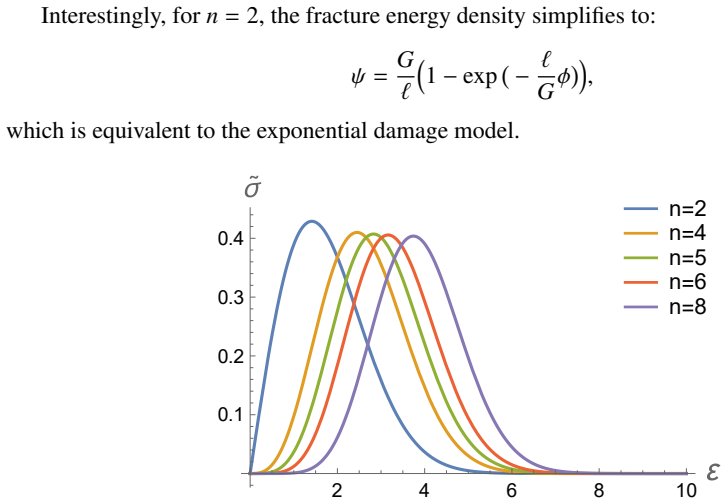
- The saturation condition $F(s)=1$ for $s\ge s_c$ covers the piecewise and radical families but excludes the exponential, Cauchy, logistic, half-normal, and Gudermannian laws introduced earlier, so whether tailed CDFs admit a $\Gamma$-limit is a testable open question.
- A natural extension of the construction is to apply the survival-function integral to tensorial damage variables or to ductile fracture, which the conclusion itself names as future work.
- The CDF viewpoint suggests fitting $F$ to measured flaw-size or micro-strength distributions rather than to stress-strain curves, turning the softening law into a statistical prediction about the material's defect population.
Editorial analysis
A structured set of objections, weighed in public.
Referee Report
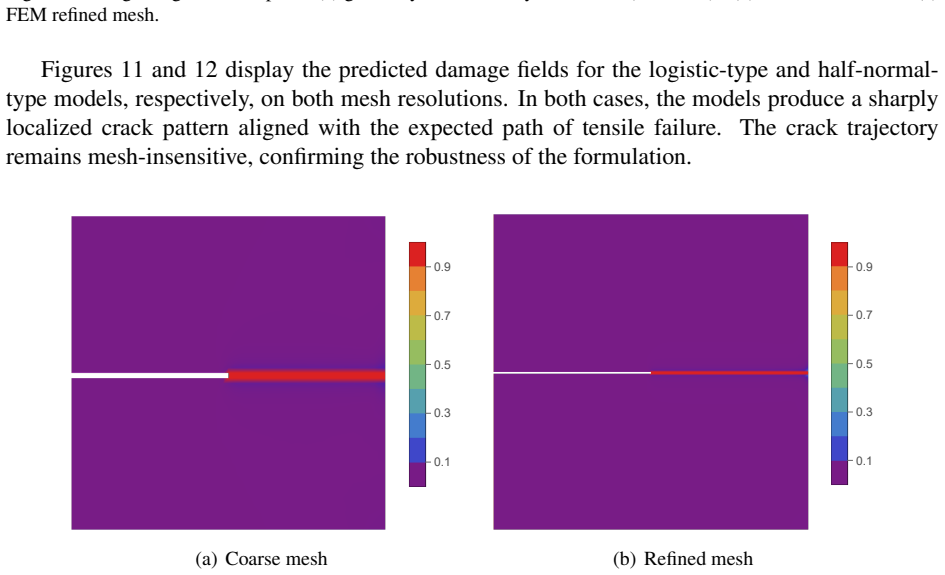
Summary. The paper proposes a family of damage models whose stored-energy density is the integral of a survival function 1−F(s) for a cumulative distribution function F, and claims three main results: (i) every such law is thermodynamically admissible with finite fracture energy (Theorem 1); (ii) the corresponding scaled energies Γ-converge in L1 to a sharp-interface Griffith functional (Theorem 2); and (iii) rate-independent quasi-static evolutions exist (Theorem 3). A single 2D numerical benchmark is presented as illustration. The central analytical claims are contradicted by elementary counterexamples already present in the paper's own definitions.
Significance. If the three theorems were correct, the paper would provide a useful probabilistic-to-continuum bridge between CDF-generated softening laws and sharp-interface fracture, and the explicit energy densities in Sections 4 and Appendix C would be valuable for computational damage mechanics. The paper does contain many explicit formulas, 1D stress-strain computations, and a physically appealing interpretation of damage as a cumulative failure probability. However, the main analytical results are not merely unproven; Theorem 1 is false as stated, and Theorem 2 is internally inconsistent with a constant-gradient recovery sequence. Since the existence result Theorem 3 relies on Theorem 2's compactness, the paper's central claims fail. The remaining numerical example cannot compensate for the collapse of the analytical core.
major comments (5)
- [Theorem 1, Eq. (15)-(16)] The claim that monotonicity, boundedness, g(0)=0, and lim g=1 imply finite fracture energy ∫0∞(1−g)dη<∞ is false. The function g(η)=η/(1+η) satisfies all assumptions in Eq. (15) but gives 1−g(η)=1/(1+η), whose integral over [0,∞) diverges. The proof's assertion that boundedness plus monotone convergence implies integrability is incorrect; monotone convergence to 0 does not force a decay rate. This invalidates the admissibility theorem as stated.
- [Theorem 2, Eq. (60)-(65)] The Γ-convergence claim is internally contradicted by the constant sequence uλ(x)=x1 on a bounded domain Ω. Under the saturation assumption F(s)=1 for s≥sc, the integrand satisfies ψλ(t)=G/λ for all t≥sc/λ, with G=∫0^{sc}(1−F(s))ds, so sup_t ψλ(t)=G/λ→0. Hence Eλ(uλ)=G/λ |Ω|→0 while uλ→u(x)=x1 strongly in L1 and ∇^a u=e1, so E∞(u)=+∞ by Eq. (65). The Γ-liminf inequality fails for this admissible, constant sequence. The compactness assertion in Eq. (64) is also false: a uniform bound on Eλ cannot force |∇^a u| to vanish, because the energy controls only a vanishing prefactor times the measure of nonzero-gradient regions, not a penalty on large gradients. The proof's statement that ψλ saturates at the value 1 is incorrect; it saturates at G/λ.
- [Eq. (65)] The limiting functional E∞(u)=0 if ∇^a u=0 a.e. and +∞ otherwise is not a Griffith functional, even formally. It assigns zero energy to every SBV function with vanishing approximate gradient, regardless of the size, location, or jump height of its jump set J_u. A Griffith fracture energy must contain a surface term such as ∫_{J_u} γ([u]) dH^{d-1}, analogous to the dissipation in Eq. (68). The claimed Γ-limit contains no surface term, so the title claim of Γ-convergence to Griffith fracture is not established even in the formal sense.
- [Theorem 2, Eq. (60); Sections 2 and 4; Appendices A-C] The saturation assumption F(s)=1 for all s≥sc excludes essentially every distribution introduced in the paper: the exponential, Cauchy, logistic, half-normal, Gudermannian, hypergeometric, radical, rational, piecewise, and rapid-decay CDFs all satisfy F(s)<1 for every finite s. Replacing Eq. (60) by the weaker finite-energy condition ∫0∞(1−F)ds<∞ does not repair the proof, because the counterexample uλ=x1 still applies to the exponential CDF, for which ψλ(t)=λ^{-1}(1−e^{-λt}). Consequently Theorem 2, and any result depending on it, does not cover the damage laws that are the paper's subject.
- [Theorem 3, Section 6] The proof of Theorem 3 invokes Theorem 2 for sequential L1-compactness of sublevel sets of Eλ and for lower semicontinuity. Since the compactness assertion in Theorem 2 is false, the existence argument collapses. Moreover, for fixed λ the energy Eλ is uniformly bounded by (G/λ)|Ω| and contains no term that controls the jump set, so the claimed coercivity in the SBV sense is not present; the direct-method step in Eq. (71) is therefore unsupported.
minor comments (5)
- [Abstract and Section 1] The abstract and introduction repeatedly state that the paper establishes Γ-convergence to a Griffith functional; these statements should be revised to reflect the actual limiting functional and the validity conditions of the theorems.
- [Section 2.1, Eq. (4)] The phrase 'monolithic non-decreasing function' should be 'monotonically non-decreasing function'; there are several similar wording and typographical errors throughout, e.g., 'denstiy' in Eq. (29) and 'refered' in Section 2.
- [Section 4.1, Eq. (29)] The CDF F(x)=min(x^n,1) is not C^1 at x=1, so it does not satisfy the smoothness assumption of Theorem 1; this mismatch should be noted if Theorem 1 is intended to cover the models in Section 4.
- [Section 5, proof of Theorem 2] The proof of the Γ-limsup inequality is only sketched and contains internal inconsistencies: the recovery sequence is described as having energy '≈0·(width)' while also 'ψλ saturates at the finite value G'; the two statements are incompatible because the saturation value is G/λ, not G.
- [Appendix C.6, Eq. (C.33)] The rational-distribution damage model in Eq. (C.33) has ψ(0)=0 but its Taylor expansion in Eq. (C.34) contains a linear term with coefficient 1 only after re-scaling; the expansion as written is inconsistent with the definition unless n=1, so this should be checked.
Circularity Check
A definitional admissibility theorem, but the central Gamma-convergence claim is an internal mathematical error rather than a circular reduction.
-
self definitional
[Section 3.4, Theorem 1 and Remark 1 (Eqs. 15-16)]
"Suppose (i) g(0)=0,(ii)lim_{η→∞}g(η)=1,(iii) g'(η)≥0∀η>0 (15) Then d:=g(η) is (a) bounded, (b) monotonically non-decreasing, and (c) yields a finite fracture energy ∫_0^∞(1−g(η))dη<∞. ... A cumulative distribution function satisfies Eq.15 by definition, hence every CDF is an admissible degradation map."
The hypotheses (i)-(iii) are exactly the defining properties of a CDF on [0,∞). The conclusion that d is bounded and monotone therefore restates the input definition rather than deriving a new property; the label 'admissible' for (a)-(b) is the definition of CDF behavior. Property (c) does not follow from (i)-(iii) — bounded monotone survival functions need not be integrable — so the claim 'every CDF is admissible' is either definitional for (a)-(b) or an unproved integrability assumption for (c). No independent mechanism is introduced.
full rationale
The only step that reduces by construction is Theorem 1/Remark 1: admissibility for monotonicity and boundedness is the CDF definition restated. The central Gamma-convergence result (Theorem 2) is not circular in the sense of conclusion-equals-input: the claimed compactness and Gamma-liminf fail because under Eq.(60) the scaled integrand satisfies ψλ(t)=G/λ for t≥s_c/λ, so Eλ(x1)→0 while E∞(x1)=+∞; that is a mathematical contradiction, not a fitted-input or self-citation reduction. The compact-support assumption Eq.(60) excludes several laws introduced earlier, again a scope/correctness gap rather than circularity. Calibration of ℓ from experimental peak stress (Eqs.43,51,57,C.7,C.14,C.21,C.31) is explicitly disclosed, not a hidden prediction. Self-citations to the author's variational-damage papers ([22],[37]) identify equivalences but do not carry the analytical proofs; the energetic-solution argument rests on standard references ([25]-[28]). Hence the circularity score is low despite serious correctness concerns.
Assumptions & free parameters
free parameters (4)
- internal length scale ℓ (or ratio G/ℓ) =
e.g., G/ℓ = e σ_max^2/k (Eq.43); variants in Eqs.51,57,C.7,C.14,C.21,C.31
- coefficient γ in ψ=∫0^φ [1-F(γs)]ds =
γ=nℓ/((n+1)G) for F(x)=min(x^n,1); γ=ℓ/G for exponential model
- shape parameter n in radical, piecewise, rational, and hypergeometric distributions =
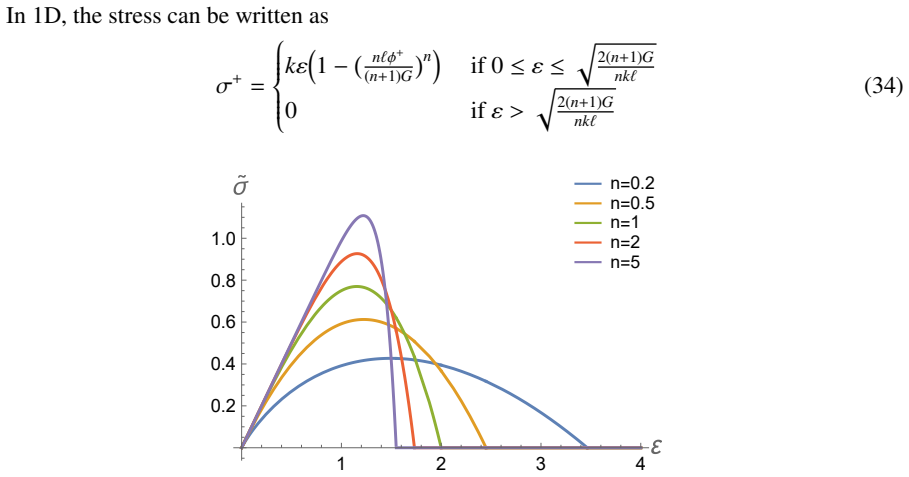
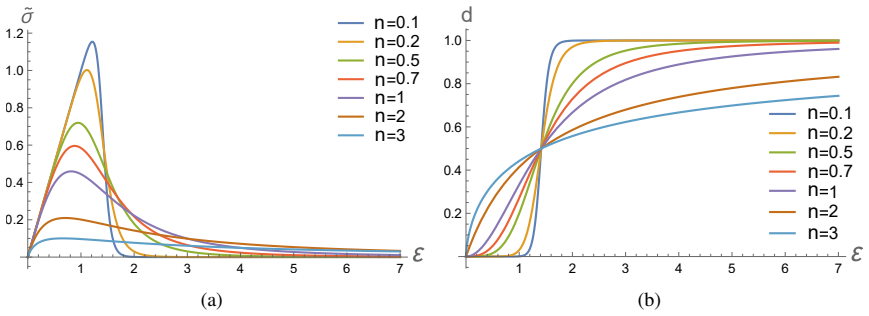
n>0, unspecified; figures use n∈{0.2,0.5,1,2,5}
- critical saturation energy s_c in Theorem 2 =
undefined
assumptions (6)
- standard math SBV compactness theorem of Ambrosio-Fusco-Pallara and De Giorgi-Ambrosio (cited as [23,24])
- standard math Abstract energetic solution existence theory of Mielke-Theil and Mainik-Mielke (cited as [25,26])
- domain assumption Small-strain linear elasticity and spectral split of strain into tensile and compressive parts (Eqs.10-14)
- ad hoc to paper Rapid saturation of the CDF: F(s)=1 for all s≥s_c (Eq.60)
- ad hoc to paper Saturation calibration max(ψ)=G/ℓ used to fix γ and ℓ
- ad hoc to paper Finite fracture energy ∫0∞(1-g)dη<∞ asserted in Theorem 1
Cite this review
Pith. "Pith review of CDF-Generated Damage Laws: Admissibility, Gamma-Convergence to Griffith Fracture, and Well-Posedness." pith.science (2026). https://pith.science/paper/5YV25WLF
@misc{pith2026250606949,
  author       = {Pith},
  title        = {Pith review of: CDF-Generated Damage Laws: Admissibility, Gamma-Convergence to Griffith Fracture, and Well-Posedness},
  year         = {2026},
  howpublished = {\url{https://pith.science/paper/5YV25WLF}},
  note         = {Machine review of arXiv:2506.06949}
}
abstract
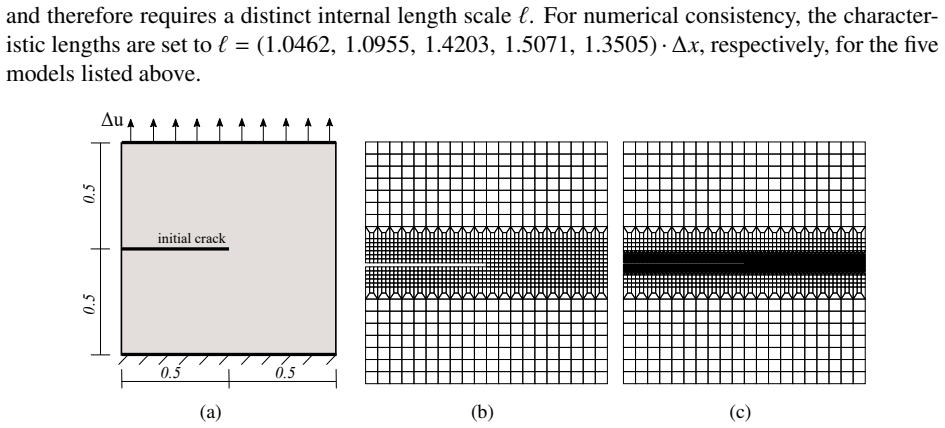
We formulate a family of scalar softening laws by setting the stored-energy density $\psi(\eta)=\int_{0}^{\eta}[1-F(s)]d s$, where $F$ ranges over exponential, Cauchy, logistic, half-normal, Gudermannian, hypergeometric, radical, rational, piece-wise, and rapid-decay cumulative-distribution functions (CDFs). We prove that every such law yields a degradation map that is monotone, bounded, and dissipative, rendering the associated hyperelastic material thermodynamically admissible. Working directly in spatial dimensions $d=2,3$, we establish compactness and $\Gamma$-convergence of the CDF-based energies to a sharp-interface Griffith functional. We further show the existence of rate-independent quasi-static evolutions by constructing global energetic solutions that satisfy both stability and energy balance. These analytical results provide a rigorous bridge between the probabilistic damage formulation and Griffith-type fracture mechanics. One illustrative example is presented to show the effectiveness of the current damage laws.
Figures


Figures from the paper (11 more)




Reference graph
Works this paper leans on
-
[1]
Rupture time under creep conditions.Izv
L Kachanov. Rupture time under creep conditions.Izv. Akad. Nauk SSSR, 8:26–31, 1958
work page 1958
-
[2]
Springer Science & Business Media, 1986
L Kachanov.Introduction to continuum damage mechanics, volume 10. Springer Science & Business Media, 1986
work page 1986
-
[3]
Continuum damage mechanics: Part i—general concepts
JL Chaboche. Continuum damage mechanics: Part i—general concepts. 1988
work page 1988
-
[4]
Springer science & business media, 2012
J Lemaitre.A course on damage mechanics. Springer science & business media, 2012
work page 2012
-
[5]
Springer Science & Business Media, 2012
S Murakami.Continuum damage mechanics: a continuum mechanics approach to the anal- ysis of damage and fracture, volume 185. Springer Science & Business Media, 2012
work page 2012
-
[6]
A Shojaei, GQ Li, J Fish, and PJ Tan. Multi-scale constitutive modeling of ceramic matrix composites by continuum damage mechanics.International Journal of Solids and Structures, 51(23-24):4068–4081, 2014
work page 2014
-
[7]
Springer Science & Business Media, 2006
J Lemaitre and R Desmorat.Engineering damage mechanics: ductile, creep, fatigue and brittle failures. Springer Science & Business Media, 2006
work page 2006
- [8]
Show all 39 references
-
[9]
Mechanical modeling of material damage
S Murakami. Mechanical modeling of material damage. 1988
1988
-
[10]
Springer Science & Business Media, 2010
WH Zhang and YQ Cai.Continuum damage mechanics and numerical applications. Springer Science & Business Media, 2010
2010
-
[11]
Quantum logic and probability theory
A Wilce. Quantum logic and probability theory. 2002
2002
-
[12]
Statistical size effect in quasi-brittle structures: I
Z P Bazant, YP Xi, and S G Reid. Statistical size effect in quasi-brittle structures: I. is weibull theory applicable?Journal of engineering Mechanics, 117(11):2609–2622, 1991
1991
-
[13]
Fluctuation-based fracture mechanics of heterogeneous materials.Physical Review E, 106(6):065003, 2022
T Mulla, RJM Pellenq, and FJ Ulm. Fluctuation-based fracture mechanics of heterogeneous materials.Physical Review E, 106(6):065003, 2022. 41
2022
-
[14]
N Guy, D M Seyedi, and F Hild. A probabilistic nonlocal model for crack initiation and propagation in heterogeneous brittle materials.International journal for numerical methods in engineering, 90(8):1053–1072, 2012
2012
-
[15]
Cambridge university press, 1998
S Suresh.Fatigue of materials. Cambridge university press, 1998
1998
-
[16]
A statistical distribution function of wide applicability.Journal of applied mechanics, 1951
W Weibull. A statistical distribution function of wide applicability.Journal of applied mechanics, 1951
1951
-
[17]
Routledge, 2019
Z P Bazant and J Planas.Fracture and size effect in concrete and other quasi-brittle materi- als. Routledge, 2019
2019
-
[18]
Elsevier, 1996
D Krajcinovic.Damage mechanics, volume 41. Elsevier, 1996
1996
-
[19]
Thermodynamically Consistent Damage Models Derived from Cumulative Distri- bution Functions, with FEM Implementations
HL Ren. Thermodynamically Consistent Damage Models Derived from Cumulative Distri- bution Functions, with FEM Implementations. 2025. under review
2025
-
[20]
Routledge, 2018
B V Gnedenko.Theory of probability. Routledge, 2018
2018
-
[21]
Stockholms universitet, 1996
C Walck et al.Hand-book on statistical distributions for experimentalists. Stockholms universitet, 1996
1996
-
[22]
Variational damage model: a new paradigm for fractures.Frontiers of Structural and Civil Engineering, 19(1):1–21, 2025
HL Ren, T Rabczuk, and XY Zhuang. Variational damage model: a new paradigm for fractures.Frontiers of Structural and Civil Engineering, 19(1):1–21, 2025
2025
-
[23]
Oxford university press, 2000
L Ambrosio, N Fusco, and D Pallara.Functions of bounded variation and free discontinuity problems. Oxford university press, 2000
2000
-
[24]
Springer Science & Business Media, 1993
G Dal Maso.An introduction to G-convergence. Springer Science & Business Media, 1993
1993
-
[25]
A mathematical model for rate-independent phase transformations with hysteresis
A Mielke and F Theil. A mathematical model for rate-independent phase transformations with hysteresis. InProceedings of the Workshop on “Models of Continuum Mechanics in Analysis and Engineering, pages 117–129, 1999
1999
-
[26]
Existence results for energetic models for rate-independent systems
A Mainik and A Mielke. Existence results for energetic models for rate-independent systems. Calculus of Variations and Partial Differential Equations, 22(1):73–100, 2005
2005
-
[27]
A rate-independent model for inelastic behavior of shape-memory alloys.Multiscale Modeling&Simulation, 1(4):571–597, 2003
A Mielke and T Roubícek. A rate-independent model for inelastic behavior of shape-memory alloys.Multiscale Modeling&Simulation, 1(4):571–597, 2003
2003
-
[28]
Quasistatic crack growth in nonlinear elasticity
G D Maso, G A Francfort, and R Toader. Quasistatic crack growth in nonlinear elasticity. Archive for Rational Mechanics and Analysis, 176:165–225, 2005
2005
-
[29]
C Miehe, F Welschinger, and M Hofacker. Thermodynamically consistent phase-field models of fracture: Variational principles and multi-field fe implementations.International Journal for Numerical Methods in Engineering, 83(10):1273–1311, 2010. 42
2010
-
[30]
On the folded normal distribution.Mathematics, 2(1):12–28, 2014
M Tsagris, C Beneki, and H Hassani. On the folded normal distribution.Mathematics, 2(1):12–28, 2014
2014
-
[31]
CRC standard mathematical tables.West Palm Beach, 1978
W H Beyer. CRC standard mathematical tables.West Palm Beach, 1978
1978
-
[32]
The generalized gudermannian distribution: inference and volatility modelling
E Altun. The generalized gudermannian distribution: inference and volatility modelling. Statistics, 53(2):364–386, 2019
2019
-
[33]
Generalized hypergeometric, digamma and trigamma distributions.Annals of the Institute of Statistical Mathematics, 31:373–390, 1979
M Sibuya. Generalized hypergeometric, digamma and trigamma distributions.Annals of the Institute of Statistical Mathematics, 31:373–390, 1979
1979
-
[34]
Calculation methods for Wallenius’ noncentral hypergeometric distribution.Com- munications in Statistics—Simulation and Computation®, 37(2):258–273, 2008
A Fog. Calculation methods for Wallenius’ noncentral hypergeometric distribution.Com- munications in Statistics—Simulation and Computation®, 37(2):258–273, 2008
2008
-
[35]
JW Gibbs.Elementary principles in statistical mechanics: developed with especial reference to the rational foundations of thermodynamics. C. Scribner’s sons, 1902
1902
-
[36]
Academic press, 2011
GB Arfken, HJ Weber, and FE Harris.Mathematical methods for physicists: a comprehen- sive guide. Academic press, 2011
2011
-
[37]
Variational damage model: A novel consis- tent approach to fracture.Computers&Structures, 305:107518, 2024
HL Ren, XY Zhuang, HH Zhu, and T Rabczuk. Variational damage model: A novel consis- tent approach to fracture.Computers&Structures, 305:107518, 2024
2024
-
[38]
Hyperelasticity with softening for modeling materials failure.Journal of the Mechanics and Physics of Solids, 55(10):2237–2264, 2007
KY V olokh. Hyperelasticity with softening for modeling materials failure.Journal of the Mechanics and Physics of Solids, 55(10):2237–2264, 2007
2007
-
[39]
A new energy-based local damage model for dynamic analysis of cracks.Compu- tational Mechanics, pages 1–25, 2024
HT Tran. A new energy-based local damage model for dynamic analysis of cracks.Compu- tational Mechanics, pages 1–25, 2024. 43
2024
Reviewed August 7, 2026 · model on record in the stance chip above.
Discussion (0). Sign in to comment.