REVIEW 5 major objections 4 minor 35 references
Task-driven real-world super-resolution of document scans
T0 review · 5 major / 4 minor · reviewed 2026-08-07 · deepseek-v4-flash
Pith's one-line read Task-driven training of an SR network with auxiliary losses from text detection, recognition, keypoint alignment, and hue consistency improves text-detection IoU on real-world document scans, the paper claims.
desk verdict The paper's own Table 2 contradicts the abstract's fidelity claim, and the IoU gain is measured in the same CTPN feature space used for training. read the letter →
The pith
A machine-rendered reading of the paper's core claim, the machinery that carries it, and where it could break.
The reading
What carries the argument
The mechanism is a multi-task loss wrapped around SRResNet, with the auxiliary losses generated by three frozen 'proxy-supervisor' networks. CTPN contributes three L1 feature-alignment terms (deep convolutional features, classification logits, regression outputs); a CRNN contributes an L1 term on its last Bi-LSTM recurrent features; Key.Net contributes an L2 multi-scale keypoint-descriptor loss. Together with pixel MSE, bicubic cycle-consistency, and an HSV hue-consistency loss, the total is $L_{\mathrm{total}}=\sum_{i=1}^{8}\lambda_i(t)L_i$. The weights are set by dynamic weight averaging, $\lambda_i(t)=N\exp(r_i(t-1)/T)/\sum_{j=1}^{N}\exp(r_j(t-1)/T)$ with $r_i(t)=L_i(t-1)/L_i(t-2)$ and temperature $T=2$, which up-weights tasks whose losses decline slowly. Because the auxiliary networks are frozen, they act as learned feature extractors that generate implicit labels from the HR reference, so no manual text annotations are required during SR training.
What would settle it
Measure character-level or word-level error rates of a standard OCR engine on the super-resolved outputs of the full task-driven model (MR+++) and the baseline SRResNet for the same real-world scans; if the task-driven model does not beat the baseline on error rate while its IoU is higher, the OCR-benefit claim fails. Alternatively, ablate the CTPN, CRNN, and Key.Net losses one by one and check whether IoU differences persist; if removing all task-driven losses leaves IoU essentially unchanged, the auxiliary losses are not the cause.
Extended reading notes
Core claim
The paper's central claim is that a super-resolution network trained with OCR-derived auxiliary losses produces images that are materially better for downstream text detection on real document scans than either bicubic upsampling or an SR model trained purely on pixel fidelity. The authors validate this with an SRResNet generator optimized with eight losses: pixel MSE, cycle consistency, three CTPN feature-alignment terms, a CRNN feature-alignment term, a Key.Net multi-scale keypoint loss, and hue consistency, combined by dynamic weight averaging. In experiments on real and simulated document datasets, the task-driven variants achieve higher text-detection intersection over union than the baselines, with the strongest and most consistent gains on real-world scans. The authors report that these gains come with lower PSNR/SSIM/LPIPS than bicubic interpolation, and they themselves flag in their discussion that the network sometimes invents serifs and glyph fragments that improve IoU without necessarily preserving the meaning of the text.
Load-bearing premise
The whole result rests on the assumption that the intersection-over-union between text detections on the super-resolved image and on the high-resolution reference is a faithful measure of real OCR benefit, and that the IoU gains come from the task-driven training rather than from invented text details (serifs, glyph fragments) that merely make the detector happier.
Editorial extensions
If this is right
- Real-world scanned documents, not only synthetic downsampled images, can serve as effective training data for task-driven SR when paired LR–HR scans are registered at a fixed 4× ratio.
- An OCR-ready SR model can be produced using only pretrained text detectors and recognizers as frozen supervisors, eliminating the need for annotated text during SR training.
- Dynamic weight averaging enables stable joint optimization of pixel-, structure-, and semantics-level losses, making the loss-balancing problem tractable without hand-tuned weights.
- The approach generalizes across document genres—bulletins, scientific articles, medical leaflets, and historical books—indicating that the task-driven signal, not dataset-specific texture, drives the improvement.
- The same template can be transferred to other vision tasks by swapping in different frozen auxiliary networks, though the resulting SR model is specialized to its training task and degrades on out-of-domain imagery.
Reading between the lines
- Because the reported IoU gains coincide with lower PSNR/SSIM/LPIPS, the practical test of this approach should be end-to-end OCR accuracy (character or word error rates) on the super-resolved scans; that would settle whether IoU is measuring genuine readability or merely detector-pleasing artifacts.
- The hallucinated serifs and glyph fragments the authors observe suggest that a recognition-based or human-fidelity check should be part of the evaluation protocol, not just text-box overlap.
- The framework's dependence on the quality of the frozen OCR networks means that improving those networks—or fine-tuning them jointly—would likely amplify the SR gains, a path the authors list as future work.
- A testable extension: retrain the same multi-task loss on handwritten or multilingual documents to see whether the proxy-supervisor mechanism transfers, or whether it only helps printed Latin text.
Editorial analysis
A structured set of objections, weighed in public.
Referee Report
Summary. The paper proposes a multi-task training framework for SRResNet aimed at real-world document super-resolution. The total loss combines pixel-wise MSE, a cycle-consistency term, three CTPN feature-alignment losses, a CRNN feature-alignment loss, a Key.Net keypoint loss, and a hue-consistency loss, balanced adaptively via dynamic weight averaging (DWA). The authors evaluate on a newly acquired real-world scan dataset (with registration at 4x magnification) and on simulated degraded pairs, reporting PSNR, SSIM, LPIPS, and text-localization IoU. The central claim, stated in the abstract, is that the approach improves text detection IoU while preserving overall image fidelity.
Significance. If the claimed result held, the paper would offer a useful recipe for task-driven SR in document imaging, plus a registered real-world benchmark dataset. The paper has several strengths: it performs extensive ablations over loss components, uses statistical significance testing (Kruskal-Wallis and Dunn tests) across all metrics, and it honestly discusses the risk of hallucinations. However, the central claim is internally contradicted by the paper's own quantitative results, and the positive IoU finding is weakened by an evaluation setup that is circular with the training objective and by the absence of an isolated comparison that separates real-data fine-tuning from the task-driven losses. The dataset and code are not currently available, which further limits reproducibility.
major comments (5)
- [Abstract; Section 4.2, Table 2] The abstract's claim that the method improves text detection 'while preserving overall image fidelity' is contradicted by Table 2. Every trained variant, including the full task-driven model MR+++, has lower PSNR, lower SSIM, and higher LPIPS than bicubic interpolation on both simulated and real-world sets (e.g., real-world PSNR 13.72 dB for MR+++ vs. 19.02 dB for bicubic; SSIM 0.4182 vs. 0.7403; LPIPS 0.4424 vs. 0.2516). The paper's own Section 4.2 explicitly concedes that all trained SR models retrieve worse image fidelity scores than bicubic interpolation. Since the central claim is a conjunction of improved detection and preserved fidelity, the second conjunct is false by the authors' own measurements.
- [Section 3.1; Section 4.2] The IoU evaluation is circular with the training objective. The task-driven losses in Eqs. (10)-(12) align CTPN deep features, classification logits, and regression outputs between the SR output and the HR reference, while the evaluation metric in Section 4.2 is IoU of text localization extracted from the SR and HR images. The paper does not state that an independent text detector is used, so the IoU gains likely measure how well the SR output matches the CTPN feature space used in training, rather than a generic improvement in text detection. A concrete test would be to evaluate with a different text detector (e.g., EAST or DBNet) and to report character-level or word-level recognition accuracy with an independent OCR engine.
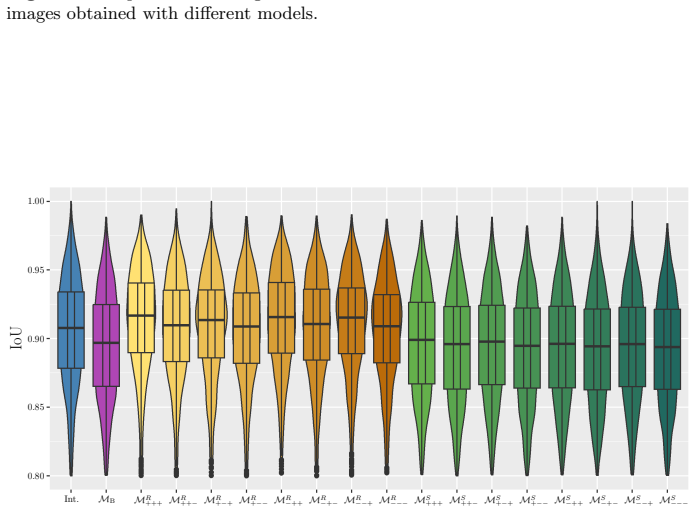
- [Section 4.1, Table 1; Section 4.2] The experimental design confounds real-data fine-tuning with the task-driven losses. All MR variants are trained on real-world scans, while all MS variants are trained on simulated data. In Table 2, only MR variants show IoU gains over bicubic/MB (e.g., real-world IoU 0.8894 for MR+++ vs. 0.8820 for Int. and 0.8703 for MB), whereas the MS variants have IoU comparable to or worse than the baselines. This leaves open the possibility that the improvement comes from training on real scanned data rather than from the proposed auxiliary losses. The authors should include a real-data MSE-only variant (no CTPN/CRNN/Key.Net losses) and a simulated-data task-driven variant with the same architecture to isolate the contribution of the task-driven losses.
- [Section 4.2, Table 2; Section 4.3] The reported IoU improvements are small (e.g., 0.8894 for MR+++ vs. 0.8820 for bicubic on real-world images), and Section 4.3 concedes that the network sometimes 'invented' serifs or glyph fragments that improve IoU while potentially altering meaning. The paper claims that task-driven SR benefits OCR, but it does not report a direct OCR accuracy metric (such as character or word error rate). Without such a metric, the practical value of the IoU gain is unclear, and the risk of hallucinated text artifacts is not adequately quantified or mitigated.
- [Section 3.1, Eqs. (7) and (14)] The Key.Net loss is defined twice with different formulations: Eq. (7) compares 2D keypoint coordinates via an L2 distance, while Eq. (14) defines a multi-scale index proposal (MSIP) loss over local descriptors under the same symbol LKey.Net. This is an inconsistency that must be resolved; the paper should specify which loss is actually implemented in the reported experiments and how the two definitions relate.
minor comments (4)
- [Section 2.3; Section 3.1, Eq. (15)] The DWA method is cited as [21] in Section 2.3 but as [23] in Eq. (15); the reference list contains both Liu et al. papers, and the intended citation should be clarified.
- [Throughout] There are several typos and formatting slips: 'downsamped' in Section 3.1, 'F unction' in the Section 2 title, 'T ask-Specific' in Section 2.2, 'T raining' in Section 4.1, and 'V ariants' in Section 4.1. These should be corrected.
- [Section 4.2, Tables 3-10] Although the statistical tests are a strength, the paper does not report confidence intervals for the mean IoU differences, and the violin plots (Figures 2-3) show substantial distribution overlap. Reporting paired differences with confidence intervals would better convey the practical magnitude of the effects.
- [Section 4.1, Datasets] The real-world dataset is described as a contribution, but the authors state it will be published only upon paper acceptance. Since the dataset is central to the evaluation, please make it available (or provide a public repository with sample data) to enable reproducibility and comparison.
Circularity Check
The IoU-based headline claim is partially self-referential: the evaluation localizer (CTPN) is the same network whose feature spaces are optimized during training, while the 'preserving fidelity' conjunct is contradicted by the paper's own Table 2.
-
fitted input called prediction
[Section 3.1, Eqs. (10)-(12); Section 4.1 (evaluation metrics)]
"To guide the network toward preserving spatial features relevant to text detection, we incorporate a set of auxiliary loss functions derived from a frozen CTPN model. ... For each variant, we report the PSNR, structural similarity index (SSIM), learned perceptual image patch similarity (LPIPS), and intersection over union (IoU) between the text localization extracted from super-resolved and HR reference images."
The SR network is explicitly trained so that CTPN's deep features, classification logits, and regression outputs on the super-resolved image match those on the HR reference (Eqs. 10-12). The headline text-detection metric is the IoU between 'text localization extracted from super-resolved and HR reference images,' and the paper's own text localizer is CTPN—the same frozen network used in the loss. Thus the reported IoU gain (e.g., MR+++ 0.8894 vs. Int. 0.8820 on real-world images) is measuring agreement in the very feature space the model was optimized to align, so the improvement is partially forced by the training objective rather than an independent measure of general text-detection benefit.
full rationale
The paper's core training mechanism—multi-task supervision from frozen CTPN, CRNN, Key.Net, and hue losses against an HR reference—is a legitimate optimization setup, not itself an instance of circular derivation. The main circularity concern is the evaluation loop: the same CTPN feature space that is minimized during training is used to define the IoU text-detection metric, so the claimed improvement in text detection is at least partially baked into the training signal. Self-citation to the authors' prior FedCSIS paper [35] is used only to justify the SRResNet backbone choice and is not load-bearing for the central empirical claim. The abstract's second conjunct, 'while preserving overall image fidelity,' is not a circularity issue but an internal-consistency problem: Table 2 shows every task-driven MR variant below bicubic interpolation on PSNR, SSIM, and LPIPS, and MR+++ below the MSE baseline MB on all three fidelity metrics. Overall, the paper has one partially circular evaluation (score 4) but no full collapse of the derivation into its inputs.
Assumptions & free parameters
free parameters (2)
- DWA temperature T =
2
- Number of sampled keypoints for Key.Net loss =
not stated
assumptions (3)
- domain assumption Frozen CTPN, CRNN, and Key.Net feature activations are informative proxies for SR quality in documents.
- domain assumption The rigid 2D translation registration provides accurate LR-HR alignment for the scanned pairs.
- domain assumption IoU between text localization of SR and HR is a valid measure of task-driven SR improvement.
Cite this review
Pith. "Pith review of Task-driven real-world super-resolution of document scans." pith.science (2026). https://pith.science/paper/WEEPEWHA
@misc{pith2026250606953,
  author       = {Pith},
  title        = {Pith review of: Task-driven real-world super-resolution of document scans},
  year         = {2026},
  howpublished = {\url{https://pith.science/paper/WEEPEWHA}},
  note         = {Machine review of arXiv:2506.06953}
}
read the original abstract
Single-image super-resolution refers to the reconstruction of a high-resolution image from a single low-resolution observation. Although recent deep learning-based methods have demonstrated notable success on simulated datasets -- with low-resolution images obtained by degrading and downsampling high-resolution ones -- they frequently fail to generalize to real-world settings, such as document scans, which are affected by complex degradations and semantic variability. In this study, we introduce a task-driven, multi-task learning framework for training a super-resolution network specifically optimized for optical character recognition tasks. We propose to incorporate auxiliary loss functions derived from high-level vision tasks, including text detection using the connectionist text proposal network, text recognition via a convolutional recurrent neural network, keypoints localization using Key.Net, and hue consistency. To balance these diverse objectives, we employ dynamic weight averaging mechanism, which adaptively adjusts the relative importance of each loss term based on its convergence behavior. We validate our approach upon the SRResNet architecture, which is a well-established technique for single-image super-resolution. Experimental evaluations on both simulated and real-world scanned document datasets demonstrate that the proposed approach improves text detection, measured with intersection over union, while preserving overall image fidelity. These findings underscore the value of multi-objective optimization in super-resolution models for bridging the gap between simulated training regimes and practical deployment in real-world scenarios.
Figures


Figures from the paper (5 more)


Reference graph
Works this paper leans on
- [1]
-
[2]
In: Proceedings of the IEEE/CVF International Conference on Computer Vision (ICCV) (October 2019)
Barroso-Laguna, A., Riba, E., Ponsa, D., Mikolajczyk, K.: Key.net: Keypoint de- tection by handcrafted and learned cnn filters. In: Proceedings of the IEEE/CVF International Conference on Computer Vision (ICCV) (October 2019)
work page 2019
- [3]
-
[4]
Information Fusion 79, 124–145 (2022), https://doi.org/10.1016/j.inffus.2021.09.005
Chen, H., He, X., Qing, L., Wu, Y., Ren, C., Sheriff, R.E., Zhu, C.: Real-world single image super-resolution: A brief review. Information Fusion 79, 124–145 (2022), https://doi.org/10.1016/j.inffus.2021.09.005
- [5]
-
[6]
Revista dos Trabalhos de Inicia¸ c˜ ao Cient ´ ıfica da UNICAMP (26) (2018)
Correia, P.H.B., Rivera, G.A.R.: Evaluation of OCR free software applied to old books. Revista dos Trabalhos de Inicia¸ c˜ ao Cient ´ ıfica da UNICAMP (26) (2018)
work page 2018
- [7]
-
[8]
Dong, C., Loy, C.C., He, K., Tang, X.: Learning a deep convolutional network for image super-resolution. In: Proc. IEEE/CVF ECCV. pp. 184–199. Springer (2014), https://doi.org/10.1007/978-3-319-10593-2_13
Show all 35 references
-
[9]
arXiv preprint arXiv:1506.02211 (2015), https://doi.org/10.48550/arXiv.1506.02211 Task-driven real-world super-resolution of document scans 25
Dong, C., Zhu, X., Deng, Y., Loy, C.C., Qiao, Y.: Boosting optical character recognition: A super-resolution approach. arXiv preprint arXiv:1506.02211 (2015), https://doi.org/10.48550/arXiv.1506.02211 Task-driven real-world super-resolution of document scans 25
-
[10]
Computer Vision and Image Un- derstanding p
Frizza, T., Dansereau, D.G., Seresht, N.M., Bewley, M.: Semantically accurate super-resolution generative adversarial networks. Computer Vision and Image Un- derstanding p. 103464 (2022), https://doi.org/10.1016/j.cviu.2022.103464
2022
-
[11]
In: 2017 14th IAPR International Conference on Document Analysis and Recognition (ICDAR)
Gomez, R., Shi, B., Gomez, L., Numann, L., Veit, A., Matas, J., Belongie, S., Karatzas, D.: ICDAR2017 robust reading challenge on COCO-text. In: 2017 14th IAPR International Conference on Document Analysis and Recognition (ICDAR). vol. 1, pp. 1435–1443. IEEE (2017), https://do...
2017 doi
-
[12]
In: Proc
Guo, H., Dai, T., Zhu, M., Meng, G., Chen, B., Wang, Z., Xia, S.T.: One-stage low-resolution text recognition with high-resolution knowledge transfer. In: Proc. 31st ACM International Conference on Multimedia. pp. 2189–2198 (2023)
2023
-
[13]
In: Proc
Guo, M., Haque, A., Huang, D.A., Yeung, S., Fei-Fei, L.: Dynamic task prioriti- zation for multitask learning. In: Proc. European Conference on Computer Vision (ECCV). pp. 270–287 (2018)
2018
-
[14]
In: Proc
Haris, M., Shakhnarovich, G., Ukita, N.: Task-driven super resolution: Object de- tection in low-resolution images. In: Proc. ICONIP. pp. 387–395. Springer (2021), https://doi.org/10.1007/978-3-030-92307-5_45
2021 doi
-
[15]
In: Proc
Honda, K., Fujita, H., Kurematsu, M.: Improvement of text image super-resolution benefiting multi-task learning. In: Proc. International Conference on Industrial, Engineering and Other Applications of Applied Intelligent Systems. pp. 275–286. Springer (2022)
2022
-
[16]
IEEE Journal of Selected Topics in Applied Earth Observations and Remote Sensing 17, 18949– 18966 (2024)
Kawulok, M., Kowaleczko, P., Ziaja, M., Nalepa, J., Kostrzewa, D., Latini, D., De Santis, D., Salvucci, G., Petracca, I., La Pegna, V., Bartalis, Z., Del Frate, F.: Hyperspectral image super-resolution: task-based evaluation. IEEE Journal of Selected Topics in Applied Earth Ob...
2024
-
[17]
In: Proc
Kendall, A., Gal, Y., Cipolla, R.: Multi-task learning using uncertainty to weigh losses for scene geometry and semantics. In: Proc. Conference on Computer Vision and Pattern Recognition (CVPR). pp. 7482–7491 (2018)
2018
-
[18]
In: Proc
Kim, J., Kwon Lee, J., Mu Lee, K.: Accurate image super-resolution using very deep convolutional networks. In: Proc. IEEE/CVF CVPR. pp. 1646–1654 (2016), https://doi.org/10.1109/CVPR.2016.182
2016 doi
-
[19]
In: Proc
Ledig, C., Theis, L., Husz´ ar, F., Caballero, J., Cunningham, A., et al.: Photo- realistic single image super-resolution using a generative adversarial network. In: Proc. IEEE/CVF CVPR. pp. 4681–4690 (2017), https://doi.org/10.1109/CVPR. 2017.19
2017 doi
-
[20]
In: Proc
Lim, B., Son, S., Kim, H., Nah, S., Mu Lee, K.: Enhanced deep residual networks for single image super-resolution. In: Proc. IEEE/CVF CVPR Workshops. pp. 136–144 (2017), https://doi.org/10.1109/CVPRW.2017.151
2017 doi
-
[21]
In: Proc
Liu, S., Johns, E., Davison, A.J.: End-to-end multi-task learning with attention. In: Proc. Conference on Computer Vision and Pattern Recognition (CVPR). pp. 1871–1880 (2019)
2019
-
[22]
Symmetry 15(4), 849 (2023)
Liu, Y., Wang, Y., Shi, H.: A convolutional recurrent neural-network-based ma- chine learning for scene text recognition application. Symmetry 15(4), 849 (2023)
2023
-
[23]
arXiv preprint arXiv:1910.10344 (2019)
Liu, Z., Li, L., Wu, Y., Zhang, C.: Facial expression restoration based on improved graph convolutional networks. arXiv preprint arXiv:1910.10344 (2019)
2019 arXiv
-
[24]
In: Proc
Lu, Z., Li, J., Liu, H., Huang, C., Zhang, L., Zeng, T.: Transformer for single image super-resolution. In: Proc. IEEE/CVF CVPR. pp. 457–466 (2022), https: //doi.org/10.1109/CVPRW56347.2022.00061
2022
-
[25]
In: International Conference on Frontiers in Handwriting Recognition
Madi, B., Alaasam, R., El-Sana, J.: Text edges guided network for historical doc- ument super resolution. In: International Conference on Frontiers in Handwriting Recognition. pp. 18–33. Springer (2022) 26 Authors Suppressed Due to Excessive Length
2022
-
[26]
Neurocomputing 398, 304–313 (2020), https://doi.org/10.1016/j
Rad, M.S., Bozorgtabar, B., Musat, C., Marti, U.V., Basler, M., Ekenel, H.K., Thiran, J.P.: Benefiting from multitask learning to improve single image super- resolution. Neurocomputing 398, 304–313 (2020), https://doi.org/10.1016/j. neucom.2019.07.107
2020 doi
-
[27]
IEEE transac- tions on pattern analysis and machine intelligence 39(11), 2298–2304 (2016)
Shi, B., Bai, X., Yao, C.: An end-to-end trainable neural network for image-based sequence recognition and its application to scene text recognition. IEEE transac- tions on pattern analysis and machine intelligence 39(11), 2298–2304 (2016)
2016
-
[28]
arXiv preprint arXiv:1409.1556 (2014)
Simonyan, K., Zisserman, A.: Very deep convolutional networks for large-scale image recognition. arXiv preprint arXiv:1409.1556 (2014)
2014 arXiv
-
[29]
IEEE Trans- actions on Pattern Analysis and Machine Intelligence 44(7), 3614–3633 (2021), https://doi.org/10.1109/TPAMI.2021.3054719
Vandenhende, S., Georgoulis, S., Van Gansbeke, W., Proesmans, M., Dai, D., Van Gool, L.: Multi-task learning for dense prediction tasks: A survey. IEEE Trans- actions on Pattern Analysis and Machine Intelligence 44(7), 3614–3633 (2021), https://doi.org/10.1109/TPAMI.2021.3054719
2021
-
[30]
In: Proc
Wan, C., Yu, H., Li, Z., Chen, Y., Zou, Y., Liu, Y., Yin, X., Zuo, K.: Swift parameter-free attention network for efficient super-resolution. In: Proc. IEEE/CVF Conference on Computer Vision and Pattern Recognition. pp. 6246– 6256 (2024)
2024
-
[31]
arXiv preprint arXiv:1909.07113 (2019), https://doi.org/10.48550/arXiv.1909.07113
Wang, W., Xie, E., Sun, P., Wang, W., Tian, L., Shen, C., Luo, P.: TextSR: Content-aware text super-resolution guided by recognition. arXiv preprint arXiv:1909.07113 (2019), https://doi.org/10.48550/arXiv.1909.07113
-
[32]
In: Proceedings of the IEEE/CVF conference on computer vision and pattern recognition
Xie, C., Zhang, X., Li, L., Meng, H., Zhang, T., Li, T., Zhao, X.: Large kernel distillation network for efficient single image super-resolution. In: Proceedings of the IEEE/CVF conference on computer vision and pattern recognition. pp. 1283– 1292 (2023)
2023
-
[33]
Multimedia Tools and Applications 83(18), 55921–55962 (2024)
Yu, M., Shi, J., Xue, C., Hao, X., Yan, G.: A review of single image super-resolution reconstruction based on deep learning. Multimedia Tools and Applications 83(18), 55921–55962 (2024)
2024
-
[34]
In: Proc
Zhang, Y., Tian, Y., Kong, Y., Zhong, B., Fu, Y.: Residual dense network for image super-resolution. In: Proc. IEEE/CVF CVPR. pp. 2472–2481 (2018)
2018
-
[35]
In: 2024 19th Conference on Computer Science and Intelligence Systems (FedCSIS)
Zyrek, M., Kawulok, M.: Task-driven single-image super-resolution reconstruction of document scans. In: 2024 19th Conference on Computer Science and Intelligence Systems (FedCSIS). pp. 259–264. IEEE (2024)
2024
Reviewed August 7, 2026 · model on record in the stance chip above.
Discussion (0). Sign in to comment.