REVIEW 3 major objections 5 minor 36 references
Half-AVAE: Adversarial-Enhanced Factorized and Structured Encoder-Free VAE for Underdetermined Independent Component Analysis
T0 review · 3 major / 5 minor · reviewed 2026-08-07 · deepseek-v4-flash
Pith's one-line read Half-AVAE claims to solve underdetermined independent component analysis by dropping the encoder entirely and instead enforcing latent independence with an adversarial discriminator and prior-separation terms, cutting average RMSE to…
desk verdict Plausible architecture, unsupported headline result: the underdetermined-ICA gain is a single matched-prior synthetic run with no seeds, baselines, or sensitivity analysis. read the letter →
The pith
A machine-rendered reading of the paper's core claim, the machinery that carries it, and where it could break.
The reading
What carries the argument
The load-bearing mechanism is the encoder-free variational objective combined with distribution-level independence enforcement. Instead of an encoder mapping X to q(Z|X), the model directly optimizes the parameters Ω=(μz,$σ^{2}$_z) of a distribution IΩ(Z) to minimize −E_{IΩ(Z)}[ln PΨ(X|Z)] + KL(IΩ(Z)‖PΓ(Z)), so no inverse mapping $f^{{-1}}$ needs to exist. Independence is enforced two ways: an adversarial network whose discriminator DΦ distinguishes joint samples {Z^a_τ,…,Z^n_τ} from shuffled marginal samples, pulling the joint distribution R(Z) toward the product ∏R(Z^i); and External Enhancement terms that separate the GP-SE prior length scales Γ_i and penalize variances, making each latent dimension a distinct structured temporal process.
What would settle it
Run the identical underdetermined three-source, two-mixture experiment with sources that are not squared-exponential Gaussian processes — for example independent Laplace or AR(1) signals with known length scales — and check whether Half-GP-AVAE still achieves RMSE near 0.23 rather than degrading toward the Half-GP-VAE level; alternatively, ablate the EE terms (β1=β2=β3=0) and verify whether the adversarial module alone sustains the improvement.
Extended reading notes
Core claim
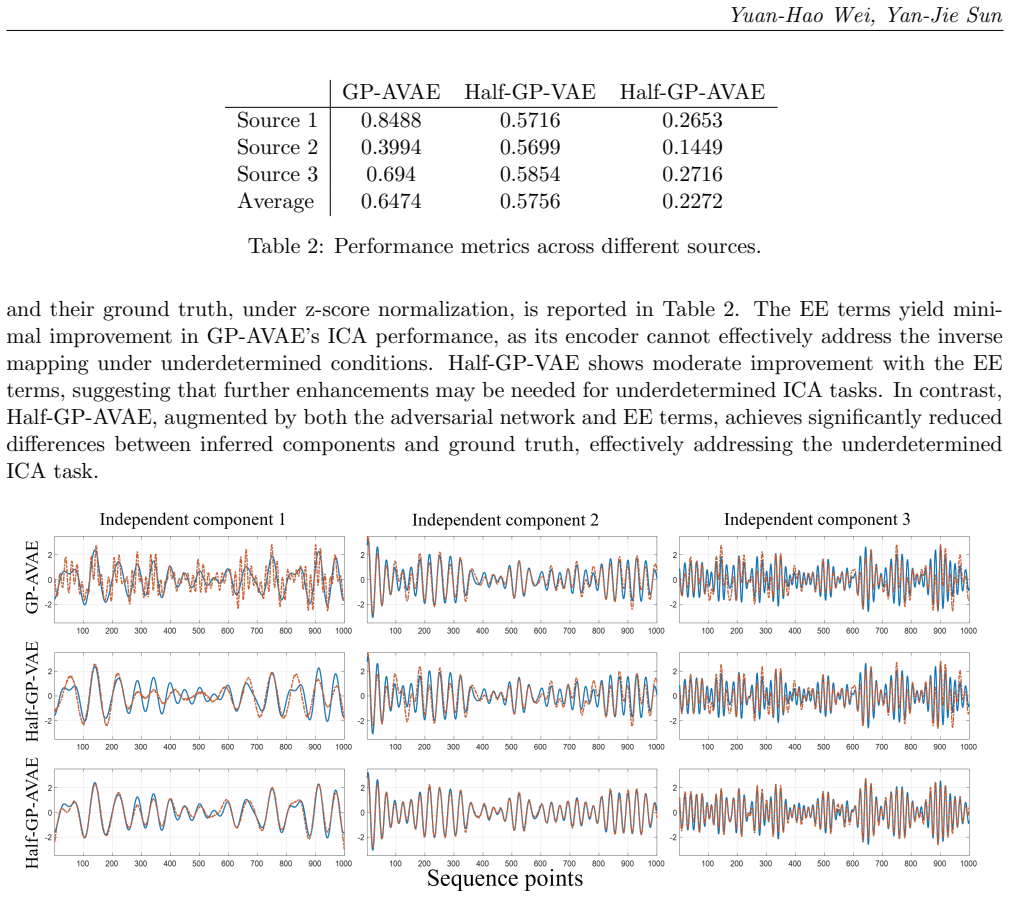
The central discovery is that an encoder-free VAE with factorized Gaussian-process priors, adversarial independence training, and External Enhancement terms recovers independent components in underdetermined linear ICA. The paper constructs Half-GP-AVAE by taking the Half-VAE posterior IΩ(Z), whose mean sequence and variance for each latent dimension are optimized directly through the ELBO, and coupling it with a discriminator that treats jointly sampled latent tuples as real and shuffled (marginally matched) tuples as fake, thereby driving the joint distribution toward the product of the marginal distributions. External Enhancement terms β1 Σ 1/(Γi−Γj)^2 + β2 Σ Γi + β3 Σ $σ^{2}$_{Zi} are added to force distinct prior length scales and bounded variances. In the underdetermined experiment with three GP-SE-structured sources and two mixtures, the method achieves average RMSE 0.2272 versus 0.6474 (GP-AVAE) and 0.5756 (Half-GP-VAE), and the paper reads this as validating the theoretical correctness of the Half-VAE framework for underdetermined ICA.
Load-bearing premise
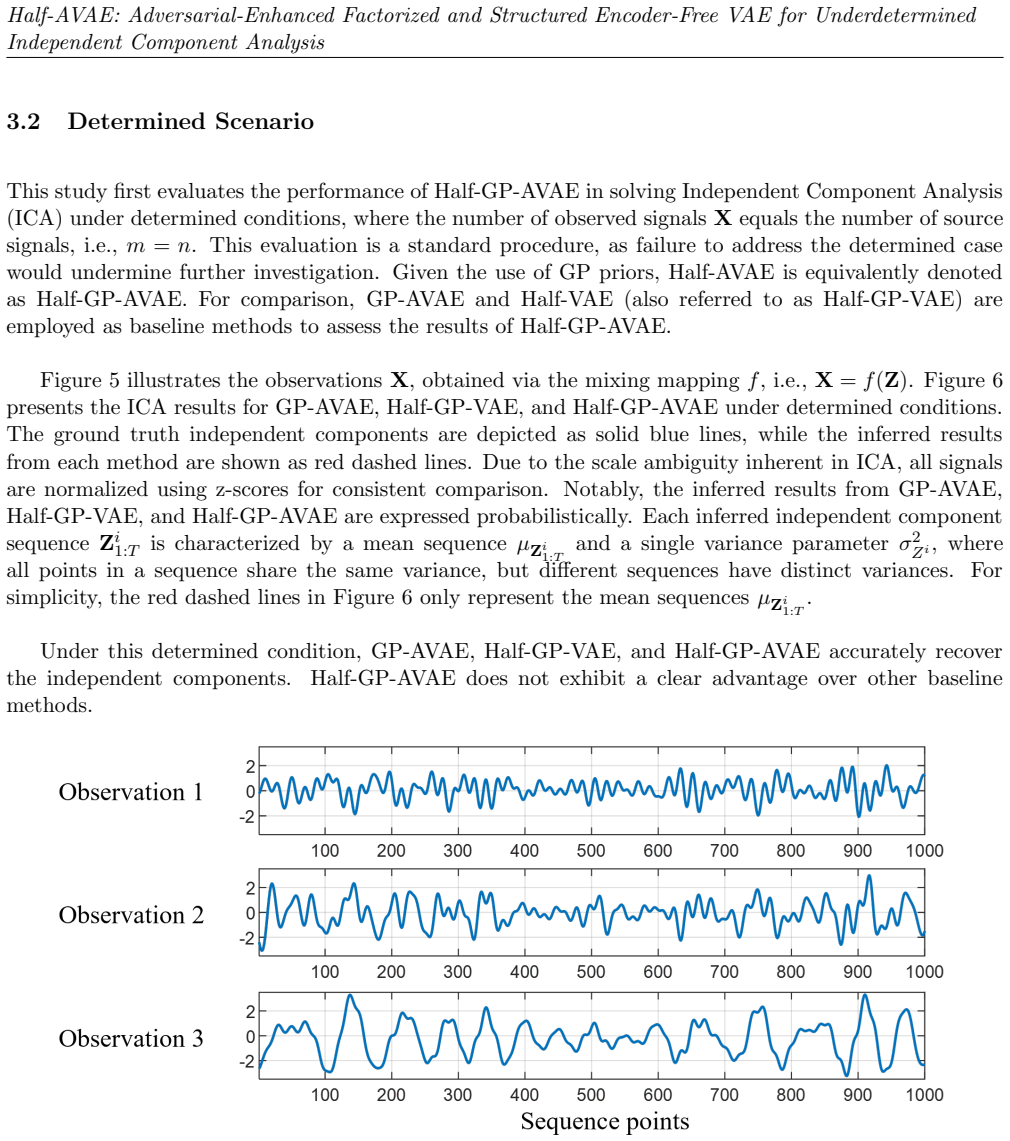
The experiments generate sources as independent Gaussian processes with squared-exponential kernels, the same family the model uses as its prior, so the reported gains may depend on a matched prior-data setup rather than a general ability to solve underdetermined ICA.
Editorial extensions
If this is right
- Underdetermined linear mixtures of structured sources can be separated without any encoder network, as long as the posterior is optimized directly and independence is pressured explicitly.
- Adversarial marginal-joint alignment plus prior-length-scale separation together give a large error reduction (Table 2: 0.2272 vs. 0.5756/0.6474), implying each mechanism alone leaves a gap.
- The results suggest that VAE-based ICA pipelines should be built around the variational bound and prior design rather than the encoder-decoder symmetry.
- The method's success on time-structured sources points toward applications in blind source separation, disentanglement, and causal representation learning where n > m.
Reading between the lines
- Because the synthetic sources are drawn from the same GP-SE family used as the prior, the reported advantage may narrow on sources with different temporal structure; a natural test is i.i.d. or heavy-tailed sources.
- The EE hyperparameters β1, β2, β3 are hand-set without sensitivity analysis, so transfer to new tasks may require retuning; a principled schedule or automatic selection would strengthen the approach.
- The shuffling-based adversarial independence estimator could be replaced by other dependence measures (such as HSIC or distance covariance) with the same encoder-free backbone, yielding a family of underdetermined ICA solvers.
- If the method generalizes, it offers a practical route for neuroimaging or audio source separation where sensors are scarce relative to sources.
Editorial analysis
A structured set of objections, weighed in public.
Referee Report
Summary. This paper proposes Half-AVAE, an encoder-free variational autoencoder that combines Gaussian Process priors with an adversarial discriminator and External Enhancement (EE) regularizers to perform underdetermined independent component analysis. The method is derived from the standard VAE ELBO and extends the authors' prior Half-VAE and GP-AVAE frameworks. Experiments on synthetic signals compare Half-GP-AVAE against GP-AVAE and Half-GP-VAE under determined and underdetermined conditions, reporting lower RMSE for Half-GP-AVAE in the underdetermined case (Table 2). The paper concludes that these results validate the theoretical correctness of the Half-VAE framework for underdetermined ICA.
Significance. If the reported empirical result is reproducible, the proposed combination is a plausible way to handle underdetermined linear ICA for structured time-series sources, and the paper is clearly written at the conceptual level. The derivation of the ELBO in Section 2 is standard, but the concrete combination of encoder-free variational inference, adversarial independence, and EE regularizers is coherent and the synthetic comparison is a useful sanity check. However, the absence of code, the underspecified data-generation process, and the single-run evaluation substantially limit the significance as presented.
major comments (3)
- [Section 3.1] The generative process of the synthetic sources is not specified; the paper only states that three sequences with 'distinct temporal or spatial structures' were generated, and then defines the GP-SE prior in Eq. (15) 'to capture these structures.' Without stating whether the source sequences were sampled from independent GP-SE processes or generated in another way, the reader cannot exclude a matched-prior setting in which the model's prior is the true data-generating process. This is load-bearing because the central empirical claim (Section 3.3.2, Table 2) is the superior RMSE of Half-GP-AVAE; the authors should provide the exact generative model or code.
- [Section 3.3.2 and Table 2] The reported RMSE values come from a single run with no error bars, no number of random seeds, no train/validation/test split, and no sensitivity analysis for the EE weights β1, β2, β3 in Eq. (16) or the adversarial weight Λ in Eq. (14a). The text explicitly says these weights were 'tuned to balance' the loss terms on this same synthetic task, so the large margin (0.2272 vs. 0.5756/0.6474) may reflect selection on the test set rather than a genuine algorithmic improvement. Repeated runs with multiple seeds and a hold-out protocol are needed.
- [Section 4] The statement that the results 'validate the theoretical correctness of the Half-VAE framework' is an overclaim. The experiments are a single synthetic demonstration; they do not provide identifiability guarantees or a theoretical argument for underdetermined ICA recovery. The conclusion should be rephrased as an empirical feasibility result, or the paper should add a formal identifiability analysis.
minor comments (5)
- [Sections 2.3 and 2.4] Equation (6) is numbered twice: once for the factorization of the prior and once for the independence condition used in the adversarial section. Renumber to avoid confusion.
- [Section 2.4] The notation R(Zi) is used ambiguously: the text says 'the sequence Zi 1:T corresponds to qΘ(Zi|X)' but the adversarial module operates on the mean sequence μZi 1:T. Please clarify the distinction between the distribution over latent sequences and the distribution over mean sequences.
- [Tables 1 and 2] The table captions do not specify that the reported values are RMSE after z-score normalization; this information appears only in the running text. Add it to the captions for readability.
- [Section 3.3.2] The sentence 'The EE terms yield minimal improvement in GP-AVAE's ICA performance' could be quantified by reporting the actual RMSE differences from Table 2 rather than leaving the reader to compute them.
- [References] Reference 'Wei, Y. et al. (2024a)' is cited as an unpublished thesis or report; please provide a published, accessible version or more bibliographic detail so readers can verify the prior work.
Circularity Check
No load-bearing circularity; the encoder-free derivation is algebraically self-contained, and the matched-prior concern is an experimental-design limitation rather than a circular step.
full rationale
The paper's derivation chain is self-contained: Equations (4)-(5) give the standard VAE ELBO, and Equation (13) replaces the encoder posterior q(Z|X) with a directly optimized distribution IOmega(Z). This replacement is algebraically valid because the ELBO lower bound holds for any variational distribution, so the encoder-free step does not reduce by construction to the prior work it cites. The adversarial objective (Eq. 9) and the EE regularizer (Eq. 16) are added to that ELBO, and the reported RMSE values in Tables 1-2 are empirical outcomes of optimizing the resulting losses, not quantities fixed by the fitted parameters themselves. The self-citations to Wei et al. (2024a,b) motivate the GP priors and Half-VAE architecture, but the central encoder-free claim is also supported by the paper's own equations and by the experiments, so no uniqueness theorem or unverified self-citation chain is load-bearing. The main caveat is in Section 3.1, where the paper says the GP-SE prior is designed 'to capture these structures' of the synthetic sources without specifying the generative distribution of those sources; if the sources were sampled from the same GP-SE family, the experiment would be a matched-prior sanity check rather than an external validation. However, the paper never states that the sources were drawn from Eq. (15), the baselines share the same prior, and the reported advantage of Half-GP-AVAE is not forced by construction. Missing seeds, error bars, and sensitivity analysis affect robustness, not circularity. Therefore no specific circular step is established.
Assumptions & free parameters
free parameters (4)
- EE weights β1, β2, β3 =
not reported
- Λ adversarial weight =
not reported
- GP length scales Γi =
trainable, not reported
- Latent variance parameters σ²_Zi =
trainable, not reported
assumptions (4)
- standard math The ELBO objective is a valid surrogate for matching the variational distribution to the posterior (Sec. 2.1).
- domain assumption The true sources are independent Gaussian processes with squared-exponential kernels (Sec. 3.1).
- domain assumption An encoder-free variational distribution IΩ(Z) can approximate the true posterior and thereby solve underdetermined ICA (Sec. 2.5).
- standard math Shuffling the index sequence preserves each marginal distribution R(Zi), so shuffling yields samples from the product of marginals (Sec. 2.4).
Cite this review
Pith. "Pith review of Half-AVAE: Adversarial-Enhanced Factorized and Structured Encoder-Free VAE for Underdetermined Independent Component Analysis." pith.science (2026). https://pith.science/paper/TEWMC2JF
@misc{pith2026250607011,
  author       = {Pith},
  title        = {Pith review of: Half-AVAE: Adversarial-Enhanced Factorized and Structured Encoder-Free VAE for Underdetermined Independent Component Analysis},
  year         = {2026},
  howpublished = {\url{https://pith.science/paper/TEWMC2JF}},
  note         = {Machine review of arXiv:2506.07011}
}
read the original abstract
This study advances the Variational Autoencoder (VAE) framework by addressing challenges in Independent Component Analysis (ICA) under both determined and underdetermined conditions, focusing on enhancing the independence and interpretability of latent variables. Traditional VAEs map observed data to latent variables and back via an encoder-decoder architecture, but struggle with underdetermined ICA where the number of latent variables exceeds observed signals. The proposed Half Adversarial VAE (Half-AVAE) builds on the encoder-free Half-VAE framework, eliminating explicit inverse mapping to tackle underdetermined scenarios. By integrating adversarial networks and External Enhancement (EE) terms, Half-AVAE promotes mutual independence among latent dimensions, achieving factorized and interpretable representations. Experiments with synthetic signals demonstrate that Half-AVAE outperforms baseline models, including GP-AVAE and Half-VAE, in recovering independent components under underdetermined conditions, as evidenced by lower root mean square errors. The study highlights the flexibility of VAEs in variational inference, showing that encoder omission, combined with adversarial training and structured priors, enables effective solutions for complex ICA tasks, advancing applications in disentanglement, causal inference, and generative modeling.
Figures


Figures from the paper (6 more)



Reference graph
Works this paper leans on
-
[1]
Ahuja, K., Mahajan, D., Wang, Y., and Bengio, Y. (2023). Interventional causal representation learning. In International conference on machine learning , pages 372--407. PMLR
work page 2023
-
[2]
Arjovsky, M., Chintala, S., and Bottou, L. (2017). Wasserstein generative adversarial networks. In International conference on machine learning , pages 214--223. PMLR
work page 2017
-
[3]
Bourlard, H. and Kamp, Y. (1988). Auto-association by multilayer perceptrons and singular value decomposition. Biological cybernetics , 59(4):291--294
work page 1988
-
[4]
Learning Independent Features with Adversarial Nets for Non-linear ICA
Brakel, P. and Bengio, Y. (2017). Learning independent features with adversarial nets for non-linear ica. arXiv preprint arXiv:1710.05050
work page Pith review arXiv 2017
-
[5]
P., Higgins, I., Pal, A., Matthey, L., Watters, N., Desjardins, G., and Lerchner, A
Burgess, C. P., Higgins, I., Pal, A., Matthey, L., Watters, N., Desjardins, G., and Lerchner, A. (2018). Understanding disentangling in -vae. arXiv preprint arXiv:1804.03599
arXiv 2018
-
[6]
Cardoso, J.-F. (1998). Blind signal separation: statistical principles. Proceedings of the IEEE , 86(10):2009--2025
work page 1998
-
[7]
Chen, R. T., Li, X., Grosse, R. B., and Duvenaud, D. K. (2018). Isolating sources of disentanglement in variational autoencoders. Advances in neural information processing systems , 31
work page 2018
-
[8]
Chen, X., Duan, Y., Houthooft, R., Schulman, J., Sutskever, I., and Abbeel, P. (2016). Infogan: Interpretable representation learning by information maximizing generative adversarial nets. Advances in neural information processing systems , 29
work page 2016
Show all 36 references
-
[9]
Comon, P. (1994). Independent component analysis, a new concept? Signal processing , 36(3):287--314
1994
-
[10]
M., Mircea, M., Mueller, N
Eraslan, G., Simon, L. M., Mircea, M., Mueller, N. S., and Theis, F. J. (2019). Single-cell rna-seq denoising using a deep count autoencoder. Nature communications , 10(1):390
2019
-
[11]
Ganin, Y., Ustinova, E., Ajakan, H., Germain, P., Larochelle, H., Laviolette, F., March, M., and Lempitsky, V. (2016). Domain-adversarial training of neural networks. Journal of machine learning research , 17(59):1--35
2016
-
[12]
J., Pouget-Abadie, J., Mirza, M., Xu, B., Warde-Farley, D., Ozair, S., Courville, A., and Bengio, Y
Goodfellow, I. J., Pouget-Abadie, J., Mirza, M., Xu, B., Warde-Farley, D., Ozair, S., Courville, A., and Bengio, Y. (2014). Generative adversarial nets. Advances in neural information processing systems , 27
2014
-
[13]
H., Vording, M
Gr nbech, C. H., Vording, M. F., Timshel, P. N., S nderby, C. K., Pers, T. H., and Winther, O. (2020). scvae: variational auto-encoders for single-cell gene expression data. Bioinformatics , 36(16):4415--4422
2020
-
[14]
P., Glorot, X., Botvinick, M
Higgins, I., Matthey, L., Pal, A., Burgess, C. P., Glorot, X., Botvinick, M. M., Mohamed, S., and Lerchner, A. (2017). beta-vae: Learning basic visual concepts with a constrained variational framework. ICLR (Poster) , 3
2017
-
[15]
and Glass, J
Hsu, W.-N. and Glass, J. (2018). Scalable factorized hierarchical variational autoencoder training. arXiv preprint arXiv:1804.03201
2018 arXiv
-
[16]
Hyvarinen, A., Karhunen, J., and Oja, E. (2001). Independent component analysis and blind source separation
2001
-
[17]
Hyvarinen, A., Sasaki, H., and Turner, R. (2019). Nonlinear ica using auxiliary variables and generalized contrastive learning. In The 22nd International Conference on Artificial Intelligence and Statistics , pages 859--868. PMLR
2019
-
[18]
Khemakhem, I., Kingma, D., Monti, R., and Hyvarinen, A. (2020). Variational autoencoders and nonlinear ica: A unifying framework. In International conference on artificial intelligence and statistics , pages 2207--2217. PMLR
2020
-
[19]
Kingma, D. P. (2013). Auto-encoding variational bayes. arXiv preprint arXiv:1312.6114
2013 arXiv
-
[20]
Kingma, D. P. and Welling, M. (2019). An introduction to variational autoencoders. arxiv e-prints, page. arXiv preprint arXiv:1906.02691
2019 arXiv
-
[21]
Komanduri, A., Wu, Y., Huang, W., Chen, F., and Wu, X. (2022). Scm-vae: Learning identifiable causal representations via structural knowledge. In 2022 IEEE International Conference on Big Data (Big Data) , pages 1014--1023. IEEE
2022
-
[22]
E., Le Priol, R., Lacoste, A., and Lacoste-Julien, S
Lachapelle, S., Rodriguez, P., Sharma, Y., Everett, K. E., Le Priol, R., Lacoste, A., and Lacoste-Julien, S. (2022). Disentanglement via mechanism sparsity regularization: A new principle for nonlinear ica. In Conference on Causal Learning and Reasoning , pages 428--484. PMLR
2022
-
[23]
Liang, T. (2021). How well generative adversarial networks learn distributions. Journal of Machine Learning Research , 22(228):1--41
2021
-
[24]
M., Cohen, T., and Gavves, S
Lippe, P., Magliacane, S., L \"o we, S., Asano, Y. M., Cohen, T., and Gavves, S. (2022). Citris: Causal identifiability from temporal intervened sequences. In International Conference on Machine Learning , pages 13557--13603. PMLR
2022
-
[25]
B., Jordan, M
Lopez, R., Regier, J., Cole, M. B., Jordan, M. I., and Yosef, N. (2018). Deep generative modeling for single-cell transcriptomics. Nature methods , 15(12):1053--1058
2018
-
[26]
Pearl, J. (2019). The seven tools of causal inference, with reflections on machine learning. Communications of the ACM , 62(3):54--60
2019
-
[27]
J., Mohamed, S., and Wierstra, D
Rezende, D. J., Mohamed, S., and Wierstra, D. (2014). Stochastic backpropagation and approximate inference in deep generative models. In International conference on machine learning , pages 1278--1286. PMLR
2014
-
[28]
E., Hinton, G
Rumelhart, D. E., Hinton, G. E., and Williams, R. J. (1986). Learning representations by back-propagating errors. nature , 323(6088):533--536
1986
-
[29]
Sch \"o lkopf, B. (2022). Causality for machine learning. In Probabilistic and causal inference: The works of Judea Pearl , pages 765--804
2022
-
[30]
Tzeng, E., Hoffman, J., Saenko, K., and Darrell, T. (2017). Adversarial discriminative domain adaptation. In Proceedings of the IEEE conference on computer vision and pattern recognition , pages 7167--7176
2017
-
[31]
and Gu, J
Wang, D. and Gu, J. (2018). Vasc: dimension reduction and visualization of single-cell rna-seq data by deep variational autoencoder. Genomics, proteomics & bioinformatics , 16(5):320--331
2018
-
[32]
Way, G. P. and Greene, C. S. (2018). Extracting a biologically relevant latent space from cancer transcriptomes with variational autoencoders. In PACIFIC SYMPOSIUM on BIOCOMPUTING 2018: Proceedings of the Pacific Symposium , pages 80--91. World Scientific
2018
-
[33]
Wei, Y. et al. (2024a). Innovative blind source separation techniques combining gaussian process algorithms and variational autoencoders with applications in structural health monitoring
2024
-
[34]
Wei, Y.-H. (2025). Vaes and gans: Implicitly approximating complex distributions with simple base distributions and deep neural networks--principles, necessity, and limitations. arXiv preprint arXiv:2503.01898
2025 arXiv
-
[35]
Wei, Y.-H., Sun, Y.-J., and Zhang, C. (2024b). Half-vae: An encoder-free vae to bypass explicit inverse mapping. arXiv preprint arXiv:2409.04140
2024 arXiv
-
[36]
Yang, M., Liu, F., Chen, Z., Shen, X., Hao, J., and Wang, J. (2021). Causalvae: Disentangled representation learning via neural structural causal models. In Proceedings of the IEEE/CVF conference on computer vision and pattern recognition , pages 9593--9602
2021
Reviewed August 7, 2026 · model on record in the stance chip above.
Discussion (0). Sign in to comment.