REVIEW 3 major objections 5 minor 46 references
Stochastic Push-Pull for Decentralized Nonconvex Optimization
T0 review · 3 major / 5 minor · reviewed 2026-08-07 · deepseek-v4-flash
Pith's one-line read Stochastic Push-Pull, a decentralized two-graph optimizer, converges for smooth nonconvex objectives and matches centralized speed whenever the two graphs share a common root.
desk verdict Solid and genuinely new linear-speedup analysis for Stochastic Push-Pull, with a few peripheral but fixable gaps; worth a serious referee. read the letter →
The pith
A machine-rendered reading of the paper's core claim, the machinery that carries it, and where it could break.
The reading
What carries the argument
The machinery is a family of infinite sums over products of the two mixing matrices, which displace the spectral-gap constant used in most decentralized analyses. With the projections $\Pi_R = I - \mathbf{1}\pi_R^T$ and $\Pi_C = I - \pi_C \mathbf{1}^T$, the paper defines $\tilde{R}^k = \Pi_R R^k$, $\tilde{C}^k = \Pi_C C^k$, and then $M_1 := \|\pi_R^T C\|^2 + \sum_{t=1}^\infty \|\pi_R^T (C^{t+1} - C^t)\|^2$, $M_2 := \sum_{t=1}^\infty t \|\pi_R^T (C^{t+1} - C^t)\|$, together with eight further sums $N_1, \dots, N_8$ of norms of products like $\sum_{k=1}^{t-1} \tilde{R}^k \tilde{C}^{t-k}$. Exponential decay of $R$ and $C$ (Definition 2.3) guarantees all these sums are finite (Lemma 3.1), so the sums, not a spectral gap, carry the network's influence on the rate and reduce to closed forms in $\lambda = \|W - \mathbf{1}\mathbf{1}^T/n\|$ when $R = C = W$ is doubly stochastic (Lemma 3.2). The hinge of the whole proof is Lemma 2.5: under the common-root assumption, $\pi_R^T \pi_C > 0$, and this scalar enters the descent lemma as the coefficient of the negative gradient term that drives convergence.
What would settle it
On a smooth nonconvex problem with fixed noise variance $\sigma^2$, smoothness $L$, and gap $\Delta_f$, run S-PP over a family of balanced directed graphs (doubly stochastic, non-symmetric $W$, e.g., directed rings with known $\lambda = \|W - \mathbf{1}\mathbf{1}^T/n\|$) doubling $n$ each time; Corollary 4.1 predicts the gradient norm obeys $\sqrt{\Delta_f \sigma^2 L/(nT)}$ once $T$ passes the transient $O(n^3/(1-\lambda)^6)$, so if the measured $T$ needed to reach a target gradient norm fails to shrink like $1/n$, or the transient exponent departs from $6$, the claimed speedup regime is mischaracterized. A second check targets the root assumption directly: build $R$ and $C$ that are exponentially decaying but have disjoint root sets, so $\pi_R^T \pi_C = 0$ and the theorem's hypotheses fail, and test whether S-PP still converges at a comparable rate — if it does, the common-root condition is not necessary.
Extended reading notes
Core claim
On the paper's own terms, the central claim is Theorem 4.1: for a suitably chosen constant step size, S-PP satisfies $\frac{1}{T+1}\sum_{t=0}^{T} \mathbb{E}[\|\nabla f(\hat{x}(t))\|^2] \leq O\!\left( \left(\frac{Q}{n\pi^2}\right)^{1/2} \left(\frac{\Delta_f \sigma^2 L}{n(T+1)}\right)^{1/2} + \frac{(\Delta_f^2 \sqrt{\max\{P_2,P_3\}\max\{N_4,N_7\}} L^2 \sigma^2)^{1/3}}{n\pi (T+1)^{2/3}} + \cdots \right)$, where $\hat{x}(t) = \pi_R^T X(t)$ is the root-weighted iterate and the constants $P_i$, $Q$, and $N_i$ are defined from the mixing matrices. Corollary 4.2 converts this into the headline speedup statement: if $\max\{M_1, \tilde{M}_2, M_1\tilde{M}_2\}/(n(\pi_R^T \pi_C)^2) \leq C$ for a constant $C$ independent of $n$, then the $1/\sqrt{nT}$ term dominates and S-PP matches centralized SGD, a result the paper reports as previously unavailable for Stochastic Push-Pull. The same framework also yields linear speedup for DSGT with merely doubly stochastic, non-symmetric $W$ on balanced directed graphs (claimed as new), recovery of the bound of [1] and an improved transient time over [8] when $W$ is symmetric, and a relaxation of the standard positive-diagonal requirement on $R$ and $C$ to an exponential-decay property that admits zero-diagonal $(0,1)$-mixing matrices from spanning trees.
Load-bearing premise
The load-bearing premise is that the pull graph $G_R$ and the reversed push graph $G_C^T$ each contain a spanning tree and that two such trees share a common root node, so that the stationary left-eigenvectors $\pi_R$ and $\pi_C$ of the mixing matrices overlap with $\pi_R^T \pi_C > 0$ — if the graphs have no common root this overlap is zero, the descent lemma loses its negative downhill term, and the proof's contraction argument collapses.
Editorial extensions
If this is right
- When $\max\{M_1, \tilde{M}_2, M_1 \tilde{M}_2\}/(n(\pi_R^T \pi_C)^2) \le C$ holds, doubling the number of agents halves the attainable gradient norm at a fixed iteration count, so training over directed networks carries no asymptotic penalty relative to a central server.
- For doubly stochastic mixing $W$, the analysis yields linear speedup for DSGT, and the paper claims the non-symmetric, balanced-directed-graph case as new, with an explicit transient phase of $O(n^3/(1-\lambda)^6)$.
- For symmetric $W$ on undirected graphs, the constants collapse to closed spectral forms, reproducing the DSGT bound of [1] and improving the transient time stated in [8].
- Because only exponential decay is required of $R$ and $C$, zero-diagonal $(0,1)$-matrices built from spanning trees become admissible, and Lemma 2.6 shows the earlier strictly-positive-diagonal assumption was strictly stronger.
- Corollary 4.3 shows the ratio $\max\{M_1, \tilde{M}_2, M_1 \tilde{M}_2\}/(n(\pi_R^T \pi_C)^2)$ is always at least $1/10$, so the sufficient condition is tight up to a constant and the theorem cannot be sharpened to a higher-order speedup.
Reading between the lines
- The constants $M_1, M_2, N_1, \dots, N_8$ are computable from powers of $R$ and $C$, so the paper's condition doubles as a design criterion: a search over spanning trees and edge weights could keep $Q/(n\pi^2)$ bounded, offering a practical alternative to spectral-gap-based topology design for directed graphs.
- The common-root condition is weaker than strong connectivity, so the proof should carry over to hierarchies or broadcast-style networks where some agents only send or only receive, and whether time-varying graphs whose unions share a root inherit the same rates is a natural extension the paper does not address.
- The special case $\tilde{M}_2 = 0$ for tree-structured graphs shows the delay-induced noise terms vanish when information flows without cycles, which suggests cycle-heavy topologies such as rings might be reweighted to mimic the tree cancellation, a modification that could shorten their transient phase and is directly testable.
- Because $\pi_R^T \pi_C$ appears squared in the denominator, the ratio $Q/(n\pi^2)$ reads as an effective network-inefficiency factor for directed topologies, and comparing this factor across graphs such as rings, Erdős–Rényi, and multi-sub-ring topologies could serve as a practical ranking tool for choosing communication structures.
Editorial analysis
A structured set of objections, weighed in public.
Referee Report
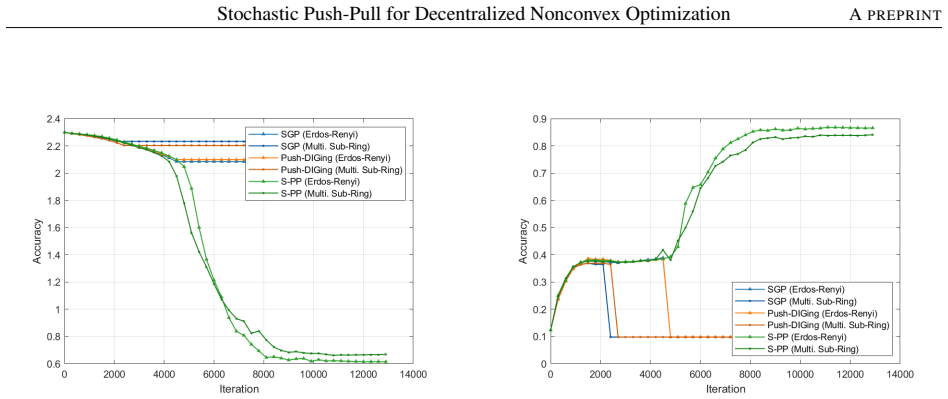
Summary. The paper analyzes the Stochastic Push-Pull (S-PP) algorithm for decentralized nonconvex optimization over directed graphs. It relaxes earlier assumptions on the weight matrices to an exponential-decay condition, introduces an analytical framework based on the infinite sums M1, M2, N1, ..., N8, and proves an O(1/sqrt(T)) convergence rate with explicit constants (Theorem 4.1). It then gives a sufficient condition for linear speedup matching centralized SGD (Corollary 4.2), a lower bound stating that no higher-order speedup is possible (Corollary 4.3), and comparisons with existing DSGT analyses for doubly stochastic and symmetric mixing matrices (Corollary 4.1, Remarks 4.1-4.2). Numerical experiments on logistic regression with nonconvex regularization and CNN training on MNIST compare S-PP with SGP and Push-DIGing.
Significance. If the main result is correct, the paper makes a useful contribution: it provides the first explicit linear-speedup condition for Stochastic Push-Pull over general directed graphs, and its infinite-sum framework gives a new way to express network-dependence without relying solely on a spectral gap. The main theorem is supported by a detailed appendix, and the claimed linear-speedup condition is a legitimate sufficient-condition result rather than a fitted relation. However, several supporting proofs are incomplete or contain errors: the proof of Lemma 3.2 has a false inequality in the symmetric-case N7 bound, Corollary 4.3 uses an undefined constant, and Lemma 3.1 leaves the finiteness of N5-N8 to a sketch. These issues do not appear to invalidate Theorem 4.1 itself, but they affect secondary claims in the paper and need to be fixed before the manuscript is publishable.
major comments (3)
- [Appendix A.3, Lemma 3.2 (symmetric case)] The proof of the claimed bound N7 <= 10/((1+min{lambda_n,0})(1-lambda)) contains a false inequality. For an eigenvalue x with |x| in (0,1), the derivation obtains (f_t(x))^2 <= 4/(1-sqrt(|x|))^2 |x|^t and then states this is <= 4/(1-|x|) |x|^t. Since 1-|x| = (1-sqrt(|x|))(1+sqrt(|x|)) > (1-sqrt(|x|))^2, the inequality is reversed. For lambda_n = -r with r near 1, the true summand behaves like t^2 r^{2t}, giving N7 = O((1-r)^{-3}) after summation, whereas the claimed bound is O((1-r)^{-2}). This directly affects the estimates used in Corollary 4.1 cases 2 and 3 and the transient-time comparison in Remark 4.2, so the derivation must be corrected or the affected claims withdrawn.
- [Corollary 4.3 proof] The proof applies Lemma 3.3 with weights alpha_i = i ||pi_R^T(C^{i+1}-C^i)|| / M9, but the constant M9 is never defined. The argument can be repaired by taking M9 = M2 in the non-spanning-tree cases, but as written the proof is incomplete; a reader cannot verify that the required condition sum_i alpha_i <= 1 holds or that the final bound is expressed in terms of the quantities appearing in the corollary statement.
- [Lemma 3.1] The proof explicitly establishes finiteness only for M1 and says the remaining sums follow by similar arguments. For N5-N8, the summands are convolutions of the form ||tilde R^k tilde C^{t-k}|| or variants, and their finiteness requires a separate argument splitting the summation range into k <= m and k > m (or equivalently using the product decay bound ||tilde R^k tilde C^{t-k}|| <= N^2(1-p)^{t/2}). Since the constants P1-P5 in Lemma 3.12 and Theorem 4.1 are defined using these sums, a complete proof of Lemma 3.1 is load-bearing for the main theorem and should be supplied.
minor comments (5)
- [Remarks 4.1 and 4.2] The transient-time claims O(n^3/(1-lambda)^6), O(max{n^3/(c^2(1-lambda)^2), n/(1-lambda)^{8/3}}), and the comparison with [8] are asserted without derivation; they should be derived from the displayed bounds in Corollary 4.1 or stated as conjectures.
- [Section 1.3 and Assumption 2.1] The graph G_C^T is used in Assumption 2.1 but is defined only in a footnote; please define it explicitly in the notation section.
- [Section 4.1, paragraph before Corollary 4.3] The sentence 'Corollary 4.3 indicates that Theorem 4.1 does not allow for higher-order speedup' would be clearer if it explicitly said 'the leading 1/sqrt(T) term cannot be improved to a higher power of T under the given assumptions'.
- [Figure 3 caption] The caption says divergent algorithms are plotted with 'their first non-NaN values in the records', but it is unclear whether this means only the first recorded value is shown or whether the curves are truncated; please clarify.
- [Theorem 4.1 statement] The proof uses the notation C0 = 2*10^6 inside the 'less than or similar to' bound; please state explicitly that the hidden constant is C0 and that all 'less than or similar to' symbols in the theorem refer to this constant.
Circularity Check
No significant circularity: the convergence rate is derived from the stated assumptions, and the linear-speedup condition is an explicit sufficient condition obtained from the proved bound.
full rationale
Walking the claimed derivation chain: Lemma 2.5 derives pi_R^T pi_C > 0 from Assumptions 2.1 and 2.4; Lemmas 3.10-3.12 bound consensus error and the descent using the finite constants N_i and M_i; Theorem 4.1 then optimizes the step size; Corollary 4.2 states the condition under which the dominant term becomes O((Delta_f sigma^2 L / (n(T+1)))^{1/2}). None of these steps assumes the conclusion. The linear-speedup condition max{M1, tilde M2, M1 tilde M2}/(n(pi_R^T pi_C)^2) <= C is exactly the coefficient of the theorem's leading term, but that is a legitimate sufficient condition extracted from the proved bound, not an input assumed in the proof. There is no fitted parameter renamed as a prediction, and no quantity is fit to data. The citations to the authors' own prior work [42,43] are used for elementary norm inequalities (Lemmas 3.3 and 3.4) and a special-case cancellation for spanning trees defining tilde M2 = 0; these are not unverified uniqueness or existence theorems and are not load-bearing for the central convergence claim. Two textual defects exist but are not circularity: the proof of Corollary 4.3 invokes an undefined constant M9, and Lemma 3.1 only sketches the finiteness of N_2 through N_8 and M_2 ('Hence, we omit those details'). Both are peripheral to Theorem 4.1 and Corollary 4.2, which are otherwise self-contained given the exponential-decay assumption that makes the sums finite.
Assumptions & free parameters
assumptions (6)
- domain assumption Assumption 2.1: The graphs G_R and G_C^T each contain a spanning tree and there exists a pair sharing a common root.
- domain assumption Assumption 2.4: The matrices R and C^T are row/column stochastic and exponentially decaying (Definition 2.3).
- domain assumption Assumption 2.7: Unbiased stochastic gradients with uniformly bounded variance sigma^2.
- domain assumption Assumption 2.8: Each local objective f_i is L-smooth and lower bounded.
- standard math Perron-Frobenius theorem and Gelfand's formula.
- standard math Lemma 3.4 (||AB||_F <= ||A||_2 ||B||_F) and Lemma 3.3 (convexity-style norm bound).
Cite this review
Pith. "Pith review of Stochastic Push-Pull for Decentralized Nonconvex Optimization." pith.science (2026). https://pith.science/paper/75PIDQD2
@misc{pith2026250607021,
  author       = {Pith},
  title        = {Pith review of: Stochastic Push-Pull for Decentralized Nonconvex Optimization},
  year         = {2026},
  howpublished = {\url{https://pith.science/paper/75PIDQD2}},
  note         = {Machine review of arXiv:2506.07021}
}
read the original abstract
To understand the convergence behavior of the Push-Pull method for decentralized optimization with stochastic gradients (Stochastic Push-Pull), this paper presents a comprehensive analysis. Specifically, we first clarify the algorithm's underlying assumptions, particularly those regarding the network structure and weight matrices. Then, to establish the convergence rate under smooth nonconvex objectives, we introduce a general analytical framework that not only encompasses a broad class of decentralized optimization algorithms, but also recovers or enhances several state-of-the-art results for distributed stochastic gradient tracking methods. A key highlight is the derivation of a sufficient condition under which the Stochastic Push-Pull algorithm achieves linear speedup, matching the scalability of centralized stochastic gradient methods -- a result not previously reported. Extensive numerical experiments validate our theoretical findings, demonstrating the algorithm's effectiveness and robustness across various decentralized optimization scenarios.
Figures


Reference graph
Works this paper leans on
-
[1]
S. A. ALGHUNAIM ANDK. YUAN,A unified and refined convergence analysis for non-convex decentralized learning, IEEE Transactions on Signal Processing, 70 (2022), pp. 3264–3279
work page 2022
- [2]
- [3]
-
[4]
B. GHARESIFARD ANDJ. CORTÉS,When does a digraph admit a doubly stochastic adjacency matrix?, in Proceedings of the 2010 American Control Conference, IEEE, 2010, pp. 2440–2445
work page 2010
-
[5]
R. A. HORN ANDC. R. JOHNSON,Matrix analysis, Cambridge university press, 2012
work page 2012
- [6]
-
[7]
K. HUANG ANDS. PU,Improving the transient times for distributed stochastic gradient methods, IEEE Transac- tions on Automatic Control, 68 (2022), pp. 4127–4142
work page 2022
-
[8]
A. KOLOSKOVA, T. LIN,ANDS. U. STICH,An improved analysis of gradient tracking for decentralized machine learning, Advances in Neural Information Processing Systems, 34 (2021), pp. 11422–11435
work page 2021
Show all 46 references
-
[9]
KOLOSKOVA, N
A. KOLOSKOVA, N. LOIZOU, S. BOREIRI, M. JAGGI,ANDS. STICH,A unified theory of decentralized sgd with changing topology and local updates, in International Conference on Machine Learning, PMLR, 2020, pp. 5381–5393
2020
-
[10]
KOLOSKOVA, S
A. KOLOSKOVA, S. STICH,ANDM. JAGGI,Decentralized stochastic optimization and gossip algorithms with compressed communication, in International Conference on Machine Learning, PMLR, 2019, pp. 3478–3487
2019
-
[11]
KUNGURTSEV, M
V. KUNGURTSEV, M. MORAFAH, T. JAVIDI,ANDG. SCUTARI,Decentralized asynchronous nonconvex stochas- tic optimization on directed graphs, IEEE Transactions on Control of Network Systems, 10 (2023), pp. 1796–1804
2023
-
[12]
LECUN, C
Y. LECUN, C. CORTES, C. BURGES,ET AL.,Mnist handwritten digit database, 2010
2010
-
[13]
Z. LI, W. SHI,ANDM. YAN,A decentralized proximal-gradient method with network independent step-sizes and separated convergence rates, IEEE Transactions on Signal Processing, 67 (2019), pp. 4494–4506
2019
-
[14]
X. LIAN, C. ZHANG, H. ZHANG, C.-J. HSIEH, W. ZHANG,ANDJ. LIU,Can decentralized algorithms outperform centralized algorithms? a case study for decentralized parallel stochastic gradient descent, Advances in neural information processing systems, 30 (2017)
2017
-
[15]
LIANG, X
L. LIANG, X. HUANG, R. XIN,ANDK. YUAN,Understanding the influence of digraphs on decentralized optimization: Effective metrics, lower bound, and optimal algorithm, arXiv preprint arXiv:2312.04928, (2023)
2023 arXiv
-
[16]
Y. LIAO, Z. LI, S. PU,ANDT.-H. CHANG,A robust compressed push-pull method for decentralized nonconvex optimization, arXiv preprint arXiv:2408.01727, (2024)
2024 arXiv
-
[17]
NADIRADZE, A
G. NADIRADZE, A. SABOUR, P. DAVIES, S. LI,ANDD. ALISTARH,Asynchronous decentralized sgd with quantized and local updates, Advances in Neural Information Processing Systems, 34 (2021), pp. 6829–6842
2021
-
[18]
NEDI ´C ANDA
A. NEDI ´C ANDA. OLSHEVSKY,Distributed optimization over time-varying directed graphs, IEEE Transactions on Automatic Control, 60 (2014), pp. 601–615
2014
-
[19]
NEDI ´C ANDA
A. NEDI ´C ANDA. OLSHEVSKY,Stochastic gradient-push for strongly convex functions on time-varying directed graphs, IEEE Transactions on Automatic Control, 61 (2016), pp. 3936–3947
2016
-
[20]
NEDI ´C, A
A. NEDI ´C, A. OLSHEVSKY,ANDM. G. RABBAT,Network topology and communication-computation tradeoffs in decentralized optimization, Proceedings of the IEEE, 106 (2018), pp. 953–976
2018
-
[21]
NEDIC, A
A. NEDIC, A. OLSHEVSKY,ANDW. SHI,Achieving geometric convergence for distributed optimization over time-varying graphs, SIAM Journal on Optimization, 27 (2017), pp. 2597–2633
2017
-
[22]
NEDIC ANDA
A. NEDIC ANDA. OZDAGLAR,Distributed subgradient methods for multi-agent optimization, IEEE Transactions on Automatic Control, 54 (2009), pp. 48–61
2009
-
[23]
D. T. A. NGUYEN, D. T. NGUYEN,ANDA. NEDI ´C,Accelerated ab/push–pull methods for distributed opti- mization over time-varying directed networks, IEEE Transactions on Control of Network Systems, 11 (2023), pp. 1395–1407
2023
-
[24]
S. PU ANDA. NEDI ´C,Distributed stochastic gradient tracking methods, Mathematical Programming, 187 (2021), pp. 409–457. 28 Stochastic Push-Pull for Decentralized Nonconvex OptimizationAPREPRINT
2021
-
[25]
S. PU, A. OLSHEVSKY,ANDI. C. PASCHALIDIS,Asymptotic network independence in distributed stochastic optimization for machine learning: Examining distributed and centralized stochastic gradient descent, IEEE signal processing magazine, 37 (2020), pp. 114–122
2020
-
[26]
S. PU, A. OLSHEVSKY,ANDI. C. PASCHALIDIS,A sharp estimate on the transient time of distributed stochastic gradient descent, IEEE Transactions on Automatic Control, 67 (2021), pp. 5900–5915
2021
-
[27]
S. PU, W. SHI, J. XU,ANDA. NEDI ´C,Push–pull gradient methods for distributed optimization in networks, IEEE Transactions on Automatic Control, 66 (2020), pp. 1–16
2020
-
[28]
REN ANDR
W. REN ANDR. W. BEARD,Consensus seeking in multiagent systems under dynamically changing interaction topologies, IEEE Transactions on automatic control, 50 (2005), pp. 655–661
2005
-
[29]
SAADATNIAKI, R
F. SAADATNIAKI, R. XIN,ANDU. A. KHAN,Decentralized optimization over time-varying directed graphs with row and column-stochastic matrices, IEEE Transactions on Automatic Control, 65 (2020), pp. 4769–4780
2020
-
[30]
SCUTARI ANDY
G. SCUTARI ANDY. SUN,Distributed nonconvex constrained optimization over time-varying digraphs, Mathe- matical Programming, 176 (2019), pp. 497–544
2019
-
[31]
W. SHI, Q. LING, G. WU,ANDW. YIN,Extra: An exact first-order algorithm for decentralized consensus optimization, SIAM Journal on Optimization, 25 (2015), pp. 944–966
2015
-
[32]
Z. SONG, W. LI, K. JIN, L. SHI, M. YAN, W. YIN,ANDK. YUAN,Communication-efficient topologies for decentralized learning with o(1) consensus rate, Advances in Neural Information Processing Systems, 35 (2022), pp. 1073–1085
2022
-
[33]
SPIRIDONOFF, A
A. SPIRIDONOFF, A. OLSHEVSKY,ANDI. C. PASCHALIDIS,Robust asynchronous stochastic gradient-push: Asymptotically optimal and network-independent performance for strongly convex functions, Journal of machine learning research, 21 (2020), pp. 1–47
2020
-
[34]
H. TANG, X. LIAN, M. YAN, C. ZHANG,ANDJ. LIU, d2: Decentralized training over decentralized data, in International Conference on Machine Learning, PMLR, 2018, pp. 4848–4856
2018
-
[35]
Y. TIAN, Y. SUN,ANDG. SCUTARI,Achieving linear convergence in distributed asynchronous multiagent optimization, IEEE Transactions on Automatic Control, 65 (2020), pp. 5264–5279
2020
-
[36]
C. XI, R. XIN,ANDU. A. KHAN,Add-opt: Accelerated distributed directed optimization, IEEE Transactions on Automatic Control, 63 (2017), pp. 1329–1339
2017
-
[37]
XIN ANDU
R. XIN ANDU. A. KHAN,A linear algorithm for optimization over directed graphs with geometric convergence, IEEE Control Systems Letters, 2 (2018), pp. 315–320
2018
-
[38]
R. XIN, S. PU, A. NEDI ´C,ANDU. A. KHAN,A general framework for decentralized optimization with first-order methods, Proceedings of the IEEE, 108 (2020), pp. 1869–1889
2020
-
[39]
R. XIN, A. K. SAHU, U. A. KHAN,ANDS. KAR,Distributed stochastic optimization with gradient tracking over strongly-connected networks, in 2019 IEEE 58th Conference on Decision and Control (CDC), IEEE, 2019, pp. 8353–8358
2019
-
[40]
T. YANG, X. YI, J. WU, Y. YUAN, D. WU, Z. MENG, Y. HONG, H. WANG, Z. LIN,ANDK. H. JOHANSSON, A survey of distributed optimization, Annual Reviews in Control, 47 (2019), pp. 278–305
2019
-
[41]
B. YING, K. YUAN, Y. CHEN, H. HU, P. PAN,ANDW. YIN,Exponential graph is provably efficient for decentralized deep training, Advances in Neural Information Processing Systems, 34 (2021), pp. 13975–13987
2021
-
[42]
YOU ANDS
R. YOU ANDS. PU,B-ary tree push-pull method is provably efficient for decentralized learning on heterogeneous data, arXiv preprint arXiv:2404.05454, (2024)
2024 arXiv
-
[43]
YOU ANDS
R. YOU ANDS. PU,Distributed learning over arbitrary topology: Linear speed-up with polynomial transient time, arXiv preprint arXiv:2503.16123, (2025)
2025 arXiv
-
[44]
K. YUAN, S. A. ALGHUNAIM,ANDX. HUANG,Removing data heterogeneity influence enhances network topology dependence of decentralized sgd, Journal of Machine Learning Research, 24 (2023), pp. 1–53
2023
-
[45]
ZHAO ANDY
S. ZHAO ANDY. LIU,Asymptotic properties of s-ab method with diminishing step-size, IEEE Transactions on Automatic Control, (2023)
2023
-
[46]
Z. ZHU, Y. TIAN, Y. HUANG, J. XU,ANDS. HE,R-fast: Robust fully-asynchronous stochastic gradient tracking over general topology, IEEE Transactions on Signal and Information Processing over Networks, (2024). 29
2024
Reviewed August 7, 2026 · model on record in the stance chip above.
Discussion (0). Sign in to comment.