REVIEW 5 major objections 4 minor 79 references
A Layered Self-Supervised Knowledge Distillation Framework for Efficient Multimodal Learning on the Edge
T0 review · 5 major / 4 minor · reviewed 2026-08-07 · deepseek-v4-flash
Pith's one-line read Teacher-free layered distillation lifts student accuracy with zero extra inference cost.
desk verdict A teacher-free distillation recipe assembled from known components, but the central loss is dimensionally mismatched and the headline numbers don't match the tables. read the letter →
The pith
A machine-rendered reading of the paper's core claim, the machinery that carries it, and where it could break.
The reading
What carries the argument
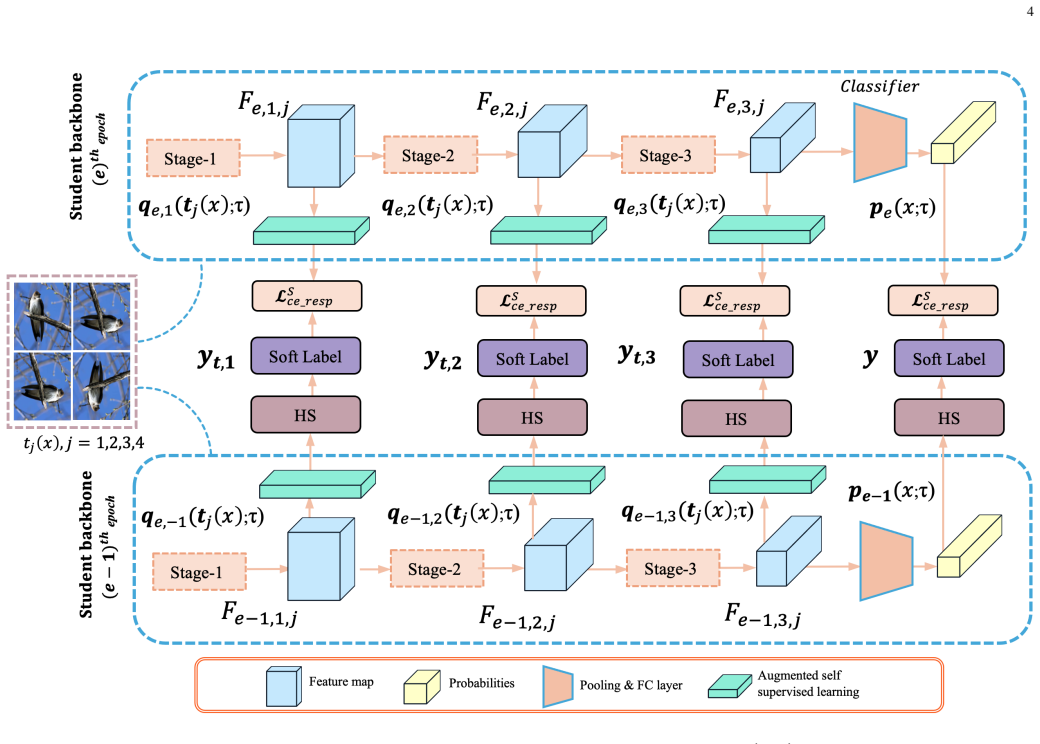
The central mechanism is the self-supervised augmented distribution (SAD), a softmax over the joint N×M label space formed by pairing the original class labels with self-supervised transformations, combined with hierarchical label softening: each auxiliary classifier's previous-epoch SAD is blended with the one-hot target to build a progressively refined soft label. Supporting this are two cross-stage losses, a KL divergence from deeper to shallower classifiers and an L2 feature-consistency loss, which make earlier stages imitate later ones during training.
What would settle it
A faithful reproduction of the training pipeline on CIFAR-100 with the exact equations and hyperparameters (α=0.8, β=0.1, γ=0.1) would settle the central claim: if the cross-entropy in Eq. (5) raises a shape mismatch because q has N×M classes and y_S has N classes, or if the reported 72.45% top-1 accuracy is not recovered, the objective or the accuracy claim fails.
Extended reading notes
Core claim
LSSKD trains a compact student by appending an auxiliary classifier after each bottleneck stage, each producing a Self-supervised Augmented Distribution (SAD) over the joint label space of N original and M transformed classes. The training objective combines hierarchical softened labels (a convex blend of one-hot targets and the previous epoch's stage-wise predictions) with two self-distillation terms: a KL divergence that makes shallow classifiers mimic the deepest classifier's SAD, and an L2 loss that aligns average-pooled feature maps from earlier stages with those of the last stage. The paper reports average top-1 gains of 4.54% over PS-KD and 1.14% over SSKD on CIFAR-100, a 0.32% gain over HASSKD on ImageNet, and consistent improvements across lightweight backbones and few-shot regimes. All auxiliary branches are discarded at inference, so the final model carries no extra parameters or computation.
Load-bearing premise
The method assumes the hierarchical loss in Eq. (5) is a computable cross-entropy, but as written the prediction is over N×M classes while the soft label is over N classes, and the paper never defines the matching N×M target, so the objective may not be implementable literally.
Editorial extensions
If this is right
- On CIFAR-100, LSSKD reaches 72.45% top-1 with a ResNet-18 student, exceeding the teacher-based KD baseline by roughly 1.8 points and surpassing SSKD and PS-KD by 1.14% and 4.54% respectively, without any pre-trained teacher.
- The same recipe transfers to ImageNet, yielding a 0.32% top-1 improvement over HASSKD with a ResNet-18 student.
- Under data scarcity, LSSKD beats KD, CRD, and SSKD at 25%, 50%, and 75% training-data fractions on CIFAR-100 and Tiny-ImageNet, which is relevant for low-label edge settings.
- Because all auxiliary classifiers are removed before deployment, the inference-time model has the same cost and parameter count as the baseline student, making the gains essentially free during inference.
- Stage-wise auxiliary classifiers themselves improve, indicating that intermediate representations receive useful supervision from the deepest classifier, not just the final output.
Reading between the lines
- If the reported gains survive independent reproduction, the core insight is that stage-wise auxiliary classifiers can act as pure training-time regularizers, effectively turning any staged backbone into its own teacher, which could extend beyond CNNs to transformers with stage-wise heads.
- The label-space inconsistency in Eq. (5) — a cross-entropy between an N×M prediction and an N-class soft label — suggests the published objective is incomplete; a corrected implementation would likely need an expanded N×M soft target, which could change the loss and possibly the measured gains.
- Because the self-supervised transformation mechanism is modality-agnostic in principle, applying the same staged-distillation recipe to audio or radar streams with modality-specific augmentations is a natural testbed for the paper's multimodal and cyber-physical deployment claims.
Editorial analysis
A structured set of objections, weighed in public.
Referee Report
Summary. The paper proposes LSSKD, a teacher-free self-distillation framework that appends auxiliary classifiers to each network stage, generates 'self-supervised augmented distributions' over an N×M transformed label space, softens targets with past-epoch predictions, and combines hierarchical cross-entropy, KL divergence, and L2 feature losses. It reports state-of-the-art CIFAR-100 and Tiny-ImageNet few-shot results, claims a 4.54% average improvement over PS-KD and 1.14% over SSKD on CIFAR-100, and asserts a 0.32% ImageNet gain over HASSKD, with all auxiliary classifiers removable at inference.
Significance. If the reported results were reproducible, the framework would be a useful contribution to efficient and edge-oriented training: it removes the need for a pretrained teacher, adds no inference cost after removing auxiliary branches, and includes a broad architecture sweep plus few-shot experiments. However, the central training objective is not well-defined as written, the headline accuracy margins are inconsistent with the tables, and the ImageNet claim is not backed by a table. These issues prevent the central claims from being verified from the submitted manuscript, despite the potentially useful components of the approach.
major comments (5)
- [Section III-C, Eq. (5)] The central hierarchical SAD loss is not well-defined as written. In Eq. (5), L_{S,ce}^{heir-SAD} computes cross-entropy between q_S^{e,l}(t_j(x);τ), which is an N×M-dimensional self-supervised augmented distribution, and y_S, which Eq. (1) defines as a soft target over the N original classes. Cross-entropy requires the prediction and target to share the same class space, so Eq. (5) cannot be implemented unless an N×M target is specified. The symbol y_{S,t,l}^{(2)} is mentioned as such a target but is never defined, and Eq. (2)'s y_{S,t,l} is not used in Eq. (5). If the intended target is y_S, all self-supervision dimensions are discarded and the hierarchical loss degenerates; if it is y_{S,t,l}^{(2)}, its construction must be given. Because every reported accuracy in Tables I–IV is produced by the total loss built from Eq. (5), the empirical results cannot be verified from the submitted text.
- [Abstract and Section IV-B] The headline margins are not supported by the tables. The abstract reports a 4.54% average improvement over PS-KD and a 1.14% gain over SSKD on CIFAR-100, and Section IV-B repeats the 4.54% figure but attributes it to SSKD. Reading the tables directly, the average difference against PS-KD in Table III is (3.98+1.67+4.06)/3 ≈ 3.24%, and the average difference against SSKD in Table II is (0.73+2.51+1.87+0.44+0.74+1.79)/6 ≈ 1.35%. Neither matches the claimed values. These discrepancies concern the paper's central claim and must be reconciled with the actual experimental records.
- [Section IV-B, ImageNet claim] The claimed ImageNet improvement is not verifiable from any table. Section IV-B states that LSSKD yields a top-1 gain of 0.33% on ImageNet using ResNet-18 for both teacher and student and refers to 'Table IV-B', but no ImageNet table appears in the manuscript; Table IV is a CIFAR-100 baseline comparison. The abstract's 0.32% ImageNet gain over HASSKD is therefore an unsupported assertion. The authors should add the missing experiment table with the comparison method and standard deviations.
- [Section V-A, Table IV] The baseline numbers in Table IV are inconsistent with Table II and the method identity is ambiguous. Table IV reports a WRN-16-2 baseline of 76.77, while Table II reports the same WRN-16-2 baseline as 73.57, making the claimed +6.39% gain untrustworthy. The table also labels the proposed method 'MSAKD' instead of LSSKD, as do Table III and Table IV's caption. This naming inconsistency further obscures whether the reported results were produced by the method described in Section III.
- [Section III-D, Eq. (8)] The feature-consistency loss in Eq. (8) is not dimension-safe. It computes an L2 norm between F_t^l, the average-pooled feature of the l-th bottleneck stage, and F_t^o, the average-pooled feature of the last layer, but the manuscript does not specify the channel dimensions of these tensors or any projection that makes them commensurate. Bottleneck stages in ResNet-type networks have different channel counts, so without an explicit alignment the loss is undefined or at least architecture-dependent. Please specify the pooling and projection used to implement Eq. (8).
minor comments (4)
- [Abstract, Introduction, Section VI] The abstract and conclusion state that LSSKD is suitable for deploying small language models and multimodal sensing, but Section VI explicitly lists task generalization beyond image classification as future work, and the experiments cover only image classification. Please either add supporting experiments or remove the unsupported deployment claims.
- [Throughout] The method name is inconsistent: the title and body use 'LSSKD', while Tables III and IV call the proposed method 'MSAKD' and Table II refers to 'HSSAKD' for a baseline that appears as 'HASSKD' in the related work. Please unify the nomenclature and citation aliases.
- [Section III-D, total loss] The total loss expression L_T = (1−β)·L_ce^resp + L_ce^heir + β·L_div + γ·L_feat applies the (1−β) weight only to L_ce^resp, even though L_S^LS is defined as L_ce^resp + L_ce^heir. Please clarify the intended weighting of the hierarchical cross-entropy term.
- [Section IV-B and Table III] The text says the gain over PS-KD is 4.56% in one place and 4.54% in the abstract; the abstract also says 0.32% ImageNet gain while Section IV-B says 0.33%. Please make the reported numbers consistent.
Circularity Check
No significant circularity: the empirical claims are evaluated on held-out test data, and the self-distillation objective is a training mechanism, not a derivation of the reported results from the results themselves.
full rationale
The paper's central claims are empirical accuracy numbers on CIFAR-100, ImageNet, and Tiny-ImageNet, measured on test sets after training with a fixed objective. The method is a self-knowledge-distillation framework in which the student uses its own previous-epoch predictions, augmented distributions, and feature maps as training targets; this is a training procedure, not a circular derivation of a predicted quantity from a fitted input. Hyperparameters α, β, and γ are stated to be tuned on a 10% held-out validation split, so they are not fit to the test results used for comparison. The reported comparisons against PS-KD, SSKD, HASSKD, and other baselines use consistent training pipelines and standard datasets. The notable formal defect in the paper, Eq. (5), compares an N×M self-supervised augmented distribution to the N-dimensional soft label y_S, and the symbol y_{S,t,l}^{(2)} is mentioned but never defined; this is an implementability and correctness issue, not a circularity issue, because it does not make the reported accuracies equal to the inputs by construction. No load-bearing self-citation or imported-uniqueness argument appears. Accordingly, no circular step can be identified under the required standard of quoting a specific reduction of a result to its own input.
Assumptions & free parameters
free parameters (4)
- alpha (α) =
0.8
- beta (β) =
0.1
- gamma (γ) =
0.1
- temperature (tau) =
not reported
assumptions (5)
- domain assumption Auxiliary classifiers at intermediate stages produce useful supervision signals.
- domain assumption The deepest classifier generalizes better and can supervise shallower classifiers.
- domain assumption Previously-epoch predictions can serve as stable soft targets.
- domain assumption Feature maps from different stages can be compared with L2 loss.
- domain assumption Rotation-based self-supervision transfers to classification.
invented entities (1)
-
Self-supervised Augmented Distributions (SADs)
Cite this review
Pith. "Pith review of A Layered Self-Supervised Knowledge Distillation Framework for Efficient Multimodal Learning on the Edge." pith.science (2026). https://pith.science/paper/ZZHU5YEQ
@misc{pith2026250607055,
  author       = {Pith},
  title        = {Pith review of: A Layered Self-Supervised Knowledge Distillation Framework for Efficient Multimodal Learning on the Edge},
  year         = {2026},
  howpublished = {\url{https://pith.science/paper/ZZHU5YEQ}},
  note         = {Machine review of arXiv:2506.07055}
}
read the original abstract
We introduce Layered Self-Supervised Knowledge Distillation (LSSKD) framework for training compact deep learning models. Unlike traditional methods that rely on pre-trained teacher networks, our approach appends auxiliary classifiers to intermediate feature maps, generating diverse self-supervised knowledge and enabling one-to-one transfer across different network stages. Our method achieves an average improvement of 4.54\% over the state-of-the-art PS-KD method and a 1.14% gain over SSKD on CIFAR-100, with a 0.32% improvement on ImageNet compared to HASSKD. Experiments on Tiny ImageNet and CIFAR-100 under few-shot learning scenarios also achieve state-of-the-art results. These findings demonstrate the effectiveness of our approach in enhancing model generalization and performance without the need for large over-parameterized teacher networks. Importantly, at the inference stage, all auxiliary classifiers can be removed, yielding no extra computational cost. This makes our model suitable for deploying small language models on affordable low-computing devices. Owing to its lightweight design and adaptability, our framework is particularly suitable for multimodal sensing and cyber-physical environments that require efficient and responsive inference. LSSKD facilitates the development of intelligent agents capable of learning from limited sensory data under weak supervision.
Figures


Figures from the paper (3 more)


Reference graph
Works this paper leans on
-
[1]
Data augmentation for improving deep learning in image classification problem,
A. Mikołajczyk and M. Grochowski, “Data augmentation for improving deep learning in image classification problem,” in 2018 international interdisciplinary PhD workshop (IIPhDW) . IEEE, 2018, pp. 117–122
work page 2018
-
[2]
Capan: Class-aware prototypical adversarial net- works for unsupervised domain adaptation,
Z. Yu and P. Wang, “Capan: Class-aware prototypical adversarial net- works for unsupervised domain adaptation,” in 2024 IEEE International Conference on Multimedia and Expo (ICME) . IEEE, 2024, pp. 1–6
work page 2024
-
[3]
Multi-batch nuclear-norm adversarial net- work for unsupervised domain adaptation,
P. Wang, Y . Yang, and Z. Yu, “Multi-batch nuclear-norm adversarial net- work for unsupervised domain adaptation,” in 2024 IEEE International Conference on Multimedia and Expo (ICME) . IEEE, 2024, pp. 1–6
work page 2024
-
[4]
Object detection with deep learning: A review,
Z.-Q. Zhao, P. Zheng, S.-t. Xu, and X. Wu, “Object detection with deep learning: A review,” IEEE transactions on neural networks and learning systems, vol. 30, no. 11, pp. 3212–3232, 2019
2019
-
[5]
Evaluation-oriented knowledge distillation for deep face recognition,
Y . Huang, J. Wu, X. Xu, and S. Ding, “Evaluation-oriented knowledge distillation for deep face recognition,” in Proceedings of the IEEE/CVF Conference on Computer Vision and Pattern Recognition , 2022, pp. 18 740–18 749
work page 2022
-
[6]
F. Zhang, X. Zhu, and M. Ye, “Fast human pose estimation,” in Pro- ceedings of the IEEE/CVF conference on computer vision and pattern recognition, 2019, pp. 3517–3526
work page 2019
-
[7]
Semantics-aware adaptive knowledge distillation for sensor-to-vision action recognition,
Y . Liu, K. Wang, G. Li, and L. Lin, “Semantics-aware adaptive knowledge distillation for sensor-to-vision action recognition,” IEEE Transactions on Image Processing , vol. 30, pp. 5573–5588, 2021
work page 2021
-
[8]
A survey on deep learn- ing techniques for image and video semantic segmentation,
A. Garcia-Garcia, S. Orts-Escolano, S. Oprea, V . Villena-Martinez, P. Martinez-Gonzalez, and J. Garcia-Rodriguez, “A survey on deep learn- ing techniques for image and video semantic segmentation,” Applied Soft Computing, vol. 70, pp. 41–65, 2018
work page 2018
Show all 79 references
-
[9]
Pixel representation augmented through cross-attention for high-resolution remote sensing imagery segmentation,
Y . Luo, J. Wang, X. Yang, Z. Yu, and Z. Tan, “Pixel representation augmented through cross-attention for high-resolution remote sensing imagery segmentation,” Remote Sensing, vol. 14, no. 21, p. 5415, 2022
2022
-
[10]
The com- putational limits of deep learning,
N. C. Thompson, K. Greenewald, K. Lee, and G. F. Manso, “The com- putational limits of deep learning,” arXiv preprint arXiv:2007.05558 , 2020
2007 arXiv
-
[11]
Compute-in-memory chips for deep learning: Recent trends and prospects,
S. Yu, H. Jiang, S. Huang, X. Peng, and A. Lu, “Compute-in-memory chips for deep learning: Recent trends and prospects,” IEEE circuits and systems magazine, vol. 21, no. 3, pp. 31–56, 2021
2021
-
[12]
Energy and policy con- siderations for modern deep learning research,
E. Strubell, A. Ganesh, and A. McCallum, “Energy and policy con- siderations for modern deep learning research,” in Proceedings of the AAAI conference on artificial intelligence , vol. 34, no. 09, 2020, pp. 13 693–13 696
2020
-
[13]
Edge-computing based knowledge distillation and multi- task learning for partial discharge recognition,
J. Ji, Z. Shu, H. Li, K. X. Lai, M. Lu, G. Jiang, W. Wang, Y . Zheng, and X. Jiang, “Edge-computing based knowledge distillation and multi- task learning for partial discharge recognition,” IEEE Transactions on Instrumentation and Measurement , 2024
2024
-
[14]
Dpal-bert: A faster and lighter ques- tion answering model
L. Yin, L. Wang, Z. Cai, S. Lu, R. Wang, A. AlSanad, S. A. AlQahtani, X. Chen, Z. Yin, X. Li et al. , “Dpal-bert: A faster and lighter ques- tion answering model.” CMES-Computer Modeling in Engineering & Sciences, vol. 141, no. 1, 2024
2024
-
[15]
Learning both weights and con- nections for efficient neural network,
S. Han, J. Pool, J. Tran, and W. Dally, “Learning both weights and con- nections for efficient neural network,” Advances in neural information processing systems, vol. 28, 2015
2015
-
[16]
Quantized convolutional neural networks for mobile devices,
J. Wu, C. Leng, Y . Wang, Q. Hu, and J. Cheng, “Quantized convolutional neural networks for mobile devices,” in Proceedings of the IEEE conference on computer vision and pattern recognition, 2016, pp. 4820– 4828
2016
-
[17]
Model compression,
C. Bucilu ˇa, R. Caruana, and A. Niculescu-Mizil, “Model compression,” in Proceedings of the 12th ACM SIGKDD international conference on Knowledge discovery and data mining , 2006, pp. 535–541
2006
-
[18]
Self-knowledge distillation with progressive refinement of targets,
K. Kim, B. Ji, D. Yoon, and S. Hwang, “Self-knowledge distillation with progressive refinement of targets,” in Proceedings of the IEEE/CVF International Conference on Computer Vision , 2021, pp. 6567–6576
2021
-
[19]
Simplifying neural networks by soft weight sharing,
S. J. Nowlan and G. E. Hinton, “Simplifying neural networks by soft weight sharing,” in The Mathematics of Generalization . CRC Press, 2018, pp. 373–394
2018
-
[20]
Dropout: a simple way to prevent neural networks from over- fitting,
N. Srivastava, G. Hinton, A. Krizhevsky, I. Sutskever, and R. Salakhut- dinov, “Dropout: a simple way to prevent neural networks from over- fitting,” The journal of machine learning research , vol. 15, no. 1, pp. 1929–1958, 2014
1929
-
[21]
Batch normalization: Accelerating deep network training by reducing internal covariate shift,
S. Ioffe and C. Szegedy, “Batch normalization: Accelerating deep network training by reducing internal covariate shift,” in International conference on machine learning . pmlr, 2015, pp. 448–456
2015
-
[22]
Improved regularization of convolutional neural networks with cutout,
T. DeVries and G. W. Taylor, “Improved regularization of convolutional neural networks with cutout,” arXiv preprint arXiv:1708.04552 , 2017
2017 arXiv
-
[23]
Distilling the knowledge in a neural network,
G. Hinton, O. Vinyals, and J. Dean, “Distilling the knowledge in a neural network,” arXiv preprint arXiv:1503.02531 , 2015
2015 arXiv
-
[24]
Improved implicit diffusion model with knowledge distillation to estimate the spatial distribution density of carbon stock in remote sensing imagery,
Z. Yu, “Improved implicit diffusion model with knowledge distillation to estimate the spatial distribution density of carbon stock in remote sensing imagery,” arXiv preprint arXiv:2411.17973 , 2024
2024 arXiv
-
[25]
Paying more attention to attention: Improving the performance of convolutional neural networks via atten- tion transfer,
S. Zagoruyko and N. Komodakis, “Paying more attention to attention: Improving the performance of convolutional neural networks via atten- tion transfer,” arXiv preprint arXiv:1612.03928 , 2016
2016 arXiv
-
[26]
Hierarchical self-supervised augmented knowledge distillation,
C. Yang, Z. An, L. Cai, and Y . Xu, “Hierarchical self-supervised augmented knowledge distillation,” arXiv preprint arXiv:2107.13715 , 2021
2021 arXiv
-
[27]
Knowledge distillation using hierarchical self-supervision aug- mented distribution,
——, “Knowledge distillation using hierarchical self-supervision aug- mented distribution,” IEEE Transactions on Neural Networks and Learn- ing Systems, 2022
2022
-
[28]
Knowledge distillation beyond model compression,
F. Sarfraz, E. Arani, and B. Zonooz, “Knowledge distillation beyond model compression,” in 2020 25th International Conference on Pattern Recognition (ICPR). IEEE, 2021, pp. 6136–6143
2020
-
[29]
Reffakd: Resource-efficient autoencoder-based knowledge distillation,
D. Doshi and J.-E. Kim, “Reffakd: Resource-efficient autoencoder-based knowledge distillation,” arXiv preprint arXiv:2404.09886 , 2024
2024 arXiv
-
[30]
Constructing three-way decision with fuzzy granular-ball rough sets based on uncertainty invariance,
J. Yang, Z. Liu, G. Wang, Q. Zhang, S. Xia, D. Wu, and Y . Liu, “Constructing three-way decision with fuzzy granular-ball rough sets based on uncertainty invariance,” IEEE Transactions on Fuzzy Systems , 2025
2025
-
[31]
Unifying dis- tillation and privileged information,
D. Lopez-Paz, L. Bottou, B. Sch ¨olkopf, and V . Vapnik, “Unifying dis- tillation and privileged information,” arXiv preprint arXiv:1511.03643 , 2015
2015 arXiv
-
[32]
Online knowledge distillation with diverse peers,
D. Chen, J.-P. Mei, C. Wang, Y . Feng, and C. Chen, “Online knowledge distillation with diverse peers,” in Proceedings of the AAAI conference on artificial intelligence , vol. 34, no. 04, 2020, pp. 3430–3437
2020
-
[33]
Densely guided knowledge distillation using multiple teacher assistants,
W. Son, J. Na, J. Choi, and W. Hwang, “Densely guided knowledge distillation using multiple teacher assistants,” in Proceedings of the IEEE/CVF International Conference on Computer Vision , 2021, pp. 9395–9404
2021
-
[34]
Continual learning with knowl- edge distillation: A survey,
S. Li, T. Su, X. Zhang, and Z. Wang, “Continual learning with knowl- edge distillation: A survey,” Authorea Preprints, 2024
2024
-
[35]
Dynamic contrastive distillation for image-text retrieval,
J. Rao, L. Ding, S. Qi, M. Fang, Y . Liu, L. Shen, and D. Tao, “Dynamic contrastive distillation for image-text retrieval,” IEEE Transactions on Multimedia, vol. 25, pp. 8383–8395, 2023
2023
-
[36]
Knowledge distillation: A survey,
J. Gou, B. Yu, S. J. Maybank, and D. Tao, “Knowledge distillation: A survey,” International Journal of Computer Vision , vol. 129, no. 6, pp. 1789–1819, 2021
2021
-
[37]
A survey on large language models: Applications, challenges, limitations, and practical usage,
M. U. Hadi, R. Qureshi, A. Shah, M. Irfan, A. Zafar, M. B. Shaikh, N. Akhtar, J. Wu, S. Mirjalili et al., “A survey on large language models: Applications, challenges, limitations, and practical usage,” Authorea Preprints, 2023
2023
-
[38]
A survey on knowledge distillation of large language models,
X. Xu, M. Li, C. Tao, T. Shen, R. Cheng, J. Li, C. Xu, D. Tao, and T. Zhou, “A survey on knowledge distillation of large language models,” arXiv preprint arXiv:2402.13116 , 2024
2024 arXiv
-
[39]
Gpt-4 technical report,
J. Achiam, S. Adler, S. Agarwal, L. Ahmad, I. Akkaya, F. L. Aleman, D. Almeida, J. Altenschmidt, S. Altman, S. Anadkat et al. , “Gpt-4 technical report,” arXiv preprint arXiv:2303.08774 , 2023
2023 arXiv
-
[40]
Llama 2: Open foundation and fine-tuned chat models,
H. Touvron, L. Martin, K. Stone, P. Albert, A. Almahairi, Y . Babaei, N. Bashlykov, S. Batra, P. Bhargava, S. Bhosale et al. , “Llama 2: Open foundation and fine-tuned chat models,” arXiv preprint arXiv:2307.09288, 2023
2023 arXiv
-
[41]
Mistral–a journey towards reproducible language model training,
S. Karamcheti, L. Orr, J. Bolton, T. Zhang, K. Goel, A. Narayan, R. Bommasani, D. Narayanan, T. Hashimoto, D. Jurafsky et al. , “Mistral–a journey towards reproducible language model training,” 2021. 9
2021
-
[42]
On the efficacy of knowledge distillation,
J. H. Cho and B. Hariharan, “On the efficacy of knowledge distillation,” in Proceedings of the IEEE/CVF international conference on computer vision, 2019, pp. 4794–4802
2019
-
[43]
Curiosity-bottleneck: Exploration by distilling task-specific novelty,
Y . Kim, W. Nam, H. Kim, J.-H. Kim, and G. Kim, “Curiosity-bottleneck: Exploration by distilling task-specific novelty,” in International confer- ence on machine learning . PMLR, 2019, pp. 3379–3388
2019
-
[44]
Learning efficient vision transformers via fine-grained manifold distil- lation,
Z. Hao, J. Guo, D. Jia, K. Han, Y . Tang, C. Zhang, H. Hu, and Y . Wang, “Learning efficient vision transformers via fine-grained manifold distil- lation,” Advances in Neural Information Processing Systems , vol. 35, pp. 9164–9175, 2022
2022
-
[45]
Robust overfitting may be mitigated by properly learned smoothening,
T. Chen, Z. Zhang, S. Liu, S. Chang, and Z. Wang, “Robust overfitting may be mitigated by properly learned smoothening,” in International Conference on Learning Representations , 2020
2020
-
[46]
Varia- tional information distillation for knowledge transfer,
S. Ahn, S. X. Hu, A. Damianou, N. D. Lawrence, and Z. Dai, “Varia- tional information distillation for knowledge transfer,” in Proceedings of the IEEE/CVF Conference on Computer Vision and Pattern Recognition, 2019, pp. 9163–9171
2019
-
[47]
Relational knowledge distilla- tion,
W. Park, D. Kim, Y . Lu, and M. Cho, “Relational knowledge distilla- tion,” in Proceedings of the IEEE/CVF Conference on Computer Vision and Pattern Recognition, 2019, pp. 3967–3976
2019
-
[48]
Similarity-preserving knowledge distillation,
F. Tung and G. Mori, “Similarity-preserving knowledge distillation,” in Proceedings of the IEEE/CVF international conference on computer vision, 2019, pp. 1365–1374
2019
-
[49]
Fitnets: Hints for thin deep nets,
R. Adriana, B. Nicolas, K. S. Ebrahimi, C. Antoine, G. Carlo, and B. Yoshua, “Fitnets: Hints for thin deep nets,” Proc. ICLR, vol. 2, no. 3, p. 1, 2015
2015
-
[50]
A gift from knowledge distillation: Fast optimization, network minimization and transfer learning,
J. Yim, D. Joo, J. Bae, and J. Kim, “A gift from knowledge distillation: Fast optimization, network minimization and transfer learning,” in Proceedings of the IEEE conference on computer vision and pattern recognition, 2017, pp. 4133–4141
2017
-
[51]
Knowledge transfer via distillation of activation boundaries formed by hidden neurons,
B. Heo, M. Lee, S. Yun, and J. Y . Choi, “Knowledge transfer via distillation of activation boundaries formed by hidden neurons,” in Proceedings of the AAAI Conference on Artificial Intelligence , vol. 33, no. 01, 2019, pp. 3779–3787
2019
-
[52]
Deeply-supervised nets,
C.-Y . Lee, S. Xie, P. Gallagher, Z. Zhang, and Z. Tu, “Deeply-supervised nets,” in Artificial intelligence and statistics . Pmlr, 2015, pp. 562–570
2015
-
[53]
Knowl- edge distillation with the reused teacher classifier,
D. Chen, J.-P. Mei, H. Zhang, C. Wang, Y . Feng, and C. Chen, “Knowl- edge distillation with the reused teacher classifier,” in Proceedings of the IEEE/CVF conference on computer vision and pattern recognition , 2022, pp. 11 933–11 942
2022
-
[54]
Knowledge distillation with deep su- pervision,
S. Luo, D. Chen, and C. Wang, “Knowledge distillation with deep su- pervision,” in 2023 International Joint Conference on Neural Networks (IJCNN). IEEE, 2023, pp. 1–8
2023
-
[55]
Contrastive representation distilla- tion,
Y . Tian, D. Krishnan, and P. Isola, “Contrastive representation distilla- tion,” arXiv preprint arXiv:1910.10699 , 2019
1910 arXiv
-
[56]
Sskd: Self- supervised knowledge distillation for cross domain adaptive person re- identification,
W. Liu, S. Nie, J. Yin, R. Wang, D. Gao, and L. Jin, “Sskd: Self- supervised knowledge distillation for cross domain adaptive person re- identification,” in 2021 7th IEEE International Conference on Network Intelligence and Digital Content (IC-NIDC) . IEEE, 2021, pp. 81–85
2021
-
[57]
A simple framework for contrastive learning of visual representations,
T. Chen, S. Kornblith, M. Norouzi, and G. Hinton, “A simple framework for contrastive learning of visual representations,” in International conference on machine learning . PMLR, 2020, pp. 1597–1607
2020
-
[58]
Revisiting knowledge distillation via label smoothing regularization,
L. Yuan, F. E. Tay, G. Li, T. Wang, and J. Feng, “Revisiting knowledge distillation via label smoothing regularization,” in Proceedings of the IEEE/CVF Conference on Computer Vision and Pattern Recognition , 2020, pp. 3903–3911
2020
-
[59]
Regularizing class-wise predictions via self-knowledge distillation,
S. Yun, J. Park, K. Lee, and J. Shin, “Regularizing class-wise predictions via self-knowledge distillation,” in Proceedings of the IEEE/CVF con- ference on computer vision and pattern recognition , 2020, pp. 13 876– 13 885
2020
-
[60]
Scale fusion light cnn for hyperspectral face recognition with knowledge distillation and attention mechanism,
J.-Y . Niu, Z.-H. Xie, Y . Li, S.-J. Cheng, and J.-W. Fan, “Scale fusion light cnn for hyperspectral face recognition with knowledge distillation and attention mechanism,” Applied Intelligence, vol. 52, no. 6, pp. 6181– 6195, 2022
2022
-
[61]
Knowledge distillation meets self- supervision,
G. Xu, Z. Liu, X. Li, and C. C. Loy, “Knowledge distillation meets self- supervision,” in European conference on computer vision . Springer, 2020, pp. 588–604
2020
-
[62]
Learning from multiple teacher networks,
S. You, C. Xu, C. Xu, and D. Tao, “Learning from multiple teacher networks,” in Proceedings of the 23rd ACM SIGKDD international conference on knowledge discovery and data mining , 2017, pp. 1285– 1294
2017
-
[63]
Identity mappings in deep residual networks,
K. He, X. Zhang, S. Ren, and J. Sun, “Identity mappings in deep residual networks,” in Computer Vision–ECCV 2016: 14th European Conference, Amsterdam, The Netherlands, October 11–14, 2016, Proceedings, Part IV 14. Springer, 2016, pp. 630–645
2016
-
[64]
Learning multiple layers of features from tiny images,
A. Krizhevsky, G. Hinton et al. , “Learning multiple layers of features from tiny images,” 2009
2009
-
[65]
Imagenet classification with deep convolutional neural networks,
A. Krizhevsky, I. Sutskever, and G. E. Hinton, “Imagenet classification with deep convolutional neural networks,” Advances in neural informa- tion processing systems , vol. 25, 2012
2012
-
[66]
Tiny imagenet visual recognition challenge,
Y . Le and X. Yang, “Tiny imagenet visual recognition challenge,” CS 231N, vol. 7, no. 7, p. 3, 2015
2015
-
[67]
Deep residual learning for image recognition,
K. He, X. Zhang, S. Ren, and J. Sun, “Deep residual learning for image recognition,” in Proceedings of the IEEE conference on computer vision and pattern recognition , 2016, pp. 770–778
2016
-
[68]
Wide residual networks,
S. Zagoruyko and N. Komodakis, “Wide residual networks,” arXiv preprint arXiv:1605.07146, 2016
2016 arXiv
-
[69]
Aggregated residual transformations for deep neural networks,
S. Xie, R. Girshick, P. Doll ´ar, Z. Tu, and K. He, “Aggregated residual transformations for deep neural networks,” in Proceedings of the IEEE conference on computer vision and pattern recognition, 2017, pp. 1492– 1500
2017
-
[70]
Very deep convolutional networks for large-scale image recognition,
K. Simonyan and A. Zisserman, “Very deep convolutional networks for large-scale image recognition,” arXiv preprint arXiv:1409.1556 , 2014
2014 arXiv
-
[71]
Mobilenetv2: Inverted residuals and linear bottlenecks,
M. Sandler, A. Howard, M. Zhu, A. Zhmoginov, and L.-C. Chen, “Mobilenetv2: Inverted residuals and linear bottlenecks,” in Proceedings of the IEEE conference on computer vision and pattern recognition , 2018, pp. 4510–4520
2018
-
[72]
Shufflenet v2: Practical guidelines for efficient cnn architecture design,
N. Ma, X. Zhang, H.-T. Zheng, and J. Sun, “Shufflenet v2: Practical guidelines for efficient cnn architecture design,” in Proceedings of the European conference on computer vision (ECCV) , 2018, pp. 116–131
2018
-
[73]
Shufflenet: An extremely effi- cient convolutional neural network for mobile devices,
X. Zhang, X. Zhou, M. Lin, and J. Sun, “Shufflenet: An extremely effi- cient convolutional neural network for mobile devices,” in Proceedings of the IEEE conference on computer vision and pattern recognition , 2018, pp. 6848–6856
2018
-
[74]
Correlation congruence for knowledge distillation,
B. Peng, X. Jin, J. Liu, D. Li, Y . Wu, Y . Liu, S. Zhou, and Z. Zhang, “Correlation congruence for knowledge distillation,” in Proceedings of the IEEE/CVF International Conference on Computer Vision , 2019, pp. 5007–5016
2019
-
[75]
Knowledge distillation using hierarchical self-supervision augmented distribution,
C. Yang, Z. An, L. Cai, and Y . Xu, “Knowledge distillation using hierarchical self-supervision augmented distribution,”IEEE Transactions on Neural Networks and Learning Systems , vol. 35, no. 2, pp. 2094– 2108, 2024
2024
-
[76]
Multi-mode online knowledge distillation for self-supervised visual representation learning,
K. Song, J. Xie, S. Zhang, and Z. Luo, “Multi-mode online knowledge distillation for self-supervised visual representation learning,” in Pro- ceedings of the IEEE/CVF Conference on Computer Vision and Pattern Recognition, 2023, pp. 11 848–11 857
2023
-
[77]
Cross-layer distillation with semantic calibration,
D. Chen, J.-P. Mei, Y . Zhang, C. Wang, Z. Wang, Y . Feng, and C. Chen, “Cross-layer distillation with semantic calibration,” in AAAI Conference on Artificial Intelligence , 2020. [Online]. Available: https://api.semanticscholar.org/CorpusID:227335337
2020
-
[78]
Rethinking the inception architecture for computer vision,
C. Szegedy, V . Vanhoucke, S. Ioffe, J. Shlens, and Z. Wojna, “Rethinking the inception architecture for computer vision,” in Proceedings of the IEEE conference on computer vision and pattern recognition , 2016, pp. 2818–2826
2016
-
[79]
Cutmix: Reg- ularization strategy to train strong classifiers with localizable features,
S. Yun, D. Han, S. J. Oh, S. Chun, J. Choe, and Y . Yoo, “Cutmix: Reg- ularization strategy to train strong classifiers with localizable features,” in Proceedings of the IEEE/CVF international conference on computer vision, 2019, pp. 6023–6032
2019
Reviewed August 7, 2026 · model on record in the stance chip above.
Discussion (0). Sign in to comment.