REVIEW 2 major objections 7 minor 18 references
Prime the search: Using large language models for guiding geometric task and motion planning by warm-starting tree search
T0 review · 2 major / 7 minor · reviewed 2026-08-07 · deepseek-v4-flash
Pith's one-line read STaLM shows that a single batch of LLM task plans, warm-started into a hybrid-action Monte Carlo tree search, solves six geometric task-and-motion planning problems at success rates of 0.84 to 1.00.
desk verdict Solid systems paper on LLM-guided G-TAMP, but the warm-start mechanism itself is not directly ablated and the stats are thin. read the letter →
The pith
A machine-rendered reading of the paper's core claim, the machinery that carries it, and where it could break.
The reading
What carries the argument
The load-bearing machinery is a predicate-based prompt plus a hybrid-action tree search that is warm-started with the LLM's explored nodes. The prompt computes two geometric predicates, PICKOCCLUDEDBY and PLACEOCCLUDEDBY, by sweeping the robot's motion and checking collisions against movable objects, and it relays the goal, domain descriptions, and a request to list the 'challenges' to the LLM in PDDL style. The search, WarmStartedUCT, operates on a tree with discrete nodes and continuous nodes, selects with UCT, samples continuous parameters via progressive widening, and is initialized by adding every discrete and continuous node visited while concretizing the LLM's task plans, with leaf values estimated by rollout and backed up. This lets the LLM's partial advances be recombined and extended instead of discarded.
What would settle it
Take a G-TAMP instance where no object is occluded and the only infeasibility comes from 3D shape (a large object that fits no region, or a placement region with a low ceiling), so all occlusion predicates are false. If STaLM's success rate on such problems collapses toward plain UCT, that would confirm the LLM guidance is only as good as the occlusion predicates. Also, an experiment that warms up the tree with an equal number of randomly explored nodes instead of the LLM plan's nodes would reveal whether the LLM's content or merely the extra node budget explains the reported success gap.
Extended reading notes
Core claim
On its own terms, the paper's central discovery is that binary geometric occlusion relations, computed by a motion planner and phrased in a PDDL-style prompt, are enough for an LLM to propose task plans that are mostly right, and that those plans are most useful as a warm start rather than as a command. STaLM converts the LLM's batch of discrete action sequences into explored tree nodes, then runs UCT over both discrete actions and sampled continuous parameters. The paper reports that this warm-started search succeeds on 84–100% of trials across six G-TAMP problems, outperforming pure UCT, a heuristic-guided UCT, PDDLStream, SayCan variants, iterative replanning, and LLM-MCTS, which calls the LLM on every simulation and times out everywhere. An ablation shows that removing the occlusion predicates collapses the method to near-baseline levels, and an analysis of failed LLM plans shows that the warm-started tree repairs all three observed failure modes: precondition violations, missing 3D shape understanding, and only partially achieved goals.
Load-bearing premise
The load-bearing premise is that a short list of yes/no occlusion relations, derived by motion planning, is enough geometric information for the LLM's common sense to pick a good order of object relocations; if the hard part of a problem is not occlusion but anything the predicates do not name (object shape, clearances, support), the LLM's task plan would steer the warm-started search in a misleading direction, and the paper's Limitations section concedes the predicates cannot capture such geometry.
Editorial extensions
If this is right
- If STaLM is correct, robot G-TAMP solvers need only one LLM call per problem instance, so the dominant inference cost shifts from per-node LLM queries to the one-time prompt creation and the continuous-parameter search.
- The success of warm-starting suggests that in hybrid action spaces, failed high-level plans retain searchable value; future planners can reuse partial task plans as tree seeds rather than treating them as binary successes or failures.
- The ablation results indicate that the quality of the geometric prompt, not the LLM's general reasoning ability, is the main lever, so progress in grounding shape and spatial relations into prompts should translate directly into planning success.
- Success rates of 0.84–1.00 on six problems imply the approach may transfer to other structured rearrangement domains that can be summarized by small sets of geometric predicates.
Reading between the lines
- The paper's own P5/P6 grill example suggests a boundary: where feasibility depends on non-occlusion geometry (object size, region shape), the binary predicate prompt will not tell the LLM the constraint, and the method's margin over pure search should shrink; a benchmark curated to hide all occlusion cues would test this directly.
- The warm-start effect may be mostly about giving UCT extra explored nodes; comparing WarmStartedUCT against UCT seeded with an equal number of randomly explored nodes (or nodes from a generic planner) would measure how much the LLM's content, rather than the extra node budget, contributes.
- The single-call cost structure makes the method attractive for domains where LLM inference is slow or costly, but with faster open-weight models the trade-off between re-querying and warm-starting could reverse, aligning with the paper's Llama3.1 experiment where the smaller model's plans left more work to the tree search.
Editorial analysis
A structured set of objections, weighed in public.
Referee Report
Summary. The paper proposes STaLM, a geometric task and motion planning (G-TAMP) method that uses one batched LLM query to generate task plans, concretizes them by sampling continuous parameters, and, if the concrete plans fail, warm-starts a hybrid-action UCT search with the nodes explored during concretization. The authors design a predicate-based prompt that encodes occlusion relations computed by motion planning, and they evaluate STaLM on six simulated G-TAMP problems against pure planners, learned-heuristic planners, and LLM-based planners. They report that STaLM achieves higher success rates and lower planning times than all baselines, and they analyze three types of LLM plan failures that the subsequent tree search can repair.
Significance. If the empirical claims hold, the paper makes a practical contribution by showing that a single LLM query can guide a hybrid-action tree search for G-TAMP, avoiding the repeated LLM calls of methods such as LLM-MCTS. The algorithm is clearly specified in Algorithms 1–5, the code is released, and the ablation of the prompt design (Table 4) supports the importance of geometric predicates. However, the central claimed mechanism—warm-starting the tree search with nodes explored during concretization—is not isolated by any experiment, and the success rates are reported without confidence intervals or significance tests despite multiple stochastic components. The significance of the result is therefore currently conditional on an additional ablation and on statistical reporting.
major comments (2)
- [4.3, Tables 2 and 3] The paper's central claim, reflected in the title and abstract, is that warm-starting MCTS with nodes explored while concretizing LLM task plans improves G-TAMP search. No reported experiment isolates this mechanism. The 'w/o UCT' variant in Table 3 removes the entire search phase, while the UCT baseline in Table 2 is a cold tree with Nbudget=35. Consequently, the observed gains of STaLM over plain UCT could be due to (i) the extra computation spent in QueryLLM and Concretize, (ii) the LLM's discrete action choices acting as a search prior even without tree seeding, or (iii) the warm-started nodes and value backups described in Algorithm 4. The authors should add an ablation that runs the same LLM query and Concretize phase but then performs a fresh, non-warm-started UCT with the same Nbudget and total time budget, and compare it against STaLM's WarmUpTree-initialized UCT. Without this comparison, the attribution of the performance gains to the warm-start mechanism is unsupported.
- [4.3, Tables 2–4; Appendix B] All success rates are based on 50 trials, but the evaluation has several stochastic components: LLM decoding at temperature 1, randomized continuous-parameter sampling for PICK and PLACE, and randomized progressive widening during UCT. The paper reports no confidence intervals, standard errors, or significance tests for any success rate. This matters because some differences are small; for example, in Table 3, STaLM versus STaLM w/o UCT for GPT-4 is 0.84 versus 0.78 on P3 and 0.96 versus 0.94 on P6, and the differences in Table 2 between STaLM and Iterative-Replanning are also modest on several problems. The authors should report confidence intervals or repeated-seed statistics. In addition, the hyperparameters (c=50, k_alpha=1.5, c_alpha=0.15, Nbatch=5, Nbudget=30, reward values, gamma) are fixed without sensitivity analysis, so it is unclear how robust the reported rankings are to these choices.
minor comments (7)
- [Table 4] The first two columns of Table 4 use '3' and '-' symbols that are not self-explanatory; replace them with checkmarks or explicit labels such as 'Occlusion info: yes/no' and 'Ask challenge: yes/no'.
- [Figure 5] The right panel of Figure 5 gives counts of failure types per problem, but the bars are difficult to read; add numeric labels or replace the panel with a small table.
- [Section 4.4] The discussion of the three LLM failure categories is qualitative. Since the paper argues that WarmStartedUCT repairs these failures, a quantitative breakdown showing which failure types are solved by the warm-start phase versus by the subsequent UCT would directly support the main claim.
- [Section 4.1] The sentence 'We give a reward of 3 for each AtPosition accomplished and /C06 for sampling infeasible action' appears to contain a rendering error: /C06 should probably be written as −6.
- [Algorithms 1 and 2] The symbol 'Plans' is used in Algorithm 1, line 3, and as the return value in Algorithm 2, line 15, but the capitalization is inconsistent with the pseudocode variables; unify the notation for clarity.
- [Section 4.2] The description of LLM-MCTS says 'Nbudget = 5 LLM responses' in one sentence and later says 'Nbudget is 35'; clarify whether Nbudget denotes the number of LLM calls or the number of MCTS simulations, since the two uses are confusing.
- [References] Several reference entries list future conference dates (for example, the Corl entries with 'September 27–30, 2025'); these appear to be bibliographic formatting errors and should be corrected.
Circularity Check
No circular derivation: STaLM's gains are measured empirically, and the self-cited geometric predicates are independently computed and ablated.
full rationale
The paper's central claims are empirical comparisons (Table 2) and ablations (Tables 3 and 4), not derivations from fitted constants. The LLM plans are generated from a prompt whose geometric predicates are computed by a motion planner (Section 3.2: 'we check collisions between the swept volume of the motions and movable objects'), and their contribution is directly tested by removing occlusion information in Table 4. The self-citations to Kim et al. for geometric predicates and Hcount are not load-bearing: predicates are independently computed in this paper and Hcount is only a baseline. No equation defines a predicted quantity in terms of a fitted parameter, and no uniqueness theorem or ansatz is imported from the authors' prior work to force the method's choice. The absence of an ablation that isolates warm-starting from the extra LLM-guided computation is an attribution or methodological limitation, not circularity, because the warm-started nodes are not defined in terms of the measured success rates. The paper is self-contained against external benchmarks, so the circularity score is 0.
Assumptions & free parameters
free parameters (8)
- Nbatch =
5
- Nbudget =
30
- UCT exploration constant c =
50
- PW constants (k_alpha, c_alpha) =
1.5, 0.15
- Reward values =
+3 per goal achieved, -6 for infeasible action
- Discount factor gamma =
0.99
- LLM decoding temperature =
1
- Time budgets =
300s for P1,P2,P4; 600s for P3,P5,P6
assumptions (5)
- domain assumption The world is a deterministic, fully observable MDP with known fixed object shapes and known transition model.
- domain assumption LLMs pretrained on internet-scale text possess common-sense knowledge useful for G-TAMP task planning.
- domain assumption Geometric predicates (PICKOCCLUDEDBY, PLACEOCCLUDEDBY) computed via motion-planning swept-volume collision checks capture the geometric constraints needed for planning.
- ad hoc to paper A batch of Nbatch=5 LLM plans contains at least one plan that is a useful warm-start for MCTS.
- standard math Standard UCT with progressive widening is an effective search algorithm for hybrid action spaces in this setting.
Cite this review
Pith. "Pith review of Prime the search: Using large language models for guiding geometric task and motion planning by warm-starting tree search." pith.science (2026). https://pith.science/paper/RMPYWEVX
@misc{pith2026250607062,
  author       = {Pith},
  title        = {Pith review of: Prime the search: Using large language models for guiding geometric task and motion planning by warm-starting tree search},
  year         = {2026},
  howpublished = {\url{https://pith.science/paper/RMPYWEVX}},
  note         = {Machine review of arXiv:2506.07062}
}
read the original abstract
The problem of relocating a set of objects to designated areas amidst movable obstacles can be framed as a Geometric Task and Motion Planning (G-TAMP) problem, a subclass of task and motion planning (TAMP). Traditional approaches to G-TAMP have relied either on domain-independent heuristics or on learning from planning experience to guide the search, both of which typically demand significant computational resources or data. In contrast, humans often use common sense to intuitively decide which objects to manipulate in G-TAMP problems. Inspired by this, we propose leveraging Large Language Models (LLMs), which have common sense knowledge acquired from internet-scale data, to guide task planning in G-TAMP problems. To enable LLMs to perform geometric reasoning, we design a predicate-based prompt that encodes geometric information derived from a motion planning algorithm. We then query the LLM to generate a task plan, which is then used to search for a feasible set of continuous parameters. Since LLMs are prone to mistakes, instead of committing to LLM's outputs, we extend Monte Carlo Tree Search (MCTS) to a hybrid action space and use the LLM to guide the search. Unlike the previous approach that calls an LLM at every node and incurs high computational costs, we use it to warm-start the MCTS with the nodes explored in completing the LLM's task plan. On six different G-TAMP problems, we show our method outperforms previous LLM planners and pure search algorithms. Code can be found at: https://github.com/iMSquared/prime-the-search
Figures
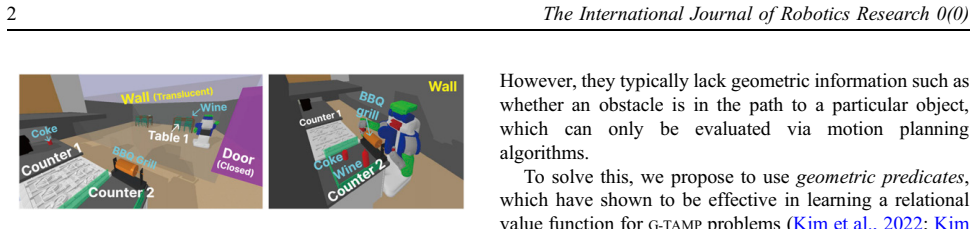


Figures from the paper (9 more)


Reference graph
Works this paper leans on
-
[1]
(2022) Do as i can, not as i say: grounding language in robotic affordances
Ahn M, Brohan A, Brown N, et al. (2022) Do as i can, not as i say: grounding language in robotic affordances. In: Conference on Robot Learning, Seoul, Korea, September 27 - 30,
work page 2022
-
[3]
Braun CV , Ortiz-Haro J, Toussaint M, et al. (2021) Rhh-lgp: Receding Horizon and Heuristics-Based Logic-Geometric Programming for Task and Motion Planning . Piscataway: 2022 IEEE/RSJ International Conference on Intelligent Ro- bots and Systems (IROS). Chen Y , Arkin J, Zhang Y , et al. (2023)Autotamp: Autoregressive Task and Motion Planning with Llms as ...
work page 2021
-
[5]
(2011) Continuous upper con fidence trees
Cou¨etoux A, Hoock JB, Sokolovska N, et al. (2011) Continuous upper con fidence trees. In: Learning and Intelligent Opti- mization. Berlin, Heidelberg: Springer Berlin Heidelberg, 433–445. Driess D, Ha JS and Toussaint M (2020a) Deep visual reasoning: learning to predict action sequences for task and motion planning from an initial scene image. Robotics: S...
work page 2011
-
[6]
In P5 and P6, the beef grill is too large to be placed inside the counter because there are green walls around the region. Therefore, if the grill is placed first, it prevents the robot from placing another object (red can in the hand) in the region. To accomplish the task, the robot must place all the other objects into the counter first and then place the...
work page 2016
-
[8]
Washington, DC: The Association for the Advancement of Arti ficial Intelligence
Katz M, Sohrabi S and Udrea O (2020) Top-quality Planning: Finding Practically Useful Sets of Best Plans . Washington, DC: The Association for the Advancement of Arti ficial Intelligence. Khodeir MNM, Agro B and Shkurti F (2021) Learning to search in task and motion planning with streams. IEEE Robotics and Automation Letters 8: 1983 –1990. Kim B and Shiman...
work page 2020
-
[9]
Washington, DC: The Association for the Advancement of Arti ficial Intelligence
Kim B, Kaelbling L and Lozano-P´erez T (2018) Guiding Search in Continuous State-Action Spaces by Learning an Action Sampler from Off-Target Search Experience . Washington, DC: The Association for the Advancement of Arti ficial Intelligence. Kim B, Wang Z, Kaelbling LP , et al. (2019) Learning to guide task and motion planning using score-space representat...
work page 2018
-
[10]
(2023) Learning efficient abstract planning models that choose what to predict
Kumar N, McClinton W, Chitnis R, et al. (2023) Learning efficient abstract planning models that choose what to predict. In: Conference on Robot Learning, Seoul, Korea, September 27 - 30,
work page 2023
-
[11]
In: The Conference on Lifelong Learning Agents, Pisa, Italy, 29-1 August
Li A and Silver T (2023) Embodied active learning of relational state abstractions for bilevel planning. In: The Conference on Lifelong Learning Agents, Pisa, Italy, 29-1 August
work page 2023
Show all 18 references
-
[12]
(2023) Text2motion: from natural language instructions to feasible plans
Lin K, Agia C, Migimatsu T, et al. (2023) Text2motion: from natural language instructions to feasible plans. Autonomous Robots 47: 1345 –1365. Liu B, Jiang Y , Zhang X, et al. (2023) Llm+ p: empowering large language models with optimal planning pro ficiency. arXiv preprint arX...
2023 arXiv
-
[13]
(2022) Con flict- directed diverse planning for logic-geometric program- ming
12 The International Journal of Robotics Research 0(0) Ortiz-Haro J, Karpas E, Toussaint M, et al. (2022) Con flict- directed diverse planning for logic-geometric program- ming. International Conference on Automated Planning and Scheduling 32: 279 –287. Rana K, Haviland J, Garg...
2022
-
[14]
arXiv preprint arXiv: 2103.05456
Ren T, Chalvatzaki G and Peters J (2021) Extended tree search for robot task and motion planning. arXiv preprint arXiv: 2103.05456. Rosin CD (2011) Multi-armed bandits with episode context. Annals of Mathematics and Arti ficial Intelligence 61: 203–230. Sabne A (2020) Xla: comp...
2021 arXiv
-
[15]
(2023) Inventing Relational State and Action Abstractions for Effective and Ef ficient Bilevel Planning
Silver T, Chitnis R, Kumar N, et al. (2023) Inventing Relational State and Action Abstractions for Effective and Ef ficient Bilevel Planning . Washington, DC: Association for the Ad- vancement of Arti ficial Intelligence. Silver T, Dan S, Srinivas K, et al. (2024) Generalized Pl...
2023 arXiv
-
[16]
Piscataway: 2017 IEEE International Conference on Robotics and Automation (ICRA)
Toussaint M and Lopes MC (2017) Multi-bound Tree Search for Logic-Geometric Programming in Cooperative Manipulation Domains. Piscataway: 2017 IEEE International Conference on Robotics and Automation (ICRA). Vu B, Migimatsu T and Bohg J (2024) Coast: Constraints and Streams for...
2017 arXiv
-
[17]
(2023) Siren’s song in the ai ocean: a survey on hallucination in large language models
Zhang Y , Li Y , Cui L, et al. (2023) Siren’s song in the ai ocean: a survey on hallucination in large language models. arXiv preprint arXiv:2309.01219. Zhao WX, Zhou K, Li J, et al. (2023) A survey of large language models. arXiv preprint arXiv:2303.18223. Zhao Z, Lee WS and ...
2023 arXiv
-
[30]
For WarmStartUCT of STaLM, We use UCT exploration constant c = 50, PW constants ( kα, cα) = (1.5, 0.15)
and gpt- 4-turbo-2024-04-09 with a decoding temperature of 1 to generate TaskPlans in QueryLLM. For WarmStartUCT of STaLM, We use UCT exploration constant c = 50, PW constants ( kα, cα) = (1.5, 0.15). C Hand-designed heuristics The modi fied Hcount ( Kim et al., 2022 ) used in ...
2024
-
[2020]
(2020b) Deep Visual Heuristics: Learning Feasibility of Mixed-Integer Programs for Ma- nipulation Planning
Driess D, Oguz OS, Ha JS, et al. (2020b) Deep Visual Heuristics: Learning Feasibility of Mixed-Integer Programs for Ma- nipulation Planning . Piscataway: 2020 IEEE International Conference on Robotics and Automation (ICRA). Coumans E and Bai Y (2016) Pybullet, a python module ...
2020
-
[2024]
(2021) Integrated task and motion planning
Garrett CR, Chitnis R, Holladay R, et al. (2021) Integrated task and motion planning. Annual review of control, robotics, and autonomous systems 4: 265 –293. Guan L, V almeekam K, Sreedharan S, et al. (2023) Leveraging pre- trained large language models to constr and utilize w...
2021 arXiv
-
[2025]
(2023) Preference learning for guiding the tree search in continuous pomdps
Ahn J, Son S, Lee D, et al. (2023) Preference learning for guiding the tree search in continuous pomdps. In: Conference on Robot Learning, Seoul, Korea, September 27 - 30,
2023
Reviewed August 7, 2026 · model on record in the stance chip above.
Discussion (0). Sign in to comment.