REVIEW 4 major objections 5 minor 16 references
BRIGHT+: Upgrading the BRIGHT Benchmark with MARCUS, a Multi-Agent RAG Clean-Up Suite
T0 review · 4 major / 5 minor · reviewed 2026-08-07 · deepseek-v4-flash
Pith's one-line read Cleaning BRIGHT with answer-aware LLM agents and re-chunking into coherent units yields consistent retrieval gains across dense retrievers.
desk verdict A useful cleaned benchmark and a plausible pipeline, but the headline claim of consistent significant gains doesn't survive the paper's own ablation, and gold-span curation is a genuine leakage risk. read the letter →
The pith
A machine-rendered reading of the paper's core claim, the machinery that carries it, and where it could break.
The reading
What carries the argument
The MARCUS pipeline is the central mechanism: it combines (1) an Aggregate stage that uses BRIGHT's gold-chunk annotations to split each document into Gold Parts and Irrelevant Parts; (2) a Clean stage with two LLM agents—SafeClean, which removes only interface-level clutter from gold spans without rewriting, and FastClean, which aggressively discards non-answer content and returns an empty string if nothing substantive remains; and (3) a Split stage whose LLM agent re-chunks the cleaned text into the fewest coherent units possible, rendering tables and code into natural language. The Gold-Part decomposition is what lets the pipeline preserve every answer-bearing span verbatim while discarding roughly 96% of the original chunks.
What would settle it
Run the MARCUS cleaning on a version of BRIGHT from which all gold-answer span annotations have been withheld, then compare retrieval gains on the resulting corpus; if the gains largely disappear or turn negative, the improvement is driven by label-guided curation rather than by generic noise removal.
Extended reading notes
Core claim
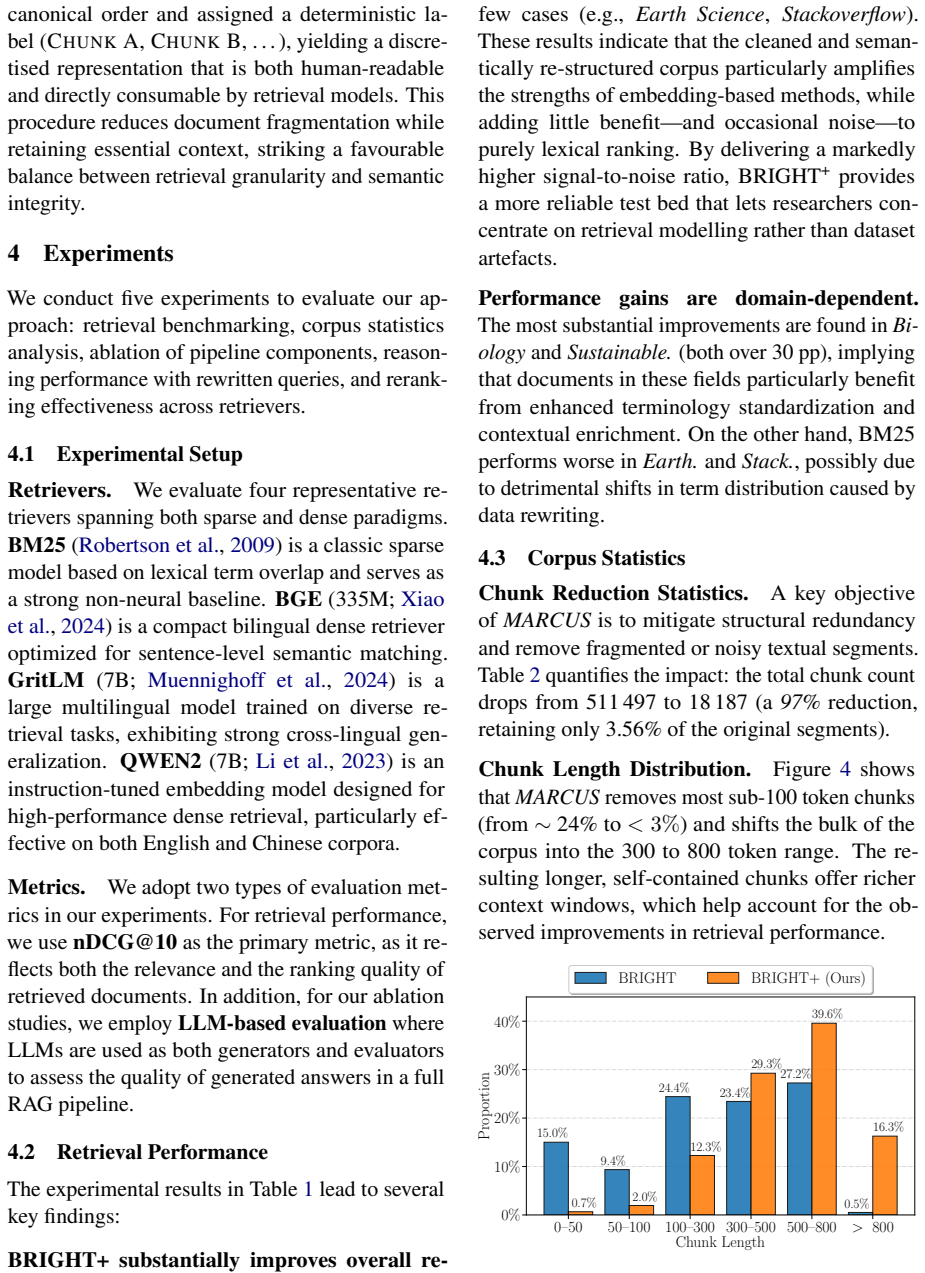
The central discovery is that a large share of BRIGHT's difficulty is an artifact of corpus construction rather than intrinsic reasoning complexity. By using the benchmark's own gold-answer annotations to partition each document into answer-bearing Gold Parts and irrelevant content, then applying one LLM agent to clean the gold spans conservatively and another to discard non-answer content aggressively, and finally re-segmenting the cleaned text with a third LLM agent that minimizes chunk count while preserving coherence, the authors reduce the corpus from 511,497 chunks to 18,187 and shift most chunks into the 300–800 token range. On this cleaned corpus, QWEN2, GritLM, and BGE all improve by double-digit nDCG@10 points on average, with the largest gains in Biology and Sustainable Living. The paper concludes that semantic segmentation, rather than noise removal, is the dominant driver of the gains, since a split-only variant performs nearly as well as the full pipeline on retrieval metrics while the full pipeline wins on end-to-end RAG answer quality.
Load-bearing premise
The benchmark improvement rests on the assumption that cleaning the corpus with knowledge of the exact answer spans used in evaluation measures genuine noise reduction rather than label-guided curation.
Editorial extensions
If this is right
- Dense retrievers (BGE, GritLM, QWEN2) gain consistently on every BRIGHT+ domain, while the sparse BM25 baseline shows only a small average lift and declines on some domains.
- LLM-based semantic segmentation is the dominant source of improvement: a split-only variant achieves near-full retrieval gains, and the full pipeline adds further gains in end-to-end RAG answer quality.
- The released BRIGHT+ corpus and MARCUS pipeline let future work evaluate retrieval models on a lower-noise, more coherent corpus rather than on dataset artifacts.
- The pipeline's dependence on span-level gold annotations means it can be transferred to other benchmarks that provide query-document alignment or rationale supervision.
Reading between the lines
- Because cleaning is guided by the exact gold answer spans used in evaluation, part of the observed improvement may reflect label-based curation rather than generic noise removal; a control experiment that withholds gold spans during cleaning would disentangle these effects.
- The shift toward 300–800 token chunks suggests an optimal chunk size for retrieval-augmented reasoning, and a similar sweet spot may exist for other RAG corpora, which could be tested by ablating chunk lengths on unmodified web corpora.
- The pipeline's success on reasoning-centric retrieval raises the possibility that applying the same clean-and-split recipe to other noisy web-sourced benchmarks could improve their discriminative power, provided answer-span annotations or reliable rationales exist.
Editorial analysis
A structured set of objections, weighed in public.
Referee Report
Summary. The paper proposes MARCUS, a multi-agent LLM pipeline that cleans and re-chunks the BRIGHT retrieval benchmark into a new corpus called BRIGHT+. The pipeline first uses BRIGHT's gold chunk annotations to split documents into "Gold Parts" and "Irrelevant Parts," then applies two LLM agents (SafeClean and FastClean) to remove structural noise, and finally a Splitter agent to produce semantically coherent chunks. The authors evaluate BRIGHT+ on four retrievers with nDCG@10, run ablations comparing cleaning and splitting variants, and report downstream RAG QA scores. The central claim is that BRIGHT+ yields consistent and significant improvements in retrieval and multi-hop reasoning across retrievers and domains.
Significance. If the claims were fully supported, a cleaned, re-chunked version of BRIGHT would be a useful resource for the retrieval community, and the audit of noise concentrated in StackExchange-derived subdomains is a valuable observation. The MARCUS pipeline is clearly described, and the prompt templates in Appendix A are a helpful contribution. However, the evaluation design has a load-bearing issue: the corpus is constructed using the gold answer spans of the very queries on which retrieval is measured, which can inflate results independently of genuine noise removal. The paper's own ablation shows that the split-only variant MARCUS-S outperforms the full MARCUS pipeline on average, and no significance tests or error bars are provided. These issues prevent the central claim from being established as stated.
major comments (4)
- [Section 3.2, Figure 2] The pipeline uses the gold chunk annotations from BRIGHT, which correspond to the evaluation queries, to partition each document into Gold Parts and Irrelevant Parts, and then discards or aggressively cleans the Irrelevant Parts. Retrieval is subsequently evaluated on the same queries against the resulting corpus. This is label leakage by design: the answer-bearing content is isolated and concentrated into clean, dedicated chunks while non-answer content is removed, so any measured improvement may reflect curation around the labels rather than general noise reduction. The paper does not include a control experiment that applies the cleaning and splitting without access to the gold spans (e.g., running FastClean and Splitter on entire documents, or constructing the corpus using only a held-out subset of query annotations and evaluating on the rest). The Limitations section acknowledges the dependence on BRIGHT-specific span annotations, which reinforces this concern. A control experiment is necessary to support the claim that BRIGHT+ is a fairer benchmark rather than an easier, answer-concentrated one.
- [Section 4.4.1, Table 3] Table 3 shows that MARCUS-S, which only applies the Splitter to the original BRIGHT documents, outperforms the full MARCUS pipeline on average nDCG@10 for all four retrievers: BM25 18.7 vs. 17.7, BGE 32.1 vs. 31.6, GritLM 42.3 vs. 41.3, and QWEN2 45.2 vs. 42.6. This directly contradicts the abstract and Section 4.2's claim that the full MARCUS pipeline yields consistent improvements. The cleaning stage appears to hurt retrieval performance on this metric, and the paper's own deployment recommendation to prefer MARCUS-S in production further undermines the advertised contribution. The authors need to reconcile this result with the paper's framing, either by repositioning MARCUS-S as the main contribution or by providing a reasoned, evidence-based explanation for why the full pipeline is still preferred.
- [Section 4.2, Table 1] The claim of "consistent and significant improvements" is not supported by the reported results. No error bars, confidence intervals, or significance tests are provided for any of the nDCG@10 numbers, so the word "significant" is used only in a colloquial sense. Moreover, Table 1 shows that BM25 gains only +0.5 points on average and declines on Earth Science (from 27.2 to 22.7) and Stackoverflow (from 18.4 to 11.6). The improvements are consistent across domains only for the three dense retrievers, not for BM25. The authors should report query-level variance (e.g., bootstrap confidence intervals) and run appropriate statistical tests, and they should temper the claim of consistency to match what the data actually show.
- [Section 4.3, Table 2, Figures 4-5] The large chunk reduction from 511,497 to 18,187 (retention of 3.56%) is driven primarily by the Step 1 gold-partitioning that discards Irrelevant Parts, not by the cleaning agents alone. Consequently, the shifts in chunk-length distribution (Figure 4) and query-chunk similarity (Figure 5) are expected consequences of removing most non-answer content and isolating the gold spans, and they do not by themselves demonstrate that the corpus is semantically cleaner in a general sense. The paper should disentangle how much of the reduction and of the score shifts comes from gold-based filtering versus from the SafeClean/FastClean and Splitter agents, for example by reporting the same statistics after applying the pipeline without the gold-partition step.
minor comments (5)
- [Abstract] The abstract refers to "BRIGHT-Plus" while the rest of the paper consistently uses "BRIGHT+"; please unify the terminology.
- [Table 4] The "Δ" column reports "↑ 83%" and "↑ 100%", but the text explains that MARCUS-S accounts for roughly four-fifths of the total gain. The notation is ambiguous because 83% and 100% could be read as relative performance improvements, which would be inconsistent with the numbers (e.g., 58.4 to 60.2 is about a 3% relative gain). Please clarify that these percentages denote the share of the total improvement, or use a different notation.
- [General] The paper states that the BRIGHT+ corpus and MARCUS pipeline are released, but no code or data link is provided in the manuscript. Please include a URL or repository reference.
- [Figure 2] In Figure 2, the two "Gold Chunk" boxes appear to show identical or overlapping text, which looks like a copy-paste error. The figure should be corrected to show the actual chunks produced by the Splitter.
- [Section 3.3.1] There is a grammatical issue in the sentence "we prompt the LLM to perform selective deletion headers, sidebars, navigation widgets..."; it should read "selective deletion of headers, sidebars, navigation widgets...".
Circularity Check
Retrieval gains on BRIGHT+ are measured against the same gold-span annotations used to construct BRIGHT+, making the headline improvement partly self-fulfilling.
-
self definitional
[Section 3.2 (Step 1: Aggregate) and Section 4.1 (Metrics), Table 2]
"The BRIGHT benchmark includes gold chunk annotations for each query, along with their relative positions within the source documents. By aggregating these gold chunks in their original order, we reconstruct the Gold Parts of a document—that is, the span containing answer-supporting content. All remaining content in the same document is grouped as the Irrelevant Parts."
BRIGHT+ is built by preserving the gold answer spans of the evaluation queries (Gold Parts, kept verbatim by SafeClean) and aggressively discarding 96.4% of the original chunks, including all Irrelevant Parts. The retrieval experiment then computes nDCG@10 on those same queries and gold chunks. Thus the test set is derived from the labels used to construct the corpus; concentrating answer spans into clean, isolated chunks and deleting distractor content inflates retrieval by construction. No control applies the same clean-and-split procedure without gold spans, so the reported 'consistent and significant improvements' cannot be separated from this label leakage.
full rationale
The paper does not fit a model to a subset of data and call it prediction, nor does it rely on self-citations as load-bearing evidence. The central circularity is evaluative: BRIGHT+ is constructed from BRIGHT's per-query gold chunk annotations, and the same queries and gold chunks are then used as the retrieval test set. This makes the reported improvements partly an artifact of test-label-guided curation rather than an unbiased measurement of corpus quality. The presence of MARCUS-S, a non-gold-label variant that performs comparably, indicates that semantic re-chunking has some independent benefit, so the circularity is partial rather than total. Nevertheless, the released BRIGHT+ corpus and its headline numbers are contaminated by construction, and no control experiment removes the leakage. Score 6 reflects one central claim that partially reduces to its own evaluation input.
Assumptions & free parameters
assumptions (4)
- domain assumption Gold annotations in BRIGHT are accurate and provide a complete specification of answer-bearing content.
- domain assumption LLM-based cleaning preserves the semantics of gold spans and does not introduce artifacts that affect retrieval.
- domain assumption nDCG@10 scores are comparable across corpora of vastly different sizes, so improvements observed on BRIGHT+ are meaningful.
- domain assumption The LLM-based evaluator provides valid quality scores for generated answers.
Cite this review
Pith. "Pith review of BRIGHT+: Upgrading the BRIGHT Benchmark with MARCUS, a Multi-Agent RAG Clean-Up Suite." pith.science (2026). https://pith.science/paper/FALQTRMB
@misc{pith2026250607116,
  author       = {Pith},
  title        = {Pith review of: BRIGHT+: Upgrading the BRIGHT Benchmark with MARCUS, a Multi-Agent RAG Clean-Up Suite},
  year         = {2026},
  howpublished = {\url{https://pith.science/paper/FALQTRMB}},
  note         = {Machine review of arXiv:2506.07116}
}
read the original abstract
Retrieval-Augmented Generation (RAG) systems require corpora that are both structurally clean and semantically coherent. BRIGHT is a recent and influential benchmark designed to evaluate complex multi-hop retrieval across diverse, high-reasoning domains. However, its practical effectiveness is limited by common web-crawled artifacts - such as content redundancy and semantic discontinuity - that impair retrieval accuracy and downstream reasoning. Notably, we find that such issues are concentrated in seven StackExchange-derived subdomains, while other domains (e.g., Coding and Theorem-based content) remain relatively clean. In this study, we present MARCUS, a multi-agent pipeline that leverages large language models (LLMs) to systematically clean and re-chunk BRIGHT into a higher-quality corpus: BRIGHT-Plus. MARCUS applies dedicated agents for structural noise removal and semantic segmentation, preserving answer-bearing spans while improving contextual integrity. Experimental evaluations demonstrate that BRIGHT-Plus yields consistent and significant improvements in both retrieval accuracy and multi-hop reasoning across a diverse set of retrievers. We release both the BRIGHT-Plus corpus and the MARCUS pipeline to support future research on robust, reasoning-centric retrieval.
Figures


Figures from the paper (3 more)


Reference graph
Works this paper leans on
-
[1]
Do not rewrite, summarize, or reformat the content
-
[2]
Remove only the following irrelevant elements: navigation bars, sidebars, headers, footers, language links, edit/tool buttons, login links, donation banners, search boxes, and copyright
-
[3]
Keep all meaningful article content, including section titles, paragraphs, lists, citations, and embedded text
-
[4]
If you encounter garbled characters (e.g., ?), try to infer the correct meaning from context; if uncertain, leave unchanged
-
[5]
Output must be valid, clean Markdown only—no extra explanation or commentary
-
[6]
Raw HTML: {html} FAST CLEAN You are given raw text (possibly containing HTML)
Never remove actual article content or paragraph text. Raw HTML: {html} FAST CLEAN You are given raw text (possibly containing HTML). Extract and return only the main article content. Rules:
-
[8]
navbars, sidebars, headers, footers, edit/login links, banners, ads, search boxes, etc.)
Remove irrelevant elements (e.g. navbars, sidebars, headers, footers, edit/login links, banners, ads, search boxes, etc.)
-
[9]
If there is no main content, return an empty line
Show all 16 references
-
[10]
Keep all actual article text intact—no rewriting, summarizing, or reformatting
-
[11]
Raw TEXT: {html} SPLITTER Split the input text into as few coherent, readable chunks as possible, ideally just one
Only output the cleaned main article content (plain text). Raw TEXT: {html} SPLITTER Split the input text into as few coherent, readable chunks as possible, ideally just one. Preserve as much semantic integrity as possible. Chunking rules:
-
[12]
Only split when there is a clear and significant shift in topic or structure
Minimize the number of chunks. Only split when there is a clear and significant shift in topic or structure
-
[13]
Each chunk should be as long as possible while still forming a coherent unit of meaning
-
[14]
Chunk A:
Label each chunk in order as "Chunk A:", "Chunk B:", "Chunk C:", etc
-
[15]
If the input contains tables or structured data, summarize them in natural language and include as part of a chunk
-
[16]
You may delete content at the beginning or end, but preserve original wording and structure elsewhere
Do not modify the original text content except for structured data. You may delete content at the beginning or end, but preserve original wording and structure elsewhere. Example output: Chunk A: This entire chunk stays together because it maintains a consistent topic and logi...
-
[2024]
Weiwei Sun, Lingyong Yan, Xinyu Ma, Shuaiqiang Wang, Pengjie Ren, Zhumin Chen, Dawei Yin, and Zhaochun Ren
Bright: A realistic and challenging benchmark for reasoning-intensive retrieval. Weiwei Sun, Lingyong Yan, Xinyu Ma, Shuaiqiang Wang, Pengjie Ren, Zhumin Chen, Dawei Yin, and Zhaochun Ren. 2023. Is chatgpt good at search? investigating large language models as re-ranking agent...
2023 arXiv
Reviewed August 7, 2026 · model on record in the stance chip above.
Discussion (0). Sign in to comment.