REVIEW 2 major objections 4 minor 26 references
A duality between surface charge and work function in scanning Kelvin probe microscopy
T0 review · 2 major / 4 minor · reviewed 2026-08-07 · deepseek-v4-flash
Pith's one-line read Scanning Kelvin probe microscopy cannot tell the blur of surface charge from the blur of work-function variation: both are the same point spread function scaled by δ/ε.
desk verdict The PSF duality claim is a genuine advance and likely correct, but the key theoretical step from Eq. 10 to Eq. 11 is under-derived and needs repair before publication. read the letter →
The pith
A machine-rendered reading of the paper's core claim, the machinery that carries it, and where it could break.
The reading
What carries the argument
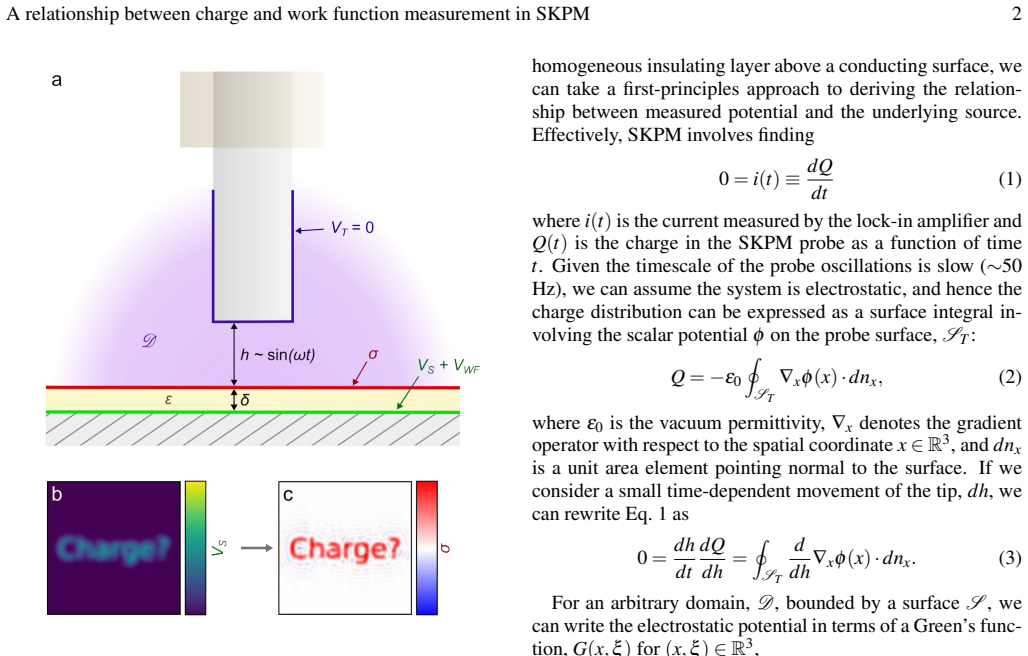
The carrying object is the pair of point spread functions $P_\sigma=u_0/u_2$ and $P_{\mathrm{WF}}=u_1/u_2$, built from the integrated Green's function $U(\boldsymbol{\xi})=\oint_{S_T} \frac{d}{dh}\nabla_x G(\mathbf{x},\boldsymbol{\xi})\cdot d\mathbf{n}_x$, which maps a surface source at $\boldsymbol{\xi}$ to the probe's vibration-induced current. The load-bearing step is the first-order Taylor approximation $u_0(\boldsymbol{\eta};z=\delta)\approx(\delta/\varepsilon_0)\,u_1(\boldsymbol{\eta};z=0)$, which is valid when the insulating layer is thin compared with the probe-sample distance and turns the charge PSF into a scaled copy of the work-function PSF. Replacing $\varepsilon_0$ with the layer permittivity $\varepsilon$ gives the capacitor factor $\delta/\varepsilon$.
What would settle it
Take a sample with an insulating layer thick enough that the linear approximation fails (for example, δ comparable to the probe-sample distance and ε/ε0 ≳ 10), measure the normalized PSFs from a small work-function feature and a small charge spot, and check whether the two curves still collapse; Eq. (11) predicts they do, so a clear difference in width or shape beyond the noise floor would falsify the claim.
Extended reading notes
Core claim
On the authors' own terms, the measured SKPM voltage $V_S(\eta)$ is a convolution: $V_S(\eta)=\int (u_0/u_2)\,\sigma(\eta-\xi)\,d\xi+\int (u_1/u_2)\,V_{\mathrm{WF}}(\eta-\xi)\,d\xi$, so each source has a point spread function, $P_\sigma=u_0/u_2$ and $P_{\mathrm{WF}}=u_1/u_2$. The discovery is that, for a thin insulating layer of thickness $\delta$ and permittivity $\varepsilon$ on a conductor, $P_\sigma \approx (\delta/\varepsilon)\, P_{\mathrm{WF}}$ (Eq. 11), because the integrated Green's function obeys $u_0(\eta;z=\delta)\approx(\delta/\varepsilon_0)\,u_1(\eta;z=0)$. The same-shaped PSFs are demonstrated in finite-element simulations and by comparing a work-function calibration target with a 2 µm charge spot deposited by a focused ion beam; the scaling factor is then used to convert SKPM voltages into charge-density maps whose totals match Faraday-cup measurements within a correlation slope of $-1.15\pm 0.14$ C/C.
Load-bearing premise
The argument assumes the electrostatic response varies linearly between the charge plane and the back electrode, which holds only when the insulating layer is thin and homogeneous relative to the probe-sample geometry; for thick or high-permittivity layers the equality of PSF shapes is no longer exact.
Editorial extensions
If this is right
- A work-function PSF calibration suffices to deconvolve SKPM charge images on thin insulating layers, removing the need for separate charge simulations or per-thickness calibrations.
- Charge-based calibration targets can be used instead of work-function targets, giving much larger signals and better high-frequency PSF estimates.
- Relative charge densities can be recovered by subtracting pre- and post-contact SKPM scans and deconvolving with the charge PSF, as demonstrated on contact-charged PDMS/SiO2 samples.
- SKPM-derived total charge agrees with an independent Faraday-cup measurement (correlation slope -1.15 ± 0.14 C/C), supporting the quantitative recipe.
- The equivalence and scaling fail for thick or high-permittivity layers, and the simulations map the regime of validity to typical insulators with ε/ε0 ≲ 5 and probe-sample distances large compared with layer thickness.
Reading between the lines
- Beyond the paper's claims, the duality may be a general feature of scanning-probe geometries wherever one source is a potential boundary and the other is a charge layer: Kelvin probe force microscopy would inherit the same calibration shortcut if the linear-layer condition is met.
- Retaining the next term in the Taylor expansion would give a thickness-dependent correction, allowing the framework to quantify exactly when the capacitor heuristic fails rather than only charting the failure numerically.
- Because charge targets produce much stronger signals than work-function targets, the duality inverts the usual calibration logic: a known charge spot could serve as a high-signal calibration standard for work-function imaging.
- The linear scaling could be exploited in reverse to infer dielectric thickness or permittivity by comparing the PSF amplitude of a known charge to a work-function target.
Editorial analysis
A structured set of objections, weighed in public.
Referee Report
Summary. The manuscript claims a duality in scanning Kelvin probe microscopy (SKPM) between the point spread functions (PSFs) for surface charge and for work function. The central claim is Eq. (11): for a thin insulating layer of thickness δ and permittivity ε above a conducting back electrode, the charge PSF Pσ is approximately (δ/ε) times the work-function PSF PWF. The authors derive this from a Green's function formalism (Eqs. (4)–(9)), then test it with COMSOL simulations across varying δ and ε, and experimentally by comparing PSFs from a small work-function target and a PFIB-deposited charge spot. They further validate the scaling by comparing SKPM-based total charge measurements with Faraday cup measurements for contact-charged SiO2 samples.
Significance. If established, this duality provides a practical and rigorous calibration method for quantitative surface charge imaging with SKPM: a single work-function PSF calibration would suffice for charge deconvolution, and the δ/ε scaling provides a first-principles basis for the previously heuristic capacitor formula. The paper's strengths are the direct experimental comparison of the two PSF shapes, the FEM-based mapping of the validity regime, and the independent Faraday cup validation with a slope near unity (-1.15 ± 0.14). The theoretical derivation, however, contains a gap that must be addressed before the central claim is fully supported.
major comments (2)
- [II, Eqs. (10)–(11)] The step from Eq. (10) to Eq. (11) is not a mathematical consequence of the preceding definitions. Equation (10) states u0(η; z=δ) ≈ (δ/ε0) u1(η; z=0). Since Pσ = u0/u2 and PWF = u1/u2, this directly yields Pσ ≈ (δ/ε0) PWF, not (δ/ε) PWF. The sentence 'Replacing the vacuum permittivity by the material permittivity ε' is an ad hoc substitution; the Green's function G in Eq. (4) is said to account for the insulating layer, so the 1/ε0 prefactor in the charge term is fixed by Poisson's equation for free charge and cannot be replaced by 1/ε. The authors should either redefine u0 so that the material permittivity enters the definition, or derive the ε dependence from the Green's function rather than by fiat.
- [II, Eq. (10)] The Taylor approximation u0(η; z=δ) ≈ (δ/ε0) u1(η; z=0) is asserted with no analytic error bound. The paper checks validity numerically for a limited range of δ and ε (Fig. 2f), but the central claim of a universal duality requires a characterization of the regime of validity. The authors should provide an estimate of the error, for example in terms of the next term in the Taylor expansion of U(z) or a bound involving δ/H, where H is the probe-sample distance, or at least delineate the parameter range where the approximation holds to a specified accuracy.
minor comments (4)
- [Fig. 2f] The ratio plot would be more informative if the δ/ε0 prediction were also shown, to explicitly demonstrate the discrepancy that motivates the ε substitution.
- [Fig. 3 and Supplementary Material] The supplementary power spectra comparison (Fig. S2) is not referenced at the point of Figure 3; adding a reference would help the reader interpret the bandwidth and noise discussion.
- [III A] The phrase 'can be expected to fail miserably' is informal for a journal article; consider a more quantitative statement such as 'the linear relation breaks down significantly'.
- [II, Eq. (9)] The normal direction n in the definition of u1(η) ≡ ∇U(η) · n is not defined; the authors should specify that it is the outward normal to the sample surface.
Circularity Check
No significant circularity: the PSF duality is derived from electrostatics and independently tested; the ε0-to-ε step is a derivation gap, not a circular input.
full rationale
The central claim Pσ ≈ (δ/ε)PWF is not circular. It is obtained from a Green's-function treatment of the probe/sample electrostatics (Eqs. 4–9), and the δ/ε factor is not a fitted parameter but a combination of independent sample geometry and material properties. The step from Eq. 10 to Eq. 11 does explicitly 'replace the vacuum permittivity by the material permittivity' for the region between charge and back electrode; this is a stated approximation whose derivation is incomplete, and no analytic error bound is provided for the Taylor step u0(z=δ) ≈ (δ/ε0)u1(z=0). However, this is a rigor gap, not a circular reduction: Eq. 10 does not already contain Eq. 11 by definition, and the result is independently checked by COMSOL simulations of the same electrostatics and by Faraday-cup comparisons of integrated SKPM charge. Self-citations (refs. 11 and 24) are methodological or contextual and are not load-bearing for the duality result. Therefore, no significant circularity is present.
Assumptions & free parameters
assumptions (4)
- domain assumption Quasistatic electrostatics: the probe oscillation is slow enough that the instantaneous charge distribution is given by the static potential (Eq. 2).
- domain assumption The sample is an infinitely wide, flat, translationally invariant layered system, so the Green's function depends only on the lateral separation between tip and source.
- domain assumption Charge is confined to a 2D surface at the dielectric-air interface above a homogeneous dielectric layer backed by a conducting electrode.
- ad hoc to paper The first-order Taylor approximation u0(eta; z=delta) approximately equal to (delta divided by epsilon0) u1(eta; z=0) holds, i.e., delta is small compared with the probe-sample distance and the dielectric is homogeneous between the charge plane and the back electrode.
Cite this review
Pith. "Pith review of A duality between surface charge and work function in scanning Kelvin probe microscopy." pith.science (2026). https://pith.science/paper/5XJFYSNP
@misc{pith2026250607187,
  author       = {Pith},
  title        = {Pith review of: A duality between surface charge and work function in scanning Kelvin probe microscopy},
  year         = {2026},
  howpublished = {\url{https://pith.science/paper/5XJFYSNP}},
  note         = {Machine review of arXiv:2506.07187}
}
read the original abstract
Scanning Kelvin probe microscopy (SKPM) is a powerful technique for macroscopic imaging of the electrostatic potential above a surface. Though most often used to image work-function variations of conductive surfaces, it can also be used to probe the surface charge on insulating surfaces. In both cases, relating the measured potential to the underlying signal is non-trivial. Here, we derive general relationships between the measured SKPM voltage and the underlying source, revealing either can be cast as a convolution with an appropriately scaled point spread function (PSF). For charge that exists on a thin insulating layer above a conductor, the PSF has the same shape as what would occur from a work-function variation alone, differing by a simple scaling factor. We confirm this relationship by: (1) backing it out from finite-element simulations of work-function and charge signals, and (2) experimentally comparing the measured PSF from a small work-function target to that from a small charge spot. This scaling factor is further validated by comparing SKPM charge measurements with Faraday cup measurements for highly charged samples from contact-charging experiments. Our results highlight a hereto unappreciated connection between SKPM voltage and charge signals, offering a rigorous recipe to extract either from experimental data.
Figures


Figures from the paper (1 more)

Reference graph
Works this paper leans on
-
[1]
author author D. J. \ Lacks \ and\ author T. Shinbrot ,\ title title Long-standing and unresolved issues in triboelectric charging , \ 10.1038/s41570-019-0115-1 journal journal Nat. Rev. Chem. \ volume 3 ,\ pages 465--476 ( year 2019 ) NoStop
-
[2]
author author A. Kumada , author Y. Shimizu , author M. Chiba , \ and\ author K. Hidaka ,\ title title Pockels surface potential probe and surface charge density measurement , \ 10.1016/S0304-3886(02)00189-4 journal journal J. Electrostat. \ volume 58 ,\ pages 45--58 ( year 2003 ) NoStop
-
[3]
author author S. Li , author P. Bista , author S. A. L. \ Weber , author M. Kappl , \ and\ author H.-J. \ Butt ,\ title title Spontaneous Charging of Drops on Lubricant-Infused Surfaces , \ 10.1021/acs.langmuir.2c02085 journal journal Langmuir \ volume 38 ,\ pages 12610--12616 ( year 2022 ) NoStop
-
[4]
author author Y. Fang , author C. K. \ Ao , author Y. Jiang , author Y. Sun , author L. Chen , \ and\ author S. Soh ,\ title title Static charge is an ionic molecular fragment , \ 10.1038/s41467-024-46200-3 journal journal Nat. Commun. \ volume 15 ,\ pages 1--11 ( year 2024 ) NoStop
-
[5]
M e \' e ndez Harper , author C
author author J. M e \' e ndez Harper , author C. S. \ McDonald , author E. J. \ Rheingold , author L. C. \ Wehn , author R. E. \ Bumbaugh , author E. J. \ Cope , author L. E. \ Lindberg , author J. Pham , author Y.-H. \ Kim , author J. Dufek , \ and\ author C. H. \ Hendon ,\ title title Moisture-controlled triboelectrification during coffee grinding , \ ...
-
[6]
author author T. Hackl , author G. Schitter , \ and\ author P. Mesquida ,\ title title AC Kelvin Probe Force Microscopy Enables Charge Mapping in Water , \ 10.1021/acsnano.2c07121 journal journal ACS Nano \ volume 16 ,\ pages 17982--17990 ( year 2022 ) NoStop
-
[7]
author author S. Metwally \ and\ author U. Stachewicz ,\ title title Surface potential and charges impact on cell responses on biomaterials interfaces for medical applications , \ 10.1016/j.msec.2019.109883 journal journal Mater. Sci. Eng., C \ volume 104 ,\ pages 109883 ( year 2019 ) NoStop
-
[8]
author author Y. I. \ Sobolev , author W. Adamkiewicz , author M. Siek , \ and\ author B. A. \ Grzybowski ,\ title title Charge mosaics on contact-electrified dielectrics result from polarity-inverting discharges , \ 10.1038/s41567-022-01714-9 journal journal Nat. Phys. \ volume 18 ,\ pages 1347--1355 ( year 2022 ) NoStop
Show all 26 references
-
[9]
author author W. A. \ Zisman ,\ title title A new method of measuring contact potential differences in metals , \ 10.1063/1.1748947 journal journal Rev. Sci. Instrum. \ volume 3 ,\ pages 367--370 ( year 1932 ) NoStop
1932 doi
-
[10]
author author P. P. \ Craig \ and\ author V. Radeka ,\ title title Stress Dependence of Contact Potential: The ac Kelvin Method , \ 10.1063/1.1684484 journal journal Rev. Sci. Instrum. \ volume 41 ,\ pages 258--264 ( year 1970 ) NoStop
-
[11]
author author I. C. D. \ Lenton , author F. Pertl , author L. Shafeek , \ and\ author S. R. \ Waitukaitis ,\ title title Beyond the blur: using experimental point spread functions to help scanning Kelvin probe microscopy reach its full potential , \ https://arxiv.org/abs/2404....
2024 arXiv
-
[12]
Nazarov , author M.-G
author author A. Nazarov , author M.-G. \ Olivier , \ and\ author D. Thierry ,\ title title SKP and FT-IR microscopy study of the paint corrosion de-adhesion from the surface of galvanized steel , \ https://doi.org/10.1016/j.porgcoat.2011.10.009 journal journal Progress in Org...
-
[13]
Nazarov \ and\ author D
author author A. Nazarov \ and\ author D. Thierry ,\ title title Application of Scanning Kelvin Probe in the Study of Protective Paints , \ 10.3389/fmats.2019.00192 journal journal Front. Mater. \ volume 6 ,\ pages 462587 ( year 2019 ) NoStop
2019
-
[14]
Nalbach \ and\ author H
author author M. Nalbach \ and\ author H. Kliem ,\ title title Contact Charging and Surface Charge Measurement Using a Scanning Kelvin Technique , \ 10.1002/1521-396X(200004)178:2<715::AID-PSSA715>3.0.CO;2-K journal journal Phys. Status Solidi A \ volume 178 ,\ pages 715--719 ...
-
[15]
Martin \ and\ author H
author author B. Martin \ and\ author H. Kliem ,\ title title Space Charge Measurements with the Scanning Kelvin Probe , \ 10.1109/TDEI.2008.4483478 journal journal IEEE Trans. Dielectr. Electr. Insul. \ volume 15 ,\ pages 560--567 ( year 2008 ) NoStop
2008
-
[16]
Sadeghi , author A
author author A. Sadeghi , author A. Baratoff , \ and\ author S. Goedecker ,\ title title Electrostatic interactions with dielectric samples in scanning probe microscopies , \ 10.1103/PhysRevB.88.035436 journal journal Phys. Rev. B \ volume 88 ,\ pages 035436 ( year 2013 ) NoStop
-
[17]
author author A. M. \ Somoza \ and\ author E. Palacios-Lid o \' o n ,\ title title Localized charges in thin films by Kelvin probe force microscopy: From single to multiple charges , \ 10.1103/PhysRevB.101.075432 journal journal Phys. Rev. B \ volume 101 ,\ pages 075432 ( year...
-
[18]
Heile , author R
author author D. Heile , author R. Olbrich , author M. Reichling , \ and\ author P. Rahe ,\ title title Modeling nanoscale charge measurements , \ 10.1103/PhysRevB.108.085420 journal journal Phys. Rev. B \ volume 108 ,\ pages 085420 ( year 2023 ) NoStop
-
[19]
Cai \ and\ author N
author author W. Cai \ and\ author N. Yao ,\ title title Dynamic nano-triboelectrification using torsional resonance mode atomic force microscopy , \ 10.1038/srep27874 journal journal Sci. Rep. \ volume 6 ,\ pages 1--9 ( year 2016 ) NoStop
-
[20]
author author A. M. \ Barnes \ and\ author A. D. \ Dinsmore ,\ title title Heterogeneity of surface potential in contact electrification under ambient conditions: A comparison of pre- and post-contact states , \ 10.1016/j.elstat.2016.04.002 journal journal J. Electrostat. \ vo...
-
[21]
Palleau , author L
author author E. Palleau , author L. Ressier , author . Borowik , \ and\ author T. M e \' e lin ,\ title title Numerical simulations for a quantitative analysis of AFM electrostatic nanopatterning on , \ 10.1088/0957-4484/21/22/225706 journal journal Nanotechnology \ volume 21...
-
[22]
B u \" u rgi , author T
author author L. B u \" u rgi , author T. Richards , author M. Chiesa , author R. H. \ Friend , \ and\ author H. Sirringhaus ,\ title title A microscopic view of charge transport in polymer transistors , \ 10.1016/j.synthmet.2004.08.009 journal journal Synth. Met. \ volume 146...
-
[23]
author author H. T. \ Baytekin , author A. Z. \ Patashinski , author M. Branicki , author B. Baytekin , author S. Soh , \ and\ author B. A. \ Grzybowski ,\ title title The Mosaic of Surface Charge in Contact Electrification , \ 10.1126/science.1201512 journal journal Science \...
-
[24]
Pertl , author J
author author F. Pertl , author J. C. \ Sobarzo , author L. Shafeek , author T. Cramer , \ and\ author S. Waitukaitis ,\ title title Quantifying nanoscale charge density features of contact-charged surfaces with an FEM/KPFM-hybrid approach , \ 10.1103/PhysRevMaterials.6.125605...
-
[25]
author author M. P. \ Reiter \ and\ author T. Shinbrot ,\ title title Characterization of stick-slip of peeling tape , \ @noop journal journal Tribology lubrication technology \ ,\ pages 24--32 ( year 2021 ) NoStop
2021
-
[26]
Navarro-Rodriguez , author E
author author M. Navarro-Rodriguez , author E. Palacios-Lidon , \ and\ author A. M. \ Somoza ,\ title title The surface charge decay: A theoretical and experimental analysis , \ 10.1016/j.apsusc.2022.155437 journal journal Appl. Surf. Sci. \ volume 610 ,\ pages 155437 ( year 2...
2022
Reviewed August 7, 2026 · model on record in the stance chip above.
Discussion (0). Sign in to comment.