REVIEW 3 major objections 5 minor 43 references
Broken Symmetries, Information and Emergence: What is theory, that biology should be mindful of it?
T0 review · 3 major / 5 minor · reviewed 2026-08-07 · deepseek-v4-flash
Pith's one-line read The paper argues that theoretical biology needs a unifying framework built on information processing and computation—C3I (Control, Communication, Coding, Information)—and that phenomena from oscillation patterns to cooperative behavior…
desk verdict A well-written perspective that recasts a broad 'life-as-computation' thesis as C3I, but the thesis is too permissive to be testable; worth referee time as an essay, not as a research claim. read the letter →
The pith
A machine-rendered reading of the paper's core claim, the machinery that carries it, and where it could break.
The reading
What carries the argument
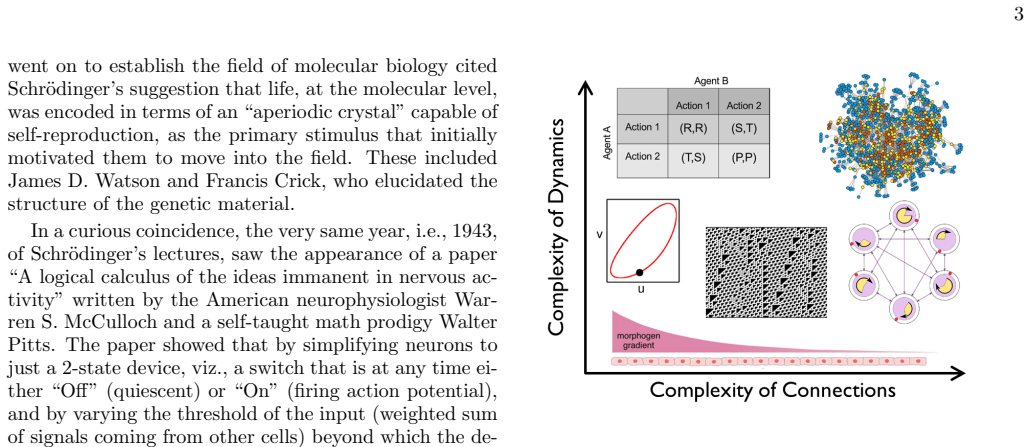
The load-bearing device is the C3I framework—Control, Communication, Coding and Information—which reframes biological processes as transformations of information that together constitute computation. Within this, the concrete demonstration is the SPOD (Spatially Patterned Oscillator Death) state: because each oscillator rests at either a high or low value, the pattern is unambiguously a binary string, and a perturbation (also expressible as a binary string) induces a transition to another pattern, making the system's dynamics a rule-based computation. The paper also relies on cellular automata as discrete computational models and on spatial games as models in which agents with conflicting goals produce collective patterns; together these show the same informational logic across continuous dynamics, discrete dynamics, and strategic choice.
What would settle it
Find an array of coupled relaxation oscillators—for instance, microfluidic chemical oscillators—perturb a SPOD state at a single site, and check whether the resulting transition probabilities between observed patterns match the basin-of-attraction and energy ordering predicted from the anti-ferromagnetic spin-chain mapping; if transitions frequently go against that ordering or land in states not representable as binary strings, the SPOD computation claim is falsified.
Extended reading notes
Core claim
The central discovery the paper seeks to establish is that biological phenomena across scales can be unified by viewing organisms as information-processing systems, with the paper's own oscillator, cellular-automaton, and game-theoretic results as demonstrations. In the SPOD framework, a collective state of coupled relaxation oscillators is represented as a binary string of high and low values; a brief perturbation, also encoded as a binary string, drives the system to a new SPOD state, so the transition is a computation whose rules are shaped by an underlying energy landscape. The same logic appears in cellular automata and in spatial games, where local imitation of successful neighbors produces complex patterns. The intended conclusion is that a theory of biology should be built at the algorithmic and strategic levels of abstraction—what problems organisms solve and by what steps—rather than only at the implementation level.
Load-bearing premise
The argument's load-bearing premise is that a continuous biological system can be represented as binary states without losing the biological meaning of what the system does, so that observed transitions really are computations rather than a convenient encoding imposed by the theorist.
Editorial extensions
If this is right
- If biological theory is organized around information processing, then theoretical biology should aim to describe organisms at the algorithmic and strategic levels, with molecular detail as the implementation layer.
- Transitions between collective states in biological systems—from oscillator arrest to cellular patterning—should be interpreted as computations, making information-theoretic quantities such as state entropy and basin size natural observables.
- The universality of SPOD and cluster-synchronization regimes across different relaxation-oscillator models implies that the information-processing framework may transfer across organs, species, and timescales.
- Because agents in games do not share a common optimization function, statistical mechanics cannot always be applied directly to social systems; a new theoretical treatment of interacting goal-directed components is needed.
Reading between the lines
- One testable extension would be to measure whether biological networks known to show oscillation death—such as cardiac tissue during arrhythmia—exhibit the discrete energy-landscape transitions predicted for SPOD states.
- The binary-string encoding could be applied to other collective variables, like gene-expression switches, asking whether cell-fate decisions appear as computations with well-defined basins.
- The paper's C3I proposal suggests that a formal principle resembling a 'good regulator' theorem—where a biological controller must contain a model of its environment—could ground why information processing is the right organizing concept.
- If SPOD systems are computationally universal, one could attempt to compile simple algorithms onto oscillator arrays, turning the framework into a design principle for physical systems that compute.
Editorial analysis
A structured set of objections, weighed in public.
Referee Report
Summary. This is a perspective article advocating that theoretical biology should be organized around the concepts of Control, Communication, Coding and Information (C3I), with computation understood as the totality of information transformations in living processes. The paper opens with a historical account of the relationship between physics and biology, from Aristotle through Schrödinger, Turing, and von Neumann, and then presents three strands of the authors' own work as evidence: spatially patterned oscillator death (SPOD) in coupled relaxation oscillators, cellular automata akin to the Game of Life, and spatial prisoner's dilemma games on networks. The central illustration is the claim that SPOD states, being composed of oscillators arrested at high or low values, can be represented as binary strings and that perturbation-induced transitions between such states constitute computation. The paper concludes by proposing C3I as the conceptual foundation for a future theoretical biology, citing David Marr's levels of analysis as a template.
Significance. If the C3I program could be made precise and testable, it would offer a genuinely cross-scale unifying perspective and challenge the field to articulate what a theory of biology should explain. The paper's historical synthesis is engaging and its call for explicit theoretical frameworks is timely. The authors are honest about the long-standing difficulties of defining computation in continuous systems. However, as it stands, the central thesis is a research manifesto rather than a theory: no specific, falsifiable consequences are derived, and the SPOD example does not bridge the gap between metaphorical 'computation' and measurable biological information processing.
major comments (3)
- [Opening paragraph and Concluding Thoughts] The paper defines theory as 'a logically consistent set of propositions ... implies certain consequences that can be tested experimentally' (first paragraph), then proposes C3I as 'the basis for a theory of biology' (Concluding Thoughts). Yet the definition of computation as 'a rule-based transformation of an input state to an output' (Fig. 4 section) and as 'the totality of transformations to which information is subjected' (Concluding Thoughts) is satisfied by any deterministic dynamical system under a suitable assignment of states and rules. No experimental consequence is stated that would distinguish the C3I framework from ordinary dynamical-systems biology, so the central claim fails by the paper's own standard. The authors should either identify specific falsifiable predictions (e.g., a bound on the set of possible SPOD-state transitions, or a prediction about when error-correcting codes appear in development) or explicitly characterize C3I as a descriptive research program rather than a theory.
- [SPOD section (Fig. 4)] The authors assert that SPOD states 'can unambiguously be represented as a binary string' and that perturbation-induced transitions are 'a computation.' This conflates a threshold-coarse-grained description with the information content of the actual dynamical system. It is not shown that the binary projection is a faithful homomorphism: e.g., that identical binary input strings always yield identical binary output strings, or that the coarse-grained transition rules capture the continuous system's response across initial conditions and parameter variations. Without such validation, the SPOD example is a metaphor, not a demonstration. The paper's own reference to the difficulty of logic-gate representations in continuous systems (Ref. [35]) underscores the need for this validation, which is absent.
- [References [24], [37]] The paper's key quantitative claims about SPOD transitions and underlying energy landscapes rest on Ref. [37] (an arXiv preprint) and the cellular automata comparison on Ref. [24] (marked 'in preparation'). This is not improper in a perspective, but the reader cannot evaluate whether the cited work actually supports the strong statements made (e.g., 'the rules governing the possible transitions between SPOD states emerge from an underlying energy landscape'). The authors should either summarize the relevant results in enough detail to be self-contained or clearly indicate the provisional status of the evidence and avoid assertive phrasing such as 'It was found' without giving the reader access to the findings.
minor comments (5)
- [Title] The title highlights 'Broken Symmetries,' but the body never connects symmetry breaking to the C3I framework; the only substantive discussions of symmetry are in the context of development (around Ref. [18]) and Turing patterns. Consider either deepening this connection or revising the title to better reflect the paper's focus.
- [Von Neumann paragraph] There is a typo: 'to implement implement self-regulation' should read 'to implement self-regulation.'
- [Figure 5 caption] The caption states that the cellular automaton rules are 'somewhat different from Conway's Game of Life' but does not specify the threshold values used; providing the exact rules would make the comparison reproducible.
- [Greek transliteration] The phrase 'ta automata tˆ on thaumatˆ on' has inconsistent transliteration and diacritics; consider using a standard transliteration such as 'ta automata ton thaumaton'.
- [Throughout] The paper repeatedly says 'we show' or 'we have proposed,' but the article is a review of previously published and unpublished work; phrasing such as 'we summarize' or 'we have demonstrated elsewhere' would more accurately convey the contributions.
Circularity Check
The central C3I claim is made true by stipulation: computation is defined so broadly that every dynamical system counts, and the SPOD 'computation' illustration is the same thresholded dynamics relabelled as binary-string processing.
-
self definitional
[Concluding Thoughts and SPOD section (pp. 7-10): 'If computation is defined as a rule-based transformation...' and 'we view computation as the totality of transformations...']
"If computation is defined as a rule-based transformation of an input state to an output, one can then view dynamical systems as performing a sequence of logical operations. ... we view computation as the totality of transformations to which information is subjected in all aspects of living processes."
The paper's central proposal is that theoretical biology should be organized around information and computation (C3I). But under the first quoted definition, any deterministic dynamical system is a rule-based map from initial to later states, so every biological process qualifies as computation by construction. The second definition extends computation to all information transformations, making the thesis unfalsifiable: no biological phenomenon could in principle count against it. The conclusion that organisms are fundamentally information-processing systems is therefore already contained in the definition of computation, rather than derived from the oscillator, cellular-automaton, or game examples.
-
renaming known result
[SPOD computation discussion and Figure 4 caption, p.8]
"Such a state is characterized by oscillators arrested at either high or low values of the associated variables, and hence they can unambiguously be represented as a binary string. ... Thus, this entire process can be interpreted as a computation (see Fig. 4), and by studying the nature of transformations exhibited by the system, it is possible to determine the types of logical operations performed by the system."
The binary-string representation is obtained by coarse-graining continuous oscillator variables into 'high' and 'low' states, and the perturbation mask is likewise binarized as 1/0. The subsequent 'computation' is not an independently measured quantity; it is the same thresholded transition relabelled. Because the definition of computation already includes any rule-based state transformation, the conclusion that SPOD transitions 'are' computations is assured by the representational choice, not by evidence that the system's dynamics has an intrinsic computational semantics.
full rationale
This is an essay/perspective rather than a derivation, so there are no fitted parameters renamed as predictions and no equations that reduce to one another. The paper's evidence is largely drawn from the authors' own prior studies ([34], [36], [37], [40], [24]), but citing one's own published models in a review is not by itself circular, and those results are not recast as predictions here. The circularity problem is conceptual: the C3I thesis is made true by stipulation. Computation is defined so broadly that any rule-based input-output transition counts, and then identified with 'the totality of transformations to which information is subjected in all aspects of living processes.' There is no imaginable biological process that could falsify the claim that organisms compute under that definition. The SPOD illustration demonstrates the same definitional move: continuous oscillator patterns are thresholded into binary strings and the resulting state-to-state transitions are declared computations; the 'unambiguous' binary encoding is a modeling convenience, not an empirically established property of the system. This warrants a moderate-to-high circularity score because the central organizing claim is self-definitional, even though no quantitative prediction is forced by a fit. The extensive self-citation is a secondary concern and, on its own, would not raise the score above 2.
Assumptions & free parameters
assumptions (3)
- domain assumption Organisms and biological systems can be treated as information-processing entities that respond to environmental noise.
- domain assumption SPOD states can unambiguously be represented as binary strings, so perturbation-induced transitions between them constitute computation.
- domain assumption The transition rules between SPOD states are governed by an energy landscape from a mapping to an anti-ferromagnetic spin chain.
invented entities (1)
-
C3I (Control, Communication, Coding and Information)
Cite this review
Pith. "Pith review of Broken Symmetries, Information and Emergence: What is theory, that biology should be mindful of it?." pith.science (2026). https://pith.science/paper/GDYFYJO3
@misc{pith2026250607210,
  author       = {Pith},
  title        = {Pith review of: Broken Symmetries, Information and Emergence: What is theory, that biology should be mindful of it?},
  year         = {2026},
  howpublished = {\url{https://pith.science/paper/GDYFYJO3}},
  note         = {Machine review of arXiv:2506.07210}
}
read the original abstract
The discipline of `theoretical biology' has been developing from its inception several decades ago almost in parallel with the advances in biology, so much so that the latter is often considered to be almost exclusively an empirical science. However, the scenario has been changing in recent years with statistical mechanics, nonlinear dynamics and soft-matter physics being more and more frequently invoked to explain various biological observations. As distinct from computational biology, theoretical biology is not just an attempt to reproduce in-silico experimental phenomena, but asks more general and abstract questions. It strives to attain a more fundamental understanding of the mechanisms underlying biological phenomena, ranging from oscillations to strategic actions, that can be unified through the perspective that views organisms as processing information to respond appropriately despite the noise in their environment. We show through a number of investigations carried out by our group, on the emergence of systems-level phenomena through interactions between components, how an approach melding physics, and the theory of information & computation can act as an unifying framework for biological processes across a wide range of temporal and spatial scales.
Figures


Figures from the paper (3 more)


Reference graph
Works this paper leans on
-
[35]
T. P. Chatzinikolaou et al., Electronics 11, 1683 (2022)
work page 2022
-
[37]
A. P. Shamim, S. N. Menon and S. Sinha, arXiv 2208.09187 (2023)
work page Pith review arXiv 2023
- [24]
-
[1]
The Growth of Biological Thought, by Ernst Mayr (Har- vard University Press, Cambridge, Mass., 1982)
work page 1982
-
[2]
The Lagoon: How Aristotle Invented Science, by Armand Marie Leroi (Bloomsbury, London, 2014)
work page 2014
- [3]
-
[4]
Thomas Steele Hall (Harvard University Press, Cambridge, Mass., 1972)
Treatise of Man, by Ren´ e Descartes, trans. Thomas Steele Hall (Harvard University Press, Cambridge, Mass., 1972)
work page 1972
-
[5]
Alex Reid (Edi- tions Du Griffon, Neuchatel, 1958)
Automata: A Historical and Technological Study, by Al- fred Chapuis and Edmond Droz, trans. Alex Reid (Edi- tions Du Griffon, Neuchatel, 1958)
work page 1958
Show all 43 references
-
[6]
The Last Man Who Knew Everything, by Andrew Robin- son (Oneworld Publications, Oxford, 2006)
2006
-
[7]
On the similarity of effect of electrical stimulus on inorganic and living substances
J. C. Bose, “On the similarity of effect of electrical stimulus on inorganic and living substances”, Interna- tional Congress of Science, Paris (1900); https://en. wikisource.org/wiki/Collected_Physical_Papers/ On_the_Similarity_of_Effect_of_Electrical_ Stimulus_on_Inorganic_a...
1900
-
[8]
Dasgupta, Notes Rec
S. Dasgupta, Notes Rec. R. Soc. Lond. 52 (2), 307 (1998)
1998
-
[9]
Bohr, Nature (Lond.) 131, 457 (1933)
N. Bohr, Nature (Lond.) 131, 457 (1933)
1933
-
[10]
Stent, Genome 31, 11 (1989)
G. Stent, Genome 31, 11 (1989)
1989
-
[11]
E. P. Fischer, Genetics 177, 673 (2007)
2007
-
[12]
Judson (Simon & Schuster, New York, NY, 1979)
The Eighth Day of Creation, by Horace F. Judson (Simon & Schuster, New York, NY, 1979)
1979
-
[13]
Phillips, Cell Systems 12, 465 (2021)
R. Phillips, Cell Systems 12, 465 (2021)
2021
-
[14]
McCulloch (MIT Press, Cambridge, Mass., 1965)
Introduction, by Seymour Papert, Embodiments of Mind by Warren S. McCulloch (MIT Press, Cambridge, Mass., 1965)
1965
-
[15]
Wolpert, J
L. Wolpert, J. Theor. Biol. 25, 1 (1969)
1969
-
[16]
Kuyyamudi, S
C. Kuyyamudi, S. N. Menon, and S. Sinha, Indian J. Phys. 96, 2657 (2022)
2022
-
[17]
P. W. Anderson, Science 177, 393 (1972)
1972
-
[18]
D. J. Marston, and B. Goldstein, Dev. Cell. 11, 273 (2006)
2006
-
[19]
P. T. Saunders, IEEE Ann. Hist. Comput. 15, 33 (1993)
1993
-
[20]
H. M. Al-Hashimi, Proc. Natl. Acad. Sci. USA 120, e2220022120 (2023)
2023
-
[21]
John von Neumann and the Origins of Modern Comput- ing, by William Aspray (MIT Press, Cambridge, Mass., 1990)
1990
-
[22]
Brenner, Brit
S. Brenner, Brit. Med. Bull. 29, 269 (1973)
1973
-
[23]
Wheels, Life and Other Mathematical Amusements, by Martin Gardner (W H Freeman, New York, NY, 1983)
1983
-
[25]
A. M. Turing, Phil. Trans. Roy. Soc. Lond. B 237, 37 (1952)
1952
-
[26]
Jacob and J
F. Jacob and J. Monod, J. Mol. Biol. 3, 318 (1961)
1961
-
[27]
Gonze, and P
D. Gonze, and P. Ruoff, Acta Biotheor. 69, 857 (2021)
2021
-
[28]
Sridhar (CRC Press, Boca Raton, FL, 2015)
Patterns in Excitable Media, by Sitabhra Sinha and S. Sridhar (CRC Press, Boca Raton, FL, 2015)
2015
-
[29]
Biochemical Oscillations and Cellular Rhythms, by Al- bert Goldbeter (Cambridge Univ Press, Cambridge, 1996)
1996
-
[30]
A. T. Winfree, J. Theor. Biol., 16, 15 (1967)
1967
- [31]
-
[32]
Toiya, V
M. Toiya, V. K. Vanag, and I. R. Epstein, Angew. Chem. Int. Ed. 47, 7753 (2008)
2008
-
[33]
Singh, and S
R. Singh, and S. Sinha, Phys. Rev. E 87, 012907 (2013)
2013
-
[34]
Janaki, S
R. Janaki, S. N. Menon, R. Singh, and S. Sinha, Phys. Rev. E 99, 052216 (2019)
2019
-
[36]
S. N. Menon and S. Sinha, Proc. 10th IEEE Intl. Conf. Signal Processing (2014)
2014
-
[38]
Sharma, S
A. Sharma, S. N. Menon, V. Sasidevan, and S. Sinha, PLoS Comput. Biol. 15, e1006977 (2019)
2019
-
[39]
M. A. Nowak and R. M. May, Nature (Lond.) 359, 826 (1992)
1992
-
[40]
S. N. Menon, V. Sasidevan, and S. Sinha, Front. Phys. 6, 34 (2018)
2018
-
[41]
D. J. Watts and S. H. Strogatz, Nature (Lond.) 393, 440 (1998)
1998
-
[42]
Brenner, Interview by Peter Sylwan, 12 December 2002; https://www.nobelprize.org/prizes/medicine/ 2002/brenner/interview/
S. Brenner, Interview by Peter Sylwan, 12 December 2002; https://www.nobelprize.org/prizes/medicine/ 2002/brenner/interview/
2002
-
[43]
Vision, by David Marr (W H Freeman, San Francisco, CA, 1982)
1982
Reviewed August 7, 2026 · model on record in the stance chip above.
Discussion (0). Sign in to comment.