REVIEW 4 major objections 4 minor 54 references
Quantum SAT Problems with Finite Sets of Projectors are Complete for a Plethora of Classes
T0 review · 4 major / 4 minor · reviewed 2026-08-07 · deepseek-v4-flash
Pith's one-line read This paper constructs quantum SAT problems with finite sets of projectors that are complete for BQP_1, coRP, QCMA, and six intersection/union classes, so any complete classification of quantum constraint satisfaction problems must contain…
desk verdict A serious QSAT classification paper whose qudit results look solid and whose qubit results hinge on a single reduction I could not verify from the visible text. read the letter →
The pith
A machine-rendered reading of the paper's core claim, the machinery that carries it, and where it could break.
The reading
What carries the argument
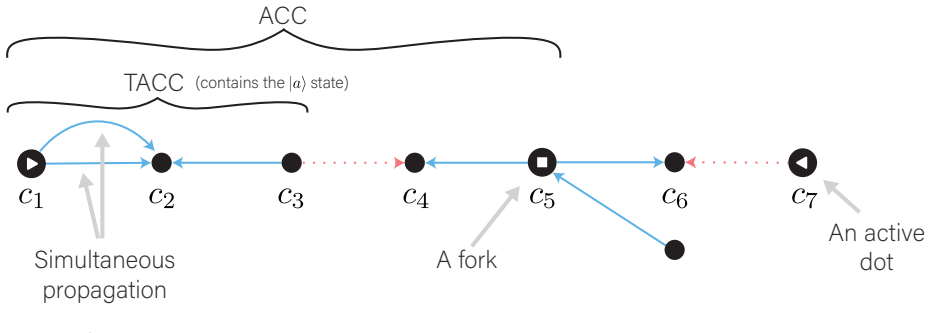
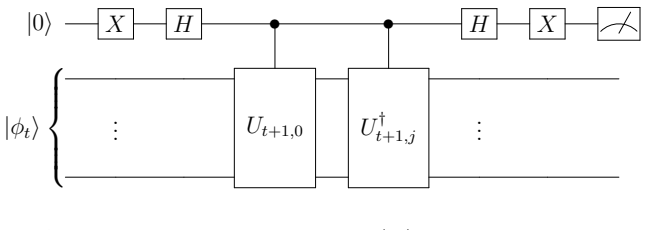
The load-bearing object is a redefinition of the standard circuit-to-Hamiltonian projectors H_init, H_prop, H_out into 'ternary clock' projectors: each logical qudit carries an extra undefined state |?>, while clock qudits carry the states |r>, |a>, |d> that index a computation step. The projectors are engineered so that any instance is either trivially satisfiable, trivially unsatisfiable, or encodes the evaluation of a quantum circuit; monogamy of entanglement (the fact that one qubit cannot be maximally entangled with two others) is used in LCT-QSAT to reject instances whose clock graph is not a single directed chain. The same structural lemmas are re-proved in SLCT-QSAT using only clock-consistency constraints, removing the need for auxiliary Bell-pair subspaces and lowering the qudit dimension from 17 to 6. The QCMA and coRP variants modify the initialization projector to couple logical qudits to witness or auxiliary qudits, forcing the witness to be classical without losing perfect completeness.
What would settle it
A concrete check would be to enumerate all small qubit QCSP instances and apply the paper's reduction in reverse: find one qubit instance that is not equivalent to any qudit instance under the claimed surjective mapping, or whose satisfiability differs from its parent qudit instance, which would refute Theorem 5. For the coRP claim specifically, implementing the Section 6 decision algorithm on exhaustively enumerated small instances and comparing its output with exact diagonalization would show a no-instance accepted with probability above 1/3, directly contradicting the claimed soundness.
Extended reading notes
Core claim
The central claim is that finite sets of O(1)-local projectors yield QSAT problems complete for BQP_1, coRP, and QCMA, plus six complete problems for PI and SoPU classes. The first QSAT problem, LCT-QSAT, is BQP_1-complete with 4-local clauses on 17-dimensional qudits and uses monogamy of entanglement to force the clock structure to be a one-dimensional chain. A refined version, SLCT-QSAT, achieves the same completeness on 6-dimensional qudits, and Corollary 1.1 removes the dependence on the particular Clifford-cyclotomic gate set. Small modifications produce Witnessed SLCT-QSAT, which is QCMA-complete on 8-dimensional qudits, and Classical SLCT-QSAT, which is coRP-complete on 8-dimensional qudits. Theorem 5 then shows every qudit QCSP reduces to a qubit QCSP of the same difficulty, giving qubit versions with locality 48 (for BQP_1 and QCMA) and 60 (for coRP). Direct products and sums of these problems with 3-SAT and Stoquastic 6-SAT yield complete problems for PI(coRP,NP), SoPU(coRP,NP), PI(BQP_1,NP), SoPU(BQP_1,NP), PI(BQP_1,MA), and SoPU(BQP_1,MA). Corollary 1.3 concludes that any classification of strong quantum CSPs with O(1)-local qubit clauses must either include all thirteen classes or show that some of them coincide.
Load-bearing premise
The load-bearing premise is that every qudit constraint problem can be re-encoded as a qubit constraint problem of exactly the same difficulty; if the reduction misses some qubit instances or changes their satisfiability, the qubit versions of the BQP_1, coRP, and QCMA completeness claims collapse.
Editorial extensions
If this is right
- There is a finite-set QSAT problem, SLCT-QSAT and its qubit version, whose yes/no instances can be decided by a quantum circuit with perfect completeness, giving the first nontrivial BQP_1-complete problem.
- There is a QSAT problem, Classical SLCT-QSAT, decidable by a randomized classical algorithm with one-sided error, so frustration-freeness with a restricted projector set can be a coRP-complete question.
- The QCMA-complete problem Witnessed SLCT-QSAT shows that allowing a classical witness in a QSAT instance places it in a class strictly between the witness-free and quantum-witness settings, unless some of these classes collapse.
- Any future classification theorem for strong quantum CSPs, analogous to Schaefer's theorem for classical CSPs, must either incorporate at least thirteen distinct classes or provide a proof that some of the thirteen are equal.
- Because the qubit versions have finite projector sets and constant locality, the completeness results transfer to physically natural qubit Hamiltonians rather than remaining confined to high-dimensional qudit constructions.
Reading between the lines
- If the qudit-to-qubit reduction of Theorem 5 is as strong as claimed, the three qubit QSAT problems provide concrete qubit Hamiltonians whose frustration-free problem sits in BQP_1, coRP, or QCMA; these are natural candidates for attempts to lower the locality constant or to find simpler glassy versions of the same clauses.
- The monogamy-of-entanglement gadget used to force linear clock structure could be reused in other constraint problems where a one-dimensional interaction graph simplifies the decision procedure, independent of the quantum circuit encoding.
- The thirteen-class conclusion sharpens the stakes of derandomization-style open questions: establishing, for instance, coRP = P would immediately collapse two of the new PI and SoPU classes to NP, while showing BQP_1 and NP are incomparable would force any classification to separate them.
- A testable extension would be to search for smaller-dimensional versions of the ternary |? > trick, asking whether the same containment and hardness arguments survive when the logical Hilbert space dimension is reduced below six while keeping the same promise on the spectral gap.
Editorial analysis
A structured set of objections, weighed in public.
Referee Report
Summary. The paper defines several finite-projector quantum SAT problems and claims completeness for BQP_1 (with the Clifford-cyclotomic gate set G8), QCMA, coRP, and six PI/SoPU classes. The central technical device is a modified circuit-to-Hamiltonian construction in which the usual H_init, H_prop, and H_out terms are re-engineered with a ternary 'undefined' logical state, high-dimensional clock qudits, and (in the first construction) monogamy-of-entanglement constraints. These ingredients are intended to force every instance to be either trivially satisfiable, trivially unsatisfiable, or equivalent to evaluating a witness-free quantum circuit, a deterministic classical circuit, or a circuit with a classical witness. The paper further claims a general reduction from qudit QCSPs to qubit QCSPs (Theorem 5), and uses direct product/sum constructions to obtain six PI/SoPU-complete qubit QSAT problems, giving Corollary 1.3 that any strong QCSP classification must contain at least 13 classes. The version of the manuscript provided to me contains no Section 7, no Section 8, and no Appendices A-C, although the text repeatedly refers to them; this is the main obstacle to verification.
Significance. If the missing proofs are correct, this is a substantial contribution. The paper would provide the first nontrivial BQP_1-complete problem, new QCMA- and coRP-complete QSAT problems, and the first complete problems for several PI and SoPU classes, together with a concrete lower bound of 13 classes for any future Schaefer-type classification of strong quantum constraint satisfaction. The construction of LCT-QSAT, in particular the use of monogamy of entanglement to force a one-dimensional clock structure, is genuinely novel. The main-text algorithms are written in enough detail to be reproducible, although no machine-checked proofs or code are provided. The significance is conditional: the advertised qubit and PI/SoPU results all depend on the absent Section 7 and Section 8, and the containment proofs depend on absent appendices.
major comments (4)
- [§7 (Theorem 5 and Corollary 1.2)] The qudit-to-qubit reduction, Theorem 5, is the load-bearing bridge for every qubit-level claim, but it is not present in the submitted manuscript. Section 1.2 itself concedes that the standard encoding is not surjective on instances and that the resulting qubit problem contains harder instances. A correct proof must supply a finite O(1)-local qubit projector set whose full instance closure under arbitrary collections, in the sense of Definition 2.7, has the same yes/no classification and the same 1/poly promise gap as the original qudit problem. Without this construction, Corollary 1.2, Theorem 6, and Corollary 1.3 are unsupported.
- [§3.3, §4.1, and Appendices A/B] The containment proofs for LCT-QSAT and SLCT-QSAT rely on the structural classification lemmas Lemmas 3.1-3.10 and 4.1-4.8, but the text states that their proofs are collected in Appendices A and B, which are not included. In particular, Lemmas 3.2-3.7 are what justify the rejection steps of the classical algorithm; without those proofs, the perfect-completeness claim cannot be checked. The same applies to Propositions 3.1-3.3 and to the claims about simultaneous propagation clauses. The complete appendix material must be provided.
- [§3.2, §3.5, and §4.3] There is a gate-set mismatch in the hardness reductions. Definitions 3.1 and 4.1 allow propagation unitaries only from {H, HT, (H⊗H)CNOT}, but the hardness proofs begin with a BQP_1 circuit U_x whose gates are from Clifford+T, G8 = {H, CNOT, T}, and then place those gates directly into Π_prop clauses. No exact polynomial-time decomposition of CNOT or T in terms of the allowed set is given. Since BQP_1 requires perfect completeness, even approximation is not acceptable here; a short exact decomposition lemma is needed.
- [§8 (Theorem 6 and Corollary 1.3)] Section 8, which is supposed to define the direct product and direct sum of QCSPs and prove Theorem 6, is absent. The claim in Section 1.2 that satisfying states 'always respect the product (resp. sum) structure' and the 'mild technical conditions' for efficient conversion are exactly the technical content needed for the six PI/SoPU completeness results. Without this section, Theorem 6 and the 13-class Corollary 1.3 remain assertions rather than proven results.
minor comments (4)
- [§2.3] In the paragraph after Definition 2.7, the sentence 'there exists a state a state that satisfies all constraints' contains a duplicated phrase and should be corrected.
- [§3.2] The remark that certain tensor products are abbreviated as |a⟩⟨a| is under-specified; a table of the decomposition of the 17-dimensional qudit into logical, clock, and endpoint subspaces would make the projector definitions much easier to check.
- [§3.4.1, Step (2.5)] The step 'If there are no Π_init and Π_out clauses' is ambiguous; Lemma 3.6 refers to a clock component that does not contain at least one Π_init and at least one Π_out clause, so the step should be phrased as 'does not contain both types of clauses'.
- [§3.4.4, Eq. (19)] The soundness bound 'max p_i,j ≥ sum/(total number of projectors)' is stated with 'total number of projectors' without defining whether the count includes only measured projectors or all projectors in the instance; this should be made explicit, since the soundness argument uses the promise on the full instance.
Circularity Check
No significant circularity: the hardness and membership proofs are independent reductions, and the only self-citation is used to disavow flawed prior work.
full rationale
The derivation chain is self-contained in the nontrivial directions. Theorems 1-4 reduce arbitrary BQP1/QCMA/coRP circuits to instances of explicitly defined Hamiltonian terms (e.g. Eqs. 9-11, 25-27, and Definitions 3.1, 4.1, 5.1, 6.1), and containment is proved by a separate structural analysis followed by a quantum or classical simulation of the circuit expressed by the TACC; neither direction uses the target QSAT problem as its own witness. Theorem 5, the qudit-to-qubit reduction, is explicitly flagged as nontrivial — the paper concedes in Section 1.2 that the standard embedding is not surjective on instances and says the issue is addressed with 'a more careful mapping' — and the available text does not define the qubit problem as identical to the qudit problem by construction. The absence of the Section 7 proof is an evidentiary gap for the qubit corollaries, not a circular step. The only self-citation (Meiburg 2021) is invoked to state that those earlier constructions are flawed, which is the opposite of loading the argument onto self-citation. The PI/SoPU results concern newly introduced classes whose definitions are independent of the QSAT instances; direct-product and direct-sum hardness follows from the class definitions, which is a legitimate completeness statement rather than a fitted input renamed as a prediction. No load-bearing step reduces, by the paper's own equations or by self-citation, to its own inputs.
Assumptions & free parameters
free parameters (4)
- LCT-QSAT qudit dimension =
17
- SLCT-QSAT qudit dimension =
6
- Witnessed/Classical SLCT-QSAT qudit dimension =
8
- Clifford-cyclotomic degree for BQP_1 completeness =
8 (Clifford+T)
assumptions (6)
- standard math Kitaev's Geometric Lemma
- standard math QCMA = QCMA_1 with gate set G8 (Jordan et al.)
- standard math BQP_1^{G_{2i}} = BQP_1^{G_{2j}} (Rudolph)
- standard math Giles-Selinger exact synthesis of Clifford+T unitaries
- domain assumption Monogamy of entanglement
- standard math The promise gap can be amplified for BQP_1/QCMA/coRP
invented entities (4)
-
Undefined logical state |?⟩
-
Clock auxiliary subspaces C_A and C_B
-
Endpoint subspace E_C
-
Witness/Aux subspace
Cite this review
Pith. "Pith review of Quantum SAT Problems with Finite Sets of Projectors are Complete for a Plethora of Classes." pith.science (2026). https://pith.science/paper/O6HZXDAK
@misc{pith2026250607244,
  author       = {Pith},
  title        = {Pith review of: Quantum SAT Problems with Finite Sets of Projectors are Complete for a Plethora of Classes},
  year         = {2026},
  howpublished = {\url{https://pith.science/paper/O6HZXDAK}},
  note         = {Machine review of arXiv:2506.07244}
}
abstract
Previously, all known variants of the Quantum Satisfiability (QSAT) problem, i.e. deciding whether a $k$-local ($k$-body) Hamiltonian is frustration-free, could be classified as being either in $\mathsf{P}$; or complete for $\mathsf{NP}$, $\mathsf{MA}$, or $\mathsf{QMA_1}$. Here, we demonstrate new qubit variants of this problem that are complete for $\mathsf{BQP_1}$, $\mathsf{coRP}$, $\mathsf{QCMA}$, $\mathsf{PI(coRP,NP)}$, $\mathsf{PI(BQP_1,NP)}$, $\mathsf{PI(BQP_1,MA)}$, $\mathsf{SoPU(coRP,NP)}$, $\mathsf{SoPU(BQP_1,NP)}$, and $\mathsf{SoPU(BQP_1,MA)}$. Our result implies that a complete classification of quantum constraint satisfaction problems (QCSPs), analogous to Schaefer's dichotomy theorem for classical CSPs, must either include these 13 classes, or otherwise show that some are equal. Additionally, our result showcases two new types of QSAT problems that can be decided efficiently, as well as the first nontrivial $\mathsf{BQP_1}$-complete problem. We first prove there are qudit QSAT problems that are complete for $\mathsf{BQP_1}$, $\mathsf{coRP}$, and $\mathsf{QCMA}$ by re-defining elements of the circuit-to-Hamiltonian transformation. We then show that any QCSP can be reduced to a problem in qubits while maintaining the same complexity - something believed not to be possible classically. The remaining six problems are obtained by considering "sums" and "products" of the first seven QSAT problems. Before this work, the QSAT problems generated in this way resulted in complete problems for $\mathsf{PI}$ and $\mathsf{SoPU}$ classes that were trivially equal to other known classes. We thus commence the study of these new and seemingly nontrivial classes. While [Meiburg, 2021] first sought to prove completeness for the first three classes, we note that his constructions are flawed. Here, we rework them and obtain improvements on the required qudit dimensionality.
Figures


Figures from the paper (11 more)




Reference graph
Works this paper leans on
-
[1]
Kitaev, Alexander Shen, and Mikhail N
Alexei Y. Kitaev, Alexander Shen, and Mikhail N. Vyalyi.Classical and quantum computation. 47. American Mathematical Soc., 2002
work page 2002
-
[2]
The Complexity of the Local Hamiltonian Problem
Julia Kempe, Alexei Kitaev, and Oded Regev. “The Complexity of the Local Hamiltonian Problem”. In:FSTTCS 2004: Foundations of Software Technology and Theoretical Computer Science. Springer, 2004, pp. 372–383.isbn: 978-3-540-24058-7.doi:10.1007/978-3-540-30538-5_31
-
[3]
Sergey Bravyi.Efficient algorithm for a quantum analogue of 2-SAT. 2006. arXiv:quant-ph/0602108 [quant-ph].url:https://arxiv.org/abs/quant-ph/0602108
arXiv 2006
-
[4]
Quantum 3-SAT isQMA 1-complete
David Gosset and Daniel Nagaj. “Quantum 3-SAT isQMA 1-complete”. In:SIAM Journal on Com- puting45.3 (2016), pp. 1080–1128
work page 2016
-
[5]
Exact Synthesis of Multiqubit Clifford-Cyclotomic Circuits
Matthew Amy et al. “Exact Synthesis of Multiqubit Clifford-Cyclotomic Circuits”. In:Reversible Com- putation. Ed. by Torben Ægidius Mogensen and Lukasz Mikulski. Cham: Springer Nature Switzerland, 2024, pp. 238–245
work page 2024
-
[6]
Sergey Bravyi, Arvid J. Bessen, and Barbara M. Terhal.Merlin-Arthur Games and Stoquastic Complex- ity. 2006. arXiv:quant-ph/0611021 [quant-ph].url:https://arxiv.org/abs/quant-ph/0611021
arXiv 2006
-
[7]
Commutative version of the local Hamiltonian problem and com- mon Eigenspace problem
Sergey Bravyi and Mikhail Vyalyi. “Commutative version of the local Hamiltonian problem and com- mon Eigenspace problem”. In:Quantum Info. Comp.5 (May 2005), pp. 187–215.doi:10 . 26421 / QIC5.3-2
work page 2005
-
[8]
Quantum Computational Complexity of the N-Representability Problem: QMA Complete
Yi-Kai Liu, Matthias Christandl, and F. Verstraete. “Quantum Computational Complexity of the N-Representability Problem: QMA Complete”. In:Phys. Rev. Lett.98 (11 2007), p. 110503.doi: 10.1103/PhysRevLett.98.110503.url:https://link.aps.org/doi/10.1103/PhysRevLett.98. 110503
work page doi:10.1103/physrevlett.98.110503.url:https://link.aps.org/doi/10.1103/physrevlett.98 2007
Show all 54 references
-
[9]
Interacting Boson Problems Can Be QMA Hard
Tzu-Chieh Wei, Michele Mosca, and Ashwin Nayak. “Interacting Boson Problems Can Be QMA Hard”. In:Phys. Rev. Lett.104 (4 2010), p. 040501.doi:10.1103/PhysRevLett.104.040501.url:https: //link.aps.org/doi/10.1103/PhysRevLett.104.040501
2010 doi
-
[10]
Computational complexity of interacting electrons and funda- mental limitations of density functional theory
Norbert Schuch and Frank Verstraete. “Computational complexity of interacting electrons and funda- mental limitations of density functional theory”. In:Nature physics5.10 (2009), pp. 732–735
2009
-
[11]
The Bose-Hubbard model is QMA-complete
Andrew M Childs, David Gosset, and Zak Webb. “The Bose-Hubbard model is QMA-complete”. In: Automata, Languages, and Programming: 41st International Colloquium, ICALP 2014. Springer. 2014, pp. 308–319
2014
-
[12]
The complexity of quantum spin systems on a two-dimensional square lattice
Roberto Oliveira and Barbara M. Terhal. “The complexity of quantum spin systems on a two-dimensional square lattice”. In:Quantum Info. Comput.8.10 (Nov. 2008), pp. 900–924.issn: 1533-7146
2008
-
[13]
The Local Hamiltonian Problem on a Line with Eight States is QMA-Complete
Sean Hallgren, Daniel Nagaj, and Sandeep Narayanaswami. “The Local Hamiltonian Problem on a Line with Eight States is QMA-Complete”. In:Quantum Info. Comput.13.9–10 (2013), pp. 721–750. issn: 1533-7146
2013
-
[14]
On the Complexity of Two Dimensional Commuting Local Hamiltonians
Dorit Aharonov, Oded Kenneth, and Itamar Vigdorovich. “On the Complexity of Two Dimensional Commuting Local Hamiltonians”. In:13th Conference on the Theory of Quantum Computation, Com- munication and Cryptography (TQC 2018). Ed. by Stacey Jeffery. Vol. 111. Leibniz Internation...
2018 doi
-
[15]
Sandy Irani and Jiaqing Jiang.Commuting Local Hamiltonian Problem on 2D beyond qubits. 2023. arXiv:2309.04910 [quant-ph].url:https://arxiv.org/abs/2309.04910
2023 arXiv
-
[16]
Grilo.Complexity of geometrically local stoquastic Hamiltonians
Asad Raza, Jens Eisert, and Alex B. Grilo.Complexity of geometrically local stoquastic Hamiltonians
-
[17]
Complexity classification of local Hamiltonian problems
Toby Cubitt and Ashley Montanaro. “Complexity classification of local Hamiltonian problems”. In: SIAM Journal on Computing45.2 (2016), pp. 268–316. 71
2016
-
[18]
On complexity of the quantum Ising model
Sergey Bravyi and Matthew Hastings. “On complexity of the quantum Ising model”. In:Communica- tions in Mathematical Physics349.1 (2017), pp. 1–45
2017
-
[19]
The complexity of facets (and some facets of complexity)
C.H. Papadimitriou and M. Yannakakis. “The complexity of facets (and some facets of complexity)”. In:Journal of Computer and System Sciences28.2 (Apr. 1984), pp. 244–259.issn: 0022-0000.doi: 10.1016/0022-0000(84)90068-0.url:http://dx.doi.org/10.1016/0022-0000(84)90068-0
1984 doi
-
[20]
The Boolean Hierarchy I: Structural Properties
Jin-Yi Cai et al. “The Boolean Hierarchy I: Structural Properties”. In:SIAM Journal on Computing 17.6 (Dec. 1988), pp. 1232–1252.issn: 1095-7111.doi:10.1137/0217078.url:http://dx.doi.org/ 10.1137/0217078
1988 doi
-
[21]
Alex Meiburg.Quantum Constraint Problems can be complete forBQP,QCMA, and more. 2021. arXiv: 2101.08381 [quant-ph].url:https://arxiv.org/abs/2101.08381
2021 arXiv
-
[22]
Dorian Rudolph.Towards a universal gateset forQMA 1. 2024. arXiv:2411.02681 [quant-ph].url: https://arxiv.org/abs/2411.02681
2024 arXiv
-
[23]
Quantum mechanical computers
Richard P Feynman. “Quantum mechanical computers.” In:Found. Phys.16.6 (1986), pp. 507–532
1986
-
[24]
Explicitly correlated electronic structure calcula- tions with transcorrelated matrix product operators
Alberto Baiardi, Micha l Lesiuk, and Markus Reiher. “Explicitly correlated electronic structure calcula- tions with transcorrelated matrix product operators”. In:Journal of Chemical Theory and Computation 18.7 (2022), pp. 4203–4217
2022
-
[25]
Quantum simulation of three-body interactions in weakly driven quantum systems
Francesco Petiziol et al. “Quantum simulation of three-body interactions in weakly driven quantum systems”. In:Phys. Rev. Lett.126.25 (2021), p. 250504
2021
-
[26]
J. H. Busnaina et al.Native Three-Body Interactions in a Superconducting Lattice Gauge Quantum Simulator. 2025. arXiv:2501.13383 [quant-ph].url:https://arxiv.org/abs/2501.13383
2025 arXiv
-
[27]
Chuang et al.Observation of a Halo Trimer in an Ultracold Bose-Fermi Mixture
Alexander Y. Chuang et al.Observation of a Halo Trimer in an Ultracold Bose-Fermi Mixture. 2024. arXiv:2411.04820 [cond-mat.quant-gas].url:https://arxiv.org/abs/2411.04820
2024
-
[28]
Probing Few-Body Nuclear Dynamics via 3H and 3He (e, e ′ p)pn Cross-Section Measurements
R. Cruz-Torres et al. “Probing Few-Body Nuclear Dynamics via 3H and 3He (e, e ′ p)pn Cross-Section Measurements”. In:Phys. Rev. Lett.124 (21 2020), p. 212501.doi:10 . 1103 / PhysRevLett . 124 . 212501.url:https://link.aps.org/doi/10.1103/PhysRevLett.124.212501
2020 doi
-
[29]
Two Combinatorial MA-Complete Problems
Dorit Aharonov and Alex B. Grilo. “Two Combinatorial MA-Complete Problems”. In:12th Innovations in Theoretical Computer Science Conference (ITCS 2021). Ed. by James R. Lee. Vol. 185. Leibniz International Proceedings in Informatics (LIPIcs). Dagstuhl, Germany: Schloss Dagstuhl...
2021 doi
-
[30]
Achieving perfect completeness in classical-witness quantum Merlin-Arthur proof systems
Stephen P. Jordan et al. “Achieving perfect completeness in classical-witness quantum Merlin-Arthur proof systems”. In:Quantum Info. Comput.12(5-6) (2012), pp. 461–471
2012
-
[31]
The complexity of satisfiability problems
Thomas J. Schaefer. “The complexity of satisfiability problems”. In:Proceedings of the Tenth Annual ACM Symposium on Theory of Computing. STOC ’78. New York, NY, USA: Association for Computing Machinery, 1978, pp. 216–226.isbn: 9781450374378.doi:10 . 1145 / 800133 . 804350.url...
1978
-
[32]
A proof of the CSP dichotomy conjecture
Dmitriy Zhuk. “A proof of the CSP dichotomy conjecture”. In:Journal of the ACM (JACM)67.5 (2020), pp. 1–78
2020
-
[33]
Quantum computations: algorithms and error correction
A Yu Kitaev. “Quantum computations: algorithms and error correction”. In:Russian Mathematical Surveys52.6 (1997), p. 1191
1997
-
[34]
Exact synthesis of multiqubit Clifford+ T circuits
Brett Giles and Peter Selinger. “Exact synthesis of multiqubit Clifford+ T circuits”. In:Physical Review A87.3 (2013), p. 032332
2013
-
[35]
Dorit Aharonov and Tomer Naveh.Quantum NP - A Survey. 2002. arXiv:quant - ph / 0210077 [quant-ph].url:https://arxiv.org/abs/quant-ph/0210077
2002 arXiv
-
[36]
On perfect completeness for QMA
Scott Aaronson. “On perfect completeness for QMA”. In:Quantum Info. Comput.9 (2009), pp. 81–89
2009
-
[37]
The complexity of stoquastic local Hamiltonian problems
Sergey Bravyi et al. “The complexity of stoquastic local Hamiltonian problems”. In:Quantum Info. Comput.8.5 (2008), pp. 361–385.issn: 1533-7146. 72
2008
-
[38]
Quantum hamiltonian complexity
Sevag Gharibian et al. “Quantum hamiltonian complexity”. In:Foundations and Trends in Theoretical Computer Science10.3 (2015), pp. 159–282
2015
-
[39]
Ground state connectivity of local Hamiltonians
Sevag Gharibian and Jamie Sikora. “Ground state connectivity of local Hamiltonians”. In:International Colloquium on Automata, Languages, and Programming. Springer. 2015, pp. 617–628
2015
-
[40]
Two QCMA-complete problems
Pawel Wocjan, Dominik Janzing, and Thomas Beth. “Two QCMA-complete problems”. In:Quantum Info. Comput.3.6 (2003), pp. 635–643.issn: 1533-7146
2003
-
[41]
QCMA hardness of ground space connectivity for commuting Hamiltonians
David Gosset, Jenish C. Mehta, and Thomas Vidick. “QCMA hardness of ground space connectivity for commuting Hamiltonians”. In:Quantum1 (2017), p. 16
2017
-
[42]
Ying-hao Chen.2-Local Hamiltonian with Low Complexity is QCMA. 2019. arXiv:1909.03787 [cs.CC]. url:https://arxiv.org/abs/1909.03787
2019 arXiv
-
[43]
PP is closed under intersection
Richard Beigel, Nick Reingold, and Daniel Spielman. “PP is closed under intersection”. In:Proceedings of the twenty-third annual ACM symposium on Theory of computing - STOC ’91. STOC ’91. ACM Press, 1991, pp. 1–9.doi:10.1145/103418.103426.url:http://dx.doi.org/10.1145/103418. 103426
1991
-
[44]
The complexity of satisfiability problems: Refining Schaefer’s theorem
Eric Allender et al. “The complexity of satisfiability problems: Refining Schaefer’s theorem”. In:Journal of Computer and System Sciences75.4 (June 2009), pp. 245–254.issn: 0022-0000.doi:10.1016/j. jcss.2008.11.001.url:http://dx.doi.org/10.1016/j.jcss.2008.11.001
2009 doi
-
[45]
Undirected connectivity in log-space
Omer Reingold. “Undirected connectivity in log-space”. In:Journal of the ACM55.4 (Sept. 2008), pp. 1–24.issn: 1557-735X.doi:10.1145/1391289.1391291.url:http://dx.doi.org/10.1145/ 1391289.1391291
2008
-
[46]
On truth-table reducibility to SAT
Samuel R. Buss and Louise Hay. “On truth-table reducibility to SAT”. In:Information and Compu- tation91.1 (Mar. 1991), pp. 86–102.issn: 0890-5401.doi:10.1016/0890- 5401(91)90075- d.url: http://dx.doi.org/10.1016/0890-5401(91)90075-D
1991 doi
-
[47]
The strong exponential hierarchy collapses
Lane A. Hemachandra. “The strong exponential hierarchy collapses”. In:Journal of Computer and System Sciences39.3 (Dec. 1989), pp. 299–322.issn: 0022-0000.doi:10.1016/0022-0000(89)90025- 1.url:http://dx.doi.org/10.1016/0022-0000(89)90025-1
1989 doi
-
[48]
Chris Cade, Marten Folkertsma, and Jordi Weggemans.Complexity of the Guided Local Hamiltonian Problem: Improved Parameters and Extension to Excited States. 2024. arXiv:2207.10097 [quant-ph]. url:https://arxiv.org/abs/2207.10097. A Proofs of Lemmas: Section 3 Lemma 3.1(Single-t...
2024 arXiv
-
[50]
If they are well-defined or undefined and includec 0
-
[51]
If they are well-defined and includec T
-
[52]
Proof.Case (1) is trivial
If they are undefined, includec T , and point towards it. Proof.Case (1) is trivial. By assumption,c 0 is present in a well-defined clause of the TACC that points away from it. This is the same setting as in Lemma 4.4, which concludes that the instance is unsatisfiable. Consid...
-
[53]
If they are well-defined or undefined, and point towardsc d
-
[54]
Proof.The first case was already covered in Lemma 4.3
If they are well-defined and point away fromc d. Proof.The first case was already covered in Lemma 4.3. For the second case, recall thatc d must be|a⟩ at all times. Satisfying the Π prop clause requires the active state to shift towards the other clock qudit, leavingc d to be ...
-
[2024]
arXiv:2407.15499 [quant-ph].url:https://arxiv.org/abs/2407.15499
Reviewed August 7, 2026 · model on record in the stance chip above.
Discussion (0). Sign in to comment.