REVIEW 3 major objections 4 minor 1 cited by
Uncertainty-Aware Strategies: A Model-Agnostic Framework for Robust Financial Optimization through Subsampling
T0 review · 3 major / 4 minor · reviewed 2026-08-07 · deepseek-v4-flash
Pith's one-line read The paper claims that replacing the plug-in objective with an uncertainty-aware objective over a distribution of candidate models improves out-of-sample financial decisions, and that a bootstrap-like subsampling approximation delivers…
desk verdict The Gaussian analytic core is solid, but the CVaR-SGD algorithm's proof and implementation target opposite tails, so the paper's main computational claim does not hold as written. read the letter →
The pith
A machine-rendered reading of the paper's core claim, the machinery that carries it, and where it could break.
The reading
What carries the argument
The central object is the uncertainty-aware objective in equation (2), a composition of an inner objective $J$ with an outer uncertainty measure $U$, where $U$ maps a random variable on the model space $\Theta$ to $\mathbb{R}$. For $U$ the paper uses the entropic risk $\mathrm{Entr}_{\lambda'}$ and the conditional value-at-risk $\mathrm{CVaR}_\alpha$; for the sampling distribution $P$ over models it uses subsampling: drawing $n$ events from the estimated measure $\hat P$, giving an empirical measure $P_\theta = \frac1n\sum_{i=1}^n \delta_{\omega_i}$, and treating $\theta$ as random with distribution $\hat P^n$. The proof machinery for convergence is the Rockafellar–Uryasev representation $\mathrm{CVaR}_\alpha(Z)=\min_\zeta (\zeta + \frac1\alpha E[(Z-\zeta)_+])$, which lets the paper write the robust objective as a convex function of the action and apply the standard SGD convergence theorem.
What would settle it
Simulate the exact setting of Theorem 5.1 with $m$ fixed (say $m=50$, $\alpha=0.1$) on a scalar convex quadratic objective where the CVaR gradient is computable in closed form, and compare Algorithm 1's mean update direction to the true CVaR gradient; a systematic finite-$m$ bias that does not vanish as $t$ grows would contradict the unbiasedness premise and with it the $O(1/\sqrt{t})$ rate.
Extended reading notes
Core claim
The central claim is that the plug-in objective $J(X(a),\hat P)$ should be replaced by the uncertainty-aware objective $U(J(X(a),P_\theta),P)$, where $U$ is a risk measure over the model-indexing variable $\theta$. With $U$ chosen as entropic risk or CVaR, the resulting action shrinks toward zero when the estimated signal is weak, in contrast to the plug-in action, which scales linearly with the estimate and can produce negative out-of-sample utility. The paper derives closed-form strategies and out-of-sample performance in a Gaussian i.i.d. setting (Lemmas 3.1 and 3.2), shows that the mixture measure is essentially a variance adjustment and fails to robustify enough, and proves (Theorem 5.1) that a CVaR-SGD algorithm with step size $B/(\rho\sqrt{t})$ converges at rate $O(1/\sqrt{t})$ to the CVaR-robust objective. Numerically, subsampling-based uncertainty-aware strategies match Bayesian (Kalman-filter) performance and improve deep hedging out-of-sample.
Load-bearing premise
The convergence proof for CVaR-SGD assumes that keeping the worst $k$ of $m$ sampled objectives and averaging their gradients is an unbiased estimate of the true CVaR gradient, which is exactly true only as the number of samples grows; for finite $m$ the $k$-smallest selection is a rank-based statistic with a smoothed inclusion probability, so the practical algorithm's update is only approximately the CVaR gradient.
Editorial extensions
If this is right
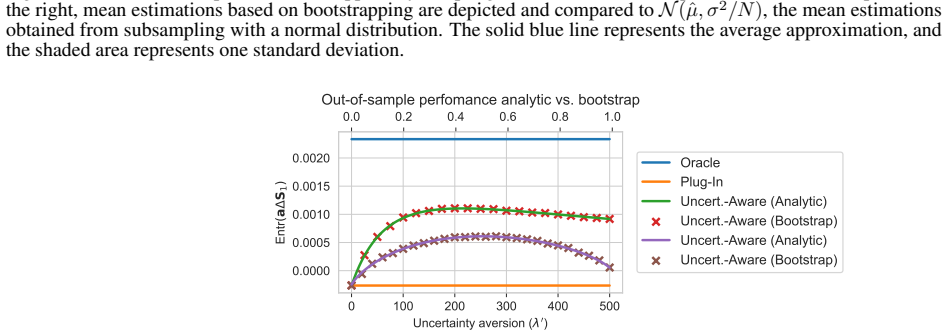
- Plug-in and mixture strategies can produce negative out-of-sample utility in the Gaussian example, while uncertainty-aware strategies with sufficient risk aversion are positive and converge to the trivial zero-investment strategy as uncertainty aversion grows.
- The CVaR-based uncertainty-aware strategy has a zero-investment region: it stays out of the market unless the estimated signal exceeds a threshold proportional to $1/\sqrt{N}$, acting as a built-in significance filter.
- CVaR-SGD with memory capped at $m$ simultaneous subsamples behaves like vanilla SGD with roughly $m/(1-\alpha)$ subsamples, improving approximation accuracy for larger $\alpha$ at the same memory cost.
- On the PEP–KO pairs-trading backtest, subsampling with CVaR matches the Kalman-filter Bayesian robustification; deep hedging robustified by CVaR over subsamples improves both the mean and the dispersion of the out-of-sample P&L objective across a test distribution of Heston models.
Reading between the lines
- If the central claim holds, the same nesting trick transfers to any simulation-based optimization where a plug-in estimate is known to overfit, such as reinforcement learning, energy hedging, or generative model selection.
- The CVaR zero-investment region suggests a practical diagnostic: the ratio of the estimated signal to its standard error determines both whether to trade and how aggressively, linking the method to classical significance testing.
- A testable extension is to apply the subsampling uncertainty measure with other coherent risk measures, such as expected shortfall variants or distortion risk measures, and check whether the dominance over mixtures persists outside the Gaussian case.
- The paper notes that the empirical-measure bootstrap underrepresents tails; a smoothed or tail-thickened bootstrap could be tested as a direct drop-in replacement for the subsample distribution.
Editorial analysis
A structured set of objections, weighed in public.
Referee Report
Summary. The manuscript proposes a two-level decision framework in which a standard financial objective J(X(a), P_θ) is evaluated under an outer uncertainty measure U over a distribution P of candidate models, and develops an "ad hoc" subsampling approximation to P. The authors derive closed-form Gaussian comparisons (Section 3), a bootstrap-style subsampling scheme (Section 4), a memory-efficient CVaR-SGD algorithm (Section 5), and numerical experiments in pairs trading and deep hedging. The central claims are that uncertainty measures outperform mixture-of-measures robustification and match Bayesian methods, and that CVaR-SGD preserves convergence while reducing memory consumption.
Significance. If the central theoretical claims were established, the paper would make a useful contribution: it gives a model-agnostic way to robustify plug-in financial optimizers, with clean analytic normal benchmarks and a plausible route to deep-learning-scale implementation. The entropic/CVaR closed forms in Section 3 are internally consistent, and the subsampling bridge to bootstrapping is conceptually appealing. However, the advertised computational guarantee (Theorem 5.1) rests on an unsupported finite-sample unbiasedness assertion, and Algorithm 1 as written targets the wrong tail; these issues must be resolved before the memory-efficiency contribution can be accepted.
major comments (3)
- [Appendix C.1, Theorem 5.1] The proof of Theorem 5.1 asserts that the average of the gradients over the k smallest of m i.i.d. sample objectives satisfies E[b_g(phi)] = (1/alpha) E[grad J 1_{J <= zeta_alpha}]. For finite m this is not true: the event that sample i is among the k smallest depends on all m order statistics, so by symmetry E[b_g(phi)] is a conditional expectation of g_1 given J_1 <= J_(k), which is not the population CVaR_alpha gradient. The equality holds only asymptotically as m goes to infinity with k/m -> alpha, and the theorem is stated for finite m as used in Algorithm 1. Consequently the O(1/sqrt(t)) bound in Theorem 5.1 is not established.
- [Algorithm 1 versus Theorem 5.1] Algorithm 1 samples k with E[k/m] = 1 - alpha and then keeps the k smallest objectives, i.e. the worst (1-alpha)-fraction of the batch. Theorem 5.1 and the definition of CVaR_alpha require the worst alpha-fraction with E[k] = alpha m. For alpha in (0,1) these are complementary tails, so the implemented estimator estimates CVaR_{1-alpha}, not CVaR_alpha. As a result, the favorable precision results for CVaR-SGD in Section 5.1 do not demonstrate convergence to the intended uncertainty-aware objective.
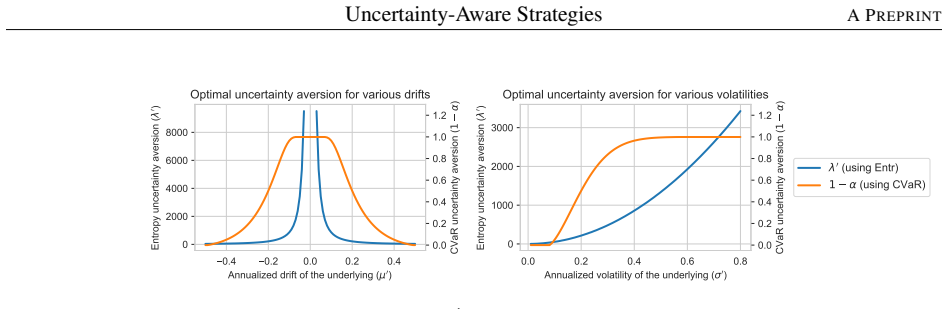
- [Section 5 and Figures 4, 9, 10, 12] The empirical claims that uncertainty-aware subsampling outperforms mixture measures and matches Bayesian methods are not supported by error bars, confidence intervals, or significance tests: Figures 9, 10, and 12 report point estimates only, and Figure 12's standard deviations are of the objective, not of the estimated performance difference. In addition, Figure 4 selects the uncertainty-aversion parameters lambda-prime and alpha on the same test environments used to report performance, so the reported gains of a "reasonably calibrated" uncertainty-aware strategy are not shown to be out-of-sample predictive. These omissions are load-bearing for the paper's empirical conclusions.
minor comments (4)
- [Section B, proof of Lemma 3.1] The proof begins "By the same arguments as in Lemma 3.1" but Lemma 3.1 is the lemma being proved; this should refer to the preceding derivation or to Lemma B.1. The sentence "what results, under the assumption that ..." is also garbled and should be rewritten.
- [Related Work] The phrase "wore-case measure" should be "worst-case measure".
- [Section 4 and Figure 8] There are typos in "repitition" (Section 4, caption of Figure 6) and "eastimation" (caption of Figure 8), and the phrase "dStdestimates" in Section 5.2 should be "dSt estimates".
- [Section 5.1, Figure 10] The label "2-distance to analytic strategy" is ambiguous; the text says Euclidean distance, so the figure label should state "Euclidean distance" or "L2 distance" explicitly.
Circularity Check
No significant circularity: the paper's analytic derivations are self-contained and do not reduce to their inputs.
full rationale
The central derivation chain is not circular. Lemmas 3.1 and 3.2 start from the stated objective (outer Entr or CVaR applied to an inner Entr under a Gaussian posterior for the drift) and solve the resulting one-dimensional optimization explicitly; the out-of-sample performance formulas are then computed under the stated Gaussian assumptions using true parameters, not recovered by assuming the conclusion. The mixture comparison, Remark 3.1, explicitly identifies the mixture strategy with the expectation-uncertainty case, which is a known coincidence rather than a hidden redefinition. The subsampling section derives the induced distribution of the mean and shows via CLT that it reproduces the analytic strategies in the Gaussian limit; this is an approximation result with stated assumptions. The CVaR-SGD content in Theorem 5.1 is the closest to a concern, but the issue there is soundness: the proof's claim that the k-smallest-gradient average is an unbiased estimator of the CVaR_alpha gradient is not established for finite m and Algorithm 1's k targets E[k/m]=1-alpha while the theorem's CVaR_alpha uses the alpha-tail. That is a correctness gap in a proof, not a circular reduction in which the target result is assumed by construction or a fitted parameter is renamed as a prediction. The empirical sections do tune uncertainty-aversion parameters on the evaluation environments (e.g., Figure 4 chooses lambda' and alpha to maximize out-of-sample performance, and the PEP-KO backtest reports the maximum around alpha=15%), which weakens the strength of the reported improvements and should be read as overfitting/tuning risk, but the analytic comparisons and the stated conditions for improvement (e.g., Lemma B.5) are derived independently of any fitted value. Self-citations occur for deep hedging and related robustness work, but none of these citations carries a load-bearing uniqueness or ansatz claim that the paper's own derivation depends on. Under the hard rule requiring an explicit reduction of an equation to its input or a fitted parameter renamed as a prediction, no circular step can be quoted; the appropriate finding is 'no significant circularity'.
Assumptions & free parameters
free parameters (3)
- uncertainty aversion lambda' (entropic) or alpha (CVaR) =
grid/lookup, e.g. PEP-KO example alpha ~ 0.15; Figure 4 plots optimal values
- test distribution of Heston parameters =
Figure 11 densities; no explicit calibration code
- plug-in Heston model parameters =
Table 1: reversion speed 1.0, reversion level 0.03, vol of vol 0.2, correlation -0.8, drift 0, initial vol 0.03
assumptions (5)
- domain assumption Klibanoff et al. (2005) smooth ambiguity framework
- domain assumption Estimator normality: mu_hat ~ N(mu, sigma^2/N) and sigma_hat^2 assumed equal to sigma^2
- standard math Subsampling asymptotic: empirical measure and central limit theorem approximate the population model distribution
- domain assumption Convexity and rho-Lipschitz continuity for CVaR-SGD
- ad hoc to paper Test distribution of Heston models calibrated to typical one-day parameter changes
Cite this review
Pith. "Pith review of Uncertainty-Aware Strategies: A Model-Agnostic Framework for Robust Financial Optimization through Subsampling." pith.science (2026). https://pith.science/paper/UGQ4TKLQ
@misc{pith2026250607299,
  author       = {Pith},
  title        = {Pith review of: Uncertainty-Aware Strategies: A Model-Agnostic Framework for Robust Financial Optimization through Subsampling},
  year         = {2026},
  howpublished = {\url{https://pith.science/paper/UGQ4TKLQ}},
  note         = {Machine review of arXiv:2506.07299}
}
read the original abstract
This paper addresses the challenge of model uncertainty in quantitative finance, where decisions in portfolio allocation, derivative pricing, and risk management rely on estimating stochastic models from limited data. In practice, the unavailability of the true probability measure forces reliance on an empirical approximation, and even small misestimations can lead to significant deviations in decision quality. Building on the framework of Klibanoff et al. (2005), we enhance the conventional objective - whether this is expected utility in an investing context or a hedging metric - by superimposing an outer "uncertainty measure", motivated by traditional monetary risk measures, on the space of models. In scenarios where a natural model distribution is lacking or Bayesian methods are impractical, we propose an ad hoc subsampling strategy, analogous to bootstrapping in statistical finance and related to mini-batch sampling in deep learning, to approximate model uncertainty. To address the quadratic memory demands of naive implementations, we also present an adapted stochastic gradient descent algorithm that enables efficient parallelization. Through analytical, simulated, and empirical studies - including multi-period, real data and high-dimensional examples - we demonstrate that uncertainty measures outperform traditional mixture of measures strategies and our model-agnostic subsampling-based approach not only enhances robustness against model risk but also achieves performance comparable to more elaborate Bayesian methods.
Figures


Figures from the paper (9 more)




Forward citations
Cited by 1 Pith paper
-
Robust Control under Stationary Ambiguity
Policies trained under stationary latent ambiguity, implemented by refreshing the latent parameter, preserve robustness to regime shifts better than policies trained under a fixed latent draw.
Reference graph
Works this paper leans on
-
[1]
Coherent measures of risk.Mathematical Finance, 9(3):203–228, 1999
Philippe Artzner, Freddy Delbaen, Jean-Marc Eber, and David Heath. Coherent measures of risk.Mathematical Finance, 9(3):203–228, 1999
work page 1999
-
[2]
David H. Bailey, Jonathan M. Borwein, Marcos López de Prado, and Qiji Jim Zhu. Pseudo-mathematics and financial charlatanism: the effects of backtest overfitting on out-of-sample performance.Notices Amer. Math. Soc., 61(5):458–471, 2014
work page 2014
-
[3]
Daniel Bartl, Samuel Drapeau, Jan Obłó j, and Johannes Wiesel. Sensitivity analysis of wasserstein distributionally robust optimization problems.Proceedings of the Royal Society A: Mathematical, Physical and Engineering Sciences, 477(2256), dec 2021
work page 2021
-
[4]
Brown, and Constantine Caramanis
Dimitris Bertsimas, David B. Brown, and Constantine Caramanis. Theory and applications of robust optimization. SIAM Review, 53(3):464–501, 2011
work page 2011
-
[5]
Bielecki, Igor Cialenco, and Marek Rutkowski
Tomasz R. Bielecki, Igor Cialenco, and Marek Rutkowski. Arbitrage-free pricing of derivatives in nonlinear market models.Probability, Uncertainty and Quantitative Risk, 3(1):2, 2018
work page 2018
-
[6]
Global portfolio optimization.Financial Analysts Journal, 48(5):28–43, 1992
Fischer Black and Robert Litterman. Global portfolio optimization.Financial Analysts Journal, 48(5):28–43, 1992
1992
-
[7]
The pricing of options and corporate liabilities.J
Fischer Black and Myron Scholes. The pricing of options and corporate liabilities.J. Polit. Econ., 81(3):637–654, 1973
work page 1973
-
[8]
Large-scale machine learning with stochastic gradient descent
Léon Bottou. Large-scale machine learning with stochastic gradient descent. InProceedings of COMPSTAT’2010: 19th International Conference on Computational StatisticsParis France, August 22-27, 2010 Keynote, Invited and Contributed Papers, pages 177–186. Springer, 2010
work page 2010
Show all 70 references
-
[9]
Stochastic gradient descent tricks
Léon Bottou. Stochastic gradient descent tricks. InNeural networks: tricks of the trade: second edition, pages 421–436. Springer, 2012
2012
-
[10]
Buehler, L
H. Buehler, L. Gonon, J. Teichmann, and B. Wood. Deep hedging.Quant. Finance, 19(8):1271–1291, 2019
2019
-
[11]
Deep hedging.Quantitative Finance, 19(8):1271– 1291, 2019
Hans Buehler, Lukas Gonon, Josef Teichmann, and Ben Wood. Deep hedging.Quantitative Finance, 19(8):1271– 1291, 2019
2019
-
[12]
A data-driven market simulator for small data environments.arXiv preprint arXiv:2006.14498, 2020
Hans Buehler, Blanka Horvath, Terry Lyons, Imanol Perez Arribas, and Ben Wood. A data-driven market simulator for small data environments.arXiv preprint arXiv:2006.14498, 2020
2006 arXiv
-
[13]
A data-driven market simulator for small data environments.SSRN Electronic Journal, 2020
Hans Buehler, Blanka Horvath, Terry Lyons, Imanol Perez Arribas, and Ben Wood. A data-driven market simulator for small data environments.SSRN Electronic Journal, 2020. 18 Uncertainty-Aware StrategiesA PREPRINT
2020
-
[14]
Deep bellman hedging.arXiv preprint arXiv:2207.00932, 2022
Hans Buehler, Phillip Murray, and Ben Wood. Deep bellman hedging.arXiv preprint arXiv:2207.00932, 2022
2022 arXiv
-
[15]
Campbell, Andrew W
John Y . Campbell, Andrew W. Lo, and A.Craig MacKinlay.The Econometrics of Financial Markets. Princeton University Press, 1997
1997
-
[16]
Algorithms for cvar optimization in mdps
Yinlam Chow and Mohammad Ghavamzadeh. Algorithms for cvar optimization in mdps. InAdvances in Neural Information Processing Systems 27 (NIPS 2014), pages 3509–3517, 2014
2014
-
[17]
Risk-sensitive and robust decision-making: a CVaR optimization approach
Yinlam Chow, Aviv Tamar, Shie Mannor, and Marco Pavone. Risk-sensitive and robust decision-making: a CVaR optimization approach. InAdvances in Neural Information Processing Systems 28 (NeurIPS 2015), pages 1522–1530, 2015
2015
-
[18]
Springer, 2017
Charles K Chui, Guanrong Chen, et al.Kalman filtering. Springer, 2017
2017
-
[19]
Springer, 2001
Stuart Coles.An Introduction to Statistical Modeling of Extreme Values. Springer, 2001
2001
-
[20]
Model uncertainty and its impact on the pricing of derivative instruments.Math
Rama Cont. Model uncertainty and its impact on the pricing of derivative instruments.Math. Finance, 16(3):519– 547, 2006
2006
-
[21]
Risk measures under model uncertainty: a bayesian viewpoint, 2022
Christa Cuchiero, Guido Gazzani, and Irene Klein. Risk measures under model uncertainty: a bayesian viewpoint, 2022
2022
-
[22]
Istituto italiano degli attuari, 1940
Bruno De Finetti.Il problema dei pieni. Istituto italiano degli attuari, 1940
1940
-
[23]
Distributionally robust optimization under moment uncertainty with application to data-driven problems.Operations Research, 58(3):595–612, 2010
Erick Delage and Yinyu Ye. Distributionally robust optimization under moment uncertainty with application to data-driven problems.Operations Research, 58(3):595–612, 2010
2010
-
[24]
A theoretical framework for the pricing of contingent claims in the presence of model uncertainty.The Annals of Applied Probability, 16(2):827–852, 2006
Laurent Denis and Claude Martini. A theoretical framework for the pricing of contingent claims in the presence of model uncertainty.The Annals of Applied Probability, 16(2):827–852, 2006
2006
-
[25]
Estimate nothing.Quantitative Finance, 14(12):2065–2072, 2014
Moritz Duembgen and LCG Rogers. Estimate nothing.Quantitative Finance, 14(12):2065–2072, 2014
2014
-
[26]
Princeton University Press, 2010
Darrell Duffie.Dynamic asset pricing theory. Princeton University Press, 2010
2010
-
[27]
John Wiley & Sons, 2013
Daniel J Duffy.Finite Difference methods in financial engineering: a Partial Differential Equation approach. John Wiley & Sons, 2013
2013
-
[28]
Bootstrap methods: another look at the jackknife
Bradley Efron. Bootstrap methods: another look at the jackknife. InBreakthroughs in statistics: Methodology and distribution, pages 569–593. Springer, 1992
1992
-
[29]
Affine processes under parameter uncertainty.Probability, Uncertainty and Quantitative Risk, 4(1):5, 2019
Tolulope Fadina, Ariel Neufeld, and Thorsten Schmidt. Affine processes under parameter uncertainty.Probability, Uncertainty and Quantitative Risk, 4(1):5, 2019
2019
-
[30]
De Gruyter, Berlin, Boston, 2004
Hans Föllmer and Alexander Schied.Stochastic Finance: An Introduction in Discrete Time. De Gruyter, Berlin, Boston, 2004
2004
-
[31]
Portfolio selection with parameter and model uncertainty: A multi-prior approach.Review of Financial Studies, 20(1):41–81, 2007
Lorenzo Garlappi, Raman Uppal, and Tan Wang. Portfolio selection with parameter and model uncertainty: A multi-prior approach.Review of Financial Studies, 20(1):41–81, 2007
2007
-
[32]
Pairs trading: Performance of a relative-value arbitrage rule.The review of financial studies, 19(3):797–827, 2006
Evan Gatev, William N Goetzmann, and K Geert Rouwenhorst. Pairs trading: Performance of a relative-value arbitrage rule.The review of financial studies, 19(3):797–827, 2006
2006
-
[33]
John Wiley & Sons, 2011
Jim Gatheral.The volatility surface: a practitioner’s guide. John Wiley & Sons, 2011
2011
-
[34]
Robust risk measurement and model risk.Quantitative Finance, 14(1):29–58, 2014
Paul Glasserman and Xingbo Xu. Robust risk measurement and model risk.Quantitative Finance, 14(1):29–58, 2014
2014
-
[35]
Robust portfolio selection problems.Mathematics of Operations Research, 28(1):1–38, 2003
Donald Goldfarb and Garud Iyengar. Robust portfolio selection problems.Mathematics of Operations Research, 28(1):1–38, 2003
2003
-
[36]
MIT press, 2016
Ian Goodfellow, Yoshua Bengio, and Aaron Courville.Deep learning. MIT press, 2016
2016
-
[37]
Managing smile risk.The Best of Wilmott, 1:249–296, 2002
Patrick S Hagan, Deep Kumar, Andrew S Lesniewski, and Diana E Woodward. Managing smile risk.The Best of Wilmott, 1:249–296, 2002
2002
-
[38]
Robust control and model uncertainty.American Economic Review, 91(2):60–66, 2001
Lars Peter Hansen and Thomas J Sargent. Robust control and model uncertainty.American Economic Review, 91(2):60–66, 2001
2001
-
[39]
Sargent.Robustness
Lars Peter Hansen and Thomas J. Sargent.Robustness. Princeton University Press, Princeton, NJ, 2008. 19 Uncertainty-Aware StrategiesA PREPRINT
2008
-
[40]
Steven L. Heston. A closed-form solution for options with stochastic volatility with applications to bond and currency options.Rev. Financ. Stud., 6(2):327–343, 1993
1993
-
[41]
Deep learning in finance and banking: A literature review and classification
Jian Huang, Junyi Chai, and Stella Cho. Deep learning in finance and banking: A literature review and classification. Frontiers of Business Research in China, 14(1):13, 2020
2020
-
[42]
Garud N. Iyengar. Robust dynamic programming.Mathematics of Operations Research, 30(2):257–280, 2005
2005
-
[43]
A deep reinforcement learning framework for the financial portfolio management problem.arXiv preprint arXiv:1706.10059, 2017
Zhengyao Jiang, Dixing Xu, and Jinjun Liang. A deep reinforcement learning framework for the financial portfolio management problem.arXiv preprint arXiv:1706.10059, 2017
2017 arXiv
-
[44]
Bayes–stein estimation for portfolio analysis.Journal of Financial and Quantitative Analysis, 21(3):279–292, 1986
Philippe Jorion. Bayes–stein estimation for portfolio analysis.Journal of Financial and Quantitative Analysis, 21(3):279–292, 1986
1986
-
[45]
Jang Ho Kim, Woo Chang Kim, and Frank J. Fabozzi. Recent advancements in robust optimization for investment management.Annals of Operations Research, 266(1):183–198, 2018
2018
-
[46]
A smooth model of decision making under ambiguity
Peter Klibanoff, Massimo Marinacci, and Sujoy Mukerji. A smooth model of decision making under ambiguity. Econometrica, 73(6):1849–1892, 2005
2005
-
[47]
Boston and New York, Houghton Mifflin Company, 1921
Frank Hyneman Knight.Risk, uncertainty and profit, volume 31 ofHart, Schaffner & Marx Price Essays. Boston and New York, Houghton Mifflin Company, 1921
1921
-
[48]
Robust hedging gans: Towards automated robustification of hedging strategies.Applied Mathematical Finance, 31(3):164–201, 2024
Yannick Limmer and Blanka Horvath and. Robust hedging gans: Towards automated robustification of hedging strategies.Applied Mathematical Finance, 31(3):164–201, 2024
2024
-
[49]
Robust deep hedging.Quantitative Finance, pages 1–16, 2021
Eva Lütkebohmert, Thorsten Schmidt, and Julian Sester. Robust deep hedging.Quantitative Finance, pages 1–16, 2021
2021
-
[50]
McNeil and Rüdiger Frey
Alexander J. McNeil and Rüdiger Frey. Estimation of tail-related risk measures for heteroscedastic financial time series: an extreme value approach.Journal of Empirical Finance, 7(3-4):271–300, 2000
2000
-
[51]
optimized
Richard O. Michaud. The markowitz optimization enigma: Is “optimized” optimal?Financial Analysts Journal, 45(1):31–42, 1989
1989
-
[52]
Data-driven distributionally robust optimization using the wasserstein metric: Performance guarantees and tractable reformulations.Mathematical Programming, 171(1– 2):115–166, 2018
Peyman Mohajerin Esfahani and Daniel Kuhn. Data-driven distributionally robust optimization using the wasserstein metric: Performance guarantees and tractable reformulations.Mathematical Programming, 171(1– 2):115–166, 2018
2018
-
[53]
A risk-neutral equilibrium leading to uncertain volatility pricing
Johannes Muhle-Karbe and Marcel Nutz. A risk-neutral equilibrium leading to uncertain volatility pricing. Finance and Stochastics, 22(2):281–295, 2018
2018
-
[54]
Pakkanen
Phillip Murray, Ben Wood, Hans Buehler, Magnus Wiese, and Mikko S. Pakkanen. Deep hedging: Continuous reinforcement learning for hedging of general portfolios across multiple risk aversions. InProceedings of the 3rd ACM International Conference on AI in Finance, pages 361–368....
2022
-
[55]
Sig-wasserstein gans for time series generation
Hao Ni, Lukasz Szpruch, Marc Sabate-Vidales, Baoren Xiao, Magnus Wiese, and Shujian Liao. Sig-wasserstein gans for time series generation. InProceedings of the Second ACM International Conference on AI in Finance, pages 1–8, 2021
2021
-
[56]
Conditional sig-wasserstein gans for time series generation.arXiv preprint arXiv:2006.05421, 2020
Hao Ni, Lukasz Szpruch, Magnus Wiese, Shujian Liao, and Baoren Xiao. Conditional sig-wasserstein gans for time series generation.arXiv preprint arXiv:2006.05421, 2020
2006 arXiv
-
[57]
Deep exploration via bootstrapped dqn
Ian Osband, Charles Blundell, Alexander Pritzel, and Benjamin Van Roy. Deep exploration via bootstrapped dqn. InAdvances in Neural Information Processing Systems 29 (NIPS 2016), pages 4026–4034, 2016
2016
-
[58]
Estimating and backtesting risk under heavy tails.Journal of Empirical Finance, 65:1–22, 2022
Marcin Pitera and Thorsten Schmidt. Estimating and backtesting risk under heavy tails.Journal of Empirical Finance, 65:1–22, 2022
2022
-
[59]
A novel scaling approach for unbiased adjustment of risk estimators.arXiv preprint arXiv:2312.05655, 2023
Marcin Pitera, Thorsten Schmidt, and Łukasz Stettner. A novel scaling approach for unbiased adjustment of risk estimators.arXiv preprint arXiv:2312.05655, 2023
2023 arXiv
-
[60]
A stochastic approximation method.The annals of mathematical statistics, pages 400–407, 1951
Herbert Robbins and Sutton Monro. A stochastic approximation method.The annals of mathematical statistics, pages 400–407, 1951
1951
-
[61]
Tyrrell Rockafellar, Stanislav Uryasev, et al
R. Tyrrell Rockafellar, Stanislav Uryasev, et al. Optimization of conditional value-at-risk.Journal of risk, 2:21–42, 2000. 20 Uncertainty-Aware StrategiesA PREPRINT
2000
-
[62]
Cam- bridge university press, 2014
Shai Shalev-Shwartz and Shai Ben-David.Understanding machine learning: From theory to algorithms. Cam- bridge university press, 2014
2014
-
[63]
Shreve.Stochastic calculus for finance
Steven E. Shreve.Stochastic calculus for finance. I. Springer Finance. Springer-Verlag, New York, 2004. The binomial asset pricing model
2004
-
[64]
Shreve.Stochastic calculus for finance
Steven E. Shreve.Stochastic calculus for finance. II. Springer Finance. Springer-Verlag, New York, 2004. Continuous-time models
2004
-
[65]
Policy gradient for coherent risk measures.arXiv preprint arXiv:1502.03919, 2015
Aviv Tamar, Yinlam Chow, Mohammad Ghavamzadeh, and Shie Mannor. Policy gradient for coherent risk measures.arXiv preprint arXiv:1502.03919, 2015
2015 arXiv
-
[66]
John Wiley & Sons, 2000
Domingo Tavella and Curt Randall.Pricing financial instruments: The finite difference method, volume 13. John Wiley & Sons, 2000
2000
-
[67]
Wand and M.C
M.P. Wand and M.C. Jones. Kernel smoothing.Chapman and Hall/CRC Monographs on Statistics and Applied Probability, 60, 1995
1995
-
[68]
Deep hedging: Learning to simulate equity option markets.SSRN Electronic Journal, 2019
Magnus Wiese, Lianjun Bai, Ben Wood, and Hans Buehler. Deep hedging: Learning to simulate equity option markets.SSRN Electronic Journal, 2019
2019
-
[69]
Quant GANs: deep generation of financial time series.Quant
Magnus Wiese, Robert Knobloch, Ralf Korn, and Peter Kretschmer. Quant GANs: deep generation of financial time series.Quant. Finance, 20(9):1419–1440, 2020
2020
-
[70]
out-of-sample
David Wu and Sebastian Jaimungal. Robust risk-aware option hedging.Applied Mathematical Finance, 30(3):153– 174, 2023. 21 Uncertainty-Aware StrategiesA PREPRINT A Basics on Risk Measures Consider the probability space (Ω,F,P) and let X∈L 0(Ω,F,P) . Then, the entropy [30] for r...
2023
Reviewed August 7, 2026 · model on record in the stance chip above.
Discussion (0). Sign in to comment.