REVIEW 2 major objections 5 minor 20 references
Asymptotic Solution for Skin Heating by an Electromagnetic Beam at an Incident Angle
T0 review · 2 major / 5 minor · reviewed 2026-08-07 · deepseek-v4-flash
Pith's one-line read An angled millimeter-wave beam heats skin exactly like the perpendicular projected beam after rescaling depth by $\cos\theta_2$, time by $\cos^2\theta_2$, and amplitude by $\cos\theta_2$.
desk verdict The oblique-incidence asymptotic solution and scaling law are clean and worth publishing; the angle-independent transmission coefficient threatens the applied comparison claims, not the core math. read the letter →
The pith
A machine-rendered reading of the paper's core claim, the machinery that carries it, and where it could break.
The reading
What carries the argument
The load-bearing object is the rescaled depth-time map defined by Eqs. (26)-(27): the angled-beam depth profile $W^{(0)}(z,t;\lambda)$ satisfies the same one-dimensional heat problem as the normal-incidence profile $U^{(0)}$ after the substitution $(z,t)\to(z/\lambda,t/\lambda^2)$, and the two are related by $W^{(0)}(z,t;\lambda)=\lambda\,U^{(0)}(z/\lambda,t/\lambda^2)$. This identity reduces the angled problem to the previously solved normal-incidence case. It works because the heat equation is linear, the lateral derivatives are suppressed at leading order by $\varepsilon\ll 1$, and the heat source separates into $f(x,y)$ times an exponential in $z$; the refracted angle only enters through $\lambda=\cos\theta_2$ and the projected spot parameters. The paper's surface temperature results rest on the single-variable function $h(t)=\operatorname{erfc}(\sqrt{t})e^t-1+2\sqrt{t/\pi}$, which is $U^{(0)}$ evaluated at $z=0$.
What would settle it
Measure the beam-center surface temperature for the same intrinsic beam at two incident angles $\theta_1$ and $0$ with an infrared camera, and compute $R = T_{\mathrm{surf}}(t;\theta_1)\big/\left[\cos\theta_2\,T_{\mathrm{surf}}(t/\cos^2\theta_2;0)\right]$ using the model's own Snell angle $\theta_2$ and the same $\alpha$ for both. If $R$ differs from 1 by more than the model's $O(\varepsilon)$ error over the reported time range, the leading-order rescaling law fails; if the discrepancy tracks an independently measured $\alpha(\theta_1)/\alpha(0)$, then the constant-$\alpha$ assumption is the failing part.
Extended reading notes
Core claim
On the paper's own terms, the discovery is that obliquely incident millimeter-wave heating is not a new problem. The leading-order asymptotic solution of the heat equation, Eq. (28), separates as $T^{(0)} = P_d^a\, f(x,y;\sigma_\xi,\sigma_\eta,\phi_2)\, \lambda\, U^{(0)}(z/\lambda, t/\lambda^2)$ with $\lambda=\cos\theta_2$, $P_d^a = \alpha\cos\theta_1 P_d^{(i)}$, and $U^{(0)}$ the parameter-free solution for normal incidence. Equivalently, the temperature field of an angled beam is obtained from the perpendicular projected beam by stretching depth by $\lambda$, stretching time by $\lambda^2$, and multiplying the whole field by $\lambda$. The author asserts this is valid for arbitrary incident angle $\theta_1$ because the only small parameter is $\varepsilon$, the ratio of the sub-millimeter penetration depth to the multi-centimeter lateral beam scale; lateral heat conduction drops out at leading order. All later scaling laws, including surface-temperature ordering, activation-time ordering, and the activated-volume equivalence, are corollaries of this one identity.
Load-bearing premise
The fraction of beam power entering the skin, $\alpha$, is treated as a single constant that does not change with incident angle or polarization.
Editorial extensions
If this is right
- At any fixed time, the beam-center surface temperature for an angled beam lies between the temperature of the same intrinsic beam at normal incidence (hotter) and the temperature of the projected beam at normal incidence (cooler).
- The time to reach nociceptor activation is ordered the same way: the normal-incidence intrinsic beam activates first, the angled beam second, and the projected beam last.
- Estimating absorbed power density from the early-time surface-temperature slope overestimates the true value by $1/\cos\theta_2$ if the incident angle is ignored, whereas the late-time estimator is angle-independent.
- The activated skin volume of an angled beam at time $t$ equals that of a modified perpendicular beam at time $t/\cos^2\theta_2$, with power density scaled by $\cos\theta_2\cos\theta_1$ and intrinsic spot area scaled by $\cos\theta_2/\cos\theta_1$.
- Lateral heat conduction is negligible at leading order, so the in-plane shape of the Gaussian spot enters only as a multiplicative factor $f(x,y)$, not through lateral diffusion.
Reading between the lines
- The analysis assumes a single angle-independent surface transmission fraction $\alpha$; if real Fresnel transmission varies with incidence angle and polarization, the ordering of activation times in Eq. (50) could reverse, and measuring $\alpha(\theta_1)$ for the relevant polarization would be the natural correction.
- The rescaling identity only needs the heat source to factor into a lateral envelope times an exponential in depth, so the same argument should carry over to non-Gaussian beam profiles, with $f(x,y)$ replaced by the measured spot shape.
- Because the equivalence maps angled exposure at time $t$ to perpendicular exposure at time $t/\cos^2\theta_2$, safety comparisons between different beam orientations could be reduced to comparing equivalent normal-incidence exposures at adjusted times.
Signed reviews
Editorial analysis
A structured set of objections, weighed in public.
Referee Report
Summary. The paper studies skin heating by an obliquely incident Gaussian millimeter-wave beam. Using the small ratio ε of electromagnetic penetration depth to lateral beam scale, the authors nondimensionalize the heat equation, drop O(ε²) lateral conduction and O(ε) lateral beam drift at leading order, and separate variables to obtain Eq. (28): the oblique-beam temperature is expressed as P_d^a f(x,y) λ U^(0)(z/λ, t/λ²), where λ = cos θ2 and U^(0) is the known normal-incidence solution from the authors' earlier work. They then derive scaling laws for the three-dimensional temperature, the skin surface temperature, and the activated skin volume, and compare three beam configurations: the original oblique beam, the same intrinsic beam at normal incidence, and the projected beam at normal incidence.
Significance. If the result holds, it reduces a genuinely three-dimensional oblique-incidence heating problem to the known one-dimensional normal-incidence solution through an exact scaling in depth, time, and amplitude, with no fitted parameters. This is a useful and clean contribution for millimeter-wave dosimetry. The central asymptotic derivation is internally consistent: the scaling (26)-(27) exactly maps the λ case to the λ=1 case, and the size of ε is realistically tiny for 95 GHz beams with centimeter-scale spots. The paper's main weakness is not in the asymptotic solution itself but in the comparative conclusions, which depend on treating the surface transmission fraction α as an angle-independent constant.
major comments (2)
- [§2.3, Eq. (14); §4.2, Eqs. (42)-(44) and (50)] The surface transmission fraction α is introduced as a single constant independent of incidence angle and polarization, and the same value is used for beams at θ1 and at θ1=0 in the comparisons of Section 4.2. For a real skin-air interface, however, the Fresnel power transmission coefficient depends on both. This is load-bearing: for s-polarization at large incidence angles the transmission coefficient drops substantially (for n_skin≈1.4 at θ1≈85°, α(θ1)/α(0) is roughly 0.5), so the right inequality in (44), comparing the original oblique beam with the projected perpendicular beam, becomes α(θ1)λh(t/λ²) > α(0)h(t). With λ≈0.70 and λh(t/λ²)/h(t)≈1/λ at small t, this ordering is reversed. The left inequality in (44) appears robust because of the additional cosθ1 factor in P_d^a, but the conclusion as stated in conclusion 4, and the activation-time ordering (50), are not valid for arbitrary incident angle and polarization. The fix is to carry α(θ1) explicitly through the derivation or to state the polarization and angle restrictions under which the inequalities hold; the asymptotic solution (28) itself remains valid if α is interpreted as angle-dependent.
- [§4.2, assertions (A1)-(A2), Eqs. (40)-(43)] The surface-temperature ordering (44) and the activation-time ordering (50) rest on assertions (A1) and (A2), but the text says only that they 'can be derived analytically' and then demonstrates them numerically in Figure 6. Since these monotonicity statements are load-bearing for the paper's main comparative claims, the analytic proof should be included or a reference supplied. The explicit formula (34) and the small- and large-time expansions (37) make this a short exercise, but as written the comparison is not fully analytic.
minor comments (5)
- [§2.2, after Eq. (9)] The sentence 'We express (σξ, ση, ϕ2) in terms of (σξ, ση, ϕ2)' appears to be a typo; the second set should presumably be (σ1, σ2, ϕ, θ1).
- [§3.1] There are two typos: 'nondimensional systrem' should be 'nondimensional system', and 'when the incident angle and/or the specific beam spot geometry are varies' should be 'are varied'.
- [§2.3] 'Appying the Beer-Lambert Law' should be 'Applying the Beer-Lambert Law'.
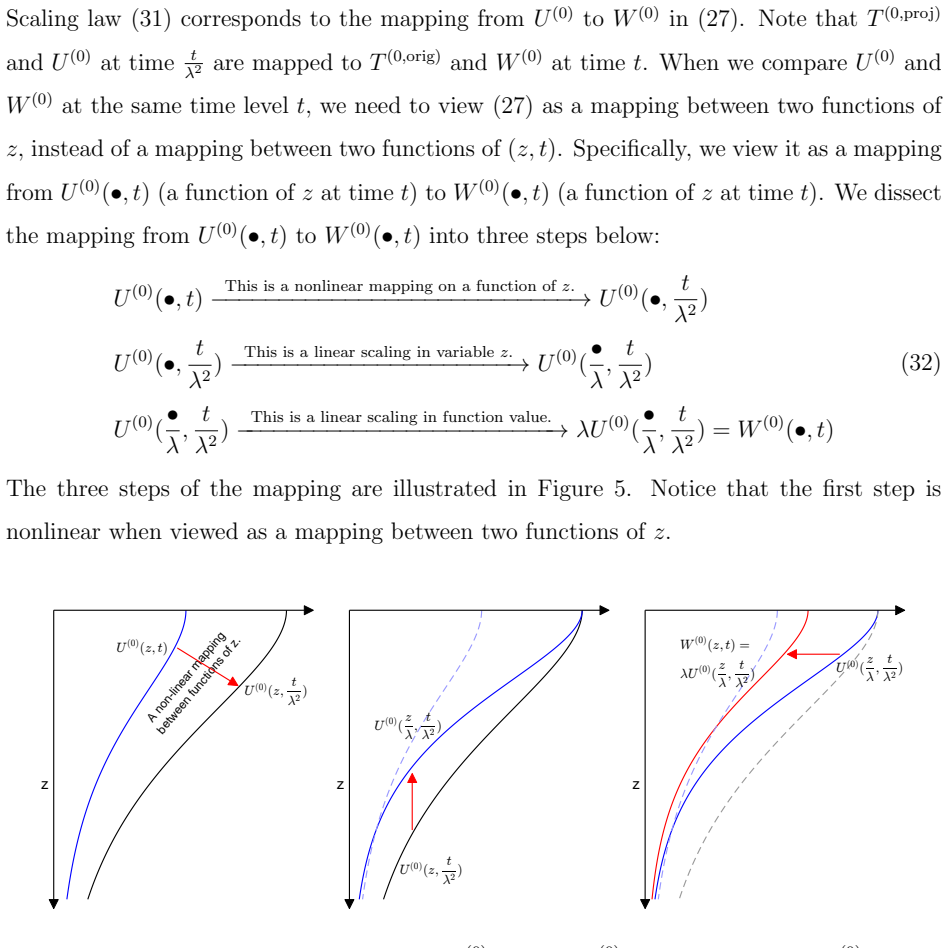
- [Figure 5] The labels in Figure 5 such as 't62' are unclear and appear to be a rendering artifact; they should be typeset as t/λ² to match the notation in Eq. (32).
- [§4.2, Eq. (37)] It would help to state explicitly that the asymptotics in (37) are for fixed λ and are used only in the discussion of the estimation formulas (38) and (39); the present wording is slightly ambiguous about the t-range.
Circularity Check
No significant circularity: the oblique-incidence scaling law is derived from the governing model by an exact λ-rescaling, and the imported normal-incidence solution U(0) is a parameter-free subproblem solution, not the target result.
full rationale
The paper's central result (28) is obtained by solving the nondimensional IBVP (19) asymptotically. At leading order, the temperature separates into a lateral Gaussian factor f(x,y) and a depth-time factor W^(0)(z,t;λ), governed by (24). The step from the known λ=1 solution U^(0) to general λ is an exact derivation, not an assumption: the rescaling (26), (˜z,˜t)=(z/λ,t/λ²) and W=λU^(0)(˜z,˜t), maps IBVP (24) with source (1/λ)e^(−z/λ) onto the same IBVP with λ=1, as the paper verifies explicitly. Thus the claimed arbitrary-incidence solution is not equivalent to its input by construction; the λ-scaling is the derived content. The formula U^(0)(z,t) in (25) is imported from the authors' prior work [19], but it is a parameter-free analytical solution for the normal-incidence subproblem and does not presuppose the oblique-angle result, so this self-citation does not make the derivation circular. The scaling laws (31), (36), (44), and (48) follow algebraically from (28) and monotonicity properties of h(t), with no fitted parameters renamed as predictions. The physical assumption that α in (14) is independent of incident angle is a plausible modeling limitation rather than a circularity, since the subsequent inequalities all take α as a common constant factor; whether Fresnel transmission changes the ordering is a correctness concern, not a logical reduction of the derivation to its own inputs.
Assumptions & free parameters
assumptions (10)
- domain assumption Skin material properties are uniform in space.
- domain assumption Baseline skin temperature is spatially uniform.
- domain assumption Surface heat loss (radiation, evaporation, convection) is neglected.
- domain assumption Skin is a semi-infinite domain in depth.
- domain assumption Electromagnetic absorption follows Beer-Lambert decay with constant absorption coefficient mu.
- domain assumption Snell's law holds with n_skin approximately 1.4 and n_air approximately 1.0.
- domain assumption The surface transmission fraction alpha is constant, independent of incident angle and polarization.
- domain assumption The beam power density over a perpendicular cross-section is a general 2D Gaussian.
- ad hoc to paper Depth-to-lateral scale ratio epsilon = (1/mu)/r_s is small, and the leading-order asymptotic term dominates.
- ad hoc to paper Assertions (A1): h(s)/sqrt(s) is increasing; (A2): h(s)/s is decreasing for s>0.
Cite this review
Pith. "Pith review of Asymptotic Solution for Skin Heating by an Electromagnetic Beam at an Incident Angle." pith.science (2026). https://pith.science/paper/3HUCLVPD
@misc{pith2026250607317,
  author       = {Pith},
  title        = {Pith review of: Asymptotic Solution for Skin Heating by an Electromagnetic Beam at an Incident Angle},
  year         = {2026},
  howpublished = {\url{https://pith.science/paper/3HUCLVPD}},
  note         = {Machine review of arXiv:2506.07317}
}
read the original abstract
We investigate the temperature evolution in the three-dimensional skin tissue exposed to a millimeter-wave electromagnetic beam that is not necessarily perpendicular to the skin surface. This study examines the effect of the beam's incident angle. The incident angle influences the thermal heating in two aspects: (i) the beam spot projected onto the skin is elongated compared to the intrinsic beam spot in a perpendicular cross section, resulting in a lower power per skin area; and (ii) within the tissue, the beam propagates at the refracted angle relative to the depth direction. At millimeter-wavelength frequencies, the characteristic penetration depth is sub-millimeter, whereas the lateral extent of the beam spans at least several centimeters in applications. We explore the small ratio of the penetration depth to the lateral length scale in a non-dimensional formulation and derive a leading-term asymptotic solution for the temperature distribution. This analysis does not rely on a small incident angle and is therefore applicable to arbitrary angles of incidence. Based on the asymptotic solution, we establish scaling laws for the three-dimensional skin temperature, the skin surface temperature, and the skin volume in which thermal nociceptors are activated.
Figures


Figures from the paper (3 more)


Reference graph
Works this paper leans on
-
[19]
Wang, H., Burgei, W.A. and Zhou, H. (2020) Analytical solution of one-dimensional Pennes’ bioheat equation. Open Physics, 18(1), 1084-1092. doi: 10.1515/phys-2020-0197
-
[1]
(2021) DEPS Millimeter Wave Issue Introduction
Whitmore, J.N. (2021) DEPS Millimeter Wave Issue Introduction. Journal of Directed Energy, 6(4):297-298
work page 2021
-
[2]
Miller, S.A., Cook, M.C., McQuade, J.S., D’Andrea, J.A., Chalfin, S. Ziriax, J., Parker, J.E. and Beason, C.W. (2021) Summary of Results from the Active Denial Biological Effects Research Program. Journal of Directed Energy, 6(4):299-325
work page 2021
-
[3]
Cook, M.C., Miller, S.A., Pointer, K.L., Johnson, L.R., Kuhnel, C.T., Tobin, P.E., Dayton, T.E. and Parker, J.E. (2021) Laser Threshold for Pain in Response to 94- GHz Millimeter Wave Energy Experienced Under Varying Ambient Temperatures and Humidities. Journal of Directed Energy, 6(4):326-336
work page 2021
-
[4]
Cook, M.C., Johnson, L.R., Miller, S.A., Parker, J.E. and McMurray, T.J. (2021) Eye- Blink and Face-Avert Responses to 94-GHz Radio Frequency Radiation Experienced Following Alcohol Consumption. Journal of Directed Energy, 6(4):337-352
work page 2021
-
[5]
Haeuser, K., Miller, S.A., McQuade, J.S., Whitmore, J., Parker, J.E. and Hinojosa, C. (2021) Behavioral Effects of Exposure to Active Denial System on Operators of Motor Vehicles. Journal of Directed Energy, 6(4):353-377
work page 2021
-
[6]
Cobb, B.L., Cook, M.C., Scholin, T.L., Johnson, L., Kraemer, D.C. and McMurray, T.J. (2021) Lack of Effects of 94-GHz Energy Exposure on Sperm Production, Morphology, and Motility in Sprague Dawley Rats. Journal of Directed Energy, 6(4):378-387
work page 2021
-
[7]
Parker, J.E., Eggers, J.S., Tobin, P.E. and Miller, S.A. (2021) Thermal Injury in Large Animals Due to 94-GHz Radio Frequency Radiation Exposures. Journal of Directed Energy, 6(4):388-407
work page 2021
Show all 20 references
-
[8]
and Johnson, L.R
Parker, J.E., Beason, C.W. and Johnson, L.R. (2021) Millimeter Wave Dosimetry Using Carbon-Loaded Teflon. Journal of Directed Energy, 6(4):408-421. 33
2021
-
[9]
, Burgei, W
Wang, H. , Burgei, W. and Zhou, H. (2020) Non-Dimensional Analysis of Thermal Effect on Skin Exposure to an Electromagnetic Beam. American Journal of Operations Research, 10, 147-162. doi: 10.4236/ajor.2020.105011
2020
-
[10]
and O’Connor, K
Cazares, S.M., Snyder, J.A., Belanich, J., Biddle, J.C., Buytendyk, A.M., Teng, S.H.M. and O’Connor, K. (2019) Active Denial Technology Computational Human Effects End-to-End Hypermodel for Effectiveness (ADT CHEETEH-E). Human Factors and Mechanical Engineering for Defense and...
2019 doi
-
[11]
and Parrish, J.A
Anderson, R.R. and Parrish, J.A. (1981) The optics of human skin. Journal of inves- tigative dermatology, 77(1), 13-19. doi: 10.1111/1523-1747.ep12479191
1981 doi
-
[12]
and Star, W.M
Van Gemert, M.J.C., Jacques, S.L., Sterenborg, H.J.C.M. and Star, W.M. (1989) Skin optics. IEEE Transactions on Biomedical Engineering, 36(12), 1146-1154. doi: 10.1109/10.42108
1989 doi
-
[13]
and Bezuglyi, M
Bezugla, N., Romodan, O., Komada, P., Stelmakh, N. and Bezuglyi, M. (2024) Fun- damentals of Determination of the Biological Tissue Refractive Index by Ellipsoidal Reflector Method. Photonics, 11(9), 828. doi: 10.3390/photonics11090828
2024 doi
-
[14]
Walters, T. J., D. W. Blick, L. R. Johnson, E. R. Adair, and K. R. Foster (2000) Heating and pain sensation produced in human skin by millimeter waves: comparison to a simple thermal model. Health Phys 78:259-267
2000
-
[15]
and Beason, C.W
Parker, J.E., Nelson, E.J. and Beason, C.W. (2017) Thermal and Behavioral Effects of Exposure to 30-kW, 95-GHz Millimeter Wave Energy. Technical Report, AFRL-RH- FS-TR-2017-0016
2017
-
[16]
and Cook, M.C
Parker, J.E., Nelson, E.J., Beason, C.W. and Cook, M.C. (2017) Effects of Variable Spot Size on Human Exposure to 95-GHz Millimeter Wave Energy. Technical Report, AFRL-RH-FS-TR-2017-0017
2017
-
[17]
(2024) Thermal damage to the 34 skin from 8.2 and 95 GHz microwave exposures in swine
Parker, J.E., Butterworth, J.W., Rodriguez, R.A., Kowalczewski, C.J., Christy, R.J., Voorhees, W.B., Payne, J.A., and Whitmore, J.N. (2024) Thermal damage to the 34 skin from 8.2 and 95 GHz microwave exposures in swine. Biomed Phys Eng Express, 10:045024 doi: 10.1088/2057-1976/ad488e
2024 doi
-
[18]
and Campbell, J,N
Tillman, D.B., Treede, R.D., Meyer, R.A. and Campbell, J,N. (1995) Response of C fibre nociceptors in the anesthetized monkey to heat stimuli: estimates of receptor depth and threshold. The Journal of physiology, 485 (Pt 3), 753-65. doi: 10.1113/jphys- iol.1995.sp020766
1995 doi
-
[20]
and Zhou, H
Wang, H., Burgei, W.A. and Zhou, H. (2023) Inferring internal temperature from mea- sured surface temperatures in electromagnetic heating.Journal of Directed Energy, 7(2), 209-221. 35
2023
Reviewed August 7, 2026 · model on record in the stance chip above.
Discussion (0). Continue with ORCID to comment.