REVIEW 2 major objections 5 minor 45 references
Charged scalar boson in Melvin universe
T0 review · 2 major / 5 minor · reviewed 2026-08-07 · deepseek-v4-flash
Pith's one-line read A charged scalar boson in the Melvin magnetic universe has quantized energies that reduce to modified Landau levels, with rotation adding a linear frequency shift and a hard-wall confining term.
desk verdict Clean Whittaker reduction for a charged scalar in Melvin, but the Planck-scale claims rest on a selective truncation and the figures don't match the formulas. read the letter →
The pith
A machine-rendered reading of the paper's core claim, the machinery that carries it, and where it could break.
The reading
What carries the argument
The central object is the Melvin metric function $\Lambda(r)=1+\tfrac14 G B_0^2 r^2$, which encodes how the axial magnetic field curves spacetime and enters every term of the Klein–Gordon equation. The argument proceeds by inserting the ansatz $\Psi=e^{-i\varepsilon t}e^{i\ell\phi}e^{ip_z z}R(r)$, expanding $\Lambda^N$ to first order in $G B_0^2 r^2$, and changing variables to $z=\zeta r^2$, which brings the radial equation into Whittaker form. Quantization is imposed by the polynomial condition $a=-n$ on Kummer's confluent hypergeometric function $M(a,b,z)$, and in the finite-critical-radius case the same function's asymptotic expansion enforces $R(r_c)=0$, yielding the $1/r_c^2$ energy spacing.
What would settle it
Solve Eq. (37) numerically with the full metric instead of the truncated expansion, keeping the term $\tfrac34 e\ell B_0 G B_0^2 r^2$ that is dropped in passing to Eq. (38), and compare the $n=0$, $\ell=1$ energy at $B_0=0.1\,m_P^2$ with Eq. (50); a difference comparable to the claimed gravitational correction would falsify the first-order spectrum.
Extended reading notes
Core claim
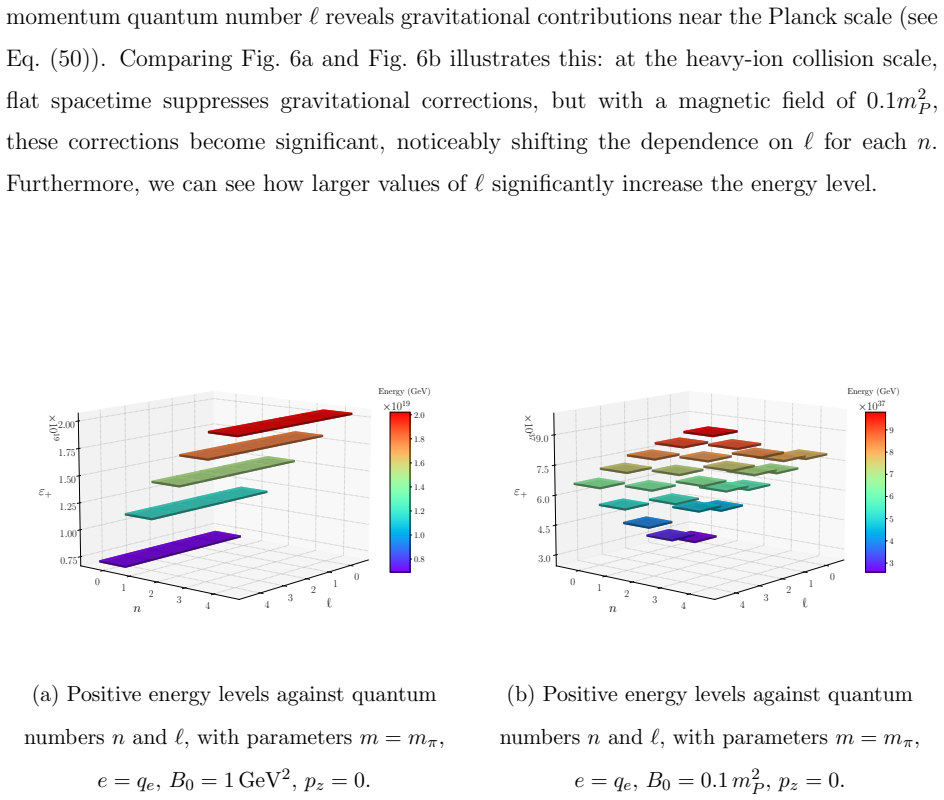
On its own terms, the paper establishes that the radial Klein–Gordon equation for a charged scalar boson in the Melvin metric becomes, after expanding $\Lambda(r)=1+\tfrac14 G B_0^2 r^2$ to first order in $G$, a Whittaker equation whose normalizable solutions quantize the energy as $$ \varepsilon_{\pm}=\pm\sqrt{$m^{2}$+$p_z^{2}$+$GB_0^{2}$\$ell^{2}$-e\ell B_0+B_0\sqrt{$e^{2}$+$2Gm^{2}$}\,(2n+1+|\ell|)}. $$ In the rotating frame the same derivation replaces $\varepsilon$ by $\varepsilon+\omega\ell$, so the spectrum is $\varepsilon_{\pm}=-\omega\ell\pm\sqrt{\cdots}$, and at finite critical radius $r_c$ the hard-wall condition $R(r_c)=0$ turns the magnetic oscillator term into $\pi^2 r_c^{-2}(n+|\ell|/2+1/2)^2$. The paper interprets the $GB_0^2\ell^2$ and $\sqrt{e^2+2Gm^2}$ terms as gravitational corrections to Landau quantization and the $\omega\ell$ shift as the non-inertial signature; numerically these corrections are negligible at $10^{19}$ G but visibly reorder the $n$ and $\ell$ dependence at $B_0\sim 0.1\,m_P^2$.
Load-bearing premise
The derivation depends on expanding the Melvin metric factor $\Lambda(r)=1+\tfrac14 G B_0^2 r^2$ to first order in Newton's constant and treating all dropped terms as negligible, even at Planck-scale magnetic fields.
Editorial extensions
If this is right
- At heavy-ion-collision fields ($B_0\sim 10^{19}$ G), the gravitational terms in the spectrum are numerically negligible, so the main new effect is the non-inertial $\omega\ell$ shift.
- Near the Planck scale, the $GB_0^2\ell^2$ and $B_0\sqrt{e^2+2Gm^2}$ terms can outweigh the $e\ell B_0$ term and reorder the levels as $\ell$ grows.
- For a rotating observer, every state $\{n,\ell\}$ has a critical angular velocity beyond which the positive-energy branch $\varepsilon_+$ becomes negative.
- In the regime with a finite critical radius, increasing $\omega$ (shrinking $r_c$) raises the positive energies through the $\pi^2/r_c^2$ confinement term, which dominates the downward $\omega\ell$ shift at high $\omega$.
- In the zero-field limit the rotating-frame spectrum becomes $\varepsilon_{\pm}=-\omega\ell\pm\sqrt{m^2+p_z^2}$, so rotation alone splits the levels linearly in $\ell$.
Reading between the lines
- A natural next step is to apply the same rotating-frame construction to the Dirac equation in the Melvin spacetime; comparing scalar and spinor spectra would isolate a spin–rotation coupling from the orbital $\omega\ell$ shift.
- The hard-wall spectrum suggests a direct probe: measuring the spacing between adjacent $n$ levels in a rotating magnetized system would determine the critical radius $r_c$ and hence the combination $\omega^2-GB_0^2$.
- The authors' first-order truncation of $\Lambda(r)$ should be checked against a numerical solution of the full radial equation at $B_0\sim 0.1\,m_P^2$; this is the fastest way to see whether the claimed gravitational corrections survive beyond the approximation.
- If the spectra hold, they give a clean starting point for computing quantum processes in magnetized curved spacetime, such as pair-production or decay rates, where the level spacing enters the phase-space factors.
Editorial analysis
A structured set of objections, weighed in public.
Referee Report
Summary. The manuscript derives closed-form energy spectra for a charged scalar boson minimally coupled to the electromagnetic field in the Melvin magnetic universe, in both inertial and rotating frames. The radial Klein-Gordon equation is reduced to a Whittaker equation after expanding the Melvin function to first order in GB0^2 r^2, yielding Landau-like levels with gravitational corrections; the rotating case is treated either with an infinite radial domain or with a hard wall at the critical radius.
Significance. If the derivation were fully consistent, the paper would be a useful analytic example of curved-spacetime Landau quantization with non-inertial effects. Strengths include the exact collapse of the rotating-frame equation to the inertial one with ε → ε + ωℓ (Eqs. 55-56), the correct B0 → 0 flat limit (Eq. 51), and the explicit Whittaker solutions. However, the headline Planck-scale spectra rest on a selective truncation that is not a controlled expansion, and the hard-wall quantization contains a phase discrepancy. For realistic heavy-ion fields with GB0^2 ≪ 1 the main numerical results are probably unaffected, which limits the damage but does not cure the inconsistent strong-field claims.
major comments (2)
- [Eq. (37) to Eq. (40), Sec. IV] The step from Eq. (37) to Eq. (38) is selective: it keeps the O(GB0^2 ℓ^2) term from Λ^4 and the O(Gm^2B0^2r^2) term from Λ^2, but drops the O(GB0^3r^2) term (3/4)eℓG B0^3 r^2 that comes from eℓB0Λ^3. This dropped term is first order in the same expansion parameter GB0^2r^2. For B0 = 0.1 mP^2, e = √(4πα), ℓ = 1, the dropped coefficient is approximately (3eℓGB0)/(e^2+2Gm^2) ≈ 0.99 of the retained oscillator coefficient (e^2/4+Gm^2/2)B0^2, so it is not a small correction. Including this term changes ζ^2 to (e^2/4+Gm^2/2)B0^2 − (3/4)eℓG B0^3, which can even change the sign of the radial potential for appropriate ℓ. Consequently, Eqs. (50) and (59) are not the consistent first-order spectra of Eq. (37) at the stated Planck-scale fields; the derivation must either keep the term or restrict its validity to GB0 ≪ 1, which covers the heavy-ion scale but not the Planck-scale curves and their associated gravitational corrections.
- [Eq. (62) to Eq. (63), Sec. V.B] The hard-wall quantization condition appears to have a phase error. Substituting a = 1/2 + |ℓ|/2 − τ^2/(4ζ) and b = 1 + |ℓ| into the asymptotic formula (62) gives b − 2a = τ^2/(2ζ), so the cosine argument is |τ|r_c − (1+|ℓ|)π/2 + π/4. Setting this to π/2 + nπ yields |τ|r_c = (n + 3/4 + |ℓ|/2)π, not (n + 1/2 + |ℓ|/2)π as in Eq. (63). Unless the formula in (62) is being used with a different normalization, the energy spectrum (63) needs to be corrected by π/4 in the quantization phase. Additionally, the statement that Eq. (62) applies for z0 ≪ 1 is not the standard small-argument expansion of M(a,b,z), which would be M ≈ 1; please verify the regime of validity of this asymptotic approximation.
minor comments (5)
- [Eq. (30)] The notation Λ_N(r) is introduced with an explicit integer N, but N is never specified; the subsequent text simply uses the linear approximation. Please clarify what N represents or remove the subscript.
- [Abstract and Sec. III] The abstract says non-inertial effects result in a 'modified spacetime geometry,' but the transformation ϕ = χ + ωt is a coordinate redefinition of the same Melvin spacetime, not a new solution of the Einstein-Maxwell equations. This wording could mislead readers and should be revised.
- [Eq. (55)] The grouped terms in Eq. (55) cancel identically before any approximation; this is correct, but the presentation could be shortened to avoid the appearance of a non-trivial cancellation step.
- [Figs. 3 and 4] In Fig. 3(b) and Fig. 4(b) the wave-function values span many orders of magnitude, which makes the oscillatory structure hard to see; a normalized amplitude or a logarithmic scale would improve readability.
- [Conclusions] The phrase 'for the first time in the literature' is not verifiable from the cited references and is stronger than needed; I recommend a more measured formulation.
Circularity Check
No significant circularity: the spectra follow from the Melvin metric and the covariant Klein-Gordon equation, with no fitted inputs and no load-bearing self-citations.
full rationale
The derivation chain is self-contained: the Melvin metric (Eqs. 19-21) and the covariant Klein-Gordon equation (Eq. 33) are the inputs; the radial equation (Eq. 37), the Whittaker solution (Eq. 48), the polynomiality condition (Eq. 49), and the resulting spectra (Eqs. 50, 59, 63) are all derived by explicit algebra within the paper. No parameter is fitted to data, and no quantity is renamed and then presented as a prediction; the flat-spacetime limits (Eqs. 51 and 60) are consistency checks that recover known results instead of being used as inputs. Author self-citations ([26], [29], [30], [35]-[38]) appear only for background comparisons and for the standard rotating-frame procedure phi = chi + omega t, which the paper applies directly in Eq. (26) rather than importing as an unverified premise; no uniqueness theorem or ansatz is taken from these citations. The approximation Lambda_N(r) of Eq. (30) is stated and justified in the paper itself. The skeptic concern about Eq. (37)-to-(38) dropping the O(GB0^2) part of e*l*B0*Lambda^3 is a consistency/truncation issue at Planck-scale fields, not a case where a result equals its input by construction, so it does not constitute circularity under the criteria of this pass. No circular step can be exhibited, and the appropriate finding is a low score.
Assumptions & free parameters
assumptions (5)
- domain assumption The Melvin line element (19) with Λ = 1 + G B0² r² / 4 is the correct Einstein-Maxwell background for an axial magnetic field.
- standard math The covariant Klein-Gordon equation (33) with minimal electromagnetic coupling governs a charged scalar boson.
- domain assumption The angular coordinate transformation φ = χ + ωt defines a physical non-inertial frame, and the physical radial domain is limited by g_tt = 0 at r = r_c.
- ad hoc to paper Terms of order G B0² r² in the expansion of Λ may be kept selectively, dropping the (3/4) eℓB0 G B0² r² term from Λ³.
- standard math The uniform asymptotic formula (62) for the Kummer function M(a,b,z0) yields the hard-wall quantization condition.
Cite this review
Pith. "Pith review of Charged scalar boson in Melvin universe." pith.science (2026). https://pith.science/paper/6V5TBDQB
@misc{pith2026250607329,
  author       = {Pith},
  title        = {Pith review of: Charged scalar boson in Melvin universe},
  year         = {2026},
  howpublished = {\url{https://pith.science/paper/6V5TBDQB}},
  note         = {Machine review of arXiv:2506.07329}
}
read the original abstract
This work investigates the dynamics of a charged scalar boson in the Melvin universe by solving the Klein-Gordon equation with minimal coupling in both inertial and non-inertial frames. Non-inertial effects are introduced through a rotating reference frame, resulting in a modified spacetime geometry and the appearance of a critical radius that limits the radial domain of the field. Analytical solutions are obtained under appropriate approximations, and the corresponding energy spectra are derived. The results indicate that both the magnetic field and non-inertial effects modify the energy levels, with additional contributions depending on the coupling between the rotation parameter and the quantum numbers. A numerical analysis is also presented, illustrating the behavior of the solutions for two characteristic magnetic field scales: one that may be considered extreme, of the order of the ones proposed to be produced in heavy-ion collisions and another near the Planck scale.
Figures


Figures from the paper (7 more)




Reference graph
Works this paper leans on
-
[1]
Conversely, asr→ ∞, the Kretschmann scalar vanishes,K→0. In Fig. 1 we can observe the behavior of the Kretschmann scalarKnear the origin (r= 0) and forr→ ∞for four different values of the magnetic field strengthB 0. 6 500 1000 1500 2000 2500 3000 r/lP 0 2 4 6 8K(r)/m4 P ×10−12 B0 = 0.0001 m2 P B0 = 0.0002 m2 P B0 = 0.0005 m2 P B0 = 0.0008 m2 P FIG. 1: Kre...
work page 2000
-
[2]
The imposition of the hard-wall boundary condition leads to the following quantization condition for the energy spectrum: ε± =−ωℓ± s m2 +p 2 z +GB 2 0ℓ2 −eℓB 0 + π2 r2 c n+ |ℓ| 2 + 1 2 2 ,(63) 19 wheren= 0,1,2, . . .. In this regime, the approximatingr 2 c ≈ω −2 leads to the following energy spectrum: ε± ≈ −ωℓ± s m2 +p 2 z +GB 2 0ℓ2 −eℓB 0 +π 2ω2 n+ |ℓ| 2...
-
[3]
C. Thompson and R. C. Duncan, “The soft gamma repeaters as very strongly magnetized neu- tron stars-i. radiative mechanism for outbursts,”Monthly Notices of the Royal Astronomical Society, vol. 275, no. 2, pp. 255–300, 1995
work page 1995
-
[4]
Magnetars: properties, origin and evolution,
S. Mereghetti, J. A. Pons, and A. Melatos, “Magnetars: properties, origin and evolution,” Space Science Reviews, vol. 191, pp. 315–338, 2015
work page 2015
-
[5]
L. L. Lopes and D. Menezes, “On Magnetized Neutron Stars,”Journal of Cosmology and Astroparticle Physics, vol. 08, p. 002, 2015
work page 2015
-
[6]
Event-by-event fluctuations of magnetic and electric fields in heavy ion collisions,
A. Bzdak and V. Skokov, “Event-by-event fluctuations of magnetic and electric fields in heavy ion collisions,”Physics Letters B, vol. 710, no. 1, pp. 171–174, 2012. 22
work page 2012
-
[7]
Electromagnetic field evolution in relativistic heavy-ion collisions,
V. Voronyuk, V. D. Toneev, W. Cassing, E. L. Bratkovskaya, V. P. Konchakovski, and S. A. Voloshin, “Electromagnetic field evolution in relativistic heavy-ion collisions,”Physical Review C, vol. 83, no. 5, p. 054911, 2011
work page 2011
-
[8]
Magnetohydrodynamics, charged currents, and directed flow in heavy ion collisions,
U. G¨ ursoy, D. Kharzeev, and K. Rajagopal, “Magnetohydrodynamics, charged currents, and directed flow in heavy ion collisions,”Physical Review C, vol. 89, no. 5, p. 054905, 2014
work page 2014
Show all 45 references
-
[9]
Strongly interacting matter in extreme magnetic fields,
P. Adhikari, M. Ammon, S. S. Avancini, A. Ayala, A. Bandyopadhyay, D. Blaschke, F. L. Braghin, P. Buividovich, R. P. Cardoso, C. Cartwright,et al., “Strongly interacting matter in extreme magnetic fields,”arXiv preprint arXiv:2412.18632, 2024
2024 arXiv
-
[10]
Relativistic quantum dynamics of a charged particle in cosmic string spacetime in the presence of magnetic field and scalar potential,
E. R. Figueiredo Medeiros and E. R. Bezerra de Mello, “Relativistic quantum dynamics of a charged particle in cosmic string spacetime in the presence of magnetic field and scalar potential,”The European Physical Journal C, vol. 72, no. 6, p. 2051, 2012
2012
-
[11]
Exact solutions of the klein–gordon equation in the presence of a dyon, magnetic flux and scalar potential in the spacetime of gravitational defects,
A. L. C. de Oliveira and E. R. B. de Mello, “Exact solutions of the klein–gordon equation in the presence of a dyon, magnetic flux and scalar potential in the spacetime of gravitational defects,”Classical and Quantum Gravity, vol. 23, pp. 5249–5263, 2006
2006
-
[12]
Exact solutions of scalar bosons in the presence of the aharonov-bohm and coulomb potentials in the gravitational field of topological defects,
A. Boumali and H. Aounallah, “Exact solutions of scalar bosons in the presence of the aharonov-bohm and coulomb potentials in the gravitational field of topological defects,”Ad- vances in High Energy Physics, vol. 2018, no. 1, p. 1031763, 2018
2018
-
[13]
Exact solutions of the schr¨ odinger equation with a coulomb ring-shaped potential in the cosmic string spacetime,
Z. Wang, Z.-w. Long, C.-y. Long, and J. Teng, “Exact solutions of the schr¨ odinger equation with a coulomb ring-shaped potential in the cosmic string spacetime,”Physica Scripta, vol. 90, no. 5, p. 055201, 2015
2015
-
[14]
Landau quantization in the spinning cosmic string spacetime,
C. R. Muniz, V. B. Bezerra, and M. S. Cunha, “Landau quantization in the spinning cosmic string spacetime,”Annals of Physics, vol. 350, pp. 105–111, 2014
2014
-
[15]
Solutions of the schr¨ odinger equation for pseudo-coulomb potential plus a new improved ring-shaped potential in the cosmic string space–time,
A. N. Ikot, T. M. Abbey, E. O. Chukwuocha, and M. C. Onyeaju, “Solutions of the schr¨ odinger equation for pseudo-coulomb potential plus a new improved ring-shaped potential in the cosmic string space–time,”Canadian Journal of Physics, vol. 94, no. 5, pp. 517–521, 2016
2016
-
[16]
Effects of cosmic string on non-relativistic quantum particles with potential and thermodynamic properties,
F. Ahmed, “Effects of cosmic string on non-relativistic quantum particles with potential and thermodynamic properties,”International Journal of Theoretical Physics, vol. 62, no. 7, p. 142, 2023
2023
-
[17]
Rotating effects on the Dirac oscillator in the cosmic string spacetime,
K. Bakke, “Rotating effects on the Dirac oscillator in the cosmic string spacetime,”General Relativity and Gravitation, vol. 45, pp. 1847–1859, 2013. 23
2013
-
[18]
Relativistic landau quantization for a neutral particle,
K. Bakke and C. Furtado, “Relativistic landau quantization for a neutral particle,”Physical Review A, vol. 80, p. 032106, Sept. 2009
2009
-
[19]
Anandan quantum phase for a neutral particle with fermi–walker reference frame in the cosmic string background,
K. Bakke and C. Furtado, “Anandan quantum phase for a neutral particle with fermi–walker reference frame in the cosmic string background,”The European Physical Journal C, vol. 69, pp. 531–539, 2010
2010
-
[20]
Generalized dirac oscillator in cosmic string space-time,
L.-F. Deng, C.-Y. Long, Z.-W. Long, and T. Xu, “Generalized dirac oscillator in cosmic string space-time,”Advances in High Energy Physics, vol. 2018, no. 1, p. 2741694, 2018
2018
-
[21]
The dirac oscillator in a spinning cosmic string spacetime,
M. Hosseinpour, H. Hassanabadi, and M. de Montigny, “The dirac oscillator in a spinning cosmic string spacetime,”The European Physical Journal C, vol. 79, pp. 1–7, 2019
2019
-
[22]
Scattering states of dirac equation in the presence of cosmic string for coulomb interaction,
M. Hosseinpour and H. Hassanabadi, “Scattering states of dirac equation in the presence of cosmic string for coulomb interaction,”International Journal of Modern Physics A, vol. 30, no. 21, p. 1550124, 2015
2015
-
[23]
Exact solution of the dirac equation for a coulomb and scalar potentials in the gravitational field of a cosmic string,
G. d. A. Marques, V. B. Bezerra, and S. G. Fernandes, “Exact solution of the dirac equation for a coulomb and scalar potentials in the gravitational field of a cosmic string,”Physics Letters A, vol. 341, no. 1-4, pp. 39–47, 2005
2005
-
[24]
Dirac oscillator in the cosmic string spacetime in the context of gravity’s rainbow,
K. Bakke and H. Mota, “Dirac oscillator in the cosmic string spacetime in the context of gravity’s rainbow,”The European Physical Journal Plus, vol. 133, pp. 1–9, 2018
2018
-
[25]
Scattering and bound states for the hulth´ en potential in a cosmic string background,
M. Hosseinpour, F. M. Andrade, E. O. Silva, and H. Hassanabadi, “Scattering and bound states for the hulth´ en potential in a cosmic string background,”The European Physical Journal C, vol. 77, no. 5, pp. 1–6, 2017
2017
-
[26]
Dirac oscillator in a spinning cosmic string spacetime in external magnetic fields: Investigation of the energy spectrum and the connection with condensed matter physics,
M. M. Cunha, H. S. Dias, and E. O. Silva, “Dirac oscillator in a spinning cosmic string spacetime in external magnetic fields: Investigation of the energy spectrum and the connection with condensed matter physics,”Physical Review D, vol. 102, no. 10, p. 105020, 2020
2020
-
[27]
On the 2d dirac oscillator in the presence of vector and scalar potentials in the cosmic string spacetime in the context of spin and pseudospin symmetries,
D. F. Lima, F. M. Andrade, L. B. Castro, C. Filgueiras, and E. O. Silva, “On the 2d dirac oscillator in the presence of vector and scalar potentials in the cosmic string spacetime in the context of spin and pseudospin symmetries,”The European Physical Journal C, vol. 79, pp. 1...
2019
-
[28]
Dirac equation and the Melvin metric,
L. C. N. Santos and C. C. Barros, “Dirac equation and the Melvin metric,”European Physical Journal C, vol. 76, p. 560, Oct. 2016
2016
-
[29]
Static and dynamic melvin universes,
D. Bini and B. Mashhoon, “Static and dynamic melvin universes,”Physical Review D, vol. 105, no. 12, p. 124012, 2022. 24
2022
-
[30]
Bonnor-Melvin universe with a cosmological constant,
M. ˇZofka, “Bonnor-Melvin universe with a cosmological constant,”Physical Review D, vol. 99, no. 4, p. 044058, 2019
2019
-
[31]
Scalar bosons in Bonnor-Melvin-Λ universe: exact solution, Landau levels and Coulomb-like potential,
L. G. Barbosa and C. C. Barros, “Scalar bosons in Bonnor-Melvin-Λ universe: exact solution, Landau levels and Coulomb-like potential,”Physica Scripta, vol. 100, no. 3, p. 035302, 2025
2025
-
[32]
Klein-Gordon Oscillator Subject to a Coulomb-type Poten- tial in Bonnor-Melvin Universe with a Cosmological Constant,
L. G. Barbosa and C. C. Barros, “Klein-Gordon Oscillator Subject to a Coulomb-type Poten- tial in Bonnor-Melvin Universe with a Cosmological Constant,”Few-Body Systems, vol. 66, no. 1, p. 7, 2025
2025
-
[33]
Quantum electrodynamics in strong magnetic fields. i. electron states,
D. B. Melrose and A. J. Parle, “Quantum electrodynamics in strong magnetic fields. i. electron states,”Australian journal of physics, vol. 36, no. 6, pp. 755–774, 1983
1983
-
[34]
Noninertial effects on the dirac oscillator in a topological defect spacetime,
K. Bakke, “Noninertial effects on the dirac oscillator in a topological defect spacetime,”The European Physical Journal Plus, vol. 127, pp. 1–8, 2012
2012
-
[35]
Noninertial effects on the ground state energy of a massive scalar field in the cosmic string spacetime,
H. F. Mota and K. Bakke, “Noninertial effects on the ground state energy of a massive scalar field in the cosmic string spacetime,”Physical Review D, vol. 89, no. 2, p. 027702, 2014
2014
-
[36]
Non-inertial effects on relativistic scalar massive charged bosons in a topologically nontrivial space-time and aharonov–bohm effect,
F. Ahmed, “Non-inertial effects on relativistic scalar massive charged bosons in a topologically nontrivial space-time and aharonov–bohm effect,”International Journal of Geometric Methods in Modern Physics, vol. 20, no. 01, p. 2350011, 2023
2023
-
[37]
Some remarks on scalar particles under the influence of noninertial effects in a spacetime with a screw dislocation,
L. C. N. Santos, F. M. da Silva, C. E. Mota, and V. B. Bezerra, “Some remarks on scalar particles under the influence of noninertial effects in a spacetime with a screw dislocation,” The European Physical Journal Plus, vol. 138, no. 2, p. 174, 2023
2023
-
[38]
Scalar bosons under the influence of noninertial effects in the cosmic string spacetime,
L. C. N. Santos and C. C. Barros, “Scalar bosons under the influence of noninertial effects in the cosmic string spacetime,”The European Physical Journal C, vol. 77, pp. 1–7, 2017
2017
-
[39]
Relativistic quantum motion of spin-0 particles under the influence of noninertial effects in the cosmic string spacetime,
L. C. N. Santos and C. C. Barros, “Relativistic quantum motion of spin-0 particles under the influence of noninertial effects in the cosmic string spacetime,”The European Physical Journal C, vol. 78, pp. 1–8, 2018
2018
-
[40]
Non-inertial effects on a non- relativistic quantum harmonic oscillator in the presence of a screw dislocation,
L. C. N. Santos, F. M. Da Silva, C. E. Mota, and V. B. Bezerra, “Non-inertial effects on a non- relativistic quantum harmonic oscillator in the presence of a screw dislocation,”International Journal of Geometric Methods in Modern Physics, vol. 20, no. 04, p. 2350067, 2023
2023
-
[41]
Static Magnetic Fields in General Relativity,
W. B. Bonnor, “Static Magnetic Fields in General Relativity,”Proceedings of the Physical Society A, vol. 67, pp. 225–232, Mar. 1954
1954
-
[42]
Pure magnetic and electric geons,
M. A. Melvin, “Pure magnetic and electric geons,”Physics Letters, vol. 8, pp. 65–68, Jan. 1964. 25
1964
-
[43]
Dynamics of Cylindrical Electromagnetic Universes,
M. A. Melvin, “Dynamics of Cylindrical Electromagnetic Universes,”Physical Review, vol. 139, pp. 225–243, July 1965
1965
-
[44]
Absolute Stability of Melvin’s Magnetic Universe,
K. S. Thorne, “Absolute Stability of Melvin’s Magnetic Universe,”Physical Review, vol. 139, pp. 244–254, July 1965
1965
-
[45]
Abramowitz and I
M. Abramowitz and I. A. Stegun,Handbook of mathematical functions: with formulas, graphs, and mathematical tables, vol. 55. Courier Corporation, 1965. Appendix A: Riemann T ensor Components In this appendix, we present the components of the Riemann tensor associated with the g...
1965
Reviewed August 7, 2026 · model on record in the stance chip above.
Discussion (0). Sign in to comment.