REVIEW 1 major objections 1 minor 1 cited by
Mutual Correlation
T0 review · 1 major / 1 minor · reviewed 2026-08-07 · deepseek-v4-flash
Pith's one-line read Partitioning the 2-cumulant norm reveals orbital correlation pairs.
desk verdict A novel, algebraically sound decomposition of the 2-cumulant norm, but the pair-only diagnostic rests on an unchecked assumption that three- and four-fragment terms are negligible. read the letter →
The pith
A machine-rendered reading of the paper's core claim, the machinery that carries it, and where it could break.
The reading
What carries the argument
The central object is the two-body reduced density matrix cumulant $\lambda_2$, the connected part of the 2-RDM, and its squared Frobenius norm $C = \tfrac{1}{4}\lVert\lambda_2\rVert_F^2$. Mutual correlation for a bipartition is the difference between the total $C$ and the fragment contributions, $M_{AB} = C_S - C_A - C_B$; extending to a general $n$-partition gives a sum over pair, triple, and quadruple mutual-correlation terms with closed expressions in terms of $\lambda_2$ elements. For orbital pairs, the spin-free specialization $M_{PQ}$ is expressed through the $\Lambda_2$ tensor of squared cumulant elements, and a cost function $L = \sum_{P<Q} (M_{PQ})^2$ is maximized over orbital rotations to define maximally correlated orbitals.
What would settle it
Compute the full decomposition of $C$ for a state whose wavefunction is dominated by triple or quadruple excitations, such as a three-electron-pair system with three mutually entangled geminals, and check whether $M_{ABC}$ or $M_{ABCD}$ is large enough to change the orbital-pair ranking; alternatively, compare orbital mutual correlation with orbital mutual information on a system where the 4-RDM is available and see whether they rank the pairs differently.
Extended reading notes
Core claim
On the paper's own terms, the central discovery is that the total two-cumulant correlation $C$ can be decomposed exactly into intra-fragment terms and mutual-correlation terms $M_{AB}$, $M_{ABC}$, and $M_{ABCD}$, and that for molecular ground states the pair term $M_{AB}$ already captures the essential structure. Applied to orbital pairs, $M_{PQ}$ assigns numbers between 0 and 3/4 that rank bonding–antibonding pairs, bond breaking, and diradical character, in agreement with the qualitative picture from orbital mutual information but at lower computational cost, since it is built from the 2-cumulant alone. Maximizing the sum of squared pair mutual correlations over orbital rotations yields maximally correlated orbitals in which correlation localizes into disjoint pairs, supporting a geminal-pair picture of strongly correlated ground states.
Load-bearing premise
The metric's validity rests on the assumption that the two-body cumulant alone captures the correlation structure that matters for interpretation and active space selection, so that three-body and four-body cumulant contributions, which appear as $M_{ABC}$ and $M_{ABCD}$ terms, are negligible in the molecular states considered.
Editorial extensions
If this is right
- Orbital mutual correlation can be computed from any method that yields the 2-RDM, including coupled cluster, perturbation theory, CI, Green's function, and DMRG, without the 4-RDM that orbital mutual information requires.
- Mutual correlation plots identify the specific orbital pairs responsible for strong correlation, distinguishing bond-breaking pairs from weakly correlated pairs based on calibrated value ranges.
- The decomposition into $M_{AB}$, $M_{ABC}$, and $M_{ABCD}$ shows that the pair term is intensive and comparable across different systems, unlike the total $C$ which grows with system size.
- Maximally correlated orbitals localize correlation into a small number of disjoint pairs, supporting geminal-pair structure in molecular ground states and offering a basis-independent partitioning of correlation.
- The partitioning approach generalizes beyond the correlation norm to other squared cumulant metrics and to observables such as energy and spin.
Reading between the lines
- If mutual correlation is as robust as the benchmarks suggest, it could serve as a cheap entanglement proxy for time-dependent simulations, tracking how correlation migrates between orbital pairs during a dynamics run; the paper lists time-dependent tracking as a future application but does not test it.
- The validity of the pair-only picture could be probed by computing $M_{ABC}$ and $M_{ABCD}$ for a state with strong three-body correlations; the paper does not test any such state.
- A testable extension would be comparing maximally correlated orbitals from mutual correlation against orbitals obtained by minimizing a cost function of one-orbital entanglement, to see whether the two localization criteria agree on which pairs are strongly correlated.
- Because $M_{PQ}$ depends only on the 2-cumulant, it could in principle be measured by fermionic classical-shadow tomography, which the paper cites as a way to obtain the 2-RDM; this connection is not developed in the paper.
Editorial analysis
A structured set of objections, weighed in public.
Referee Report
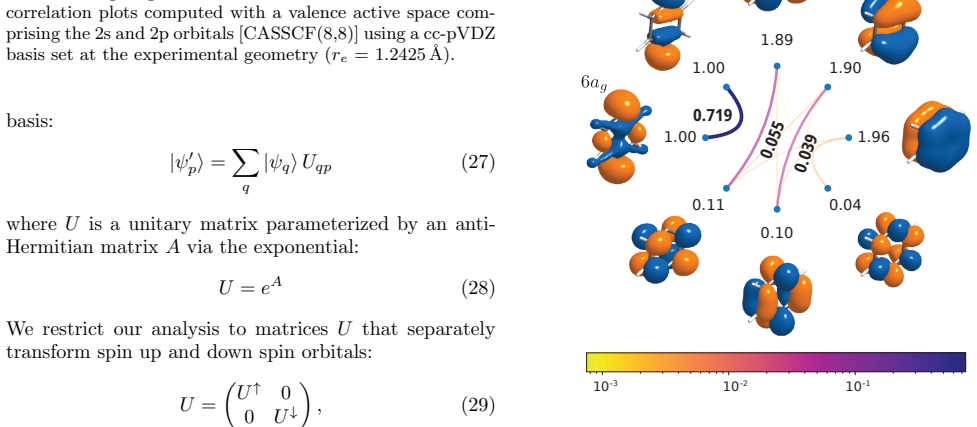
Summary. The paper introduces "mutual correlation," a metric obtained by partitioning the squared Frobenius norm of the two-body cumulant, C = (1/4)||λ2||^2_F, into fragment contributions. For a bipartition, M_AB = C_S − C_A − C_B quantifies nonadditive correlation between subsystems, and the construction is extended to a general partition with the exact decomposition C_S = Σ C_A + Σ M_AB + Σ M_ABC + Σ M_ABCD (Eq. 20). The paper specializes to orbital pairs, defines an orbital mutual correlation M_PQ, calibrates strong/medium/weak ranges, and applies the metric to H2, N2, C2, p-benzyne, H10, O3, and H4. It also introduces maximally correlated orbitals by maximizing Σ (M_PQ)^2 and compares with orbital mutual information. The central claim is that M_PQ provides a computationally cheaper, 2-RDM-only alternative to entropy-based diagnostics for active space selection and for interpreting correlation structure in molecular states.
Significance. If the metric is sound, it is a potentially useful addition to the toolbox of correlation diagnostics: it depends only on the 2-RDM, is invariant under orbital rotations within fragments, and exhibits the expected qualitative behavior in the benchmark systems. The general partition identity (Eq. 20) is algebraically elegant, and the paper explicitly aims to provide a quantitative, machine-checkable alternative to 4-RDM-based orbital mutual information. The computational advantage is real, and the graphical representation of orbital pair correlations is clear. However, the paper's quantitative calibration and one of its main conclusions (the dominance of disjoint orbital pairs) rest on an analytical toy-model result that I find inconsistent with the paper's own definitions, as detailed below. The neglect of three- and four-fragment mutual-correlation terms is also a load-bearing omission for the conclusions drawn from pair-only plots.
major comments (1)
- [Abstract and Section III.D] The abstract claims that maximally correlated orbitals "identify a basis-independent partitioning of correlation," but no such basis independence is demonstrated. The cost function L = Σ (M_PQ)^2 in Eq. (30) is defined in a specific orbital basis, and the paper itself notes the existence of multiple local minima. The optimization selects a particular orbital basis but does not establish that the resulting partition is independent of the starting basis or of the chosen cost function. This claim should be tempered or supported by a concrete invariance argument or numerical test.
minor comments (1)
- [General] There are minor formatting issues in the equations (e.g., Eq. (25) has subscripts/superscripts that are not cleanly typeset) and a few typographical slips in the text (e.g., "λ 2-norm" formatting in Section II.A). These do not affect the substance of the work.
Circularity Check
No circularity: mutual correlation is defined from the 2-cumulant norm and benchmarked against external, independent references; the omitted M_ABC/M_ABCD terms are an acknowledged scope limitation, not a circular reduction.
full rationale
The central quantity is constructed transparently: lambda2 is defined in Eq. (5), C in Eq. (6), fragment contributions C_A in Eq. (12), and M_AB in Eq. (13) as C_S - C_A - C_B. This is a definition, not a fitted prediction, and the paper does not claim to derive M_AB from any fitted parameter. The orbital specialization M_PQ (Eqs. (24)-(26)) is likewise an exact restriction of the same definition to pairs of spatial orbitals. Benchmarks are external: orbital mutual information is independently defined via one- and two-orbital entropies (Eqs. (33)-(38)), and chemically motivated tests (H2, N2, C2, p-benzyne, H4) are interpreted against known electronic structures rather than tuned to force agreement. Basis-set sensitivity is checked directly in Table II. The only quantity that is optimized with respect to the metric itself is the localization cost function L = sum_{P<Q} (M_PQ)^2 (Eq. (30)); maximizing this function is explicitly presented as a localization procedure, so the resulting concentration of M_PQ into pairs is the stated objective, not a hidden circular prediction. The paper explicitly limits the general decomposition in Eq. (20) to pair terms (Section II.C: 'we limit our analysis to the mutual correlation between two subsystems'), leaving M_ABC and M_ABCD for future work; this is an acknowledged scope restriction that affects completeness of the 'disjoint pairs' generalization, but it is not a circular argument. Self-citations to Forte, Psi4, VMDCube, and the author's earlier H10 benchmark are software/tool citations and external benchmark context, not load-bearing derivational premises. No circular step can be exhibited.
Assumptions & free parameters
free parameters (1)
- calibration thresholds =
strong: 0.075-0.75, medium: 0.0075-0.075, weak: 0-0.0075
assumptions (3)
- domain assumption The Frobenius norm squared of the 2-cumulant C is a valid measure of electron correlation, with additive and basis-invariant properties.
- domain assumption Orbital-pair partition of C captures chemically relevant nonadditive correlation; 3-body and 4-body mutual correlation terms M_ABC and M_ABCD are negligible for the systems studied.
- domain assumption CASSCF wave functions and natural orbitals provide a faithful representation of the correlation structure of the benchmark molecules.
Cite this review
Pith. "Pith review of Mutual Correlation." pith.science (2026). https://pith.science/paper/2UON3G6L
@misc{pith2026250607344,
  author       = {Pith},
  title        = {Pith review of: Mutual Correlation},
  year         = {2026},
  howpublished = {\url{https://pith.science/paper/2UON3G6L}},
  note         = {Machine review of arXiv:2506.07344}
}
abstract
Quantifying correlation and complexity in quantum many-body states is central to advancing theoretical and computational chemistry, physics, and quantum information science. This work introduces a novel framework, mutual correlation, based on the Frobenius norm squared of the two-body reduced density matrix cumulant. Through systematic partitioning of the cumulant norm, mutual correlation quantifies nonadditive correlations among interacting subsystems. Benchmark studies on model systems, including H$_{10}$, N$_{2}$, and p-benzyne, demonstrate its efficacy and computational advantage compared to entropy-based metrics such as orbital mutual information. Maximally correlated orbitals, obtained by maximizing a nonlinear cost function of the mutual correlation, are also considered to identify a basis-independent partitioning of correlation. This study suggests that mutual correlation is a broadly applicable metric, useful in active space selection and the interpretation of electronic states.
Figures


Figures from the paper (5 more)



Forward citations
Cited by 1 Pith paper
-
AEGISS -- Atomic orbital and Entropy-based Guided Inference for Space Selection -- A novel semi-automated active space selection workflow for quantum chemistry and quantum computing applications
AEGISS combines DMRG single-orbital entropy screening with per-cluster atomic-orbital projections to semi-automatically construct compact active spaces, demonstrated on five molecular benchmarks.
Reference graph
Works this paper leans on
-
[1]
Scaling of entanglement close to a quantum phase transition
Osterloh, A.; Amico, L.; Falci, G.; Fazio, R. Scaling of entanglement close to a quantum phase transition . Nature 2002, 416, 608--610
2002
-
[2]
J.; Nielsen, M
Osborne, T. J.; Nielsen, M. A. Entanglement in a simple quantum phase transition . Phys. Rev. A 2002, 66, 032110
2002
-
[3]
Topological Entanglement Entropy
Kitaev, A.; Preskill, J. Topological Entanglement Entropy . Phys. Rev. Lett. 2006, 96, 110404
2006
-
[4]
Entanglement Entropy in Fermionic Laughlin States
Haque, M.; Zozulya, O.; Schoutens, K. Entanglement Entropy in Fermionic Laughlin States . Phys. Rev. Lett. 2007, 98, 060401
work page 2007
-
[5]
Rissler, J.; Noack, R. M.; White, S. R. Measuring orbital interaction using quantum information theory . Chem. Phys. 2006, 323, 519--531
work page 2006
-
[6]
Hachmann, J.; Dorando, J. J.; Avil\'es, M.; Chan, G. K.-L. The radical character of the acenes: A density matrix renormalization group study . J. Chem. Phys. 2007, 127, 134309
work page 2007
-
[7]
Freitag, L.; Knecht, S.; Keller, S. F.; Delcey, M. G.; Aquilante, F.; Pedersen, T. B.; Lindh, R.; Reiher, M.; González, L. Orbital entanglement and CASSCF analysis of the Ru–NO bond in a Ruthenium nitrosyl complex . Phys. Chem. Chem. Phys. 2015, 17, 14383--14392
work page 2015
-
[8]
Lampert, J. S.; Krogmeier, T. J.; Schlimgen, A. W.; Head-Marsden, K. Orbital entanglement and the double d-shell effect in binary transition metal molecules . J. Chem. Phys. 2024, 161, 174103
work page 2024
Show all 83 references
-
[9]
Optimizing the density-matrix renormalization group method using quantum information entropy
Legeza, O.; S\'olyom, J. Optimizing the density-matrix renormalization group method using quantum information entropy . Phys. Rev. B 2003, 68, 195116
2003
-
[10]
J.; Wilson, A
Jiang, W.; DeYonker, N. J.; Wilson, A. K. Multireference Character for 3d Transition-Metal-Containing Molecules . J. Chem. Theory Comput. 2012, 8, 460--468
2012
-
[11]
Liu, F.; Duan, C.; Kulik, H. J. Rapid Detection of Strong Correlation with Machine Learning for Transition-Metal Complex High-Throughput Screening . J. Phys. Chem. Lett. 2020, 11, 8067--8076
2020
-
[12]
Duan, C.; Liu, F.; Nandy, A.; Kulik, H. J. Data-Driven Approaches Can Overcome the Cost–Accuracy Trade-Off in Multireference Diagnostics . J. Chem. Theory Comput. 2020, 16, 4373--4387
2020
-
[13]
J.; Reiher, M
Stein, C. J.; Reiher, M. Automated Selection of Active Orbital Spaces. J. Chem. Theory Comput. 2016, 12, 1760--1771
2016
-
[14]
Active Space Selection Based on Natural Orbital Occupation Numbers from n -Electron Valence Perturbation Theory
Khedkar, A.; Roemelt, M. Active Space Selection Based on Natural Orbital Occupation Numbers from n -Electron Valence Perturbation Theory . J. Chem. Theory Comput. 2019, 15, 3522--3536
2019
-
[15]
Cumulant expansion of the reduced density matrices
Kutzelnigg, W.; Mukherjee, D. Cumulant expansion of the reduced density matrices . J. Chem. Phys. 1999, 110, 2800--2809
1999
-
[16]
Bose-Einstein Condensation and Liquid Helium
Penrose, O.; Onsager, L. Bose-Einstein Condensation and Liquid Helium . Phys. Rev. 1956, 104, 576--584
1956
-
[17]
Yang, C. N. Concept of Off-Diagonal Long-Range Order and the Quantum Phases of Liquid He and of Superconductors . Rev. Mod. Phys. 1962, 34, 694--704
1962
-
[18]
The nature of electron correlation in molecules
Mcweeny, R. The nature of electron correlation in molecules . Int. J. Quantum Chem. 1967, 1, 351--359
1967
-
[19]
J.; Park, Y
Bartlett, R. J.; Park, Y. C.; Bauman, N. P.; Melnichuk, A.; Ranasinghe, D.; Ravi, M.; Perera, A. Index of multi-determinantal and multi-reference character in coupled-cluster theory. J. Chem. Phys. 2020, 153, 234103
2020
-
[20]
Mazziotti, D. A. Approximate solution for electron correlation through the use of Schwinger probes . Chem. Phys. Lett. 1998, 289, 419--427
1998
-
[21]
n-Electron problem and its formulation in terms ofk-particle density cumulants
Kutzelnigg, W. n-Electron problem and its formulation in terms ofk-particle density cumulants . Int. J. Quantum Chem. 2003, 95, 404--423
2003
-
[22]
P.; Turney, J
Misiewicz, J. P.; Turney, J. M.; Schaefer III, H. F. Cumulants as the variables of density cumulant theory: A path to Hermitian triples . J. Chem. Phys. 2021, 155, 244105
2021
-
[23]
Juhász, T.; Mazziotti, D. A. The cumulant two-particle reduced density matrix as a measure of electron correlation and entanglement . J. Chem. Phys. 2006, 125, 174105
2006
-
[24]
Mazziotti, D. A. Two-Electron Reduced Density Matrix as the Basic Variable in Many-Electron Quantum Chemistry and Physics . Chem. Rev. 2012, 112, 244--262
2012
-
[25]
On the notion of strong correlation in electronic structure theory
Ganoe, B.; Shee, J. On the notion of strong correlation in electronic structure theory . Faraday Discuss. 2024,
2024
-
[26]
Quantum Theory of Many-Particle Systems
Löwdin, P.-O. Quantum Theory of Many-Particle Systems. I. Physical Interpretations by Means of Density Matrices, Natural Spin-Orbitals, and Convergence Problems in the Method of Configurational Interaction . Phys. Rev. 1955, 97, 1474--1489
1955
-
[27]
Pulay, P.; Hamilton, T. P. UHF natural orbitals for defining and starting MC-SCF calculations . J. Chem. Phys. 1988, 88, 4926--4933
1988
-
[28]
M.; Pulay, P
Bofill, J. M.; Pulay, P. The unrestricted natural orbital–complete active space (UNO–CAS) method: An inexpensive alternative to the complete active space–self-consistent-field (CAS–SCF) method . J. Chem. Phys. 1989, 90, 3637--3646
1989
-
[29]
S.; Schaefer, H
Grev, R. S.; Schaefer, H. F. Natural orbitals from single and double excitation configuration interaction wave functions: their use in second-order configuration interaction and wave functions incorporating limited triple and quadruple excitations . J. Chem. Phys. 1992, 96, 6850--6856
1992
-
[30]
Split-localized orbitals can yield stronger configuration interaction convergence than natural orbitals
Bytautas, L.; Ivanic, J.; Ruedenberg, K. Split-localized orbitals can yield stronger configuration interaction convergence than natural orbitals . J. Chem. Phys. 2003, 119, 8217--8224
2003
-
[31]
L.; Sherrill, C
Abrams, M. L.; Sherrill, C. D. Natural orbitals as substitutes for optimized orbitals in complete active space wavefunctions . Chem. Phys. Lett. 2004, 395, 227--232
2004
-
[32]
G.; Bartlett, R
Taube, A. G.; Bartlett, R. J. Frozen natural orbital coupled-cluster theory: Forces and application to decomposition of nitroethane . J. Chem. Phys. 2008, 128, 164101
2008
-
[33]
Efficient and accurate local approximations to coupled-electron pair approaches: An attempt to revive the pair natural orbital method
Neese, F.; Wennmohs, F.; Hansen, A. Efficient and accurate local approximations to coupled-electron pair approaches: An attempt to revive the pair natural orbital method . J. Chem. Phys. 2009, 130, 114108
2009
-
[34]
G.; Levine, B
Shu, Y.; Hohenstein, E. G.; Levine, B. G. Configuration interaction singles natural orbitals: an orbital basis for an efficient and size intensive multireference description of electronic excited states. J. Chem. Phys. 2015, 142, 024102
2015
-
[35]
Natural Orbitals and Sparsity of Quantum Mutual Information
Ratini, L.; Capecci, C.; Guidoni, L. Natural Orbitals and Sparsity of Quantum Mutual Information . J. Chem. Theory Comput. 2024, 20, 3535--3542
2024
-
[36]
E.; Weinhold, F
Reed, A. E.; Weinhold, F. Natural localized molecular orbitals . J. Chem. Phys. 1985, 83, 1736--1740
1985
-
[37]
E.; Weinstock, R
Reed, A. E.; Weinstock, R. B.; Weinhold, F. Natural population analysis . J. Chem. Phys. 1985, 83, 735--746
1985
-
[38]
On Measures of Entropy and Information
R \'e nyi, A. On Measures of Entropy and Information. Proceedings of the fourth Berkeley symposium on mathematics, statistics and probability. 1961; pp 547--561
1961
-
[39]
Coffman, V.; Kundu, J.; Wootters, W. K. Distributed entanglement . Phys. Rev. A 2000, 61, 052306
2000
-
[40]
Li, H.; Haldane, F. D. M. Entanglement Spectrum as a Generalization of Entanglement Entropy: Identification of Topological Order in Non-Abelian Fractional Quantum Hall Effect States . Phys. Rev. Lett. 2008, 101, 010504
2008
-
[41]
Entanglement Measures for Single- and Multireference Correlation Effects
Boguslawski, K.; Tecmer, P.; Örs Legeza; Reiher, M. Entanglement Measures for Single- and Multireference Correlation Effects . J. Phys. Chem. Lett. 2012, 3, 3129--3135
2012
-
[42]
Quantum Information-Assisted Complete Active Space Optimization (QICAS)
Ding, L.; Knecht, S.; Schilling, C. Quantum Information-Assisted Complete Active Space Optimization (QICAS) . J. Phys. Chem. Lett. 2023, 14, 11022--11029
2023
-
[43]
Physical entanglement between localized orbitals
Ding, L.; Dünnweber, G.; Schilling, C. Physical entanglement between localized orbitals . Quantum Sci. Technol. 2023, 9, 015005
2023
-
[44]
Quantum correlations in molecules: from quantum resourcing to chemical bonding
Ding, L.; Knecht, S.; Zimborás, Z.; Schilling, C. Quantum correlations in molecules: from quantum resourcing to chemical bonding . Quantum Sci. Technol. 2023, 8, 015015
2023
-
[45]
What can quantum information theory offer to quantum chemistry? Faraday Discuss
Aliverti-Piuri, D.; Chatterjee, K.; Ding, L.; Liao, K.; Liebert, J.; Schilling, C. What can quantum information theory offer to quantum chemistry? Faraday Discuss. 2024, 254, 76--106
2024
-
[46]
Quantum Information Orbitals (QIO): Unveiling Intrinsic Many-Body Complexity by Compressing Single-Body Triviality
Liao, K.; Ding, L.; Schilling, C. Quantum Information Orbitals (QIO): Unveiling Intrinsic Many-Body Complexity by Compressing Single-Body Triviality . J. Phys. Chem. Lett. 2024, 15, 6782--6790
2024
-
[47]
Entanglement Witness for Indistinguishable Electrons Using Solid-State Spectroscopy
Liu, T.; Xu, L.; Liu, J.; Wang, Y. Entanglement Witness for Indistinguishable Electrons Using Solid-State Spectroscopy . Phys. Rev. X 2025, 15, 011056
2025
-
[48]
B.; Rippin, M
Vedral, V.; Plenio, M. B.; Rippin, M. A.; Knight, P. L. Quantifying Entanglement . Phys. Rev. Lett. 1997, 78, 2275--2279
1997
-
[49]
Degree of Entanglementa
Shimony, A. Degree of Entanglementa . Ann. Ny. Acad. Sci. 1995, 755, 675--679
1995
-
[50]
Monotones and invariants for multi-particle quantum states
Barnum, H.; Linden, N. Monotones and invariants for multi-particle quantum states . 2001, 34, 6787
2001
-
[51]
Wei, T.-C.; Goldbart, P. M. Geometric measure of entanglement and applications to bipartite and multipartite quantum states . Phys. Rev. A 2003, 68, 042307
2003
-
[52]
Entanglement-complexity geometric measure
Nico-Katz, A.; Bose, S. Entanglement-complexity geometric measure . Phys. Rev. Research 2023, 5, 013041
2023
-
[53]
A.; Dowling, M
Nielsen, M. A.; Dowling, M. R.; Gu, M.; Doherty, A. C. Quantum computation as geometry. Science 2006, 311, 1133--1135
2006
-
[54]
The Complexity of Quantum States and Transformations: From Quantum Money to Black Holes
Aaronson, S. The Complexity of Quantum States and Transformations: From Quantum Money to Black Holes . arXiv 2016,
2016
-
[55]
H.; Evangelista, F
Stair, N. H.; Evangelista, F. A. Exploring Hilbert space on a budget: Novel benchmark set and performance metric for testing electronic structure methods in the regime of strong correlation . J. Chem. Phys. 2020, 153, 104108
2020
-
[56]
How many distinct and reliable multireference diagnostics are there? J
Xu, X.; Soriano-Agueda, L.; López, X.; Ramos-Cordoba, E.; Matito, E. How many distinct and reliable multireference diagnostics are there? J. Chem. Phys. 2025, 162, 124102
2025
-
[57]
P.; Murphy, P.; Paterson, M
Coe, J. P.; Murphy, P.; Paterson, M. J. Applying Monte Carlo configuration interaction to transition metal dimers: Exploring the balance between static and dynamic correlation . Chem. Phys. Lett. 2014, 604, 46--52
2014
-
[58]
P.; Paterson, M
Coe, J. P.; Paterson, M. J. Investigating Multireference Character and Correlation in Quantum Chemistry . J. Chem. Theory Comput. 2015, 11, 4189--4196
2015
-
[59]
V.; Blunt, N
Izsák, R.; Ivanov, A. V.; Blunt, N. S.; Holzmann, N.; Neese, F. Measuring Electron Correlation: The Impact of Symmetry and Orbital Transformations . J. Chem. Theory Comput. 2023, 19, 2703--2720
2023
-
[60]
J.; Taylor, P
Lee, T. J.; Taylor, P. R. A diagnostic for determining the quality of single‐reference electron correlation methods . Int. J. Quantum Chem. 1989, 36, 199--207
1989
-
[61]
L.; Nielsen, I
Janssen, C. L.; Nielsen, I. M. New diagnostics for coupled-cluster and Møller–Plesset perturbation theory . Chem. Phys. Lett. 1998, 290, 423--430
1998
-
[62]
Nielsen, I. M. B.; Janssen, C. L. Double-substitution-based diagnostics for coupled-cluster and Møller–Plesset perturbation theory . Chem. Phys. Lett. 1999, 310, 568--576
1999
-
[63]
R.; Bochicchio, R
Alcoba, D. R.; Bochicchio, R. C.; Lain, L.; Torre, A. On the measure of electron correlation and entanglement in quantum chemistry based on the cumulant of the second-order reduced density matrix . J. Chem. Phys. 133, 144104
-
[64]
Raeber, A.; Mazziotti, D. A. Large eigenvalue of the cumulant part of the two-electron reduced density matrix as a measure of off-diagonal long-range order . Phys. Rev. A 2015, 92, 052502
2015
-
[65]
O.; Sager-Smith, L
Schouten, A. O.; Sager-Smith, L. M.; Mazziotti, D. A. Large cumulant eigenvalue as a signature of exciton condensation . Phys. Rev. B 2022, 105, 245151
2022
-
[66]
S.; Fedorov, D
Gordon, M. S.; Fedorov, D. G.; Pruitt, S. R.; Slipchenko, L. V. Fragmentation Methods: A Route to Accurate Calculations on Large Systems . Chem. Rev. 2012, 112, 632--672
2012
-
[67]
C.; Miyake, A
Zhao, A.; Rubin, N. C.; Miyake, A. Fermionic Partial Tomography via Classical Shadows . Phys. Rev. Lett. 2021, 127, 110504
2021
-
[68]
White, S. R. Density matrix formulation for quantum renormalization groups . Phys. Rev. Lett. 1992, 69, 2863--2866
1992
-
[69]
Quantum chemistry in Fock space
Kutzelnigg, W. Quantum chemistry in Fock space. I. The universal wave and energy operators . J. Chem. Phys. 1982, 77, 3081--3097
1982
-
[70]
Normal order and extended Wick theorem for a multiconfiguration reference wave function
Kutzelnigg, W.; Mukherjee, D. Normal order and extended Wick theorem for a multiconfiguration reference wave function . J. Chem. Phys. 1997, 107, 432--449
1997
-
[71]
Density-cumulant functional theory
Kutzelnigg, W. Density-cumulant functional theory . J. Chem. Phys. 2006, 125, 171101--171101--4
2006
-
[72]
P.; Turney, J
Misiewicz, J. P.; Turney, J. M.; Schaefer III, H. F.; Sokolov, A. Y. Assessing the orbital-optimized unitary Ansatz for density cumulant theory . J. Chem. Phys. 2020, 153, 244102
2020
-
[73]
Kong, L.; Valeev, E. F. A novel interpretation of reduced density matrix and cumulant for electronic structure theories . J. Chem. Phys. 2011, 134, 214109
2011
-
[74]
A.; Li, C.; Verma, P.; Hannon, K
Evangelista, F. A.; Li, C.; Verma, P.; Hannon, K. P.; Schriber, J. B.; Zhang, T.; Cai, C.; Wang, S.; He, N.; Stair, N. H.; Huang, M.; Huang, R.; Misiewicz, J. P.; Li, S.; Marin, K.; Zhao, Z.; Burns, L. A. Forte: A suite of advanced multireference quantum chemistry methods . J....
2024
-
[75]
Smith, D. G. A.; Burns, L. A.; Simmonett, A. C.; Parrish, R. M.; Schieber, M. C.; Galvelis, R.; Kraus, P.; Kruse, H.; Remigio, R. D.; Alenaizan, A.; James, A. M.; Lehtola, S.; Misiewicz, J. P.; Scheurer, M.; Shaw, R. A.; Schriber, J. B.; Xie, Y.; Glick, Z. L.; Sirianni, D. A.;...
2020
-
[76]
VMD -- V isual M olecular D ynamics
Humphrey, W.; Dalke, A.; Schulten, K. VMD -- V isual M olecular D ynamics. Journal of Molecular Graphics 1996, 14, 33--38
1996
-
[77]
Evangelista, F. A. VMDCube. https://github.com/fevangelista/vmdcube, 2025
2025
-
[78]
Dunning, T. H. Gaussian basis sets for use in correlated molecular calculations. I. The atoms boron through neon and hydrogen . J. Chem. Phys. 1989, 90, 1007--1023
1989
-
[79]
P.; Herzberg, G
Huber, K. P.; Herzberg, G. Molecular Spectra and Molecular Structure, IV. Constants of Diatomic Molecules . 1979, 8--689
1979
-
[80]
A.; Hanauer, M.; K\" o hn, A.; Gauss, J
Evangelista, F. A.; Hanauer, M.; K\" o hn, A.; Gauss, J. A sequential transformation approach to the internally contracted multireference coupled cluster method . J. Chem. Phys. 2012, 136, 204108
2012
-
[81]
Pipek, J.; Mezey, P. G. A fast intrinsic localization procedure applicable for ab initio and semiempirical linear combination of atomic orbital wave functions . J. Chem. Phys. 1989, 90, 4916--4926
1989
-
[82]
Pipek–Mezey Orbital Localization Using Various Partial Charge Estimates
Lehtola, S.; Jónsson, H. Pipek–Mezey Orbital Localization Using Various Partial Charge Estimates . J. Chem. Theory Comput. 2014, 10, 642--649
2014
-
[83]
" id="W5M0MpCehiHzreSzNTczkc9d
Keller, S.; Boguslawski, K.; Janowski, T.; Reiher, M.; Pulay, P. Selection of active spaces for multiconfigurational wavefunctions . J. Chem. Phys. 2015, 142, 244104 mcitethebibliography document n2.pdf0000664000000000000000000373424115006453362010612 0ustar rootroot 1 0 obj <...
2015
Reviewed August 7, 2026 · model on record in the stance chip above.
Discussion (0). Continue with ORCID to comment.