Enhanced Consistency Bi-directional GAN (CBiGAN) for Malware Anomaly Detection
Pith reviewed 2026-05-19 11:25 UTC · model grok-4.3
The pith
A consistency bi-directional GAN applied to visual encodings of raw binaries enables stable malware anomaly detection across heterogeneous datasets and file formats.
A machine-rendered reading of the paper's core claim, the machinery that carries it, and where it could break.
Core claim
The CBiGAN framework demonstrates stable detection performance in terms of Area Under the Curve while maintaining a unified and computationally lightweight processing pipeline on visual encodings of heterogeneous malware data across multiple datasets. It does not introduce a new generative architecture but evaluates consistency based generative modeling applied at scale to malware anomaly detection.
What carries the argument
The Consistency Bi-directional GAN (CBiGAN), which enforces consistency between latent encodings and their reconstructions to quantify deviations from learned benign structure through discrepancy measures.
If this is right
- Malware anomaly detection becomes feasible directly on raw binary content converted to images without semantic disassembly.
- The same lightweight pipeline applies to both Portable Executable and Object Linking and Embedding file formats.
- Stable AUC performance holds across a large corpus covering 214 malware families.
- Consistency enforcement provides a practical direction for scaling generative modeling to diverse threat families.
Where Pith is reading between the lines
- If visual encodings preserve structural relationships reliably, similar methods could apply to other binary analysis tasks like packer detection.
- Testing on newly emerging malware families not in the training distribution would reveal whether the learned benign model generalizes.
- Integration with existing static analysis tools could create hybrid systems that flag anomalies for further review.
Load-bearing premise
Reconstruction discrepancies in the latent space reliably quantify deviations from learned benign structure when visual encodings preserve sufficient local structural relationships.
What would settle it
A substantial decrease in AUC scores when applying the model to malware samples whose visual encodings closely mimic benign ones despite malicious behavior would indicate that the encodings do not capture the necessary distinctions for reliable detection.
Figures


read the original abstract
Static malware analysis remains a core technique in cybersecurity due to its ability to assess potentially malicious software without execution. Nevertheless, many existing static approaches rely on handcrafted features or curated datasets that may not generalize well to evolving malware distributions. In this work, we investigate an alternative representation that operates directly on raw binary content. Executable files are transformed into visual encodings that preserve local structural relationships, enabling the use of deep learning models without requiring semantic disassembly or dynamic behavior profiling. This study explores the use of a Consistency Bi-directional Generative Adversarial Network (CBi-GAN) as an anomaly detection framework rather than as a generative model. The method enforces consistency between latent encodings and reconstructions, allowing deviations from learned benign structure to be quantified through reconstruction discrepancies. Importantly, the approach does not introduce a new generative architecture, instead, it evaluates how consistency based generative modeling can be applied at scale to heterogeneous malware data. The proposed framework is evaluated across multiple datasets comprising both Portable Executable (PE) and Object Linking and Embedding (OLE) files, including a large self-collected corpus spanning 214 malware families. Results demonstrate stable detection performance in terms of Area Under the Curve (AUC) while maintaining a unified and computationally lightweight processing pipeline. These findings suggest that consistency based generative modeling provides a practical and scalable direction for malware anomaly detection across diverse file formats and threat families.
Editorial analysis
A structured set of objections, weighed in public.
Referee Report
Summary. The manuscript proposes transforming raw binary executables into visual encodings that preserve local structural relationships, then applying an Enhanced Consistency Bi-directional GAN (CBiGAN) as an anomaly detector rather than a generator. Consistency enforcement between latent encodings and reconstructions allows quantification of deviations from learned benign structure via reconstruction error. The framework is evaluated on PE and OLE datasets, including a large self-collected corpus spanning 214 malware families, and reports stable AUC performance in a unified, computationally lightweight pipeline without semantic disassembly or dynamic profiling.
Significance. If the results hold under rigorous validation, the work could provide a practical, scalable static-analysis alternative for heterogeneous malware detection across file formats and families. The application of consistency-based generative modeling to anomaly detection on visual binary encodings is a reasonable direction that avoids handcrafted features, though the empirical nature without parameter-free derivations or external benchmarks limits broader theoretical impact.
major comments (3)
- [Abstract] Abstract: The claim of stable AUC performance is presented without any details on training procedures, baseline comparisons, error bars, dataset splits, or handling of class imbalance. This absence makes it impossible to verify whether the reported results support the central claim of reliable anomaly detection across the evaluated datasets.
- [§3 (Proposed Method)] §3 (Proposed Method): The load-bearing assumption that reconstruction discrepancies in the latent space reliably quantify deviations from benign structure depends on visual encodings preserving sufficient semantic information. Byte-level visuals can exhibit similar patterns for packed or obfuscated malware and benign files with comparable layouts, and the method explicitly avoids semantic disassembly; this risks false negatives and requires explicit justification or ablation to support the anomaly-detection claim.
- [§4 (Experiments)] §4 (Experiments): No independent external benchmark or parameter-free derivation is supplied; the AUC metric is therefore an empirical fit on the specific datasets (PE/OLE and the 214-family corpus) rather than a generalizable result, weakening the cross-dataset stability claim.
minor comments (2)
- [§3 (Proposed Method)] Clarify the precise architectural enhancements that distinguish the proposed CBiGAN from prior consistency bi-directional GAN variants; a dedicated comparison subsection would improve reproducibility.
- [§4 (Experiments)] Figure captions and axis labels in the experimental results should explicitly state the number of runs, random seeds, and whether error bars represent standard deviation or confidence intervals.
Simulated Author's Rebuttal
We thank the referee for their insightful comments and the opportunity to improve our manuscript. We address each of the major comments in detail below, indicating the revisions we intend to make.
read point-by-point responses
-
Referee: [Abstract] Abstract: The claim of stable AUC performance is presented without any details on training procedures, baseline comparisons, error bars, dataset splits, or handling of class imbalance. This absence makes it impossible to verify whether the reported results support the central claim of reliable anomaly detection across the evaluated datasets.
Authors: We agree that the abstract would benefit from additional context to support the claims. In the revised manuscript, we will expand the abstract slightly to reference the experimental setup, including that results are based on standard train-test splits on the PE and OLE datasets with the 214-family corpus, and that comparisons to baseline methods are detailed in Section 4. Full details on training procedures, error bars, and class imbalance handling (via appropriate sampling or loss weighting) are already provided in the experiments section but will be cross-referenced more explicitly. revision: yes
-
Referee: [§3 (Proposed Method)] §3 (Proposed Method): The load-bearing assumption that reconstruction discrepancies in the latent space reliably quantify deviations from benign structure depends on visual encodings preserving sufficient semantic information. Byte-level visuals can exhibit similar patterns for packed or obfuscated malware and benign files with comparable layouts, and the method explicitly avoids semantic disassembly; this risks false negatives and requires explicit justification or ablation to support the anomaly-detection claim.
Authors: This is a valid concern regarding the limitations of byte-level visual representations. The manuscript emphasizes that the visual encoding preserves local structural relationships to enable detection without disassembly, which is key for scalability across file formats. To address potential issues with packed or obfuscated samples, we will add explicit justification in Section 3 explaining why this approach still captures sufficient deviations for anomaly detection in practice. Additionally, we will include an ablation study or discussion on performance variations with obfuscated samples in the revised version to support the claim. revision: yes
-
Referee: [§4 (Experiments)] §4 (Experiments): No independent external benchmark or parameter-free derivation is supplied; the AUC metric is therefore an empirical fit on the specific datasets (PE/OLE and the 214-family corpus) rather than a generalizable result, weakening the cross-dataset stability claim.
Authors: We acknowledge the empirical nature of the work and that no parameter-free derivation is provided, as the focus is on practical application rather than theoretical bounds. The cross-dataset stability is demonstrated through consistent AUC performance across diverse datasets, including the large self-collected corpus covering 214 malware families. To strengthen this, we will add more baseline comparisons and clarify the generalizability aspects in the revised Section 4. While independent external benchmarks beyond the evaluated ones are not included, the variety of datasets used supports the stability claim within the scope of static malware analysis. revision: partial
Circularity Check
No circularity: empirical application of existing CBiGAN to visual malware encodings with external dataset benchmarks
full rationale
The paper applies an existing consistency bi-directional GAN framework to anomaly detection on raw binary visual encodings without introducing new architecture or derivations. Central results consist of empirical AUC performance across PE/OLE datasets and a self-collected 214-family corpus. No equations, self-definitional steps, fitted-input predictions, or load-bearing self-citations are present in the provided text that reduce claims to inputs by construction. The approach is explicitly framed as evaluating consistency-based modeling at scale rather than deriving new results from prior author work, rendering the evaluation self-contained against the reported benchmarks.
Axiom & Free-Parameter Ledger
Lean theorems connected to this paper
-
IndisputableMonolith/Cost/FunctionalEquation.leanwashburn_uniqueness_aczel unclear?
unclearRelation between the paper passage and the cited Recognition theorem.
The CBiGAN introduces a consistency constraint... anomaly score as a linear combination of pixel-based reconstruction error and feature-based discrimination error.
-
IndisputableMonolith/Foundation/AlexanderDuality.leanalexander_duality_circle_linking unclear?
unclearRelation between the paper passage and the cited Recognition theorem.
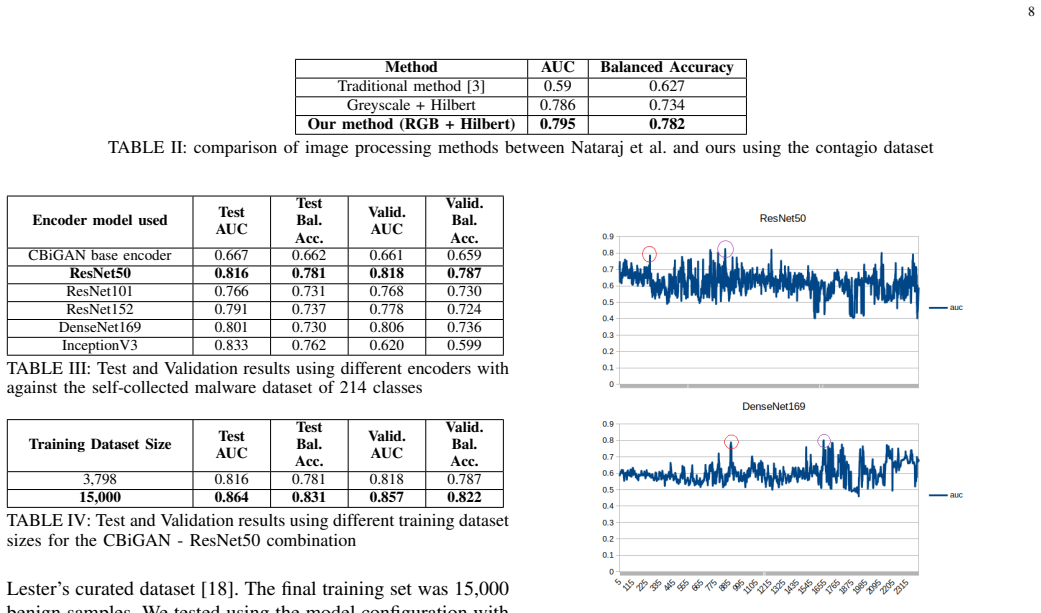
We replaced the base encoder of the CBiGAN with several deep networks (ResNet, DenseNet, Inception)...
What do these tags mean?
- matches
- The paper's claim is directly supported by a theorem in the formal canon.
- supports
- The theorem supports part of the paper's argument, but the paper may add assumptions or extra steps.
- extends
- The paper goes beyond the formal theorem; the theorem is a base layer rather than the whole result.
- uses
- The paper appears to rely on the theorem as machinery.
- contradicts
- The paper's claim conflicts with a theorem or certificate in the canon.
- unclear
- Pith found a possible connection, but the passage is too broad, indirect, or ambiguous to say the theorem truly supports the claim.
Reference graph
Works this paper leans on
-
[1]
Saridou, B., Moulas, I., Shiaeles, S., & Papadopoulos, B. K. (2023). Image-Based malware detection using ˘A-Cuts and binary visualisation. Applied Sciences, 13(7), 4624. https://doi.org/10.3390/app13074624
-
[2]
Time series data augmentation for neural networks by time warping with a discriminative teacher,
Carrara, F., Amato, G., Brombin, L., Falchi, F., & Gennaro, C. (2021, January 10). Combining GANs and AutoEncoders for efficient anomaly detection. International Conference on Pattern Recognition. https://doi. org/10.1109/icpr48806.2021.9412253
-
[3]
Nataraj, K., Jacob, G., & Manjunath, B. S. (2011). Malware images: visualization and automatic classification. Proceedings of the 8th Inter- national Symposium on Visualization for Cyber Security
work page 2011
- [4]
-
[5]
Yumoto, S., Kitsukawa, T., Moro, A., Pathak, S., Nakamura, T., & Umeda, K. (2023). Anomaly detection from images in pipes using GAN. ROBOMECH Journal, 10(1). https://doi.org/10.1186/ s40648-023-00246-y
work page 2023
-
[6]
Wu, Q., Zhu, X., & Liu, B. (2021). A survey of Android malware static detection technology based on machine learning. Journal of Mobile Information Systems, 2021, 1–18. https://doi.org/10.1155/2021/8896013
-
[7]
Ngo, Q., Nguyen, H., Le, V ., & Nguyen, D. (2020). A survey of IoT malware and detection methods based on static features. ICT Express, 6(4), 280–286. https://doi.org/10.1016/j.icte.2020.04.005
-
[8]
Sihwail, R., Omar, K., & Ariffin, K. A. Z. (2018). A survey on malware analysis techniques: static, dynamic, hybrid and memory analysis. In- ternational Journal on Advanced Science, Engineering and Information Technology, 8(4–2), 1662. https://doi.org/10.18517/ijaseit.8.4-2.6827
-
[9]
Pan, Y ., Ge, X., Fang, C., & Yi, F. (2020). A Systematic Literature Re- view of Android Malware Detection using Static Analysis. IEEE Access, 8, 116363–116379. https://doi.org/10.1109/access.2020.3002842
-
[10]
Vu, D., Nguyen, T., Nguyen, T. V ., Nguyen, T. N., Massacci, F., & Phung, P. H. (2019). HIT4Mal: Hybrid image transformation for malware classification. Transactions on Emerging Telecommunications Technologies, 31(11). https://doi.org/10.1002/ett.3789
-
[11]
R., Shiaeles, S., & Papadopoulos, B
Saridou, B., Rose, J. R., Shiaeles, S., & Papadopoulos, B. (2022). SAGMAD–A signature agnostic malware detection system based on binary visualisation and fuzzy sets. Electronics, 11(7), 1044. https: //doi.org/10.3390/electronics11071044
-
[12]
Gu, J., Kong, R., Sun, H., Zhuang, H., Pan, F., & Lin, Z. (2023). A novel detection technique based on benign samples and one-class algorithm for malicious PDF documents containing JavaScript. Interna- tional Conference on Computer Application and Information Security. https://doi.org/10.1117/12.2637518
-
[13]
Shaukat, K., Luo, S., & Varadharajan, V . (2024). A novel machine learning approach for detecting first-time-appeared malware. Engineer- ing Applications of Artificial Intelligence, 131, 107801. https://doi.org/ 10.1016/j.engappai.2023.107801
-
[14]
Generative Adversarial Networks
Goodfellow, I. J., Pouget-Abadie, J., Mirza, M., Xu, B., Warde-Farley, D., Ozair, S., Courville, A., & Bengio, Y . (2014). Generative adversarial networks. https://arxiv.org/abs/1406.2661
work page internal anchor Pith review Pith/arXiv arXiv 2014
-
[15]
Donahue, J., Kr ¨ahenb¨uhl, P., & Darrell, T. (2016). Adversarial feature learning. arXiv (Cornell University). https://arxiv.org/pdf/1605.09782
work page internal anchor Pith review Pith/arXiv arXiv 2016
-
[16]
MalwareBazaar - Malware sample exchange. (n.d.). https://bazaar.abuse. ch/
-
[17]
Microsoft Malware Classification Challenge (BIG 2015) — Kaggle. (n.d.). https://www.kaggle.com/c/malware-classification
work page 2015
-
[18]
Lester, M. (2021, June 8). PE Malware Machine Learning Dataset. Practical Security Analytics LLC. https://practicalsecurityanalytics.com/ pe-malware-machine-learning-dataset/
work page 2021
-
[19]
Mila. (2013, March 16). 16,800 clean and 11,960 malicious files for signature testing and research. https://contagiodump.blogspot.com/2013/ 03/16800-clean-and-11960-malicious-files.html
work page 2013
discussion (0)
Sign in with ORCID, Apple, or X to comment. Anyone can read and Pith papers without signing in.