REVIEW 4 major objections 6 minor 10 references
Irregular traces of multiple SLE(0) systems with multiple marked points
T0 review · 4 major / 6 minor · reviewed 2026-08-07 · deepseek-v4-flash
Pith's one-line read The paper claims that multiple SLE(0) traces, deterministic limits of random Loewner curves, lose their usual regularity when two or more marked points are present: traces can share asymptotic directions and spiral around marked points…
desk verdict The examples are explicit and the question is real, but the note never shows that the plotted streamlines are SLE(0) traces. read the letter →
The pith
A machine-rendered reading of the paper's core claim, the machinery that carries it, and where it could break.
The reading
What carries the argument
The central object is the symmetric divisor and its associated quadratic differential and vector field. For half-integer charges, $Q(z)dz^2=\prod_{k}(z-x_k)^2\prod_j(z-q_j)^{2\sigma_j}dz^2$ is a meromorphic quadratic differential, and the claimed traces are its horizontal trajectories, equivalently flow lines of $v_Q(z)=1/\sqrt{Q(z)}$. The machinery has three moving parts: the normalized Coulomb gas correlation $C[\sigma]=\prod_{i<j}(z_i-z_j)^{2\sigma_i\sigma_j}$ supplies the partition function driving the Loewner equations; the integral of motion $N_t(z)$ transfers the description along the Loewner map; and the phase portrait of $v_Q$ near the singularities determines regularity. When several marked points are present, the vector field can have separatrices from different growth points joining the same direction and recurrent flow around a zero, which is what produces the irregular traces.
What would settle it
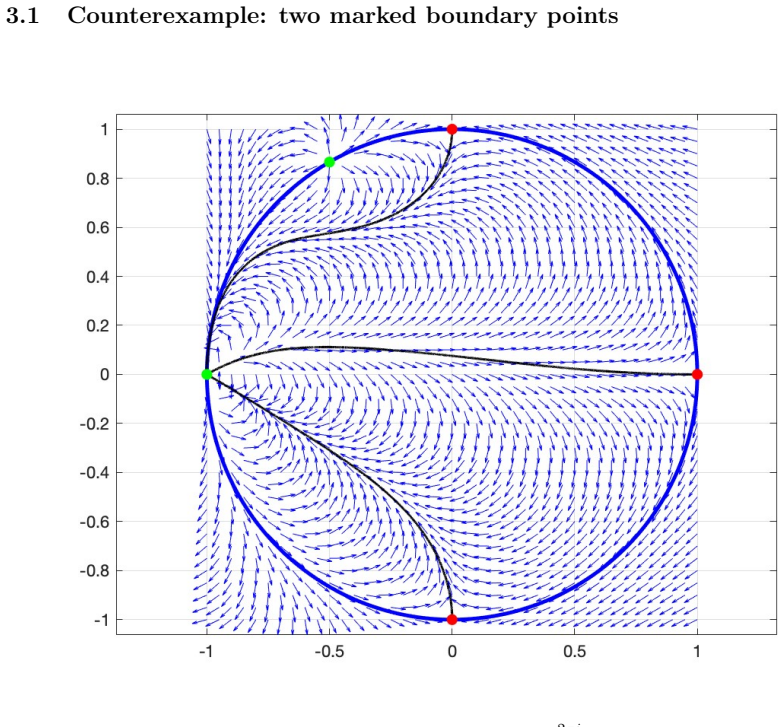
Run the multiple SLE(0) Loewner chain itself for the Figure 3.3 configuration: integrate the driving equations (2.4)-(2.5) with the partition function Z from (2.6) for the divisor $\sigma=x_1+x_2+x_3-q_1-q_2-\frac{3}{2}q_3-\frac{3}{2}q_4$, and compare the computed hull boundaries with the flow lines of $v_Q$. The claim is false if the hull boundary starting at $x_3=i$ does not wind around $q_1=-1/3$, or if the boundaries from $x_1=-i$ and $x_2=e^{\pi i/3}$ do not asymptotically share a direction.
Extended reading notes
Core claim
The core claim is that for configurations with multiple additional marked points, the otherwise regular SLE(0) trace picture fails. Working with a symmetric divisor $\sigma=\sum x_k+\sum \sigma_j q_j$ and half-integer charges $2\sigma_j\in\mathbb{Z}$, the author identifies the traces with the horizontal trajectories of $Q(z)dz^2=\prod(z-x_k)^2\prod(z-q_j)^{2\sigma_j}dz^2$. Theorem 2.8 asserts this identification up to collision times, and Theorem 2.9 supplies the integral of motion $N_t(z)$ that makes the Loewner flow follow those trajectories. The new phenomenon is that in the presence of at least two marked points, trajectories can asymptotically share a direction and spiraling can occur without spin; the three examples in Section 3 display same-direction convergence and a zero-spin spiral around $q_1=-1/3$.
Load-bearing premise
The load-bearing premise is Theorem 2.8's identification of the multiple SLE(0) Loewner traces with the horizontal trajectories of the constructed quadratic differential; its proof is one sentence referring to 'similar' chordal and radial cases, and if that identification fails for multi-marked-point configurations the reported spiraling describes only the auxiliary vector field, not SLE(0).
Editorial extensions
If this is right
- With at least two marked points, full regularity of SLE(0) traces cannot be taken for granted: shared asymptotic directions and zero-spin spirals are genuine features of the described systems.
- The quadratic-differential correspondence still holds up to collisions, so the same machinery that produced regular traces also produces the irregular examples, meaning the correspondence itself does not select only regular geometries.
- Spin at an interior marked point is sufficient for radial spiraling, but multiple marked points make it non-essential: spiraling occurs with no spin at all.
- The regularity statements established for one marked point cannot be extended unchanged to general multi-marked-point configurations; any extension must impose extra conditions on the divisor or the placement of marked points.
Reading between the lines
- Extension: since half-integer charges already break regularity, configurations with non-half-integer charges, where the paper notes that even the quadratic-differential description is unavailable, should exhibit at least as wild behaviour, possibly with logarithmic winding at the marked points.
- Extension: the shared asymptotic directions in the examples resemble saddle connections of the vector field $1/\sqrt{Q}$; a systematic phase-portrait classification of real symmetric divisors would predict exactly when two SLE(0) traces merge directions or spiral.
- Extension: it would be testable whether these irregular classical flows are the $\kappa\to 0$ limits of random multiple SLE($\kappa$) curves, or whether the randomness selects only the regular subset; the MATLAB code in the note is a starting point for such a comparison.
Editorial analysis
A structured set of objections, weighed in public.
Referee Report
Summary. The manuscript proposes a framework for multiple SLE(0) systems associated with a symmetric divisor with several marked points. It asserts (Theorem 2.8) that for half-integer charges the Loewner hulls are contained in horizontal trajectories of an explicit quadratic differential, and (Theorem 2.9) that an integral of motion exists. The paper then presents three MATLAB-generated examples (Section 3) claimed to exhibit irregular trace behavior: two trajectories asymptotically approaching the same direction and, in Example 3.3, a spiral around an uncharged marked point. The stated conclusion is that regularity of SLE(0) traces breaks down when multiple interior marked points are present.
Significance. If rigorously established, the paper would report a new phenomenon in the deterministic limit of multiple SLE: multiple interior marked points could cause spiraling and asymptotic convergence of traces even without spin. The explicit constructions and the included MATLAB code are useful and reproducible, and the flow-line pictures of the quadratic differentials are self-contained. However, the paper does not prove that the plotted streamlines are the SLE(0) traces; Theorem 2.8 only asserts containment of hulls in horizontal trajectories, with proof deferred to prior work on single-marked-point cases. The branch dependence of the vector field in Example 3.3 adds further doubt. Thus the significance is conditional on a missing identification between the Loewner dynamics and the auxiliary differential.
major comments (4)
- [§2.3 (Theorem 2.8)] The central identification of SLE(0) traces with horizontal trajectories of Q(z) dz^2 is asserted with the one-sentence proof 'The proof is similar to the multiple chordal and multiple radial SLE(0) cases.' This conveys no argument, and the cited cases (MZ25b, Zha25b) involve one marked point, not the multiple-interior-point configurations used in Section 3. Since every counterexample in this note is derived from this identification, the paper's main claim is unsupported within the manuscript.
- [§3 (Examples 3.1–3.3)] Even accepting Theorem 2.8, the theorem states that the Loewner hull K_t is contained in horizontal trajectories, with terminal directions toward the critical points; it does not assert that the trace emanating from a specified growth point coincides with the particular streamline of v_Q = 1/sqrt(Q) computed in MATLAB. At a double zero of Q several horizontal directions are possible, and no selection criterion is provided. Therefore Figures 3.1–3.3 demonstrate properties of flow lines of an auxiliary vector field, not of SLE(0) traces.
- [§3.3 (Example 3.3)] The square root of the quadratic differential contains factors (z-1/2)^{-3/2}(z-2)^{-3/2}, which are not single-valued on the upper half-plane or the disk. The vector field v_Q is branch-dependent, and different branch cuts can change the computed streamlines and in particular the reported spiral around q1 = -1/3. The manuscript does not specify the branch cut or explain why the resulting curve is a well-defined SLE(0) trace. This makes the claimed 'spiraling in the absence of spin' an artifact of the numerical setup rather than a demonstrated property.
- [Abstract / §2] The abstract states that the paper establishes regularity of trajectories near singularities (no spiraling, no same-direction convergence) in the chordal and radial cases with one marked point, but no theorem in Section 2 proves this. The introduction says it 'has been shown', but no specific reference or proof is given. This is a missing load-bearing support for the paper's claimed contribution, which is the contrast between those regular cases and the new irregular examples.
minor comments (6)
- [Definition 2.1] Definition 2.1 is grammatically incomplete: 'C[σ] is a differential of conformal dimension λj at zj by Let λ(σ) = ...' The sentence should be rewritten.
- [Theorem 2.9] The proof says 'By direction computation'; it should be 'direct computation'.
- [§2.2, Definition 2.6] There are typos: 'where eachνi' missing space, and 'conjudgation' for 'conjugation' in Definition 2.7.
- [§3.1, Figure 3.1 caption] The caption uses q1 = 2πi/3, while the text and code use q1 = e^{2πi/3}; please align the notation.
- [§3.2, Figure 3.2 vs text] The text lists marked points q1=0, q2=∞, q3=−1, but the caption says q1=1, q2=−1, q2*=∞. This inconsistency should be resolved.
- [Theorem 2.8] The statement says 'with zeros at z', but the set of growth points is x = {x1,...,xn}; please use consistent notation.
Circularity Check
The SLE(0)-trace interpretation of the examples rests on an unproved theorem whose proof is deferred to the author's own prior work; the central claim is therefore imported rather than derived.
-
self citation load bearing
[Section 2.3 (Theorem 2.8), applied in Section 3 via Remark 3.2]
"Proof. The proof is similar to the multiple chordal and multiple radial SLE(0) cases. □"
Theorem 2.8 is the only bridge asserting that the Loewner hulls, and hence the SLE(0) traces, lie on horizontal trajectories of the quadratic differential. Its proof is a single sentence deferring to the author's own chordal and radial SLE(0) papers. Section 3 then labels the plotted flow lines of v_Q = 1/sqrt(Q) as 'traces of the SLE(0) system' solely on the strength of this unproved theorem. Thus the paper's central claim that irregular behavior occurs for multiple SLE(0) traces reduces to a load-bearing self-citation rather than a derivation in this note.
full rationale
The paper's geometric examples are computed from the vector field v_Q = 1/sqrt(Q) and are internally consistent: the streamlines are genuine horizontal trajectories of the displayed quadratic differentials. No fitted-input circularity is present, because the charges are specified, not fitted, and the examples are not predictions from data. However, the paper's advertised conclusion is about SLE(0) traces, not merely about quadratic-differential trajectories. The only step connecting the Loewner chain to these trajectories is Theorem 2.8, whose proof is deferred to the author's previous work via 'similar to the multiple chordal and multiple radial SLE(0) cases.' That previous work is by the same author(s), so the central identification is supported by self-citation rather than by an independent, machine-checked, or externally verified argument. Moreover, the theorem as stated asserts only that the Loewner hulls are contained in horizontal trajectories; it does not identify the SLE(0) trace with the specific streamline selected in Section 3, and at double zeros several horizontal directions are available. Consequently, the claim that multiple SLE(0) traces can spiral or asymptotically share a direction is not established within this note except by relying on an unproved, self-cited theorem. This is partial circularity: the differential-geometric content is independent, but the SLE(0) interpretation of the central examples is imported rather than derived.
Assumptions & free parameters
free parameters (2)
- Hand-chosen charge configurations and marked point locations in the counterexamples =
Fig 3.1: sigma = x1+x2+x3 - q1 - 4q2, q1=e^{2*pi*i/3}, q2=-1; Fig 3.2: sigma = x1+x2+x3 - q1 - q2 - 3q3, q1=0…
- Normalization constants C for sqrt(Q) =
C = 0.5003 - 0.8662i (Fig 3.1), C = -1.2071 - 0.5000i (Fig 3.2), C = i * e^{-i*pi/6} (Fig 3.3)
assumptions (4)
- domain assumption Multiple SLE(0) traces are horizontal trajectories of the quadratic differential Q(z)dz^2 associated with the symmetric divisor.
- domain assumption The normalized Coulomb gas correlation C[sigma] is Mobius invariant under the neutrality condition integral of sigma = -2.
- standard math Flow lines of the vector field 1/sqrt(Q(z)) coincide with horizontal trajectories of Q(z)dz^2.
- ad hoc to paper MATLAB streamline computations faithfully capture the asymptotic behavior of continuous trajectories, including spiraling and same-direction convergence.
Cite this review
Pith. "Pith review of Irregular traces of multiple SLE(0) systems with multiple marked points." pith.science (2026). https://pith.science/paper/PL2VRWBF
@misc{pith2026250607513,
  author       = {Pith},
  title        = {Pith review of: Irregular traces of multiple SLE(0) systems with multiple marked points},
  year         = {2026},
  howpublished = {\url{https://pith.science/paper/PL2VRWBF}},
  note         = {Machine review of arXiv:2506.07513}
}
read the original abstract
In this supplementary note, we study the traces of multiple SLE(0) systems with two or more additional marked points. For general chordal configurations, the traces correspond to the real locus of real rational functions; in the radial case, they correspond to the horizontal trajectories of residue-free quadratic differentials. In both settings, we establish the regularity of the trajectories near singularities: no spiraling occurs, and no two trajectories asymptotically converge to the same direction. Moreover, in the radial case with non-zero spin at the marked interior point, we show that the spin induces a spiraling behavior at the marked interior point. However, this regularity breaks down when multiple interior marked points are present. In such cases, trajectories may asymptotically approach the same direction, and spiraling can occur even in the absence of spin. We present explicit counterexamples generated using MATLAB, with code provided for reference.
Figures


Reference graph
Works this paper leans on
-
[1]
Conformal field theories of stochastic Loewner evolutions
[BB03] M. Bauer and D. Bernard. “Conformal field theories of stochastic Loewner evolutions”. In: Communications in Mathematical Physics 239.3 (2003), pp. 493–521. [Car03] J. L. Cardy. “Stochastic Loewner evolution and Dyson’s circular ensembles”. In: Jour- nal of Physics A 36.24 (2003), pp. L379–L386. [Car96] J. L. Cardy. Scaling and renormalization in st...
work page 2003
-
[2]
Contour lines of the two-dimensional discrete Gaussian free field
Z¨ urich: European Mathematical Society, 2006, pp. 1421–1451. [SS09] O. Schramm and S. Sheffield. “Contour lines of the two-dimensional discrete Gaussian free field”. In: Acta Mathematica 202.1 (2009), pp. 21–137. [WW24] Y. Wang and H. Wu. “Commutation relations for two-sided radial SLE”. In: (2024). arXiv: arXiv:2405.07082 [math.PR]. url: https://arxiv.o...
arXiv 2009
-
[6]
Towards a conformal field theory for Schramm-Loewner evolutions
arXiv: 2410.21544 [math.PR]. url: https://arxiv.org/ abs/2410.21544. [Pel19] E. Peltola. “Towards a conformal field theory for Schramm-Loewner evolutions”. In: Journal of Mathematical Physics 60.10 (2019), p. 103305. [PW19] E. Peltola and H. Wu. “Global and local multiple SLEs for κ ≤ 4 and connection probabilities for level lines of GFF”. In: Communicati...
-
[7]
Towards conformal invariance of 2D lattice models
Z¨ urich: European Mathematical Society, 2006, pp. 513–543. [Smi06] S. Smirnov. “Towards conformal invariance of 2D lattice models”. In: International Congress of Mathematicians . Vol
work page 2006
-
[9]
Multiple chordal SLE($\kappa$) and quantum Calogero-Moser system
arXiv: 2505.16093 [math.PR]. url: https://arxiv.org/abs/2505.16093. [Zha25b] Jiaxin Zhang. Multiple chordal SLE(0) and classical Calogero-Moser system
-
[10]
Multiple chordal SLE(0) and classical Calogero-Moser system
arXiv: 2505.17129 [math.PR]. url: https://arxiv.org/abs/2505.17129. [Zha25c] Jiaxin Zhang. “On Multiple SLE Systems and their Deterministic Limits”. PhD thesis. California Institute of Technology,
-
[50]
Conformal field theory on the Riemann sphere and its boundary version for SLE
Fields Institute Communications. Providence, RI: American Mathematical Society, 2007, pp. 199–224. [KM13] N-G Kang and N. Makarov. “Gaussian free field and conformal field theory”. In: Ast´ erisque353 (2013), pp. viii+136. [KM21] N-G. Kang and N. Makarov. “Conformal field theory on the Riemann sphere and its boundary version for SLE”. In: (2021). arXiv: a...
work page Pith review arXiv 2013
-
[434]
Conformal restriction, highest-weight representations and SLE
[FW03] R. Friedrich and W. Werner. “Conformal restriction, highest-weight representations and SLE”. In: Communications in Mathematical Physics 243.1 (2003), pp. 105–122. [HL21] V. Healey and G. Lawler. “ N -sided radial Schramm-Loewner evolution”. In: Probability Theory and Related Fields 181.1-3 (2021), pp. 451–488. [KL07] M. Kozdron and G. Lawler. “The ...
work page 2003
Show all 10 references
-
[1996]
Euler integrals for commuting SLEs
[Dub06] Julien Dub´ edat. “Euler integrals for commuting SLEs”. In: Journal of Statistical Physics 123.6 (2006), pp. 1183–1218. [Dub15] Julien Dub´ edat. “SLE and Virasoro representations: localization”. In: Communications in Mathematical Physics 336.2 (2015), pp. 695–760. [FK...
2006
-
[2025]
url: https://arxiv.org/ abs/2505.14762
arXiv: 2505.14762 [math.PR]. url: https://arxiv.org/ abs/2505.14762. [MZ25b] Nikolai Makarov and Jiaxin Zhang. Multiple radial SLE(0) and classical Calogero- Sutherland System
Reviewed August 7, 2026 · model on record in the stance chip above.
Discussion (0). Sign in to comment.