REVIEW 4 major objections 6 minor 44 references
Event-Priori-Based Vision-Language Model for Efficient Visual Understanding
T0 review · 4 major / 6 minor · reviewed 2026-08-07 · deepseek-v4-flash
Pith's one-line read EP-VLM uses event-camera motion to cut VLM visual tokens by half, keeping 98% accuracy on RealWorldQA.
desk verdict A plausible event-guided token-sparsification trick for VLMs, but the experiments don't yet isolate the event prior from any 50% patch-retention baseline. read the letter →
The pith
A machine-rendered reading of the paper's core claim, the machinery that carries it, and where it could break.
The reading
What carries the argument
The load-bearing mechanism is the pair consisting of the event-prioritized visual mask $M^E_v$ and the packed rotary position embeddings $\tilde{R}^{2D}$. Event frames are accumulated over a window, resized to the RGB resolution, and split into the same non-overlapping patches as the image; each patch is scored by its $\ell^1$ motion intensity, and the $(1-\tau)$-quantile threshold turns that score into a binary keep/drop mask. The same mask is applied twice: once to select which RGB patch embeddings enter the visual encoder, and once to select which full-resolution 2D RoPE vectors accompany them. The encoder therefore sees a packed sequence of $N'<N$ tokens in which every token still carries the rotation matrix of its original grid coordinate, which is what prevents unstructured sparsification from destroying spatial understanding.
What would settle it
Run EP-VLM on RealWorldQA at $\tau=0.5$ but replace the event mask with a mask choosing the same number of patches uniformly at random. If random selection scores near 61.4% accuracy at the same FLOPs, then the event prior is not doing the work; if random selection collapses, the event signal is essential. Separately, measure end-to-end latency and energy on the target edge device, since the paper reports only theoretical FLOPs reductions and the deployed savings could be smaller or larger.
Extended reading notes
Core claim
EP-VLM's central discovery is that a motion-based event prior can identify which image patches matter before the visual encoder runs, so a VLM can process a fraction of the tokens without retraining and without losing much accuracy. The method computes, for each patch of a temporally aligned event map, the $\ell^1$ intensity $S^E_{v,uv}=\sum_{(x,y)\in \mathrm{Patch}_{uv}(E_v)} |E_v(x,y)|$, then builds a binary mask $M^E_{v,uv}=\mathbf{1}(S^E_{v,uv} \ge Q_{1-\tau}(S^E_v))$ that retains the top $\tau$ fraction of motion-active patches. Those patches are packed into a shorter input sequence, and the full-resolution 2D RoPE vectors are packed with the same mask, so each remaining token keeps its original spatial coordinate. At $\tau=0.5$ on Qwen2-VL-2B, RealWorldQA accuracy goes from 62.9% to 61.4% (98% retained) while FLOPs fall from 14.7T to 7.4T (about 50% saved); the 7B variant goes from 70.1% to 67.2% with 42.4% FLOPs saved. The paper interprets this as evidence that event data can act as a reliable computational prior for semantic saliency in VLMs.
Load-bearing premise
The load-bearing premise is that patch-wise event intensity is a valid saliency prior for the query and that event data is available for every RGB input; the paper never specifies how event streams were obtained for RealWorldQA or compares against non-event patch selection.
Editorial extensions
If this is right
- At $\tau=0.5$, EP-VLM processes about half the visual tokens and reports roughly 50% lower FLOPs and MACs, with RealWorldQA accuracy falling from 62.9% to 61.4% on Qwen2-VL-2B and from 70.1% to 67.2% on Qwen2-VL-7B.
- At $\tau=0.3$, the 2B model loses only 0.3 accuracy points while saving roughly 30% FLOPs, so the $\tau$ knob defines a smooth and controllable accuracy-efficiency trade-off.
- Because EP-VLM changes only which input tokens are fed in and how positional embeddings are attached, it keeps parameter counts identical to the baseline and requires no retraining or architectural modification.
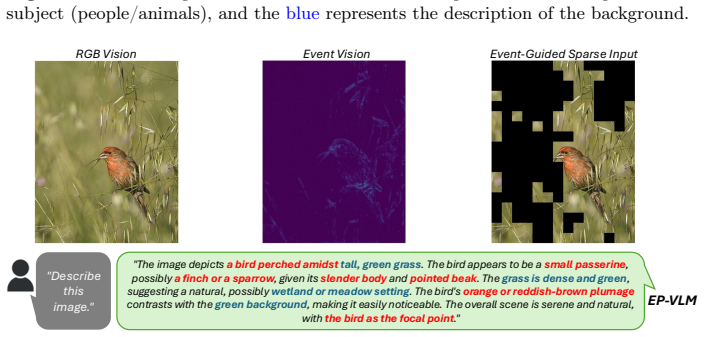
- The qualitative captions produced from 50% event-guided input preserve subjects, attributes, and spatial relations such as 'woman to the right of the dog,' indicating that the sparsified input retains the information needed for relational reasoning.
- The paper's results suggest that event-guided sparsification is a general input-conditioning strategy that could be layered on other VLM families beyond Qwen2-VL.
Reading between the lines
- A matched control using a non-event selector, such as random patch selection, RGB gradient magnitude, or optical flow at the same $\tau$, would isolate how much of the accuracy retention is due to events specifically; the paper does not run this ablation.
- For static or nearly static scenes, event density approaches zero, so an event-only prior cannot decide which patches to keep; a deployable system would likely need a fallback that blends event intensity with RGB saliency, which the paper leaves implicit.
- The efficiency numbers are theoretical FLOPs and MACs, and the paper concedes that sparse-indexing overhead can inflate theoretical counts; the actual edge benefit hinges on measured latency and energy, which is a natural next experiment.
- Event-guided sparsification attacks input redundancy, so it should stack with weight-level compression methods such as quantization and pruning; combining them could yield multiplicative savings, though the paper does not test this.
Editorial analysis
A structured set of objections, weighed in public.
Referee Report
Summary. The paper proposes EP-VLM, a method for reducing VLM inference cost by using event-camera data as a saliency prior to drop RGB patches before visual encoding. The retained patches are packed into a shorter sequence, and full-resolution 2D RoPE embeddings are packed with the same mask so that positional information is preserved. Experiments on RealWorldQA with Qwen2-VL-2B/7B report FLOPs/MACs reductions up to about 70% at sparsity tau=0.7, with the tau=0.5 setting retaining about 98% of baseline accuracy for the 2B model. Qualitative examples from n-ImageNet illustrate the intended effect of event-guided sparsification.
Significance. The idea is interesting and the position-preserving packed-RoPE mechanism is a coherent, low-overhead design that requires no retraining. The paper is also honest that tau is a swept threshold rather than an optimized parameter. However, the experimental validation as presented does not support the central claim that event priors are the cause of the efficiency-accuracy trade-off: the event source for RealWorldQA is undocumented, no non-event control is included, and the reported efficiency numbers are internally inconsistent in the text. The contribution would be significant if these gaps are closed, especially as an input-conditioning method compatible with any VLM.
major comments (4)
- [§4.1, Table 1; §3.2] RealWorldQA is a frame-based benchmark that does not natively provide DVS event streams, yet the paper never states how the event data used for Table 1 were obtained. The only explicit event-dataset reference in the paper is n-ImageNet, which appears only in the qualitative section (§4.2) and cannot support the quantitative RealWorldQA results. If events were synthesized from RGB via frame differencing or optical flow, that synthesis is itself a saliency heuristic and its computational cost must be included in the reported FLOPs/MACs; if no event data were used, the experiment does not test the proposed mechanism.
- [§4.1, Table 1] No ablation isolates the contribution of the event prior. A control that applies the same packing and RoPE strategy with a random patch mask, a center-bias mask, or a gradient/entropy-based mask at the same tau would determine whether the observed '98% accuracy at 50% FLOPs' is attributable to event data or merely to any 50% token retention. Without such a control, the central attribution claim is unsupported.
- [§4.1, paragraph after Table 1] The text after Table 1 states that 'the apparent increase in theoretical FLOPs/MACs stems from sparse data indexing overhead,' but Table 1 shows a decrease in FLOPs/MACs at every sparsity level (e.g., 14.7T to 7.4T for the 2B model at tau=0.5). This is contradictory. The paper must clarify whether the reported FLOPs are computed on the dense graph, the sparse graph, or with indexing overhead included, and the claim about actual latency and energy decreases is not backed by any latency or energy measurements.
- [§4.1, Table 1] The quantitative results in Table 1 are single-point estimates with no error bars, number of runs, or test-set size. Accuracy differences of 0.3–6.0 points are reported as exact values; at the 2B scale, such differences can be within sampling noise, and the claim of retaining '98% of accuracy' requires a measure of variance.
minor comments (6)
- [Title and Abstract] The title and abstract use 'Event-Priori'; the standard English term is 'Event-Prior' (or 'event prior').
- [References] Reference [39] cites a Grok-2 beta release blog post rather than the RealWorldQA dataset; please provide the correct dataset reference.
- [§3.2] The 'defined temporal window' for accumulating events is never given a value, and no sensitivity analysis for this window is reported.
- [§4.2] The qualitative examples appear cherry-picked and are not quantified; they cannot support the general claim that event-guided sparsification produces richer semantic understanding.
- [§4.1] The paper does not report the prompt template, decoding parameters, or number of test samples used for RealWorldQA; please add these details for reproducibility.
- [§3.3] The notation is confusing because H_v is defined both as the output of the MLP projection (Eq. 10) and, in the same subsection, as the resulting tensor after describing the packed RoPE; please use distinct symbols for encoder output and projected tokens.
Circularity Check
No significant circularity: the FLOPs saving follows from the sparsity ratio, but the accuracy claim is independently measured and not derived from the event prior.
full rationale
EP-VLM's derivation chain is not circular. Eq. (6) defines the event-prioritized mask as a top-tau quantile of per-patch event intensity, and Eq. (7) packs only the retained RGB patches; the reported FLOPs/MACs reductions in Table 1 (e.g., -49.7% at tau=0.5) are therefore near-arithmetic consequences of processing half the visual tokens. The empirical content of the paper is the accuracy retention on RealWorldQA (62.9% to 61.4%), which is measured against an external benchmark and is not forced by the mask definition or by the packing scheme. The event-prior hypothesis is supported by that accuracy result, not by the by-construction FLOPs saving. Several references to the authors' own prior work appear (refs. 5, 8, 16-18, 23, 32, 42), but only as background/related work on quantization, pruning, or autonomous driving; none is load-bearing for EP-VLM's central mechanism, and no uniqueness theorem or ansatz is imported from these citations. Non-circular concerns that should be weighed as correctness risks: the paper never states how event streams were obtained for the frame-based RealWorldQA benchmark (Sec. 4.1), and Sec. 4.1's sentence about an 'apparent increase in theoretical FLOPs/MACs' contradicts the decreases shown in Table 1. Neither issue makes the accuracy claim circular.
Assumptions & free parameters
free parameters (2)
- Sparsity threshold tau =
0.3, 0.5, 0.7
- Event accumulation window =
unspecified
assumptions (3)
- domain assumption Event data temporally and spatially aligned with each RGB frame exists
- domain assumption Patch-wise motion intensity from events correlates with semantic relevance to the text query
- standard math Packing full-resolution RoPE embeddings preserves relative positional information among retained tokens
Cite this review
Pith. "Pith review of Event-Priori-Based Vision-Language Model for Efficient Visual Understanding." pith.science (2026). https://pith.science/paper/Q7ODKHBI
@misc{pith2026250607627,
  author       = {Pith},
  title        = {Pith review of: Event-Priori-Based Vision-Language Model for Efficient Visual Understanding},
  year         = {2026},
  howpublished = {\url{https://pith.science/paper/Q7ODKHBI}},
  note         = {Machine review of arXiv:2506.07627}
}
read the original abstract
Large Language Model (LLM)-based Vision-Language Models (VLMs) have substantially extended the boundaries of visual understanding capabilities. However, their high computational demands hinder deployment on resource-constrained edge devices. A key source of inefficiency stems from the VLM's need to process dense and redundant visual information. Visual inputs contain significant regions irrelevant to text semantics, rendering the associated computations ineffective for inference. This paper introduces a novel Event-Priori-Based Vision-Language Model, termed EP-VLM. Its core contribution is a novel mechanism leveraging motion priors derived from dynamic event vision to enhance VLM efficiency. Inspired by human visual cognition, EP-VLM first employs event data to guide the patch-wise sparsification of RGB visual inputs, progressively concentrating VLM computation on salient regions of the visual input. Subsequently, we construct a position-preserving tokenization strategy for the visual encoder within the VLM architecture. This strategy processes the event-guided, unstructured, sparse visual input while accurately preserving positional understanding within the visual input. Experimental results demonstrate that EP-VLM achieves significant efficiency improvements while maintaining nearly lossless accuracy compared to baseline models from the Qwen2-VL series. For instance, against the original Qwen2-VL-2B, EP-VLM achieves 50% FLOPs savings while retaining 98% of the original accuracy on the RealWorldQA dataset. This work demonstrates the potential of event-based vision priors for improving VLM inference efficiency, paving the way for creating more efficient and deployable VLMs for sustainable visual understanding at the edge.
Figures


Reference graph
Works this paper leans on
-
[1]
In: Proceedings of the IEEE conference on computer vision and pattern recognition
Amir, A., Taba, B., Berg, D., Melano, T., McKinstry, J., Di Nolfo, C., Nayak, T., Andreopoulos, A., Garreau, G., Mendoza, M., et al.: A low power, fully event-based gesture recognition system. In: Proceedings of the IEEE conference on computer vision and pattern recognition. pp. 7243–7252 (2017)
2017
-
[2]
Anthropic: Claude 3.5 sonnet. https://www.anthropic.com/news/claude-3-5- sonnet (2024), https://www.anthropic.com/news/claude-3-5-sonnet
work page 2024
-
[3]
In: Proceedings of the IEEE international confer- ence on computer vision
Antol, S., Agrawal, A., Lu, J., Mitchell, M., Batra, D., Zitnick, C.L., Parikh, D.: Vqa: Visual question answering. In: Proceedings of the IEEE international confer- ence on computer vision. pp. 2425–2433 (2015)
2015
-
[4]
Bai, S., Chen, K., Liu, X., Wang, J., Ge, W., Song, S., Dang, K., Wang, P., Wang, S., Tang, J., et al.: Qwen2. 5-vl technical report. arXiv preprint arXiv:2502.13923 (2025)
arXiv 2025
-
[5]
arXiv preprint arXiv:2504.11514 (2025)
Baumann, N., Hu, C., Sivasothilingam, P., Qin, H., Xie, L., Magno, M., Benini, L.: Enhancing autonomous driving systems with on-board deployed large language models. arXiv preprint arXiv:2504.11514 (2025)
arXiv 2025
-
[6]
Nature398(6725), 334–338 (1999)
Berry, M.J., Brivanlou, I.H., Jordan, T.A., Meister, M.: Anticipation of moving stimuli by the retina. Nature398(6725), 334–338 (1999)
work page 1999
-
[7]
In: Proceedings of the The 31st British Machine Vision Virtual Conference
Chamorro Hernández, W.O., Andrade-Cetto, J., Solà Ortega, J.: High-speed event camera tracking. In: Proceedings of the The 31st British Machine Vision Virtual Conference. pp. 1–12 (2020)
work page 2020
-
[8]
arXiv preprint arXiv:2402.11960 (2024)
Chen, H., Lv, C., Ding, L., Qin, H., Zhou, X., Ding, Y., Liu, X., Zhang, M., Guo, J., Liu, X., et al.: Db-llm: Accurate dual-binarization for efficient llms. arXiv preprint arXiv:2402.11960 (2024)
arXiv 2024
Show all 44 references
-
[9]
In: 2022 International Joint Conference on Neural Networks (IJCNN)
Cordone, L., Miramond, B., Thierion, P.: Object detection with spiking neural networks on automotive event data. In: 2022 International Joint Conference on Neural Networks (IJCNN). pp. 1–8. IEEE (2022)
2022
-
[10]
arXiv preprint arXiv:2010.11929 (2020)
Dosovitskiy, A., Beyer, L., Kolesnikov, A., Weissenborn, D., Zhai, X., Unterthiner, T., Dehghani, M., Minderer, M., Heigold, G., Gelly, S., et al.: An image is worth 16x16 words: Transformers for image recognition at scale. arXiv preprint arXiv:2010.11929 (2020)
2020 arXiv
-
[11]
IEEE transactions on pattern analysis and machine intelligence 44(1), 154–180 (2020)
Gallego, G., Delbrück, T., Orchard, G., Bartolozzi, C., Taba, B., Censi, A., Leutenegger, S., Davison, A.J., Conradt, J., Daniilidis, K., et al.: Event-based vision: A survey. IEEE transactions on pattern analysis and machine intelligence 44(1), 154–180 (2020)
2020
-
[12]
arXiv preprint arXiv:2312.06677 (2023)
Guan, Y., Wang, D., Chu, Z., Wang, S., Ni, F., Song, R., Li, L., Gu, J., Zhuang, C.: Intelligent virtual assistants with llm-based process automation. arXiv preprint arXiv:2312.06677 (2023)
2023 arXiv
-
[13]
arXiv preprint arXiv:2501.12948 (2025)
Guo, D., Yang, D., Zhang, H., Song, J., Zhang, R., Xu, R., Zhu, Q., Ma, S., Wang, P., Bi, X., et al.: Deepseek-r1: Incentivizing reasoning capability in llms via reinforcement learning. arXiv preprint arXiv:2501.12948 (2025)
2025 arXiv
-
[14]
5-vl technical report
Guo, D., Wu, F., Zhu, F., Leng, F., Shi, G., Chen, H., Fan, H., Wang, J., Jiang, J., Wang, J., et al.: Seed1. 5-vl technical report. arXiv preprint arXiv:2505.07062 (2025)
2025 arXiv
-
[15]
arXiv preprint arXiv:2405.19334 (2024)
He, Y., Liu, Z., Chen, J., Tian, Z., Liu, H., Chi, X., Liu, R., Yuan, R., Xing, Y., Wang, W., et al.: Llms meet multimodal generation and editing: A survey. arXiv preprint arXiv:2405.19334 (2024)
2024 arXiv
-
[16]
arXiv preprint arXiv:2402.04291 (2024) 14 H
Huang, W., Liu, Y., Qin, H., Li, Y., Zhang, S., Liu, X., Magno, M., Qi, X.: Billm: Pushing the limit of post-training quantization for llms. arXiv preprint arXiv:2402.04291 (2024) 14 H. Qin et al
2024 arXiv
-
[17]
arXiv preprint arXiv:2405.14917 (2024)
Huang, W., Qin, H., Liu, Y., Li, Y., Liu, X., Benini, L., Magno, M., Qi, X.: Slim- llm: Salience-driven mixed-precision quantization for large language models. arXiv preprint arXiv:2405.14917 (2024)
2024 arXiv
-
[18]
Visual Intelligence2(1), 36 (2024)
Huang, W., Zheng, X., Ma, X., Qin, H., Lv, C., Chen, H., Luo, J., Qi, X., Liu, X., Magno, M.: An empirical study of llama3 quantization: From llms to mllms. Visual Intelligence2(1), 36 (2024)
2024
-
[19]
arXiv preprint arXiv:2410.21276 (2024)
Hurst, A., Lerer, A., Goucher, A.P., Perelman, A., Ramesh, A., Clark, A., Os- trow, A., Welihinda, A., Hayes, A., Radford, A., et al.: Gpt-4o system card. arXiv preprint arXiv:2410.21276 (2024)
2024 arXiv
-
[20]
In: Proceedings of the IEEE/CVF international conference on computer vision
Kim,J.,Bae,J.,Park,G.,Zhang,D.,Kim,Y.M.:N-imagenet:Towardsrobust,fine- grained object recognition with event cameras. In: Proceedings of the IEEE/CVF international conference on computer vision. pp. 2146–2156 (2021)
2021
-
[21]
arXiv preprint arXiv:2209.15639 (2022)
Kuo, W., Cui, Y., Gu, X., Piergiovanni, A., Angelova, A.: F-vlm: Open- vocabulary object detection upon frozen vision and language models. arXiv preprint arXiv:2209.15639 (2022)
2022 arXiv
-
[22]
Li, J., Guan, Z., Wang, J., Cheung, C.Y., Zheng, Y., Lim, L.L., Lim, C.C., Ruamvi- boonsuk, P., Raman, R., Corsino, L., et al.: Integrated image-based deep learning andlanguagemodelsforprimarydiabetescare.Naturemedicine30(10),2886–2896 (2024)
2024
-
[23]
arXiv preprint arXiv:2410.03129 (2024)
Li, Z., Yan, X., Zhang, T., Qin, H., Xie, D., Tian, J., Kong, L., Zhang, Y., Yang, X., et al.: Arb-llm: Alternating refined binarizations for large language models. arXiv preprint arXiv:2410.03129 (2024)
2024
-
[24]
arXiv preprint arXiv:2412.19437 (2024)
Liu, A., Feng, B., Xue, B., Wang, B., Wu, B., Lu, C., Zhao, C., Deng, C., Zhang, C., Ruan, C., et al.: Deepseek-v3 technical report. arXiv preprint arXiv:2412.19437 (2024)
2024 arXiv
-
[25]
Advances in neural information processing systems36, 34892–34916 (2023)
Liu, H., Li, C., Wu, Q., Lee, Y.J.: Visual instruction tuning. Advances in neural information processing systems36, 34892–34916 (2023)
2023
-
[26]
arXiv preprint arXiv:2412.00832 (2024)
Liu, S., Li, J., Zhao, G., Zhang, Y., Meng, X., Yu, F.R., Ji, X., Li, M.: Event- gpt: Event stream understanding with multimodal large language models. arXiv preprint arXiv:2412.00832 (2024)
2024 arXiv
-
[27]
Advances in neural information processing systems36, 21702–21720 (2023)
Ma, X., Fang, G., Wang, X.: Llm-pruner: On the structural pruning of large lan- guage models. Advances in neural information processing systems36, 21702–21720 (2023)
2023
-
[28]
In: European Conference on Computer Vision
Messikommer, N., Gehrig, D., Loquercio, A., Scaramuzza, D.: Event-based asyn- chronous sparse convolutional networks. In: European Conference on Computer Vision. pp. 415–431. Springer (2020)
2020
-
[29]
https://ai
Meta, A.: The llama 4 herd: The beginning of a new era of natively multimodal ai innovation. https://ai. meta. com/blog/llama-4-multimodal-intelligence/, checked on4(7), 2025 (2025)
2025
-
[30]
https://github.com/MrYxJ/calculate-flops.pytorch (2024), https://github.com/MrYxJ/calculate-flops.pytorch
MrYxJ: calflops: a flops and params calculate tool for neural networks. https://github.com/MrYxJ/calculate-flops.pytorch (2024), https://github.com/MrYxJ/calculate-flops.pytorch
2024
-
[31]
The International journal of robotics research36(2), 142–149 (2017)
Mueggler, E., Rebecq, H., Gallego, G., Delbruck, T., Scaramuzza, D.: The event- camera dataset and simulator: Event-based data for pose estimation, visual odome- try, and slam. The International journal of robotics research36(2), 142–149 (2017)
2017
-
[32]
arXiv preprint arXiv:2402.05445 (2024)
Qin, H., Ma, X., Zheng, X., Li, X., Zhang, Y., Liu, S., Luo, J., Liu, X., Magno, M.: Accurate lora-finetuning quantization of llms via information retention. arXiv preprint arXiv:2402.05445 (2024)
2024 arXiv
-
[33]
In: International conference on machine learning
Radford, A., Kim, J.W., Hallacy, C., Ramesh, A., Goh, G., Agarwal, S., Sastry, G., Askell, A., Mishkin, P., Clark, J., et al.: Learning transferable visual models from Event-Priori-Based Vision-Language Model 15 natural language supervision. In: International conference on mac...
2021
-
[34]
In: Proceedings of the IEEE/CVF conference on computer vision and pattern recognition
Schaefer, S., Gehrig, D., Scaramuzza, D.: Aegnn: Asynchronous event-based graph neural networks. In: Proceedings of the IEEE/CVF conference on computer vision and pattern recognition. pp. 12371–12381 (2022)
2022
-
[35]
In: Proceedings of the IEEE/CVF international conference on computer vision
Song, C.H., Wu, J., Washington, C., Sadler, B.M., Chao, W.L., Su, Y.: Llm- planner: Few-shot grounded planning for embodied agents with large language models. In: Proceedings of the IEEE/CVF international conference on computer vision. pp. 2998–3009 (2023)
2023
-
[36]
arXiv preprint arXiv:2306.11695 (2023)
Sun, M., Liu, Z., Bair, A., Kolter, J.Z.: A simple and effective pruning approach for large language models. arXiv preprint arXiv:2306.11695 (2023)
2023 arXiv
-
[37]
arXiv preprint arXiv:2312.11805 (2023)
Team, G., Anil, R., Borgeaud, S., Alayrac, J.B., Yu, J., Soricut, R., Schalkwyk, J., Dai, A.M., Hauth, A., Millican, K., et al.: Gemini: a family of highly capable multimodal models. arXiv preprint arXiv:2312.11805 (2023)
2023 arXiv
-
[38]
arXiv preprint arXiv:2409.12191 (2024)
Wang, P., Bai, S., Tan, S., Wang, S., Fan, Z., Bai, J., Chen, K., Liu, X., Wang, J., Ge, W., et al.: Qwen2-vl: Enhancing vision-language model’s perception of the world at any resolution. arXiv preprint arXiv:2409.12191 (2024)
2024 arXiv
-
[39]
https://x.ai/blog/grok-2 (2024), https://x.ai/blog/grok-2
X.AI: Grok-2 beta release. https://x.ai/blog/grok-2 (2024), https://x.ai/blog/grok-2
2024
-
[40]
arXiv preprint arXiv:2402.13116 (2024)
Xu, X., Li, M., Tao, C., Shen, T., Cheng, R., Li, J., Xu, C., Tao, D., Zhou, T.: A survey on knowledge distillation of large language models. arXiv preprint arXiv:2402.13116 (2024)
2024 arXiv
-
[41]
arXiv preprint arXiv:2505.09388 (2025)
Yang, A., Li, A., Yang, B., Zhang, B., Hui, B., Zheng, B., Yu, B., Gao, C., Huang, C., Lv, C., et al.: Qwen3 technical report. arXiv preprint arXiv:2505.09388 (2025)
2025 arXiv
-
[42]
arXiv preprint arXiv:2410.21352 (2024)
Yang, G., He, C., Guo, J., Wu, J., Ding, Y., Liu, A., Qin, H., Ji, P., Liu, X.: Llm- cbench: Benchmarking large language model compression for efficient deployment. arXiv preprint arXiv:2410.21352 (2024)
2024 arXiv
-
[43]
In: ICASSP 2025-2025 IEEE International Conference on Acoustics, Speech and Signal Processing (ICASSP)
Yu, Z., Qu, Q., Chen, X., Wang, C.: Can large language models grasp event signals? exploring pure zero-shot event-based recognition. In: ICASSP 2025-2025 IEEE International Conference on Acoustics, Speech and Signal Processing (ICASSP). pp. 1–5. IEEE (2025)
2025
-
[44]
arXiv preprint arXiv:2402.14289 (2024)
Zhou, B., Hu, Y., Weng, X., Jia, J., Luo, J., Liu, X., Wu, J., Huang, L.: Tinyllava: A framework of small-scale large multimodal models. arXiv preprint arXiv:2402.14289 (2024)
2024 arXiv
Reviewed August 7, 2026 · model on record in the stance chip above.
Discussion (0). Sign in to comment.