Data-Informed Mathematical Characterization of Absorption Properties in Artificial and Natural Porous Materials
Pith reviewed 2026-05-19 10:53 UTC · model grok-4.3
The pith
A monotonicity-preserving fitting procedure paired with PDE calibration characterizes water absorption properties in porous materials such as marble and mortar.
A machine-rendered reading of the paper's core claim, the machinery that carries it, and where it could break.
Core claim
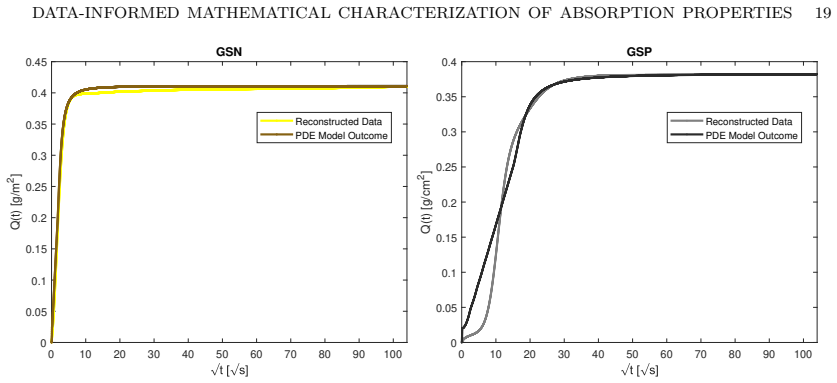
Experimental data from imbibition tests on marble, travertine, wackestone and mortar mock-ups are used to inform and validate the mathematical and simulation frameworks. A monotonicity-preserving fitting procedure is developed to preprocess the measurements, and the imbibition process is simulated through a partial differential equation model with parameters calibrated against rough and smoothed data. The procedure effectively characterizes absorption properties of different materials.
What carries the argument
The monotonicity-preserving fitting procedure that preprocesses noisy absorption measurements while keeping the increasing trend, used to calibrate a PDE model of the imbibition process.
If this is right
- The method allows reliable comparison of absorption properties across natural and artificial porous materials.
- It supports the development of simulation tools for predicting water movement in these materials.
- It serves as a tool for the study and preservation of cultural heritage objects composed of such materials.
Where Pith is reading between the lines
- This method may apply to characterizing absorption in other porous substances like concrete or biological tissues.
- Further validation could involve applying the calibrated models to predict absorption under different environmental conditions not tested in the original experiments.
- Combining this approach with material imaging could enable more detailed spatial analysis of porosity effects.
Load-bearing premise
Smoothing the data with the monotonicity-preserving procedure does not distort the actual physical absorption rates used in the PDE calibration.
What would settle it
New absorption experiments on the same material samples where the PDE predictions from parameters fitted to smoothed data deviate significantly from observations, unlike those from raw data.
Figures



read the original abstract
In this work, we characterize the water absorption properties of selected porous materials through a combined approach that integrates laboratory experiments and mathematical modeling. Specifically, experimental data from imbibition tests on marble, travertine, wackestone and mortar mock-ups are used to inform and validate the mathematical and simulation frameworks. First, a monotonicity-preserving fitting procedure is developed to preprocess the measurements, aiming to reduce noise and mitigate instrumental errors. The imbibition process is then simulated through a partial differential equation model, with parameters calibrated against rough and smoothed data. The proposed procedure appears particularly effective to characterize absorption properties of different materials and it represents a reliable tool for the study and preservation of cultural heritage.
Editorial analysis
A structured set of objections, weighed in public.
Referee Report
Summary. The manuscript develops a pipeline to characterize water absorption in porous materials (marble, travertine, wackestone, mortar) by combining imbibition experiments with a monotonicity-preserving smoother for data preprocessing and a PDE model whose parameters are calibrated to both raw and smoothed curves. The authors conclude that the combined procedure is particularly effective for material characterization and a reliable tool for cultural-heritage studies.
Significance. If the validation gaps are closed, the integration of monotonicity-preserving fitting with PDE calibration could supply a reproducible workflow for non-destructive assessment of porous heritage materials. The explicit use of both rough and smoothed data for calibration is a constructive design choice that, once quantified, would strengthen the claim of reliability.
major comments (2)
- [Abstract] Abstract: the assertion that the procedure 'appears particularly effective' rests on the unverified premise that the monotonicity-preserving smoother leaves the physically relevant absorption rate unchanged; no table or figure compares the resulting PDE permeability/porosity parameters (or their confidence intervals) obtained from raw versus smoothed data.
- [Results / Calibration section] The manuscript supplies no cross-validation metrics, error bars on fitted coefficients, or stability tests with respect to the smoothing parameter; without these the central claim that the pipeline is reliable for heritage applications cannot be assessed quantitatively.
minor comments (2)
- The abstract would be clearer if it stated the number of replicate imbibition tests performed per material and the precise functional form of the PDE (including boundary conditions).
- Notation for the smoothing parameter and the calibrated constants should be introduced consistently in the text and any accompanying equations.
Simulated Author's Rebuttal
We thank the referee for the constructive comments, which highlight important opportunities to strengthen the quantitative support for our claims. We agree that direct comparisons and additional validation metrics are needed to substantiate the reliability of the pipeline for heritage applications. We respond to each major comment below and will incorporate the suggested improvements in the revised manuscript.
read point-by-point responses
-
Referee: [Abstract] Abstract: the assertion that the procedure 'appears particularly effective' rests on the unverified premise that the monotonicity-preserving smoother leaves the physically relevant absorption rate unchanged; no table or figure compares the resulting PDE permeability/porosity parameters (or their confidence intervals) obtained from raw versus smoothed data.
Authors: We acknowledge that the current manuscript does not include an explicit side-by-side comparison of the calibrated PDE parameters obtained from the raw versus smoothed data. In the revised version we will add a dedicated table (and, if space permits, a supplementary figure) reporting the fitted permeability and porosity values together with their confidence intervals for both datasets across all four materials. This addition will directly address whether the monotonicity-preserving smoother preserves the physically relevant absorption characteristics and will allow readers to evaluate any systematic differences introduced by preprocessing. revision: yes
-
Referee: [Results / Calibration section] The manuscript supplies no cross-validation metrics, error bars on fitted coefficients, or stability tests with respect to the smoothing parameter; without these the central claim that the pipeline is reliable for heritage applications cannot be assessed quantitatively.
Authors: We agree that quantitative validation is essential for the reliability claim. In the revision we will add error bars on the fitted coefficients based on the calibration procedure and will include stability tests that vary the smoothing parameter over a plausible range, reporting the resulting variation in the PDE parameters. Full k-fold cross-validation is limited by the small number of experimental replicates per material; we will therefore provide leave-one-out validation results where feasible and, if additional independent measurements become available, compare them against the calibrated model predictions. These changes will supply the quantitative assessment requested. revision: partial
Circularity Check
No significant circularity; derivation remains self-contained against experimental inputs
full rationale
The paper develops a monotonicity-preserving fitting procedure as a preprocessing step to reduce noise in imbibition test data from porous materials, then calibrates a PDE model against both the raw measurements and the smoothed versions. This constitutes a standard data-informed workflow in which the fitting serves as an independent noise-mitigation tool rather than a self-referential definition of the target absorption properties. No step reduces by construction to its own outputs (e.g., no fitted parameter is relabeled as an independent prediction, and no uniqueness theorem or self-citation is invoked to force the modeling choices). The central characterization therefore rests on external laboratory data and remains falsifiable against independent physical measurements, yielding a self-contained derivation chain.
Axiom & Free-Parameter Ledger
free parameters (1)
- permeability and porosity-related constants in the PDE
axioms (1)
- domain assumption The imbibition process can be adequately described by a deterministic PDE with constant material coefficients.
Lean theorems connected to this paper
-
IndisputableMonolith/Cost/FunctionalEquation.leanwashburn_uniqueness_aczel unclear?
unclearRelation between the paper passage and the cited Recognition theorem.
we take B'(s) = max{0, -4D(sR-s)(sS-s)/(sR-sS)^2} ... B(s) piecewise cubic
-
IndisputableMonolith/Foundation/AlphaCoordinateFixation.leanJ_uniquely_calibrated_via_higher_derivative unclear?
unclearRelation between the paper passage and the cited Recognition theorem.
monotonicity-preserving differential reconstruction ... Legendre expansion of wf
What do these tags mean?
- matches
- The paper's claim is directly supported by a theorem in the formal canon.
- supports
- The theorem supports part of the paper's argument, but the paper may add assumptions or extra steps.
- extends
- The paper goes beyond the formal theorem; the theorem is a base layer rather than the whole result.
- uses
- The paper appears to rely on the theorem as machinery.
- contradicts
- The paper's claim conflicts with a theorem or certificate in the canon.
- unclear
- Pith found a possible connection, but the passage is too broad, indirect, or ambiguous to say the theorem truly supports the claim.
Reference graph
Works this paper leans on
-
[1]
A.E. Adams, W.S. Mackenzie, and C. Guilford. Atlas of Sedimentary Rocks Under the Microscope . Routledge, 2017. doi:10.4324/9781315841243. 20 DATA-INFORMED MATHEMATICAL CHARACTERIZATION OF ABSORPTION PROPERTIES 0 50 100 150 200 250 300 350 400 0 0.2 0.4 0.6 0.8 1 1.2Q(t) [g/cm2] Mortar (OT1) Original Data PDE Model Outcome 0 50 100 150 200 250 300 350 400...
-
[2]
R. Askey. The 1839 Paper on Permutations: Its Relation to the Rodrigues Formula and Further Developments. In Simon L. Altmann and Eduardo L. Ortiz, editors, Mathematics and Social Utopias in France: Olinde Rodrigues and His Times , volume 28 of History of Mathematics , pages 105–118. American Mathematical Society, 2005
work page 2005
-
[3]
S. Assouline. A model for soil relative hydraulic conductivity based on the water retention charac- teristic curve. Water Resources Research, 37(2):265–271, 2001. doi:10.1029/2000WR900254
-
[4]
J. Bear. Dynamics of flow in porous media . Dynamics of flow in porous media, 1972
work page 1972
-
[5]
J. Bear and Y. Bachmat. Introduction to Modeling of Transport Phenomena in Porous Media . Springer Netherlands, 1990. doi:10.1007/978-94-009-1926-6
-
[6]
E. Bonetti, C. Cavaterra, R. Natalini, and M. Solci, editors. Mathematical Modeling in Cultural Heritage: MACH2019 . Springer International Publishing, 2021. doi:10.1007/978-3-030-58077-3
-
[7]
M.P. Bracciale, G. Bretti, A. Broggi, M. Ceseri, A. Marrocchi, R. Natalini, and C. Russo. Mathemat- ical modelling of experimental data for crystallization inhibitors. Applied Mathematical Modelling , 48:21–38, 2017. doi:10.1016/j.apm.2016.11.026
-
[8]
E. C. Braun, G. Bretti, and R. Natalini. Parameter estimation techniques for a chemotaxis model inspired by Cancer-on-Chip (COC) experiments. International Journal of Non-Linear Mechanics , 140:103895, 2022. doi:10.1016/j.ijnonlinmec.2021.103895. DATA-INFORMED MATHEMATICAL CHARACTERIZATION OF ABSORPTION PROPERTIES 21
-
[9]
G. Bretti and C. M. Belfiore. Mathematical modelling of the water absorption properties for historical lime-based mortars from Catania (Sicily, Italy). arXiv, 2024. doi:10.48550/arXiv.2411.11129
work page internal anchor Pith review doi:10.48550/arxiv.2411.11129 2024
-
[10]
G. Bretti, C. Cavaterra, M. Solci, and M. Spagnuolo, editors. Mathematical Modeling in Cultural Heritage: MACH2021 . Springer Nature Singapore, 2023. doi:10.1007/978-981-99-3679-3
-
[11]
G. Bretti, M. Ceseri, and R. Natalini. A moving boundary problem for reaction and diffusion pro- cesses in concrete: Carbonation advancement and carbonation shrinkage. Discrete and Continuous Dynamical Systems - S , 15(8):2033–2052, 2022. doi:10.3934/dcdss.2022092
-
[12]
G. Bretti and R. Natalini. Forecasting damage and consolidation: Mathematical models of reacting flows in porous media. In Mathematical Modeling in Cultural Heritage , pages 187–207, Singapore,
-
[13]
Springer Nature Singapore
-
[14]
R.H. Brooks and A.T. Corey. Hydraulic Properties of Porous Media . Colorado State University Hydrology Paper. Colorado State University, 1964
work page 1964
-
[15]
R. H. Byrd, J. C. Gilbert, and J. Nocedal. A trust region method based on interior point techniques for nonlinear programming. Mathematical Programming, 89(1):149–185, Nov 2000. doi:10.1007/ PL00011391
work page 2000
-
[16]
R. H. Byrd, M. E. Hribar, and J. Nocedal. An Interior Point Algorithm for Large-Scale Nonlinear Pro- gramming. SIAM Journal on Optimization , 9(4):877–900, 1999. doi:10.1137/S1052623497325107
-
[17]
A. E. Charola and E. Wendler. Editorial Note. Restoration of Buildings and Monuments , 21(1):v–vi,
-
[18]
doi:10.1515/rbm-2015-0006
-
[19]
Z. Chen, G. Huan, and Y. Ma. Computational Methods for Multiphase Flows in Porous Media . Society for Industrial and Applied Mathematics, 2006. doi:10.1137/1.9780898718942
-
[20]
F. Clarelli, R. Natalini, C. Nitsch, and M. L. Santarelli. A mathematical model for consolidation of building stones. Applied and Industrial Mathematics in Italy III: Selected Contributions from the 9th SIMAI Conference, Rome, Italy , 2008. doi:10.1142/9789814280303_0021
-
[21]
M. A. Cohen and C. O. Tan. A polynomial approximation for arbitrary functions. Applied Mathe- matics Letters, 25(11):1947–1952, 2012. doi:10.1016/j.aml.2012.03.007
-
[22]
J. Crank and P. Nicolson. A practical method for numerical evaluation of solutions of partial differen- tial equations of the heat-conduction type. Advances in Computational Mathematics , 6(1):207–226,
-
[23]
doi:10.1007/bf02127704
-
[24]
E. De Micheli. Legendre Series Analysis and Computation via Composed Abel–Fourier Transform. Symmetry, 15(6), 2023. doi:10.3390/sym15061282
-
[25]
J.R. Dormand and P.J. Prince. A family of embedded Runge-Kutta formulae. Journal of Computa- tional and Applied Mathematics , 6(1):19–26, 1980. doi:10.1016/0771-050X(80)90013-3
-
[26]
C. Fratello, M. Di Fazio, A. Cristina, S. Stefan, F. Andreas, F. Leonelli, and L. Medeghini. Study for the production of a new sustainable additive for restauration mortars. In Abstract Book: The Geoscience Paradigm: Resources, Risks and Future Perspectives, pages 171–171, 2023. doi:10.3301/ ABSGI.2023.02
work page 2023
-
[27]
C. Giavarini, M.L. Santarelli, R. Natalini, and F. Freddi. A non-linear model of sulphation of porous stones: Numerical simulations and preliminary laboratory assessments. Journal of Cultural Heritage, 9(1):14–22, 2008. doi:10.1016/j.culher.2007.12.001
-
[28]
L. Giuliani, C. Genova, V. Stagno, L. Paoletti, A. L. Matulac, A. Ciccola, M. Di Fazio, S. Ca- puani, and G. Favero. Multi-technique assessment of chelators-loaded pva-borax gel-like systems performance in cleaning of stone contaminated with copper corrosion products. Gels, 10(7), 2024. doi:10.3390/gels10070455
-
[29]
E. Hairer, S. P. Nørsett, and G. Wanner. Solving Ordinary Differential Equations I . Springer Berlin Heidelberg, 1987. doi:10.1007/978-3-662-12607-3
-
[30]
T. L. Hohenbrink, C. Jackisch, W. Durner, K. Germer, S. C. Iden, J. Kreiselmeier, F. Leuther, J. C. Metzger, M. Naseri, and A. Peters. Soil water retention and hydraulic conductivity mea- sured in a wide saturation range. Earth System Science Data , 15(10):4417–4432, 2023. doi: 10.5194/essd-15-4417-2023
-
[31]
J. Kennedy and R. Eberhart. Particle swarm optimization. In Proceedings of ICNN’95 - International Conference on Neural Networks, volume 4, pages 1942–1948, 1995. doi:10.1109/ICNN.1995.488968. 22 DATA-INFORMED MATHEMATICAL CHARACTERIZATION OF ABSORPTION PROPERTIES
-
[32]
E. J. Keogh and M. J. Pazzani. Scaling up Dynamic Time Warping for Datamining Applications. In Lecture Notes in Computer Science. In: ˙Zytkow, J.M., Rauch, J. (eds) Principles of Data Mining and Knowledge Discovery PKDD , 1999. doi:10.1007/978-3-540-48247-5_1
-
[33]
K. Malaga-Starzec, U. ˚Akesson, J.E. Lindqvist, and B. Schouenborg. Microscopic and macroscopic characterization of the porosity of marble as a function of temperature and impregnation. Construc- tion and Building Materials , 20(10):939–947, 2006. doi:10.1016/j.conbuildmat.2005.06.016
-
[34]
A. Mancini, F. Frondini, E. Capezzuoli, E. Galvez Mejia, G. Lezzi, D. Matarazzi, A. Brogi, and R. Swennen. Porosity, bulk density and CaCO3 content of travertines. A new dataset from Rapolano, Canino and Tivoli travertines (Italy). Data in Brief , 25:104158, 2019. doi:10.1016/j.dib.2019. 104158
-
[35]
L. Medeghini, L. Calzolari, S. Capriotti, M. Bernabale, C. De Vito, M. Giustini, I. Pettiti, G. Dell’Agli, L. Spiridigliozzi, A. Antonacci, G. Gasperuzzo, V. Scognamiglio, V. Di Tullio, M. Zap- pelli, L. Conti, E. Giovent` u, M. Marcelli, A. Bonaccini, and S. Mignardi. How the materials knowledge of roman mortars could be helpful for the production of fut...
-
[36]
M. N. Mikhail. On the validity and stability of the method of lines for the solution of partial differential equations. Applied Mathematics and Computation , 22(2):89–98, 1987. doi:10.1016/ 0096-3003(87)90038-5
work page 1987
-
[37]
A. Moropoulou, A. Bakolas, and K. Bisbikou. Investigation of the technology of historic mortars. Journal of Cultural Heritage , 1(1):45–58, 2000. doi:10.1016/S1296-2074(99)00118-1
-
[38]
R. Nave. Hyperphysics, 2025. Accessed: 2025-02-10. URL: http://hyperphysics.phy-astr.gsu. edu/hbase/hframe.html
work page 2025
-
[39]
F. Petitjean, A. Ketterlin, and P. Gancarski. A global averaging method for dynamic time warping, with applications to clustering. Pattern Recognition, 44(3):678–693, 2011. doi:10.1016/j.patcog. 2010.09.013
-
[40]
J. O. Ramsay. Estimating Smooth Monotone Functions. Journal of the Royal Statistical Society Series B: Statistical Methodology , 60(2):365–375, 01 2002. doi:10.1111/1467-9868.00130
-
[41]
M. Ruf and H. Steeb. Effects of thermal treatment on acoustic waves in Carrara marble.International Journal of Rock Mechanics and Mining Sciences , 159:105205, 2022. doi:10.1016/j.ijrmms.2022. 105205
-
[42]
A. R. Santos, M. do Ros´ ario Veiga, A. Santos Silva, J. de Brito, and J. I. ´Alvarez. Evolution of the microstructure of lime based mortars and influence on the mechanical behaviour: The role of the aggregates. Construction and Building Materials , 187:907–922, 2018. doi:10.1016/j.conbuildmat. 2018.07.223
-
[43]
L. F. Shampine and M. W. Reichelt. The MATLAB ODE Suite. SIAM Journal on Scientific Com- puting, 18(1):1–22, 1997. doi:10.1137/S1064827594276424
-
[44]
O. V. Shishkina. The Neumann stability of high-order symmetric schemes for convection- diffusion problems. Siberian Mathematical Journal , 48(6):1141–1146, Nov 2007. doi:10.1007/ s11202-007-0115-0
work page 2007
-
[45]
M. Th. van Genuchten. A closed-form equation for predicting the hydraulic conductivity of unsatu- rated soils. Soil Science Society of America Journal , 44(5):892–898, 1980. doi:10.2136/sssaj1980. 03615995004400050002x
-
[46]
R. A. Waltz, J. L. Morales, J. Nocedal, and D. Orban. An interior algorithm for nonlinear optimiza- tion that combines line search and trust region steps. Mathematical Programming, 107(3):391–408,
-
[47]
doi:10.1007/s10107-004-0560-5
-
[48]
D. Wang, D. Tan, and L. Liu. Particle swarm optimization algorithm: an overview. Soft Computing, 22(2):387–408, 2017. doi:10.1007/s00500-016-2474-6
-
[49]
P. Wesseling. von neumann stability conditions for the convection-diffusion eqation. IMA Journal of Numerical Analysis, 16(4):583–598, 10 1996. doi:10.1093/imanum/16.4.583. DATA-INFORMED MATHEMATICAL CHARACTERIZATION OF ABSORPTION PROPERTIES 23
-
[50]
S. Yuan. ODE-ORIENTED SEMI-ANALYTICAL METHODS. In Computational Mechanics in Structural Engineering , pages 375–388. Elsevier Science Ltd, Oxford, 1999. doi:10.1016/ B978-008043008-9/50067-3
work page 1999
-
[51]
A. Zalooli, M. Khamehchiyan, and M. R. Nikudel. The quantification of total and effective porosities in travertines using PIA and saturation-buoyancy methods and the implication for strength and durability. Bulletin of Engineering Geology and the Environment , 77(4):1739–1751, 2018. doi:10. 1007/s10064-017-1072-x
work page 2018
-
[52]
Q. Zeng, K. Li, T. Fen-Chong, and P. Dangla. Effect of porosity on thermal expansion coefficient of cement pastes and mortars. Construction and Building Materials , 28(1):468–475, 2012. doi:10. 1016/j.conbuildmat.2011.09.010
work page 2012
-
[53]
S. Zhang, S. F. Cox, and M. S. Paterson. The influence of room temperature deformation on porosity and permeability in calcite aggregates. Journal of Geophysical Research: Solid Earth , 99(B8):15761– 15775, 1994. doi:10.1029/94JB00647
discussion (0)
Sign in with ORCID, Apple, or X to comment. Anyone can read and Pith papers without signing in.