REVIEW 3 major objections 7 minor 3 cited by
ProSplat: Improved Feed-Forward 3D Gaussian Splatting for Wide-Baseline Sparse Views
T0 review · 3 major / 7 minor · reviewed 2026-08-07 · deepseek-v4-flash
Pith's one-line read ProSplat claims that a two-stage feed-forward pipeline — 3D Gaussian generation followed by a one-step diffusion enhancement — raises wide-baseline sparse-view novel view synthesis by about 1 dB PSNR over prior state of the art, without…
desk verdict ProSplat is a credible empirical SOTA for feed-forward wide-baseline 3DGS, but its two named attention/selection contributions add only ~0.1 dB and the published epipolar formula in Eq. (14) is not the correct fundamental matrix as written. read the letter →
The pith
A machine-rendered reading of the paper's core claim, the machinery that carries it, and where it could break.
The reading
What carries the argument
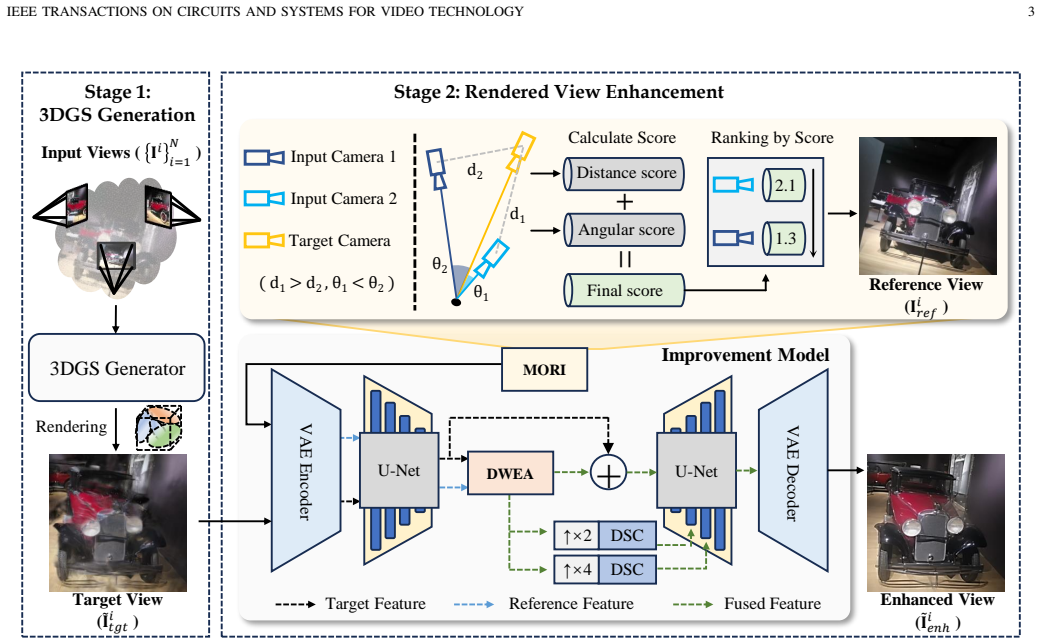
The central object is the improvement model: a one-step diffusion model (SD-Turbo fine-tuned with LoRA following the Pix2Pix-Turbo recipe) that operates on the rendered target image rather than on latent renderings. Two components carry the geometry-aware enhancement: MORI, which scores each input view by a combination of translation distance and viewing-direction cosine similarity and injects the best-matching reference view's features into the U-Net's expansive path; and DWEA, which computes an epipolar line for each target pixel in the reference view and multiplies the global dot-product attention scores by a normalized exponentially decaying distance to that line, then passes them through a sigmoid before weighting the reference value vectors. The resulting fused feature is upsampled with depthwise separable convolutions at 2x and 4x and added into the U-Net decoder. The divide-and-conquer joint training is the third load-bearing piece, aligning the generator's output distribution with the improvement model's input expectations.
What would settle it
Re-run the Table IV ablation on a wide-baseline test set with low reference-view overlap, and measure depth-map consistency between the raw 3DGS render and the enhanced image (e.g., via a pretrained monocular depth network). If removing the denoising step loses less than the reported 0.4 dB PSNR, or if the one-step diffusion systematically changes the depth structure, the central claim that diffusion enhancement is the source of the gain is weakened. Alternatively, extrapolate target views beyond the 360-degree scan coverage and check whether the one-step model introduces hallucinated textures that hurt geometry.
Extended reading notes
Core claim
The central claim is that the bottleneck in wide-baseline feed-forward novel view synthesis is the rendered image fidelity, not the 3D Gaussian geometry, and that a one-step pretrained diffusion model, adapted with LoRA and constrained by epipolar geometry, can restore texture and color while preserving structure. Working directly on rendered pixel-level images rather than latent features lets the model exploit 3DGS's known structure, while MORI's reference-view selection and DWEA's distance-weighted epipolar attention localize the diffusion prior to geometrically plausible regions. The divide-and-conquer training strategy — first training the improvement model alone, then jointly fine-tuning the Gaussian adapter with the VAE encoder — aligns the generator's output distribution to what the enhancer expects. If these results hold, ProSplat establishes that wide-baseline sparse-view synthesis can reach high fidelity in a single forward pass, without per-scene optimization or multi-step denoising.
Load-bearing premise
The advertised gain rests on the assumption that a single-step diffusion model, fine-tuned with LoRA, has enough generative capacity to restore texture and color in severely degraded wide-baseline renderings without corrupting the underlying geometry, and the authors themselves note it may produce flat or over-smoothed textures in views with minimal coverage.
Editorial extensions
If this is right
- Wide-baseline feed-forward novel view synthesis reaches state-of-the-art metrics without per-scene optimization or multi-step denoising, keeping the pipeline a single forward pass.
- Rendered pixel-level images are a better substrate for diffusion-based enhancement than latent features, because the 3DGS structure constrains the diffusion prior and reduces hallucination.
- Epipolar geometry can be injected into latent-space attention cheaply as a distance-based modulation, improving cross-view consistency over plain global attention.
- The divide-and-conquer training recipe (independent enhancement training, then joint fine-tuning of only the generator adapter and VAE encoder) provides a template for coupling feed-forward 3D generators with pretrained 2D diffusion priors.
- On RealEstate10K extrapolation, ProSplat beats all baselines on PSNR, SSIM, and LPIPS but not FID, and the authors argue the lower FID of MVSplat360 comes with hallucinated content, implying perceptual distribution matching is not the same as geometric fidelity.
Reading between the lines
- The same MORI+DWEA enhancement module could be attached to other feed-forward 3DGS generators (the authors test an MVSplat-based generator as a robustness check), so the gain may be partly generator-agnostic rather than specific to DepthSplat.
- A scaling prediction follows: since the benefit hinges on a one-step diffusion prior, improvements in single-step distillation should transfer directly to ProSplat's ceiling, while a plateau in one-step generation would cap the method's gains.
- A natural stress test is to increase the number of input views (e.g., 8–12); if the improvement model still helps, it suggests the bottleneck is per-view rendering fidelity rather than coverage, whereas if gains shrink, DWEA's reference fusion may be underused when overlap is already high.
- Using a distilled video diffusion model for the enhancement stage could impose temporal consistency across adjacent target views, addressing a failure mode the paper acknowledges (flat or over-smoothed textures in minimally covered viewpoints).
Editorial analysis
A structured set of objections, weighed in public.
Referee Report
Summary. The paper proposes ProSplat, a two-stage feed-forward framework for wide-baseline sparse-view novel view synthesis. Stage 1 uses DepthSplat to generate 3D Gaussian primitives and render target views; Stage 2 refines those renderings with a one-step SD-Turbo diffusion model fine-tuned with LoRA, augmented by a Maximum Overlap Reference view Injection (MORI) strategy and a Distance-Weighted Epipolar Attention (DWEA) module. A divide-and-conquer training strategy is used, first training the improvement model independently and then jointly fine-tuning part of the 3DGS generator. On DL3DV-10K (4/5/6 input views) and RealEstate10K (2 input views and an extrapolation setting), the authors report consistent improvements over pixelSplat, MVSplat, MVSplat360, DepthSplat, and NoPoSplat, with the largest gain being about 1.4 dB PSNR over DepthSplat on DL3DV-10K with 6 views. Ablations show that each component contributes to the final result.
Significance. If the reported results hold, ProSplat would be a practical feed-forward alternative for wide-baseline sparse-view rendering, avoiding per-scene optimization while improving both distortion and perceptual metrics. The paper's strengths are its two-dataset evaluation, multiple input-view configurations, held-out test scenes, and component-wise ablations in Table IV. The central empirical claim is credible and does not collapse without the diffusion prior, since removing the denoising process still leaves a 0.97 dB PSNR advantage over DepthSplat. However, the formal derivation of the proposed geometric mechanism is problematic, and the MORI component is under-validated; these issues must be resolved before the paper can be accepted. No code is provided in the manuscript, which further limits verification of the claimed mechanisms.
major comments (3)
- [III-C2, Eqs. (12)-(14)] The fundamental matrix in Eq. (14) is not the epipolar fundamental matrix for pixel coordinates under the usual world-to-camera convention. With x_cam = R X + T, the relative transformation from the target to the reference view is R = R_ref R_tgt^T and t = T_ref - R_ref R_tgt^T T_tgt, giving F = K_ref^{-T} [t]_x R K_tgt^{-1}. Eq. (12) omits the factor R_ref in the translation vector, and Eq. (14) uses K_ref^{-1} instead of K_ref^{-T}. As written, the line F * coord is not guaranteed to contain the corresponding reference pixel, so the attention mechanism is not actually constrained by true epipolar geometry. Since Section I lists DWEA as a contribution that "leverages epipolar geometry," the paper must either provide a correct derivation with an explicit pose convention or state that the implementation uses a corrected formula. This is load-bearing because the DWEA+MORI ablation in Table IV is the only evidence for the claimed geometric mechanism.
- [III-C1, Eq. (10) and Table IV] The MORI overlap score in Eq. (10) uses hand-set weights (1 for inverse distance and 1/2 for the angular similarity) with no sensitivity analysis, and Table IV only ablates MORI and DWEA as a single combined component. The paper should provide an ablation of MORI alone against plausible alternatives (e.g., nearest translation, highest angular similarity, fixed reference view, or averaging over all input views) and vary the score weights. Without such experiments, the claim that MORI is an effective, necessary reference-selection strategy is not established.
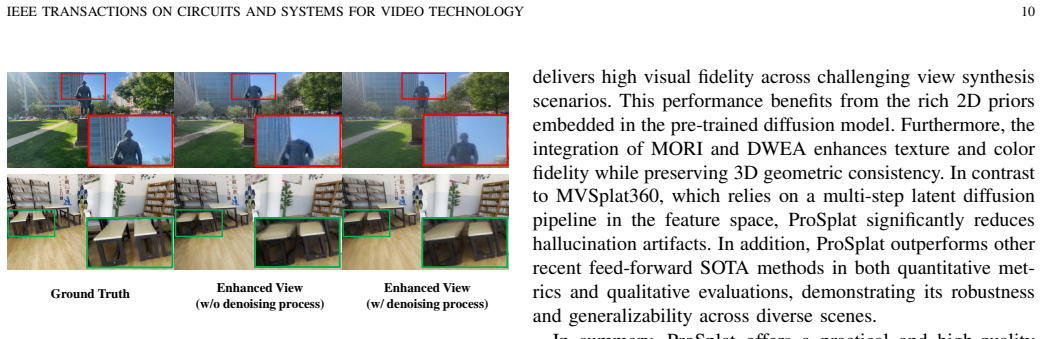
- [IV-D, Table IV] Table IV shows that removing the one-step denoising process leaves PSNR at 18.84 versus 17.87 for DepthSplat, so the headline gain does not collapse without the diffusion prior. However, the diffusion model contributes the largest single component gain, and Section VI acknowledges that it can produce flat or over-smoothed textures in low-coverage views. To strengthen the wide-baseline claim, the paper should report results on splits with even lower view overlap or provide a per-scene breakdown showing that the gains are not concentrated in scenes where the diffusion prior can plausibly hallucinate the missing content.
minor comments (7)
- [III-C1, Eq. (10)] The distance score 1/Dist and the normalized angular score are combined with a sum, but the distance term is not normalized to a fixed range, so the relative weighting depends on the units of the translation vectors; the manuscript should clarify or normalize these terms consistently.
- [III-C2, Eqs. (6)-(7)] The one-step denoising process D(˜z_int, epsilon, t) is not defined, and it is not specified how the timestep t is chosen for a one-step procedure; please give the exact denoising step used in training and inference.
- [III-D and IV-A] The joint-training description is inconsistent: Section III-D states that all components except the VAE encoder are frozen, while Section IV-A says the VAE encoder and decoder are both unfrozen; please correct this discrepancy.
- [IV-C] The sentence "For MVSplat360, we fine-tune the publicly released checkpoint on DL3DV-10K for 100 K steps" appears in the RealEstate10K subsection and appears to describe the DL3DV-10K experiments; it should be relocated or clarified so the fine-tuning protocol for each dataset is unambiguous.
- [Table III] The NoPoSplat entry in Table III is cited as [20], but NoPoSplat is reference [49]; please fix this citation.
- [III-C2 and Fig. 2] The epipolar distance map is computed from pixel coordinates, while DWEA operates on VAE/U-Net latent features at a lower resolution; the paper does not explain how the distance map is aligned or downsampled to the feature grid, so please specify this mapping.
- [IV-A] The paper claims an efficient feed-forward framework but does not report inference time or computational cost; given the one-step diffusion model and the 3DGS rendering, reporting runtime and parameters would support the efficiency claim.
Circularity Check
No significant circularity: the reported results are empirical comparisons on held-out test views with external pretrained components, and no prediction reduces to a fitted parameter or self-citation.
full rationale
ProSplat's claimed derivation chain is an empirical two-stage training and evaluation pipeline, not a formal derivation whose conclusion is encoded in its inputs. The 3DGS generator is the external, pretrained DepthSplat; the improvement model is initialized from the external SD-Turbo and Pix2Pix-Turbo procedures and fine-tuned with LoRA; and the reported PSNR/SSIM/LPIPS gains are measured on held-out target views from DL3DV-10K and RealEstate10K after excluding benchmark scenes from training. The MORI reference-view scores and DWEA attention weights are hand-specified functional forms, not parameters fitted to optimize the final metrics, and the 'prediction' is the network output on unseen test views, not a re-statement of the training objective. The paper contains no load-bearing self-citation: its references to prior feed-forward 3DGS and diffusion works are external and independently published, and the framework is not justified by a uniqueness theorem or by the authors' own prior results. The skeptical observation that Eq. (14) may not correctly express the fundamental matrix for pixel coordinates is a mathematical correctness concern about the claimed mechanism, not evidence that the derivation reduces to its own inputs. Likewise, the limitation that the single-step diffusion model has limited generative capacity is an acknowledged empirical weakness, not a circular step. Under the stated criteria, no specific reduction of a claimed result to an input, fit, or self-citation chain can be exhibited; therefore the appropriate finding is no significant circularity.
Assumptions & free parameters
free parameters (3)
- MORI overlap score weights =
1/Dist + 0.5*(Angle+1)
- Loss weighting lambda =
5
- Joint training hyperparameters =
50,000 steps, lr 1e-5, batch size 1
assumptions (4)
- domain assumption Pretrained DepthSplat checkpoints and SD-Turbo with LoRA provide reliable priors that transfer to wide-baseline rendering.
- domain assumption Camera poses are accurate enough for MORI and DWEA.
- standard math The pinhole camera model with known intrinsics applies to all input and target views.
- ad hoc to paper Epipolar-line distance is a valid geometric consistency signal in latent space.
Cite this review
Pith. "Pith review of ProSplat: Improved Feed-Forward 3D Gaussian Splatting for Wide-Baseline Sparse Views." pith.science (2026). https://pith.science/paper/HG4XGCEE
@misc{pith2026250607670,
  author       = {Pith},
  title        = {Pith review of: ProSplat: Improved Feed-Forward 3D Gaussian Splatting for Wide-Baseline Sparse Views},
  year         = {2026},
  howpublished = {\url{https://pith.science/paper/HG4XGCEE}},
  note         = {Machine review of arXiv:2506.07670}
}
read the original abstract
Feed-forward 3D Gaussian Splatting (3DGS) has recently demonstrated promising results for novel view synthesis (NVS) from sparse input views, particularly under narrow-baseline conditions. However, its performance significantly degrades in wide-baseline scenarios due to limited texture details and geometric inconsistencies across views. To address these challenges, in this paper, we propose ProSplat, a two-stage feed-forward framework designed for high-fidelity rendering under wide-baseline conditions. The first stage involves generating 3D Gaussian primitives via a 3DGS generator. In the second stage, rendered views from these primitives are enhanced through an improvement model. Specifically, this improvement model is based on a one-step diffusion model, further optimized by our proposed Maximum Overlap Reference view Injection (MORI) and Distance-Weighted Epipolar Attention (DWEA). MORI supplements missing texture and color by strategically selecting a reference view with maximum viewpoint overlap, while DWEA enforces geometric consistency using epipolar constraints. Additionally, we introduce a divide-and-conquer training strategy that aligns data distributions between the two stages through joint optimization. We evaluate ProSplat on the RealEstate10K and DL3DV-10K datasets under wide-baseline settings. Experimental results demonstrate that ProSplat achieves an average improvement of 1 dB in PSNR compared to recent SOTA methods.
Figures


Figures from the paper (2 more)

Forward citations
Cited by 3 Pith papers
-
GenSplatCodec: Feed-Forward Gaussian Splatting Compression via One-Step Diffusion
A dual-stream feed-forward 3DGS codec plus geometry-guided one-step diffusion decoding beats cascaded compressors on rate-distortion while keeping multi-view consistency.
-
Latent Riemannian Flow Matching for Geometry-Grounded 3D Foundation Models
Using a product-of-hyperspheres Riemannian flow matching model on VGGT's latent codes, the authors generate plausible depth, point maps, and RGB for target views from one to four unposed context images.
-
Sparse-View 3D Reconstruction: Recent Advances and Open Challenges
A comprehensive survey that organizes sparse-view 3D reconstruction methods into geometry-based, NeRF, 3DGS, and diffusion-based categories, with benchmarks and open challenges.
Reference graph
Works this paper leans on
-
[1]
Dynamic view synthesis from dynamic monocular video,
C. Gao, A. Saraf, J. Kopf, and J.-B. Huang, “Dynamic view synthesis from dynamic monocular video,” in Proceedings of the IEEE/CVF International Conference on Computer Vision , 2021, pp. 5712–5721
work page 2021
-
[2]
Matryod- shka: Real-time 6dof video view synthesis using multi-sphere images,
B. Attal, S. Ling, A. Gokaslan, C. Richardt, and J. Tompkin, “Matryod- shka: Real-time 6dof video view synthesis using multi-sphere images,” in European Conference on Computer Vision. Springer, 2020, pp. 441– 459
work page 2020
-
[3]
Rendering Anywhere You See: Renderability Field-guided Gaussian Splatting
X. Jin, Y . Fang, M. Frosi, J. Ge, J. Xiao, and M. Matteucci, “Rendering anywhere you see: Renderability field-guided gaussian splatting,” arXiv preprint arXiv:2504.19261, 2025
work page Pith review arXiv 2025
-
[4]
Nerf: Representing scenes as neural radiance fields for view synthesis,
B. Mildenhall, P. P. Srinivasan, M. Tancik, J. T. Barron, R. Ramamoorthi, and R. Ng, “Nerf: Representing scenes as neural radiance fields for view synthesis,” Communications of the ACM , vol. 65, no. 1, pp. 99–106, 2021
2021
-
[5]
Instant neural graphics primitives with a multiresolution hash encoding,
T. M ¨uller, A. Evans, C. Schied, and A. Keller, “Instant neural graphics primitives with a multiresolution hash encoding,” ACM Transactions on Graphics (TOG), vol. 41, no. 4, pp. 1–15, 2022
2022
-
[6]
Plenoxels: Radiance fields without neural networks,
S. Fridovich-Keil, A. Yu, M. Tancik, Q. Chen, B. Recht, and A. Kanazawa, “Plenoxels: Radiance fields without neural networks,” in Proceedings of the IEEE/CVF Conference on Computer Vision and Pattern Recognition, 2022, pp. 5501–5510
2022
-
[7]
3d gaussian splatting for real-time radiance field rendering
B. Kerbl, G. Kopanas, T. Leimk ¨uhler, and G. Drettakis, “3d gaussian splatting for real-time radiance field rendering.” ACM Transactions on Graphics (TOG), vol. 42, no. 4, pp. 139–1, 2023
work page 2023
-
[8]
Neural point catacaustics for novel-view synthesis of reflections,
G. Kopanas, T. Leimk ¨uhler, G. Rainer, C. Jambon, and G. Drettakis, “Neural point catacaustics for novel-view synthesis of reflections,” ACM Transactions on Graphics (TOG) , vol. 41, no. 6, pp. 1–15, 2022
work page 2022
Show all 64 references
-
[9]
pixelsplat: 3d gaussian splats from image pairs for scalable generalizable 3d recon- struction,
D. Charatan, S. L. Li, A. Tagliasacchi, and V . Sitzmann, “pixelsplat: 3d gaussian splats from image pairs for scalable generalizable 3d recon- struction,” in Proceedings of the IEEE/CVF Conference on Computer Vision and Pattern Recognition , 2024, pp. 19 457–19 467
2024
-
[10]
Mvsplat: Efficient 3d gaussian splatting from sparse multi-view images,
Y . Chen, H. Xu, C. Zheng, B. Zhuang, M. Pollefeys, A. Geiger, T.- J. Cham, and J. Cai, “Mvsplat: Efficient 3d gaussian splatting from sparse multi-view images,” inEuropean Conference on Computer Vision. Springer, 2024, pp. 370–386. IEEE TRANSACTIONS ON CIRCUITS AND SYSTEMS FO...
2024
-
[11]
Depthsplat: Connecting gaussian splatting and depth,
H. Xu, S. Peng, F. Wang, H. Blum, D. Barath, A. Geiger, and M. Pollefeys, “Depthsplat: Connecting gaussian splatting and depth,” in Proceedings of the IEEE/CVF Conference on Computer Vision and Pattern Recognition, 2025
2025
-
[12]
Gaussian graph network: Learning efficient and generalizable gaussian representations from multi-view images,
S. Zhang, X. Fei, F. Liu, H. Song, and Y . Duan, “Gaussian graph network: Learning efficient and generalizable gaussian representations from multi-view images,” Advances in Neural Information Processing Systems, vol. 37, pp. 50 361–50 380, 2024
2024
-
[13]
pixelnerf: Neural radiance fields from one or few images,
A. Yu, V . Ye, M. Tancik, and A. Kanazawa, “pixelnerf: Neural radiance fields from one or few images,” in Proceedings of the IEEE/CVF Conference on Computer Vision and Pattern Recognition , 2021, pp. 4578–4587
2021
-
[14]
Viewcrafter: Taming video diffusion models for high-fidelity novel view synthesis,
W. Yu, J. Xing, L. Yuan, W. Hu, X. Li, Z. Huang, X. Gao, T.-T. Wong, Y . Shan, and Y . Tian, “Viewcrafter: Taming video diffusion models for high-fidelity novel view synthesis,” arXiv preprint arXiv:2409.02048 , 2024
2024 arXiv
-
[15]
3dgs-enhancer: Enhancing unbounded 3d gaussian splatting with view-consistent 2d diffusion priors,
X. Liu, C. Zhou, and S. Huang, “3dgs-enhancer: Enhancing unbounded 3d gaussian splatting with view-consistent 2d diffusion priors,”Advances in Neural Information Processing Systems, vol. 37, pp. 133 305–133 327, 2024
2024
-
[16]
Difix3d+: Improving 3d reconstructions with single-step diffusion models,
J. Z. Wu, Y . Zhang, H. Turki, X. Ren, J. Gao, M. Z. Shou, S. Fidler, Z. Gojcic, and H. Ling, “Difix3d+: Improving 3d reconstructions with single-step diffusion models,” in Proceedings of the IEEE/CVF Confer- ence on Computer Vision and Pattern Recognition , 2025
2025
-
[17]
Stable video diffusion: Scaling latent video diffusion models to large datasets,
A. Blattmann, T. Dockhorn, S. Kulal, D. Mendelevitch, M. Kilian, D. Lorenz, Y . Levi, Z. English, V . V oleti, A. Lettset al., “Stable video diffusion: Scaling latent video diffusion models to large datasets,” arXiv preprint arXiv:2311.15127, 2023
2023 arXiv
-
[18]
Dynamicrafter: Animating open-domain im- ages with video diffusion priors,
J. Xing, M. Xia, Y . Zhang, H. Chen, W. Yu, H. Liu, G. Liu, X. Wang, Y . Shan, and T.-T. Wong, “Dynamicrafter: Animating open-domain im- ages with video diffusion priors,” in European Conference on Computer Vision. Springer, 2024, pp. 399–417
2024
-
[19]
High- resolution image synthesis with latent diffusion models,
R. Rombach, A. Blattmann, D. Lorenz, P. Esser, and B. Ommer, “High- resolution image synthesis with latent diffusion models,” in Proceedings of the IEEE/CVF Conference on Computer Vision and Pattern Recogni- tion, 2022, pp. 10 684–10 695
2022
-
[20]
Mvsplat360: Feed-forward 360 scene synthesis from sparse views,
Y . Chen, C. Zheng, H. Xu, B. Zhuang, A. Vedaldi, T.-J. Cham, and J. Cai, “Mvsplat360: Feed-forward 360 scene synthesis from sparse views,” in Advances in Neural Information Processing Systems (NeurIPS) , 2024
2024
-
[21]
One- step image translation with text-to-image models,
G. Parmar, T. Park, S. Narasimhan, and J.-Y . Zhu, “One- step image translation with text-to-image models,” arXiv preprint arXiv:2403.12036, 2024
2024 arXiv
-
[22]
One-step diffusion with distribution matching distillation,
T. Yin, M. Gharbi, R. Zhang, E. Shechtman, F. Durand, W. T. Freeman, and T. Park, “One-step diffusion with distribution matching distillation,” in Proceedings of the IEEE/CVF Conference on Computer Vision and Pattern Recognition, 2024, pp. 6613–6623
2024
-
[23]
Adversarial diffusion distillation,
A. Sauer, D. Lorenz, A. Blattmann, and R. Rombach, “Adversarial diffusion distillation,” in European Conference on Computer Vision . Springer, 2024, pp. 87–103
2024
-
[24]
Lora: Low-rank adaptation of large language models
E. J. Hu, Y . Shen, P. Wallis, Z. Allen-Zhu, Y . Li, S. Wang, L. Wang, W. Chen et al., “Lora: Low-rank adaptation of large language models.” ICLR, vol. 1, no. 2, p. 3, 2022
2022
-
[25]
Auto-encoding variational bayes,
D. P. Kingma, M. Welling et al. , “Auto-encoding variational bayes,” 2013
2013
-
[26]
U-net: Convolutional networks for biomedical image segmentation,
O. Ronneberger, P. Fischer, and T. Brox, “U-net: Convolutional networks for biomedical image segmentation,” in Medical image computing and computer-assisted intervention–MICCAI 2015: 18th international con- ference, Munich, Germany, October 5-9, 2015, proceedings, part III 18 ...
2015
-
[27]
Dl3dv-10k: A large-scale scene dataset for deep learning-based 3d vision,
L. Ling, Y . Sheng, Z. Tu, W. Zhao, C. Xin, K. Wan, L. Yu, Q. Guo, Z. Yu, Y . Lu et al. , “Dl3dv-10k: A large-scale scene dataset for deep learning-based 3d vision,” in Proceedings of the IEEE/CVF Conference on Computer Vision and Pattern Recognition , 2024, pp. 22 160–22 169
2024
-
[28]
Stereo magnification: Learning view synthesis using multiplane images,
T. Zhou, R. Tucker, J. Flynn, G. Fyffe, and N. Snavely, “Stereo magnification: Learning view synthesis using multiplane images,” in SIGGRAPH, 2018
2018
-
[29]
Image quality assessment: from error visibility to structural similarity,
Z. Wang, A. C. Bovik, H. R. Sheikh, and E. P. Simoncelli, “Image quality assessment: from error visibility to structural similarity,” IEEE transactions on image processing , vol. 13, no. 4, pp. 600–612, 2004
2004
-
[30]
The unreasonable effectiveness of deep features as a perceptual metric,
R. Zhang, P. Isola, A. A. Efros, E. Shechtman, and O. Wang, “The unreasonable effectiveness of deep features as a perceptual metric,” in Proceedings of the IEEE/CVF Conference on Computer Vision and Pattern Recognition, 2018, pp. 586–595
2018
-
[31]
Xception: Deep learning with depthwise separable convolu- tions,
F. Chollet, “Xception: Deep learning with depthwise separable convolu- tions,” in Proceedings of the IEEE/CVF Conference on Computer Vision and Pattern Recognition, 2017, pp. 1251–1258
2017
-
[32]
View interpolation for image synthesis,
S. E. Chen and L. Williams, “View interpolation for image synthesis,” in Seminal Graphics Papers: Pushing the Boundaries, Volume 2 , 2023, pp. 423–432
2023
-
[33]
The lumigraph,
S. J. Gortler, R. Grzeszczuk, R. Szeliski, and M. F. Cohen, “The lumigraph,” in Seminal Graphics Papers: Pushing the Boundaries, Volume 2, 2023, pp. 453–464
2023
-
[34]
Deepstereo: Learning to predict new views from the world’s imagery,
J. Flynn, I. Neulander, J. Philbin, and N. Snavely, “Deepstereo: Learning to predict new views from the world’s imagery,” in Proceedings of the IEEE/CVF Conference on Computer Vision and Pattern Recognition , 2016, pp. 5515–5524
2016
-
[35]
Learning-based view synthesis for light field cameras,
N. K. Kalantari, T.-C. Wang, and R. Ramamoorthi, “Learning-based view synthesis for light field cameras,” ACM Transactions on Graphics (TOG), vol. 35, no. 6, Dec. 2016
2016
-
[36]
Dust3r: Geometric 3d vision made easy,
S. Wang, V . Leroy, Y . Cabon, B. Chidlovskii, and J. Revaud, “Dust3r: Geometric 3d vision made easy,” in Proceedings of the IEEE/CVF Conference on Computer Vision and Pattern Recognition , 2024, pp. 20 697–20 709
2024
-
[37]
Regnerf: Regularizing neural radiance fields for view synthesis from sparse inputs,
M. Niemeyer, J. T. Barron, B. Mildenhall, M. S. Sajjadi, A. Geiger, and N. Radwan, “Regnerf: Regularizing neural radiance fields for view synthesis from sparse inputs,” in Proceedings of the IEEE/CVF Conference on Computer Vision and Pattern Recognition , 2022, pp. 5480–5490
2022
-
[38]
Simplenerf: Regu- larizing sparse input neural radiance fields with simpler solutions,
N. Somraj, A. Karanayil, and R. Soundararajan, “Simplenerf: Regu- larizing sparse input neural radiance fields with simpler solutions,” in SIGGRAPH Asia 2023 Conference Papers , 2023, pp. 1–11
2023
-
[39]
Depth-supervised nerf: Fewer views and faster training for free,
K. Deng, A. Liu, J.-Y . Zhu, and D. Ramanan, “Depth-supervised nerf: Fewer views and faster training for free,” in Proceedings of the IEEE/CVF Conference on Computer Vision and Pattern Recognition , 2022, pp. 12 882–12 891
2022
-
[40]
Fsgs: Real-time few-shot view synthesis using gaussian splatting,
Z. Zhu, Z. Fan, Y . Jiang, and Z. Wang, “Fsgs: Real-time few-shot view synthesis using gaussian splatting,” in European conference on computer vision. Springer, 2024, pp. 145–163
2024
-
[41]
Monosdf: Exploring monocular geometric cues for neural implicit surface recon- struction,
Z. Yu, S. Peng, M. Niemeyer, T. Sattler, and A. Geiger, “Monosdf: Exploring monocular geometric cues for neural implicit surface recon- struction,” Advances in neural information processing systems , vol. 35, pp. 25 018–25 032, 2022
2022
-
[42]
Dropgaussian: Structural regularization for sparse-view gaussian splatting,
H. Park, G. Ryu, and W. Kim, “Dropgaussian: Structural regularization for sparse-view gaussian splatting,” arXiv preprint arXiv:2504.00773 , 2025
2025 arXiv
-
[43]
Novel view synthesis under large-deviation viewpoint for autonomous driving,
X. Ma, J. Zhang, P. Lu, S. Xu, and C. Pan, “Novel view synthesis under large-deviation viewpoint for autonomous driving,” in Proceedings of the AAAI Conference on Artificial Intelligence , vol. 39, no. 6, 2025, pp. 6000–6008
2025
-
[44]
Gs-lrm: Large reconstruction model for 3d gaussian splatting,
K. Zhang, S. Bi, H. Tan, Y . Xiangli, N. Zhao, K. Sunkavalli, and Z. Xu, “Gs-lrm: Large reconstruction model for 3d gaussian splatting,” in European Conference on Computer Vision. Springer, 2024, pp. 1–19
2024
-
[45]
Lgm: Large multi-view gaussian model for high-resolution 3d content creation,
J. Tang, Z. Chen, X. Chen, T. Wang, G. Zeng, and Z. Liu, “Lgm: Large multi-view gaussian model for high-resolution 3d content creation,” in European Conference on Computer Vision . Springer, 2024, pp. 1–18
2024
-
[46]
Splatter image: Ultra- fast single-view 3d reconstruction,
S. Szymanowicz, C. Rupprecht, and A. Vedaldi, “Splatter image: Ultra- fast single-view 3d reconstruction,” in Proceedings of the IEEE/CVF Conference on Computer Vision and Pattern Recognition , 2024, pp. 10 208–10 217
2024
-
[47]
Gps-gaussian: Generalizable pixel-wise 3d gaussian splatting for real- time human novel view synthesis,
S. Zheng, B. Zhou, R. Shao, B. Liu, S. Zhang, L. Nie, and Y . Liu, “Gps-gaussian: Generalizable pixel-wise 3d gaussian splatting for real- time human novel view synthesis,” in Proceedings of the IEEE/CVF Conference on Computer Vision and Pattern Recognition , 2024, pp. 19 680–19 690
2024
-
[48]
Gps-gaussian+: Generalizable pixel-wise 3d gaussian splatting for real- time human-scene rendering from sparse views,
B. Zhou, S. Zheng, H. Tu, R. Shao, B. Liu, S. Zhang, L. Nie, and Y . Liu, “Gps-gaussian+: Generalizable pixel-wise 3d gaussian splatting for real- time human-scene rendering from sparse views,” IEEE Transactions on Pattern Analysis and Machine Intelligence , 2025
2025
-
[49]
No pose, no problem: Surprisingly simple 3d gaussian splats from sparse unposed images,
B. Ye, S. Liu, H. Xu, X. Li, M. Pollefeys, M.-H. Yang, and S. Peng, “No pose, no problem: Surprisingly simple 3d gaussian splats from sparse unposed images,” arXiv preprint arXiv:2410.24207 , 2024
2024 arXiv
-
[50]
latentsplat: Autoencoding variational gaussians for fast generalizable 3d reconstruc- tion,
C. Wewer, K. Raj, E. Ilg, B. Schiele, and J. E. Lenssen, “latentsplat: Autoencoding variational gaussians for fast generalizable 3d reconstruc- tion,” in European Conference on Computer Vision . Springer, 2024, pp. 456–473
2024
-
[51]
Zero-1-to-3: Zero-shot one image to 3d object,
R. Liu, R. Wu, B. Van Hoorick, P. Tokmakov, S. Zakharov, and C. V on- drick, “Zero-1-to-3: Zero-shot one image to 3d object,” in Proceedings of the IEEE/CVF International Conference on Computer Vision , 2023, pp. 9298–9309
2023
-
[52]
Zero123++: a single image to consistent multi-view diffusion base model,
R. Shi, H. Chen, Z. Zhang, M. Liu, C. Xu, X. Wei, L. Chen, C. Zeng, and H. Su, “Zero123++: a single image to consistent multi-view diffusion base model,” arXiv preprint arXiv:2310.15110 , 2023. IEEE TRANSACTIONS ON CIRCUITS AND SYSTEMS FOR VIDEO TECHNOLOGY 12
2023 arXiv
-
[53]
Mvdream: Multi- view diffusion for 3d generation,
Y . Shi, P. Wang, J. Ye, M. Long, K. Li, and X. Yang, “Mvdream: Multi- view diffusion for 3d generation,” arXiv preprint arXiv:2308.16512 , 2023
2023 arXiv
-
[54]
Epidiff: Enhancing multi-view synthesis via localized epipolar-constrained diffusion,
Z. Huang, H. Wen, J. Dong, Y . Wang, Y . Li, X. Chen, Y .-P. Cao, D. Liang, Y . Qiao, B. Dai et al. , “Epidiff: Enhancing multi-view synthesis via localized epipolar-constrained diffusion,” in Proceedings of the IEEE/CVF Conference on Computer Vision and Pattern Recognition, 2...
2024
-
[55]
Sparsefusion: Distilling view-conditioned diffusion for 3d reconstruction,
Z. Zhou and S. Tulsiani, “Sparsefusion: Distilling view-conditioned diffusion for 3d reconstruction,” in Proceedings of the IEEE/CVF Conference on Computer Vision and Pattern Recognition , 2023, pp. 12 588–12 597
2023
-
[56]
Genfusion: Closing the loop between reconstruction and generation via videos,
S. Wu, C. Xu, B. Huang, A. Geiger, and A. Chen, “Genfusion: Closing the loop between reconstruction and generation via videos,” arXiv preprint arXiv:2503.21219, 2025
2025 arXiv
-
[57]
Nerfdiff: Single-image view synthesis with nerf- guided distillation from 3d-aware diffusion,
J. Gu, A. Trevithick, K.-E. Lin, J. M. Susskind, C. Theobalt, L. Liu, and R. Ramamoorthi, “Nerfdiff: Single-image view synthesis with nerf- guided distillation from 3d-aware diffusion,” inInternational Conference on Machine Learning . PMLR, 2023, pp. 11 808–11 826
2023
-
[58]
Generative novel view synthesis with 3d-aware diffusion models,
E. R. Chan, K. Nagano, M. A. Chan, A. W. Bergman, J. J. Park, A. Levy, M. Aittala, S. De Mello, T. Karras, and G. Wetzstein, “Generative novel view synthesis with 3d-aware diffusion models,” in Proceedings of the IEEE/CVF International Conference on Computer Vision , 2023, pp....
2023
-
[59]
Surface splatting,
M. Zwicker, H. Pfister, J. Van Baar, and M. Gross, “Surface splatting,” in Proceedings of the 28th annual conference on Computer graphics and interactive techniques , 2001, pp. 371–378
2001
-
[60]
Swin transformer: Hierarchical vision transformer using shifted windows,
Z. Liu, Y . Lin, Y . Cao, H. Hu, Y . Wei, Z. Zhang, S. Lin, and B. Guo, “Swin transformer: Hierarchical vision transformer using shifted windows,” in Proceedings of the IEEE/CVF International Conference on Computer Vision, 2021, pp. 10 012–10 022
2021
-
[61]
Attention is all you need,
A. Vaswani, N. Shazeer, N. Parmar, J. Uszkoreit, L. Jones, A. N. Gomez, Ł. Kaiser, and I. Polosukhin, “Attention is all you need,” Advances in neural information processing systems , vol. 30, 2017
2017
-
[62]
Pytorch: An imperative style, high-performance deep learn- ing library,
A. Paszke, “Pytorch: An imperative style, high-performance deep learn- ing library,” arXiv preprint arXiv:1912.01703 , 2019
1912 arXiv
-
[63]
Roma: Robust dense feature matching,
J. Edstedt, Q. Sun, G. B ¨okman, M. Wadenb¨ack, and M. Felsberg, “Roma: Robust dense feature matching,” in Proceedings of the IEEE/CVF Conference on Computer Vision and Pattern Recognition , 2024, pp. 19 790–19 800
2024
-
[64]
Gans trained by a two time-scale update rule converge to a local nash equilibrium,
M. Heusel, H. Ramsauer, T. Unterthiner, B. Nessler, and S. Hochreiter, “Gans trained by a two time-scale update rule converge to a local nash equilibrium,” Advances in neural information processing systems , vol. 30, 2017
2017
Reviewed August 7, 2026 · model on record in the stance chip above.
Discussion (0). Sign in to comment.