REVIEW 4 major objections 8 minor 51 references
Phase estimation via delocalized photon subtraction operation inside the SU(1,1) interferometer
T0 review · 4 major / 8 minor · reviewed 2026-08-07 · deepseek-v4-flash
Pith's one-line read The paper claims that a delocalized photon subtraction operation inside an SU(1,1) interferometer, applied between the two amplifiers to a coherent-vacuum input, gives phase sensitivities that beat both localized single-mode versions, get…
desk verdict The ideal-case analysis of D-PSO in an SU(1,1) interferometer looks solid and reasonably novel, but the lossy QFI section mixes two incompatible loss models, so the robustness claim is not yet supported. read the letter →
The pith
A machine-rendered reading of the paper's core claim, the machinery that carries it, and where it could break.
The reading
What carries the argument
The central object is the delocalized photon subtraction operation $(s a + t b)^m$ inserted behind the first OPA, with real weights $s$ and $t$ normalized by $s+t=1$; $s=1$ gives subtraction from mode $a$ only, $t=1$ from mode $b$ only, and intermediate $s$ gives delocalized subtraction. The calculation is carried by a generating function $Q_{m,x_1,y_1,x_2,y_2}$ that turns all needed expectation values of normally ordered products into derivatives of one exponential, giving closed-form expressions for phase sensitivity, total photon number, and quantum Fisher information. In the lossy case the authors use the minimized-Kraus bound, which reduces to a formula in the mean and variance of the photon number in mode $a$. The operation's tunable superposition of mode $a$ and mode $b$ subtraction is what lets it inherit the best behavior of both localized operations.
What would settle it
Compute the lossy quantum Fisher information with the same two-mode fictitious beam-splitter loss used in the phase-sensitivity calculation, placing the loss both before and after the phase shift; if the D-PSO advantage over L-PSO disappears in either placement, the paper's robustness claim is not universal.
Extended reading notes
Core claim
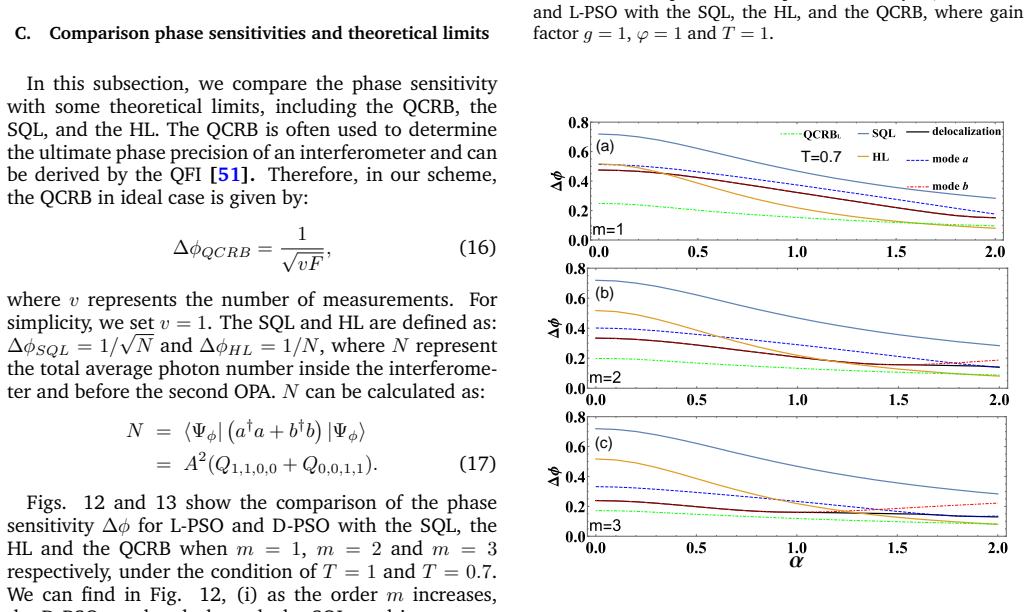
The central claim is that applying $(s a + t b)^m$ between the two optical parametric amplifiers of an SU(1,1) interferometer beats doing the same photon subtraction on only one mode. The paper derives the output state exactly through a generating-function method, computes phase sensitivity from error propagation on the total photon number, and computes the quantum Fisher information directly for the ideal case and via a minimized Kraus bound under photon loss. Its main findings are that D-PSO's optimal working range in phase shift, coherent amplitude, gain, and transmissivity encompasses the optimal ranges of both mode-a-only and mode-b-only subtraction; that its quantum Fisher information is larger than either localized operation in a broad parameter region; and that as the order $m$ increases its sensitivity comes closer to the quantum Cramér-Rao bound while still beating the standard quantum limit and, in part of parameter space, the Heisenberg limit.
Load-bearing premise
The loss-robustness conclusion relies on assuming that the single-mode loss parameter in the Fisher-information calculation describes the same physical loss as the two-mode transmissivity in the phase-sensitivity calculation, with the loss position fixed; the paper does not state this link.
Editorial extensions
If this is right
- A standard SU(1,1) interferometer with coherent and vacuum inputs can reach sub-SQL, and in some regions sub-Heisenberg-limit, phase sensitivity by adding an $m$-th-order delocalized photon subtraction before the phase shift.
- Choosing the delocalization weight $s$ optimally makes the interferometer avoid the need to choose which single mode to subtract from, because the D-PSO optimal phase-shift, amplitude, gain, and transmissivity ranges cover both localized operations.
- As the order $m$ grows, the intensity-detection phase sensitivity moves closer to the quantum Cramér-Rao bound, so higher-order D-PSO is a practical way to close the gap to the ultimate precision limit.
- Under photon loss, D-PSO keeps a phase-sensitivity advantage over both localized operations across the transmissivity range, meaning the precision gain is not bought at the cost of fragility.
- The quantum Fisher information advantage of D-PSO over L-PSO widens with order, loss parameter, and coherent amplitude, which identifies favorable operating conditions for the scheme.
Reading between the lines
- Beyond the paper, the same tunable-weight construction could be applied to other non-Gaussian operations, such as photon addition or photon catalysis inside SU(1,1), where a delocalized superposition might again combine the strengths of the two modes; the paper does not explore these variants.
- The underlying mechanism suggested by the results is that D-PSO acts as a coherent superposition of two channel operations, so it should generate controllable two-mode correlations after the first amplifier; a direct measurement of entanglement or discord versus the weight $s$ would test this picture.
- A testable experimental prediction is that the optimal phase sensitivity occurs at an interior value of $s$, not at $s=0$ or $s=1$, for fixed coherent amplitude, gain, order, and loss; scanning $s$ would confirm that delocalization itself, rather than simply more photon subtraction, is responsible for the improvement.
Editorial analysis
A structured set of objections, weighed in public.
Referee Report
Summary. The manuscript proposes inserting a delocalized photon-subtraction operation (D-PSO), written as (s a + t b)^m with s+t=1, between the two OPAs of an SU(1,1) interferometer whose inputs are a coherent state and vacuum. Using error propagation on the photon-number-sum measurement, it derives the phase sensitivity and separately computes the quantum Fisher information with a generating-function technique in Appendix A. The paper compares D-PSO with the two localized subtraction operations (on mode a only or mode b only) in ideal and lossy conditions, and benchmarks the results against the SQL, HL, and QCRB. The central claims are that D-PSO improves phase sensitivity and QFI relative to L-PSO and is more robust against internal photon loss.
Significance. If the claims hold, the paper offers a compact non-Gaussian operation that improves SU(1,1)-interferometer phase estimation and systematically clarifies the difference between delocalized and localized subtraction. The main strengths are the explicit analytic expressions in Appendix A, the direct error-propagation and QFI calculations, and the comparison against external bounds rather than fitted parameters; the optimized coefficient t is a control parameter, not a fit to a target sensitivity. However, the lossy-QFI section is internally inconsistent and disconnected from the loss model used for phase sensitivity, so the robustness claim in the abstract and conclusion is not currently established. Because the issue is localizable and fixable, the paper is a viable candidate for publication after a major revision.
major comments (4)
- [§IV B, Eq. (13) and text after Eq. (12)] The sentence stating that η=1 and η=0 represent the situations of complete lossy and absorption is contradicted by Eq. (13), which gives F_L=4⟨Δn²⟩ at η=1 (the ideal pure-state QFI value) and F_L=0 at η=0, and by Figs. 9–11, where F_L increases with η. This suggests η is meant to be the transmission efficiency, not the loss probability; the text and notation must be corrected, and the relation of η to the transmissivity T used elsewhere must be stated.
- [§II and §IV B] The phase-sensitivity calculation in Sec. II models loss by two fictitious beam splitters with transmissivity T placed after the D-PSO and before the phase shift, and Figs. 5, 12 and 13 use this T. The lossy QFI in Sec. IV B, by contrast, uses a single-mode parameter η and explicitly considers loss only in mode a. No relation such as η=T is stated, and no justification is given for ignoring loss in mode b for the QFI. Therefore the claimed ability to resist internal photon loss is not supported by the manuscript as written; the authors should either state and justify the mapping or recompute F_L under the same two-mode loss model.
- [§IV B, Eq. (12)] The parameter λ in the Kraus operator is left unspecified in the reported F_L; the text says λ=0 and λ=−1 correspond to loss before and after the phase shift, but Eq. (13) and Figs. 9–11 do not state which value is used. If F_L depends on λ, the QFI values and hence the QCRB used in Fig. 13 are ambiguous; the authors must fix λ or minimize over it.
- [§IV C, Fig. 13] Fig. 13 compares the phase sensitivity computed at T=0.7 with a QCRB derived from F_L, but the value of η used for the QCRB is not stated. Figs. 10 and 11 also use 'T=0.7' in the captions although Eq. (13) is expressed in terms of η. If η is intended to equal T, that identification must be explicit; otherwise the comparison mixes two unrelated loss models and the claim that D-PSO approaches the QCRB under loss is not meaningful.
minor comments (8)
- [§III, after Fig. 5] The sentence 'It is found from Fig. 4 as follows' appears in the paragraph discussing the T-dependence and should refer to Fig. 5.
- [throughout] The notation for the phase is inconsistent: equations and the text use ϕ, while most figure captions and some textual passages use φ; please unify the symbol.
- [Figs. 10 and 11] The captions state T=0.7, but the plotted quantity F_L is defined by Eq. (13) in terms of η; the value of η used (presumably η=0.7) should be stated explicitly.
- [Figs. 2–13] The value of the delocalization coefficient t is not reported for the plotted curves; for reproducibility, state whether t is optimized pointwise or fixed for each figure.
- [Eq. (2) and Appendix A] The quantity Q_{m,x1,y1,x2,y2} is used in Eq. (2) but defined only in Appendix A; a brief forward reference or a one-line definition in Sec. II would improve readability.
- [throughout] There are several typographical errors, including 'gardually' for 'gradually', 'equivals' for 'equivalent', and 'differerence' for 'difference'.
- [References] The reference formatting is inconsistent, e.g., 'Phys. Rev, A', 'Phys. Rev. L.', and some entries with incomplete author lists; please standardize the bibliography style.
- [Abstract and Conclusion] The phrase that D-PSO can 'cover and even exceed the advantages of the L-PSO on two modes' is stronger than the parameter-dependent numerical evidence; it should be qualified with the ranges of φ, α, g, m, and T for which the comparison holds.
Circularity Check
No significant circularity: the central phase-sensitivity and QFI results are direct evaluations of standard error-propagation and quantum-Fisher-information definitions, with external benchmarks; the flagged loss-model mismatch is a consistency concern, not a circular derivation.
full rationale
The paper's central derivation is self-contained. The phase sensitivity in Eq. (3) is the standard error-propagation formula, and the QFI in Eqs. (4)-(7) uses the standard pure-state definition; all expectation values are computed by direct operator calculus from the model state in Eq. (1) via the generating-function method in Appendix A. The comparison benchmarks (SQL, HL, QCRB) are external standards, and the parameter t is a control parameter of the proposed D-PSO operation, not a parameter fitted to a target sensitivity. The lossy-QFI formula Eq. (13) is taken from Escher et al. (Ref. [50]), an external established result, so it provides independent support rather than relying on a self-citation. One minor caveat is that D-PSO contains the two L-PSO operations as endpoints of Eq. (1) (s=1, t=0 and s=0, t=1), and the D-PSO curves are obtained by optimizing t; therefore the statement that D-PSO can 'cover' the L-PSO advantages is partly guaranteed by construction. However, the nontrivial claims of exceeding L-PSO and approaching the QCRB still require the explicit calculations, and the central derivation does not reduce to its inputs by definition. The inconsistency between the single-mode loss parameter eta in Sec. IV B and the two-beam-splitter transmissivity T in Sec. II is a correctness and modeling concern, not a circularity, and does not affect the ideal-case results.
Assumptions & free parameters
free parameters (2)
- t =
optimized numerically, not reported
- m =
1, 2, 3
assumptions (5)
- domain assumption The SU(1,1) interferometer is modeled as two balanced OPAs with a phase shift between them, described by two-mode squeezing transformations.
- domain assumption The D-PSO operation (s a + t b)^m is physically realizable as a delocalized photon subtraction across both modes, following delocalized photon-addition experiments.
- standard math The QFI for a pure state with a phase shift generated by n_a is F = 4 Var(n_a).
- standard math The lossy QFI obeys the Escher et al. formula F_L = 4*eta*<n>*<Delta n^2> / ((1-eta)*<Delta n^2> + eta*<n>).
- ad hoc to paper Internal photon loss is modeled by fictitious beam splitters with transmissivity T, and the loss parameters T and eta are treated equivalently.
Cite this review
Pith. "Pith review of Phase estimation via delocalized photon subtraction operation inside the SU(1,1) interferometer." pith.science (2026). https://pith.science/paper/OZNME543
@misc{pith2026250607684,
  author       = {Pith},
  title        = {Pith review of: Phase estimation via delocalized photon subtraction operation inside the SU(1,1) interferometer},
  year         = {2026},
  howpublished = {\url{https://pith.science/paper/OZNME543}},
  note         = {Machine review of arXiv:2506.07684}
}
read the original abstract
We propose a theoretical scheme to improve the precision of phase measurement using intensity detection by implementing delocalized photon subtraction operation (D-PSO) inside the SU(1,1) interferometer, with the coherent state and the vacuum state as the input states. We compare the phase sensitivity and the quantum Fisher information between D-PSO and localized photon subtraction operation (L-PSO) under both ideal and photon-loss cases. It has been found that the D-PSO can improve the measurement accuracy of the SU(1,1) interferometer and enhance its robustness against internal photon loss. And it can cover and even exceed the advantages of the L-PSO on two modes, respectively. In addition, by comparing the standard quantum limit, the Heisenberg limit and quantum Cram\'er-Rao bound, we find that the phase sensitivity of the D-PSO can get closer to the quantum Cram\'er-Rao bound and has the ability to resist internal loss.
Figures


Figures from the paper (7 more)


Reference graph
Works this paper leans on
-
[1]
Giovannetti, V., Lloyd, S. & Maccone, L. Advances in quantum metrology . Nature Photon 5, 222–229 (2011)
work page 2011
-
[2]
Gopinath, Cas- caded multiparameter quantum metrology , Phys
Gregory Krueper, Lior Cohen, and Juliet T. Gopinath, Cas- caded multiparameter quantum metrology , Phys. Rev. A. 111, 012618 (2025)
work page 2025
-
[3]
Pang and A
S. Pang and A. N. Jordan, Optimal adaptive control for quantum metrology with time-dependent Hamiltonians, Nat. Commun. 8, 14695 (2017)
2017
-
[4]
W. Ge, K. Jacobs, Z. Eldredge, A. V. Gorshkov, and M. Foss-Feig, Distributed Quantum Metrology with Linear Networks and Separable Inputs, Phys. Rev. Lett. 121, 043604 (2018)
work page 2018
-
[5]
S. M. Roy and S. L. Braunstein, Exponentially enhanced quantum metrology , Phys. Rev. Lett. 100, 220501 (2008)
work page 2008
-
[6]
T. Corbitt and N. Mavalvala, Quantum noise in gravitational-wave interferometers, Journal of optics. B, S675–S683 (2004)
work page 2004
-
[7]
R. X. Adhikari, Gravitational radiation detection with laser interferometry , Rev. Mod. Phys. 86, 121 (2014)
work page 2014
- [8]
Show all 51 references
-
[9]
Wilken, M
H.Vahlbruch, D. Wilken, M. Mehmet, and B. Willke, Laser power stabilization beyond the shot noise limit using squeezed light, Phys. Rev. L. 121, 173601 (2018)
2018
-
[10]
Gill, Atomic clocks- raising the standards, Sci
P. Gill, Atomic clocks- raising the standards, Sci. 294, 1666–1668 (2001)
2001
-
[11]
Weinberg, Lindblad decoherence in atomic clocks, Phys
S. Weinberg, Lindblad decoherence in atomic clocks, Phys. Rev. A. 94, 042117 (2016)
2016
-
[12]
Arndt and C
M. Arndt and C. Brand, Interference of atomic clocks, Sci. 349, 1168–1169 (2015)
2015
-
[13]
Ludlow, Martin M
Andrew D. Ludlow, Martin M. Boyd, Jun Ye, E. Peik, and P. O. Schmidt, Optical atomic clocks, Rev. Mod. Phys. 87, 637 (2015)
2015
-
[14]
Bornman, S
N. Bornman, S. Prabhakar, A. Valles, J. Leach, and A. Forbes, Ghost imaging with engineered quantum states by hong-ou-mandel interference, New J. Phys 21, 073044 (2019)
2019
-
[15]
Tsang, Quantum imaging beyond the diffraction limit by optical centroid measurements, Phys
M. Tsang, Quantum imaging beyond the diffraction limit by optical centroid measurements, Phys. Rev. L. 102, 253601 (2009)
2009
-
[16]
Thiel, T
C. Thiel, T. Bastin, J. Martin, E. Solano, J. von Zanthier, and G. S. Agarwal, Quantum imaging with incoherent photons, Phys. Rev. L. 99, 133603 (2007)
2007
-
[17]
Mikhalychev, S
A. Mikhalychev, S. Almazrouei, S. Mikhalycheva, A. Bouchalkha, D. Mogilevtsev, and B. Ahmedov, Efficient estimation of error bounds for quantum multiparamet- ric imaging with constraints, Phys. Rev. A. 111, 032618 10 (2025)
2025
-
[18]
S. D. Huver, C. F. Wildfeuer, and J. P. Dowling, Entangled fock states for robust quantum optical metrology , imag- ing, and sensing, Phys. Rev. A. 78, 063828 (2008)
2008
-
[19]
Cubitt, Aram W
Jianxin Chen, Toby S. Cubitt, Aram W. Harrow, and Graeme Smith, Entanglement can Completely Defeat Quantum Noise, Phys. Rev. Lett. 107, 250504 (2011)
2011
-
[20]
C. M. Caves, Quantum-mechanical noise in an interfer- ometer, Phys. Rev. D 23, 1693 (1981)
1981
-
[21]
Dowling, J. P. Quantum optical metrology – the lowdown on high-N00N states. Contemporary Physics, 49(2), 125– 143 (2008)
2008
-
[22]
T. Kim, J. Shin, Y. Ha, H. Kim, G. Park, T. G. Noh, and C. K. Hong, The phase-sensitivity of a Mach–Zehnder in- terferometer for Fock state inputs, Opt. Commun. 156, 37 (1998)
1998
-
[23]
Luca Pezz ´e and Augusto Smerzi, Ultrasensitive Two- Mode Interferometry with Single-Mode Number Squeez- ing, Phys. Rev. Lett. 110, 163604 (2013)
2013
-
[24]
Luca Pezz ´e and Augusto Smerzi, Mach-Zehnder Inter- ferometry at the Heisenberg Limit with Coherent and Squeezed-Vacuum Light, Phys. Rev. Lett. 100, 073601 (2008)
2008
-
[25]
Stefan Ataman, Optimal Mach-Zehnder phase sensitivity with Gaussian states, Phys. Rev. A. 100, 063821 (2019)
2019
-
[26]
Mishra, and Stefan Ataman, Optimal phase sensitivity of an unbalanced Mach-Zehnder interferome- ter, Phys
Karunesh K. Mishra, and Stefan Ataman, Optimal phase sensitivity of an unbalanced Mach-Zehnder interferome- ter, Phys. Rev. A. 106, 023716 (2022)
2022
-
[27]
Express 32, 28267 (2024)
Zekun Zhao, Qingqian Kang, Huan Zhang, Teng Zhao, Cunjin Liu, and Liyun Hu, Phase estimation via coher- ent and photon-catalyzed squeezed vacuum states, Opt. Express 32, 28267 (2024)
2024
-
[28]
Yurke, S
B. Yurke, S. L. McCall, and J. R. Klauder, SU (2) and SU (1,1) interferometers, Phys. Rev. A 33(6), 4033–4054 (1986)
1986
-
[29]
Jian-Dong Zhang, Chenglong You, Chuang Li, and Shuai Wang, Phase sensitivity approaching the quantum Cram´er-Rao bound in a modified SU(1,1) interferometer, Phys. Rev. A. 103,032617 (2021)
2021
-
[30]
Huan Zhang, Wei Ye, Chaoping Wei, Ying Xia, Shoukang Chang, Zeyang Liao, and Liyun Hu, Improved phase sensi- tivity in a quantum optical interferometer based on multi- photon catalytic two-mode squeezed vacuum states, Phys. Rev. A. 103, 013705 (2021)
2021
-
[31]
Qingqian Kang, Zekun Zhao, Teng Zhao, Cunjin Liu, and Liyun Hu, Phase estimation via a number-conserving op- eration inside a SU(1,1) interferometer, Phys. Rev. A. 110, 022432 (2024)
2024
-
[32]
Kun Zhang, Yinghui Lv, Yu Guo, Jietai Jing, and Wu- Ming Liu, Enhancing the precision of a phase measure- ment through phase-sensitive non-Gaussianity , Phys. Rev, A. 105, 042607 (2022)
2022
-
[33]
Mattia Walschaers, Non-Gaussian Quantum States and Where to Find Them, PRX. Quantum. 2, 030204 (2021)
2021
-
[34]
L. L. Guo, Y. F. Yu, and Z. M. Zhang, Improving the phase sensitivity of an SU(1,1) interferometer with photon- added squeezed vacuum light, Opt. Express 26, 29099 (2018)
2018
-
[35]
Ouyang, S
Y. Ouyang, S. Wang, and L. J. Zhang, Quantum optical interferometry via the photon-added two-mode squeezed vacuum states, J. Opt. Soc. Am. B 33, 1373 (2016)
2016
-
[36]
Birrittella and C
R. Birrittella and C. C. Gerry , Quantum optical interfer- ometry via the mixing of coherent and photon-subtracted squeezed vacuum states of light, J. Opt. Soc. Am. B 31, 586 (2014)
2014
-
[37]
Express, 31, 8414 (2023)
Youke Xu, Teng Zhao, Qingqian Kang, Cunjin Liu, Liyun Hu, and Sanqiu Liu, Phase sensitivity of an SU(1,1) in- terferometer in photon-loss via photon operations, Opt. Express, 31, 8414 (2023)
2023
-
[38]
S. K. Chang, W. Ye, H. Zhang, L. Y. Hu, J. H. Huang, and S. Q. Liu, Improvement of phase sensitivity in an SU(1,1) in- terferometer via a phase shift induced by a Kerr medium, Phys. Rev. A. 105, 033704 (2022)
2022
-
[39]
Suhail Zubairy , Entanglement criteria and nonlocality for multimode continuous-variable systems, Phys
Qingqing Sun, Hyunchul Nha, and M. Suhail Zubairy , Entanglement criteria and nonlocality for multimode continuous-variable systems, Phys. Rev. A. 80.020101 (2009)
2009
-
[40]
Costanzo, Marco Bellini, and Alessandro Zavatta, Generating Discorrelated States for Quantum Information Protocols by Coherent Multimode Photon Addition, Adv
Nicola Biagi, Luca S. Costanzo, Marco Bellini, and Alessandro Zavatta, Generating Discorrelated States for Quantum Information Protocols by Coherent Multimode Photon Addition, Adv. Quantum. Tech. 4, 2000141 (2021)
2021
-
[41]
Nicola Biagi, Saverio Francesconi, Manuel Gessner, Marco Bellini, and Alessandro Zavatta, Remote Phase Sensing by Coherent Single Photon Addition, Adv. Quantum. Tech- nol. 5, 2200039 (2022)
2022
-
[42]
Costanzo, Marco Bellini, and Alessandro Zavatta, Entangling Macroscopic Light States by Delocalized Photon Addition, Phys
Nicola Biagi, Luca S. Costanzo, Marco Bellini, and Alessandro Zavatta, Entangling Macroscopic Light States by Delocalized Photon Addition, Phys. Rev. Lett. 124, 033604 (2020)
2020
-
[43]
Stefan Ataman, Phase sensitivity of a Mach-Zehnder inter- ferometer with single-intensity and difference-intensity detection, Phys. Rev. A. 98, 043856 (2018)
2018
-
[44]
Shengshuai Liu, Yanbo Lou, Jun Xin, and Jietai Jing, Quantum Enhancement of Phase Sensitivity for the Bright-Seeded SU(1,1) Interferometer with Direct Inten- sity Detection, Phys. Rev. Applied. 10, 064046 (2018)
2018
-
[45]
D. Li, C. H. Yuan, Z. Y. Ou, and W. Zhang, The phase sen- sitivity of an SU(1,1) interferometer with coherent and squeezed-vacuum light, New J. Phys. 16, 073020 (2014)
2014
-
[46]
X. Y. Hu, C. P. Wei, Y. F. Yu, and Z. M. Zhang, Enhanced phase sensitivity of an SU(1,1) interferometer with dis- placed squeezed vacuum light, Front. Phys. 11, 114203 (2016)
2016
-
[47]
P. M. Anisimov, G. M. Raterman, A. Chiruvelli, W. N. Plick, S. D. Huver, H. Lee, and J. P. Dowling, Quantum metrol- ogy with two-mode squeezed vacuum: Parity detection beats the Heisenberg limit, Phys.Rev.Lett. 104, 103602 (2010)
2010
-
[48]
D. Li, B. T. Gard, Y. Gao, C. H. Yuan, W. Zhang, H. Lee, and J. P. Dowling, Phase sensitivity at the Heisenberg limit in an SU(1,1) interferometer via parity detection, Phys. Rev. A. 94, 063840 (2016)
2016
-
[49]
Marcin Jarzyna and Rafał Demkowicz-Dobrza ´nski, Quan- tum interferometry with and without an external phase reference, Phys. Rev. A. 85, 01180 (2012)
2012
-
[50]
B. M. Escher, R. L. de Matos Filho, and L. Davidovich, General framework for estimating the ultimate precision limit in noisy quantum-enhanced metrology , Nat. Phys. 7, 406 (2011)
2011
-
[51]
S. L. Braunstein and C. M. Caves, Statistical distance and the geometry of quantum states, Phys. Rev. Lett. 72(22), 3439–3443 (1994)
1994
Reviewed August 7, 2026 · model on record in the stance chip above.
Discussion (0). Sign in to comment.