REVIEW 5 major objections 5 minor 11 references
Evaluating Robustness in Latent Diffusion Models via Embedding Level Augmentation
T0 review · 5 major / 5 minor · reviewed 2026-08-07 · deepseek-v4-flash
Pith's one-line read The paper claims that jittering text embeddings after the encoder—zeroing or noise-multiplying random tokens—makes Stable Diffusion 3 and SDXL more tolerant of misspellings without losing image fidelity.
desk verdict A sensible augmentation idea is undermined by a robustness metric that rewards ignoring the prompt, so the central claim is not established. read the letter →
The pith
A machine-rendered reading of the paper's core claim, the machinery that carries it, and where it could break.
The reading
What carries the argument
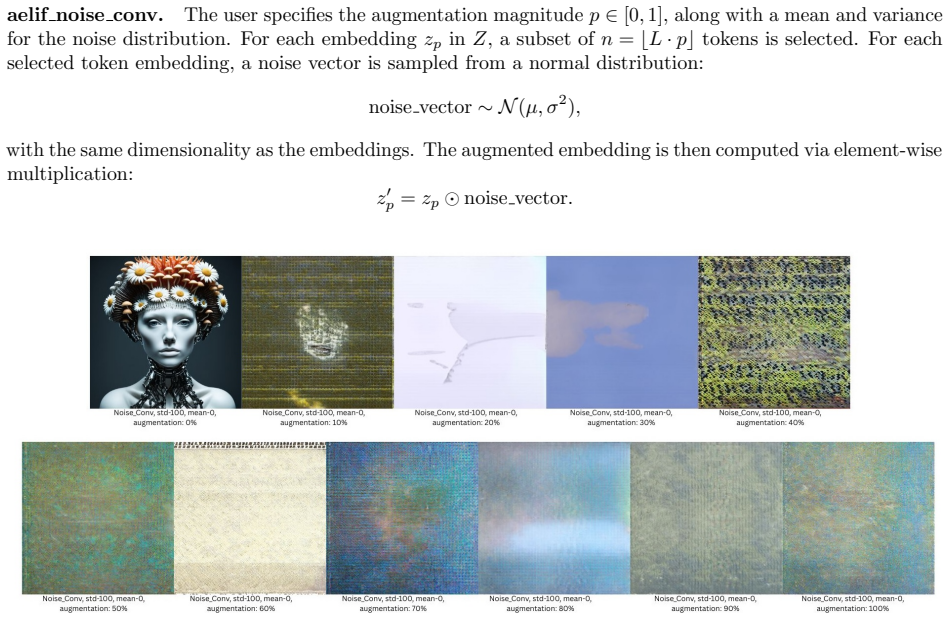
The central object is AELIF and its two operators, which act on the sequence of prompt embeddings $Z$ produced by the text encoder. $\texttt{aelif\_mask}$ selects $n = \lfloor L \cdot p \rfloor$ token positions and sets them to the zero vector; $\texttt{aelif\_noise\_conv}$ samples a Gaussian noise vector with a user-set mean and variance and multiplies the selected token embeddings element-wise. The placement—after the text encoder and before the denoising network—is what isolates the robustness of the denoiser from the text encoder. The evaluation pipeline computes the 2-Wasserstein distance between CLIP embeddings of generated images and a fixed training image, counting lower distances as stronger robustness.
What would settle it
On the same corrupted-prompt set, compute both the 2-Wasserstein distance to the fixed training image and a prompt-following score such as the CLIP similarity between the generated image and the corrupted prompt; if the AELIF-trained model lowers the first while failing to improve or worsening the second relative to the baseline, then the reported robustness gain is actually a pull toward the training distribution, not better handling of the prompt.
Extended reading notes
Core claim
The paper's central claim is that injecting noise into prompt embeddings at the interface between the text encoder and the denoising network is enough to make latent diffusion models robust to textual corruption, and that this can be done without sacrificing fidelity. AELIF (Augmentation of Embeddings with Latent Implicit Filtering) corrupts a random fraction of the embedding tokens used to condition the denoiser, either by masking them to zero or by element-wise multiplication with Gaussian noise. When these corruptions are mixed into DreamBooth fine-tuning of SD3 and SDXL, generated images under misspelled prompts stay close to the fine-tuned subject, while clean-prompt quality is preserved. The concluding sentence of the introduction states the claim directly: "Experiments on DreamBooth categories show that AELIF improves robustness while preserving fidelity."
Load-bearing premise
The paper's central claim depends on the assumption that measuring how close generated images come to a single fixed training image in CLIP embedding space tells you how well the model handled a corrupted prompt, rather than just how strongly it reproduces the training example.
Editorial extensions
If this is right
- Across the DreamBooth categories, AELIF-trained SD3 models beat the baseline on 64.96 percent of corrupted prompts on average, and SDXL models on 65.98 percent, so the reported improvement is systematic across architectures.
- AELIF acts as a regularizer during fine-tuning, so the robustness gain is claimed to come with preserved fidelity rather than as a trade-off.
- Because the corruption is applied after the text encoder, any observed gain is attributed to the denoising network itself, which allows cleaner diagnosis of where text-to-image systems fail.
- The method only touches the embedding interface, so it applies to any latent diffusion model whose text encoder emits token embeddings.
Reading between the lines
- The evaluation metric conflates "following the corrupted prompt" with "reproducing a training-like image"; if AELIF mainly strengthens prior preservation, some of the apparent robustness could be memorization, and a prompt-alignment metric would separate the two.
- A natural stress test is to run the same corrupted-prompt suite on prompts that name objects unrelated to the instance class; if the AELIF model still pulls outputs toward the training image, the robustness result would actually be a collapse onto the training distribution.
- The same embedding-interface corruption could be adapted to other conditioning modalities, such as reference-image conditioning or inpainting masks, by perturbing the corresponding encoder outputs before denoising.
- The paper's proposed standardized benchmark could be operationalized as a public suite that reports both distributional distance and perceptual fidelity, which would tell whether the roughly 65-percent win rate survives independent replication.
Editorial analysis
A structured set of objections, weighed in public.
Referee Report
Summary. The paper proposes two embedding-level augmentation techniques, AELIF-mask and AELIF-noise-conv, applied after the text encoder and before the denoising network of Stable Diffusion 3 and SDXL, integrated into DreamBooth fine-tuning. The authors claim that these augmentations improve the robustness of LDMs to prompt misspellings and other textual corruption while preserving fidelity. They evaluate robustness by computing the 2-Wasserstein distance between CLIP embeddings of generated images and a single fixed training image, and report win percentages for augmented versus non-augmented training across categories.
Significance. If the robustness gains were real, embedding-level augmentation would be a cheap and practical way to make LDMs more tolerant to user typos, and the proposed evaluation pipeline would be a useful contribution. The paper also tests two state-of-the-art models and provides a clear pipeline diagram. However, the evaluation metric is not a valid measure of prompt-following robustness: it rewards regression to a single training image, which AELIF's regularizing effect naturally encourages. The reported results are also mixed, with several categories showing no improvement, and the aggregate win rates lack any statistical support. Therefore the central claim is not established, and the paper's significance is currently limited by its evaluation methodology.
major comments (5)
- [Section 4.2 (Robustness Evaluation Pipeline, steps 7–8)] The 2-Wasserstein distance between the CLIP embedding of each generated image and a single fixed training image cannot separate a model that correctly follows the perturbed prompt from a model that ignores the prompt and always reproduces a training-like image. Because AELIF is a regularizer that pulls the denoising output toward the training distribution, the lower distances reported in Tables 3–4 may be a direct artifact of this metric. The paper does not report any complementary measure that verifies the generated image actually matches the content requested in the perturbed prompt.
- [Appendix A, Tables 1–2] The 'data augmentation' evaluation uses the same distance-to-training-data criterion, and several entries do not support the claimed improvement: in Table 1, 'vase' has Original 4.41 versus Noise Conv 4.57 and Mask 4.78; in Table 2, 'backpack dog' has Original 7.15 versus Mask 7.43, and 'teapot' has Original 5.47 versus Mask 5.43 and Noise 5.70. Lower distance to training data is not an established measure of augmentation quality, and it may simply reflect overfitting or mode collapse.
- [Tables 3–4] The aggregate win rates are close to chance for several categories (e.g., teapot 50.00% and backpack dog 52.78% for SD3 in Table 3, teapot 53.57% for SDXL in Table 4), and no standard errors, confidence intervals, paired significance tests, or number of prompts per category are reported. Without these, the mean win rate of approximately 65% cannot be distinguished from random seed noise, especially since the per-prompt W2 differences in Appendix B are often below 0.005.
- [Sections 4.1–4.2] Essential experimental details are missing: the augmentation magnitude p used during training and evaluation, the noise mean and standard deviation for the noise convolution (Figure 4 uses sigma=100 but the training configuration is not stated), the number of GPT-4o prompts per category, the number of seeds, and how the fixed training image is selected. The paper is therefore not reproducible, and the comparison between conditions may be confounded by uncontrolled factors.
- [Section 1 (Introduction) and Section 3.3] The stated hypothesis that robustness should be measured without the text encoder is not realized by the evaluation pipeline: the robustness evaluation feeds adversarial text prompts through the full text encoder and denoising pipeline, so it measures the combined system rather than isolating the denoising network. The augmentations are applied after the text encoder only during training, while at eval time the text encoder output for a misspelled prompt is uncontrolled, so the claimed isolation of the denoising component is not achieved.
minor comments (5)
- [Abstract and Figure 2] The abstract contains the typo 'wll' for 'will', and the Figure 2 caption says 'This figure show casts the problems' instead of 'shows'.
- [References] Several citations have incorrect author lists; for example, the SDXL reference 'Rombach et al., 2023' and the SD3 reference 'Watson et al., 2024' do not match the actual papers.
- [Section 4.2] The sentence 'For each group of embedding from AELIF augmentation calculate the Wasserstein distance with training training images' contains a typo ('training training'), and the numbered evaluation steps are mixed with unnumbered text, making the pipeline harder to follow.
- [Section 3.2] The claim that AELIF is 'novel' is overstated: masking token embeddings and adding noise to embeddings are standard techniques in the robustness literature, and the paper does not discuss related work on embedding perturbations.
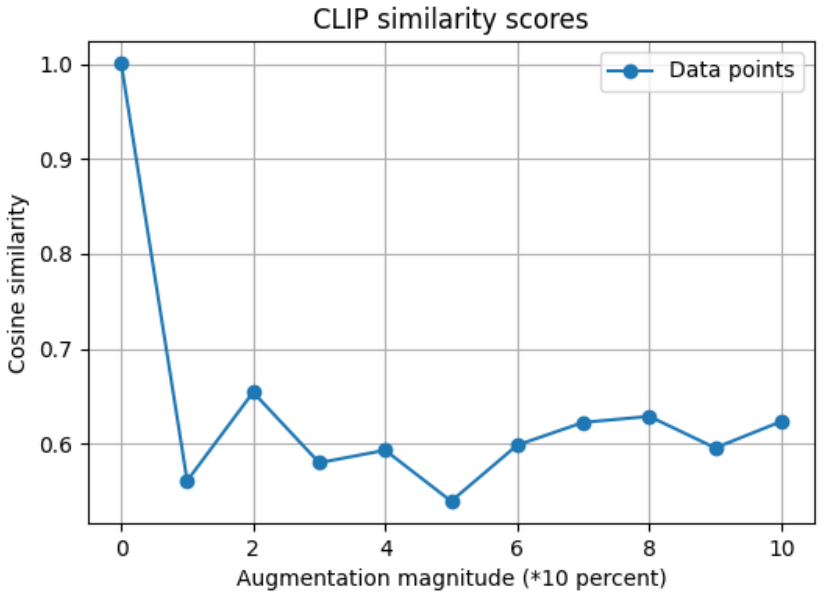
- [Figure 5] The caption does not explain the y-axis (cosine similarity) or the meaning of the plotted points, and the relationship between augmentation magnitude and image distortion is demonstrated only through a single illustrative example.
Circularity Check
Robustness metric equals closeness to the training image, which AELIF regularization is designed to increase.
-
self definitional
[Section 4.2, Robustness Evaluation Pipeline, steps 6–8; Appendix A]
"6. Select a fixed training image x_t for comparison. 7. Compute CLIP embeddings for all outputs and reference: CLIP(X_O), CLIP(X_A), CLIP(x_t). 8. For each image in X_O and X_A, compute the 2-Wasserstein distance to CLIP(x_t): W2(CLIP(x), CLIP(x_t)) (lower is better) ... We then computed the Wasserstein distance between the CLIP embeddings of the generated images and the training data. Lower distances indicate closer alignment with the training distribution."
The paper defines robustness to adversarial prompts as a lower 2-Wasserstein distance between the generated image's CLIP embedding and a fixed training image. DreamBooth fine-tuning, with or without AELIF, trains the model to reproduce the instance and class training images; AELIF is an embedding-level regularizer applied during that training. Thus any model that ignores the perturbed prompt and outputs a training-like image is rewarded with a lower W2 score and counts as 'more robust.' The reported win percentages in Tables 3–4 are aggregates of this same distance, so the claimed improvement reduces to the definition of the metric plus the regularizing effect of the augmentation.
full rationale
The central derivation chain is: AELIF augments text embeddings after the encoder during DreamBooth fine-tuning, and the robustness evaluation measures the 2-Wasserstein distance from generated-image CLIP embeddings to a fixed training image. Since DreamBooth training is explicitly a prior-preserving instance-fitting procedure, and AELIF is a regularizer applied inside that procedure, the evaluation metric is aligned with the training objective rather than with robustness to prompt perturbations. A model that ignores a corrupted prompt and reproduces the training subject scores optimally under the proposed metric. Consequently, the headline claim that 'AELIF improves robustness while preserving fidelity' is not supported as an independent finding; the improvement is substantially an artifact of defining robustness as closeness to training data. The paper also omits significance testing, confidence intervals, and seed details, and per-prompt differences are often below 0.005, but those are correctness risks rather than circularity. No author self-citations or imported uniqueness theorems are load-bearing. The circularity is partial: AELIF could in principle improve genuine prompt-following robustness, but the presented evaluation cannot distinguish that from regression to the training distribution, so the central empirical claim reduces to the metric choice.
Assumptions & free parameters
free parameters (2)
- augmentation magnitude p =
not reported
- noise mean mu and std sigma for aelif noise conv =
not reported
assumptions (3)
- domain assumption W2 distance between CLIP embeddings of generated and training images is a valid proxy for image fidelity and robustness.
- domain assumption Applying augmentations after the text encoder isolates the robustness of the denoising architecture.
- ad hoc to paper Element-wise multiplication of embeddings by Gaussian noise simulates real user misspellings and grammatical errors.
Cite this review
Pith. "Pith review of Evaluating Robustness in Latent Diffusion Models via Embedding Level Augmentation." pith.science (2026). https://pith.science/paper/B2NVG6KN
@misc{pith2026250607706,
  author       = {Pith},
  title        = {Pith review of: Evaluating Robustness in Latent Diffusion Models via Embedding Level Augmentation},
  year         = {2026},
  howpublished = {\url{https://pith.science/paper/B2NVG6KN}},
  note         = {Machine review of arXiv:2506.07706}
}
read the original abstract
Latent diffusion models (LDMs) achieve state-of-the-art performance across various tasks, including image generation and video synthesis. However, they generally lack robustness, a limitation that remains not fully explored in current research. In this paper, we propose several methods to address this gap. First, we hypothesize that the robustness of LDMs primarily should be measured without their text encoder, because if we take and explore the whole architecture, the problems of image generator and text encoders wll be fused. Second, we introduce novel data augmentation techniques designed to reveal robustness shortcomings in LDMs when processing diverse textual prompts. We then fine-tune Stable Diffusion 3 and Stable Diffusion XL models using Dreambooth, incorporating these proposed augmentation methods across multiple tasks. Finally, we propose a novel evaluation pipeline specifically tailored to assess the robustness of LDMs fine-tuned via Dreambooth.
Figures


Figures from the paper (3 more)

Reference graph
Works this paper leans on
-
[1]
Stable diffusion 2.0 and 2.1 release
Stability AI. Stable diffusion 2.0 and 2.1 release. https://stability.ai/blog/stable-diffusion-2-0-release, 2022. Accessed: 2025-05-07
work page 2022
-
[2]
Stable diffusion prompts dataset
Trevor Dark. Stable diffusion prompts dataset. https://huggingface.co/datasets/trevordark/sd-prompts, 2022. Accessed: 2025-05-07
work page 2022
-
[3]
Denoising diffusion probabilistic models
Jonathan Ho, Ajay Jain, and Pieter Abbeel. Denoising diffusion probabilistic models. arXiv preprint arXiv:2006.11239, 2020. URL https://arxiv.org/abs/2006.11239
arXiv 2006
-
[4]
Hu, Yelong Shen, Phillip Wallis, Zeyuan Allen-Zhu, Yuanzhi Li, Lu Wang, and Weizhu Chen
Edward J. Hu, Yelong Shen, Phillip Wallis, Zeyuan Allen-Zhu, Yuanzhi Li, Lu Wang, and Weizhu Chen. Lora: Low-rank adaptation of large language models. arXiv preprint arXiv:2106.09685, 2021. URL https://arxiv.org/abs/2106.09685
arXiv 2021
-
[5]
Diederik P. Kingma and Max Welling. Auto-encoding variational bayes. arXiv preprint arXiv:1312.6114, 2013. URL https://arxiv.org/abs/1312.6114
arXiv 2013
-
[6]
Hierarchical text-conditional image generation with clip latents
Aditya Ramesh, Prafulla Dhariwal, Alex Nichol, Casey Chu, and Mark Chen. Hierarchical text-conditional image generation with clip latents. arXiv preprint arXiv:2204.06125, 2022. URL https://arxiv.org/abs/2204.06125
arXiv 2022
-
[7]
Google Research. Dreambooth dataset. https://github.com/google/dreambooth, 2022. Accessed: 2025-05-07
work page 2022
-
[8]
High-resolution image synthesis with latent diffusion models
Robin Rombach, Andreas Blattmann, Dominik Lorenz, Patrick Esser, and Björn Ommer. High-resolution image synthesis with latent diffusion models. arXiv preprint arXiv:2112.10752, 2021. URL https://arxiv.org/abs/2112.10752
arXiv 2021
Show all 11 references
-
[9]
Sdxl: Improving latent diffusion models for high-resolution image synthesis
Robin Rombach, Pradyumna Tuli, Vlad Niculae, Lucy Chai, Patrick Esser, and Björn Ommer. Sdxl: Improving latent diffusion models for high-resolution image synthesis. arXiv preprint arXiv:2307.01952, 2023. URL https://arxiv.org/abs/2307.01952
2023 arXiv
-
[10]
Dreambooth: Fine tuning text-to-image diffusion models for subject-driven generation
Nataniel Ruiz, Sifei Li, Stanislaw Jozwik, Shiry Ginosar, Aaron Maschinot, and Ting Zhang. Dreambooth: Fine tuning text-to-image diffusion models for subject-driven generation. arXiv preprint arXiv:2208.12242, 2022. URL https://arxiv.org/abs/2208.12242
2022 arXiv
-
[11]
Scaling rectified flow transformers for high-resolution image synthesis
Jack Watson, Tero Karras, Sifei Liu, and Yann LeCun. Scaling rectified flow transformers for high-resolution image synthesis. arXiv preprint arXiv:2403.03206, 2024. URL https://arxiv.org/abs/2403.03206
2024 arXiv
Reviewed August 7, 2026 · model on record in the stance chip above.
Discussion (0). Sign in to comment.