REVIEW 4 major objections 6 minor 38 references
Detection and manipulation of surface electric field noise of hexagonal boron nitride
T0 review · 4 major / 6 minor · reviewed 2026-08-07 · deepseek-v4-flash
Pith's one-line read This paper shows that the double-quantum spin relaxation of shallow boron-vacancy defects in hexagonal boron nitride is dominated by surface electric-field noise, revealed by depth-dependent power-law behavior and suppression by PMMA and…
desk verdict A useful first demonstration of surface electric-field noise in hBN via DQ relaxation, with a practical PMMA passivation result, but the quantitative noise numbers lean on an uncalibrated susceptibility and the concentration-independence claim is weaker than stated. read the letter →
The pith
A machine-rendered reading of the paper's core claim, the machinery that carries it, and where it could break.
The reading
What carries the argument
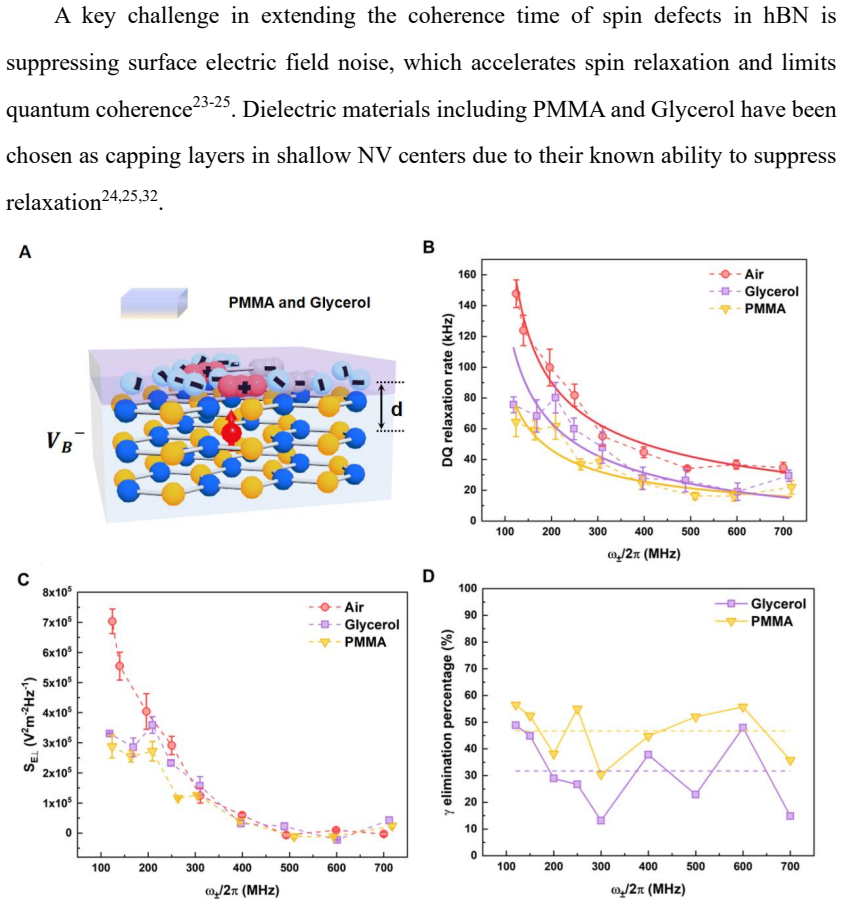
The load-bearing object is the DQ relaxation channel between $|+1\rangle$ and $|-1\rangle$, measured by the sequence in Fig. 1C and fitted with $F_2 = r e^{-(2\gamma + \Omega)\tau}$; because this channel is taken to be sensitive only to electric-field noise, while the SQ channel is magnetic-noise sensitive, the excess of $\gamma$ over the bulk value $\gamma_\infty$ is converted to a noise spectral density through $S_{E_\perp} = (\gamma - \gamma_\infty)/(d_\perp/h)^2$ with susceptibility $d_\perp/h = 0.4$ Hz m/V. The depth-controlled defect ensembles and the capping layers are the experimental handles that test whether this surface term is the dominant one.
What would settle it
Apply a known static electric field to a small ensemble of $V_B^-$ defects and measure the shift of the DQ ODMR splitting to obtain $d_\perp/h$ directly; if the value is far from 0.4 Hz m/V, the absolute noise levels in this paper rescale. Alternatively, deposit a magnetic film with controlled spin density on hBN and check whether $\gamma$ stays flat; if the DQ relaxation responds to magnetic noise, the DQ channel is not purely electric-field sensitive and the central attribution fails.
Extended reading notes
Core claim
The central discovery is that the DQ relaxation rate $\gamma$ of shallow $V_B^-$ defects in hBN is dominated by surface electric-field noise. Measurements at depths 4.8, 9.2, and 14.5 nm show $\gamma$ decreasing with depth and fitting $\gamma \sim 1/(f-2E)^a + \gamma_\infty$, with shallower defects giving larger inferred noise spectral density $S_{E_\perp}$. $\gamma$ is unchanged when the implantation dose spans $2\times10^{13}$ to $4\times10^{15}$ cm$^{-2}$, ruling out concentration-driven relaxation. Over 296 K to 453 K, $\gamma$ grows with $1/T_1 \propto T^{2.44}$. Capping with PMMA suppresses the inferred noise by 46.7% on average and glycerol by 31.8%, with the power-law frequency dependence preserved.
Load-bearing premise
The central claim collapses if the double-quantum transition is not purely electric-field sensitive or if the NV-derived susceptibility of 0.4 Hz m/V does not apply to $V_B^-$ in hBN, because then the inferred surface noise spectra are not what the paper says they are.
Editorial extensions
If this is right
- Coherence of shallow $V_B^-$ sensors should improve mainly by passivating or dielectrically engineering the hBN surface, not by diluting defect density.
- Defect ensembles can be made dense for stronger fluorescence without paying an additional relaxation penalty.
- The corrected definition $1/T_1 = 3\Omega + \gamma$ should replace $1/T_1^{(0)} = 3\Omega$ when comparing $T_1$ data across hBN samples and temperatures.
- Above room temperature, phonon-assisted relaxation grows steeply ($T^{2.44}$), so thermal operation of hBN sensors will degrade sensitivity unless the surface electric-field contribution is separately suppressed.
- PMMA capping offers a practical route to cut surface electric-field noise by roughly half, directly extending shallow-defect sensing capabilities in hBN.
Reading between the lines
- A natural extension is that the same DQ relaxation protocol could act as a local probe of surface charge dynamics, adsorbate motion, or surface phonons in hBN and other 2D materials, not just as a noise characterization tool.
- The inferred noise intensities all scale with the assumed susceptibility of 0.4 Hz m/V borrowed from NV centers; a direct measurement of $V_B^-$'s transverse electric-field susceptibility would either confirm the absolute noise levels or rescale them.
- Because PMMA's suppression does not fade at large splittings as it does in shallow NV centers, the dominant surface noise in hBN may differ in origin from diamond, possibly involving phonons rather than charge fluctuators; thickness-dependent capping experiments could test this.
Editorial analysis
A structured set of objections, weighed in public.
Referee Report
Summary. The paper reports double-quantum (DQ) spin relaxation measurements of shallow boron-vacancy (VB-) ensembles in hexagonal boron nitride (hBN) as a function of magnetic field, implantation depth, implantation dose, temperature, and dielectric capping layers. The authors interpret the DQ relaxation rate γ as dominated by surface electric-field noise, using the NV-inspired formula S_E⊥ = (γ − γ∞)/(d⊥/h)^2 with d⊥/h = 0.4 Hz m/V taken from Ref. 27. They report a depth-dependent power-law frequency dependence of γ, an apparent independence of γ from defect concentration, a temperature dependence 1/T1 ∝ T^2.44, and reductions of the inferred electric-field noise by 46.7% (PMMA) and 31.8% (glycerol). The central claim is that these observations establish surface electric-field noise as the dominant relaxation channel for shallow VB- defects in hBN.
Significance. If the central attribution holds, the paper would provide the first systematic characterization of surface electric-field noise in hBN spin defects, a relevant gap given the use of shallow VB- centers for quantum sensing. The main strengths are the direct application of an established DQ relaxation protocol, the inclusion of depth, dose, temperature, and capping-layer comparisons, and the reporting of statistical error bars on the fitted rates. The capping experiments in particular give falsifiable, practically useful results. However, the quantitative claims depend on a susceptibility value transferred from prior work without in-situ calibration, and the concentration-independence evidence is weakened by the paper's own observation that the PL signal saturates above an implantation dose of 2×10^14 cm^-2. These issues are load-bearing for the central claims and require revision.
major comments (4)
- [Fig. 3 and the paragraph 'Having established the critical role...'] The concentration-independence claim is not supported by the data as presented. The manuscript states that the VB- PL saturates and slightly decreases for implantation doses above 2×10^14 cm^-2, yet the γ measurements shown in Fig. 3 use doses of 2×10^13, 1×10^15, and 4×10^15 cm^-2. If the defect concentration saturates near 2×10^14 cm^-2, the two highest doses may correspond to nearly identical actual VB- densities, so the observed constancy of γ does not demonstrate independence from concentration. Please measure γ for several doses below and around the saturation threshold, and provide a direct measure of the relative defect concentration (e.g., PL or ODMR contrast) for each sample, or revise the claim to state independence only over the accessible fluence range.
- [Eq. (7), Figs. 2D and 5C] All absolute electric-field noise intensities are computed using the transverse susceptibility d⊥/h = 0.4 Hz m/V from Ref. 27 without any in-situ calibration on the present samples. Because S_E⊥ scales as 1/(d⊥/h)^2, any error in transferring this value directly changes the absolute noise values in Fig. 2D and the noise spectra in Fig. 5C. The relative depth trends and the suppression percentages are unaffected by this common factor, but the quantitative claim of 'detection' of surface electric-field noise is not self-contained. Please either add a calibration measurement of d⊥/h on the studied hBN samples or provide an explicit, quantitative discussion of the uncertainty introduced by using the literature value.
- [Introduction, Fig. 1B, and the interpretation around Eq. (7)] The central attribution of the DQ relaxation rate to electric-field noise rests on the assumption, inherited from NV-center work, that DQ transitions respond only to electric-field noise while magnetic and strain contributions are negligible. In hBN, strain and electric fields couple to the same transverse zero-field-splitting parameter E, and shallow-ion implantation creates depth-dependent strain gradients. A transverse strain-noise mechanism could in principle reproduce the observed depth trend and power-law frequency dependence. The capping-layer experiments provide supporting evidence but do not fully exclude such a mechanism, since PMMA and glycerol could also modify surface stress. A concrete control—for example, calibrating the transverse susceptibility with a known applied electric field, or comparing samples with different surface terminations—would substantially strengthen the attribution.
- [Fig. 2C and the fit function γ = 1/(f−2E)^a + γ∞] The fits that underlie the central power-law claim are not documented in sufficient detail. The text never reports the fitted values of a, E, or γ∞, nor their uncertainties, for any depth, temperature, or capping condition. These values are needed to verify that the power-law form is appropriate, to compute S_E⊥ via Eq. (7), and to assess whether γ∞ (the bulk contribution) is well constrained. Please include a table of all fit parameters, the definition of f used for each magnetic-field setting, and the procedure for propagating fit uncertainties into S_E⊥.
minor comments (6)
- [Abstract and Fig. 5C text] There are several typographical issues in the abstract ('offer' appears as 'off er') and in the Fig. 5C discussion ('effectively can effectively reduce'); please proofread carefully.
- [Equations] Equation numbering skips from (4) to (7). Renumber the equations or include the missing intermediate equations so that the cross-references in the text are unambiguous.
- [Fig. 3 caption and axis labels] The text and caption refer to 'defect concentrations' while the experiment varies implantation dose. Please specify the axis as implantation fluence or provide a measured concentration scale, and make clear which quantity is shown in Fig. 3C and 3D.
- [Fig. 4D inset] The log-log inset showing 1/T1 ∝ T^2.44 should include the data points with error bars, the fit range (296–453 K), and the number of points; without these, the fitted slope cannot be independently checked.
- [References] Reference 8 is missing the publication year (Nat. Mater. 23, 1379–1385, 2024). Please check all references for completeness.
- [Methods] The Methods section describes only the sample and setup; it should include the pulse-sequence parameters (microwave pulse lengths, laser power, integration times) and the fitting procedure used to extract Ω and γ, including how the amplitudes r and the background are treated.
Circularity Check
No significant circularity: the reported measurements are new, and the key conversions rely on external calibrations rather than on the paper's own conclusions.
full rationale
This paper is an experimental study of DQ spin relaxation in shallow VB- defects in hBN, and its derivation chain is not circular. The central measured quantity, the DQ relaxation rate gamma, is extracted from decay curves using rate equations (Eqs. 2 and 3), which are standard and do not presuppose the surface-electric-field-noise interpretation. The conversion to a noise spectral density S_E_perp = (gamma - gamma_infinity)/(d_perp/h)^2 (Eq. 7) uses a transverse susceptibility d_perp/h = 0.4 Hz m/V taken from Ref. 27, an external measurement on hBN, and the functional form 1/(f - 2E)^a + gamma_infinity is imported from NV-center work (Refs. 23-25). These are external assumptions and calibrations, not quantities defined in terms of the paper's own conclusions. The depth dependence, concentration independence, temperature dependence, and PMMA/glycerol suppression are independent experimental observations; none is a fitted parameter renamed as a prediction. The claim that DQ relaxation is dominated by surface electric-field noise depends on the transferability of the NV-based DQ/SQ noise model and on the literature susceptibility to hBN, but that is a validity assumption rather than a circular derivation. No self-citation chain or definitional equivalence forces the central result. The paper does not contain a passage where an output is identical to an input by construction, so no circularity is found.
Assumptions & free parameters
free parameters (3)
- γ∞ (bulk relaxation contribution) =
not reported numerically
- Power-law exponent a in γ = 1/(f-2E)^a + γ∞ =
not reported
- Temperature exponent in 1/T1 ∝ T^n =
n = 2.44
assumptions (6)
- domain assumption Ground-state spin Hamiltonian for VB− with S=1, Dgs ≈ 3.48 GHz, Egs ≈ 48-75 MHz (Eq. 1)
- domain assumption DQ relaxation is sensitive to electric field noise, SQ to magnetic field noise (Fig. 1B)
- domain assumption Rate-equation model with complete relaxation in a three-level system (Eqs. 2, 3)
- domain assumption SRIM-simulated defect depths (4.8, 9.2, 14.5 nm) correspond to actual VB− depths
- domain assumption Implantation dose is a proxy for VB− concentration
- domain assumption Surface electric field noise spectrum follows a power-law and the conversion SE⊥ = (γ-γ∞)/(d⊥/h)^2
Cite this review
Pith. "Pith review of Detection and manipulation of surface electric field noise of hexagonal boron nitride." pith.science (2026). https://pith.science/paper/5X5VX7IZ
@misc{pith2026250607734,
  author       = {Pith},
  title        = {Pith review of: Detection and manipulation of surface electric field noise of hexagonal boron nitride},
  year         = {2026},
  howpublished = {\url{https://pith.science/paper/5X5VX7IZ}},
  note         = {Machine review of arXiv:2506.07734}
}
read the original abstract
Hexagonal boron nitride (hBN) spin defects off er transformative potential for quantum sensing through atomic-scale proximity to target samples, yet their performance is fundamentally limited by rapid coherence loss. While magnetic noise mechanisms have been extensively studied, another critical infl uence from surface electric fi eld noise remains unexplored in hBN systems. Here,we address this challenge and systematically investigate surface electric fi eld noise in hBN using shallow boron vacancy defects. The double-quantum spin relaxation behavior in response to magnetic fi elds and defect depths is examined, revealing that the relaxation rate follows a distinctive depth-related power-law dependence of ODMR splitting frequency. The relaxation is also demonstrated to be independent of the defect concentrations. Furthermore, the temperature dependence of the relaxation rate is investigated, showing a noticeable rise as the temperature increases from 296 K to 453 K, thus highlighting the infl uence of thermal eff ects on spin relaxation. To further suppress surface electric fi eld noise, we explore the eff ectiveness of passivation materials, including glycerol and PMMA. Notably, PMMA is more effi cient in mitigating surface electric fi eld noise. These experiments enhance the understanding of surface electric fi eld noise in hBN and provide a foundation for developing noise mitigation strategies in future research.
Figures


Figures from the paper (2 more)

Reference graph
Works this paper leans on
-
[1]
M. W. Doherty, N. B. Manson, P. Delaney, F. Jelezko, J. Wrachtrup, L. C. L. Hollenberg, The nitrogen-vacancy colour centre in diamond. Phys. Rep. 528 (1), 1–45 (2013)
work page 2013
-
[2]
W. F. Koehl, B. B. Buckley, F. J. Heremans, G. Calusine, D. D. Awschalom, Room temperature coherent control of defect spin qubits in silicon carbide. Nature 479 (7371), 84–87 (2011)
work page 2011
-
[3]
T. T. Tran, K. Bray, M. J. Ford, M. Toth, I. Aharonovich, Quantum emission from hexagonal boron nitride monolayers. Nat. Nanotechnol. 11 (1), 37–41 (2016)
work page 2016
-
[4]
A. Gottscholl, M. Kianinia, V. Soltamov, S. Orlinskii, G. Mamin, C. Bradac, C. Kasper, K. Krambrock, A. Sperlich, M. Toth, I. Aharonovich, V. Dyakonov, Initialization and read-out of intrinsic spin defects in a van der Waals crystal at room temperature. Nat. Mater. 19 (5), 540–545 (2020)
work page 2020
-
[5]
G. Wolfowicz, F. J. Heremans, C. P. Anderson, S. Kanai, H. Seo, A. Gali, G. Galli, D. D. Awschalom, Quantum guidelines for solid-state spin defects. Nat. Rev. Mater. 6 (10), 906–925 (2021)
work page 2021
- [6]
-
[7]
H.-H. Fang, X. -J. Wang, X. Marie, H. -B. Sun, Quantum sensing with optically accessible spin defects in van der Waals layered materials. Light-Sci. Appl. 13 (1), 303 (2024)
work page 2024
-
[8]
H. L. Stern, C. M. Gilardoni, Q. Gu, S. E. Barker, O. F. J. Powell, X. Deng, S. A. Fraser, L, Follet, A. J. Ramsey, H. H. Tan, I. Aharonovich, M. Ata üre, A quantum coherent spin in hexagonal boron nitride at ambient conditions. Nat. Mater. 23 (10), 1379–1385
Show all 38 references
-
[9]
W. Liu, V. Ivá dy, Z.-P. Li, Y.-Z. Yang, S. Yu, Y. Meng, Z.-A. Wang, N.-J. Guo, F.- F. Yan, Q. Li, J. -F. Wang, J.-S. Xu, X. Liu, Z. -Q. Zhou, Y. Dong, X. -D. Chen, F.-W. Sun, Y.-T. Wang, J.-S. Tang, A. Gali, C.-F. Li, G.-C, Guo, Coherent dynamics of multi- spin VB- center in ...
2022
-
[10]
Gao, B.-Y
X.-Y. Gao, B.-Y. Jiang, A. E. L. Allcca, K.-H. Shen, M. A. Sadi, A. B. Solanki, P. Ju, Z.-J. Xu, P. Upadhyaya, Y. P. Chen, S. A. Bhave, T.-C. Li, High-contrast plasmonic- enhanced shallow spin defects in hexagonal bor on nitride for quantum sensing. Nano Lett. 21 (18), 7708–77...
2021
-
[11]
H.-B. Cai, S. -R. Ru, Z. -Z, Jiang, J. J. H. Eng, R. -H. He, F. -L. Li, Y. -S. Miao, J. Zú ñ iga-Pé rez, W.-B. Gao, Spin defects in hBN assisted by metallic nanotrenches for quantum sensing. Nano Lett. 23 (11), 4991–4996 (2023)
2023
-
[12]
Sortino, A
L. Sortino, A. Gale, L. K ühner, C. Li, J. Biechteler, F. J. Wendisch, M. Kianinia, H.-R. Ren, M. Toth, S. A. Maier, I. Aharonovich, A. Tittl, Optically addressable spin defects coupled to bound states in the conti nuum metasurfaces. Nat. Commun. 15 (1), 2008 (2024)
2024
-
[13]
X.-Y. Gao, S. Vaidya, K.-J. Li, P. Ju, B.-Y. Jiang, Z.-J. Xu, A. E. L. Allcca, K.-H. Shen, T. Taniguchi, K. Watanabe, S. A. Bhave, Y. P. Chen, Y. Peng, T.-C. Li, Nuclear spin polarization and control in hexagonal boron nitride. Nat. Mater. 21 (9), 1024– 1028 (2022)
2022
-
[14]
Ru, Z.-Z
S.-H. Ru, Z.-Z. Jiang, H.-D. Liang, J. Kenny, H.-B. Cai, X.-D. Lyu, R. Cernansky, F.-F. Zhou, Y.-Z. Yang, K. Watanabe, T. Taniguch, F. -L. Li, T. S. Koh, X. -G. Liu, F. Jelezko, A. A. Bettiol, W. -B. Gao, Robust nuclear spin polarization via ground -state level anticrossing of...
2024
-
[15]
Gottscholl, M
A. Gottscholl, M. Diez, V. Soltamov, C. Kasper, D. Krauß e, A. Sperlich, M. Kianinia, C. Bradac, I. Aharonovich, V. Dyakonov, Spin defects in hBN as promising temperature, pressure and magnetic field quantum sensors. Nat. Commun. 12 (1), 4480 (2021)
2021
-
[16]
Liu, Z.-P
W. Liu, Z.-P. Li, Y.-Z. Yang, S. Yu, Y. Meng, Z.-A. Wang, Z.-C. Li, N.-J. Guo, F.- F. Yan, Q. Li, J. -F. Wang, J. -S. Xu, Y. -T. Wang, J. -S. Tang, C. -F. Li, G. -C. Guo, Temperature-dependent energy-level shifts of spin defects in hexagonal boron nitride. ACS Photonics 8 (7),...
2021
-
[17]
Rizzato, M
R. Rizzato, M. Schalk, S. Mohr, J. C. Hermann, J. P. Leibold, F. Bruckmaier, G. Salvitti, C.-J. Qian, P.-R. Ji, G. V. Astakhov, U. Kentsch, M. Helm, A. V. Stier, J. J. Finley, D. B. Bucher, Extending the coherence of spin defects in hBN enables advanced qubit control and quant...
2023
-
[18]
Lyu, Q.-H, Tan, L.-S
X.-D. Lyu, Q.-H, Tan, L.-S. Wu, C.-S. Zhang, Z.-W. Zhao, Z. Mu, J. Zúñ iga-Pérez, H.-B. Cai, W. -B. Gao, Strain quantum sensing with spin defects in hexagonal boron nitride. Nano Lett. 22 (16), 6553–6559 (2022)
2022
-
[19]
I. O. Robertson, S. C. Scholten, P. Singh, A. J. Healey, F. Meneses, P. Reineck, H. Abe, T. Ohshima, M. Kianinia, I. Aharonovich, J. Tetienne, Detection of paramagnetic spins with an ultrathin van der Waals quantum sensor. ACS Nano 17 (14), 13408 – 13417 (2023)
2023
-
[20]
X.-Y. Gao, S. Vaidya, P. Ju, S. Dikshit, Y. P. Chen, T. -C. Li, Quantum sensing of paramagnetic spins in liquids with spin qubits in hexagonal boron nitride. ACS Photonics 10 (8), 2894–2900 (2023)
2023
-
[21]
Durand, T
A. Durand, T. Clua -Provost, F. Fabre, P. Kumar, J. Li, J. H. Edgar, P.Udvarhelyi, A. Gali, X. Marie, C. Robert, J. M. Gé rard, B. Gil, G. Cassabois, V. Jacques, Optically Active Spin Defects in Few-Layer Thick Hexagonal Boron Nitride. Phys. Rev. Lett. 131 (16), 116902 (2023)
2023
-
[22]
Huang, J
M.-Q. Huang, J. -C. Zhou, D. Chen, H. -Y. Lu, N. J. McLaughlin, S. -L. Li, M. Alghamdi, D. Djugba, J. Shi, H. -L. Wang, C. R. Du, Wide field imaging of van der Waals ferromagnet Fe3GeTe2 by spin defects in hexagonal boron nitride. Nat. Commun. 13 (1), 5369 (2022)
2022
-
[23]
B. A. Myers, A. Ariyaratne, A. C. B. Jayich, Double-quantum spin-relaxation limits to coherence of near -surface nitrogen -vacancy centers. Phys. Rev. Lett. 118 (19), 197201 (2017)
2017
-
[24]
Lin, C.-F
S.-R. Lin, C.-F. Wang, J.-F. Wang, Y.-H. Guo, Y.-J. Yang, J,-X. Zhao, P.-P. Ma, Y.-P. Chen, L. -R. Lou, W. Zhu, G. -Z. Wang, Diamond surface electric -field noise detection using shallow nitrogen -vacancy centers. Phys. Rev. B 106 (16), 165406 (2022)
2022
-
[25]
M. Kim, H. J. Mamin, M. H. Sherwood, K. Ohno, D. D Awschalom, D. Rugar, Decoherence of near-surface nitrogen-vacancy centers due to electric field noise. Phys. Rev. Lett. 115 (8), 087602 (2015)
2015
-
[26]
Gardill, M
A. Gardill, M. C. Cambria, S. Kolkowitz, Fast relaxation on q utrit transitions of nitrogen-vacancy centers in nanodiamonds. Phys. Rev. Appl. 13 (3), 034010 (2020)
2020
-
[27]
Gong, G.-H
R.-T. Gong, G.-H. He, X.-Y. Gao, P. Ju, Z.-Y. Liu, B.-T. Ye, E. A. Henriksen, T.- C. Li, C. Zu, Coherent dynamics of strongly interacting electronic spin defects in hexagonal boron nitride. Nat. Commun. 14 (1), 3299 (2023)
2023
-
[28]
N.-J. Guo, W. Liu, Z.-P. Li, Y.-Z. Yang, S. Yu, Y. Meng, Z.-A. Wang, X.-D. Zeng, F.-F. Yan, Q. Li, J. -F. Wang, J. -S. Xu, Y. -T. Wang, J. -S. Tang, C. -F. Li, G. -C. Guo, Generation of spin defects by ion implantation in hexagonal boron nitride. ACS Omega 7 (2), 1733–1739 (2022)
2022
-
[29]
M. C. Cambria, A. Gardill, Y. Li, A. Norambuena, J. R. Maze, S. Kolkowitz, State- dependent phonon-limited spin relaxation of nitrogen-vacancy centers. Phys. Rev. Res. 3 (1), 013123 (2021)
2021
-
[30]
Gottscholl, M
A. Gottscholl, M. Diez, V. Soltamov, C. Kasper, A. Sperlich, M. Kianinia, C. Bradac, I. Aharonovich, V. Dyakonov, Room temperature coherent control of spin defects in hexagonal boron nitride. Sci. Adv. 7 (14), eabf3630 (2021)
2021
-
[31]
Clua -Provost, Z
T. Clua -Provost, Z. Mu, A. Durand, C. Schrader, J. Happacher, J. Bocquel, P. Maletinsky, J. Fraunié, X. Marie, C. Robert, G. Seine, E. Janzen, J. H. Edgar, B. Gil, G. Cassabois, V. Jacques, Spin-dependent photodynamics of boron-vacancy centers in hexagonal boron nitride. Phys...
2024
-
[32]
R. Li, F. Kong, P.-J. Zhao, Z. Cheng, Z.-Y. Qin, M.-Q. Wang, Q. Zhang, P.-F. Wang, Y. Wang, F. -Z. Shi, J. -F. Du, Nanoscale Electrometry Based on a Magnetic -Field- Resistant Spin Sensor. Phys. Rev. Lett. 124 (24), 247701 (2020)
2020
-
[33]
Romach1, C
Y. Romach1, C. Müller, T. Unden, L. J. Rogers, T. Isoda, K. M. Itoh, M. Markham, A. Stacey, J. Meijer, S. Pezzagna, B. Naydenov, L. P. McGuinness, N. Bar -Gill, F. Jelezko, Spectroscopy of surface-induced noise using shallow spins in diamond. Phys. Rev. Lett. 114 (1), 017601 (2015)
2015
-
[34]
A. J. Healey, S. C. Scholten, T. Yang, J. A. Scott, G. J. Abrahams, I. O. Robertson, X.-F. Hou, Y.-F. Guo, S. Rahman, Y. Lu, M. Kianinia, I. Aharonovich, J.-P. Tetienne, Quantum microscopy with van der Waals heterostructures. Nat. Phys. 19 (1), 87–91 (2023)
2023
-
[35]
S. C. Scholten, P. Singh, A. J. Healey, I. O. Robertson, G. Haim, C. Tan, D. A. Broadway, L. Wang, H. Abe, T. Ohshima, M. Kianinia, P. Reineck, I. Aharonovich, J.- P Tetienne. Multi-species optically addressable spin defects in a van der Waals material. Nat. Commun. 15 (1), 67...
2024
-
[36]
J.-F. Du, F. -Z. Shi, X. Kong, F. Jelezko, J. Wrachtrup, Single -molecule scale magnetic resonance spectroscopy using quantum diamond sensors. Rev. Mod. Phys. 96 (2), 025001 (2024)
2024
-
[37]
Casola, T
F. Casola, T. Van Der Sar, A. Yacoby, Probing condensed matter physics with magnetometry based on nitrogen -vacancy centres in diamond. Nat. Rev. Mater. 3 (1), 1–13 (2018)
2018
-
[38]
W. Liu, S. Li, N.-J. Guo, X.-D. Zeng, L.-K. Xie, J.-Y . Liu, Y .-H. Ma, Y .-Q. Wu, Y .- T. Wang, Z.-A. Wang, J.-M. Ren, C. Ao, J.-S. Xu, J.-S. Tang, A. Gali, C.-F. Li, G.-C. Guo, Experimental observation of spin defects in van der Waals material GeS2. arXiv 2410.18892 (2024)
2024 arXiv
Reviewed August 7, 2026 · model on record in the stance chip above.
Discussion (0). Sign in to comment.