REVIEW 3 major objections 4 minor 6 references
AssetDropper: Asset Extraction via Diffusion Models with Reward-Driven Optimization
T0 review · 3 major / 4 minor · reviewed 2026-08-07 · deepseek-v4-flash
Pith's one-line read AssetDropper claims a generative model can extract any front-view asset from a selected image region, using a diffusion reward loop to keep the output consistent.
desk verdict Useful new task plus a substantial dataset, but the SOTA claim is undercut by a likely train/test asset overlap and a thin quantitative evaluation. read the letter →
The pith
A machine-rendered reading of the paper's core claim, the machinery that carries it, and where it could break.
The reading
What carries the argument
The load-bearing mechanism is the cycle-consistency reward loop. A separate diffusion model is trained on the inverse task—reattaching an extracted asset into its masked source region—and its pixel-space reconstruction error against the original reference image becomes the reward used to fine-tune the extraction generator. To make this practical, both the generator's predicted asset and the reward model's reattached output are approximated with single-step denoising estimates, and the reward term is gated by a timestep threshold so it only acts when the predicted asset is clean enough. The extraction network itself takes three visual conditions (source image, asset mask, and edge map) through a low-level feature encoder plus a semantic image-prompt adapter, and feeds the fused conditioning into a pretrained inpainting-style diffusion generator.
What would settle it
On a held-out set of real photos with extreme perspective or more than half of the target occluded, run the released model with and without reward fine-tuning and compare both to manual cutouts using an image-similarity metric and a forced-choice user study. If the reward-tuned model does not beat the no-reward model on these hard cases, the claim that reward-driven optimization improves consistency is contradicted.
Extended reading notes
Core claim
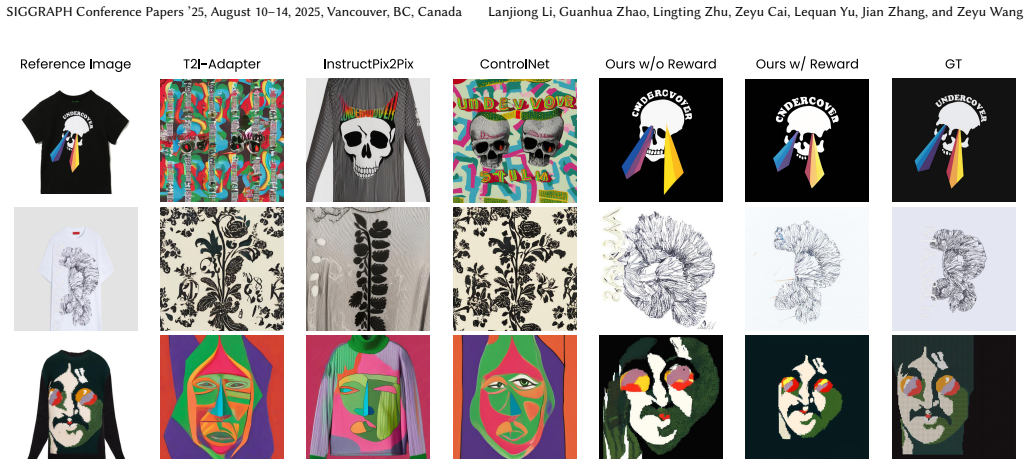
The paper's central claim is that a standardized front-view asset can be estimated from any user-selected region of a reference image by treating extraction as an example-based inpainting problem: the model consumes the source image, a mask over the target, an edge map, and a text caption, and predicts a clean frontal asset. The authors argue that a purpose-built diffusion model can learn this “degradation-to-standard” mapping from a large synthetic paired dataset of more than 200,000 samples, constructed by UV-projecting over 10,000 curated asset images onto everyday meshes and rendering them under realistic lighting from random front-hemisphere cameras. They further claim that the weak point of such a generator is consistency with user intent, and that this is best fixed by reward-driven optimization where the reward model is itself a generative model performing the inverse task—pasting the predicted asset back into the reference—so that a pixel-space cycle-consistency loss can suppress hallucination and improve color and detail fidelity. In their experiments, adding this reward lowers FID from 60.33 to 50.36 on the synthetic test set and from 49.48 to 48.71 on the real test set, while raising image-similarity scores, and their user study ranks the reward-tuned model highest on both consistency and quality.
Load-bearing premise
The load-bearing premise is that the synthetic training data—flat asset images UV-mapped onto everyday 3D surfaces and rendered under varied lighting and camera angles—represents real-world photos closely enough that both the extraction model and its reward model trained on it generalize to arbitrary in-the-wild images.
Editorial extensions
If this is right
- A designer can select a region in an ordinary photo and receive a standardized front-view asset that is ready for mockups, 3D texturing, or a shared asset library, without manual segmentation and cleanup.
- Asset extraction becomes a generative inverse problem, so distorted, curved-surface, and partly occluded subjects—cases where segmentation and rectification tools fail—can still be recovered as clean frontal assets.
- Because the reward model is a generative model that reattaches the asset, training receives a consistency signal aimed directly at hallucinated details and color drift in the extracted asset.
- The released synthetic dataset and benchmark give the community a common training and evaluation resource for the new asset-extraction task, with 191,301 training and 21,256 test samples.
- The method also transfers to AI-generated content, including 2D images and multi-view 3D renders, suggesting it can serve generative design workflows as well as photographs.
Reading between the lines
- Editorial extension: the inverse-reward recipe should carry over to any pair of forward/inverse image operators—relighting, deblurring, logo frontalization on curved surfaces—whenever a clean object can be mapped to a degraded observation and pasted back; the single-step cycle-consistency trick is the reusable part.
- Editorial extension: because the reward model and the generator are trained on the same synthetic distribution, a natural next test is to re-run reward fine-tuning on real paired examples to measure how much of the consistency gain survives when the synthetic-to-real gap widens.
- Editorial extension: the synthetic data pipeline (flat texture atlases UV-mapped onto everyday meshes with varied lighting and camera angles) could be reused to bootstrap paired training data for other standardization tasks, such as reading curved labels or frontalizing logos on bottles, without any real paired data.
- Editorial extension: the authors' closing note that severe occlusion still fails suggests conditioning the generator on temporal frames or multiple views; a video-prior variant could be evaluated on the same test benchmark to see whether extra views recover the lost information.
Editorial analysis
A structured set of objections, weighed in public.
Referee Report
Summary. The paper proposes AssetDropper, a diffusion-based pipeline for extracting standardized front-view assets from a masked region of a reference image. The generator is an SDXL inpainting UNet conditioned by a FeatureNet encoder, an IP-Adapter, and GPT-4o captions. A separate inpainting diffusion model is trained to paste extracted assets back into the reference image and is used as a reward model; reward fine-tuning uses one-step noise estimates and a cycle-consistency loss. The authors construct a synthetic dataset SAP with more than 200,000 pairs by UV-projecting over 10,000 assets onto meshes under HDRI lighting, assemble a benchmark, and report FID, KID, and CLIP-I scores plus a user study against ControlNet, T2I-Adapter, InstructPix2Pix, OmniGen, and Zero123++. They claim state-of-the-art open-world asset extraction.
Significance. The task is timely, and the inverse-task reward design is a sensible way to add consistency without a discriminative reward model. The SAP dataset is a potentially useful resource, and the one-step reward estimator follows a clear derivation. The paper is explicit about the architecture and hyperparameters. However, the quantitative evidence as presented does not yet establish the central open-world claim: the benchmark split is not shown to be asset-disjoint, and the reported gains are mostly point estimates without uncertainty. If the split ambiguity is resolved and the numbers hold, the contribution would be a solid systems paper with a reusable dataset; as it stands, the state-of-the-art claim is conditional.
major comments (3)
- [Sec. 3.2.2 / Table 1] The text says only that the SAP benchmark 'is further divided into two parts' (191,301 training and 21,256 test samples) and never states that the split is disjoint by asset identity. Because Sec. 3.2.1 renders each of more than 10,000 assets on multiple meshes under multiple HDRI environments and camera angles, a sample-level random split will almost surely place different renderings of the same asset in both training and test. If so, Table 1 measures retrieval or memorization of seen textures rather than open-world extraction, and none of FID, KID, or CLIP-I would reveal this, since those metrics compare distribution statistics or similarity to the corresponding reference rendering. Please state the split granularity explicitly; if it is not asset-disjoint, re-split by asset identity and re-run Table 1, and report whether the in-the-wild examples in Fig. 12 come from assets seen during training.
- [Sec. 4.1.3 / Table 1] All quantitative comparisons are point estimates computed on 1,000 samples, with no error bars, confidence intervals, or multiple runs. In particular, the reward-model gain on SAP-Real is FID 49.48 to 48.71 and KID 0.0014 to 0.0013, which is within typical sampling noise for these metrics. Without uncertainty estimates or paired significance tests, the claimed improvement from reward-driven optimization is not established for the real-world subset.
- [Sec. 3.4 / Sec. 3.2.1] The reward model is trained on the same SAP rendering distribution as the generator, so the closed loop may reinforce synthetic-data biases rather than provide independent feedback. The cycle-consistency loss checks only that the generated asset can be pasted back into the same rendering; it does not directly verify that the asset is the true underlying standardized asset. Please provide evidence that the reward signal correlates with human judgment on out-of-distribution inputs, for example by reporting the user-study scores separately for held-out real photos, or by showing that reward fine-tuning helps on an asset-disjoint test split.
minor comments (4)
- [Sec. 4.1.1] The hyperparameters t_thres, lambda, and t_c are reported as tuned 'with trials', but no sensitivity analysis is given; a small ablation would help the reader judge the robustness of the reward loss.
- [Sec. 4.4.2 / Fig. 8] The user study uses 25 participants and 10 image groups; please report the number of ratings per condition and whether the consistency and quality differences are statistically significant.
- [References] Black et al. 2023a and Black et al. 2023b appear to be the same arXiv report; please cite distinct versions or consolidate the entries.
- [Abstract / Sec. 3.3] The 'first' claims in the abstract and in Sec. 3.4 would benefit from a brief statement of the search scope or a consistent 'to our knowledge' qualification, since such claims are difficult to verify.
Circularity Check
No load-bearing circularity: the reward model is a separately trained auxiliary network and the SOTA claim rests on held-out benchmarks; only a minor, non-load-bearing self-citation keeps the score above zero.
full rationale
Walking the derivation chain, AssetDropperNet is trained on paired SAP data with a standard diffusion loss, while the reward model is a separately trained diffusion inpainting network that performs the inverse task of reattaching extracted assets to reference images (Sec. 3.4, Eqs. 2-4). The cycle-consistency loss compares the reward model's one-step reconstruction against the original reference image, which is a meaningful external objective rather than a fitted parameter renamed as a prediction. That the reward model is trained on the same synthetic distribution as the generator is a generalization risk, not a by-construction circularity. The stated SOTA claim is supported by comparisons to fine-tuned baselines, held-out SAP-Syn/SAP-Real test splits, and a user study, so it is not equivalent to the training objective by construction. The only self-citation is a background citation to DanceGRPO (Xue et al. 2025) in Sec. 2.3, which includes co-author Lingting Zhu but carries none of the paper's load-bearing arguments. The possible lack of an explicitly asset-disjoint train/test split is an evaluation-validity concern, not a circularity under the rubric definitions.
Assumptions & free parameters
free parameters (3)
- t_thres =
300
- lambda =
1.0
- t_c =
150
assumptions (4)
- domain assumption UV-mapped rendering of flat assets on everyday meshes with HDRI lighting approximates real-world image formation
- domain assumption A generative reward model trained on the same synthetic distribution provides valid cycle-consistency supervision
- domain assumption GPT-4o text captions accurately describe the asset content for conditioning
- domain assumption GroundingDINO masks give correct asset regions in-the-wild
invented entities (2)
-
Standardized Asset Palette Dataset (SAP)
-
Generative reward model (InpaintNet)
Cite this review
Pith. "Pith review of AssetDropper: Asset Extraction via Diffusion Models with Reward-Driven Optimization." pith.science (2026). https://pith.science/paper/TRA3DGIT
@misc{pith2026250607738,
  author       = {Pith},
  title        = {Pith review of: AssetDropper: Asset Extraction via Diffusion Models with Reward-Driven Optimization},
  year         = {2026},
  howpublished = {\url{https://pith.science/paper/TRA3DGIT}},
  note         = {Machine review of arXiv:2506.07738}
}
read the original abstract
Recent research on generative models has primarily focused on creating product-ready visual outputs; however, designers often favor access to standardized asset libraries, a domain that has yet to be significantly enhanced by generative capabilities. Although open-world scenes provide ample raw materials for designers, efficiently extracting high-quality, standardized assets remains a challenge. To address this, we introduce AssetDropper, the first framework designed to extract assets from reference images, providing artists with an open-world asset palette. Our model adeptly extracts a front view of selected subjects from input images, effectively handling complex scenarios such as perspective distortion and subject occlusion. We establish a synthetic dataset of more than 200,000 image-subject pairs and a real-world benchmark with thousands more for evaluation, facilitating the exploration of future research in downstream tasks. Furthermore, to ensure precise asset extraction that aligns well with the image prompts, we employ a pre-trained reward model to fulfill a closed-loop with feedback. We design the reward model to perform an inverse task that pastes the extracted assets back into the reference sources, which assists training with additional consistency and mitigates hallucination. Extensive experiments show that, with the aid of reward-driven optimization, AssetDropper achieves the state-of-the-art results in asset extraction. Project page: AssetDropper.github.io.
Figures


Figures from the paper (9 more)




Reference graph
Works this paper leans on
-
[3]
Aligning Text-to-Image Diffusion Models with Reward Backpropagation. arXiv:2310.03739 [cs.CV] https://arxiv.org/abs/2310.03739 Can Qin, Shu Zhang, Ning Yu, Yihao Feng, Xinyi Yang, Yingbo Zhou, Huan Wang, Juan Carlos Niebles, Caiming Xiong, Silvio Savarese, Stefano Ermon, Yun Fu, and Ran Xu. 2023. Unicontrol: A Unified Diffusion Model for Controllable Visu...
-
[6]
In 2024 IEEE/CVF Conference on Computer Vision and Pattern Recognition (CVPR)
Instancediffusion: Instance-Level Control for Image Generation. In 2024 IEEE/CVF Conference on Computer Vision and Pattern Recognition (CVPR) . 6232–6242. https://doi.org/10.1109/CVPR52733.2024.00596 Xiaoshi Wu, Yiming Hao, Keqiang Sun, Yixiong Chen, Feng Zhu, Rui Zhao, and Hong- sheng Li. 2023. Human Preference Score v2: A Solid Benchmark for Evaluating ...
arXiv 2023
-
[14]
Springer, 286–301. Luyang Zhu, Dawei Yang, Tyler Zhu, Fitsum Reda, William Chan, Chitwan Saharia, Mohammad Norouzi, and Ira Kemelmacher-Shlizerman. 2023. TryOnDiffusion: A Tale of Two UNets. In 2023 IEEE/CVF Conference on Computer Vision and Pattern Recognition (CVPR). 4606–4615. https://doi.org/10.1109/CVPR52729.2023.00447 9 SIGGRAPH Conference Papers ’2...
arXiv 2023
-
[2015]
Deep Unsupervised Learning Using Nonequilibrium Thermodynamics. In Proceedings of the 32nd International Conference on International Conference on Machine Learning - Volume 37 (Lille, France) (ICML’15). JMLR.org, 2256–2265. Jiaming Song, Chenlin Meng, and Stefano Ermon. 2020. Denoising Diffusion Implicit Models. arXiv preprint arXiv:2010.02502 (2020). Yan...
arXiv 2020
-
[2022]
In 2022 IEEE/CVF Conference on Computer Vision and Pattern Recognition (CVPR)
High-Resolution Image Synthesis with Latent Diffusion Models. In 2022 IEEE/CVF Conference on Computer Vision and Pattern Recognition (CVPR) . 10674– 10685. https://doi.org/10.1109/CVPR52688.2022.01042 Ruoxi Shi, Hansheng Chen, Zhuoyang Zhang, Minghua Liu, Chao Xu, Xinyue Wei, Linghao Chen, Chong Zeng, and Hao Su. 2023. Zero123++: A Single Image to Consist...
arXiv 2023
-
[2024]
Improving Diffusion Models for Authentic Virtual Try-on in the Wild. arXiv:2403.05139 [cs.CV] https://arxiv.org/abs/2403.05139 Ying Fan, Olivia Watkins, Yuqing Du, Hao Liu, Moonkyung Ryu, Craig Boutilier, Pieter Abbeel, Mohammad Ghavamzadeh, Kangwook Lee, and Kimin Lee. 2023. DPOK: Reinforcement Learning for Fine-Tuning Text-to-Image Diffusion Models. Adv...
arXiv 2023
Reviewed August 7, 2026 · model on record in the stance chip above.
Discussion (0). Sign in to comment.