REVIEW 5 major objections 5 minor 1 cited by
Flow-Anything: Learning Real-World Optical Flow Estimation from Large-Scale Single-view Images
T0 review · 5 major / 5 minor · reviewed 2026-08-07 · deepseek-v4-flash
Pith's one-line read The paper seeks to establish that optical flow estimation, normally trained on animated synthetic videos, can instead be trained on data generated from ordinary single-view real-world photographs, and that doing so improves accuracy on…
desk verdict A credible MPI-Flow extension with real KITTI gains, but the inpainted-region flow-label inconsistency is unquantified and should be the focus of review. read the letter →
The pith
A machine-rendered reading of the paper's core claim, the machinery that carries it, and where it could break.
The reading
What carries the argument
The load-bearing object is the Multiplane Image (MPI) representation combined with volume rendering. A single image is paired with a monocular depth estimate, then discretized into 64 fronto-parallel planes, each carrying color, density, depth, an object-occupancy mask, and per-pixel motion vectors computed by homography under a virtual camera. Volume-rendering compositing produces the novel view and the corresponding optical flow in the same operation, so the training labels match the rendered image exactly. Two additional modules carry the motion realism: Object-Independent Volume Rendering gives a segmented foreground object its own six-degree-of-freedom camera motion while the background receives a different motion, and Depth-Aware Inpainting uses rendered depth to detect wrong occlusions and fill holes left by the separate motions. Together these components convert the geometric fact that image motion equals camera motion plus object motion into dense supervised labels without any real video or manual annotation.
What would settle it
Evaluate the FA-Flow-trained model on a motion benchmark dominated by articulated humans and compare per-region error on limbs against a synthetic-trained model: if errors on non-rigid regions are not clearly better, the planar rigid-object assumption is the failing link, and the claim would be limited to rigid scenes rather than general real-world flow.
Extended reading notes
Core claim
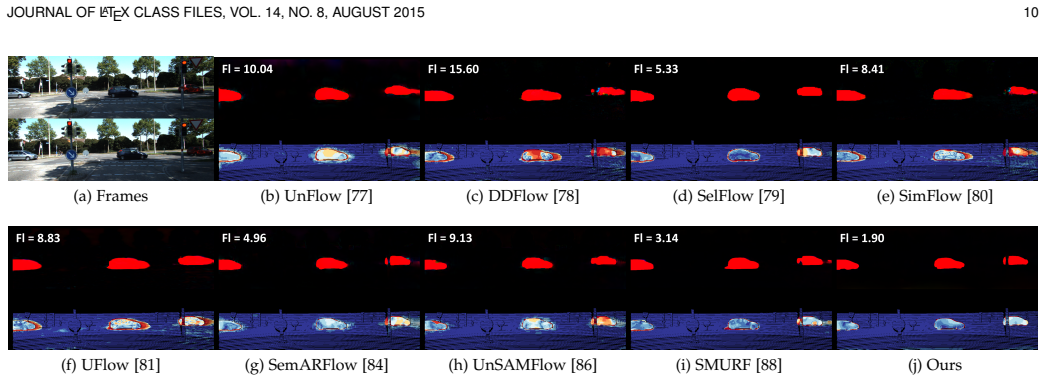
The central claim is that a pipeline built on multi-plane images can generate realistic optical flow training data from a single real-world image, and that models trained on this generated data outperform both supervised models trained on synthetic datasets and unsupervised methods trained on real video. Concretely, the paper reports that its FA-Flow-trained model reaches KITTI 15 end-point error of 1.64 and Fl-all of 5.27, compared with 3.79 and 13.0 for the best compared supervised synthetic-data baseline and 1.76 and 6.43 for the best compared unsupervised baseline. The paper also shows that even with far fewer generated pairs than the synthetic FlyingChairs plus FlyingThings3D combination, training from scratch on real-image-derived data obtains better KITTI accuracy, and that fine-tuning on FA-Flow improves results on the official KITTI test benchmark as well as on downstream video inpainting, unsupervised video segmentation, space-time view synthesis, and point tracking.
Load-bearing premise
The load-bearing assumption is that a monocular depth estimate combined with a planar rigid-motion model produces optical flow labels that match true 3D motion, so inaccurate depth at object boundaries or non-rigid motion will inject wrong labels into the training data.
Editorial extensions
If this is right
- Optical flow models could be pre-trained entirely from unlabeled still images, removing the need for synthetic rendering engines or labeled real video at the data-generation stage.
- Pretraining on FA-Flow before fine-tuning on a small labeled real dataset improves official benchmark performance, suggesting the generated data is a better starting point than the standard synthetic-plus-sparse-real combination.
- Scaling up the number of generated pairs from real images improves flow accuracy, so the method benefits from larger image collections rather than being limited by dataset size.
- Stronger flow estimates from FA-Flow-trained models improve downstream video tasks that rely on motion, including video inpainting, unsupervised video segmentation, and space-time view synthesis.
- In an unsupervised-style setting where only unlabeled target-domain images are available, the generated-data model outperforms existing unsupervised methods, indicating the approach can substitute for unsupervised training pipelines.
Reading between the lines
- If the core premise is right, the practical bottleneck for optical flow training shifts from collecting motion data to the quality of monocular depth and instance segmentation, because those are the only sources of geometric truth in the pipeline.
- The planar rigid-object motion model is likely the ceiling for articulated bodies: people with moving limbs are forced to move as rigid planes, so gains should concentrate on rigid scenes such as driving footage and may be smaller on human-motion benchmarks.
- A testable extension would replace the fixed 64-plane discretization with continuous depth or with multiple independently moving segments per object and measure whether boundary and small-object flow errors drop further.
- The diffusion-inpainted pixels are not verified against any motion signal, so an explicit consistency check between the inpainted content and the rendered flow could reveal how much label noise the inpainting step introduces.
Editorial analysis
A structured set of objections, weighed in public.
Referee Report
Summary. This paper proposes Flow-Anything, a pipeline that generates optical flow training pairs from a single real-world image by lifting it to a multiplane image (MPI) via monocular depth, applying separate virtual camera motions to a detected object and the static background, and compositing the two rendered views with a diffusion inpainting step. The generated FA-Flow dataset (built from roughly six million unlabeled images) is used to train supervised optical flow networks such as SEA-RAFT, RAFT, and FlowFormer++. The paper reports state-of-the-art results on KITTI 2012/2015, Sintel, and Spring, claiming to outperform supervised methods trained on synthetic data and unsupervised methods, and it shows improvements in downstream applications including video inpainting, unsupervised video segmentation, space-time view synthesis, and video editing.
Significance. The central claim, that large-scale real-world single-view images can serve as a source of optical flow supervision and beat synthetic-data training, is important and, if confirmed, would be a valuable step toward scalable flow pretraining. The paper's strengths include a large and diverse training set, a clean validation protocol for Table 3 (validation datasets explicitly excluded from training, marked with a dagger), extensive comparisons across architectures and benchmarks, and a wide range of downstream evaluations. The main empirical result (SEA-RAFT trained on FA-Flow reaching KITTI 15 EPE 1.64 and Fl-all 5.27 versus 4.29 and 14.2 for the C+T baseline) is striking. However, the correctness of the described generation pipeline is not fully established because of several equation-level issues and an unquantified label-image inconsistency introduced by the inpainting step.
major comments (5)
- [3.4, Eq. (13)-(14)] Equation (14) replaces the target image in the regions Minp with diffusion-inpainted content while leaving the optical flow labels Fs->t unchanged. Because no real correspondence exists between the hallucinated pixels and the source image, the flow values in those regions are structurally inconsistent with the image content. The paper does not report the typical area fraction of Minp, nor does it provide an ablation that masks or down-weights these regions in the training loss. This inconsistency directly affects the data pairs used in the headline experiments (Table 3), so the magnitude of the effect must be quantified or the training procedure must be shown to be robust to it.
- [3.3, Eq. (9)] In Eq. (9), the final flow is combined as Fs->t = M * Fobj_s->t + (1 - M) * Fbg_s->t, where M is the source-image object mask from Eq. (3). The rendered flows Fobj_s->t and Fbg_s->t are produced by volume rendering along target-view rays and are therefore defined in target-view coordinates. Combining them with a source-view mask is geometrically inconsistent; the mask must be warped to the target view or the target-view mask Mobj_t must be used. The paper should clarify the coordinate frame or correct the equation.
- [3.4, Eq. (11)-(12)] The occlusion-correction formula in Eq. (12) does not have the stated effect. Since Mocc contains the factor (1 - Mbg_t), the product Mbg_t * Mocc is identically zero, so (1 - Mbg_t * Mocc) is identically 1 and Eq. (12) reduces to It = Mobj_t * Iobj_t + Ibg_t. In regions where the background is in front of the object, this adds both the object and background images instead of selecting the background, contrary to the claim that the formula prevents wrong occlusions. The authors should provide the correct compositing equation or explain how the described implementation avoids this degeneracy.
- [Table 2] The rows for KITTI 15 Train in Table 2 use the KITTI 15 training images as the source for data generation and then evaluate on the KITTI 15 training set (curly-brace entries). This is a same-source, in-domain evaluation rather than a zero-shot cross-dataset result; the caption calls the table 'zero-shot cross-dataset validation results,' which is misleading for those entries. The same-source results should either be removed from the zero-shot table or clearly labeled as an in-domain setting, and the discussion should not cite them as cross-dataset evidence.
- [3.2-3.3] The generated labels rest on the assumptions that monocular depth estimates are sufficiently accurate at boundaries and that all objects move rigidly with a 6DOF camera motion. These assumptions are not directly validated: the paper never compares the generated flow against any known ground-truth motion, even on a small synthetic scene with known depth and camera poses. Since the central claim is that these labels improve real-world flow training, an experiment that isolates label quality (for example, generating pairs from a synthetic dataset with ground-truth depth and comparing the rendered flow to the ground truth, or ablating different depth sources) would materially increase confidence.
minor comments (5)
- [3.3] There is a typo in the sentence 'Thend, we utilize the binary mask to indicate the region of the object'; it should read 'Then, we utilize the binary mask...'.
- [3.3, Eq. (8)] In the sentence following Eq. (8), 'Fobj_s->t indicates the optical flow that matches novel view image Iobj_s' appears to be a typo; the flow matches the target view image Iobj_t, not the source image Iobj_s.
- [3.4] The notation Mbg_t is ambiguous: it is used both as the background object mask and implicitly as a validity mask for rendered background pixels (since Eq. (13) uses (1 - Mbg_t) to denote areas to inpaint). The authors should define Mbg_t explicitly as a validity mask or adjust the equations accordingly.
- [7] The limitations paragraph lists synthesis time and aerial-view coverage but omits the label-image inconsistency caused by the inpainting module; this omission should be corrected in a revision.
- [Abstract] The phrase 'For the first time, we demonstrate the benefits of generating optical flow training data from large-scale real-world images' is strong, given that MPI-Flow (the authors' own prior work) already generated flow from MPI at smaller scale; the novelty statement should distinguish the scale and the new components more carefully.
Circularity Check
No circular derivation chain; the central claim is externally tested. The only self-citation (MPI-Flow) is incremental and not load-bearing.
full rationale
The central claim is that optical flow models trained on FA-Flow data outperform models trained on synthetic data or trained unsupervised. This claim is tested on external benchmarks (KITTI, Sintel, Spring) with official ground-truth labels. The generated flow labels in the paper are computed from virtual camera poses, estimated depth, and plane homographies (Eqs. 2, 5, 8, 9); they are not obtained from the evaluation ground truth. Thus the headline result is not equivalent to its inputs. The authors do build on their own prior MPI-Flow work, citing it as the core MPI-based rendering idea, but they then compare Flow-Anything against MPI-Flow directly in Table 2 and show consistent improvements, so the self-citation is not used to shield the method from comparison. A separate, non-circular correctness concern is that Section 3.4's Depth-Aware Inpainting replaces It via a diffusion model (Eq. 14) after the flow Fs->t has already been rendered, leaving the inpainted regions without a geometrically consistent flow label; this is a quality limitation of the training data, not a circularity of the derivation. The paper's Section 7 limitations acknowledge only synthesis time and aerial-view coverage, not this inpainted-region label inconsistency, so that gap remains under-analyzed. Overall, no load-bearing step reduces to its own output by construction, so the paper receives a low circularity score.
Assumptions & free parameters
free parameters (5)
- Number of MPI planes N =
64
- Virtual camera translation range (tx, ty) =
[-0.2, 0.2]
- Virtual camera translation tz =
[0.1, 0.35]
- Virtual camera rotation Euler angles (ax, ay, az) =
[-pi/90, pi/90]
- Training image crop size =
432x960
assumptions (7)
- domain assumption MPI neural network F (from AdaMPI/MPI-Flow) produces correct color, density, and depth planes
- domain assumption Monocular depth estimate D_s is geometrically consistent
- domain assumption Instance segmentation mask M isolates dynamic objects
- domain assumption Planar homography camera model for object and background motion
- ad hoc to paper Random virtual camera motion is representative of real camera motion
- domain assumption Diffusion inpainting produces plausible content that does not need consistent flow
- domain assumption Uniform disparity sampling of MPI planes adequately covers scene depth
Cite this review
Pith. "Pith review of Flow-Anything: Learning Real-World Optical Flow Estimation from Large-Scale Single-view Images." pith.science (2026). https://pith.science/paper/O7IJG6A2
@misc{pith2026250607740,
  author       = {Pith},
  title        = {Pith review of: Flow-Anything: Learning Real-World Optical Flow Estimation from Large-Scale Single-view Images},
  year         = {2026},
  howpublished = {\url{https://pith.science/paper/O7IJG6A2}},
  note         = {Machine review of arXiv:2506.07740}
}
read the original abstract
Optical flow estimation is a crucial subfield of computer vision, serving as a foundation for video tasks. However, the real-world robustness is limited by animated synthetic datasets for training. This introduces domain gaps when applied to real-world applications and limits the benefits of scaling up datasets. To address these challenges, we propose \textbf{Flow-Anything}, a large-scale data generation framework designed to learn optical flow estimation from any single-view images in the real world. We employ two effective steps to make data scaling-up promising. First, we convert a single-view image into a 3D representation using advanced monocular depth estimation networks. This allows us to render optical flow and novel view images under a virtual camera. Second, we develop an Object-Independent Volume Rendering module and a Depth-Aware Inpainting module to model the dynamic objects in the 3D representation. These two steps allow us to generate realistic datasets for training from large-scale single-view images, namely \textbf{FA-Flow Dataset}. For the first time, we demonstrate the benefits of generating optical flow training data from large-scale real-world images, outperforming the most advanced unsupervised methods and supervised methods on synthetic datasets. Moreover, our models serve as a foundation model and enhance the performance of various downstream video tasks.
Figures


Figures from the paper (10 more)



Forward citations
Cited by 1 Pith paper
-
On the Real-World Generalisability of Optical Flow Models
Progress on Sintel, KITTI and Spring only weakly predicts real-world optical-flow accuracy; lighting and large displacements matter most, and extra synthetic data does not close the gap.
Reference graph
Works this paper leans on
-
[1]
Object tracking in satellite videos based on a multiframe optical flow tracker,
B. Du, S. Cai, and C. Wu, “Object tracking in satellite videos based on a multiframe optical flow tracker,” the IEEE Journal of Selected Topics in Applied Earth Observations and Remote Sensing , vol. 12, no. 8, pp. 3043–3055, 2019
2019
-
[2]
Siamese-detr for generic multi- object tracking,
Q. Liu, Y. Li, Y. Jiang, and Y. Fu, “Siamese-detr for generic multi- object tracking,” IEEE Transactions on Image Processing, vol. 33, pp. 3935–3949, 2024
2024
-
[3]
Optical flow-based segmentation of moving objects for mobile robot navigation using pre-trained deep learning models,
A. I. K ´aroly, R. N. Elek, T. Haidegger, K. Sz ´ell, and P . Galambos, “Optical flow-based segmentation of moving objects for mobile robot navigation using pre-trained deep learning models,” in the IEEE International Conference on Systems, Man and Cybernetic , 2019, pp. 3080–3086
2019
-
[4]
Learning monocular 3d reconstruc- tion of articulated categories from motion,
F. Kokkinos and I. Kokkinos, “Learning monocular 3d reconstruc- tion of articulated categories from motion,” in the IEEE Conference on Computer Vision and Pattern Recognition, 2021, pp. 1737–1746
2021
-
[5]
Flow- fusion: Dynamic dense rgb-d slam based on optical flow,
T. Zhang, H. Zhang, Y. Li, Y. Nakamura, and L. Zhang, “Flow- fusion: Dynamic dense rgb-d slam based on optical flow,” in the IEEE International Conference on Robotics and Automation , 2020, pp. 7322–7328
2020
-
[6]
Improving monocular visual slam in dynamic environments: an optical-flow-based ap- proach,
J. Cheng, Y. Sun, and M. Q.-H. Meng, “Improving monocular visual slam in dynamic environments: an optical-flow-based ap- proach,” Advanced Robotics, vol. 33, no. 12, pp. 576–589, 2019
2019
-
[7]
Pwc-net: Cnns for optical flow using pyramid, warping, and cost volume,
D. Sun, X. Yang, M.-Y. Liu, and J. Kautz, “Pwc-net: Cnns for optical flow using pyramid, warping, and cost volume,” in the IEEE Conference on Computer Vision and Pattern Recognition , 2018, pp. 8934–8943
2018
-
[8]
Raft: Recurrent all-pairs field transforms for optical flow,
Z. Teed and J. Deng, “Raft: Recurrent all-pairs field transforms for optical flow,” in the European Conference on Computer Vision , 2020, pp. 402–419
2020
Show all 94 references
-
[9]
A lightweight optical flow cnn —revisiting data fidelity and regularization,
T.-W. Hui, X. Tang, and C. C. Loy, “A lightweight optical flow cnn —revisiting data fidelity and regularization,” IEEE Transactions on Pattern Analysis and Machine Intelligence , vol. 43, no. 8, pp. 2555– 2569, 2021
2021
-
[10]
Motion detail preserving optical flow estimation,
L. Xu, J. Jia, and Y. Matsushita, “Motion detail preserving optical flow estimation,” IEEE Transactions on Pattern Analysis and Machine Intelligence, vol. 34, no. 9, pp. 1744–1757, 2012
2012
-
[11]
Deep- flow: Large displacement optical flow with deep matching,
P . Weinzaepfel, J. Revaud, Z. Harchaoui, and C. Schmid, “Deep- flow: Large displacement optical flow with deep matching,” in the IEEE International Conference on Computer Vision , 2013, pp. 1385– 1392
2013
-
[12]
Flownet: Learning op- tical flow with convolutional networks,
A. Dosovitskiy, P . Fischer, E. Ilg, P . Hausser, C. Hazirbas, V . Golkov, P . Van Der Smagt, D. Cremers, and T. Brox, “Flownet: Learning op- tical flow with convolutional networks,” in the IEEE International Conference on Computer Vision, 2015, pp. 2758–2766
2015
-
[13]
Flownet 2.0: Evolution of optical flow estimation with deep networks,
E. Ilg, N. Mayer, T. Saikia, M. Keuper, A. Dosovitskiy, and T. Brox, “Flownet 2.0: Evolution of optical flow estimation with deep networks,” in the IEEE Conference on Computer Vision and Pattern Recognition, 2017, pp. 2462–2470
2017
-
[14]
Are we ready for autonomous driving? the kitti vision benchmark suite,
A. Geiger, P . Lenz, and R. Urtasun, “Are we ready for autonomous driving? the kitti vision benchmark suite,” in the IEEE Conference on Computer Vision and Pattern Recognition, 2012, pp. 3354–3361
2012
-
[15]
Object scene flow for autonomous vehicles,
M. Menze and A. Geiger, “Object scene flow for autonomous vehicles,” in the IEEE Conference on Computer Vision and Pattern Recognition, 2015, pp. 3061–3070
2015
-
[16]
Dynamic shape capture via periodical- illumination optical flow estimation and multi-view photometric stereo,
Y. Fu, Y. Liu, and Q. Dai, “Dynamic shape capture via periodical- illumination optical flow estimation and multi-view photometric stereo,” in International Conference on 3D Imaging, Modeling, Process- ing, Visualization and Transmission, 2011, pp. 17–24
2011
-
[17]
Learning optical flow and scene flow with bidirectional camera-lidar fusion,
H. Liu, T. Lu, Y. Xu, J. Liu, and L. Wang, “Learning optical flow and scene flow with bidirectional camera-lidar fusion,” IEEE Transactions on Pattern Analysis and Machine Intelligence , vol. 46, no. 4, pp. 2378–2395, 2024
2024
-
[18]
Dense continuous- time optical flow from event cameras,
M. Gehrig, M. Muglikar, and D. Scaramuzza, “Dense continuous- time optical flow from event cameras,”IEEE Transactions on Pattern Analysis and Machine Intelligence, vol. 46, no. 7, pp. 4736–4746, 2024
2024
-
[19]
How do neural networks estimate optical flow? a neuropsychology- inspired study,
D. B. de Jong, F. Paredes-Vall ´es, and G. C. de Croon, “How do neural networks estimate optical flow? a neuropsychology- inspired study,” IEEE Transactions on Pattern Analysis and Machine Intelligence, vol. 44, no. 11, pp. 8290–8305, 2021
2021
-
[20]
Instance segmen- tation in the dark,
L. Chen, Y. Fu, K. Wei, D. Zheng, and F. Heide, “Instance segmen- tation in the dark,” International Journal of Computer Vision, vol. 131, no. 8, pp. 2198–2218, 2023
2023
-
[21]
Learning optical flow from still images,
F. Aleotti, M. Poggi, and S. Mattoccia, “Learning optical flow from still images,” in the IEEE Conference on Computer Vision and Pattern Recognition, 2021, pp. 15 201–15 211
2021
-
[22]
Realflow: Em-based realistic optical flow dataset generation from videos,
Y. Han, K. Luo, A. Luo, J. Liu, H. Fan, G. Luo, and S. Liu, “Realflow: Em-based realistic optical flow dataset generation from videos,” in the European Conference on Computer Vision , 2022, pp. 288–305
2022
-
[23]
Single-view view synthesis with mul- tiplane images,
R. Tucker and N. Snavely, “Single-view view synthesis with mul- tiplane images,” in the IEEE Conference on Computer Vision and Pattern Recognition, 2020, pp. 551–560
2020
-
[24]
Single-view view synthesis in the wild with learned adaptive multiplane images,
Y. Han, R. Wang, and J. Yang, “Single-view view synthesis in the wild with learned adaptive multiplane images,” in ACM SIGGRAPH, 2022
2022
-
[26]
Virtual kitti 2,
Y. Cabon, N. Murray, and M. Humenberger, “Virtual kitti 2,” arXiv preprint arXiv:2001.10773, 2020
2001 arXiv
-
[27]
Spring: A high-resolution high-detail dataset and benchmark for scene flow, optical flow and stereo,
L. Mehl, J. Schmalfuss, A. Jahedi, Y. Nalivayko, and A. Bruhn, “Spring: A high-resolution high-detail dataset and benchmark for scene flow, optical flow and stereo,” in Proceedings of the IEEE/CVF Conference on Computer Vision and Pattern Recognition , 2023, pp. 4981–4991
2023
-
[28]
Stereo ground truth with error bars,
D. Kondermann, R. Nair, S. Meister, W. Mischler, B. G ¨ussefeld, K. Honauer, S. Hofmann, C. Brenner, and B. J¨ahne, “Stereo ground truth with error bars,” in Asian Conference on Computer Vision, 2015, pp. 595–610
2015
-
[29]
Multi-scale binocular stereo matching based on semantic association,
J. Zheng, B. Jiang, W. Peng, and Q. Zhang, “Multi-scale binocular stereo matching based on semantic association,” Chinese Journal of Electronics, vol. 33, no. 4, pp. 1010–1022, 2024
2024
-
[30]
Liteflownet: A lightweight convolutional neural network for optical flow estimation,
T.-W. Hui, X. Tang, and C. C. Loy, “Liteflownet: A lightweight convolutional neural network for optical flow estimation,” in the IEEE Conference on Computer Vision and Pattern Recognition , 2018, pp. 8981–8989. JOURNAL OF LATEX CLASS FILES, VOL. 14, NO. 8, AUGUST 2015 17
2018
-
[31]
Iterative residual refinement for joint optical flow and occlusion estimation,
J. Hur and S. Roth, “Iterative residual refinement for joint optical flow and occlusion estimation,” in the IEEE Conference on Computer Vision and Pattern Recognition, 2019, pp. 5754–5763
2019
-
[32]
Learning optical flow with adaptive graph reasoning,
A. Luo, F. Yang, K. Luo, X. Li, H. Fan, and S. Liu, “Learning optical flow with adaptive graph reasoning,” in the AAAI Conference on Artificial Intelligence, vol. 36, no. 2, 2022, pp. 1890–1898
2022
-
[33]
Transformer based pluralistic image completion with reduced information loss,
Q. Liu, Y. Jiang, Z. Tan, D. Chen, Y. Fu, Q. Chu, G. Hua, and N. Yu, “Transformer based pluralistic image completion with reduced information loss,” IEEE Transactions on Pattern Analysis and Machine Intelligence, vol. 46, no. 10, pp. 6652–6668, 2024
2024
-
[34]
Flowformer++: Masked cost volume autoencod- ing for pretraining optical flow estimation,
X. Shi, Z. Huang, D. Li, M. Zhang, K. C. Cheung, S. See, H. Qin, J. Dai, and H. Li, “Flowformer++: Masked cost volume autoencod- ing for pretraining optical flow estimation,” in the IEEE Conference on Computer Vision and Pattern Recognition, 2023, pp. 1599–1610
2023
-
[35]
Sea-raft: Simple, efficient, accu- rate raft for optical flow,
Y. Wang, L. Lipson, and J. Deng, “Sea-raft: Simple, efficient, accu- rate raft for optical flow,” arXiv preprint arXiv:2405.14793, 2024
2024 arXiv
-
[36]
Physics-based noise mod- eling for extreme low-light photography,
K. Wei, Y. Fu, Y. Zheng, and J. Yang, “Physics-based noise mod- eling for extreme low-light photography,” IEEE Transactions on Pattern Analysis and Machine Intelligence , vol. 44, no. 11, pp. 8520– 8537, 2022
2022
-
[37]
Relation-guided adversarial learning for data- free knowledge transfer,
Y. Liang and Y. Fu, “Relation-guided adversarial learning for data- free knowledge transfer,” International Journal of Computer Vision , vol. 133, no. 5, pp. 2868–2885, 2025
2025
-
[38]
Guided hyperspectral image denoising with realistic data,
T. Zhang, Y. Fu, and J. Zhang, “Guided hyperspectral image denoising with realistic data,” International Journal of Computer Vision, vol. 130, no. 11, pp. 2885–2901, 2022
2022
-
[39]
Low-light raw video denoising with a high-quality realistic motion dataset,
Y. Fu, Z. Wang, T. Zhang, and J. Zhang, “Low-light raw video denoising with a high-quality realistic motion dataset,” IEEE Transactions on Multimedia, vol. 25, pp. 8119–8131, 2022
2022
-
[40]
Eventhdr: From event to high-speed hdr videos and beyond,
Y. Zou, Y. Fu, T. Takatani, and Y. Zheng, “Eventhdr: From event to high-speed hdr videos and beyond,” IEEE Transactions on Pattern Analysis and Machine Intelligence, vol. 47, no. 1, pp. 32–50, 2024
2024
-
[41]
A database and evaluation methodology for optical flow,
S. Baker, D. Scharstein, J. Lewis, S. Roth, M. J. Black, and R. Szeliski, “A database and evaluation methodology for optical flow,” International Journal of Computer Vision , vol. 92, no. 1, pp. 1–31, 2011
2011
-
[42]
Autoflow: Learning a better training set for optical flow,
D. Sun, D. Vlasic, C. Herrmann, V . Jampani, M. Krainin, H. Chang, R. Zabih, W. T. Freeman, and C. Liu, “Autoflow: Learning a better training set for optical flow,” in the IEEE Conference on Computer Vision and Pattern Recognition, 2021, pp. 10 093–10 102
2021
-
[43]
Mpi-flow: Learning realistic optical flow with multiplane images,
Y. Liang, J. Liu, D. Zhang, and Y. Fu, “Mpi-flow: Learning realistic optical flow with multiplane images,” in the IEEE International Conference on Computer Vision, 2023, pp. 13 857–13 868
2023
-
[44]
Neural volumes: Learning dynamic renderable volumes from images,
S. Lombardi, T. Simon, J. Saragih, G. Schwartz, A. Lehrmann, and Y. Sheikh, “Neural volumes: Learning dynamic renderable volumes from images,” arXiv preprint arXiv:1906.07751, 2019
1906 arXiv
-
[45]
Nerf: Representing scenes as neural radiance fields for view synthesis,
B. Mildenhall, P . P . Srinivasan, M. Tancik, J. T. Barron, R. Ra- mamoorthi, and R. Ng, “Nerf: Representing scenes as neural radiance fields for view synthesis,” Communications of the ACM , vol. 65, no. 1, pp. 99–106, 2021
2021
-
[46]
Hsi-guided intrinsic image decomposition for outdoor scenes,
F. Zhang, S. You, Y. Li, and Y. Fu, “Hsi-guided intrinsic image decomposition for outdoor scenes,” in the IEEE Conference on Computer Vision and Pattern Recognition Workshops , June 2022, pp. 313–322
2022
-
[47]
Geometry-free view syn- thesis: Transformers and no 3d priors,
R. Rombach, P . Esser, and B. Ommer, “Geometry-free view syn- thesis: Transformers and no 3d priors,” in the IEEE International Conference on Computer Vision, 2021, pp. 14 356–14 366
2021
-
[48]
Pixelsynth: Generating a 3d-consistent experience from a single image,
C. Rockwell, D. F. Fouhey, and J. Johnson, “Pixelsynth: Generating a 3d-consistent experience from a single image,” in the IEEE International Conference on Computer Vision, 2021, pp. 14 104–14 113
2021
-
[49]
Mine: Towards continuous depth mpi with nerf for novel view synthe- sis,
J. Li, Z. Feng, Q. She, H. Ding, C. Wang, and G. H. Lee, “Mine: Towards continuous depth mpi with nerf for novel view synthe- sis,” in the IEEE International Conference on Computer Vision , 2021, pp. 12 578–12 588
2021
-
[50]
Depth anything: Unleashing the power of large-scale unlabeled data,
L. Yang, B. Kang, Z. Huang, X. Xu, J. Feng, and H. Zhao, “Depth anything: Unleashing the power of large-scale unlabeled data,” in the IEEE Conference on Computer Vision and Pattern Recognition , 2024, pp. 10 371–10 381
2024
-
[52]
Multiple view geometry,
A. Heyden and M. Pollefeys, “Multiple view geometry,” Emerging Topics in Computer Vision, vol. 3, pp. 45–108, 2005
2005
-
[53]
High-resolution image synthesis with latent diffusion models,
R. Rombach, A. Blattmann, D. Lorenz, P . Esser, and B. Ommer, “High-resolution image synthesis with latent diffusion models,” in the IEEE Conference on Computer Vision and Pattern Recognition , 2022, pp. 10 684–10 695
2022
-
[54]
A naturalistic open source movie for optical flow evaluation,
D. J. Butler, J. Wulff, G. B. Stanley, and M. J. Black, “A naturalistic open source movie for optical flow evaluation,” in the European Conference on Computer Vision, 2012, pp. 611–625
2012
-
[55]
Bdd100k: A diverse driving dataset for hetero- geneous multitask learning,
F. Yu, H. Chen, X. Wang, W. Xian, Y. Chen, F. Liu, V . Madhavan, and T. Darrell, “Bdd100k: A diverse driving dataset for hetero- geneous multitask learning,” in the IEEE Conference on Computer Vision and Pattern Recognition, 2020, pp. 2636–2645
2020
-
[56]
Microsoft coco: Common objects in context,
T.-Y. Lin, M. Maire, S. Belongie, J. Hays, P . Perona, D. Ramanan, P . Doll´ar, and C. L. Zitnick, “Microsoft coco: Common objects in context,” in the European Conference on Computer Vision , 2014, pp. 740–755
2014
-
[57]
Google landmarks dataset v2-a large-scale benchmark for instance-level recognition and retrieval,
T. Weyand, A. Araujo, B. Cao, and J. Sim, “Google landmarks dataset v2-a large-scale benchmark for instance-level recognition and retrieval,” in the IEEE Conference on Computer Vision and Pattern Recognition, 2020, pp. 2575–2584
2020
-
[58]
nuscenes: A mul- timodal dataset for autonomous driving,
H. Caesar, V . Bankiti, A. H. Lang, S. Vora, V . E. Liong, Q. Xu, A. Krishnan, Y. Pan, G. Baldan, and O. Beijbom, “nuscenes: A mul- timodal dataset for autonomous driving,” inthe IEEE Conference on Computer Vision and Pattern Recognition, 2020, pp. 11 621–11 631
2020
-
[59]
Sun rgb-d: A rgb-d scene understanding benchmark suite,
S. Song, S. P . Lichtenberg, and J. Xiao, “Sun rgb-d: A rgb-d scene understanding benchmark suite,” in the IEEE Conference on Computer Vision and Pattern Recognition, 2015, pp. 567–576
2015
-
[60]
Vision meets robotics: The kitti dataset,
A. Geiger, P . Lenz, C. Stiller, and R. Urtasun, “Vision meets robotics: The kitti dataset,” International Journal of Robotics Research, vol. 32, no. 11, pp. 1231–1237, 2013
2013
-
[61]
Indoor segmen- tation and support inference from rgbd images,
N. Silberman, D. Hoiem, P . Kohli, and R. Fergus, “Indoor segmen- tation and support inference from rgbd images,” in the European Conference on Computer Vision, 2012, pp. 746–760
2012
-
[62]
The cityscapes dataset for semantic urban scene understanding,
M. Cordts, M. Omran, S. Ramos, T. Rehfeld, M. Enzweiler, R. Be- nenson, U. Franke, S. Roth, and B. Schiele, “The cityscapes dataset for semantic urban scene understanding,” in the IEEE Conference on Computer Vision and Pattern Recognition, 2016, pp. 3213–3223
2016
-
[63]
A benchmark dataset and evaluation methodology for video object segmentation,
F. Perazzi, J. Pont-Tuset, B. McWilliams, L. Van Gool, M. Gross, and A. Sorkine-Hornung, “A benchmark dataset and evaluation methodology for video object segmentation,” in the IEEE Confer- ence on Computer Vision and Pattern Recognition, 2016, pp. 724–732
2016
-
[64]
Masked-attention mask transformer for universal image segmen- tation,
B. Cheng, I. Misra, A. G. Schwing, A. Kirillov, and R. Girdhar, “Masked-attention mask transformer for universal image segmen- tation,” in the IEEE Conference on Computer Vision and Pattern Recognition, 2022, pp. 1290–1299
2022
-
[65]
Learning to estimate hidden motions with global motion aggregation,
S. Jiang, D. Campbell, Y. Lu, H. Li, and R. Hartley, “Learning to estimate hidden motions with global motion aggregation,” in the IEEE International Conference on Computer Vision , 2021, pp. 9772– 9781
2021
-
[66]
Skflow: Learning optical flow with super kernels,
S. Sun, Y. Chen, Y. Zhu, G. Guo, and G. Li, “Skflow: Learning optical flow with super kernels,” Advances in Neural Information Processing Systems, vol. 35, pp. 11 313–11 326, 2022
2022
-
[67]
Flowformer: A transformer architecture for optical flow,
Z. Huang, X. Shi, C. Zhang, Q. Wang, K. C. Cheung, H. Qin, J. Dai, and H. Li, “Flowformer: A transformer architecture for optical flow,” in the European Conference on Computer Vision, 2022, pp. 668– 685
2022
-
[68]
Dip: Deep inverse patchmatch for high-resolution optical flow,
Z. Zheng, N. Nie, Z. Ling, P . Xiong, J. Liu, H. Wang, and J. Li, “Dip: Deep inverse patchmatch for high-resolution optical flow,” in the IEEE Conference on Computer Vision and Pattern Recognition , 2022, pp. 8925–8934
2022
-
[69]
Explicit motion disentangling for efficient optical flow estimation,
C. Deng, A. Luo, H. Huang, S. Ma, J. Liu, and S. Liu, “Explicit motion disentangling for efficient optical flow estimation,” in the IEEE International Conference on Computer Vision , 2023, pp. 9521– 9530
2023
-
[70]
Craft: Cross-attentional flow transformer for robust optical flow,
X. Sui, S. Li, X. Geng, Y. Wu, X. Xu, Y. Liu, R. Goh, and H. Zhu, “Craft: Cross-attentional flow transformer for robust optical flow,” in the IEEE Conference on Computer Vision and Pattern Recognition , 2022, pp. 17 602–17 611
2022
-
[71]
Recurrent partial kernel network for efficient optical flow estimation,
H. Morimitsu, X. Zhu, X. Ji, and X.-C. Yin, “Recurrent partial kernel network for efficient optical flow estimation,” in the AAAI Conference on Artificial Intelligence , vol. 38, no. 5, 2024, pp. 4278– 4286
2024
-
[72]
Global matching with overlapping attention for optical flow estimation,
S. Zhao, L. Zhao, Z. Zhang, E. Zhou, and D. Metaxas, “Global matching with overlapping attention for optical flow estimation,” in the IEEE Conference on Computer Vision and Pattern Recognition , 2022, pp. 17 592–17 601
2022
-
[73]
Gmflow: Learning optical flow via global matching,
H. Xu, J. Zhang, J. Cai, H. Rezatofighi, and D. Tao, “Gmflow: Learning optical flow via global matching,” in the IEEE Conference on Computer Vision and Pattern Recognition, 2022, pp. 8121–8130. JOURNAL OF LATEX CLASS FILES, VOL. 14, NO. 8, AUGUST 2015 18
2022
-
[74]
Unifying flow, stereo and depth estimation,
H. Xu, J. Zhang, J. Cai, H. Rezatofighi, F. Yu, D. Tao, and A. Geiger, “Unifying flow, stereo and depth estimation,” IEEE Transactions on Pattern Analysis and Machine Intelligence, vol. 45, no. 11, pp. 13 941– 13 958, 2023
2023
-
[75]
Youtube-vos: Sequence-to-sequence video object segmentation,
N. Xu, L. Yang, Y. Fan, J. Yang, D. Yue, Y. Liang, B. Price, S. Cohen, and T. Huang, “Youtube-vos: Sequence-to-sequence video object segmentation,” in the European Conference on Computer Vision, 2018, pp. 585–601
2018
-
[76]
Tartanair: A dataset to push the limits of visual slam,
W. Wang, D. Zhu, X. Wang, Y. Hu, Y. Qiu, C. Wang, Y. Hu, A. Kapoor, and S. Scherer, “Tartanair: A dataset to push the limits of visual slam,” in IEEE/RSJ International Conference on Intelligent Robots and Systems, 2020, pp. 4909–4916
2020
-
[77]
Unflow: Unsupervised learning of optical flow with a bidirectional census loss,
S. Meister, J. Hur, and S. Roth, “Unflow: Unsupervised learning of optical flow with a bidirectional census loss,” in the AAAI Conference on Artificial Intelligence, vol. 32, no. 1, 2018
2018
-
[78]
Ddflow: Learning optical flow with unlabeled data distillation,
P . Liu, I. King, M. R. Lyu, and J. Xu, “Ddflow: Learning optical flow with unlabeled data distillation,” in the AAAI Conference on Artificial Intelligence, vol. 33, no. 01, 2019, pp. 8770–8777
2019
-
[79]
Selflow: Self-supervised learning of optical flow,
P . Liu, M. Lyu, I. King, and J. Xu, “Selflow: Self-supervised learning of optical flow,” in the IEEE Conference on Computer Vision and Pattern Recognition, 2019, pp. 4571–4580
2019
-
[80]
Unsupervised learning of op- tical flow with deep feature similarity,
W. Im, T.-K. Kim, and S.-E. Yoon, “Unsupervised learning of op- tical flow with deep feature similarity,” in the European Conference on Computer Vision, 2020, pp. 172–188
2020
-
[81]
What matters in unsupervised optical flow,
R. Jonschkowski, A. Stone, J. T. Barron, A. Gordon, K. Konolige, and A. Angelova, “What matters in unsupervised optical flow,” in the European Conference on Computer Vision, 2020, pp. 557–572
2020
-
[82]
Upflow: Upsampling pyramid for unsupervised optical flow learning,
K. Luo, C. Wang, S. Liu, H. Fan, J. Wang, and J. Sun, “Upflow: Upsampling pyramid for unsupervised optical flow learning,” in the IEEE Conference on Computer Vision and Pattern Recognition , 2021, pp. 1045–1054
2021
-
[83]
Learning by analogy: Reliable supervision from transformations for unsupervised optical flow estimation,
L. Liu, J. Zhang, R. He, Y. Liu, Y. Wang, Y. Tai, D. Luo, C. Wang, J. Li, and F. Huang, “Learning by analogy: Reliable supervision from transformations for unsupervised optical flow estimation,” in the IEEE Conference on Computer Vision and Pattern Recognition , 2020, pp. 6489–6498
2020
-
[84]
Semarflow: Injecting se- mantics into unsupervised optical flow estimation for autonomous driving,
S. Yuan, S. Yu, H. Kim, and C. Tomasi, “Semarflow: Injecting se- mantics into unsupervised optical flow estimation for autonomous driving,” in the IEEE International Conference on Computer Vision , 2023, pp. 9566–9577
2023
-
[85]
Semi-supervised learning of optical flow by flow supervisor,
W. Im, S. Lee, and S.-E. Yoon, “Semi-supervised learning of optical flow by flow supervisor,” in the European Conference on Computer Vision, 2022, pp. 302–318
2022
-
[86]
Unsamflow: Unsupervised optical flow guided by segment anything model,
S. Yuan, L. Luo, Z. Hui, C. Pu, X. Xiang, R. Ranjan, and D. Deman- dolx, “Unsamflow: Unsupervised optical flow guided by segment anything model,” arXiv preprint arXiv:2405.02608, 2024
2024 arXiv
-
[87]
Self-supervised autoflow,
H.-P . Huang, C. Herrmann, J. Hur, E. Lu, K. Sargent, A. Stone, M.-H. Yang, and D. Sun, “Self-supervised autoflow,” in the IEEE Conference on Computer Vision and Pattern Recognition , 2023, pp. 11 412–11 421
2023
-
[88]
Smurf: Self-teaching multi-frame unsupervised raft with full- image warping,
A. Stone, D. Maurer, A. Ayvaci, A. Angelova, and R. Jonschkowski, “Smurf: Self-teaching multi-frame unsupervised raft with full- image warping,” in the IEEE Conference on Computer Vision and Pattern Recognition, 2021, pp. 3887–3896
2021
-
[89]
Tap-vid: A benchmark for tracking any point in a video,
C. Doersch, A. Gupta, L. Markeeva, A. Recasens, L. Smaira, Y. Ay- tar, J. Carreira, A. Zisserman, and Y. Yang, “Tap-vid: A benchmark for tracking any point in a video,” Advances in Neural Information Processing Systems, vol. 35, pp. 13 610–13 626, 2022
2022
-
[90]
Propainter: Improving propagation and transformer for video inpainting,
S. Zhou, C. Li, K. C. Chan, and C. C. Loy, “Propainter: Improving propagation and transformer for video inpainting,” in the IEEE International Conference on Computer Vision, 2023, pp. 10 477–10 486
2023
-
[91]
Tokencut: Segmenting objects in images and videos with self-supervised transformer and normalized cut,
Y. Wang, X. Shen, Y. Yuan, Y. Du, M. Li, S. X. Hu, J. L. Crowley, and D. Vaufreydaz, “Tokencut: Segmenting objects in images and videos with self-supervised transformer and normalized cut,” IEEE Transactions on Pattern Analysis and Machine Intelligence , vol. 45, no. 12, pp. 1...
2023
-
[92]
Treating motion as option to reduce motion dependency in unsupervised video object segmentation,
S. Cho, M. Lee, S. Lee, C. Park, D. Kim, and S. Lee, “Treating motion as option to reduce motion dependency in unsupervised video object segmentation,” in the IEEE Winter Conference on Appli- cations of Computer Vision, 2023, pp. 5140–5149
2023
-
[93]
Dynamic view syn- thesis from dynamic monocular video,
C. Gao, A. Saraf, J. Kopf, and J.-B. Huang, “Dynamic view syn- thesis from dynamic monocular video,” in the IEEE International Conference on Computer Vision, 2021, pp. 5712–5721
2021
-
[94]
Neural scene flow fields for space-time view synthesis of dynamic scenes,
Z. Li, S. Niklaus, N. Snavely, and O. Wang, “Neural scene flow fields for space-time view synthesis of dynamic scenes,” in the IEEE Conference on Computer Vision and Pattern Recognition , 2021, pp. 6498–6508
2021
-
[95]
FLATTEN: optical FLow-guided ATTENtion for consistent text-to-video editing,
Y. Cong, M. Xu, christian simon, S. Chen, J. Ren, Y. Xie, J.-M. Perez-Rua, B. Rosenhahn, T. Xiang, and S. He, “FLATTEN: optical FLow-guided ATTENtion for consistent text-to-video editing,” in International Conference on Learning Representations, 2024
2024
-
[96]
Tune-a-video: One-shot tuning of image diffusion models for text-to-video generation,
J. Z. Wu, Y. Ge, X. Wang, S. W. Lei, Y. Gu, Y. Shi, W. Hsu, Y. Shan, X. Qie, and M. Z. Shou, “Tune-a-video: One-shot tuning of image diffusion models for text-to-video generation,” in International Conference on Computer Vision, 2023, pp. 7623–7633. Yingping Liang received the...
2023
Reviewed August 7, 2026 · model on record in the stance chip above.
Discussion (0). Sign in to comment.