REVIEW 5 major objections 6 minor 59 references
REMoH: A Reflective Evolution of Multi-objective Heuristics approach via Large Language Models
T0 review · 5 major / 6 minor · reviewed 2026-08-07 · deepseek-v4-flash
Pith's one-line read REMoH shows that an LLM steered by clustering-based reflection can evolve competitive, human-readable multi-objective scheduling heuristics with far less modeling effort than exact or learned methods.
desk verdict Promising framework, but the headline benchmarking result is an artifact of test-set leakage and self-referential metrics. read the letter →
The pith
A machine-rendered reading of the paper's core claim, the machinery that carries it, and where it could break.
The reading
What carries the argument
The load-bearing object is the clustering-reflection mechanism. At each generation, parent heuristics are grouped by their objective-space performance using k-means, with the number of clusters chosen by the silhouette method; the LLM writes a short reflection for each cluster and then combines those short reflections with a long-term reflection from previous generations. That synthesized text is injected into crossover and elitist mutation prompts, so new heuristics are produced by recombining known strengths and avoiding known weaknesses rather than by random variation. Individuals are encoded as executable Python code snippets, which is what makes the heuristics human-readable and lets the LLM edit them directly.
What would settle it
Run the full REMoH pipeline evolving only on Dauzere and Barnes, freeze one evolved heuristic for the entire Brandimarte suite, and recompute the mean makespan and workload-balance gaps; if those gaps rise to the RL baseline range or higher, the competitive-generalization claim fails.
Extended reading notes
Core claim
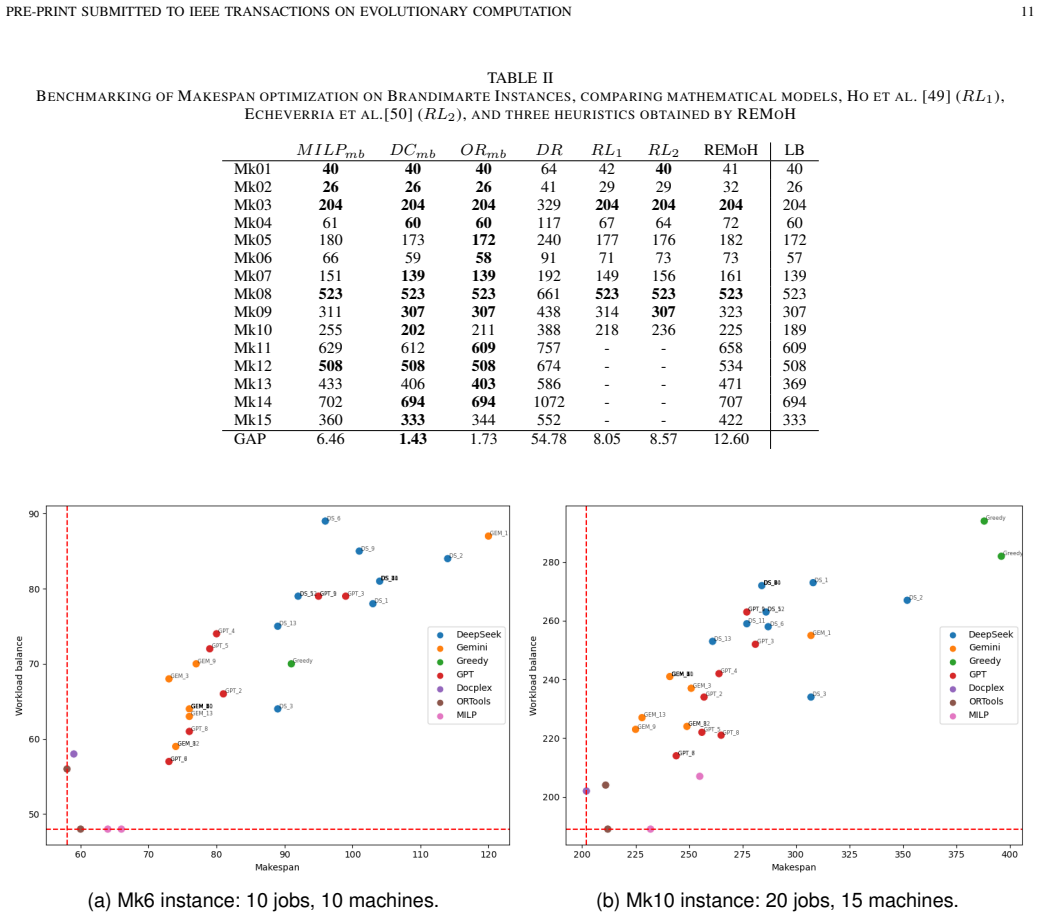
The paper's central claim is that REMoH—an NSGA-II loop whose offspring are LLM-written Python heuristics—produces Pareto fronts on the flexible job shop scheduling problem that are competitive with state-of-the-art mathematical and learning-based methods, while needing only prompt engineering instead of problem-specific modeling. On the Brandimarte suite, the best of 13 non-dominated heuristics selected per instance reach a mean makespan gap of 12.60% and a mean workload-balance gap of 12.15% relative to best-known lower bounds; the RL baselines report makespan gaps of 8.05% and 8.57% but do not optimize workload balance, and constraint programming reaches 1.43% when makespan is the lexicographic priority. The authors further claim that adding a nonlinear sequence-dependent setup-time constraint—a change that breaks MILP and RL pipelines—requires only updating the prompt and feasibility check, and that the resulting heuristics remain readable code rather than black boxes.
Load-bearing premise
The load-bearing premise is that Brandimarte is a held-out evaluation set, but the paper selects both the LLM and the best per-instance heuristic on Brandimarte itself, so the reported generalization is not measured on truly unseen data.
Editorial extensions
If this is right
- A production scheduler can obtain a new heuristic by editing a prompt rather than reformulating a MILP or retraining a policy.
- The same NSGA-II and LLM loop should transfer to other multi-objective problems, since the task description is the only problem-specific input.
- Because the final heuristics are Python code, they can be audited, modified, and reused by humans, which matters in regulated or safety-critical scheduling contexts.
- Nonlinear constraints such as idle-time-dependent setup costs can be absorbed with small prompt changes, something the paper demonstrates for FJSSP.
Reading between the lines
- If the Brandimarte results were recomputed with a single frozen heuristic for all 15 instances instead of per-instance best-of-13 selection, the reported gaps would likely increase; that frozen-heuristic number is the cleaner estimate of true generalization.
- The framework's wall-clock advantage is in the final heuristic runtime, not necessarily in the evolution phase, since each generation calls an LLM API many times; a full cost accounting would determine whether the approach is practical inside a real factory.
- Because clustering reflection uses only objective-space performance, it should transfer to non-scheduling problems with multiple objectives; a natural test is to compare REMoH with and without the reflection on a continuous multi-objective benchmark to isolate the reflection's contribution.
Editorial analysis
A structured set of objections, weighed in public.
Referee Report
Summary. The paper proposes REMoH, a framework that integrates NSGA-II with LLM-generated heuristic code for multi-objective optimization, featuring a clustering-based reflection mechanism that guides crossover and elitist mutation. The method is evaluated on the Flexible Job Shop Scheduling Problem (FJSSP) using Brandimarte, Barnes, and Dauzere instances, with benchmarking against MILP, CP solvers (OR-Tools and DoCplex), a dispatching-rule baseline, and two RL baselines. The paper reports makespan and workload-balance GAPs relative to lower bounds, an ablation of the reflection mechanism via HV/IGD, and a flexibility experiment with nonlinear sequence-dependent setup times.
Significance. If the empirical claims were sound, REMoH would be a useful contribution to the growing literature on LLM-based heuristic generation: the framework is clearly described, the reflection mechanism is a plausible improvement over prior work, and the reported experiments run on modest hardware without a GPU. The authors ship detailed pseudocode and prompt templates, and the makespan/workload comparisons against lower bounds are not circular. However, the central 'competitive results' claim is not supported by the evidence as presented, due to test-set leakage, a self-referential HV/IGD reference set, and the absence of error bars or statistical tests. The gap to CP baselines is large, which further weakens the framing.
major comments (5)
- [Appendix B and Section V-B] The reported benchmark on Brandimarte is not a clean holdout evaluation. Appendix B selects the LLM (Gemini 2.0 Flash) by evaluating Pareto-front heuristics on Brandimarte, and Section V-B states that 'we selected the best result on the makespan-balance objective pair for each instance of Brandimarte among these 13 evolved heuristics.' This per-instance oracle selection uses test labels to pick the best of 13 candidates, making the reported GAPs of 12.60% for makespan and 12.15% for workload an optimistic lower envelope rather than the performance of a single learned heuristic on unseen instances. The 'competitive' claim in the abstract is therefore not supported by the evidence.
- [Section IV-A] The HV/IGD reference set is constructed as the non-dominated front of the union of all solutions from competing heuristics, including REMoH itself. The ablation comparisons in Figures 2 and 5 therefore use a reference set that contains the method under test, which introduces a partially self-referential bias into the claimed improvements in IGD and HV. The makespan/workload comparisons against absolute lower bounds are not circular, so the main benchmarking is not wholly invalidated, but the ablation evidence is weakened.
- [Section IV-A and Tables II–III] No error bars or statistical tests are reported, despite the statement in Section IV-A that 'each metric is obtained by averaging the results obtained in three independent runs.' The GAP differences between REMoH and the CP/RL baselines are large (e.g., 12.60% vs 1.43% makespan GAP in Table II), but without variance or significance testing the reader cannot judge whether the three-run average is stable or whether the apparent differences are meaningful.
- [Section V-B] The benchmarking comparison shows REMoH is substantially worse than the exact CP baselines on both objectives: makespan GAP 12.60% versus 1.43–1.73% for CP, and workload GAP 12.15% versus 0.04% for CP. Even setting aside the leakage issue, the claim of 'competitive results' requires more careful framing, since the method is an order of magnitude worse than CP on workload balance and is also worse than both RL baselines on makespan (8.05% and 8.57% GAP).
- [Section V-C] The flexibility experiment with nonlinear setup times presents only HV/IGD curves (Figures 5a and 5b) with no comparison to any baseline, no quantitative solution-quality measure, and no convergence reference. This demonstrates that the algorithm runs and produces some nondominated front, but it does not empirically support the claim of 'enhanced adaptability' to nonlinear constraints, because there is no evidence that the evolved heuristics produce good schedules under the new constraint.
minor comments (6)
- [Section IV-B] The text is internally ambiguous: it says Brandimarte was used 'solely for training' in the Ablation Study and Flexibility Evaluation, but then says it 'served as the evaluation set' for benchmarking. Please clarify the exact train/validation split used in each experiment, and explain how this is consistent with the model selection in Appendix B.
- [Table II] The REMoH makespan GAP of 12.60% is dominated by a few instances (e.g., Mk02, Mk05, Mk06, Mk13), while many instances are close to the lower bound. Reporting per-instance GAPs or a boxplot would give a more informative picture of the method's behavior.
- [Section V-B] The RL baselines RL1 and RL2 are evaluated only on instances Mk01–Mk10, while REMoH is evaluated on all 15 instances. The mean GAP comparison in Table II is therefore not directly comparable across methods.
- [Appendix B] The LLM selection figures (Figures 6 and 7) show HV and IGD curves without confidence intervals or statistical tests; the claim that Gemini 2.0 Flash is superior to GPT-4o and DeepSeek-V3 is based on visually small final differences.
- [Reproducibility] The paper does not provide the seed heuristic, the full set of role instructions, or the LLM sampling parameters (temperature, response length, etc.), which makes the experiments difficult to reproduce exactly.
- [Typographical errors] There are several typos, including 'respeting constraints' in Prompt 6 and 'earliesF easibletT ime' in Algorithm 2, which should be corrected before publication.
Circularity Check
REMoH's 'competitive' result is partially self-referential: the ablation IGD/HV reference set is built from REMoH's own solutions, and the Brandimarte benchmark selects the best of 13 heuristics after the LLM is chosen on that same test set.
-
self definitional
[Section IV-A (Evaluation and Selection Criteria), paragraph defining the IGD/HV reference set.]
"Due to the lack of ground truth Pareto fronts in most FJSSP datasets, the reference set is constructed as the non-dominated front obtained from the union of all solutions generated by competing heuristics. Then, this Pareto is used to compute the metrics for all individuals."
The IGD/HV reference set is built from the union of all competing solutions, including the very REMoH variants whose convergence the ablation then claims to improve. A method's IGD is measured as the distance from its own solutions to a front that contains those solutions, so a low IGD is partly guaranteed by construction. The reported reflection-vs-no-reflection gap in Figure 2 is therefore not an independent measure of convergence to an external Pareto front. This bias does not affect the makespan/workload GAP tables, which are anchored to MILP/CP lower bounds.
-
fitted input called prediction
[Section V-B (Brandimarte Benchmark) and Appendix B (LLM Selection).]
"Following the experimentation performed in the LLM model selection (see Appendix B), 13 heuristics were obtained in the non-dominated front using Gemini 2.0 Flash in the REMoH framework. To perform the comparison of our approach, we selected the best result on the makespan-balance objective pair for each instance of Brandimarte among these 13 evolved heuristics."
Appendix B selects Gemini 2.0 Flash by 'training on two independent datasets ... Dauzere and Barnes, and validating in the Brandimarte dataset'; the reported benchmark then uses that same test set. Added to the per-instance best-of-13 selection, the reported GAPs (12.60% makespan, 12.15% workload) are a test-set-informed lower envelope over 13 candidates, not the expected performance of a fixed evolved heuristic on unseen instances. The 'prediction' of competitive generalization is therefore partly constructed by the selection procedure rather than independently measured; a clean holdout value would be worse.
full rationale
The central derivation of REMoH itself is not circular: heuristics are LLM-generated, evaluated on FJSSP instances, and the makespan/workload GAP comparisons are made against independent MILP/CP lower bounds and literature RL numbers, not against a quantity defined by REMoH. No load-bearing self-citation chain or uniqueness theorem is invoked. However, two parts of the evidence chain are self-referential. First, the IGD/HV ablation uses a reference set that includes REMoH's own solutions, so the claimed convergence benefit of the reflection mechanism is partly an artifact of the metric definition. Second, the Brandimarte benchmark is not a clean holdout: the LLM is selected by validation on Brandimarte (Appendix B), and the final comparison picks the best of 13 heuristics per instance on Brandimarte (Section V-B). This makes the headline 'competitive results' a partial fit to the test set rather than a predicted generalization. I score 5 rather than higher because the absolute objective values are still produced by running the generated heuristics and are compared with independent lower bounds, so the core claim retains some independent content.
Assumptions & free parameters
free parameters (7)
- Initial population size =
60 (model selection), 30-60 (ablation)
- Working population size =
20
- Iterations =
20
- Crossover rate =
0.9
- Mutation rate =
0.1
- HV reference point =
0.3 per objective
- Setup time function parameters =
1, 10, 20, 0.5
assumptions (5)
- domain assumption K-Means with silhouette method groups heuristics into meaningful performance clusters
- domain assumption The non-dominated front from the union of all methods is a valid proxy for the true Pareto front
- domain assumption LLM-generated Python heuristics are valid and comparable across instances after standard scaling
- standard math Standard NSGA-II selection is applied correctly to code individuals
- ad hoc to paper The seed heuristic and role prompts provide a fair starting point
Cite this review
Pith. "Pith review of REMoH: A Reflective Evolution of Multi-objective Heuristics approach via Large Language Models." pith.science (2026). https://pith.science/paper/AGGFYVKV
@misc{pith2026250607759,
  author       = {Pith},
  title        = {Pith review of: REMoH: A Reflective Evolution of Multi-objective Heuristics approach via Large Language Models},
  year         = {2026},
  howpublished = {\url{https://pith.science/paper/AGGFYVKV}},
  note         = {Machine review of arXiv:2506.07759}
}
read the original abstract
Multi-objective optimization is fundamental in complex decision-making tasks. Traditional algorithms, while effective, often demand extensive problem-specific modeling and struggle to adapt to nonlinear structures. Recent advances in Large Language Models (LLMs) offer enhanced explainability, adaptability, and reasoning. This work proposes Reflective Evolution of Multi-objective Heuristics (REMoH), a novel framework integrating NSGA-II with LLM-based heuristic generation. A key innovation is a reflection mechanism that uses clustering and search-space reflection to guide the creation of diverse, high-quality heuristics, improving convergence and maintaining solution diversity. The approach is evaluated on the Flexible Job Shop Scheduling Problem (FJSSP) in-depth benchmarking against state-of-the-art methods using three instance datasets: Dauzere, Barnes, and Brandimarte. Results demonstrate that REMoH achieves competitive results compared to state-of-the-art approaches with reduced modeling effort and enhanced adaptability. These findings underscore the potential of LLMs to augment traditional optimization, offering greater flexibility, interpretability, and robustness in multi-objective scenarios.
Figures


Figures from the paper (4 more)


Reference graph
Works this paper leans on
-
[1]
When large language model meets optimization,
S. Huang, K. Yang, S. Qi, and R. Wang, “When large language model meets optimization,” Swarm and Evolu- tionary Computation, vol. 90, p. 101663, 2024
work page 2024
-
[2]
Particle swarm optimization algorithm and its applications: a systematic review,
A. G. Gad, “Particle swarm optimization algorithm and its applications: a systematic review,” Archives of com- putational methods in engineering , vol. 29, no. 5, pp. 2531–2561, 2022
work page 2022
-
[3]
J. Tang, G. Liu, and Q. Pan, “A review on representative swarm intelligence algorithms for solving optimization problems: Applications and trends,” IEEE/CAA Journal of Automatica Sinica , vol. 8, no. 10, pp. 1627–1643, 2021
work page 2021
-
[4]
C. Liu and Q. Nie, “A blockchain-based llm-driven energy-efficient scheduling system towards distributed multi-agent manufacturing scenario of new energy ve- hicles within the circular economy,” Computers & In- dustrial Engineering, vol. 201, p. 110889, 2025
work page 2025
-
[5]
An llm-based approach for enabling seamless human-robot collaboration in assembly,
C. Gkournelos, C. Konstantinou, and S. Makris, “An llm-based approach for enabling seamless human-robot collaboration in assembly,” CIRP Annals, vol. 73, no. 1, pp. 9–12, 2024
work page 2024
-
[6]
Evolutionary computation in the era of large language model: Survey and roadmap,
X. Wu, S. hao Wu, J. Wu, L. Feng, and K. C. Tan, “Evolutionary computation in the era of large language model: Survey and roadmap,” 2024. [Online]. Available: https://arxiv.org/abs/2401.10034
arXiv 2024
-
[7]
Leveraging large language models for the generation of novel metaheuristic optimization algorithms,
M. Pluhacek, A. Kazikova, T. Kadavy, A. Viktorin, and R. Senkerik, “Leveraging large language models for the generation of novel metaheuristic optimization algorithms,” in Proceedings of the Companion Conference on Genetic and Evolutionary Computation, ser. GECCO ’23 Companion. New York, NY , USA: Association for Computing Machinery, 2023, p. 1812–1820. [...
-
[8]
Llmoa: A novel large language model assisted hyper- heuristic optimization algorithm,
R. Zhong, A. G. Hussien, J. Yu, and M. Munetomo, “Llmoa: A novel large language model assisted hyper- heuristic optimization algorithm,” Advanced Engineering Informatics, vol. 64, p. 103042, 2025
work page 2025
Show all 59 references
-
[9]
Evolution of heuristics: Towards efficient automatic algorithm design using large language model,
F. Liu, X. Tong, M. Yuan, X. Lin, F. Luo, Z. Wang, Z. Lu, and Q. Zhang, “Evolution of heuristics: Towards efficient automatic algorithm design using large language model,” 2024. [Online]. Available: https://arxiv.org/abs/2401.02051
2024 arXiv
-
[10]
Chen and Y
D. Chen and Y . Huang, “Integrating reinforcement learn- ing and large language models for crop production pro- cess management optimization and control through a new knowledge-based deep learning paradigm,” Computers and Electronics in Agriculture, vol. 232, p. 110028, 2025
2025
-
[11]
The new agronomists: Language models are experts in crop management,
J. Wu, Z. Lai, S. Chen, R. Tao, P. Zhao, and N. Hovakimyan, “The new agronomists: Language models are experts in crop management,” 2024. [Online]. Available: https://arxiv.org/abs/2403.19839
2024 arXiv
-
[12]
Automl-gpt: Automatic machine learning with gpt,
S. Zhang, C. Gong, L. Wu, X. Liu, and M. Zhou, “Automl-gpt: Automatic machine learning with gpt,”
-
[13]
Using large language models for hyperparameter optimization,
M. R. Zhang, N. Desai, J. Bae, J. Lorraine, and J. Ba, “Using large language models for hyperparameter optimization,” 2024. [Online]. Available: https://arxiv. org/abs/2312.04528
2024 arXiv
-
[14]
Large language model agent for hyper-parameter optimization,
S. Liu, C. Gao, and Y . Li, “Large language model agent for hyper-parameter optimization,” 2025. [Online]. Available: https://arxiv.org/abs/2402.01881
2025 arXiv
-
[15]
Understanding llms: A comprehensive overview from training to inference,
Y . Liu, H. He, T. Han, X. Zhang, M. Liu, J. Tian, Y . Zhang, J. Wang, X. Gao, T. Zhong, Y . Pan, S. Xu, Z. Wu, Z. Liu, X. Zhang, S. Zhang, X. Hu, T. Zhang, N. Qiang, T. Liu, and B. Ge, “Understanding llms: A comprehensive overview from training to inference,” Neurocomputing, ...
2025
-
[16]
Promptbreeder: Self-referential self-improvement via prompt evolution,
C. Fernando, D. Banarse, H. Michalewski, S. Osindero, and T. Rocktäschel, “Promptbreeder: Self-referential self-improvement via prompt evolution,” 2023. [Online]. Available: https://arxiv.org/abs/2309.16797
2023 arXiv
-
[17]
Large language models as optimizers,
C. Yang, X. Wang, Y . Lu, H. Liu, Q. V . Le, D. Zhou, and X. Chen, “Large language models as optimizers,” 2024. [Online]. Available: https://arxiv.org/abs/2309.03409
2024 arXiv
-
[18]
Optimus: Optimization modeling using mip solvers and large language models,
A. AhmadiTeshnizi, W. Gao, and M. Udell, “Optimus: Optimization modeling using mip solvers and large language models,” 2023. [Online]. Available: https: //arxiv.org/abs/2310.06116
2023 arXiv
-
[19]
Use your instinct: Instruction optimization for llms using neural bandits coupled with transformers,
X. Lin, Z. Wu, Z. Dai, W. Hu, Y . Shu, S.-K. Ng, P. Jaillet, and B. K. H. Low, “Use your instinct: Instruction optimization for llms using neural bandits coupled with transformers,” 2024. [Online]. Available: https://arxiv.org/abs/2310.02905
2024 arXiv
-
[20]
Leveraging PRE-PRINT SUBMITTED TO IEEE TRANSACTIONS ON EVOLUTIONARY COMPUTATION 20 large language model to generate a novel metaheuristic algorithm with CRISPE framework,
R. Zhong, Y . Xu, C. Zhang, and J. Yu, “Leveraging PRE-PRINT SUBMITTED TO IEEE TRANSACTIONS ON EVOLUTIONARY COMPUTATION 20 large language model to generate a novel metaheuristic algorithm with CRISPE framework,” Cluster Comput. , vol. 27, no. 10, pp. 13 835–13 869, Dec. 2024
2024
-
[21]
Evolutionary computation in the era of large language model: Survey and roadmap,
X. Wu, S.-H. Wu, J. Wu, L. Feng, and K. C. Tan, “Evolutionary computation in the era of large language model: Survey and roadmap,” IEEE Transactions on Evolutionary Computation, vol. 29, no. 2, pp. 534–554, 2025
2025
-
[22]
Algorithm evolution using large language model,
F. Liu, X. Tong, M. Yuan, and Q. Zhang, “Algorithm evolution using large language model,” 2023. [Online]. Available: https://arxiv.org/abs/2311.15249
2023 arXiv
-
[23]
Llamea: A large language model evolutionary algorithm for automatically generat- ing metaheuristics,
N. van Stein and T. Bäck, “Llamea: A large language model evolutionary algorithm for automatically generat- ing metaheuristics,” IEEE Transactions on Evolutionary Computation, vol. PP, pp. 1–1, 12 2024
2024
-
[24]
Evolving code with a large language model,
E. Hemberg, S. Moskal, and U.-M. O’Reilly, “Evolving code with a large language model,” 2024. [Online]. Available: https://arxiv.org/abs/2401.07102
2024 arXiv
-
[25]
Cocoevo: Co-evolution of programs and test cases to enhance code generation,
K. Li, H. Yu, T. Guo, S. Cao, and Y . Yuan, “Cocoevo: Co-evolution of programs and test cases to enhance code generation,” 2025. [Online]. Available: https://arxiv.org/abs/2502.10802
2025 arXiv
-
[26]
Large language model-based evolutionary optimizer: Reasoning with elitism,
S. Brahmachary, S. M. Joshi, A. Panda, K. Koneripalli, A. K. Sagotra, H. Patel, A. Sharma, A. D. Jagtap, and K. Kalyanaraman, “Large language model-based evolutionary optimizer: Reasoning with elitism,” 2024. [Online]. Available: https://arxiv.org/abs/2403.02054
2024 arXiv
-
[27]
Large language models as evolutionary optimizers,
S. Liu, C. Chen, X. Qu, K. Tang, and Y .-S. Ong, “Large language models as evolutionary optimizers,” 2024. [Online]. Available: https://arxiv.org/abs/2310.19046
2024 arXiv
-
[28]
Quality-diversity through ai feedback,
H. Bradley, A. Dai, H. Teufel, J. Zhang, K. Oostermeijer, M. Bellagente, J. Clune, K. Stanley, G. Schott, and J. Lehman, “Quality-diversity through ai feedback,”
-
[29]
Language model crossover: Variation through few-shot prompting,
E. Meyerson, M. J. Nelson, H. Bradley, A. Gaier, A. Moradi, A. K. Hoover, and J. Lehman, “Language model crossover: Variation through few-shot prompting,”
-
[30]
Available: https://arxiv.org/abs/2310
[Online]. Available: https://arxiv.org/abs/2310. 13032
-
[31]
Large language model for multi-objective evolutionary optimization,
F. Liu, X. Lin, Z. Wang, S. Yao, X. Tong, M. Yuan, and Q. Zhang, “Large language model for multi-objective evolutionary optimization,” 2024. [Online]. Available: https://arxiv.org/abs/2310.12541
2024 arXiv
-
[32]
Automatic programming via large language models with population self-evolution for dynamic job shop scheduling problem,
J. Huang, X. Li, L. Gao, Q. Liu, and Y . Teng, “Automatic programming via large language models with population self-evolution for dynamic job shop scheduling problem,” 2024. [Online]. Available: https: //arxiv.org/abs/2410.22657
2024 arXiv
-
[33]
Bradley, H
H. Bradley, H. Fan, T. Galanos, R. Zhou, D. Scott, and J. Lehman, The OpenELM Library: Leveraging Progress in Language Models for Novel Evolutionary Algorithms. Singapore: Springer Nature Singapore, 2024, pp. 177–201. [Online]. Available: https://doi.org/ 10.1007/978-981-99-8413-8_10
2024 doi
-
[34]
Reevo: Large language models as hyper-heuristics with reflective evolution,
H. Ye, J. Wang, Z. Cao, F. Berto, C. Hua, H. Kim, J. Park, and G. Song, “Reevo: Large language models as hyper-heuristics with reflective evolution,” 2024. [Online]. Available: https://arxiv.org/abs/2402.01145
2024 arXiv
-
[35]
Hsevo: Elevating automatic heuristic design with diversity-driven harmony search and genetic algorithm using llms,
P. V . T. Dat, L. Doan, and H. T. T. Binh, “Hsevo: Elevating automatic heuristic design with diversity-driven harmony search and genetic algorithm using llms,” 2024. [Online]. Available: https://arxiv.org/abs/2412.14995
2024 arXiv
-
[36]
Ts-eoh: An edge server task scheduling algorithm based on evolution of heuristic,
W. Yatong, P. Yuchen, and Z. Yuqi, “Ts-eoh: An edge server task scheduling algorithm based on evolution of heuristic,” 2024. [Online]. Available: https://arxiv.org/abs/2409.09063
2024 arXiv
-
[37]
A survey of job shop scheduling problem: The types and models,
H. Xiong, S. Shi, D. Ren, and J. Hu, “A survey of job shop scheduling problem: The types and models,” Computers & Operations Research, vol. 142, p. 105731, 2022
2022
-
[38]
The flexible job shop scheduling problem: A review,
S. Dauzère-Pérès, J. Ding, L. Shen, and K. Tamssaouet, “The flexible job shop scheduling problem: A review,” European Journal of Operational Research , vol. 314, no. 2, pp. 409–432, 2024
2024
-
[39]
Gavval and V
R. Gavval and V . Ravi, Clustering Bank Customer Com- plaints on Social Media for Analytical CRM via Multi- objective Particle Swarm Optimization. Cham: Springer International Publishing, 2020, pp. 213–239. [Online]. Available: https://doi.org/10.1007/978-3-030-33820-6_9
2020 doi
-
[40]
Solving the job-shop schedul- ing problem in the industry 4.0 era,
M. E. Leusin, E. M. Frazzon, M. Uriona Maldonado, M. Kück, and M. Freitag, “Solving the job-shop schedul- ing problem in the industry 4.0 era,” Technologies, vol. 6, no. 4, p. 107, 2018
2018
-
[41]
Routing and scheduling in a flexible job shop by tabu search,
P. Brandimarte, “Routing and scheduling in a flexible job shop by tabu search,” Annals of Operations Research , vol. 41, no. 3, p. 157–183, Sep. 1993. [Online]. Available: http://dx.doi.org/10.1007/BF02023073
1993 doi
-
[42]
Review on flexible job shop scheduling,
J. Xie, L. Gao, K. Peng, X. Li, and H. Li, “Review on flexible job shop scheduling,” IET collaborative intelli- gent manufacturing, vol. 1, no. 3, pp. 67–77, 2019
2019
-
[43]
Ibm ilog cp optimizer for detailed schedul- ing illustrated on three problems,
P. Laborie, “Ibm ilog cp optimizer for detailed schedul- ing illustrated on three problems,” in Integration of AI and OR Techniques in Constraint Programming for Combinatorial Optimization Problems: 6th International Conference, CPAIOR 2009 Pittsburgh, PA, USA, May 27- 31, 200...
2009
-
[44]
Industrial size job shop scheduling tackled by present day cp solvers,
G. Da Col and E. C. Teppan, “Industrial size job shop scheduling tackled by present day cp solvers,” in Principles and Practice of Constraint Programming: 25th International Conference, CP 2019, Stamford, CT, USA, September 30–October 4, 2019, Proceedings 25 . Springer, 2019, ...
2019
-
[45]
Solving the job shop scheduling problem with tabu search,
J. W. Barnes and J. B. Chambers, “Solving the job shop scheduling problem with tabu search,” IIE Transactions, vol. 27, no. 2, pp. 257–263, 1995
1995
-
[46]
V12. 1: User’s manual for cplex,
I. I. Cplex, “V12. 1: User’s manual for cplex,” Interna- tional Business Machines Corporation , vol. 46, no. 53, p. 157, 2009
2009
-
[47]
A multi-action deep reinforcement learning framework for flexible job-shop scheduling problem,
K. Lei, P. Guo, W. Zhao, Y . Wang, L. Qian, X. Meng, and L. Tang, “A multi-action deep reinforcement learning framework for flexible job-shop scheduling problem,” Expert Systems with Applications , vol. 205, p. 117796, 2022
2022
-
[48]
Perron and F
L. Perron and F. Didier, “Cp-sat,” Google, 2024
2024
-
[49]
Residual scheduling: A new reinforcement learning approach to solving job shop scheduling problem,
K.-H. Ho, J.-Y . Cheng, J.-H. Wu, F. Chiang, Y .-C. Chen, Y .-Y . Wu, and I.-C. Wu, “Residual scheduling: A new reinforcement learning approach to solving job shop scheduling problem,” IEEE Access, vol. 12, pp. 14 703– 14 718, 2024
2024
-
[50]
Leveraging constraint programming in a deep learning approach for dynamically solving the flexible job-shop scheduling problem,
I. Echeverria, M. Murua, and R. Santana, “Leveraging constraint programming in a deep learning approach for dynamically solving the flexible job-shop scheduling problem,” Expert Systems with Applications , vol. 265, p. 125895, 2025
2025
-
[51]
Flexible job- PRE-PRINT SUBMITTED TO IEEE TRANSACTIONS ON EVOLUTIONARY COMPUTATION 21 shop scheduling via graph neural network and deep reinforcement learning,
W. Song, X. Chen, Q. Li, and Z. Cao, “Flexible job- PRE-PRINT SUBMITTED TO IEEE TRANSACTIONS ON EVOLUTIONARY COMPUTATION 21 shop scheduling via graph neural network and deep reinforcement learning,” IEEE Transactions on Industrial Informatics, vol. 19, no. 2, pp. 1600–1610, 2022
2022
-
[52]
Sequence-dependent setup time flex- ible job shop scheduling problem to minimise total tardiness,
M. Mousakhani, “Sequence-dependent setup time flex- ible job shop scheduling problem to minimise total tardiness,” International journal of production research , vol. 51, no. 12, pp. 3476–3487, 2013
2013
-
[53]
A simheuristic approach for the flexible job shop scheduling problem with stochastic processing times,
R. H. Caldeira and A. Gnanavelbabu, “A simheuristic approach for the flexible job shop scheduling problem with stochastic processing times,” Simulation, vol. 97, no. 3, pp. 215–236, 2021
2021
-
[54]
A constraint programming formulation of the multi-mode resource-constrained project scheduling problem for the flexible job shop scheduling problem,
F. Yuraszeck, E. Montero, D. Canut-De-Bon, N. Cuneo, and M. Rojel, “A constraint programming formulation of the multi-mode resource-constrained project scheduling problem for the flexible job shop scheduling problem,” IEEE Access, vol. 11, pp. 144 928–144 938, 2023
2023
-
[55]
Gemini 2: Our most capable model yet,
G. DeepMind, “Gemini 2: Our most capable model yet,” https://deepmind.google/discover/blog/ gemini-2-our-most-capable-model-yet, 2023, accessed: 2025-04-15
2023
-
[56]
Deepseek- v3: Scaling mixture-of-experts with multi-head latent attention,
D. Dai, D. Guo, D. Yang, H. Zhang, J. Song, R. Zhang, R. Xu, Q. Zhu, S. Ma, P. Wang et al. , “Deepseek- v3: Scaling mixture-of-experts with multi-head latent attention,” arXiv preprint arXiv:2412.19437 , 2024. APPENDIX E BIOGRAPHY SECTION Diego Forniés-Tabuenca is a final-year...
2024 arXiv
-
[57]
Gpt-4 technical report,
OpenAI, “Gpt-4 technical report,” https://arxiv.org/abs/ 2303.08774, 2023, accessed via ChatGPT (GPT-4o), April 2025
2023 arXiv
-
[2023]
Available: https://arxiv.org/abs/2305
[Online]. Available: https://arxiv.org/abs/2305. 02499
-
[2024]
Available: https://arxiv.org/abs/2302
[Online]. Available: https://arxiv.org/abs/2302. 12170
Reviewed August 7, 2026 · model on record in the stance chip above.
Discussion (0). Sign in to comment.