REVIEW 3 major objections 5 minor 39 references
Quickest Causal Change Point Detection by Adaptive Intervention
T0 review · 3 major / 5 minor · reviewed 2026-08-07 · deepseek-v4-flash
Pith's one-line read By intervening on the origin of a changed causal edge, this paper proves that a centralized CUSUM-type statistic attains the first-order optimal detection delay $\log \gamma / I^{\Delta,[k,j]}_{j,c_j}$, matching the lower bound for any…
desk verdict The adaptive intervention idea is genuinely new and the simulations are compelling, but the central KL divergence formula is algebraically wrong, so the asymptotic optimality theorems do not hold as written. read the letter →
The pith
A machine-rendered reading of the paper's core claim, the machinery that carries it, and where it could break.
The reading
What carries the argument
The central object is the centralization transform of Definition 1: after an intervention $\mathrm{do}(X_i=c_i)$, the non-intervened coordinates are mapped to $Y = [\Sigma^{\mathrm{do}}]^{-1/2}(I - A^{\mathrm{do}})(X^{\mathrm{do}} - \mu^{\mathrm{do}}_x)$. Pre-change this is exactly standard normal; post-change, for an edge-weight perturbation in $[A]_{k,j}$, Proposition 1 shows the mean becomes a single nonzero coordinate at $k$ while the covariance stays close to identity, and intervening on $j$ makes the covariance exactly identity. Algorithm 1 then fixes intervention values $c_j$ so that the KL divergence from intervening on any other node is dominated by a gap $\delta$ for every possible change origin, which is what makes the arg-max intervention rule of Corollary 1 recover the true origin $j$ without knowing which edge changed. The detection statistics are window-limited CUSUM: Multi-AI estimates full mean-covariance pairs over a window of length $O(p^2)$, while Max-AI estimates only per-coordinate means and variances over $O(p)$ and takes the maximum over $p$ separate CUSUM statistics, exploiting the one-dimensional concentration.
What would settle it
Compute $I^{\Delta,[k,j]}_{j,c_j}$ for the $p=6$, $d=2$, $\Delta=0.1$ simulation of Section 7.3 and compare Max-AI's measured expected detection delay at ARL $=10^4$ with $\log(10^4)/I^{\Delta,[k,j]}_{j,c_j}$; if the ratio stays well above 1 as $\gamma$ grows, Theorem 3's first-order optimality fails. A second check: with two simultaneous edge changes, if Max-AI still attains the single-change benchmark $\log \gamma / I^{\Delta,[k,j]}_{j,c_j}$, then Proposition 2's concentration property is not the mechanism that carries the claimed lower bound.
Extended reading notes
Core claim
The central claim, stated on the paper's own terms, is that a single-element change in a linear structural equation model can be detected at the quickest possible rate by actively intervening on the node where the changed edge originates. Under Assumption 1, the centralization transform of Definition 1 sends the post-change distribution of the centralized vector into a normal with mean concentrated on the target node $k$ and covariance a rank-one perturbation of the identity; intervening on the origin $j$ of the changed edge makes that covariance exactly identity and leaves only a scalar mean shift $\Delta c_j / \sigma_k$. Proposition 2 then establishes a strict dominance of KL divergences: for any change location $[k,j]$, the divergence $I^{\Delta,[k,j]}_{j,c_j}$ exceeds every other intervention's divergence by at least $\delta$, and all change information is confined to one dimension. Because of that dominance, the adaptive policies in (24) and (28) identify the optimal intervention node automatically, and Theorems 2 and 3 show the resulting window-limited CUSUM statistics are first-order optimal, i.e., $J(A,T) \sim \log \gamma / I^{\Delta,[k,j]}_{j,c_j}$ as $\gamma \to \infty$, with Max-AI achieving this with an $O(p)$-length window and Multi-AI with an $O(p^2)$-length window but better tolerance for multiple changes.
Load-bearing premise
The entire concentration and optimality argument rests on Assumption 1: the post-change model differs from the pre-change model in exactly one element of exactly one component, with the change magnitude $|\Delta|$ between known bounds. If this fails, for instance if two edges change at once, the single-dimension concentration property of Proposition 2 breaks and Max-AI's first-order optimality is no longer guaranteed, a degradation the paper's own multi-change simulation confirms.
Editorial extensions
If this is right
- Under Assumption 1, Max-AI and Multi-AI reach the asymptotic lower bound, so no detection method using these intervention values can detect the change faster in first-order terms.
- The delay is inversely proportional to $I^{\Delta,[k,j]}_{j,c_j}$, and since Algorithm 1 lets $c_j$ grow with the gap $\delta$, users can trade larger intervention values for shorter detection delay.
- Multi-AI is the safer default when multiple edges may change: its optimality does not rely on single-dimension concentration, and Section 7.6 shows it beats Max-AI in multi-change scenarios.
- No-intervention and random-intervention counterparts (MAX-NI, MULTI-NI, MAX-RI, MULTI-RI) have strictly smaller KL denominators and therefore cannot reach the lower bound, isolating adaptive intervention as the source of the speedup.
- The method transfers to real decision settings where a node's value can be set directly, as demonstrated in the ecological and psychological case studies.
Reading between the lines
- Beyond the paper, the same concentration identity suggests a local version for nonlinear SEMs: around a chosen intervention value, linearization would give an approximate one-dimensional statistic, but no optimality guarantee would carry over.
- A natural testable extension is budgeted intervention: Algorithm 1 currently ignores intervention cost, and Section 6.4 only sketches the trade-off, so an adaptive $\delta$ or $c_j$ rule under a budget could be benchmarked against Theorem 1's bound.
- When the graph itself is unknown, one could combine structure learning with this detector, but the concentration property of Proposition 2 would need re-derivation, since misspecified ancestry destroys the identity covariance of the centralized statistic.
- The paper's one-change assumption is the real boundary: a practical deployment would run a multi-change diagnostic first, or choose Multi-AI, because Max-AI's optimality silently relies on a single changed edge.
Editorial analysis
A structured set of objections, weighed in public.
Referee Report
Summary. This paper studies online change point detection in linear causal structural equation models when the observer can intervene on nodes. It introduces a centralization transform that concentrates a single-edge change in the structural matrix into one coordinate, proposes an intervention-value rule (Algorithm 1), and presents two detection schemes, Multi-AI and Max-AI, with adaptive intervention policies that balance exploration and exploitation. The central theoretical claim is first-order asymptotic optimality: the worst-case detection delay satisfies J ~ log γ / I^{Δ,[k,j]}_{j,c_j} as γ→∞ (Theorems 2 and 3), with a matching lower bound in Theorem 1. The paper supports the claims with extensive simulations and two case studies.
Significance. The problem is well motivated, and the centralization idea is elegant: if the theory were correct, the paper would be a useful first step connecting causal intervention design with quickest change detection. Strengths include the single-dimension concentration property, the exploration-exploitation node-selection framework, and a broad simulation study covering graph size, sparsity, change magnitude, exogenous variance, and multiple-change scenarios, together with two real-data case studies. However, several load-bearing algebraic and conceptual issues in the theoretical sections prevent acceptance in the current form; the core rate constant and the intervention-value rule are not established as written.
major comments (3)
- [Section 4.3, Eq. (11)] The KL divergence in Eq. (11) is algebraically incorrect. For the post-change centralized distribution in Proposition 1, the determinant of the covariance matrix is 1, so the Gaussian KL formula gives D = 1/2[ σ_k^{-2}Δ^2( μ_j^{do} + Σ_{l∈anc(j)} B_{j,l} μ_l^{do} )^2 + σ_k^{-2}Δ^2 Σ_{l∈anc(j)∪j} (B_{j,l})^2 Σ_l ], with no '+1/2' and with the square on B in the second term. This quantity I is the rate constant in Theorems 1-3; the spurious +1/2 does not vanish as γ→∞, so the asserted first-order rate logγ/I is not the true rate. Section 7.4's expression I = 1/2(1 + c_j Δ^2/σ_k^2) is also inconsistent with both Eq. (11) and the corrected formula.
- [Section 4.3, Eq. (42) and Algorithm 1] The dominance condition is incompletely stated. For i∈anc(j)∪0, the inequality I_{j,c_j} − I_{i,c_i} > δ yields c_j² > ( μ_j^{do(i)} + Σ_{l∈anc(j)} B_{j,l} μ_l^{do(i)} )² + Σ_{l∈anc(j)} (B_{j,l})² Σ_l + σ_j² + 2δσ_k²/Δ². Eq. (42) and Algorithm 1 omit the μ_j and σ_j² terms. Consequently the computed intervention values C may violate Proposition 2, and Lemma 3 and Corollary 1, which are used in the optimality proofs, are unsupported as written.
- [Section 6.1, Theorem 1, and Section 6.4] The claimed optimality is relative to intervention values fixed by Algorithm 1, not global optimality over intervention values. The lower bound is taken over detection methods (A,T) in Cγ while C is held fixed, and Section 6.4 itself notes that increasing c_j reduces the detection delay. Without an intervention-cost model the problem is ill-posed because c_j is unbounded; with such a model, Algorithm 1 has no optimality guarantee. The abstract and Section 6 should qualify the optimality claim as optimality among policies that use the proposed intervention-value rule.
minor comments (5)
- [Section 4.3, Eq. (12)] Eq. (12) defines aopt as arg min, but the surrounding text and the definition in (10) require arg max; this appears to be a typo.
- [Appendix B, Eq. (43)] The marginal KL identity is missing a factor 1/2: the correct formula is I_{i,c_i}[k] = I_{i,c_i} − (1/2) log([Cov(Y^{t,do(i)})]_{k,k}) for i≠k. The error is in the proof of Proposition 2; it is conservative for inequality (16), but the proof as written is not correct.
- [Theorem 3] The theorem statement says b = logγ, while Lemma 5 and the proof require b = logγ + logp to guarantee (A*, T^max)∈Cγ; the statement and proof should be reconciled.
- [Section 7.4] The displayed formula I = 1/2(1 + c_j Δ^2/σ_k^2) also omits the square on c_j that would follow from the corrected KL computation; it should be 1/2 c_j² Δ^2/σ_k² (up to the same correction as Eq. (11)).
- [General] There are two items numbered Definition 1 (centralization and sequential intervention policy); the second should be renumbered.
Circularity Check
No significant circularity: the lower and upper bounds are compared within the explicitly scoped class of policies using Algorithm 1 intervention values, and the KL rate is derived from the model rather than fitted.
full rationale
The derivation chain is self-contained. The centralization in Definition 1 is a change of variables; Proposition 1 computes the exact post-change mean and covariance from the linear SEM; Eq. (10)-(11) define the KL divergence from those moments. Algorithm 1 constructs intervention values that make the origin node j the maximum-KL intervention node, and Proposition 2 verifies this by direct algebra. The general lower bound (Theorem 1) is stated for any detection method using the Algorithm 1 intervention values, and the upper bounds (Theorems 2-3) show that the adaptive policies attain that bound by consistency of the windowed MLE estimates (Lemmas 3, 4, 7, 8) together with a standard first-order renewal-type bound (Lemma 9, cited from Fellouris and Veeravalli 2022). The matching asymptotic constants are the same because both bounds are computed for the same model-derived KL quantity, which is the normal form of a lower/upper bound comparison, not a reduction of the prediction to the algorithm's inputs. No fitted parameter is relabeled as a prediction, no load-bearing self-citation appears, and no uniqueness theorem is imported from the authors. The paper explicitly scopes its optimality claim to the intervention-value rule C of Algorithm 1 and even notes in Section 6.4 that increasing c_j would further improve detection, so the claim is relative rather than global; that is a scope limitation, not circularity. A possible algebraic typo in Eq. (11) would be a correctness concern, not a circularity step.
Assumptions & free parameters
free parameters (4)
- Δ_min =
0.1 in simulations, assumed known
- Δ_max =
2 in simulations, assumed known
- δ =
1 in simulations, user-specified
- w and q =
varies, e.g., w=20, q=10
assumptions (6)
- domain assumption The causal graph G and pre-change parameters (A, μ, Σ) are known.
- domain assumption Assumption 1: post-change parameters differ by only one element of one component.
- domain assumption No confounding nodes exist.
- domain assumption Linear SEM with Gaussian exogenous noise.
- standard math Standard results in quickest change detection (Lai 1998, Fellouris and Veeravalli 2022) are applied.
- standard math MLE consistency over bounded parameter space Θ̃.
Cite this review
Pith. "Pith review of Quickest Causal Change Point Detection by Adaptive Intervention." pith.science (2026). https://pith.science/paper/YLMM3LPT
@misc{pith2026250607760,
  author       = {Pith},
  title        = {Pith review of: Quickest Causal Change Point Detection by Adaptive Intervention},
  year         = {2026},
  howpublished = {\url{https://pith.science/paper/YLMM3LPT}},
  note         = {Machine review of arXiv:2506.07760}
}
read the original abstract
We propose an algorithm for change point monitoring in linear causal models that accounts for interventions. Through a special centralization technique, we can concentrate the changes arising from causal propagation across nodes into a single dimension. Additionally, by selecting appropriate intervention nodes based on Kullback-Leibler divergence, we can amplify the change magnitude. We also present an algorithm for selecting the intervention values, which aids in the identification of the most effective intervention nodes. Two monitoring methods are proposed, each with an adaptive intervention policy to make a balance between exploration and exploitation. We theoretically demonstrate the first-order optimality of the proposed methods and validate their properties using simulation datasets and two real-world case studies.
Figures


Figures from the paper (7 more)


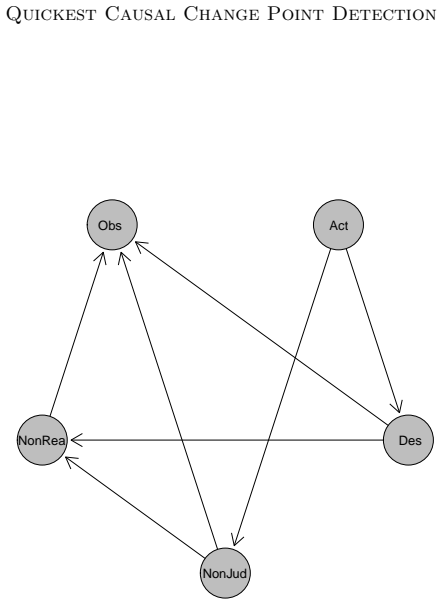
Reference graph
Works this paper leans on
-
[1]
Virginia Aglietti, Xiaoyu Lu, Andrei Paleyes, and Javier Gonz \'a lez. Causal bayesian optimization. In International Conference on Artificial Intelligence and Statistics, pages 3155--3164. PMLR, 2020
work page 2020
-
[2]
Abcd-strategy: Budgeted experimental design for targeted causal structure discovery
Raj Agrawal, Chandler Squires, Karren Yang, Karthikeyan Shanmugam, and Caroline Uhler. Abcd-strategy: Budgeted experimental design for targeted causal structure discovery. In The 22nd International Conference on Artificial Intelligence and Statistics, pages 3400--3409. PMLR, 2019
2019
-
[3]
Efficient change-point detection for tackling piecewise-stationary bandits
Lilian Besson, Emilie Kaufmann, Odalric-Ambrym Maillard, and Julien Seznec. Efficient change-point detection for tackling piecewise-stationary bandits. Journal of Machine Learning Research, 23 0 (77): 0 1--40, 2022
work page 2022
-
[4]
Nicola Branchini, Virginia Aglietti, Neil Dhir, and Theodoros Damoulas. Causal entropy optimization. In International Conference on Artificial Intelligence and Statistics, pages 8586--8605. PMLR, 2023
work page 2023
-
[5]
Sequential change detection of a correlation structure under a sampling constraint
Anamitra Chaudhuri, Georgios Fellouris, and Ali Tajer. Sequential change detection of a correlation structure under a sampling constraint. In 2021 IEEE International Symposium on Information Theory (ISIT), pages 605--610. IEEE, 2021
work page 2021
-
[6]
Environmental controls on modern scleractinian coral and reef-scale calcification
Travis A Courtney, Mario Lebrato, Nicholas R Bates, Andrew Collins, Samantha J De Putron, Rebecca Garley, Rod Johnson, Juan-Carlos Molinero, Timothy J Noyes, Christopher L Sabine, et al. Environmental controls on modern scleractinian coral and reef-scale calcification. Science advances, 3 0 (11): 0 e1701356, 2017
work page 2017
-
[7]
Quickest change detection with controlled sensing
Georgios Fellouris and Venugopal V Veeravalli. Quickest change detection with controlled sensing. In 2022 IEEE International Symposium on Information Theory (ISIT), pages 1921--1926. IEEE, 2022
work page 2022
-
[8]
Causal discovery for non-stationary non-linear time series data using just-in-time modeling
Daigo Fujiwara, Kazuki Koyama, Keisuke Kiritoshi, Tomomi Okawachi, Tomonori Izumitani, and Shohei Shimizu. Causal discovery for non-stationary non-linear time series data using just-in-time modeling. In Conference on Causal Learning and Reasoning, pages 880--894. PMLR, 2023
work page 2023
Show all 39 references
-
[9]
Causal discovery in semi-stationary time series
Shanyun Gao, Raghavendra Addanki, Tong Yu, Ryan Rossi, and Murat Kocaoglu. Causal discovery in semi-stationary time series. Advances in Neural Information Processing Systems, 36, 2024 a
2024
-
[10]
Causal discovery-driven change point detection in time series
Shanyun Gao, Raghavendra Addanki, Tong Yu, Ryan A Rossi, and Murat Kocaoglu. Causal discovery-driven change point detection in time series. arXiv preprint arXiv:2407.07290, 2024 b
2024 arXiv
-
[11]
Review of causal discovery methods based on graphical models
Clark Glymour, Kun Zhang, and Peter Spirtes. Review of causal discovery methods based on graphical models. Frontiers in genetics, 10: 0 524, 2019
2019
-
[12]
Bandit quickest changepoint detection
Aditya Gopalan, Braghadeesh Lakshminarayanan, and Venkatesh Saligrama. Bandit quickest changepoint detection. Advances in Neural Information Processing Systems, 34: 0 29064--29073, 2021
2021
-
[13]
A network approach to the five-facet model of mindfulness
Alexandre Heeren, S \'e verine Lannoy, Charlotte Coussement, Yorgo Hoebeke, Alice Verschuren, M Annelise Blanchard, Nadia Chakroun-Baggioni, Pierre Philippot, and Fabien Gierski. A network approach to the five-facet model of mindfulness. Scientific Reports, 11 0 (1): 0 15094, 2021
2021
-
[14]
Causal discovery and forecasting in nonstationary environments with state-space models
Biwei Huang, Kun Zhang, Mingming Gong, and Clark Glymour. Causal discovery and forecasting in nonstationary environments with state-space models. In International conference on machine learning, pages 2901--2910. Pmlr, 2019
2019
-
[15]
Causal discovery from heterogeneous/nonstationary data
Biwei Huang, Kun Zhang, Jiji Zhang, Joseph Ramsey, Ruben Sanchez-Romero, Clark Glymour, and Bernhard Sch \"o lkopf. Causal discovery from heterogeneous/nonstationary data. Journal of Machine Learning Research, 21 0 (89): 0 1--53, 2020
2020
-
[16]
Causal change point detection and localization
Shimeng Huang, Jonas Peters, and Niklas Pfister. Causal change point detection and localization. arXiv preprint arXiv:2403.12677, 2024
2024 arXiv
-
[17]
Sequential change-point detection in high-dimensional gaussian graphical models
Hossein Keshavarz, George Michaildiis, and Yves Atchad \'e . Sequential change-point detection in high-dimensional gaussian graphical models. Journal of machine learning research, 21 0 (82): 0 1--57, 2020
2020
-
[18]
Sequential changepoint detection in quality control and dynamical systems
Tze Leung Lai. Sequential changepoint detection in quality control and dynamical systems. Journal of the Royal Statistical Society: Series B (Methodological), 57 0 (4): 0 613--644, 1995
1995
-
[19]
Information bounds and quick detection of parameter changes in stochastic systems
Tze Leung Lai. Information bounds and quick detection of parameter changes in stochastic systems. IEEE Transactions on Information theory, 44 0 (7): 0 2917--2929, 1998
1998
-
[20]
Causal bandits: Learning good interventions via causal inference
Finnian Lattimore, Tor Lattimore, and Mark D Reid. Causal bandits: Learning good interventions via causal inference. Advances in neural information processing systems, 29, 2016
2016
-
[21]
Structural causal bandits: Where to intervene? Advances in neural information processing systems, 31, 2018
Sanghack Lee and Elias Bareinboim. Structural causal bandits: Where to intervene? Advances in neural information processing systems, 31, 2018
2018
-
[22]
Structural causal bandits with non-manipulable variables
Sanghack Lee and Elias Bareinboim. Structural causal bandits with non-manipulable variables. In Proceedings of the AAAI Conference on Artificial Intelligence, volume 33, pages 4164--4172, 2019
2019
-
[23]
Random forests for change point detection
Malte Londschien, Peter B \"u hlmann, and Solt Kov \'a cs. Random forests for change point detection. Journal of Machine Learning Research, 24 0 (216): 0 1--45, 2023
2023
-
[24]
Sequential change-point detection procedures that are nearly optimal and computationally simple
Gary Lorden and Moshe Pollak. Sequential change-point detection procedures that are nearly optimal and computationally simple. Sequential Analysis, 27 0 (4): 0 476--512, 2008
2008
-
[25]
Causal discovery and deep learning algorithms for detecting geochemical patterns associated with gold-polymetallic mineralization: A case study of the edongnan region
Zijing Luo and Renguang Zuo. Causal discovery and deep learning algorithms for detecting geochemical patterns associated with gold-polymetallic mineralization: A case study of the edongnan region. Mathematical Geosciences, pages 1--28, 2024
2024
-
[26]
Learning the structure of a nonstationary vector autoregression
Daniel Malinsky and Peter Spirtes. Learning the structure of a nonstationary vector autoregression. In The 22nd International Conference on Artificial Intelligence and Statistics, pages 2986--2994. PMLR, 2019
2019
-
[27]
Optimal stopping times for detecting changes in distributions
George V Moustakides. Optimal stopping times for detecting changes in distributions. the Annals of Statistics, 14 0 (4): 0 1379--1387, 1986
1986
-
[28]
Causal inference, social networks and chain graphs
Elizabeth L Ogburn, Ilya Shpitser, and Youjin Lee. Causal inference, social networks and chain graphs. Journal of the Royal Statistical Society Series A: Statistics in Society, 183 0 (4): 0 1659--1676, 2020
2020
-
[29]
Near-optimal multi-perturbation experimental design for causal structure learning
Scott Sussex, Caroline Uhler, and Andreas Krause. Near-optimal multi-perturbation experimental design for causal structure learning. Advances in Neural Information Processing Systems, 34: 0 777--788, 2021
2021
-
[30]
Sequential analysis: Hypothesis testing and changepoint detection
Alexander Tartakovsky, Igor Nikiforov, and Michele Basseville. Sequential analysis: Hypothesis testing and changepoint detection. CRC press, 2014
2014
-
[31]
Interventions, where and how? experimental design for causal models at scale
Panagiotis Tigas, Yashas Annadani, Andrew Jesson, Bernhard Sch \"o lkopf, Yarin Gal, and Stefan Bauer. Interventions, where and how? experimental design for causal models at scale. Advances in neural information processing systems, 35: 0 24130--24143, 2022
2022
-
[32]
Active bayesian causal inference
Christian Toth, Lars Lorch, Christian Knoll, Andreas Krause, Franz Pernkopf, Robert Peharz, and Julius Von K \"u gelgen. Active bayesian causal inference. Advances in Neural Information Processing Systems, 35: 0 16261--16275, 2022
2022
-
[33]
Sequential anomaly detection under sampling constraints
Aristomenis Tsopelakos and Georgios Fellouris. Sequential anomaly detection under sampling constraints. IEEE Transactions on Information Theory, 69 0 (12): 0 8126--8146, 2022
2022
-
[34]
Causal bandits for linear structural equation models
Burak Varici, Karthikeyan Shanmugam, Prasanna Sattigeri, and Ali Tajer. Causal bandits for linear structural equation models. Journal of Machine Learning Research, 24 0 (297): 0 1--59, 2023
2023
-
[35]
Window-limited cusum for sequential change detection
Liyan Xie, George V Moustakides, and Yao Xie. Window-limited cusum for sequential change detection. IEEE Transactions on Information Theory, 69 0 (9): 0 5990--6005, 2023
2023
-
[36]
Asymptotic optimality theory for active quickest detection with unknown postchange parameters
Qunzhi Xu and Yajun Mei. Asymptotic optimality theory for active quickest detection with unknown postchange parameters. Sequential analysis, 42 0 (2): 0 150--181, 2023
2023
-
[37]
Advances to bayesian network inference for generating causal networks from observational biological data
Jing Yu, V Anne Smith, Paul P Wang, Alexander J Hartemink, and Erich D Jarvis. Advances to bayesian network inference for generating causal networks from observational biological data. Bioinformatics, 20 0 (18): 0 3594--3603, 2004
2004
-
[38]
Partially observable multi-sensor sequential change detection: A combinatorial multi-armed bandit approach
Chen Zhang and Steven CH Hoi. Partially observable multi-sensor sequential change detection: A combinatorial multi-armed bandit approach. In Proceedings of the AAAI Conference on Artificial Intelligence, volume 33, pages 5733--5740, 2019
2019
-
[39]
Bandit change-point detection for real-time monitoring high-dimensional data under sampling control
Wanrong Zhang and Yajun Mei. Bandit change-point detection for real-time monitoring high-dimensional data under sampling control. Technometrics, 65 0 (1): 0 33--43, 2023
2023
Reviewed August 7, 2026 · model on record in the stance chip above.
Discussion (0). Sign in to comment.