REVIEW 3 major objections 4 minor 1 cited by
Experimental Test of the Principle of Tomographic Locality
T0 review · 3 major / 4 minor · reviewed 2026-08-07 · deepseek-v4-flash
Pith's one-line read A direct two-photon experiment finds no violation of tomographic locality—the principle that local measurements fully determine a composite system's state—while a real-amplitude control reproduces the predicted failure signature.
desk verdict First direct test of tomographic locality, with a clean positive control; the transformation-factorization assumption is the main caveat, but it does not sink the result. read the letter →
The pith
A machine-rendered reading of the paper's core claim, the machinery that carries it, and where it could break.
The reading
What carries the argument
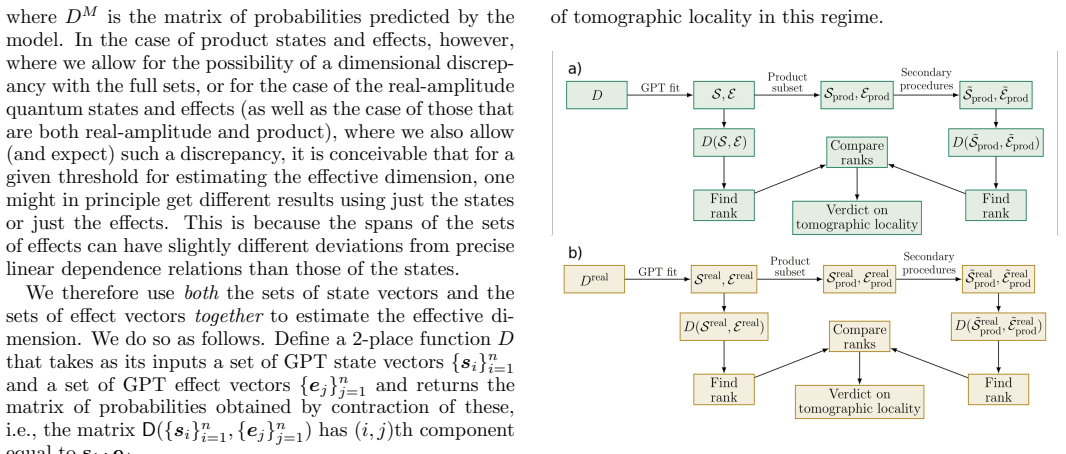
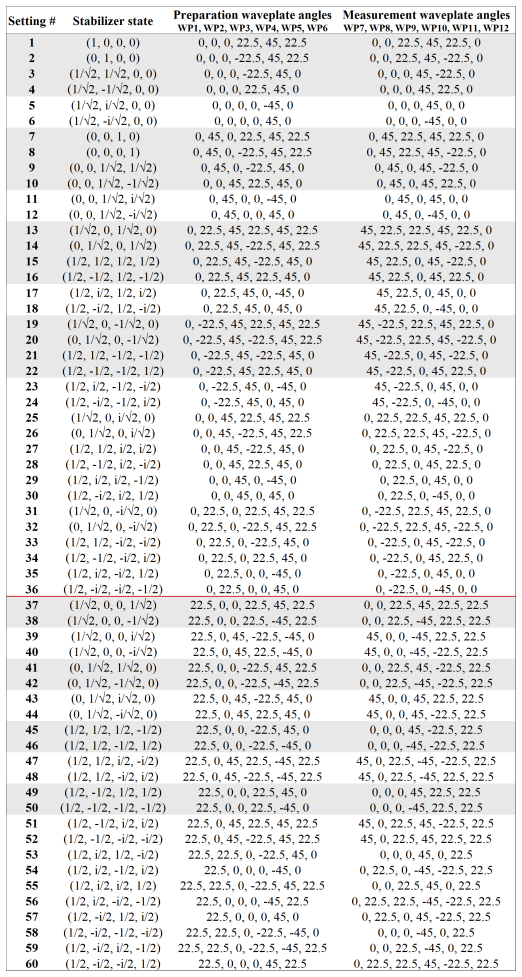
The central object is the matrix of GPT probabilities and its effective rank. States are vectors in a real vector space $V_A \otimes V_B$, effects are vectors in the dual space, and measurement probabilities are inner products collected in a matrix $D_M = S E$. The tensor product structure is defined operationally through the transformations: each mode's waveplates are modeled as acting independently, so $T = T_A \otimes T_B$. For preparations and measurements that target product states, the authors use the secondary-procedure technique to find the closest strictly factorizing state or effect inside the convex hull of all fitted states or effects. They then form the matrices $D(S,E)$, $D(\tilde{S}_{\mathrm{prod}}, \tilde{E}_{\mathrm{prod}})$ and their real-amplitude analogues, and compare effective ranks by counting singular values above a noise-calibrated threshold. The stabilizer formalism supplies the 60 states and 60 effects, with 36 product, 24 entangled, and a 24-element real-amplitude subset.
What would settle it
Take the same two-photon setup and intentionally make the two modes' transformations non-factorizing, for example by inserting a single waveplate that acts jointly on both modes before the measurement stage, and re-run the GPT fit; if the effective rank of the product-state matrix rises toward the full rank even though the physical state space is unchanged, then the factorization assumption, rather than tomographic locality, is carrying the verdict.
Extended reading notes
Core claim
On the paper's own terms, the central discovery is a method and a null result: tomographic locality can be tested in a prepare-and-measure experiment without presupposing quantum mechanics, and when the test is run on the polarization of two photonic modes, the effective rank of the full state-effect matrix and the effective rank of the strictly product state-effect matrix both come out to 16, so there is no evidence that non-separable measurements reveal anything beyond the local statistics. The same analysis applied to the real-amplitude subset yields effective ranks 10 and 9, a mismatch that is exactly the signature of a failure of tomographic locality. The paper takes this control result as confirmation that the method is sensitive enough to detect the phenomenon it is designed to test, and as support for the meaningfulness of the full-data null result.
Load-bearing premise
The load-bearing premise is that the transformations applied to the two photonic modes factorize across the modes as $T = T_A \otimes T_B$, since this factorization is what operationally defines the tensor product structure that separates product from entangled states, and a significant violation of it would distort the inferred product subspace and the rank comparison.
Editorial extensions
If this is right
- A direct experimental route is now open for testing any proposed failure of tomographic locality: prepare a tomographically complete set of states and effects, fit a GPT model, construct strictly product secondary states, and compare effective ranks.
- The equal 16-versus-16 ranks in the full data set mean that, at the achieved precision, local measurements are sufficient to characterize the photon-pair state, just as complex quantum theory predicts.
- The 10-versus-9 rank gap in the real-amplitude control shows the method would catch a genuine failure of tomographic locality, lending weight to the null result in the full data.
- Defining the tensor product structure through factorizing transformations rather than through preparations or measurements gives an operational way to identify bipartite structure when states and effects are slightly non-product, which is also needed for experimental entanglement assessment.
Reading between the lines
- The rank-gap diagnostic could be applied to other foil theories, such as quaternionic or fermionic quantum theory, where the failure of tomographic locality should produce its own characteristic dimensional deficit.
- Because the verdict depends on a singular-value threshold calibrated from noise, replacing the threshold with a Bayesian or likelihood-based rank comparison could turn the binary pass/fail into a continuous bound on how much the product sector can deviate from the full sector.
- A calibration experiment that deliberately introduces coupling between the two modes' transformations and watches how the inferred product rank responds would turn the factorization assumption from a postulate into a measured quantity.
Editorial analysis
A structured set of objections, weighed in public.
Referee Report
Summary. The paper reports an experimental test of tomographic locality using the polarization degrees of freedom of a pair of photonic modes in a prepare-and-measure scenario. The data are analyzed within the framework of generalized probabilistic theories (GPTs): a GPT tomography fit is performed with the tensor product structure defined by imposing exact factorization on the transformation procedures, T = T_A ⊗ T_B. The authors reconstruct sets of GPT state and effect vectors, use secondary procedures to infer strictly factorizing states and effects from the convex hull of the reconstructed sets, and compare the effective ranks of the full and product matrices. For the full 60×60 dataset they find effective rank 16 for both D(S,E) and D(˜Sprod,˜Eprod), concluding that there is no evidence for a failure of tomographic locality. For the 24×24 real-amplitude submatrix they find effective ranks 10 and 9 respectively, reproducing the expected failure signature and serving as a positive control.
Significance. If the central result is sound, this is the first direct experimental test of tomographic locality, a central axiom in GPT reconstructions of quantum theory. The analysis is theory-agnostic, uses cross-validation to select the model dimension, and includes a positive control that correctly detects a known violation (real-amplitude quantum theory); these are genuine strengths. The main null result is also robust in the sense that the relevant singular values are large and well separated, so the conclusion does not hinge on a fine-tuned threshold. However, the validity of the result depends on the empirical justification of the factorization assumption that defines the tensor product structure, and on the gauge invariance of the secondary-procedure objective; these points need to be established before the headline claim can be fully accepted.
major comments (3)
- [Sec. III C] The tensor product structure that defines 'product' is fixed by imposing exact factorization on the transformations, T = T_A ⊗ T_B. The paper states that deviations from factorization are 'much smaller' for transformations than for preparations or measurements, but no quantitative bound, calibration, or sensitivity analysis is provided. Since the secondary-procedure construction and the inferred product subspace are defined relative to this structure, a non-factorizing component in the realized transformations could deform the inferred product subspace and shift the effective ranks in either direction. The real-amplitude control shares the same factorization assumption, so it cannot by itself rule out such a systematic distortion. Please provide a quantitative test of the factorization assumption, for example by independently characterizing the realized transformations or by injecting non-factorizing perturbations into the fit and showing that the rank comparison is stable.
- [Eq. (1) and Sec. II] The secondary-procedure objective minimizes the 2-norm |s_sec − s| in the GPT vector space, but the GPT representation is fixed only up to the gauge freedom D_M = SΛΛ^{-1}E noted in the footnote to Eq. (1). The closest factorizing vector, and hence the matrices D(˜Sprod,˜Eprod) and their effective ranks, are not shown to be gauge-invariant. Because the factorization constraint on transformations is also representation-dependent, the reported rank comparison may depend on an arbitrary gauge choice. The authors should either fix a canonical gauge and justify it, or replace the 2-norm in Eq. (1) with a gauge-invariant measure based directly on the data matrix.
- [Sec. III D] The optimization in Eq. (1) is nonconvex, because the factorizing constraint s_sec = s_A ⊗ s_B is bilinear, and the paper reports no information about multiple random restarts, convergence diagnostics, or global optimality for the SLSQP runs. If the optimizer returns local minima for some of the secondary states or effects, the effective rank of D(˜Sprod,˜Eprod) could be underestimated or overestimated. Please report the distribution of objective values over restarts and the sensitivity of the final ranks to the initialization, at least for the secondary procedures used in the central comparison.
minor comments (4)
- [Fig. 5 caption vs Sec. IV] The caption of Fig. 5 says that the shaded regions denote singular values below 10^{-1.6}, which are treated as effectively zero, while the text in Sec. IV states that the threshold is 10^{-1}. These numbers should be reconciled.
- [Sec. IV] In the paragraph describing the real-amplitude analysis, the sentence 'We can then compute D(S,E) and D(˜Sprod,˜Eprod)' should presumably refer to D(S_real,E_real) and D(˜S_real_prod,˜E_real_prod), consistent with the notation used elsewhere.
- [Introduction and Sec. III D] There are minor typographical errors: 'for the the insight' appears in the Introduction, and 'factorizng' appears in Sec. III D. These should be corrected.
- [Footnote 4] The parameter count for the structured parameterization is written as '2(d^2 − 1) + 13d^2 + 13d^2 + 2d^2'; the duplication of the 13d^2 term is confusing and should be explained or corrected.
Circularity Check
No circularity: the rank-comparison verdict is independent of the fitted model, and the paper's self-citations are method references, not load-bearing premises.
full rationale
The derivation chain is not circular. GPT tomography fits a state set S and effect set E from the raw data D without assuming tomographic locality (Sec. II). The tensor product structure is fixed by the operational assumption that the implemented transformations factorize as T = T_A ⊗ T_B (Sec. III C), and product representatives are then inferred by secondary procedures: for each targeted product state s, Eq. (1) minimizes |s_sec − s|_2 subject to s_sec being a convex combination of the fitted states and strictly factorizing. This optimization does not by construction force the span of the resulting product vectors to equal the span of S; indeed, in the real-amplitude control the procedure yields a 9-dimensional product span inside a 10-dimensional full span, so the method can detect a failure of tomographic locality. The full-quantum verdict is therefore an experimental rank comparison, not an artifact of the fitting procedure. The self-citations (Refs. [16, 17]) are to the authors' own GPT-tomography framework, but the framework is used as a tool and is benchmarked here against the known real-amplitude prediction, so the central claim does not reduce to a self-citation chain. The singular-value threshold of 10^{-1} is calibrated using the experimental noise estimate, which is mildly self-referential, but the reported spectral gaps are large (order-1 singular values versus 10^{-1.6} and 10^{-3.1}), so the verdict is robust to the choice of threshold; this is a noise calibration rather than a circular derivation. The factorization assumption on transformations is a substantive experimental assumption and a legitimate correctness risk (the paper does not quantify its deviation), but it is not a case of a prediction being equivalent to its inputs by construction.
Assumptions & free parameters
free parameters (1)
- singular value threshold =
10^-1
assumptions (3)
- domain assumption GPT framework: states, effects, and transformations are represented as vectors and linear maps on a real vector space; composite systems are embedded in the tensor product of subsystem spaces.
- domain assumption Experimental procedures can be varied independently (circuit independence) and runs are independent and identically distributed.
- ad hoc to paper The realized transformation procedures are exactly (or nearly exactly) factorizing across the two photonic modes, and this defines the operational tensor product structure.
Cite this review
Pith. "Pith review of Experimental Test of the Principle of Tomographic Locality." pith.science (2026). https://pith.science/paper/BYWQJVUT
@misc{pith2026250607775,
  author       = {Pith},
  title        = {Pith review of: Experimental Test of the Principle of Tomographic Locality},
  year         = {2026},
  howpublished = {\url{https://pith.science/paper/BYWQJVUT}},
  note         = {Machine review of arXiv:2506.07775}
}
read the original abstract
The principle of tomographic locality states that the operational state of a multipartite system can be fully characterized by the statistics obtained from measurements that are local to the individual subsystems. This property holds in quantum theory and features prominently in axiomatic reconstructions of the theory, where it serves to rule out a wide class of alternatives. For instance, quantum theory with Hilbert spaces defined over the real field (rather than the complex field) is an example of a theory that is ruled out in this fashion. Given its foundational importance, it is worthwhile to subject this principle to a direct experimental test. Specifically, we consider an experiment on the polarization degrees of freedom of a pair of photonic modes in a prepare-and-measure scenario and analyze the resulting data within the framework of generalized probabilistic theories. The signature of a failure of tomographic locality is that there are pairs of states on the bipartite system that can only be distinguished by the statistics they yield for non-separable measurements. In the full quantum setting, we find no evidence of a violation of tomographic locality. As a test of our analysis method, we also verify that if we restrict attention to those states and measurements that lie within the fragment described by quantum theory over the real field, then a clear signature of the failure of tomographic locality is observed.
Figures


Figures from the paper (3 more)


Forward citations
Cited by 1 Pith paper
-
Decoupling local classicality from classical explainability: A noncontextual model for bilocal classical theory and a locally-classical but contextual theory
Bilocal classical theory has a classical ontological model, but some locally-classical latent theories do not, so local classicality and classical explainability are logically independent.
Reference graph
Works this paper leans on
-
[1]
Hardy, Quantum theory from five reasonable axioms, arXiv preprint quant-ph/0101012 (2001)
L. Hardy, Quantum theory from five reasonable axioms, arXiv preprint quant-ph/0101012 (2001)
arXiv 2001
-
[2]
J. Barrett, Information processing in generalized probabilis- tic theories, Physical Review A—Atomic, Molecular, and Optical Physics75, 032304 (2007)
work page 2007
-
[3]
G. Chiribella, G. M. D’Ariano, and P. Perinotti, Proba- bilistic theories with purification, Phys. Rev. A81, 062348 (2010)
work page 2010
-
[4]
M. M¨ uller, Probabilistic theories and reconstructions of quantum theory, SciPost Physics Lecture Notes , 028 (2021)
work page 2021
-
[5]
Hardy, Reconstructing quantum theory (2013), arXiv:1303.1538 [quant-ph]
L. Hardy, Reconstructing quantum theory (2013), arXiv:1303.1538 [quant-ph]
arXiv 2013
-
[6]
D. Centeno, M. Erba, D. Schmid, J. H. Selby, R. W. Spekkens, S. Soltani, J. Surace, A. Wilce, and Y. Y ¯ ıng, Twirled worlds: symmetry-induced failures of tomographic locality, arXiv preprint arXiv:2407.21688 (2024)
arXiv 2024
-
[7]
E. C. Stueckelberg, Quantum theory in real hilbert space, Helv. Phys. Acta33, 458 (1960)
work page 1960
-
[8]
H. Araki, On a characterization of the state space of quan- tum mechanics, Communications in Mathematical Physics 75, 1 (1980)
work page 1980
Show all 21 references
-
[9]
W. K. Wootters, Local accessibility of quantum states, Complexity, entropy and the physics of information8, 39 (1990)
1990
-
[10]
For instance, the pair of stabilizer statesρ ± := 1 4 (I⊗I±Y⊗Y) are in the real-amplitude sector and have nonzero components on these Hermitian operator
This is because the span of two-qubit Hermitian oper- ators that are real-amplitude includes a tensor product of single-qubit Hermitian operators that arenotthemselves real-amplitude, namely, the product of the PauliYopera- tor with itself,Y⊗Y. For instance, the pair of stabil...
-
[11]
G. M. D’Ariano, F. Manessi, P. Perinotti, and A. Tosini, Fermionic computation is non-local tomographic and vio- lates monogamy of entanglement, Europhysics Letters107, 11 20009 (2014)
2014
-
[12]
G. M. D’Ariano, F. Manessi, P. Perinotti, and A. Tosini, The Feynman problem and fermionic entanglement: Fermionic theory versus qubit theory, International Jour- nal of Modern Physics A29, 1430025 (2014)
2014
-
[13]
G. M. D’Ariano, M. Erba, and P. Perinotti, Classical- ity without local discriminability: Decoupling entangle- ment and complementarity, Physical Review A102, 052216 (2020)
2020
-
[14]
C. M. Scandolo, Information-theoretic foundations of thermodynamics in general probabilistic theories (2019), arXiv:1901.08054 [quant-ph]
2019 arXiv
-
[15]
Chiribella, L
G. Chiribella, L. Giannelli, and C. M. Scandolo, Bell non- locality in classical systems coexisting with other system types, Phys. Rev. Lett.132, 190201 (2024)
2024
-
[16]
Barnum, M
H. Barnum, M. A. Graydon, and A. Wilce, Composites and categories of Euclidean Jordan algebras, Quantum4, 359 (2020)
2020
-
[17]
M. D. Mazurek, M. F. Pusey, K. J. Resch, and R. W. Spekkens, Experimentally bounding deviations from quan- tum theory in the landscape of generalized probabilistic the- ories, PRX Quantum2, 020302 (2021)
2021
-
[18]
M. J. Grabowecky, C. A. Pollack, A. R. Cameron, R. W. Spekkens, and K. J. Resch, Experimentally bounding devi- ations from quantum theory for a photonic three-level sys- tem using theory-agnostic tomography, Physical Review A 105, 032204 (2022)
2022
-
[19]
P. J. Daley, K. J. Resch, and R. W. Spekkens, Experimen- tally adjudicating between different causal accounts of bell- inequality violations via statistical model selection, Physi- cal Review A105, 042220 (2022)
2022
-
[20]
Virtanen, R
P. Virtanen, R. Gommers, T. E. Oliphant, M. Haber- land, T. Reddy, D. Cournapeau, E. Burovski, P. Peterson, W. Weckesser, J. Bright,et al., Scipy 1.0: fundamental al- gorithms for scientific computing in python, Nature meth- ods17, 261 (2020)
2020
-
[21]
Gottesman, The heisenberg representation of quantum computers (1998), arXiv:quant-ph/9807006
D. Gottesman, The heisenberg representation of quantum computers (1998), arXiv:quant-ph/9807006. APPENDIX A: ST ABILIZER ST A TES The pure stabilizer states of a two-qubit system are de- fined as the +1 eigenstates of maximal commuting sets of tensor products of Pauli operator...
1998 arXiv
Reviewed August 7, 2026 · model on record in the stance chip above.
Discussion (0). Sign in to comment.