REVIEW 5 major objections 5 minor 19 references
Design and Evaluation of Deep Learning-Based Dual-Spectrum Image Fusion Methods
T0 review · 5 major / 5 minor · reviewed 2026-08-07 · deepseek-v4-flash
Pith's one-line read Standard pixel-level fusion metrics do not predict whether fused visible-infrared images will improve object detection, and task-aware fusion methods outperform single-modality inputs in low-light and occluded scenes.
desk verdict A new campus visible-infrared fusion dataset and a task-aware evaluation protocol worth a serious referee, but the paper's headline claim that fused images significantly beat single modalities is unsupported by its own LLVIP numbers and the SSIM table has an impossible value. read the letter →
The pith
A machine-rendered reading of the paper's core claim, the machinery that carries it, and where it could break.
The reading
What carries the argument
The load-bearing mechanism is the three-pronged evaluation protocol, especially the downstream detection leg built on the Lang-Segment-Anything pipeline, which uses Grounding DINO for text-prompt open-set detection and SAM for segmentation. Because Lang-Segment-Anything is zero-shot and needs no retraining per input type, the authors use it to compare visible, infrared, and fused inputs on an equal footing, reporting mean average precision at 0.5 IoU (mAP@50) as the headline number. The campus dataset supplies the scenario diversity, including smoke and underpass lighting, where modality advantages differ most.
What would settle it
Retrain a standard detector, such as YOLO, separately on infrared-only, visible-only, and fused images from the same pair set and re-measure mAP@50; if infrared-only or visible-only inputs match or beat fused inputs once the detector is trained on that modality, the paper's conclusion that fusion significantly enhances detection would be contradicted. A cheaper check would be running the Lang-Segment-Anything pipeline on infrared images with a thermal-tailored text prompt and seeing whether its infrared detection rate changes.
Extended reading notes
Core claim
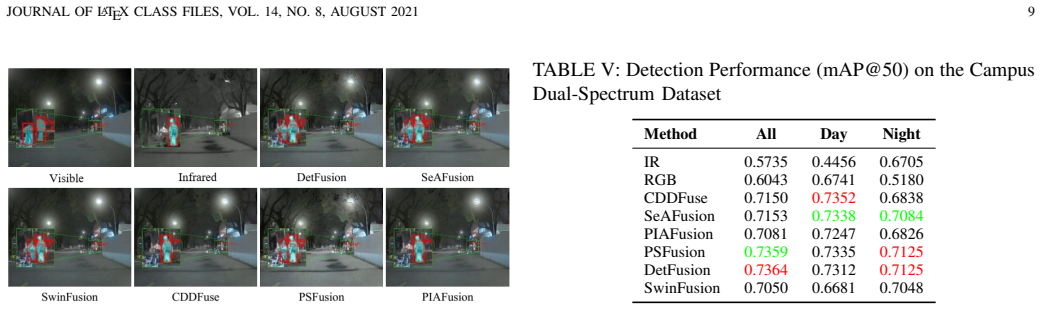
The paper's central claim is that the value of a visible-infrared fusion method should be judged by how much it helps a downstream task, not by pixel-level statistics alone. On the authors' campus dataset, every fusion method (mAP@50 from 0.705 to 0.736) outperformed infrared-only (0.5735) and visible-only (0.6043) inputs overall; on the LLVIP dataset, CDDFuse (0.8563) and SeAFusion (0.8560) edged out infrared-only (0.8546) and clearly beat visible-only (0.7929). At night, PSFusion and DetFusion led, while in daytime CDDFuse and SeAFusion led. The paper interprets this as evidence that fusion's benefit is task-dependent and that general metrics such as entropy and SSIM rank methods differently from detection accuracy.
Load-bearing premise
The fairness of the downstream comparison rests on the untested premise that the Lang-Segment-Anything detector perceives infrared, visible, and fused images with equal competence, even though it was pre-trained on natural RGB images.
Editorial extensions
If this is right
- Fused images beat single-modality inputs for pedestrian detection in low-light and occluded scenes, so fusion remains a useful preprocessing step for perception systems.
- Algorithms optimized with high-level vision supervision, such as DetFusion and SeAFusion, give balanced performance across both pixel metrics and detection, supporting task-aware fusion design.
- General-purpose metrics (EN, SD, PSNR, SSIM) should not be used alone to rank fusion methods for downstream use; task performance must be measured separately.
- Dataset conditions change which fusion method is best: CDDFuse and SeAFusion lead in well-lit scenes, while PSFusion and DetFusion lead at night, suggesting scenario-adaptive fusion is worth pursuing.
- The campus dataset with smoke and underpass scenarios provides a testbed for conditions underrepresented in urban driving datasets.
Reading between the lines
- If the Lang-Segment-Anything detector is biased toward RGB-like structure, the reported mAP gaps between fused and infrared-only inputs may be inflated; a detector fine-tuned on infrared imagery could close some of the gap, which would temper the claim that fusion itself is the cause of the gains.
- A natural benchmark extension would be to measure detection on fused images with a detector trained on fused images rather than a zero-shot one; performance differences between zero-shot and trained detectors would separate fusion informativeness from detector familiarity.
- The same evaluation protocol could be applied to other downstream tasks such as segmentation or depth estimation, where pixel-level metrics might correlate differently with task success.
- Future fusion methods could be ranked by a composite of task mAP, speed, and a small set of pixel metrics, giving practitioners a single deployment-oriented score rather than a spread of incomparable numbers.
Editorial analysis
A structured set of objections, weighed in public.
Referee Report
Summary. This manuscript presents a benchmarking study for infrared-visible image fusion. The authors introduce a campus dual-spectral dataset with 1,369 registered image pairs across daytime, nighttime, smoke, and underpass scenarios, propose a three-part evaluation protocol (runtime, standard fusion metrics, and zero-shot detection with Grounding DINO plus SAM), and compare six recent fusion methods on the new dataset plus MSRS and LLVIP. The main claims are that fusion improves downstream detection, especially under low light and occlusion, that standard fusion metrics do not predict detection performance, and that task-oriented fusion designs are more effective.
Significance. The proposed dataset and evaluation pipeline address a real gap in the infrared-visible fusion literature, and a verified version of this benchmark would be useful to the community. The paper also performs a broader comparison than many fusion papers, covering six methods and three datasets. However, the current quantitative evidence does not support the headline claims: the SSIM metric is miscalculated in Table III, the detection comparisons lack statistical support and are internally inconsistent on LLVIP, and the claimed fairness of the zero-shot detector across modalities is not established. The strengths of the paper—the dataset and the evaluation design—are contingent on fixing these issues. No statement is made about release of the dataset or code, which also limits reproducibility for a benchmark contribution.
major comments (5)
- [Section IV-D2, Table III] The reported SSIM for SwinFusion is 1.019 ± 0.048, which exceeds the theoretical upper bound of 1 for the standard SSIM index defined in Section III-B2. This indicates an implementation or normalization error in the metric computation; since SSIM comparisons in Tables II–IV are load-bearing for the paper's general-metric findings, the metric must be recomputed and the affected conclusions re-examined.
- [Section IV-E2, Tables V and VI] The abstract and Section VI claim that fused images 'significantly outperform' single-modality inputs in detection, especially under low light, but the reported mAP@50 values are single point estimates with no variance, confidence intervals, or significance tests. On the main low-light benchmark, LLVIP, the best fused method (CDDFuse, 0.8563) exceeds the infrared baseline (0.8546) by only 0.0017, and two of the four fused methods (PIAFusion 0.8394, PSFusion 0.8527) fall below it. The evidence as presented therefore contradicts rather than supports the headline claim; please report per-image or bootstrapped distributions and statistical tests, and revise the claims accordingly.
- [Section III-B3] The claim that LSA 'offers fair comparison across modalities, as it does not require model retraining' is not a fairness argument. Grounding DINO and SAM are pretrained on natural RGB images, so visible, infrared, and fused inputs are not necessarily processed with equal accuracy; any modality-dependent bias of LSA would be attributed to fusion in Tables V and VI. Please validate the downstream metric, e.g., by comparing with a detector fine-tuned on each modality or by reporting per-modality calibration and error analysis.
- [Section IV-E2 and Table I] The abstract's claim of improved detection 'especially in low-light and occluded scenes' is not quantitatively supported for occlusion. Detection experiments are run only on the daytime and nighttime annotated subsets (159 and 80 images, respectively), while the smoke-occlusion (550 pairs) and underpass (580 pairs) subsets have no annotations (Table I) and do not appear in Tables V or VI. Please either provide annotated detection evaluation on occluded scenes or restrict the claim to low-light conditions.
- [Table V] The 'All' column is not consistent with the Day and Night columns. For example, the infrared baseline has All mAP@50 = 0.5735, whereas the weighted average of Day (0.4456, 159 images) and Night (0.6705, 80 images) is approximately 0.52; similar discrepancies occur for RGB and DetFusion. Please clarify the exact protocol for the full-dataset evaluation, including the image set, annotation set, and thresholding, or report the per-image results.
minor comments (5)
- [Section III-B2] Please state explicitly how SSIM and PSNR are computed for fusion, including which source image is used as the reference and whether values are averaged across the visible and infrared sources; this is needed to interpret Tables II–IV.
- [Section IV-A] The training protocol 'train them each for 50-100 epochs until convergence' is underspecified; please report exact epochs, data splits, and whether the original released checkpoints or retrained models were used.
- [Table VI] SwinFusion and DetFusion are absent from the LLVIP detection results; please explain why, since Finding 3 relies on DetFusion's claimed consistency across datasets.
- [Introduction and Methodology] The name 'Lang-Segment-Anything' is written with inconsistent capitalization and hyphenation; please standardize it throughout the manuscript.
- [Section V, Finding 2] The claim that general metrics are not sufficient is made only qualitatively; consider reporting a correlation coefficient or rank comparison between general metrics and mAP across methods.
Circularity Check
No significant circularity: empirical benchmark against external baselines with no fitted parameters or self-citation chain.
full rationale
This paper is an empirical benchmarking study, not a derivation. The central claims—that fused images outperform single-modality inputs on pedestrian detection and that general-purpose fusion metrics do not predict downstream detection performance—rest on measured mAP@50 values in Tables V and VI, which are computed with an external zero-shot detector (Grounding DINO + SAM) on fused outputs from six externally published fusion baselines and on the original visible and infrared inputs. No parameter is fitted to the target conclusion and then renamed as a prediction; no equation in the paper reduces one claimed output to an input by construction. The fairness assertion for LSA ('it does not require model retraining for each input type') is an assumption about detector modality bias, not a definitional equivalence, so it is not circularity. The paper contains no load-bearing self-citations: references [5], [6], [10], [11], [13], [14], [17] are prior work by other research groups used as baselines or alignment tools, not as justification of this paper's conclusions. The skeptic's concern that the LLVIP gain is tiny (CDDFuse 0.8563 vs IR 0.8546) and that no significance testing is reported is a valid criticism of statistical support and of the word 'significantly,' but it is a correctness-risk issue, not a circularity issue. The derivation chain is therefore self-contained with respect to the benchmark comparisons, and the circularity score is 0.
Assumptions & free parameters
free parameters (2)
- text-threshold =
0.3
- iou-threshold =
0.5
assumptions (3)
- domain assumption The Lang-Segment-Anything zero-shot detector provides a fair, modality-agnostic measure of detection performance for visible, infrared, and fused images.
- domain assumption SuperFusion registration yields pixel-level alignment between visible and infrared frames without introducing artifacts that dominate fusion-quality differences.
- domain assumption All six baseline fusion models were trained to convergence under protocols comparable enough for fair comparison.
Cite this review
Pith. "Pith review of Design and Evaluation of Deep Learning-Based Dual-Spectrum Image Fusion Methods." pith.science (2026). https://pith.science/paper/SR6DHMA3
@misc{pith2026250607779,
  author       = {Pith},
  title        = {Pith review of: Design and Evaluation of Deep Learning-Based Dual-Spectrum Image Fusion Methods},
  year         = {2026},
  howpublished = {\url{https://pith.science/paper/SR6DHMA3}},
  note         = {Machine review of arXiv:2506.07779}
}
read the original abstract
Visible images offer rich texture details, while infrared images emphasize salient targets. Fusing these complementary modalities enhances scene understanding, particularly for advanced vision tasks under challenging conditions. Recently, deep learning-based fusion methods have gained attention, but current evaluations primarily rely on general-purpose metrics without standardized benchmarks or downstream task performance. Additionally, the lack of well-developed dual-spectrum datasets and fair algorithm comparisons hinders progress. To address these gaps, we construct a high-quality dual-spectrum dataset captured in campus environments, comprising 1,369 well-aligned visible-infrared image pairs across four representative scenarios: daytime, nighttime, smoke occlusion, and underpasses. We also propose a comprehensive and fair evaluation framework that integrates fusion speed, general metrics, and object detection performance using the lang-segment-anything model to ensure fairness in downstream evaluation. Extensive experiments benchmark several state-of-the-art fusion algorithms under this framework. Results demonstrate that fusion models optimized for downstream tasks achieve superior performance in target detection, especially in low-light and occluded scenes. Notably, some algorithms that perform well on general metrics do not translate to strong downstream performance, highlighting limitations of current evaluation practices and validating the necessity of our proposed framework. The main contributions of this work are: (1)a campus-oriented dual-spectrum dataset with diverse and challenging scenes; (2) a task-aware, comprehensive evaluation framework; and (3) thorough comparative analysis of leading fusion methods across multiple datasets, offering insights for future development.
Figures


Figures from the paper (12 more)



Reference graph
Works this paper leans on
-
[1]
Grounding dino: Marrying dino with grounded pre-training for open-set object detection,
S. Liu, Z. Zeng, T. Ren, F. Li, H. Zhang, J. Yang, Q. Jiang, C. Li, J. Yang, H. Su et al. , “Grounding dino: Marrying dino with grounded pre-training for open-set object detection,” in European Conference on Computer Vision. Springer, 2024, pp. 38–55
work page 2024
-
[2]
Segment anything,
A. Kirillov, E. Mintun, N. Ravi, H. Mao, C. Rolland, L. Gustafson, T. Xiao, S. Whitehead, A. C. Berg, W.-Y . Loet al., “Segment anything,” in Proceedings of the IEEE/CVF international conference on computer vision, 2023, pp. 4015–4026
2023
-
[3]
Image fusion techniques: a survey,
H. Kaur, D. Koundal, and V . Kadyan, “Image fusion techniques: a survey,” Archives of computational methods in Engineering , vol. 28, no. 7, pp. 4425–4447, 2021
work page 2021
-
[4]
Pa- fusion: A general image fusion network with adversarial representation learning,
X. Liu, K. Hirota, Y . Dai, B. W. Mersha, S. Shao, and J. Wang, “Pa- fusion: A general image fusion network with adversarial representation learning,” Knowledge-Based Systems , p. 113815, 2025
work page 2025
-
[5]
Image fusion in the loop of high-level vision tasks: A semantic-aware real-time infrared and visible image fusion network,
L. Tang, J. Yuan, and J. Ma, “Image fusion in the loop of high-level vision tasks: A semantic-aware real-time infrared and visible image fusion network,” Information Fusion , vol. 82, pp. 28–42, 2022
2022
-
[6]
Detfusion: A detection-driven infrared and visible image fusion network,
Y . Sun, B. Cao, P. Zhu, and Q. Hu, “Detfusion: A detection-driven infrared and visible image fusion network,” in Proceedings of the 30th ACM international conference on multimedia , 2022, pp. 4003–4011
work page 2022
-
[7]
L. Jian, X. Yang, Z. Liu, G. Jeon, M. Gao, and D. Chisholm, “Sedrfuse: A symmetric encoder–decoder with residual block network for infrared and visible image fusion,” IEEE Transactions on Instrumentation and Measurement, vol. 70, pp. 1–15, 2020
work page 2020
-
[8]
Mafusion: Multiscale attention network for infrared and visible image fusion,
X. Li, H. Chen, Y . Li, and Y . Peng, “Mafusion: Multiscale attention network for infrared and visible image fusion,” IEEE Transactions on Instrumentation and Measurement , vol. 71, pp. 1–16, 2022
work page 2022
Show all 19 references
-
[9]
Target-aware dual adversarial learning and a multi-scenario multi- modality benchmark to fuse infrared and visible for object detection,
J. Liu, X. Fan, Z. Huang, G. Wu, R. Liu, W. Zhong, and Z. Luo, “Target-aware dual adversarial learning and a multi-scenario multi- modality benchmark to fuse infrared and visible for object detection,” in Proceedings of the IEEE/CVF conference on computer vision and pattern re...
2022
-
[10]
Swinfusion: Cross-domain long-range learning for general image fusion via swin transformer,
J. Ma, L. Tang, F. Fan, J. Huang, X. Mei, and Y . Ma, “Swinfusion: Cross-domain long-range learning for general image fusion via swin transformer,” IEEE/CAA Journal of Automatica Sinica , vol. 9, no. 7, pp. 1200–1217, 2022
2022
-
[11]
Cddfuse: Correlation-driven dual-branch feature decomposition for multi-modality image fusion,
Z. Zhao, H. Bai, J. Zhang, Y . Zhang, S. Xu, Z. Lin, R. Timofte, and L. Van Gool, “Cddfuse: Correlation-driven dual-branch feature decomposition for multi-modality image fusion,” in Proceedings of the IEEE/CVF conference on computer vision and pattern recognition , 2023, pp. 5906–5916
2023
-
[12]
Ydtr: Infrared and visible image fusion via y-shape dynamic transformer,
W. Tang, F. He, and Y . Liu, “Ydtr: Infrared and visible image fusion via y-shape dynamic transformer,” IEEE Transactions on Multimedia , vol. 25, pp. 5413–5428, 2022
2022
-
[13]
L. Tang, H. Zhang, H. Xu, and J. Ma, “Rethinking the necessity of image fusion in high-level vision tasks: A practical infrared and visible image fusion network based on progressive semantic injection and scene fidelity,” Information Fusion , vol. 99, p. 101870, 2023
2023
-
[14]
Superfusion: A ver- satile image registration and fusion network with semantic awareness,
L. Tang, Y . Deng, Y . Ma, J. Huang, and J. Ma, “Superfusion: A ver- satile image registration and fusion network with semantic awareness,” IEEE/CAA Journal of Automatica Sinica , vol. 9, no. 12, pp. 2121–2137, 2022
2022
-
[15]
De- terministic edge-preserving regularization in computed imaging,
P. Charbonnier, L. Blanc-F ´eraud, G. Aubert, and M. Barlaud, “De- terministic edge-preserving regularization in computed imaging,” IEEE Transactions on image processing , vol. 6, no. 2, pp. 298–311, 1997
1997
-
[16]
Llvip: A visible-infrared paired dataset for low-light vision,
X. Jia, C. Zhu, M. Li, W. Tang, and W. Zhou, “Llvip: A visible-infrared paired dataset for low-light vision,” in Proceedings of the IEEE/CVF international conference on computer vision , 2021, pp. 3496–3504
2021
-
[17]
Piafusion: A progres- sive infrared and visible image fusion network based on illumination aware,
L. Tang, J. Yuan, H. Zhang, X. Jiang, and J. Ma, “Piafusion: A progres- sive infrared and visible image fusion network based on illumination aware,” Information Fusion , vol. 83, pp. 79–92, 2022
2022
-
[18]
Swin transformer: Hierarchical vision transformer using shifted windows,
Z. Liu, Y . Lin, Y . Cao, H. Hu, Y . Wei, Z. Zhang, S. Lin, and B. Guo, “Swin transformer: Hierarchical vision transformer using shifted windows,” in Proceedings of the IEEE/CVF international conference on computer vision , 2021, pp. 10 012–10 022
2021
-
[19]
Restormer: Efficient transformer for high-resolution image restoration,
S. W. Zamir, A. Arora, S. Khan, M. Hayat, F. S. Khan, and M.-H. Yang, “Restormer: Efficient transformer for high-resolution image restoration,” in Proceedings of the IEEE/CVF conference on computer vision and pattern recognition, 2022, pp. 5728–5739
2022
Reviewed August 7, 2026 · model on record in the stance chip above.
Discussion (0). Sign in to comment.