REVIEW 5 major objections 5 minor 2 cited by
M2Restore: Mixture-of-Experts-based Mamba-CNN Fusion Framework for All-in-One Image Restoration
T0 review · 5 major / 5 minor · reviewed 2026-08-07 · deepseek-v4-flash
Pith's one-line read A single model now handles rain, snow, and raindrops with one set of weights, reaching 31.65 dB average PSNR on the All-weather benchmark.
desk verdict A solid SOTA benchmark contribution whose mechanism claim (CLIP-guided routing) is under-ablated; worth a referee, but don't take the causal story on faith. read the letter →
The pith
A machine-rendered reading of the paper's core claim, the machinery that carries it, and where it could break.
The reading
What carries the argument
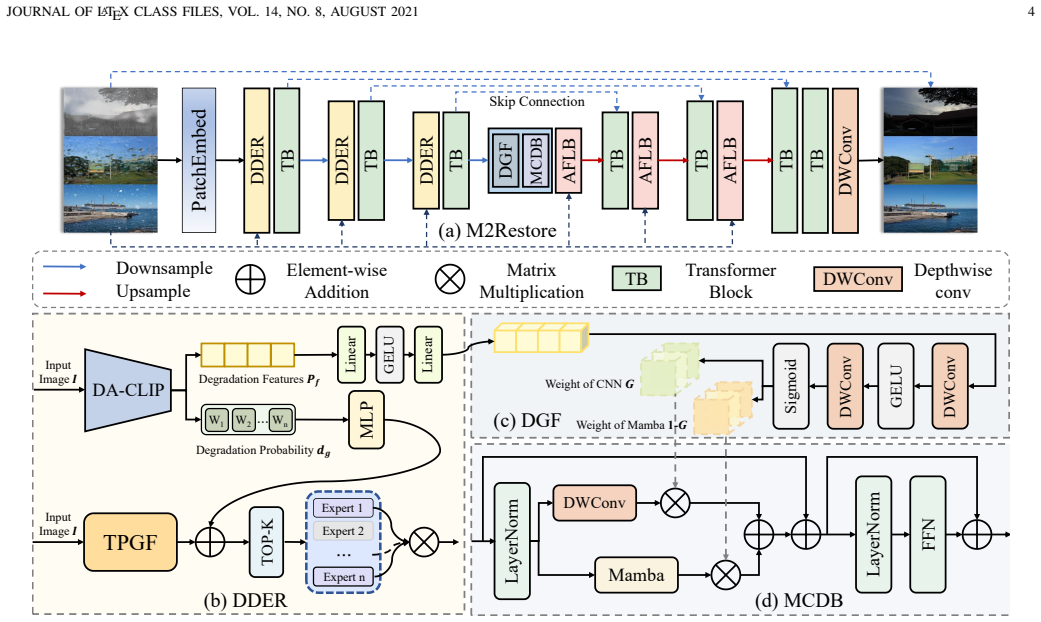
The load-bearing mechanism is the Degradation-Aware Dynamic Expert Router (DDER), which computes per-pixel routing scores S = score + alpha * b, where score comes from concatenated features and prompts, and b = dg * Wb is a bias from the global degradation probability vector dg produced by a frozen DA-CLIP model. This lets the network adapt to known and unseen degradations. A second mechanism, the Dynamic Gated Feature Fusion (DGF), balances the CNN and Mamba branches with a gate G = sigmoid(Conv1x1([F, Pf])), allocating local detail to CNN and global context to Mamba, while the Mamba-CNN Dual-Branch (MCDB) provides the underlying complementary feature extraction.
What would settle it
Evaluate M2Restore on a degradation type that DA-CLIP was not trained to recognize (e.g., nighttime rain with artificial light), and compare its PSNR against a version where the DA-CLIP outputs are replaced by random vectors; if the full model does not beat the random-bias version, the claimed generalization from CLIP priors is not doing the work.
Extended reading notes
Core claim
On its own terms, the paper discovers that a hybrid mixture-of-experts (MoE) architecture can close the gap between global context modeling and local detail preservation in all-in-one image restoration. The central discovery is that routing decisions become substantially more accurate when the per-pixel expert scores are biased by a global degradation probability vector and spatial features extracted from a frozen DA-CLIP model, combined with task-conditioned prompts. The authors show empirically that this combination yields state-of-the-art results across the three All-weather sub-tasks, with expert-weight clusters in t-SNE space separating cleanly by degradation type (average Silhouette score 0.25).
Load-bearing premise
The routing bias in DDER assumes the frozen DA-CLIP model produces useful degradation probability vectors and spatial features for both known and unseen degradations; if those priors are uninformative, the bias term would push expert selection in the wrong direction.
Editorial extensions
If this is right
- M2Restore outperforms all 11 compared methods on the All-weather dataset average PSNR and SSIM, including general and all-in-one restoration baselines.
- It is the second-fastest method at 0.17 seconds per 224x224 image on an RTX 3090, behind only AdaIR at 0.13 seconds.
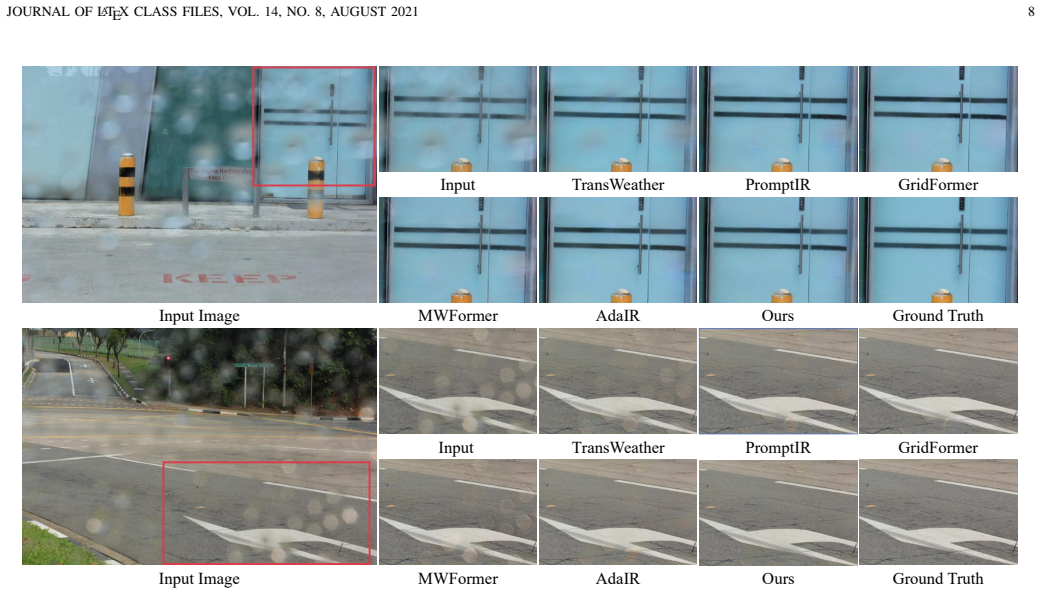
- On the real-world RainDS-real dataset, it produces visually cleaner outputs with fewer residual rain artifacts than prior methods.
- The t-SNE analysis shows that DDER expert weights form separate clusters for different degradation types, indicating the router has learned degradation-aware representations.
- Ablations removing DDER, DGF, or MCDB each lower performance, confirming that each component contributes to the final result.
Reading between the lines
- If DA-CLIP's frozen priors are uninformative for an unseen degradation type, the bias term b = dg * Wb could actively misroute expert selection; a natural test is to evaluate on a degradation absent from CLIP's training and compare against a version with random DA-CLIP outputs.
- The per-pixel Top-K routing effectively learns a soft segmentation of degradation type, which could be repurposed as an interpretable degradation map output for downstream applications.
- Because the router relies on frozen CLIP features, the architecture could likely be extended to other degradation families (blur, noise, compression artifacts) by only retraining the prompt library and experts, not the prior extractor.
- The reported runtime depends on the number of experts and the Top-K value; a scaling study of PSNR versus K would clarify how much of the efficiency claim is due to sparse activation rather than the Mamba backbone.
Editorial analysis
A structured set of objections, weighed in public.
Referee Report
Summary. The paper proposes M2Restore, an all-in-one image restoration framework that combines a Mixture-of-Experts router (DDER) with a Mamba-CNN dual-branch encoder (MCDB) and an edge-aware dynamic gating fusion module (DGF). DDER uses frozen DA-CLIP outputs—a global degradation probability vector dg and a spatial degradation feature Pf—to bias per-pixel Top-K expert selection, together with content-conditioned prompts. The model is trained on the All-weather dataset and evaluated on Outdoor-Rain, Snow100K-L, and RainDrop, reporting an average PSNR/SSIM of 31.65 dB/0.936, surpassing the closest prior method AdaIR by 1.02 dB average PSNR, with an inference time of 0.17 s per 224×224 image. Generalization to real-world images is demonstrated qualitatively on the RainDS-real dataset.
Significance. If the reported performance is reproducible, M2Restore is a competitive state-of-the-art all-in-one image restorer with an attractive speed/quality trade-off. The architectural combination is timely, and the comparison against sixteen prior methods is broad. The paper's central explanatory claims, however—that CLIP-guided routing and edge-aware gating are the mechanisms responsible for the gains—are not yet supported by controlled experiments: the ablation study removes whole modules rather than isolating the proposed components, and several hyperparameters are unreported. The headline average PSNR therefore currently rests on a single training run without significance or sensitivity evidence. These issues are fixable with additional experiments, and the underlying empirical result is promising.
major comments (5)
- [Section III-B and IV-C] The contribution of the frozen DA-CLIP priors is not isolated. Eq. (5) injects dg through the bias b = dg Wb, and Eq. (16) feeds Pf into DGF, but the ablation in Table II removes the whole DDER module (replacing it with vanilla Transformer layers) or the whole DGF module. No variant sets b = 0 or replaces Pf with a learned or zeroed feature while keeping the rest of DDER fixed. Consequently, the 1.02 dB average gain over AdaIR cannot be attributed to the CLIP-guided routing mechanism as opposed to added model capacity. Please add ablations that toggle the dg and Pf pathways independently.
- [Section III-B and III-D] The noisy Top-K routing (Eqs. 7–9) and the balance loss Lbalance (Eq. 19) are presented as components that improve routing robustness and expert utilization, but neither is ablated. Without these ablations, the reader cannot determine whether the proposed mechanisms actually matter, and the balance-loss weight λ in Eq. (19) is not reported. Please include variants with the noise disabled and with λ = 0.
- [Section III and IV-A] Key hyperparameters are missing: the number of experts N, the Top-K value K, the balance weight λ, the prompt library dimensions C and M, and the degradation probability dimension D are all unspecified in the implementation details. This is a reproducibility blocker for an empirical paper and prevents readers from assessing sensitivity of the reported 31.65 dB average. Please report these values and, ideally, a small sensitivity study.
- [Section IV-B3 and IV-E] The claim of strong generalization to unseen degradations is not quantitatively supported. The RainDS-real evaluation is qualitative only (Fig. 7), and all test sets in Table I correspond to the same degradation families used in training. The t-SNE analysis reports a Silhouette score of only 0.25, which is moderate, and does not show that the clusters are driven by dg rather than by image content. Please provide a quantitative experiment on degradation types absent from training, or soften the generalization claim accordingly.
- [Table II] The ablation results are non-monotonic: the DDER-only variant (PSNR 31.35) outperforms both the DDER+DGF variant (31.21) and the DGF+MCDB variant (31.13). This means that adding a component to a partial model can hurt performance, which weakens the message that each module is individually beneficial. The paper should explain these interactions or report additional configurations to clarify whether the full-model gain is a synergistic effect.
minor comments (5)
- [Section III-B] There is a typo: 'degradation typrs' should be 'degradation types', and the text after Eq. (11) contains 'the the j-th expert'.
- [Fig. 7 caption] The caption reads 'form the RainDS-real dataset'; 'form' should be 'from'.
- [References] Reference [70] has a malformed author field beginning with 'G. R. dense transformer...'; the authors appear to be missing and should be corrected.
- [Fig. 2] Figure 2 contains placeholder question marks in the DDER panel labels ('Degradation Features ??' and 'Degradation Probability ??'), which should be replaced with the actual symbols defined in Section III-B.
- [Section IV-B1] The text states that 'eleven image restoration methods' are compared, but Table I lists sixteen prior methods; the count should be updated.
Circularity Check
No significant circularity: the SOTA claim rests on external benchmark comparisons, and the DA-CLIP dependency is an external frozen model rather than a self-referential construction.
full rationale
The paper is an empirical architecture-comparison study. The central claim, state-of-the-art all-in-one restoration on the All-weather dataset (Table I), is supported by PSNR/SSIM measurements against external baselines on fixed test sets; no target quantity is defined in terms of the method's own outputs. The proposed DDER module uses a frozen DA-CLIP model [29], which is an external pretrained model not authored by the present authors, and the routing equations (Eqs. 4-6, 16) combine this external prior with learned prompts and features. There is no equation in which a reported prediction is identical, by construction, to a fitted input. The ablation study (Table II) removes whole modules and reports performance drops, consistent with a normal component-contribution analysis; the lack of an isolated DA-CLIP ablation is a completeness/correctness concern, not circularity. The t-SNE and Silhouette analysis in Section IV-E is post hoc interpretation of learned routing weights. Self-citations ([7], [8], [27]) appear in related-work or background context and are not load-bearing premises for the central derivation. Therefore, no circular step can be identified under the required standard of exhibiting an explicit reduction of a claimed prediction to its own inputs.
Assumptions & free parameters
free parameters (4)
- balance loss weight λ =
not reported
- number of experts N =
not reported
- Top-K K =
not reported
- prompt library dimensions C and M =
not reported
assumptions (6)
- domain assumption The All-weather dataset configuration of [11] is a fair and standard benchmark for all-in-one restoration
- domain assumption DA-CLIP [29] provides reliable degradation probability vectors and spatial degradation features for known and unknown degradation types
- ad hoc to paper The coefficient-of-variation balance loss encourages beneficial expert utilization
- ad hoc to paper Noisy Top-K routing (Bernoulli + Gaussian noise, Eq. 7-9) improves routing robustness
- ad hoc to paper The 1×1 convolution over [F, Pf] in DGF learns edge-aware balancing without explicit edge supervision
- standard math Mamba provides linear-complexity global modeling
Cite this review
Pith. "Pith review of M2Restore: Mixture-of-Experts-based Mamba-CNN Fusion Framework for All-in-One Image Restoration." pith.science (2026). https://pith.science/paper/THEORQGT
@misc{pith2026250607814,
  author       = {Pith},
  title        = {Pith review of: M2Restore: Mixture-of-Experts-based Mamba-CNN Fusion Framework for All-in-One Image Restoration},
  year         = {2026},
  howpublished = {\url{https://pith.science/paper/THEORQGT}},
  note         = {Machine review of arXiv:2506.07814}
}
read the original abstract
Natural images are often degraded by complex, composite degradations such as rain, snow, and haze, which adversely impact downstream vision applications. While existing image restoration efforts have achieved notable success, they are still hindered by two critical challenges: limited generalization across dynamically varying degradation scenarios and a suboptimal balance between preserving local details and modeling global dependencies. To overcome these challenges, we propose M2Restore, a novel Mixture-of-Experts (MoE)-based Mamba-CNN fusion framework for efficient and robust all-in-one image restoration. M2Restore introduces three key contributions: First, to boost the model's generalization across diverse degradation conditions, we exploit a CLIP-guided MoE gating mechanism that fuses task-conditioned prompts with CLIP-derived semantic priors. This mechanism is further refined via cross-modal feature calibration, which enables precise expert selection for various degradation types. Second, to jointly capture global contextual dependencies and fine-grained local details, we design a dual-stream architecture that integrates the localized representational strength of CNNs with the long-range modeling efficiency of Mamba. This integration enables collaborative optimization of global semantic relationships and local structural fidelity, preserving global coherence while enhancing detail restoration. Third, we introduce an edge-aware dynamic gating mechanism that adaptively balances global modeling and local enhancement by reallocating computational attention to degradation-sensitive regions. This targeted focus leads to more efficient and precise restoration. Extensive experiments across multiple image restoration benchmarks validate the superiority of M2Restore in both visual quality and quantitative performance.
Figures


Figures from the paper (5 more)


Forward citations
Cited by 2 Pith papers
-
SpikeRestormer: Towards Energy-Efficient All-in-One Image Restoration via Unified Event Reasoning
A spiking neural network with subtractive and additive attention performs all-in-one image restoration in one time step, matching older ANN baselines with much lower estimated energy.
-
ClusIR: Towards Cluster-Guided All-in-One Image Restoration
A cluster-guided mixture-of-experts network with frequency modulation reports competitive all-in-one image restoration results, with uneven gains and no public code.
Reference graph
Works this paper leans on
-
[1]
Efficient image dehazing with boundary constraint and contextual regularization,
G. Meng, Y . Wang, J. Duan, S. Xiang, and C. Pan, “Efficient image dehazing with boundary constraint and contextual regularization,” in Proc. IEEE Int. Conf. Comput. Vis. (ICCV) , 2013, pp. 617–624
work page 2013
-
[2]
Anchored neighborhood regression for fast example-based super-resolution,
R. Timofte, V . D. Smet, and L. V . Gool, “Anchored neighborhood regression for fast example-based super-resolution,” in Proc. IEEE Int. Conf. Comput. Vis. (ICCV) , 2013, pp. 1920–1927
work page 2013
-
[3]
A fast single image haze removal algorithm using color attenuation prior,
Q. Zhu, J. Mai, and L. Shao, “A fast single image haze removal algorithm using color attenuation prior,” IEEE Trans. Image Process. , vol. 24, no. 11, pp. 3522–3533, 2015
2015
-
[4]
Single-image super-resolution using sparse regression and natural image prior,
K. I. Kim and Y . Kwon, “Single-image super-resolution using sparse regression and natural image prior,” IEEE Trans. Pattern Anal. Mach. Intell., vol. 32, no. 6, pp. 1127–1133, 2010
work page 2010
-
[5]
Single image haze removal using dark channel prior,
K. He, J. Sun, and X. Tang, “Single image haze removal using dark channel prior,” IEEE Trans. Pattern Anal. Mach. Intell. , vol. 33, no. 12, pp. 2341–2353, 2011
work page 2011
-
[6]
Bidirectional multi-scale implicit neural representations for image deraining,
X. Chen, J. Pan, and J. Dong, “Bidirectional multi-scale implicit neural representations for image deraining,” in Proc. IEEE/CVF Conf. Comput. Vis. Pattern Recognit. (CVPR) , 2024, pp. 25 627–25 636
work page 2024
-
[7]
Ucl-dehaze: toward real-world image dehazing via unsu- pervised contrastive learning,
Y . Wang, X. Yan, F. L. Wang, H. Xie, W. Yang, X.-P. Zhang, J. Qin, and M. Wei, “Ucl-dehaze: toward real-world image dehazing via unsu- pervised contrastive learning,” IEEE Trans. Image Process., vol. 33, pp. 1361–1374, 2024
work page 2024
-
[8]
Smartassign: Learning A smart knowledge assignment strategy for deraining and desnowing,
Y . Wang, C. Ma, and J. Liu, “Smartassign: Learning A smart knowledge assignment strategy for deraining and desnowing,” in Proc. IEEE/CVF Conf. Comput. Vis. Pattern Recognit. (CVPR) , 2023, pp. 3677–3686
work page 2023
Show all 70 references
-
[9]
Apanet: Asymmetrical parallax attention network for efficient stereo image deraining,
C. Wang, T. Yan, W. Huang, X. Chen, K. Xu, and X. Chang, “Apanet: Asymmetrical parallax attention network for efficient stereo image deraining,” IEEE Trans. Computational Imaging , vol. 11, pp. 101–115, 2025
2025
-
[10]
Image desnowing via deep invertible separation,
Y . Quan, X. Tan, Y . Huang, Y . Xu, and H. Ji, “Image desnowing via deep invertible separation,” IEEE Trans. Circuits Syst. Video Technol. , vol. 33, no. 7, pp. 3133–3144, 2023
2023
-
[11]
All in one bad weather removal using architectural search,
R. Li, R. T. Tan, and L. Cheong, “All in one bad weather removal using architectural search,” in Proc. IEEE/CVF Conf. Comput. Vis. Pattern Recognit. (CVPR), 2020, pp. 3172–3182
2020
-
[12]
Multimodal prompt perceiver: Empower adaptiveness, generalizability and fidelity for all-in- one image restoration,
Y . Ai, H. Huang, X. Zhou, J. Wang, and R. He, “Multimodal prompt perceiver: Empower adaptiveness, generalizability and fidelity for all-in- one image restoration,” in Proc. IEEE/CVF Conf. Comput. Vis. Pattern Recognit. (CVPR), 2024, pp. 25 432–25 444
2024
-
[13]
Multi-weather degradation-aware transformer for image restoration,
R. Zhu, M. Wu, X. Xiong, X. Zhu, and Y . Fan, “Multi-weather degradation-aware transformer for image restoration,” in Proc. IEEE Int. Conf. Acoustics, 2024, pp. 3765–3769
2024
-
[14]
All-in-one image restoration for unknown degradations using adaptive discriminative filters for specific degradations,
D. Park, B. H. Lee, and S. Y . Chun, “All-in-one image restoration for unknown degradations using adaptive discriminative filters for specific degradations,” in Proc. IEEE/CVF Conf. Comput. Vis. Pattern Recognit. (CVPR), 2023, pp. 5815–5824
2023
-
[15]
A unified accelerator for all- in-one image restoration based on prompt degradation learning,
S. Zhang, Q. Dong, W. Mao, and Z. Wang, “A unified accelerator for all- in-one image restoration based on prompt degradation learning,” IEEE Trans. Circuits Syst. I Regul. Pap., vol. 72, no. 3, pp. 1282–1295, 2025
2025
-
[16]
Exploring the application of large-scale pre-trained models on adverse weather removal,
Z. Tan, Y . Wu, Q. Liu, Q. Chu, L. Lu, J. Ye, and N. Yu, “Exploring the application of large-scale pre-trained models on adverse weather removal,” IEEE Trans. Image Process. , vol. 33, pp. 1683–1698, 2024
2024
-
[17]
Autodir: Automatic all-in-one image restoration with latent diffusion,
Y . Jiang, Z. Zhang, T. Xue, and J. Gu, “Autodir: Automatic all-in-one image restoration with latent diffusion,” in Proc. Eur. Conf. Comput. Vis. (ECCV), vol. 15098, 2024, pp. 340–359
2024
-
[18]
Mwformer: Multi- weather image restoration using degradation-aware transformers,
R. Zhu, Z. Tu, J. Liu, A. C. Bovik, and Y . Fan, “Mwformer: Multi- weather image restoration using degradation-aware transformers,” IEEE Trans. Image Process., vol. 33, pp. 6790–6805, 2024. JOURNAL OF LATEX CLASS FILES, VOL. 14, NO. 8, AUGUST 2021 12
2024
-
[19]
Swinir: Image restoration using swin transformer,
J. Liang, J. Cao, G. Sun, K. Zhang, L. V . Gool, and R. Timofte, “Swinir: Image restoration using swin transformer,” in Proc. IEEE Int. Conf. Comput. Vis. (ICCV) Workshops , 2021, pp. 1833–1844
2021
-
[20]
Restormer: Efficient transformer for high-resolution image restoration,
S. W. Zamir, A. Arora, S. Khan, M. Hayat, F. S. Khan, and M. Yang, “Restormer: Efficient transformer for high-resolution image restoration,” in Proc. IEEE/CVF Conf. Comput. Vis. Pattern Recognit. (CVPR), 2022, pp. 5718–5729
2022
-
[21]
AdaIR: Adaptive all-in-one image restoration via frequency mining and modulation,
Y . Cui, S. W. Zamir, S. Khan, A. Knoll, M. Shah, and F. S. Khan, “AdaIR: Adaptive all-in-one image restoration via frequency mining and modulation,” in Proc. Int. Conf. Learn. Represent. (ICLR) , 2025
2025
-
[22]
Mamba: Linear-time sequence modeling with selective state spaces,
A. Gu and T. Dao, “Mamba: Linear-time sequence modeling with selective state spaces,” arXiv preprint arXiv:2312.00752 , 2023
2023 arXiv
-
[23]
Multi-dimensional visual prompt enhanced image restoration via mamba-transformer ag- gregation,
A. Jiang, H. Chen, Z. Chen, J. Ye, and M. Wang, “Multi-dimensional visual prompt enhanced image restoration via mamba-transformer ag- gregation,” arXiv preprint arXiv:2412.15845 , 2024
2024 arXiv
-
[24]
Adaptive mixtures of local experts,
R. A. Jacobs, M. I. Jordan, S. J. Nowlan, and G. E. Hinton, “Adaptive mixtures of local experts,” Neural Comput. , vol. 3, no. 1, pp. 79–87, 1991
1991
-
[25]
Path-restore: Learning network path selection for image restoration,
K. Yu, X. Wang, C. Dong, X. Tang, and C. C. Loy, “Path-restore: Learning network path selection for image restoration,” IEEE Trans. Pattern Anal. Mach. Intell. , vol. 44, no. 10, pp. 7078–7092, 2022
2022
-
[26]
Learning transferable visual models from natural language supervi- sion,
A. Radford, J. W. Kim, C. Hallacy, A. Ramesh, G. Goh, S. Agarwal, G. Sastry, A. Askell, P. Mishkin, J. Clark, G. Krueger, and I. Sutskever, “Learning transferable visual models from natural language supervi- sion,” in Proc. Int. Conf. Mach. Learn. (ICML) , vol. 139, 2021, pp. ...
2021
-
[27]
Da2diff: Exploring degradation-aware adaptive diffusion priors for all-in-one weather restoration,
J. Xiong, X. Yan, Y . Wang, W. Zhao, X.-P. Zhang, and M. Wei, “Da2diff: Exploring degradation-aware adaptive diffusion priors for all-in-one weather restoration,” arXiv preprint arXiv:2504.05135 , 2025
2025 arXiv
-
[28]
Lora-ir: Taming low-rank experts for efficient all-in-one image restoration,
Y . Ai, H. Huang, and R. He, “Lora-ir: Taming low-rank experts for efficient all-in-one image restoration,” arXiv preprint arXiv:2410.15385, 2024
2024 arXiv
-
[29]
Controlling vision-language models for multi-task image restoration,
Z. Luo, F. K. Gustafsson, Z. Zhao, J. Sj ¨olund, and T. B. Sch ¨on, “Controlling vision-language models for multi-task image restoration,” in Proc. Int. Conf. Learn. Represent. (ICLR) , 2024
2024
-
[30]
A non-local algorithm for image denoising,
A. Buades, B. Coll, and J. Morel, “A non-local algorithm for image denoising,” in Proc. IEEE Conf. Comput. Vis. Pattern Recognit. (CVPR), 2005, pp. 60–65
2005
-
[31]
Emergence of simple-cell receptive field properties by learning a sparse code for natural images,
B. A. Olshausen and D. J. Field, “Emergence of simple-cell receptive field properties by learning a sparse code for natural images,” Nature, vol. 381, no. 6583, pp. 607–609, 1996
1996
-
[32]
Beyond a gaussian denoiser: Residual learning of deep CNN for image denoising,
K. Zhang, W. Zuo, Y . Chen, D. Meng, and L. Zhang, “Beyond a gaussian denoiser: Residual learning of deep CNN for image denoising,” IEEE Trans. Image Process., vol. 26, no. 7, pp. 3142–3155, 2017
2017
-
[33]
Lightweight image super-resolution with enhanced CNN,
C. Tian, R. Zhuge, Z. Wu, Y . Xu, W. Zuo, C. Chen, and C. Lin, “Lightweight image super-resolution with enhanced CNN,” Knowl. Based Syst., vol. 205, p. 106235, 2020
2020
-
[34]
An image is worth 16x16 words: Transformers for image recognition at scale,
A. Dosovitskiy, L. Beyer, A. Kolesnikov, D. Weissenborn, X. Zhai, T. Unterthiner, M. Dehghani, M. Minderer, G. Heigold, S. Gelly, J. Uszkoreit, and N. Houlsby, “An image is worth 16x16 words: Transformers for image recognition at scale,” in Proc. Int. Conf. Learn. Represent. (...
2021
-
[35]
Mambair: A simple baseline for image restoration with state-space model,
H. Guo, J. Li, T. Dai, Z. Ouyang, X. Ren, and S. Xia, “Mambair: A simple baseline for image restoration with state-space model,” in Proc. Eur. Conf. Comput. Vis. (ECCV) , vol. 15076, 2024, pp. 222–241
2024
-
[36]
All-in-one image restoration for unknown corruption,
B. Li, X. Liu, P. Hu, Z. Wu, J. Lv, and X. Peng, “All-in-one image restoration for unknown corruption,” in Proc. IEEE/CVF Conf. Comput. Vis. Pattern Recognit. (CVPR) , 2022, pp. 17 431–17 441
2022
-
[37]
Promptir: Prompting for all-in-one image restoration,
V . Potlapalli, S. W. Zamir, S. H. Khan, and F. S. Khan, “Promptir: Prompting for all-in-one image restoration,” in Proc. Annu. Conf. Neural Inf. Process. Syst. (NIPS)) , 2023
2023
-
[38]
PALP: prompt aligned personalization of text-to-image models,
M. Arar, A. V oynov, A. Hertz, O. Avrahami, S. Fruchter, Y . Pritch, D. Cohen-Or, and A. Shamir, “PALP: prompt aligned personalization of text-to-image models,” in Proc. SIGGRAPH Asia , 2024, pp. 5:1–5:11
2024
-
[39]
Image dehazing transformer with transmission-aware 3d position embedding,
C.-L. Guo, Q. Yan, S. Anwar, R. Cong, W. Ren, and C. Li, “Image dehazing transformer with transmission-aware 3d position embedding,” in Proc. IEEE/CVF Conf. Comput. Vis. Pattern Recognit. (CVPR), 2022, pp. 5812–5820
2022
-
[40]
Dynamic convolution: Attention over convolution kernels,
Y . Chen, X. Dai, M. Liu, D. Chen, L. Yuan, and Z. Liu, “Dynamic convolution: Attention over convolution kernels,” in Proc. IEEE/CVF Conf. Comput. Vis. Pattern Recognit. (CVPR), 2020, pp. 11 027–11 036
2020
-
[41]
Moe-diffir: Task-customized diffusion priors for univer- sal compressed image restoration,
Y . Ren, X. Li, B. Li, X. Wang, M. Guo, S. Zhao, L. Zhang, and Z. Chen, “Moe-diffir: Task-customized diffusion priors for univer- sal compressed image restoration,” in Proc. Eur. Conf. Comput. Vis. (ECCV), A. Leonardis, E. Ricci, S. Roth, O. Russakovsky, T. Sattler, and G. Var...
2024
-
[42]
Unicorn: Latent diffusion-based unified controllable image restoration network across multiple degradations,
D. Mandal, S. Chattopadhyay, G. Tong, and P. Chakravarthula, “Unicorn: Latent diffusion-based unified controllable image restoration network across multiple degradations,” arXiv preprint arXiv:2503.15868 , 2025
2025 arXiv
-
[43]
Unirestorer: Universal image restoration via adaptively estimating im- age degradation at proper granularity,
J. Lin, Z. Zhang, W. Li, R. Pei, H. Xu, H. Zhang, and W. Zuo, “Unirestorer: Universal image restoration via adaptively estimating im- age degradation at proper granularity,” arXiv preprint arXiv:2412.20157, 2024
2024 arXiv
-
[44]
Uniuir: Considering underwater image restoration as an all-in-one learner,
X. Zhang, H. Zhang, G. Wang, Q. Zhang, L. Zhang, and B. Du, “Uniuir: Considering underwater image restoration as an all-in-one learner,”arXiv preprint arXiv:2501.12981, 2025
2025
-
[46]
Restoring spatially-heterogeneous distortions using mixture of experts network,
S. Kim, N. Ahn, and K.-A. Sohn, “Restoring spatially-heterogeneous distortions using mixture of experts network,” in Proc. Asian Conf. Comput. Vis. (ACCV), 2020
2020
-
[47]
Poisoning and backdooring contrastive learning,
N. Carlini and A. Terzis, “Poisoning and backdooring contrastive learning,” arXiv preprint arXiv:2106.09667 , 2021
2021 arXiv
-
[48]
Complexity experts are task-discriminative learners for any image restoration,
E. Zamfir, Z. Wu, N. Mehta, Y . Tan, D. P. Paudel, Y . Zhang, and R. Timofte, “Complexity experts are task-discriminative learners for any image restoration,” arXiv preprint arXiv:2411.18466 , 2024
2024 arXiv
-
[49]
Ramir: Reasoning and action prompting with mamba for all-in-one image restoration,
A. Tang, Y . Wu, and Y . Zhang, “Ramir: Reasoning and action prompting with mamba for all-in-one image restoration,”Appl. Intell., vol. 55, no. 4, p. 258, 2025
2025
-
[50]
Matir: A hybrid mamba- transformer image restoration model,
J. Wen, W. Hou, L. V . Gool, and R. Timofte, “Matir: A hybrid mamba- transformer image restoration model,” arXiv preprint arXiv:2501.18401, 2025
2025 arXiv
-
[51]
Cu-mamba: Selective state space models with chan- nel learning for image restoration,
R. Deng and T. Gu, “Cu-mamba: Selective state space models with chan- nel learning for image restoration,” arXiv preprint arXiv:2404.11778 , 2024
2024 arXiv
-
[52]
Learning a multi-scale vision mamba for weather-degraded remote sensing image restoration,
Y . Peng, G. Gao, and C. Shi, “Learning a multi-scale vision mamba for weather-degraded remote sensing image restoration,” Signal Image Video Process., vol. 19, no. 4, p. 274, 2025
2025
-
[53]
Vision mamba: Efficient visual representation learning with bidirectional state space model,
L. Zhu, B. Liao, Q. Zhang, X. Wang, W. Liu, and X. Wang, “Vision mamba: Efficient visual representation learning with bidirectional state space model,” in Proc. Int. Conf. Mach. Learn. (ICML) , 2024
2024
-
[54]
U-mamba: Enhancing long-range dependency for biomedical image segmentation,
J. Ma, F. Li, and B. Wang, “U-mamba: Enhancing long-range dependency for biomedical image segmentation,” arXiv preprint arXiv:2401.04722, 2024
2024 arXiv
-
[55]
Mair: A locality- and continuity-preserving mamba for image restoration,
B. Li, H. Zhao, W. Wang, P. Hu, Y . Gou, and X. Peng, “Mair: A locality- and continuity-preserving mamba for image restoration,” arXiv preprint arXiv:2412.20066, 2024
2024 arXiv
-
[56]
Mambairv2: Attentive state space restoration,
H. Guo, Y . Guo, Y . Zha, Y . Zhang, W. Li, T. Dai, S. Xia, and Y . Li, “Mambairv2: Attentive state space restoration,” arXiv preprint arXiv:2411.15269, 2024
2024 arXiv
-
[57]
Multi-expert adaptive selec- tion: Task-balancing for all-in-one image restoration,
X. Yu, S. Zhou, H. Li, and L. Zhu, “Multi-expert adaptive selec- tion: Task-balancing for all-in-one image restoration,” arXiv preprint arXiv:2407.19139, 2024
2024 arXiv
-
[58]
Heavy rain image restoration: Integrating physics model and conditional adversarial learning,
R. Li, L. Cheong, and R. T. Tan, “Heavy rain image restoration: Integrating physics model and conditional adversarial learning,” in Proc. IEEE Conf. Comput. Vis. Pattern Recognit. (CVPR) , 2019, pp. 1633– 1642
2019
-
[59]
Desnownet: Context-aware deep network for snow removal,
Y . Liu, D. Jaw, S. Huang, and J. Hwang, “Desnownet: Context-aware deep network for snow removal,” IEEE Trans. Image Process. , vol. 27, no. 6, pp. 3064–3073, 2018
2018
-
[60]
Attentive generative adversarial network for raindrop removal from a single image,
R. Qian, R. T. Tan, W. Yang, J. Su, and J. Liu, “Attentive generative adversarial network for raindrop removal from a single image,” in Proc. IEEE Conf. Comput. Vis. Pattern Recognit. (CVPR) , 2018, pp. 2482– 2491
2018
-
[61]
Multi-stage progressive image restoration,
S. W. Zamir, A. Arora, S. H. Khan, M. Hayat, F. S. Khan, M. Yang, and L. Shao, “Multi-stage progressive image restoration,” in Proc. IEEE Conf. Comput. Vis. Pattern Recognit. (CVPR), 2021, pp. 14 821–14 831
2021
-
[62]
Simple baselines for image restoration,
L. Chen, X. Chu, X. Zhang, and J. Sun, “Simple baselines for image restoration,” in Proc. Eur. Conf. Comput. Vis. (ECCV), vol. 13667, 2022, pp. 17–33
2022
-
[63]
Uformer: A general u-shaped transformer for image restoration,
Z. Wang, X. Cun, J. Bao, W. Zhou, J. Liu, and H. Li, “Uformer: A general u-shaped transformer for image restoration,” in Proc. IEEE/CVF Conf. Comput. Vis. Pattern Recognit. (CVPR), 2022, pp. 17 662–17 672
2022
-
[64]
Efficient and explicit modelling of image hierarchies for image restoration,
Y . Li, Y . Fan, X. Xiang, D. Demandolx, R. Ranjan, R. Timofte, and L. V . Gool, “Efficient and explicit modelling of image hierarchies for image restoration,” in Proc. IEEE/CVF Conf. Comput. Vis. Pattern Recognit. (CVPR), 2023, pp. 18 278–18 289
2023
-
[65]
Transweather: Transformer-based restoration of images degraded by adverse weather conditions,
J. M. J. Valanarasu, R. Yasarla, and V . M. Patel, “Transweather: Transformer-based restoration of images degraded by adverse weather conditions,” in Proc. IEEE Conf. Comput. Vis. Pattern Recognit. (CVPR), 2022, pp. 2353–2363. 13
2022
-
[66]
Restoring vision in adverse weather conditions with patch-based denoising diffusion models,
O. ¨Ozdenizci and R. Legenstein, “Restoring vision in adverse weather conditions with patch-based denoising diffusion models,” IEEE Trans. Pattern Anal. Mach. Intell. , vol. 45, no. 8, pp. 10 346–10 357, 2023
2023
-
[67]
Gradient-guided parameter mask for multi-scenario image restoration under adverse weather,
J. Guo, H. Yang, M. Zhou, and X. Zhang, “Gradient-guided parameter mask for multi-scenario image restoration under adverse weather,” arXiv preprint arXiv:2411.16739, 2024
2024 arXiv
-
[68]
Selective hourglass mapping for universal image restoration based on diffusion model,
D. Zheng, X. Wu, S. Yang, J. Zhang, J. Hu, and W. Zheng, “Selective hourglass mapping for universal image restoration based on diffusion model,” in Proc. IEEE/CVF Conf. Comput. Vis. Pattern Recognit. (CVPR), 2024, pp. 25 445–25 455
2024
-
[69]
Efficient deweahter mixture-of- experts with uncertainty-aware feature-wise linear modulation,
R. Zhang, Y . Luo, J. Liu, H. Yang, Z. Dong, D. Gudovskiy, T. Okuno, Y . Nakata, K. Keutzer, Y . Du et al. , “Efficient deweahter mixture-of- experts with uncertainty-aware feature-wise linear modulation,” in Proc. AAAI Conf. Artif. Intell. , vol. 38, no. 15, 2024, pp. 16 812–16 820
2024
-
[70]
Gridformer: Residual dense transformer with grid structure for image restoration in adverse weather conditions,
G. R. dense transformer with grid structure for image restoration in adverse weather conditions, “Gridformer: Residual dense transformer with grid structure for image restoration in adverse weather conditions,” Int. J. Comput. Vis. , pp. 1–23, 2024
2024
-
[71]
Removing raindrops and rain streaks in one go,
R. Quan, X. Yu, Y . Liang, and Y . Yang, “Removing raindrops and rain streaks in one go,” in Proc. IEEE Conf. Comput. Vis. Pattern Recognit. (CVPR), 2021, pp. 9147–9156
2021
Reviewed August 7, 2026 · model on record in the stance chip above.
Discussion (0). Sign in to comment.