REVIEW 4 major objections 6 minor 51 references
HAIBU-ReMUD: Reasoning Multimodal Ultrasound Dataset and Model Bridging to General Specific Domains
T0 review · 4 major / 6 minor · reviewed 2026-08-07 · deepseek-v4-flash
Pith's one-line read Auto-generated ultrasound data lets a 7B model beat GPT-4o and Gemini.
desk verdict Useful dataset pipeline, but the headline accuracy gaps are not yet trustworthy given train/test source overlap. read the letter →
The pith
A machine-rendered reading of the paper's core claim, the machinery that carries it, and where it could break.
The reading
What carries the argument
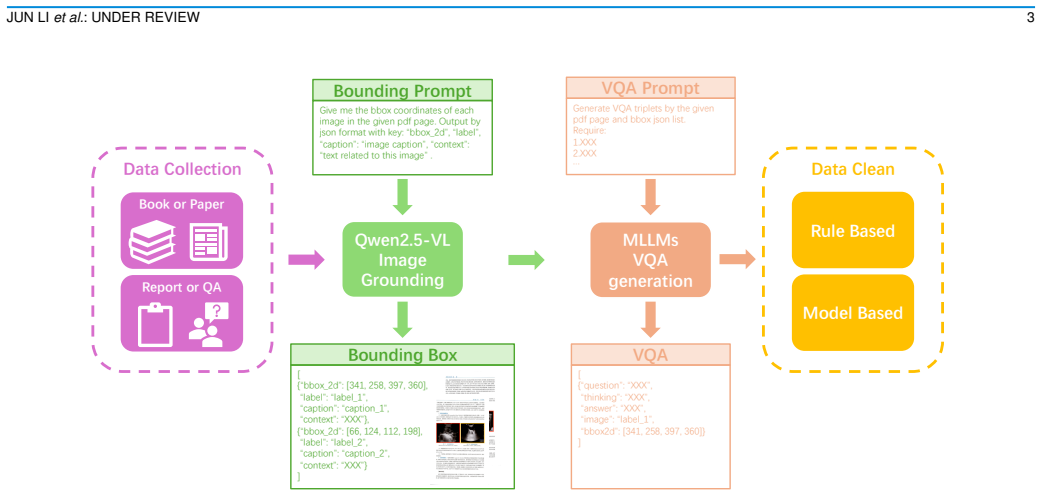
The load-bearing mechanism is the quadruplet generation pipeline: it converts a PDF page into a JSON list of bounding boxes (coordinates, label, caption, and related context) detected by Qwen2.5-VL, and then converts each boxed image plus its surrounding text into a question, thinking trace, and answer triplet via GPT-4o or Gemini-2.0-Flash-Thinking-Exp API calls with prompts that demand answers be traceable to the provided material. This machinery replaces manual expert annotation with automated extraction, which is what makes a 45,000-item supervised fine-tuning dataset affordable. The second piece of machinery is budget forcing: when a generated chain of thought is too short, the model is forced to insert a wait tag to continue reasoning, and overlong chains are truncated, so test-time compute stays in a beneficial window.
What would settle it
Run ReMUD-7B on an independently constructed ultrasound benchmark, such as questions written by practicing sonographers from hospital cases or an existing exam bank not used in training, and compare its accuracy with GPT-4o and Gemini; if the margin collapses to near zero on that held-out set, the claimed domain gain is largely an artifact of training and test distribution overlap. A cheaper check is to compute n-gram or embedding overlap between ReMUD's training questions and the test questions and show that reported test questions are near-duplicates of training items.
Extended reading notes
Core claim
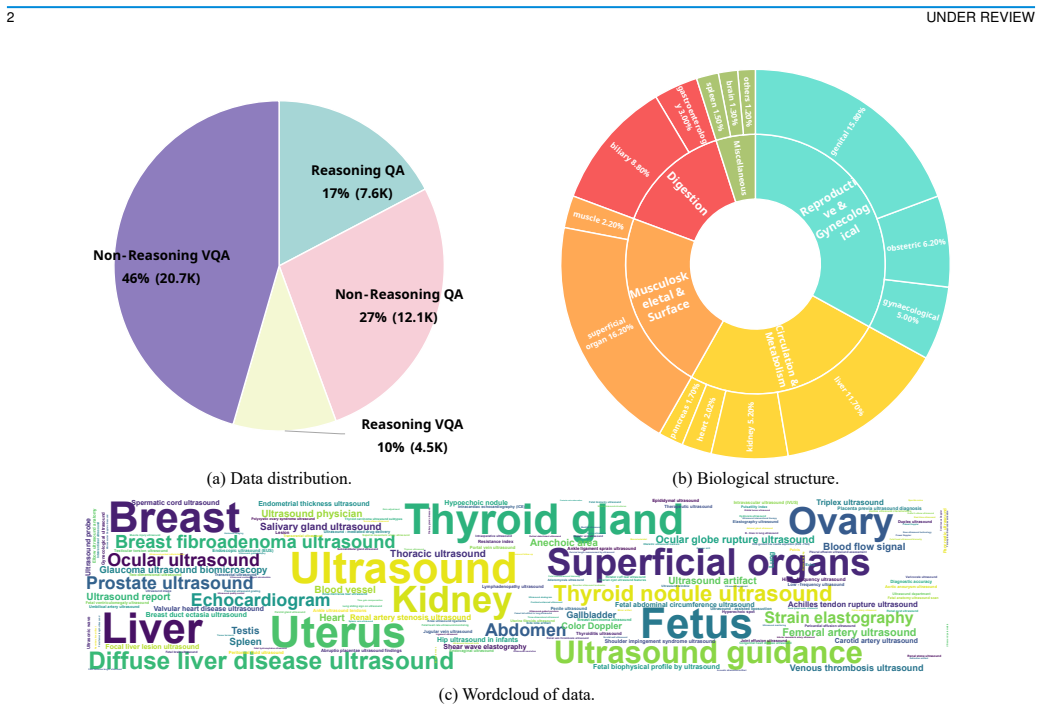
The central discovery is that a small 7-billion-parameter open multimodal model, tuned only on automatically generated ultrasound instruction data, can surpass far larger closed general-domain models on domain-specific multiple-choice exams. The paper's pipeline first uses Qwen2.5-VL's object-grounding ability to detect images on PDF pages and produce bounding boxes with captions and context, then asks the GPT-4o or Gemini-2.0-Flash-Thinking-Exp APIs to write questions, thinking traces, and answers tied strictly to that page content, and finally saves each cropped image with its triplet to build the ReMUD dataset. Fine-tuning Qwen2.5-VL-7B-Instruct on this 45,000-plus item dataset with a mix of reasoning and non-reasoning data, plus a budget-forcing wait tag at inference time, yields ReMUD-7B, which outperforms all tested general multimodal models on both of the paper's constructed test sets.
Load-bearing premise
The comparison assumes that USTQ-Knowledge and UVQA-Diagnosis are valid, unbiased measures of ultrasound ability that do not overlap with the ReMUD training distribution; both test sets are built from the same types of public ultrasound materials and the same API models used to create the training data, and no train/test deduplication is reported.
Editorial extensions
If this is right
- If the central claim is correct, automatically generated domain-specific instruction data can close the domain gap for small multimodal models without manual annotation or pretraining.
- The same pipeline, applied to other PDF- and image-based specialties such as radiology, pathology, or ophthalmology, could produce comparable supervised fine-tuning datasets.
- Budget forcing provides a cheap test-time scaling lever: accuracy rises when thinking traces are lengthened up to a point, then falls with over-long traces, as shown in the paper's Figure 6.
- The released dataset, code, and model parameters allow others to reproduce and extend the result without relying on proprietary training data.
- A small open model fine-tuned this way could serve as a practical alternative to closed general-domain APIs in settings where data privacy or cost matters.
Reading between the lines
- Editorial inference: The reported accuracy gaps may overstate the true domain gain, because the test sets are generated from the same types of public ultrasound materials and the same API models used to create the training data, and no train/test deduplication is reported; an independent, clinician-authored ultrasound benchmark would be needed to confirm how much transfers.
- Editorial inference: Because the pipeline uses GPT-4o and Gemini to create the training data and also to score data quality, the dataset inherits the biases of those two systems; using the same systems later to evaluate the model creates a feedback loop that could inflate apparent progress.
- Editorial inference: A testable implication of the paper's logic is that the pipeline transfers to other PDF-rich specialties, and that the performance gain over general models should shrink when the specialty's public materials are already well represented in the base model's pretraining data.
- Editorial inference: The budget-forcing curve in Figure 6 implies there is an optimal thinking-trace length per question; predicting that optimum per item difficulty could yield further accuracy gains without extra training, a direction the paper does not explore.
Editorial analysis
A structured set of objections, weighed in public.
Referee Report
Summary. This paper proposes an automated pipeline for generating multimodal reasoning supervised fine-tuning (SFT) data in a specific domain, instantiated for medical ultrasound. The authors construct the ReMUD dataset, containing over 45,000 text QA and image-text VQA items with reasoning and non-reasoning splits, generated from publicly available ultrasound books, guidelines, papers, and datasets via OCR, Qwen2.5-VL grounding, and GPT-4o/Gemini API calls. They fine-tune Qwen2.5-VL-7B-Instruct on ReMUD with budget forcing to produce ReMUD-7B, and evaluate it on two self-built benchmarks, USTQ-Knowledge (text) and UVQA-Diagnosis (image-text), reporting that ReMUD-7B outperforms general-domain MLLMs such as GPT-4o and Gemini-2.5-Pro-Exp. The paper also reports test-time scaling behavior with budget forcing and releases dataset, code, and model weights.
Significance. If the evaluation is valid, the contribution is practically significant: it demonstrates a scalable, low-cost recipe for creating domain-specific multimodal instruction data without manual annotation, and shows that a 7B open-weight model can beat much larger closed models on a narrow medical task. The open release of the dataset, generation code, and model parameters is a concrete asset for reproducibility and for future domain adaptation research. The budget-forcing/ReMUD analysis is also a useful empirical data point. However, the central performance claim rests entirely on the validity of two self-built test sets that appear to overlap in source material with the training data; until this is resolved, the headline numbers cannot be interpreted as evidence of general ultrasound competence.
major comments (4)
- [Section III-B.3, III-C, V-B] The evaluation sets are not shown to be independent of the training distribution. UVQA-Diagnosis is compiled from the Chinese Ultrasound Report Dataset [46], which is cited in Section III-B.3 as a training source transformed into triplets. USTQ-Knowledge is generated from "ultrasound books, guidelines, and papers" using GPT-4o, which are the same source categories and the same API model used in Section III-A for training data generation. The deduplication described in Section III-C (n-gram n=12 and sentence transformer) is stated only to ensure uniqueness within the test data, not to remove overlap between training and test sets. No train/test overlap analysis is reported. Consequently, the reported gaps (80.1 vs 78.3 on USTQ-Knowledge; 90.1 vs 66.6 on UVQA-Diagnosis) could be explained by memorization of training items rather than by domain competence. The authors should (a) quantify overlap between training and test sets at the image, report, and question-paraphrase levels, (b) remove or quarantine overlapping/near-duplicate items, and (c) re-report all numbers after this cleaning.
- [Section IV-C, V-C] The pass@1 metric is defined inconsistently. Equation (1) defines pass@1 as (1/k) * sum(p_i), which is the mean correctness over k generated responses. Section V-C, however, describes pass@1 as "at least one completely correct answer across multiple attempts." These are different quantities; for k=4 and a typical per-sample accuracy p, the "at least one correct" estimator 1 - (1-p)^k is substantially larger than the mean p. The authors must state which estimator was actually used for all models in Table II and correct either the formula or the prose. If the intended estimator is the probability of at least one correct response, the correct expression is pass@1 = 1 - prod(1-p_i).
- [Section V-B, Table II] The USTQ-Knowledge advantage of ReMUD-7B (80.1) over GPT-4o (78.3) is only 1.8 percentage points on 371 questions, which corresponds to roughly 7 questions. At this sample size, a binary proportion near 0.8 has a 95% confidence interval of about ±4 percentage points, so the observed difference is well within sampling error. Since the USTQ-Knowledge result is part of the central "outperforms general-domain MLLMs" claim, the authors should report confidence intervals or a significance test, or restrict the claim to the UVQA-Diagnosis task where the gap is much larger.
- [Section V-C] The evaluation protocol for the baselines is underspecified. The paper says that "all baseline models adopted identical sampling strategies and evaluation protocols," but it does not report the exact prompt given to each model, whether the thinking-trace field was included in the prompt, how final multiple-choice answers were extracted from free-form generated responses, or how responses that failed to follow the requested format were scored. This information is needed to assess whether the comparison in Table II is fair and to reproduce the numbers. The authors should provide the full evaluation prompts and answer-extraction code in the supplementary material.
minor comments (6)
- [Abstract and Introduction] The word "vedio" appears in the abstract and should be corrected to "video."
- [Section III-C, V-C] The second test set name is spelled inconsistently: "UVQA-Diagonis," "UVQA-diagnos," and "UVQA-Diagonsis" appear in different places; the intended name is "UVQA-Diagnosis."
- [Section III-C, Table I] The text states that ReMUD contains "1k+ test data," but Table I lists 371 + 386 = 757 test items; please correct this count or provide the actual total.
- [Section IV-C, V-C] The phrase "multi-choice" is used; the standard term is "multiple-choice."
- [Title and Abstract] The acronym "HAIBU" in the title is not explained anywhere in the paper; the authors should define it or remove it from the title.
- [Section V-D, Figure 6] Figure 6 is described as showing test-time scaling, but the text does not define the axes or specify the budget-forcing protocol used (e.g., the length thresholds for inserting "Wait" versus truncating). Please clarify so the experiment is reproducible.
Circularity Check
UVQA-Diagnosis is built from the same ultrasound report dataset [46] used to form ReMUD training triplets, and no train/test deduplication is reported, so the headline comparison partly measures fit to the training distribution.
-
fitted input called prediction
[Section III-B.3 (Diversity); Section V-B (UVQA-Diagnosis); Table I caption.]
"we gather publicly accessible ultrasound datasets from the Internet, such as those for breast nodule benign and malignant classifications and ultrasound report generation [46], [47], and transform them into triplets for better utilization. ... UVQA-Diagnosis is compiled based on the publicly available dataset, Chinese Ultrasound Report Dataset [46], which contains 7k+ ultrasound reports with 30k+ images. ... ReMUD consists of four train dataset and two test dataset. Both of them are generated from open-sourced ultrasound materials."
ReMUD-7B is supervised-fine-tuned on ReMUD, whose construction includes transforming the report dataset [46] into training triplets. The same [46] dataset is then used as the basis of the UVQA-Diagnosis test set. The paper only describes n-gram and sentence-transformer deduplication to ensure uniqueness within the test data ('ensures the uniqueness and quality of the test data'); no train/test deduplication relative to [46] is described. Consequently the reported UVQA-Diagnosis gap (ReMUD-7B 90.1 vs Gemini-2.5-Pro-Exp 66.6, Table II) can be explained substantially by the model reproducing the distribution it was trained on, rather than by a general ultrasound capability. The evaluation 'prediction' is partly a measurement of training-source fit.
full rationale
The paper is an empirical dataset-and-finetuning contribution, so the circularity question concerns whether the evaluation benchmarks are independent of the training distribution. The strongest reduction is in the UVQA-Diagnosis loop: Section III-B.3 says the authors gather open ultrasound datasets, including ultrasound report generation [46], and transform them into training triplets; Section V-B says UVQA-Diagnosis is compiled from the same Chinese Ultrasound Report Dataset [46]; and Table I's caption concedes that both train and test sets are generated from open-sourced ultrasound materials. The only deduplication described is within each test set, not between train and test. Thus the headline claim that ReMUD-7B beats general-domain MLLMs on UVQA-Diagnosis is partially circular. A similar but less specifically documented risk applies to USTQ-Knowledge, which is generated from ultrasound books/guidelines/papers by the same API models used to generate the training corpus. There is no load-bearing self-citation chain or imported uniqueness theorem; the issue is benchmark dependence, not citation circularity. Because the tests are not identical to the training items by construction and the baselines are evaluated under the same protocol, the paper is not entirely circular, but the central empirical claim is not independently secured as written. Score 6: one key 'prediction' (UVQA-Diagnosis superiority) reduces in part to fit on the training source.
Assumptions & free parameters
free parameters (6)
- Learning rate =
3e-5
- Training epochs =
3
- Sampling temperature =
0.6
- Top-p =
0.7
- Number of samples k =
4
- n-gram n =
12
assumptions (3)
- domain assumption Public ultrasound textbooks, guidelines, papers, and the Chinese Ultrasound Report Dataset are reliable sources of professional knowledge and labels.
- domain assumption GPT-4o and Gemini-2.0-Flash-Thinking-Exp generate sufficiently accurate questions, answers, and thinking traces without item-level expert review of all samples.
- ad hoc to paper The two self-built test sets are valid, non-overlapping measures of ultrasound capability.
Cite this review
Pith. "Pith review of HAIBU-ReMUD: Reasoning Multimodal Ultrasound Dataset and Model Bridging to General Specific Domains." pith.science (2026). https://pith.science/paper/4CPHGOVP
@misc{pith2026250607837,
  author       = {Pith},
  title        = {Pith review of: HAIBU-ReMUD: Reasoning Multimodal Ultrasound Dataset and Model Bridging to General Specific Domains},
  year         = {2026},
  howpublished = {\url{https://pith.science/paper/4CPHGOVP}},
  note         = {Machine review of arXiv:2506.07837}
}
read the original abstract
Multimodal large language models (MLLMs) have shown great potential in general domains but perform poorly in some specific domains due to a lack of domain-specific data, such as image-text data or vedio-text data. In some specific domains, there is abundant graphic and textual data scattered around, but lacks standardized arrangement. In the field of medical ultrasound, there are ultrasonic diagnostic books, ultrasonic clinical guidelines, ultrasonic diagnostic reports, and so on. However, these ultrasonic materials are often saved in the forms of PDF, images, etc., and cannot be directly used for the training of MLLMs. This paper proposes a novel image-text reasoning supervised fine-tuning data generation pipeline to create specific domain quadruplets (image, question, thinking trace, and answer) from domain-specific materials. A medical ultrasound domain dataset ReMUD is established, containing over 45,000 reasoning and non-reasoning supervised fine-tuning Question Answering (QA) and Visual Question Answering (VQA) data. The ReMUD-7B model, fine-tuned on Qwen2.5-VL-7B-Instruct, outperforms general-domain MLLMs in medical ultrasound field. To facilitate research, the ReMUD dataset, data generation codebase, and ReMUD-7B parameters will be released at https://github.com/ShiDaizi/ReMUD, addressing the data shortage issue in specific domain MLLMs.
Figures

Figures from the paper (3 more)


Reference graph
Works this paper leans on
-
[46]
Ultrasound report genera- tion with cross-modality feature alignment via unsupervised guidance,
J. Li, T. Su, B. Zhao, F. Lv, Q. Wang, et al., “Ultrasound report genera- tion with cross-modality feature alignment via unsupervised guidance,” 2024
work page 2024
-
[1]
H. Liu, C. Li, Q. Wu, Y . J. Lee, et al., “Visual instruction tuning,” Advances in neural information processing systems, vol. 36, pp. 34892– 34916, 2023
work page 2023
-
[2]
A. Hurst, A. Lerer, A. P. Goucher, et al., “Gpt-4o system card,” 2024
work page 2024
-
[3]
How to bridge the gap between modalities: Survey on multimodal large language model,
S. Song, X. Li, S. Li, S. Zhao, J. Yu, et al., “How to bridge the gap between modalities: Survey on multimodal large language model,” 2025
work page 2025
-
[4]
A survey of multimodel large language models,
Z. Liang, Y . Xu, Y . Hong, et al., “A survey of multimodel large language models,” in Proceedings of the 3rd International Conference on Computer, Artificial Intelligence and Control Engineering, pp. 405–409, 2024
work page 2024
-
[5]
The revolu- tion of multimodal large language models: A survey,
D. Caffagni, F. Cocchi, L. Barsellotti, N. Moratelli, et al., “The revolu- tion of multimodal large language models: A survey,” 2024
work page 2024
-
[6]
Multimodal large language models in health care: applications, challenges, and future outlook,
R. AlSaad, A. Abd-Alrazaq, S. Boughorbel, et al., “Multimodal large language models in health care: applications, challenges, and future outlook,” Journal of medical Internet research, vol. 26, p. e59505, 2024
work page 2024
-
[7]
Hallucination of multimodal large language models: A survey,
Z. Bai, P. Wang, T. Xiao, T. He, et al., “Hallucination of multimodal large language models: A survey,” arXiv preprint arXiv:2404.18930, 2024
arXiv 2024
Show all 51 references
-
[8]
Qwen2.5-vl technical report,
S. Bai, K. Chen, X. Liu, J. Wang, et al., “Qwen2.5-vl technical report,” 2025
2025
-
[9]
Google. gemini 2.0 flash thinking mode (gemini-2.0-flash-thinking-exp- 1219),
“Google. gemini 2.0 flash thinking mode (gemini-2.0-flash-thinking-exp- 1219),” december 2024
2024
-
[10]
Kimi-vl technical report,
K. Team, A. Du, B. Yin, B. Xing, B. Qu, et al., “Kimi-vl technical report,” 2025
2025
-
[11]
Deepseek-vl2: Mixture-of- experts vision-language models for advanced multimodal understand- ing,
Z. Wu, X. Chen, Z. Pan, X. Liu, et al., “Deepseek-vl2: Mixture-of- experts vision-language models for advanced multimodal understand- ing,” 2024
2024
-
[12]
Internvl3: Exploring advanced training and test-time recipes for open-source multimodal models,
J. Zhu, W. Wang, Z. Chen, Z. Liu, et al., “Internvl3: Exploring advanced training and test-time recipes for open-source multimodal models,” 2025
2025
-
[13]
Gemma 3 technical report,
G. Team, A. Kamath, J. Ferret, S. Pathak, et al., “Gemma 3 technical report,” 2025
2025
-
[14]
An image is worth 16x16 words: Transformers for image recognition at scale,
A. Dosovitskiy, L. Beyer, A. Kolesnikov, D. Weissenborn, et al., “An image is worth 16x16 words: Transformers for image recognition at scale,” arXiv preprint arXiv:2010.11929, 2020
2010 arXiv
-
[15]
Learning transferable visual models from natural language supervision,
A. Radford, J. W. Kim, C. Hallacy, et al., “Learning transferable visual models from natural language supervision,” 2021
2021
-
[16]
Swin transformer: Hierarchical vision transformer using shifted windows,
Z. Liu, Y . Lin, Y . Cao, H. Hu, Y . Wei, Z. Zhang, et al., “Swin transformer: Hierarchical vision transformer using shifted windows,” in Proceedings of the IEEE/CVF international conference on computer vision, pp. 10012–10022, 2021
2021
-
[17]
Llama: Open and efficient foundation language models,
H. Touvron, T. Lavril, G. Izacard, X. Martinet, et al., “Llama: Open and efficient foundation language models,” 2023
2023
-
[18]
Vicuna: An open-source chatbot impressing gpt-4 with 90%* chatgpt quality,
W.-L. Chiang, Z. Li, Z. Lin, Y . Sheng, et al., “Vicuna: An open-source chatbot impressing gpt-4 with 90%* chatgpt quality,” March 2023
2023
-
[19]
Qwen2.5 technical report,
Qwen, :, A. Yang, B. Yang, B. Zhang, et al., “Qwen2.5 technical report,” 2025
2025
-
[20]
Qwen2 technical report,
A. Yang, B. Yang, B. Hui, et al., “Qwen2 technical report,” 2024
2024
-
[21]
Blip-2: Bootstrapping language- image pre-training with frozen image encoders and large language models,
J. Li, D. Li, S. Savarese, and S. Hoi, “Blip-2: Bootstrapping language- image pre-training with frozen image encoders and large language models,” 2023
2023
-
[22]
Towards multimodal in-context learning for vision & language models,
S. Doveh, S. Perek, M. J. Mirza, et al., “Towards multimodal in-context learning for vision & language models,” arXiv preprint arXiv:2403.12736, 2024
2024 arXiv
-
[23]
Multimodal chain-of-thought reasoning in language models,
Z. Zhang, A. Zhang, M. Li, H. Zhao, G. Karypis, and A. Smola, “Multimodal chain-of-thought reasoning in language models,” 2024
2024
-
[24]
Visual programming: Compositional visual reasoning without training,
T. Gupta and A. Kembhavi, “Visual programming: Compositional visual reasoning without training,” in Proceedings of the IEEE/CVF Conference on Computer Vision and Pattern Recognition, pp. 14953– 14962, 2023
2023
-
[25]
Mm-narrator: Narrating long-form videos with multimodal in-context learning,
C. Zhang, K. Lin, Z. Yang, et al., “Mm-narrator: Narrating long-form videos with multimodal in-context learning,” in Proceedings of the IEEE/CVF Conference on Computer Vision and Pattern Recognition, pp. 13647–13657, 2024
2024
-
[26]
Mia- bench: Towards better instruction following evaluation of multimodal llms,
Y . Qian, H. Ye, J.-P. Fauconnier, P. Grasch, Y . Yang, and Z. Gan, “Mia- bench: Towards better instruction following evaluation of multimodal llms,” arXiv preprint arXiv:2407.01509, 2024
2024 arXiv
-
[27]
Llava-ultra: Large chinese language and vision assistant for ultrasound,
X. Guo, W. Chai, S.-Y . Li, and G. Wang, “Llava-ultra: Large chinese language and vision assistant for ultrasound,” 2024
2024
-
[28]
Gpqa: A graduate-level google-proof q&a benchmark,
D. Rein, B. L. Hou, A. C. Stickland, et al., “Gpqa: A graduate-level google-proof q&a benchmark,” 2023
2023
-
[29]
Clevr: A diagnostic dataset for compositional language and elementary visual reasoning,
J. Johnson, B. Hariharan, et al., “Clevr: A diagnostic dataset for compositional language and elementary visual reasoning,” 2016
2016
-
[30]
Expert knowledge-aware image difference graph representation learning for difference-aware medical visual question answering,
X. Hu, L. Gu, Q. An, M. Zhang, et al., “Expert knowledge-aware image difference graph representation learning for difference-aware medical visual question answering,” in Proceedings of the 29th ACM SIGKDD Conference on Knowledge Discovery and Data Mining, pp. 4156–4165, 2023
2023
-
[31]
Ai models collapse when trained on recursively generated data,
I. Shumailov, Z. Shumaylov, et al., “Ai models collapse when trained on recursively generated data,” Nature, vol. 631, no. 8022, pp. 755–759, 2024
2024
-
[32]
Pathvqa: 30000+ questions for medical visual question answering,
X. He, Y . Zhang, L. Mou, E. Xing, and P. Xie, “Pathvqa: 30000+ questions for medical visual question answering,” 2020
2020
-
[33]
Scaling llm test-time compute optimally can be more effective than scaling model parameters,
C. Snell, J. Lee, K. Xu, and A. Kumar, “Scaling llm test-time compute optimally can be more effective than scaling model parameters,” 2024
2024
-
[34]
Large language monkeys: Scaling inference compute with repeated sampling,
B. Brown, J. Juravsky, R. Ehrlich, R. Clark, et al., “Large language monkeys: Scaling inference compute with repeated sampling,” arXiv preprint arXiv:2407.21787, 2024
2024 arXiv
-
[35]
A simple model of inference scaling laws,
N. Levi, “A simple model of inference scaling laws,” 2024
2024
-
[36]
Rewarding chatbots for real-world en- gagement with millions of users,
R. Irvine, D. Boubert, et al., “Rewarding chatbots for real-world en- gagement with millions of users,” 2023
2023
-
[37]
Interpretable contrastive monte carlo tree search reasoning,
Z. Gao, B. Niu, X. He, H. Xu, H. Liu, et al., “Interpretable contrastive monte carlo tree search reasoning,” 2024
2024
-
[38]
Self-evaluation guided beam search for reasoning,
Y . Xie, K. Kawaguchi, Y . Zhao, X. Zhao, M.-Y . Kan, J. He, and Q. Xie, “Self-evaluation guided beam search for reasoning,” 2023
2023
-
[39]
Openai. learning to reason with llms,
“Openai. learning to reason with llms,” september 2024
2024
-
[40]
Deepseek-r1: Incentivizing reasoning capability in llms via reinforcement learning,
D. Guo, D. Yang, H. Zhang, et al., “Deepseek-r1: Incentivizing reasoning capability in llms via reinforcement learning,” 2025
2025
-
[41]
Synthetic continued pretraining,
Z. Yang, N. Band, S. Li, E. Cand `es, and T. Hashimoto, “Synthetic continued pretraining,” 2024
2024
-
[42]
Metamath: Bootstrap your own mathematical questions for large language models,
L. Yu, W. Jiang, H. Shi, J. Yu, et al., “Metamath: Bootstrap your own mathematical questions for large language models,” 2024
2024
-
[43]
Wizardmath: Empowering mathematical reasoning for large language models via reinforced evol- instruct,
H. Luo, Q. Sun, C. Xu, P. Zhao, et al., “Wizardmath: Empowering mathematical reasoning for large language models via reinforced evol- instruct,” 2025
2025
-
[44]
Pp-ocrv2: Bag of tricks for ultra lightweight ocr system,
Y . Du, C. Li, R. Guo, C. Cui, et al., “Pp-ocrv2: Bag of tricks for ultra lightweight ocr system,” 2021
2021
-
[45]
Pp-ocrv3: More attempts for the improvement of ultra lightweight ocr system,
C. Li, W. Liu, R. Guo, X. Yin, K. Jiang, et al., “Pp-ocrv3: More attempts for the improvement of ultra lightweight ocr system,” 2022
2022
-
[47]
Uscl: Pretraining deep ultrasound image diagnosis model through video contrastive representation learning,
Y . Chen, C. Zhang, L. Liu, C. Feng, C. Dong, Y . Luo, and X. Wan, “Uscl: Pretraining deep ultrasound image diagnosis model through video contrastive representation learning,” 2021
2021
-
[48]
Pmc-clip: Contrastive language- image pre-training using biomedical documents,
W. Lin, Z. Zhao, X. Zhang, et al., “Pmc-clip: Contrastive language- image pre-training using biomedical documents,” arXiv preprint arXiv:2303.07240, 2023
2023 arXiv
-
[49]
s1: Simple test-time scaling,
N. Muennighoff, Z. Yang, W. Shi, X. L. Li, L. Fei-Fei, et al., “s1: Simple test-time scaling,” 2025
2025
-
[50]
Evaluating large language models trained on code,
M. Chen, J. Tworek, H. Jun, Q. Yuan, et al., “Evaluating large language models trained on code,” 2021
2021
-
[51]
Llamafactory: Unified efficient fine-tuning of 100+ language mod- els,
Y . Zheng, R. Zhang, J. Zhang, Y . Ye, Z. Luo, Z. Feng, and Y . Ma, “Llamafactory: Unified efficient fine-tuning of 100+ language mod- els,” in Proceedings of the 62nd Annual Meeting of the Association for Computational Linguistics (V olume 3: System Demonstrations), (Bangkok,...
2024
Reviewed August 7, 2026 · model on record in the stance chip above.
Discussion (0). Sign in to comment.